
Published by Changwen Cookware | Reading time: 10 minutes
Introduction
Every stainless steel cookware buyer eventually faces the same question: 304 or 316L?
The answer determines food safety performance, corrosion resistance, production cost, and the certification documentation your product will need to pass import inspection. Get it right and you have a product that performs as specified and passes regulatory review. Get it wrong and you face quality disputes, unexpected corrosion failures, or products that are over-engineered and overpriced for their actual application.
This guide approaches the 304 vs 316L question from a cookware manufacturer’s perspective — covering chemical composition, mechanical properties, heat resistance, magnetic behavior, machinability, price differences, and how these grades compare against the related variants 304L, 316, and 430. By the end, you will know exactly which grade to specify for which cookware application, and why.

Key Takeaways
- 304 stainless steel is the global standard for cookware inner surfaces — food-grade, non-reactive, and sufficient for the vast majority of cooking environments. It contains 18% chromium and 8–10% nickel (hence the common designation 18/8 or 18/10).
- 316L stainless steel adds 2–3% molybdenum to the 304 composition, providing superior resistance to chloride pitting and acid corrosion. The “L” designates a low-carbon variant with better weld stability. It costs 15–25% more than 304.
- 430 stainless steel is a ferritic (magnetic) grade with lower nickel content, commonly used for cookware outer layers for induction compatibility. It is not suitable for the cooking surface.
- For cookware procurement, 304 is the correct specification for inner cooking surfaces in standard household and professional use. 316L is justified only for products specifically marketed for heavy salt, acid, or marine exposure.
- Both 304 and 316L are non-magnetic in their standard annealed condition — this is a key test point for grade verification.
- 316L vs 304 is not a question of food safety compliance — both meet FDA, LFGB, and NSF food contact standards. It is a question of corrosion performance in specific environments.
Chemical Composition: 304 vs 316L vs 304L vs 430
Understanding the composition differences is the foundation of any specification decision.
| Grade | Chromium | Nickel | Molybdenum | Carbon | Key Characteristic |
|---|---|---|---|---|---|
| 304 | 18–20% | 8–10.5% | None | ≤0.08% | Standard food-grade austenitic |
| 304L | 18–20% | 8–12% | None | ≤0.03% | Low-carbon 304, better weldability |
| 316 | 16–18% | 10–14% | 2–3% | ≤0.08% | Molybdenum-enhanced corrosion resistance |
| 316L | 16–18% | 10–14% | 2–3% | ≤0.03% | Low-carbon 316, best weld stability |
| 430 | 16–18% | ≤0.75% | None | ≤0.12% | Ferritic, magnetic, induction-compatible |
What the Molybdenum in 316L Actually Does
The defining difference between 304 and 316L is the addition of 2–3% molybdenum in 316L. Molybdenum significantly improves resistance to:
- Chloride pitting corrosion — the type caused by salt, brine, soy sauce, and chloride-containing cleaning agents
- Crevice corrosion — common in welded joints and tight gaps
- Acid corrosion — particularly sulfuric acid, hydrochloric acid, and acetic acid (vinegar) at elevated concentrations
For cookware: acidic foods like tomatoes, citrus, and wine vinegar are not aggressive enough to cause meaningful corrosion in undamaged 304 cookware under normal use. The chloride resistance of 316L becomes genuinely relevant when cookware is used heavily with high-salt brine, seafood, or is washed repeatedly with chlorine-based commercial cleaning agents.
304 vs 304L vs 316L: Chemical Composition Summary
304 stainless steel composition: Fe (balance), 18–20% Cr, 8–10.5% Ni, ≤0.08% C, ≤2% Mn, ≤1% Si. The 18/8 designation refers to the approximate chromium and nickel percentages. 18/10 refers to cookware made with the higher nickel end of the range (10% Ni), which provides slightly better corrosion resistance and a brighter surface polish.
304L vs 316L chemical composition: Both are low-carbon variants of their respective grades. The key difference remains molybdenum — 316L contains it, 304L does not. 304L and 316L are both preferred for welded applications because the low carbon content reduces the risk of carbide precipitation at weld heat-affected zones, which can create localized corrosion vulnerability.
Mechanical Properties: 304 vs 316L
Despite their composition differences, 304 and 316L have similar — and in some cases identical — mechanical properties for cookware applications.
| Property | 304 | 316L |
|---|---|---|
| Tensile strength | 515–620 MPa | 485–620 MPa |
| Yield strength (0.2% offset) | 205–310 MPa | 170–310 MPa |
| Elongation | 40–70% | 40–50% |
| Hardness (Brinell) | 201 max | 217 max |
| Density | 7.93 g/cm³ | 7.98 g/cm³ |
Stainless steel 304 vs 316 strength: 304 actually has a marginally higher tensile strength than 316L in standard specifications. For cookware applications — which do not involve extreme mechanical loading — this difference is irrelevant in practice. Both grades provide more than adequate strength for pots, pans, and cookware sets under normal use.
304 vs 316L stainless steel mechanical properties in cookware context: The mechanical differences between these grades are not a factor in cookware specification decisions. The decision should be driven by corrosion resistance requirements and cost, not strength.
Heat Resistance: 304 vs 316L
304 vs 316 Stainless Steel Heat Resistance
Both 304 and 316L perform well at typical cooking temperatures (up to approximately 300°C / 572°F for continuous use). Key heat performance data:
- Continuous service temperature: 304 up to 870°C (1,600°F); 316L up to 870°C (1,600°F) — virtually identical
- Intermittent service: Both grades can withstand temperatures up to 925°C (1,700°F) intermittently
- Sensitization range (carbide precipitation): Both grades are susceptible in the 425–860°C range. 316L’s low carbon content significantly reduces this risk compared to standard 316.
For cookware: neither grade will experience heat-related performance degradation under any normal stovetop or oven cooking conditions. The heat resistance difference between 304 and 316L is not relevant for cookware specification.
Where heat resistance becomes relevant for 316L: In industrial food processing applications where equipment is repeatedly cycled through very high temperature processes (sterilization, steam cleaning), 316L’s lower carbon content makes it more resistant to weld zone corrosion after repeated thermal cycling.
Magnetic Properties: 304 vs 316L
Stainless Steel 304 vs 316 Magnetic Behavior
This is one of the most frequently asked questions — and one of the most misunderstood.
Both 304 and 316L are austenitic stainless steels and are non-magnetic in their annealed (softened) state. Neither grade will respond to a magnet when the material is in standard annealed condition.
However, both grades can become slightly magnetic when:
- Cold-worked (drawn, pressed, or formed) — the mechanical deformation partially converts the austenite to martensite, which is magnetic
- Welded — the heat-affected zone may develop magnetic properties
Why this matters for cookware:
- 304 and 316L cookware should NOT respond to a magnet when tested on the pot walls (non-deformed areas). If a magnet sticks strongly to a pan labeled 304, it is likely 201 or a lower-grade steel.
- The outer layer of induction-compatible cookware is intentionally made from 430 stainless steel (ferritic, fully magnetic) to enable induction heating. This is by design — not a quality defect.
- The magnet test cannot distinguish 304 from 316L. Both are non-magnetic. The only reliable way to differentiate them is an X-ray fluorescence (XRF) analyzer, optical emission spectrometry (OES), or laboratory chemical analysis.
The Magnet Test Limitation
A common belief is that “if a magnet sticks, it’s not stainless steel.” This is incorrect. 430 stainless steel is fully magnetic and is a legitimate, widely used grade for cookware outer layers. The magnet test is only useful for distinguishing austenitic grades (304, 316L — non-magnetic) from ferritic grades (430 — magnetic) in non-deformed sections.
304 vs 316 vs 430 Stainless Steel for Cookware
Understanding how all three grades function together in cookware construction is essential for correct specification.
In a tri-ply (full-clad) stainless steel cookware set:
| Layer | Grade | Purpose |
|---|---|---|
| Inner (food contact) | 304 or 316L | Non-reactive cooking surface, food safety |
| Core | Aluminum | Heat conductivity and even distribution |
| Outer (stovetop contact) | 430 | Magnetic layer for induction compatibility |
304 as inner layer: The industry standard. Food-grade, non-reactive, excellent corrosion resistance for normal cooking. Used in virtually all quality stainless steel cookware globally.
316L as inner layer: Used in premium cookware lines marketed for superior food safety, heavy professional use, or high-salt/acid applications. Commands a higher retail price. Genuinely beneficial for cookware used in coastal/marine environments or with aggressive saline cooking.
430 as outer layer: Ferritic, magnetic, induction-compatible. Lower nickel content means lower cost. Not suitable for the cooking surface — it has lower corrosion resistance than 304 and can rust if the outer surface is scratched and exposed to moisture without proper maintenance.
304 vs 430 stainless steel: 304 is clearly superior in corrosion resistance and food safety. 430 is used specifically as the outer/induction layer in cookware where its magnetic properties are required, not as a premium material choice.
Price: 304 vs 316L
Stainless Steel 304 vs 316 Price
Price is one of the most important factors in cookware procurement decisions.
304 stainless steel pricing is relatively stable and predictable. Its cost is primarily driven by nickel prices on the global commodities market.
316L stainless steel costs approximately 15–25% more than 304 on average, driven by:
- Higher nickel content (10–14% vs 8–10.5% in 304)
- Addition of 2–3% molybdenum — molybdenum is a relatively expensive alloying element whose price fluctuates with supply from China and other major producers
For cookware OEM procurement: The 316L premium is justified only when your product is specifically marketed and tested for superior corrosion performance. Specifying 316L for standard household cookware that will never encounter aggressive saline or acid conditions adds cost without adding meaningful performance benefit for the end user.
304 vs 304L price difference: 304L is typically priced similarly to standard 304 — the low-carbon specification adds minimal production cost. For cookware manufacturing using stamping and deep drawing processes, 304 and 304L are often dual-certified and used interchangeably.
Machinability: 304 vs 316L
304 vs 316 Stainless Steel Machinability
Both 304 and 316L are relatively difficult to machine compared to carbon steel, due to their tendency to work-harden. For cookware production — which primarily uses stamping, deep drawing, and pressing rather than machining — machinability is not a primary consideration.
Key points:
- 304 has marginally better machinability than 316L due to slightly lower work-hardening rate
- 316L’s molybdenum content increases its tendency to work-harden slightly, increasing tool wear in machining operations
- For cookware handles, fasteners, and fittings that do require machining, 304 is the more practical choice
In cookware manufacturing context: The machinability difference between 304 and 316L is not a meaningful factor in production decisions for stamped and drawn cookware. It becomes relevant for machined components like valve bodies, fittings, and fasteners.
316L vs 304: How to Tell the Difference
304 vs 316 Stainless Steel: How to Tell the Difference
Visual inspection cannot distinguish 304 from 316L. Both grades:
- Have similar appearance after polishing (brushed or mirror finish)
- Are non-magnetic in annealed condition
- Have the same basic corrosion resistance appearance
Reliable identification methods:
XRF (X-ray Fluorescence) Analyzer: The most practical on-site testing method. An XRF gun can identify the elemental composition of the steel in seconds, confirming whether molybdenum is present (316L) or absent (304). Used by quality inspectors, customs officials, and procurement teams worldwide.
OES (Optical Emission Spectrometry): Laboratory-grade elemental analysis. More accurate than XRF but requires sample preparation.
Nitric Acid Test: A drop of concentrated nitric acid on a surface sample will cause 304 to stain more quickly than 316L — but this is a rough field test, not a precise identification method.
Third-party mill certificate review: Request the material test report (MTR) from the supplier, confirming the heat number, chemical composition, and mechanical properties of the specific steel batch used in production.
For cookware OEM procurement: Require material certificates from your manufacturer confirming the grade, heat number, and chemical composition of the steel used in production. This is standard practice for any audited supply chain.
Stainless Steel 316L vs 304 Food Grade: The Regulatory Position
Both 304 and 316L are classified as food-grade stainless steels and meet the following standards:
- FDA (US): Both grades comply with 21 CFR for food contact materials
- LFGB (EU): Both grades pass the European standard for cookware and food contact materials
- NSF/ANSI 51: Both grades are certified for food equipment construction
- GB 4806.9-2023 (China): Both grades meet the national food safety standard for food contact metals
Important clarity: 316L is not “more food safe” than 304 in a regulatory compliance sense. Both grades pass the same food contact tests. 316L provides better corrosion resistance in specific conditions — this is a performance specification, not a food safety classification.
FAQ
Is 316L better than 304 for cookware?
Not automatically. 304 is the correct specification for the vast majority of cookware applications — household cooking, professional restaurant use, and standard food preparation. 316L provides meaningfully better performance only in environments with heavy salt, brine, seafood, or aggressive cleaning chemicals. For standard cookware, specifying 316L adds cost without adding real-world benefit.
Is 304 or 316L magnetic?
Neither grade is magnetic in standard annealed condition — both are austenitic stainless steels. Both can become slightly magnetic after cold-working (forming, pressing). The outer layer of induction-compatible cookware is made from 430 stainless steel, which is intentionally magnetic. The magnet test cannot distinguish 304 from 316L.
What is the price difference between 304 and 316L?
316L costs approximately 15–25% more than 304 on average, primarily due to its higher nickel content and the addition of molybdenum. The price differential fluctuates with global molybdenum and nickel commodity prices. For cookware procurement, this premium is justified only when the end product genuinely requires superior chloride corrosion resistance.
What is the difference between 304 and 304L stainless steel?
304L is the low-carbon variant of 304, with maximum carbon content of 0.03% vs 0.08% for standard 304. 304L offers better resistance to carbide precipitation during welding and thermal cycling, making it preferred for welded assemblies. In practice, many 304 products are dual-certified as 304/304L. The price difference is minimal.
What is the difference between 316 and 316L?
316L is the low-carbon variant of 316, with the same improved chloride and acid corrosion resistance but better weld stability due to reduced carbide precipitation risk. For cookware manufacturing — which primarily uses forming rather than welding — the distinction between 316 and 316L is less critical than in industrial applications. 316L is generally preferred as the specification when 316 is required, as it provides the same corrosion benefits with better fabrication behavior.
How do I tell if cookware is 304 or 316L?
Visual inspection and the magnet test cannot distinguish these grades. The reliable methods are: XRF analyzer testing (practical on-site method), optical emission spectrometry (laboratory method), or review of the manufacturer’s material test report (MTR) showing the heat number and chemical composition. Always request material certificates from cookware suppliers when grade verification is required.
Is 430 stainless steel safe for cookware?
430 stainless steel is safe for use as the outer layer of induction-compatible cookware, where its magnetic properties are required. It is not suitable as a cooking surface because it has lower corrosion resistance than 304 or 316L and can rust when the outer surface is scratched and exposed to moisture. In tri-ply cookware, 430 performs its specific role (induction compatibility) and is never in contact with food.
What grade of stainless steel is best for cookware?
For the inner cooking surface: 304 (18/8 or 18/10) is the global industry standard and the correct specification for the vast majority of applications. 316L is the premium choice for cookware specifically marketed for heavy-duty or high-corrosion environments. For the outer layer: 430 is standard for induction-compatible cookware. The aluminum core in tri-ply cookware provides the heat conductivity performance. This 304-aluminum-430 construction is the established standard for quality stainless steel cookware globally.
Conclusion
The 304 vs 316L decision for cookware procurement is straightforward once you understand what the molybdenum addition in 316L actually does — and does not — provide.
304 is the correct specification for inner cooking surfaces in household and professional cookware. It is food-grade, non-reactive, corrosion-resistant in normal cooking environments, and the globally recognized standard for quality stainless steel pots, pans, and cookware sets. The 18/8 and 18/10 designations both refer to 304-family steel.
316L is justified when your product is specifically designed and marketed for environments involving heavy salt, brine, seafood, or aggressive commercial cleaning agents — or when your brand positioning requires the premium specification for market differentiation. The 15–25% price premium is real and should only be paid when the corrosion performance benefit is genuinely relevant to the end use.
430 belongs on the outside, not the cooking surface — its role is induction compatibility, not food safety or corrosion resistance.
For procurement teams and OEM buyers, the practical specification for most stainless steel cookware programs is 304 inner layer, aluminum core, 430 outer layer — the proven tri-ply construction that delivers the right combination of food safety, heat performance, and induction compatibility at a commercially viable price point.
About Changwen
Changwen is a stainless steel cookware manufacturer based in Jiangmen, Guangdong, China, with over 22 years of OEM and ODM experience. All our stainless steel cookware uses food-grade 304 stainless steel (18/8) on cooking surfaces with 430 magnetic outer layers for induction compatibility, manufactured to ISO 9001:2015 standards with LFGB and FDA compliance. Material certificates are available for all production batches.
MOQ from 1,000 units. 40-day lead time. Full OEM/ODM capability.
📧 changwen@cwcooking.com 📞 0086-18022963948 🌐 www.cookwarecw.com/contact-us
-
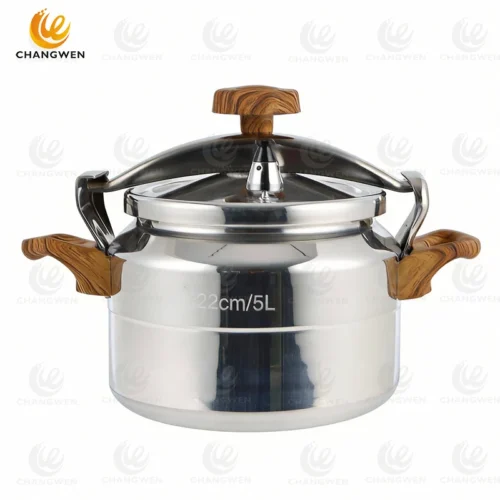
Pressure Cooker Stainless Steel for Healthy Cooking
-
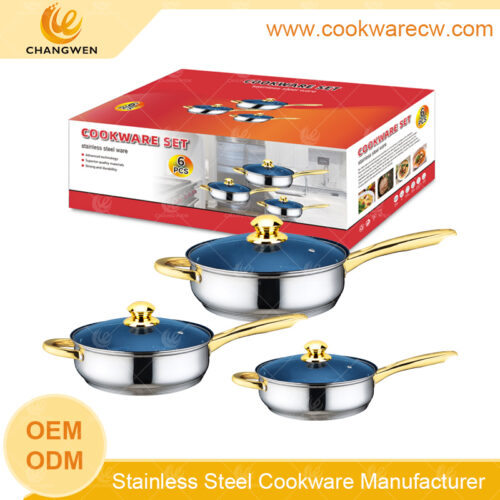
Wholesale new design stainless steel cookware 3pcs blue marble coating nonstick frypan set golden handles and knobs adjustable size CW-M0614
-
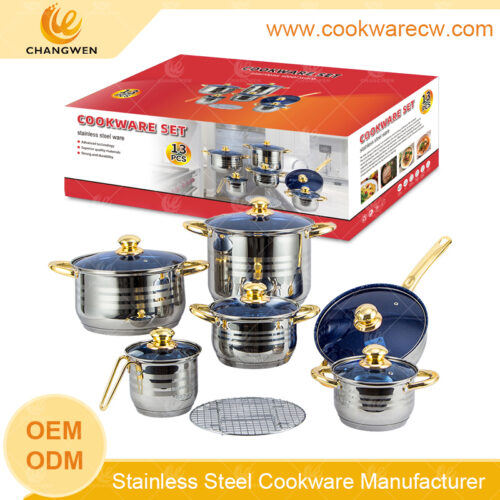
Wholesale price stainless steel pots and pans streamer rack cookware set coating inside golden wire handle milk pot with blue glass lid CW-M1304
-
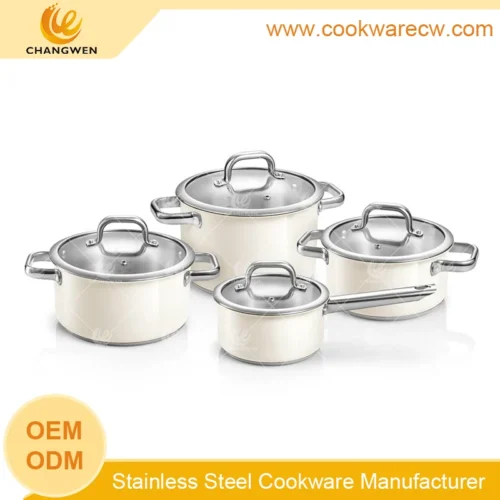
8-Piece Cream White Stainless Steel Cookware Set with Saucepan CW-ES0803
-
Large Stainless Steel Cazo
-
8pcs Die Cast Aluminum Cooking Set with Marble Ceramic Nonstick Coating
-
8-Piece Stainless Steel Cookware Set with Nonstick Pan & Steamer CW-ES0907
-
Honeycomb Stainless Steel Pan with Enhanced Heat Control CW-ETP017