
Read time: 10 minutes
Introduction
In August 2025, the FDA issued a public warning about imported cookware leaching lead into food during cooking. The affected products were not counterfeit goods — they were ordinary cooking pots sold through standard retail channels. The problem was that no one along the supply chain had verified the food safety of the materials.
That warning is why this guide exists.
Food-grade certifications for cookware are not bureaucratic paperwork. They are the documented evidence that the materials your customers cook with every day do not contaminate their food. For importers, brands, and anyone sourcing cookware from overseas manufacturers, understanding which certifications matter — and what they actually test — is the difference between a compliant product and a liability.
This guide covers every certification that matters for cookware: what food-grade actually means, how LFGB and FDA compare, which other certifications are relevant, what the tests involve, and the specific documentation to require from any manufacturer before you place an order.

Key Takeaways
- Food grade means a material does not transfer harmful substances into food under normal use conditions. It is confirmed by migration testing — laboratory analysis of what leaves the material and enters a food simulant under defined conditions.
- LFGB (Germany/EU) is the more comprehensive and stringent standard. It includes heavy metal migration, organic migration, and crucially, sensory testing — the cookware must not alter the taste or odor of food.
- FDA compliance (US) focuses on material composition and chemical stability. It is less comprehensive than LFGB but sufficient for US market access.
- Products that pass LFGB will generally satisfy FDA requirements. The reverse is not always true.
- ISO 9001 confirms quality management processes but is not a food safety certification — it tells you the factory has documented systems, not that the product is safe.
- Third-party testing by accredited laboratories (SGS, Bureau Veritas, Intertek, TÜV) is the only way to verify certification claims. Manufacturer self-declarations without supporting test reports are not verification.
- The FDA issued a lead-leaching warning on specific imported cookware in August 2025. This is an active food safety issue, not a historical one.
What Does “Food Grade” Actually Mean?
The term “food grade” means a material is safe for contact with food under the conditions in which it will be used. It is not a single certification — it is an outcome confirmed by testing.
A food-grade material:
- Does not transfer harmful substances (heavy metals, organic compounds, plasticizers) into food at levels that could endanger health
- Does not cause unacceptable changes to the composition of food
- Does not affect the taste or odor of food in a way consumers can detect
The key word is “transfer.” Food-grade certification is tested through migration analysis — the material is exposed to food simulants (acidic solutions, fatty simulants, aqueous solutions) under defined temperature and time conditions, and the amount of each substance that migrates from the material into the simulant is measured against regulatory limits.
A material can be chemically composed of non-toxic elements and still fail a food-grade test if conditions cause unexpected migration. This is why composition certificates alone are not sufficient — actual migration testing on the finished product is required.
Food Grade vs Food Safe vs Non-Toxic
These three terms appear interchangeably in cookware marketing but have different implications:
Food grade: Confirmed by migration testing against a defined regulatory standard (LFGB, FDA, etc.). The most specific and verifiable term.
Food safe: A marketing claim without a universally standardized definition. Can mean anything from “we believe this is safe” to “this has passed specific food contact testing.” Without supporting documentation, this term is unverifiable.
Non-toxic: A general material characterization, not a food contact standard. A material can be technically non-toxic in isolation but still migrate into food at harmful levels under cooking conditions.
For any cookware procurement, require food-grade certification with supporting test reports. “Food safe” and “non-toxic” claims without documentation should not be accepted as verification.
LFGB: The Gold Standard for Cookware Certification
What LFGB Is
LFGB stands for Lebensmittel-, Bedarfsgegenstände- und Futtermittelgesetzbuch — the German Food and Feed Code. It is Germany’s national implementation of EU food contact material regulations, administered by the Bundesinstitut für Risikobewertung (BfR — German Federal Institute for Risk Assessment).
LFGB is widely considered the most comprehensive food contact material standard in the world. For cookware exporters, LFGB certification is the de facto entry requirement for the German market and is accepted across all EU member states.
What LFGB Tests
LFGB testing for cookware covers four main areas:
1. Overall migration testing Measures the total amount of all substances that migrate from the cookware material into food simulants under defined temperature and time conditions. Standard food simulants include distilled water (aqueous foods), 3% acetic acid (acidic foods like tomato sauce), 10% ethanol (alcoholic foods), and olive oil or a synthetic fat simulant (fatty foods).
The test conditions replicate real cooking: the simulant is held in the cookware at defined temperatures (typically 70°C for 2 hours, or 100°C for 1 hour) and the total migration is measured. The overall migration limit under LFGB is 10 mg/dm² of cookware surface.
2. Specific migration testing (heavy metals) Measures the migration of specific heavy metals — nickel, chromium, manganese, lead, cadmium, arsenic, and others — individually. Different metals have different limit values depending on their toxicity. For stainless steel cookware, nickel and chromium are the primary metals tested.
LFGB nickel migration limit: 0.02 mg/kg food simulant. This limit is significantly more demanding than some non-EU standards.
3. Sensory testing This is the test that distinguishes LFGB from most other standards. LFGB requires that cookware does not impart any detectable odor or taste to the food simulant. Trained sensory panels evaluate whether food stored or cooked in the cookware acquires any off-notes.
This test catches problems that migration analysis alone cannot — for example, trace organic compounds that migrate below detection limits but are detectable by taste. No other major cookware standard includes sensory testing as comprehensively as LFGB.
4. Specific tests by material Additional testing requirements apply by material type:
- Stainless steel: Composition verification (confirming declared grade), surface passivation quality, nickel and chromium migration
- Non-stick coatings (PTFE, ceramic): PFOA absence, migration of coating components, adhesion testing
- Aluminum cookware: Aluminum migration, anodization quality where applicable
- Handles and lids (plastic, silicone, rubber): Plasticizer content, volatile organic compound (VOC) migration, colorant safety
Who Issues LFGB Certification
LFGB test reports must be issued by accredited testing laboratories — not by manufacturers. Accredited laboratories include SGS, Bureau Veritas, Intertek, TÜV Rheinland, TÜV SÜD, and various BfR-recognized European laboratories.
When reviewing an LFGB test report, verify:
- The issuing laboratory’s accreditation (ISO 17025 accreditation is the standard for testing laboratories)
- The validity date (typically 1–3 years before renewal testing is recommended)
- The product scope — does the certificate cover your specific product, or a different product from the same factory?
- The test conditions used — do they match your product’s intended use?
The Fork and Knife Symbol
Products that have passed LFGB food contact testing are entitled to display the “fork and knife” symbol (a stylized cutlery icon). This symbol indicates the product has been tested and confirmed safe for food contact under EU/German standards. When sourcing cookware from China or other manufacturing regions, this symbol on a product should be backed by verifiable test documentation.
FDA Compliance: The US Standard
What FDA Compliance Means for Cookware
The US Food and Drug Administration (FDA) regulates food contact materials under 21 CFR (Code of Federal Regulations) Part 177 and related sections. For stainless steel cookware, the primary reference is 21 CFR 177.2600 (rubber articles intended for repeated use) or relevant metal standards. For non-stick coatings, 21 CFR 177.1550 covers perfluorocarbon resins.
Unlike LFGB, FDA compliance for most metal cookware does not require mandatory registration or third-party certification from an accredited body. Manufacturers can achieve FDA compliance through:
- Using materials that comply with specific FDA regulations (material composition approach)
- Third-party testing demonstrating that migration levels are below FDA action levels
- Self-declaration based on available safety data — acceptable for many metal categories
What FDA Tests Focus On
FDA compliance for cookware focuses primarily on:
- Material composition: Confirming the material as declared (e.g., 304 stainless steel grade confirmed by chemical analysis)
- Heavy metal content: Lead, cadmium, mercury, arsenic limits
- Chemical stability: The material does not degrade or release harmful compounds under normal cooking conditions
- Specific substance prohibitions: PFOA (now generally prohibited), certain plasticizers, regulated colorants
What FDA does not require for metal cookware: Sensory testing. The FDA framework does not include the odor/taste transfer testing that LFGB mandates.
The August 2025 FDA Warning: What Happened
In August 2025, the FDA issued a public safety warning identifying specific imported cookware products — primarily aluminum and enameled cookware from certain suppliers — that tested positive for lead migration at levels above safe limits. The products were not fraudulently marketed as lead-free; the problem was that food safety testing had not been performed or verified before the products entered US retail channels.
The warning was updated in December 2025 to include additional products. As of early 2026, the FDA’s active monitoring of imported cookware lead contamination continues.
The practical implication for importers: FDA compliance for metal cookware cannot be assumed based on the material type alone. Independent migration testing — particularly for lead and cadmium — should be part of any cookware import qualification process, regardless of the supplier’s own claims.
LFGB vs FDA: Head-to-Head Comparison
| Factor | LFGB (Germany/EU) | FDA (USA) |
|---|---|---|
| Issuing authority | BfR (German Federal Institute) via accredited labs | US Food and Drug Administration |
| Testing rigor | Comprehensive — overall and specific migration | Focused on composition and heavy metals |
| Sensory testing | Yes — taste and odor transfer tested | No |
| Third-party requirement | Yes — accredited lab required | No — self-declaration accepted for metals |
| Geographic coverage | Germany (accepted across full EU) | United States |
| Nickel migration limit | 0.02 mg/kg (strict) | Not specifically defined for cookware |
| PFOA requirement | Restricted | Restricted (21 CFR) |
| Validity period | Test reports typically 1–3 years | No fixed period |
| Relative cost | Higher — more tests, accredited lab required | Lower — self-declaration option available |
| Market entry requirement | Effectively mandatory for EU/German market | Strongly recommended for US market |
Key takeaway: LFGB is more demanding. Products that pass LFGB testing will generally satisfy FDA requirements for the same parameters. Products that meet FDA requirements may or may not meet LFGB standards — particularly for sensory testing and specific migration limits.
For cookware brands targeting global distribution, dual LFGB + FDA certification provides the widest market access with the fewest compliance surprises.
Other Certifications That Matter
ISO 9001
What it is: An international standard for quality management systems. ISO 9001 certification means the manufacturer has documented, audited processes for production, quality control, record-keeping, and continuous improvement.
What it confirms: The factory has a quality management system. It does not confirm that the product is food safe.
Relevance for cookware: ISO 9001 is a baseline requirement for any serious manufacturing partner — it indicates the factory operates systematically rather than ad hoc. But it does not substitute for food-grade material testing. Require both.
NSF/ANSI 51
What it is: American National Standard for food equipment materials. NSF certification is widely required by US health departments for commercial foodservice equipment.
What it confirms: The material is suitable for food contact in commercial foodservice applications — more demanding use conditions than household cookware.
Relevance for cookware: Essential for any cookware sold into US commercial foodservice (restaurants, institutional kitchens, catering). Less critical for household retail, but a strong quality signal.
BSCI and SMETA
What they are: Business Social Compliance Initiative (BSCI) and Sedex Members Ethical Trade Audit (SMETA) are social compliance audit standards covering labor conditions, workplace safety, environmental practices, and business ethics at the factory level.
What they confirm: Factory social compliance — not product food safety.
Relevance for cookware: Required by many European and North American retail chains and corporate procurement programs. Does not replace food-grade testing but is a separate layer of supply chain verification.
CA Prop 65
What it is: California Proposition 65 requires businesses to provide warnings before knowingly exposing Californians to chemicals that cause cancer, birth defects, or other reproductive harm.
Relevance for cookware: Lead and cadmium are Prop 65-listed chemicals. Cookware sold in California must either comply with Prop 65 limits or carry a warning label. For cookware sold through major US retail chains or e-commerce platforms that ship to California, Prop 65 compliance is a practical requirement. Third-party testing confirming lead and cadmium levels below Prop 65 thresholds is the standard approach.
The Food-Grade Test in Practice: What Happens in the Lab
Understanding what actually happens during food-grade testing helps importers evaluate test reports intelligently.
Standard Test Procedure (Simplified)
1. Sample preparation: Production samples — not prototypes — are collected for testing. The test laboratory cleans samples according to specified protocols.
2. Food simulant selection: The appropriate food simulant is selected based on the cookware’s intended use:
- Distilled water: neutral aqueous foods
- 3% acetic acid: acidic foods (tomatoes, citrus-based sauces)
- 10% ethanol: alcoholic foods or foods cooked with wine
- Olive oil or a synthetic fat simulant: fatty foods
3. Migration conditions: The simulant is introduced into the cookware at specified temperature and time conditions that simulate actual cooking use. For stovetop cookware, typical conditions are 100°C for 4 hours.
4. Analysis: The simulant is analyzed by mass spectrometry, atomic absorption spectroscopy, inductively coupled plasma (ICP), and other methods to measure specific migration of individual substances.
5. Sensory evaluation (LFGB): Separate samples are evaluated by trained sensory panels for odor and taste transfer.
6. Comparison against limits: Results are compared against regulatory limits. The test report documents which tests were run, the conditions used, the results, and whether the product passes or fails.
What to Look for in a Test Report
When reviewing a food-grade test report from a supplier, verify:
- Issuing laboratory: Is it an accredited laboratory (look for ISO 17025 accreditation)? SGS, Bureau Veritas, Intertek, TÜV are internationally recognized.
- Sample description: Does the sample match your actual product (material, size, surface finish)?
- Test conditions: Do they match the standard (LFGB, FDA 21 CFR)?
- Scope of testing: Which specific tests were run? A partial test report covering only one or two parameters is not a complete certification.
- Results: Are all results listed with actual values, not just “pass”? Actual values allow you to assess margin from the limit.
- Date: When was the test conducted? Has the product specification changed since then?
- Signature and accreditation number: Confirming the report is authentic.
What to Require from a Cookware Manufacturer
For any serious cookware OEM or import program, the minimum documentation package should include:
LFGB test report (EU market): Issued by an accredited laboratory, covering the specific product type, with scope including overall migration, specific migration (heavy metals), and sensory evaluation.
FDA compliance documentation (US market): Third-party migration test results, material composition certificates confirming declared steel grade or material, PFOA-free declaration for any non-stick coating.
ISO 9001 certificate: Current and valid, issued by an accredited certification body.
Material test reports (MTRs): For stainless steel cookware, mill certificates from the steel supplier confirming the chemical composition of the actual batch used in production. This is separate from food contact testing and confirms the material grade (304 vs 201, etc.).
CA Prop 65 compliance (US market): Third-party testing confirming lead and cadmium below Prop 65 action levels, if selling into California or major US retail channels.
PFOA-free / PFAS-free certificates: For any non-stick cookware product, certification from an accredited laboratory confirming absence of PFOA and relevant PFAS compounds.
Never accept photocopied certificates, certificates with illegible accreditation numbers, or certificates that cover a different product from the one you are ordering. Request original documents and, for significant programs, verify certificate authenticity directly with the issuing laboratory.
FAQ
What is food grade and how is it tested?
Food grade means a material does not transfer harmful substances into food under normal use conditions. It is confirmed by migration testing — the material is exposed to food simulants (acidic, aqueous, fatty solutions) under defined temperature and time conditions, and the laboratory measures what substances migrate from the material into the simulant. Results are compared against regulatory limits (LFGB limits for EU, FDA action levels for US).
What is the difference between LFGB and FDA certification for cookware?
LFGB is Germany’s food contact standard, effectively the EU benchmark. It is more comprehensive than FDA — it includes overall migration testing, specific heavy metal migration, and sensory testing for taste and odor transfer. FDA compliance for most metal cookware does not require third-party certification and focuses primarily on material composition and heavy metal content. Products passing LFGB will generally satisfy FDA requirements. Products meeting FDA minimum standards may not meet LFGB requirements, particularly for sensory testing.
Is a food handler certification the same as food grade certification for cookware?
No. A food handler certification is a personal credential issued to individuals who handle food in commercial kitchens — confirming they have been trained in food hygiene, cross-contamination prevention, and food safety practices. Food grade certification for cookware is a material and product certification confirming the cookware is safe for food contact. They are completely different types of certification for different purposes.
What does a food grade test involve?
A food-grade test for cookware involves exposing the cookware to food simulants (distilled water, acetic acid, ethanol, and fat simulants) under defined temperature and time conditions that replicate cooking use. The simulants are then analyzed by laboratory instruments (ICP, mass spectrometry, atomic absorption spectroscopy) to measure migration of specific substances including heavy metals, organic compounds, and other regulated chemicals. For LFGB testing, a sensory panel also evaluates whether the food simulant has acquired any off-taste or odor from the cookware.
How do I verify that a supplier’s food grade certification is genuine?
Request the original test report (not a photocopy) including the issuing laboratory’s name, accreditation number, and the specific tests run with actual result values. Verify the laboratory’s accreditation by searching the relevant accreditation body database (ILAC-MRA member bodies maintain searchable databases of accredited laboratories). For any significant order, contact the laboratory directly to confirm the report was issued for your specific product.
Does ISO 9001 certification mean a cookware product is food safe?
No. ISO 9001 is a quality management system standard — it confirms the factory has documented and audited processes for production and quality control. It does not confirm that the materials used are food safe. ISO 9001 and food-grade migration testing (LFGB, FDA) are separate requirements that both matter but serve different purposes.
What happened with the FDA cookware lead warning in 2025?
In August 2025, the FDA issued a warning identifying specific imported cookware products that tested positive for lead migration at unsafe levels. The warning was updated in December 2025 with additional affected products. The affected items were standard retail cookware — not counterfeit products — that had not undergone adequate food safety testing before entering US retail channels. The FDA warning underscores that food-grade certification cannot be assumed based on material type alone: independent migration testing must be part of any cookware import qualification process.
Conclusion
Food-grade certifications for cookware are not optional documentation for export-ready products. They are the documented evidence that the pots and pans your customers cook in every day are safe.
LFGB is the most comprehensive standard available, covering migration, heavy metals, and sensory performance. FDA compliance is the US market baseline. ISO 9001 confirms manufacturing quality but not product safety. Third-party testing by accredited laboratories is the only form of verification that actually means something.
The August 2025 FDA warning about lead-leaching imported cookware is a concrete reminder of what happens when certification is skipped or assumed. The products that triggered that warning were not fraudulent — they were sourced through normal channels without adequate verification.
Require the documentation. Verify its authenticity. Build certification requirements into your purchase orders. And treat food-grade compliance not as a paperwork exercise but as the foundation of every cookware brand worth building.
Work With Changwen for Certified Cookware Production
Changwen is a stainless steel cookware manufacturer based in Jiangmen, Guangdong, China, with over 22 years of OEM and ODM experience. All production uses verified food-grade 304 stainless steel (18/8) with material test reports available for every batch.
Certifications held: ISO 9001:2015. LFGB compliant (test reports available). FDA compliant. BSCI audited.
Complete certification documentation package available for OEM programs: LFGB test reports, material test certificates, packing specifications, and export documentation. Dual LFGB + FDA programs supported.
-
Cook Stainless Steel Stock Pot CW-M0606
-
Wholesale new design stainless steel cookware 3pcs blue marble coating nonstick frypan set golden handles and knobs adjustable size CW-M0614
-
Copper-Colored Stainless Steel Cookware Set CW-ETP0502
-
Versatile Stainless Steel Pot Set with Multiple Capacity Options CW-ETP018
-
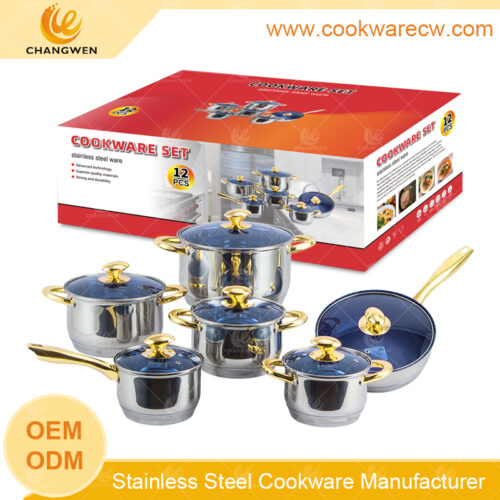
hot sales 12pcs stainless steel cookware set cooking pots set 16cm saucepan 24cm casserole & non-stick frypan with induction usage bottom CW-M1214
-
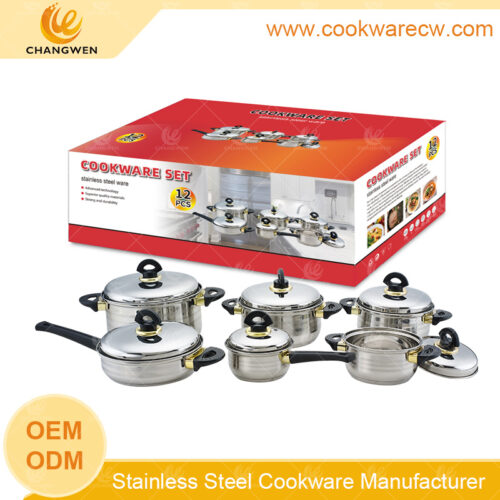
China cookware set 12pcs pots wholesale stainless steel lids black handle and knob frypan casserole saucepan CW-M1229B
-
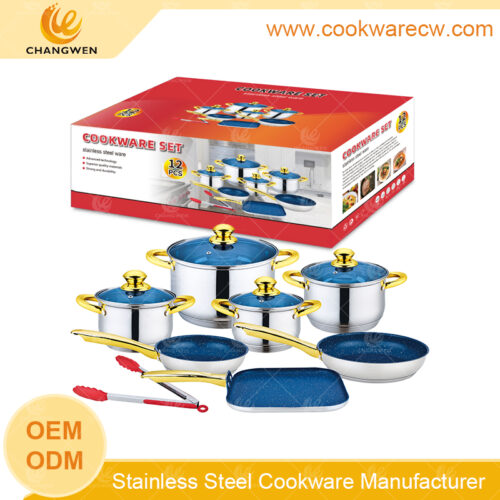
Hot sale SS ollas non-stick coated frying pans and pots stock pot with a kitchenware clip CW-M1204
-
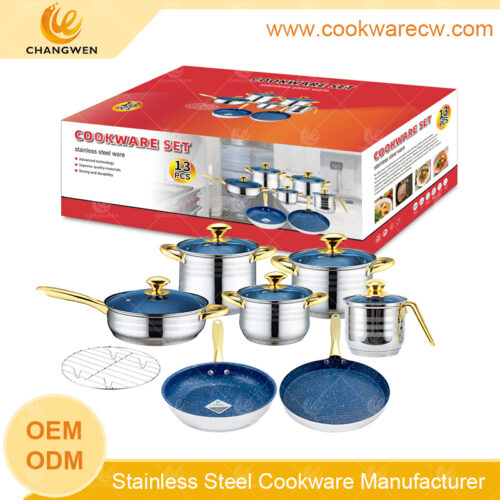
Mexican cookware set olla milk pot high stock pot kitchen wire rack and non-stick coating frypans CW-M1308