
Read time: 12 minutes
Introduction
The Australian cookware market is worth USD 664 million and growing at 7.5% annually through 2033. Consumers are moving away from coated non-stick toward stainless steel, ceramic, and cast iron — driven by health awareness, PFAS concerns, and a preference for durable, long-lasting products that justify a premium price.
For Australian brands, importers, and distributors, this shift creates a clear commercial opportunity. The question is not whether to source stainless steel cookware from China — China is the world’s dominant cookware manufacturer and the primary exporter to Australia by value. The question is how to do it correctly: right material grade, right certifications, right OEM program, right factory relationship.
This guide covers everything an Australian buyer needs to know: the market conditions, the Australian-relevant certifications, the OEM services available, the product range, the production and quality processes, and how to ship from China to Sydney and Melbourne efficiently.

Understanding the Australian Cookware Market
What Australian Consumers Want in 2026
Australian consumers buying stainless steel cookware in 2026 are not buying on price alone. They are buying on three values: durability, safety, and design.
Durability. Australians are increasingly choosing to invest in long-lasting cookware rather than replace cheap sets annually. This shift toward premiumisation is consistent across urban demographics. A cookware set positioned on 25-year durability — with a manufacturing story to support it — commands a meaningful price premium over mass-market alternatives.
Safety. Health-conscious Australians are actively researching what is in their cookware. PFOA-free labeling, PFAS-free claims, and food-grade certification documentation are now decision factors at retail and online. The question “is stainless steel cookware safe?” drives significant search volume in Australia. The answer — yes, when it is genuine food-grade 304 stainless steel — is a brand story that converts.
Design. The Australian mid-to-premium home kitchen aesthetic has shifted toward contemporary minimalism: brushed stainless steel, matte black, warm neutrals, and clean lines. Cookware that photographs well for social commerce performs disproportionately well in the Australian online retail environment, where Instagram-driven purchase decisions are significant.
The Stainless Steel Opportunity
Health-conscious Australians are increasingly selective about the materials used in cookware, seeking products that are non-toxic, PFOA-free, and made from sustainable or recyclable materials. Consumers are turning to stainless steel, ceramic, and cast iron options, which are perceived as safer and more eco-friendly.
This consumer shift is the opportunity for Australian brands sourcing quality OEM stainless steel cookware. A well-specified tri-ply 304 stainless steel cookware set, with LFGB food-grade certification, honest material documentation, and premium retail packaging, is positioned exactly where the Australian premium market is heading.
Material Preferences: 304 Stainless Steel and Tri-Ply
The Australian premium market expects:
- 304 stainless steel (18/8 or 18/10) as the food contact surface — non-reactive, food-safe, corrosion-resistant
- Tri-ply construction (304-aluminum-430) for premium product lines — even heat distribution through base and sidewalls, induction compatibility from the 430 outer layer
- Disc-base construction for mid-range and accessible price points — solid everyday cooking performance at a competitive cost
- Induction compatibility — Australian kitchens have high induction penetration. Any cookware set not specifying induction compatibility will be limited in reach
Aluminium Cookware in Australia
Aluminium cookware holds a significant share of the Australian cookware market, particularly in the mid-range and non-stick segments. For OEM brands targeting the Australian market, hard-anodized aluminium with ceramic or PTFE non-stick coating is a mainstream category alongside stainless steel. Aluminium cookware for Australia should specify:
- Hard-anodized surface treatment (not raw aluminium) for food safety and durability
- PFOA-free, PFAS-free coating certifications for any non-stick product
- Induction-compatible base disc (magnetic stainless steel layer) for induction compatibility
- LFGB or equivalent food contact certification for the coating material
Australian Standards and Certifications
This section is the most commercially important part of this guide. Getting certifications right directly determines whether your product clears customs, satisfies Australian retailer requirements, and earns consumer trust.
LFGB: The Food Safety Benchmark
LFGB (Lebensmittel-, Bedarfsgegenstände- und Futtermittelgesetzbuch) is Germany’s food and feed code — widely considered the world’s most comprehensive food contact material standard. Although primarily a German/EU standard, LFGB is increasingly accepted and expected in the Australian premium retail market as the benchmark for food-grade cookware certification.
LFGB testing covers:
- Overall migration: Total substances migrating from the cookware material into food simulants (acidic, aqueous, fatty) under cooking conditions
- Heavy metal migration: Specific limits for nickel, chromium, lead, cadmium, and other regulated metals
- Sensory testing: The cookware must not transfer detectable odor or taste to food — the test that distinguishes LFGB from most other standards
For any stainless steel cookware set positioned in the Australian mid-to-premium market, LFGB test reports from accredited laboratories (SGS, Bureau Veritas, Intertek, TÜV) are the documentation standard to provide to retailers and end consumers.
FDA Compliance
FDA (US Food and Drug Administration) compliance documents confirm the materials used meet US food contact standards under 21 CFR. While Australia’s primary food contact framework is its own national Food Standards Code, FDA documentation is internationally recognised and accepted by Australian retailers and commercial buyers as evidence of material safety.
For stainless steel cookware, FDA compliance typically involves:
- Material composition certificates confirming 304 stainless steel grade
- Heavy metal content below FDA action levels (lead, cadmium, arsenic)
- PFOA-free / PFAS-free declaration for any coated products
ISO 9001:2015
ISO 9001 quality management certification confirms the manufacturing facility has documented, audited production and quality control processes. Australian commercial buyers — particularly retail chains, foodservice distributors, and institutional procurement teams — commonly require ISO 9001 as a baseline supplier qualification.
Food Standards Australia New Zealand (FSANZ)
FSANZ Standard 1.4.3 regulates contaminants and natural toxicants in food, including limits on metals that may migrate from food contact materials. For imported cookware sold in Australia, FSANZ limits for lead, cadmium, arsenic, and other regulated metals apply.
For practical purposes: cookware that passes LFGB testing will satisfy FSANZ contaminant limits for the regulated metals. Request LFGB test reports covering heavy metal migration as your primary food safety documentation.
Packaging Compliance for the Australian Market
Australian Consumer Law (ACL) and Australian Competition and Consumer Commission (ACCC) requirements apply to product labeling and claims on cookware sold in Australia:
- Country of origin must be disclosed (“Made in China”)
- Material claims must be accurate — “304 stainless steel” or “18/10 stainless” requires documentary support
- Safety and certification claims must be verifiable — “LFGB certified” or “food-grade tested” should be backed by available test documentation
- Care and use instructions must be in English, clearly legible
Packaging must include English-language content throughout. Bilingual packaging (English + Chinese or other language) is acceptable if English content is complete and prominent.
Nickel-Free Stainless Steel Cookware for Australia
There is measurable demand for nickel-free stainless steel cookware in Australia among consumers with nickel sensitivity or nickel allergy. Standard 304 stainless steel contains 8–10% nickel. Options for nickel-sensitive consumers include:
- 18/0 stainless steel — contains no nickel (ferritic steel, similar to 430)
- Pure titanium cookware — no nickel content
- Cast iron cookware — nickel-free
For OEM brands targeting the nickel-free segment specifically, specify 18/0 stainless steel for the inner cooking surface and confirm with material test reports.
OEM Cookware Services for Australian Brands
A full-service OEM cookware program for Australian brands includes the following elements:
Logo Branding
Logo application options for stainless steel cookware:
- Laser engraving: Permanent, clean brand mark on the pot body, lid, or handle. Survives dishwashing and heavy use. Recommended for premium product lines.
- Embossing: Logo pressed into the metal surface. Tactile, premium appearance. Requires tooling investment for new designs.
- Etching: Chemical or laser etching for detailed logo work. Good for complex logo designs.
- Silk screen printing on packaging: For logo placement on boxes, labels, and inserts rather than the product itself.
Custom Retail Packaging
Professional retail packaging is the single highest-return OEM investment for the Australian market. Australian premium retail and online channels are visually driven — packaging must communicate the product’s quality story before the consumer handles it.
Custom packaging options:
- Full-color custom box with brand identity, product specifications, and certification claims
- Inner insert card with cooking tips, care instructions, and brand story
- Kraft/recycled packaging options for sustainability-positioned brands
- Gift packaging configurations for the Australian gifting and wedding registry segment
Custom Product Design
Beyond logo branding, OEM customization for the Australian market includes:
- Surface finish selection: brushed, mirror polish, matte, PVD color (hammered cream, matte black, sage green — all trending in Australian home kitchen retail)
- Handle material and color: silicone-coated Bakelite in brand-specific colors, stainless steel for oven-safe programs
- Set composition: configure which pieces form your set — mix and match from standard product lines without new tooling
- Lid specification: glass or stainless, with or without pour holes, lid knob style
Minimum Order Quantity (MOQ)
For catalog products with OEM branding (logo engraving, custom packaging):
- Standard MOQ: 1,000 units per item
- Mixed-item sets: Sets combining multiple pieces may have set-level MOQ rather than per-piece MOQ — confirm with factory
- Custom tooling programs (new handle shapes, proprietary designs): Higher MOQ to amortize tooling investment, typically 3,000–5,000 units per SKU
For Australian brands testing a new product line, an initial order of 1,000 units at standard MOQ is a viable market test before scaling.
Product Range Available for the Australian Market
Stainless Steel Cookware Sets
Complete stainless steel cookware sets for the Australian market, available in tri-ply full-clad or disc-base construction:
- 5-piece set: Typically 16cm + 18cm saucepans, 24cm frying pan, 20cm saucepan with lid, 24cm stock pot. Entry set for single or couple households.
- 8-piece set: Expanded range adding a sauté pan and additional saucepan size. The most common complete household set.
- 12-piece set: Full kitchen setup including steamer insert, additional lids, and larger stock pot. Premium gifting and wedding registry configuration.
All sets available in brushed, mirror, matte, and hammered surface finishes. All available with custom logo and packaging.
Stainless Steel Frying Pans
Individual stainless steel frying pans — among the highest search-volume single products in Australian online cookware retail:
- Tri-ply full-clad (304-aluminum-430) — premium positioning, even heat from base to sidewall
- Available in 20cm, 24cm, 28cm standard sizes
- Option: uncoated stainless interior or PTFE / ceramic non-stick over stainless body
- Induction-compatible as standard (430 outer layer)
Induction Cookware
All tri-ply and disc-base stainless steel cookware with 430 outer layer is induction-compatible as standard. The Australian market has significant induction penetration — marketing induction compatibility prominently is appropriate for most product lines.
Specific induction-ready messaging for Australian packaging: “Suitable for all stovetops including induction, gas, electric, and ceramic.”
Chef-Grade Stainless Steel Cookware
Commercial and chef-grade stainless steel cookware for Australian foodservice, hospitality, and restaurant supply:
- Heavy-gauge single-layer 304 stainless construction (1.2mm+ wall thickness) for professional kitchen durability
- Riveted handles with professional-grade heat resistance
- NSF/ANSI 51 certification available for US commercial foodservice — relevant for Australian hospitality brands targeting both markets
- GN (Gastronorm) pans: full range from 1/1 to 1/6 in 20mm, 65mm, and 100mm depths
Pressure Cookers
Stainless steel pressure cookers for the Australian market:
- Sizes: 4L, 5L, 7L, 9L, 11L
- 304 stainless steel body
- Dual-lock safety mechanism with pressure indicator
- 100 kPa operating pressure, 118–120°C cooking temperature
- Suitable for all stovetops including induction
Aluminium Cookware
For Australian brands seeking aluminium cookware alongside stainless steel:
- Hard-anodized aluminium cookware sets with PTFE or ceramic non-stick interior
- Composite-base construction: aluminium body with stainless steel induction base disc
- PFOA-free, PFAS-free coating certification available
- LFGB and FDA food contact certification for coating materials
Why Choose a China OEM Cookware Manufacturer
Cost Advantage
The cost structure of Chinese cookware manufacturing cannot be replicated in other markets. Australia has no domestic cookware manufacturing industry at commercial scale. The choice is not between Chinese OEM and Australian-made — it is between Chinese OEM and manufacturing elsewhere (Vietnam, India, Turkey, Mexico), all of which are less competitive for stainless steel cookware specifically.
China’s Jiangmen, Guangdong province — the primary stainless steel cookware manufacturing cluster — has decades of accumulated expertise, integrated supply chains (steel, aluminum, Bakelite, glass, packaging all available within hours of the factory), and capital equipment investment that produces genuinely premium cookware at competitive economics.
At standard tri-ply stainless steel cookware FOB pricing from Jiangmen, Australian brands can position products at mid-to-premium retail price points with healthy margin. This is not a race to the bottom — this is the same manufacturing base used by major international cookware brands.
Mature Supply Chain
The Australian cookware import supply chain from China is established and efficient. Major Australian retailers source cookware from China routinely. The export documentation, certification pathways, and logistics infrastructure are mature. Chinese factories with Australian export experience understand the required documentation, the packaging requirements, and the standard commercial terms.
Production Capacity and Lead Times
Established Chinese cookware manufacturers can handle both initial trial orders and scaling volumes. A factory that fills a 1,000-unit trial order for an Australian brand can scale to 10,000 units per SKU as the brand grows, without changing suppliers, reformatting specifications, or rebuilding quality relationships.
Production and Quality Control
Tri-Ply Construction: How It Is Made
Quality stainless steel cookware for the Australian premium market requires full-clad tri-ply construction. The manufacturing process:
1. Cladding: Three layers — 304 stainless steel (inner), aluminum alloy (core), 430 stainless steel (outer) — are bonded together under high pressure into a single composite sheet. This bond is permanent; the layers cannot separate under normal cooking conditions.
2. Deep drawing: The bonded tri-ply sheet is pressed into pot or pan shape through hydraulic deep-drawing equipment. Multiple drawing passes form deep vessels. The aluminum core runs continuously through the base and sidewalls.
3. Surface finishing: Interior surfaces are polished smooth. Exterior surfaces receive the specified finish — brushed satin for most Australian market products, mirror polish for premium configurations, matte or PVD color for lifestyle-positioned lines.
4. Handle attachment: Handles are attached by riveting (standard, durable) or welding (cleaner appearance, no rivet heads on interior). Handle material, color, and ergonomics are specified per OEM program.
5. Quality control: Three-stage inspection — IQC (incoming material, including XRF verification of steel grade), IPQC (in-process at critical production stages), OQC (outgoing inspection against AQL sampling plan).
Material Verification
The most common quality fraud in stainless steel cookware manufacturing is substituting 201-grade steel for 304. Both look identical. 201 has lower nickel content, lower corrosion resistance, and is not appropriate for food-grade cookware marketed as 304.
Reliable quality control for Australian OEM programs requires:
- Mill certificates (Material Test Reports) from the steel supplier, confirming chemical composition of the specific production batch
- XRF (X-ray Fluorescence) testing on finished goods or at incoming inspection to confirm grade
- Material grade declared explicitly in the purchase order as a contractual specification
Welding and Polishing Standards
Handle welding is inspected for penetration, smoothness, and the absence of sharp edges or burrs. Interior polishing is inspected for scratch-free, uniform surface finish. Exterior finish consistency — particularly for brushed finish, where directional marks must be uniform — is a key visual quality criterion for Australian retail presentation.
Shipping to Australia
Sea Freight: The Primary Mode
Ocean freight is the standard shipping mode for cookware from China to Australia. The route from Guangdong (Jiangmen area factories ship through Guangzhou Nansha, Yantian, or Hong Kong) to Australian east coast ports (Sydney, Melbourne, Brisbane) is well-established with multiple weekly services.
Current ocean freight rates (early 2026, port-to-port):
| Container | To Sydney (Port Botany) | To Melbourne (Webb Dock) |
|---|---|---|
| 20ft (20GP) | USD 900–1,400 | USD 950–1,500 |
| 40ft (40HC) | USD 1,200–1,800 | USD 1,300–1,900 |
| LCL (per CBM) | USD 35–65/CBM | USD 40–70/CBM |
Transit times:
- China (Guangdong) to Sydney/Melbourne: 12–18 days port-to-port
- Allow 5–10 additional days for customs clearance and delivery to warehouse
- Total door-to-door: approximately 3–4 weeks
Air Freight
Air freight is not economically viable for volume cookware imports. It is appropriate for:
- Urgent samples ahead of a main ocean shipment
- Small initial orders to test market fit
- High-value, low-volume specialty products where freight cost is a small percentage of product value
Current air freight: USD 4–7/kg China to Australia. A typical cookware set weighs 3–6 kg — air freight economics do not support volume shipping.
Australian Customs and Duties
Cookware from China enters Australia under HTS/HS Chapter 73 (articles of iron or steel). Australia does not currently impose punitive tariffs on Chinese cookware equivalent to US Section 301 tariffs. Standard Australian customs duty applies — typically 0–5% for most cookware categories under Australia’s general rate, with some categories duty-free under relevant FTA arrangements.
The China-Australia Free Trade Agreement (ChAFTA), in force since 2015, reduced duties on most cookware categories. Confirm current duty rates and ChAFTA eligibility with your Australian customs broker before finalizing your landed cost calculation.
Port and Customs Documentation
Standard documentation for cookware imports to Australia:
- Commercial invoice (factory price, Incoterms, country of origin)
- Packing list (carton count, weights, dimensions)
- Bill of lading / Air Waybill
- Certificate of origin (for ChAFTA tariff reduction, Form N/China FTA CO required)
- LFGB or food contact test reports (may be requested by customs biosecurity or retailers)
- Material safety data sheets for coated products
Working with an Australian licensed customs broker is strongly recommended for first-time imports. They navigate the biosecurity inspection requirements, duty calculation, and GST compliance efficiently.
Why Choose Changwen for Your Australian OEM Program
22 Years of Export Manufacturing Experience
Changwen has been manufacturing stainless steel cookware in Jiangmen, Guangdong for over 22 years. Our export programs serve brands and distributors across South America, Southeast Asia, the Middle East, and Europe. The documentation systems, certification pathways, and packaging standards required by international retail channels are part of our standard OEM program — not special arrangements.
Verified 304 Stainless Steel, Every Batch
Every production run at Changwen uses 304 stainless steel (18/8) for the food contact surface, verified by material test reports from the steel mill. XRF testing confirms grade at incoming inspection. The material certificates are available for every order — for your retailer documentation requirements and for your own brand confidence.
ISO 9001:2015, LFGB, and FDA Certified
- ISO 9001:2015 — quality management system certification from an accredited body
- LFGB compliant — food contact test reports from accredited laboratories, covering heavy metal migration and sensory testing
- FDA compliant — material composition and migration documentation for US-bound products, equally relevant for Australian buyers requiring internationally recognised food safety documentation
Full OEM Capability for the Australian Market
- Custom logo: laser engraving, embossing, or etching on product and packaging
- Australian-compliant packaging: English-language, country of origin, material claims with supporting documentation
- Surface finish options: brushed (most popular for Australian market), mirror, matte, PVD color, hammered
- Set composition: configure your set from our product catalog
- Hammered cream, matte black, sage green finishes available — all trending in Australian home kitchen retail in 2026
Stable Quality Across Production Runs
Consistency across orders is the quality metric that matters most for brand reputation. Our QC system — three-stage inspection, documented sampling plans, batch-traceable material certificates — means the product you approve in the sample matches the product that arrives in your warehouse.
Get an OEM Quote for the Australian Market
Ready to build your stainless steel cookware brand for the Australian market? We work with importers, brand owners, and distributors at every stage — from first-time trial orders to established brands scaling volume.
Tell us:
- Which products you need (sets, fry pans, saucepans, pressure cookers, GN pans)
- Your target retail price positioning
- Required certifications (LFGB, FDA, both)
- Customization requirements (logo, finish, packaging)
- Target order volume and timeline
We will respond with pricing, lead times, and a sample offer within 48 hours.
FAQ
What certifications do I need for stainless steel cookware in Australia?
Australia does not mandate a single specific cookware certification, but food contact materials must comply with Food Standards Australia New Zealand (FSANZ) contaminant limits. For practical import and retail compliance, LFGB test reports from accredited laboratories are the accepted standard — they cover the heavy metal migration limits that align with FSANZ requirements. FDA compliance documentation is also useful for Australian retailers with international procurement standards. ISO 9001 is commonly required by commercial buyers.
What is the minimum order for OEM stainless steel cookware for Australia?
Standard MOQ is 1,000 units per item for catalog products with OEM branding (logo, custom packaging). This is achievable for most Australian brand launches. Custom tooling programs (proprietary handle designs, unique shapes) have higher MOQs. Contact us to discuss your specific program.
How long does it take to ship cookware from China to Australia?
Ocean freight from Guangdong to Sydney or Melbourne takes 12–18 days port-to-port. Allow 3–4 weeks total for door-to-door including customs clearance and inland delivery. Production lead time (from order confirmation to factory gate) is 40 days. Total timeline from order placement to Australian warehouse: approximately 10–11 weeks.
Is stainless steel cookware from China eligible for reduced Australian customs duties?
Yes. Under the China-Australia Free Trade Agreement (ChAFTA), many cookware categories benefit from reduced or zero duty rates for Chinese-origin goods. A Form N certificate of origin from the factory confirms ChAFTA eligibility. Confirm the specific duty rate for your HTS code with an Australian customs broker before finalizing your landed cost calculation.
What is the best stainless steel cookware quality for the Australian premium market?
Tri-ply full-clad construction (304-aluminum-430) with total wall thickness of at least 2.6mm is the appropriate specification for premium Australian market positioning. This construction provides even heat distribution through base and sidewalls, induction compatibility, and structural rigidity. Pair with LFGB food contact certification and honest material documentation for a brand story that resonates with health-conscious Australian consumers.
-
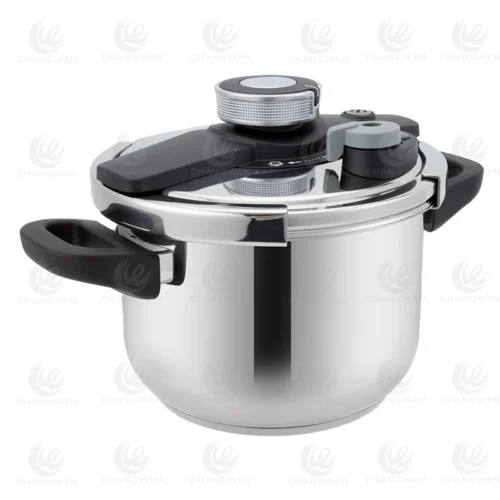
Large Pressure Cooker for Family Meals and Batch Cooking
-
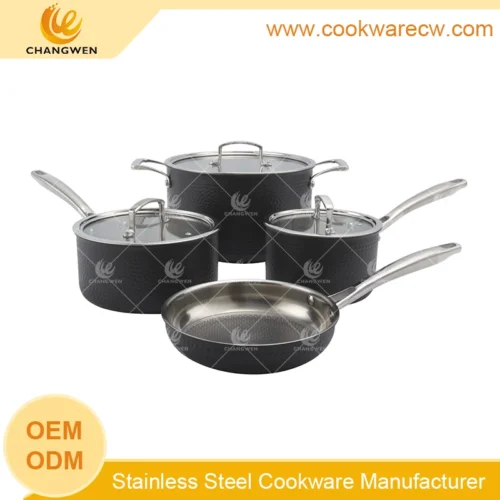
Black Hammered Stainless Steel Cookware Set CW-ETP0702
-
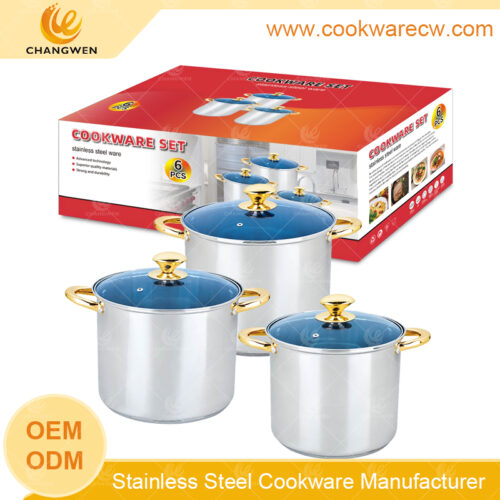
Large Stainless Cook Pot CW-M0607
-
6-Piece Stainless Steel Pot Set with Gold Handles CW-ES0610
-
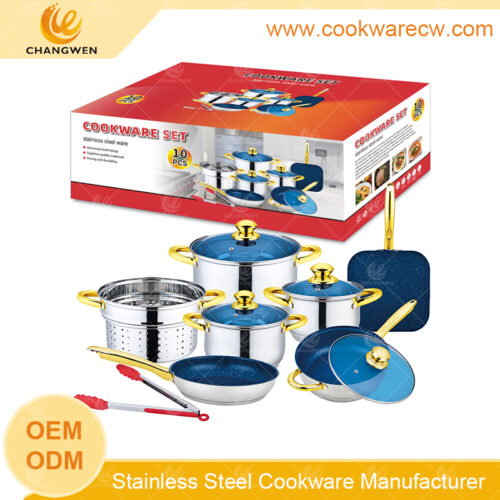
Stainless steel cookware set nonstick pans and pots casserole pot frying pan steamer with glass blue lid and a kitchenware clip CW-M1203
-
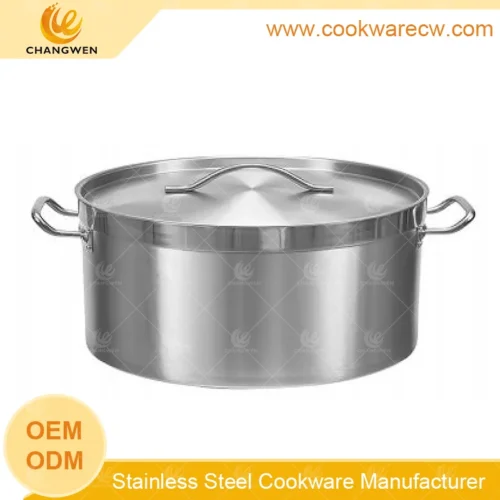
Stainless Steel Stock Pot CW-SP002
-
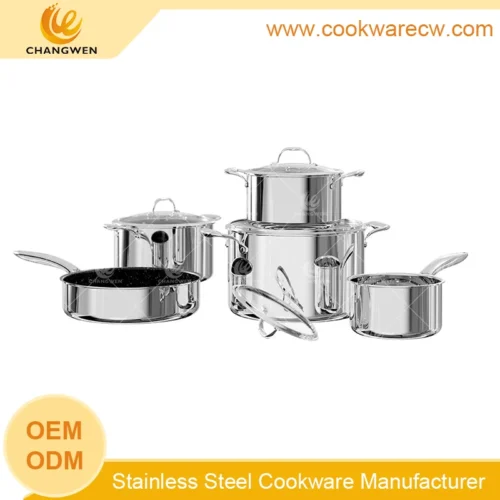
Complete Stainless Steel Cookware Set for Home & Commercial Use CW-TP0901
-
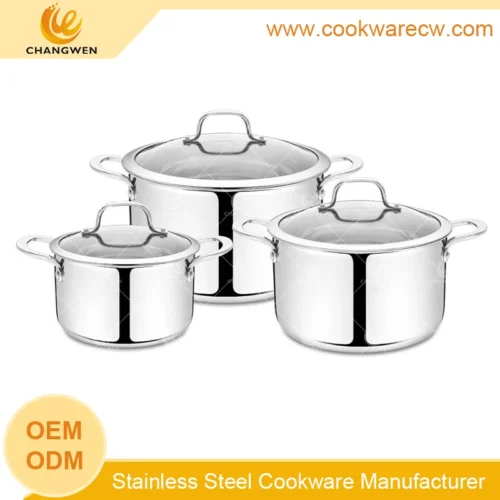
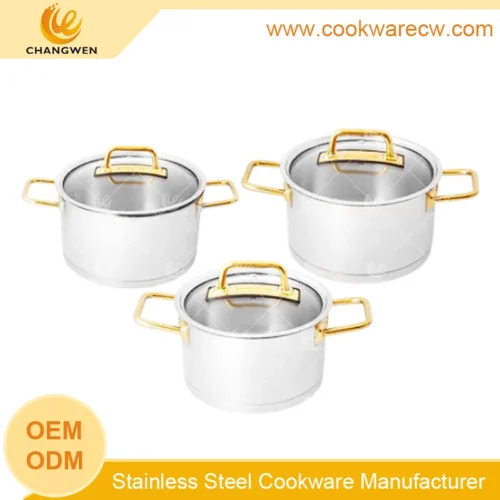
Premium Stainless Steel Pot Set for Home & Commercial Kitchens CW-TP0601