
Blog
Changwen is a leading cooking utensils manufacturers. We supply high quality stainless steel cooking pots and pans to all over the world. We can also customize the local hot-selling stainless steel pots and pans. Please send your requirements to Changwen.
What Is the Difference Between a Pot and a Pan?
Read time: 10 minutes
Introduction
You have been using the wrong vessel. Probably for years.
Not catastrophically wrong — the food came out fine. But there is a reason your pasta water keeps boiling over in the wide pan, and why your sauce never thickens properly in the tall pot. There is a reason your grandmother always grabbed the same vessel for the same dish. She knew something you were not told: the shape of the cookware changes what happens to the food inside it.
Pots and pans look similar — both are metal vessels that sit on a burner. But they are engineered for opposite purposes. A pot is designed to hold liquid in. A pan is designed to let things out — moisture, steam, everything that stands between your food and a proper sear. Once you understand that single principle, the confusing landscape of saucepans, skillets, sauce pots, and stock pots resolves into a clear set of tools, each with a job it does better than anything else.
This guide answers the question completely — including the confusing ones like whether a saucepan is a pot or a pan, what separates a skillet from a frying pan, and what POTS vs PANS disease has to do with any of this.
The Core Difference: One Rule That Explains Everything
A pot has tall, straight sides and two short loop handles. A pan has shallow sides and one long handle.
This sounds simple. The functional implication is profound.
Tall sides trap moisture. A tall-sided pot with a lid creates a sealed, humid environment. Evaporation is slow. Liquid stays in. This is exactly what you want when making stock, cooking beans, simmering soup, or poaching. The food benefits from sustained, moist heat over a long period.
Shallow sides release moisture. A shallow-sided pan with no lid exposes the food to open air. Moisture evaporates rapidly. This is exactly what you want when searing a steak, sautéing vegetables, reducing a sauce, or frying. The food browns instead of steams, because the moisture that would prevent browning is gone.
The handle design reflects the same logic. A long single handle gives you precise control over a lighter vessel that you might tilt, toss, or quickly move. Two short loop handles are for carrying heavy contents safely — a full stock pot can weigh 10 kilograms of liquid, and you want both hands gripping it close to your body.
Every piece of cookware in your kitchen is a variation on these two principles. Master the principle and the whole vocabulary suddenly makes sense.
Pot vs Pan vs Skillet: The Full Comparison
These three terms cover the most common cookware confusion. Here is the clearest breakdown:
A Pot
A pot has straight vertical sides that are taller than they are wide (or at least equal in height and width), two short handles, and is designed for cooking with significant volumes of liquid. Pots are used for anything that needs to stay wet: stocks, soups, stews, boiling pasta, braising. Their depth minimizes surface area relative to volume, which slows evaporation.
Common pot types: stock pot (largest, for high-volume liquid cooking), Dutch oven (heavy-walled, transfers from stovetop to oven), saucepot (medium volume, same two-handle configuration but smaller than a stock pot).
A Pan
A pan is shallow relative to its diameter, with a large cooking surface, sloped or straight sides, and one long handle. Pans are designed for cooking where surface contact with dry or lightly oiled heat matters — searing, sautéing, frying, browning. The large, open surface area allows moisture to escape quickly, which enables browning.
Common pan types: frying pan / skillet (sloped sides, open design, no lid standard), sauté pan (straight sides, lid included), crepe pan (very shallow), wok (steep sloped sides for tossing).
A Skillet
A skillet and a frying pan are different terms for the same thing. Both describe a shallow pan with sloped (not straight) sides, a flat bottom, a long handle, and no lid as standard. The sloped sides make it easy to flip or toss food and allow steam to escape efficiently. Skillets are ideal for searing, pan-frying, sautéing, and any technique where you want maximum food-to-surface contact and minimum moisture retention.
A skillet is slightly more versatile than a flat frying pan since it is generally deeper with a larger cooking surface, making it useful for both quick sears and shallow frying.
The key distinction between a skillet and a sauté pan: both are pans with one long handle, but a sauté pan has straight vertical sides (which retain more liquid) while a skillet has sloped sides (which let everything out). A sauté pan comes with a lid because it is sometimes used for braises and shallow cooking with liquid. A skillet typically does not.
What Is a Saucepan? (And Is It a Pot or a Pan?)
This is the question that confuses everyone, and the answer is genuinely both.
A saucepan is a deep, round cooking vessel with high straight sides, a flat bottom, a long handle, and usually a lid. It is deeper than a standard sauté pan or frying pan, but shallower than a stockpot. The diameter of a saucepan is smaller than its height in most configurations.
A saucepan is actually a pot in terms of its shape — it has straight vertical sides and is used for liquid-heavy cooking. But it has one long handle like a pan, which gives it the maneuverability of a pan. This hybrid design is exactly what makes a saucepan so useful: it is the precision tool for liquid cooking in small to medium quantities.
Saucepan uses span a wider range than most cooks realize:
- Making sauces. The tall sides prevent splatter during reduction; the long handle lets you tilt and stir continuously with control.
- Cooking grains. Rice, quinoa, oats, couscous — all benefit from the controlled steam environment a saucepan with a lid creates.
- Boiling pasta for small quantities. For 1-2 servings of pasta, a saucepan heats water faster than a full stock pot.
- Simmering soups. For individual or small-batch soup work, a saucepan is faster and more fuel-efficient than a large pot.
- Poaching. Poaching eggs, fish, or fruit requires enough depth to submerge the ingredient — a saucepan provides this without the excess volume of a full pot.
- Blanching vegetables. The saucepan depth fully submerges vegetables in boiling water for consistent, quick blanching.
A 2-quart saucepan suits most daily cooking tasks. It is large enough for reasonable portions but small enough to heat quickly and control easily.
Pot vs Sauce Pan: The Key Differences
A saucepan and a pot can look similar at first glance — both have straight sides and work with liquid. The differences matter:
| Feature | Saucepan | Pot (Stock Pot / Soup Pot) |
|---|---|---|
| Handles | One long handle | Two short loop handles |
| Capacity | Small to medium (1–7 quarts) | Medium to very large (8–30 quarts) |
| Height vs diameter | Taller than wide | Roughly equal or taller |
| Primary use | Precision liquid cooking | High-volume liquid cooking |
| Heat-up time | Fast | Slower (more mass) |
| Evaporation | Moderate — faster than a pot | Slow — tall walls minimize |
| Best for | Sauces, grains, small soups | Stocks, pasta for crowds, batch cooking |
The critical functional difference: in a saucepan, a sauce can thicken efficiently because the surface area is adequate for controlled evaporation. In a large stock pot, the same sauce reduces too slowly because the wide opening exposes too much liquid to heat while the depth means the sauce must travel farther to circulate. A sauce cooked in a stock pot will either take much longer to reduce or reduce unevenly.
Sauce Pot Uses: The Often-Confused Middle Ground
A sauce pot occupies the space between a saucepan and a stock pot. It has the same configuration as a stock pot — two loop handles, straight tall sides — but at a smaller scale, typically 4–8 quarts.
Sauce pot uses include slow-cooking sauces, stews, and soups that are too large for a saucepan but do not require the full volume of a stock pot. The two-handle design gives stability when the contents are heavy; the tall sides slow evaporation during multi-hour simmers.
A sauce pot is the right vessel when you are making a batch of Sunday tomato sauce for six people — not enough for a full stock pot, too much to control in a saucepan. The high walls protect a long-simmer sauce from the surface scorching that happens when a wide pan reduces liquid too aggressively.
When Does a Pan Become a Pot?
This is a real question that cooking philosophy people debate, and the practical answer is: when the ratio of depth to diameter crosses a threshold, and when the handle configuration shifts from one long handle to two short ones.
A shallow pan with straight sides and one handle is a sauté pan. The same form factor scaled up to greater depth — still one handle, still straight sides — becomes a saucepan. A saucepan with the handle swapped for two loop handles and the volume scaled up becomes a sauce pot. Scale that up further in height and you have a stock pot.
The functional principle that drives this transition is the handle configuration. A single long handle suggests a vessel light enough to lift and control with one hand. Two loop handles suggest a vessel that requires both hands to carry safely because of its weight when full. When a cooking vessel gets deep enough and wide enough that a single handle would be unsafe, it becomes a pot by necessity.
Size alone does not determine whether something is a pot or pan — a very large sauté pan is still a pan; a small sauce pot is still a pot. The combination of depth, volume, handle configuration, and intended use determines the category.
Can I Use a Pot as a Pan?
Sometimes yes, with awareness of the limitations.
A pot can replace a pan for:
- Boiling, simmering, and steaming — any technique that benefits from liquid retention
- Shallow frying in larger oil volumes (the depth is actually an advantage for safety)
- Braising, where the technique starts with searing and finishes with low liquid simmering
A pot cannot effectively replace a pan for:
- Searing or browning — the tall sides trap steam, and the food steams rather than sears. This is the most common mistake: trying to brown meat in a deep pot produces gray, steamed protein instead of a caramelized crust.
- Sautéing — the tall walls prevent moisture from escaping, which defeats the purpose of the technique
- Reduction — a wide pan reduces sauces faster and more evenly than a tall pot
The fundamental rule: using a pot when a pan is called for produces steamed food when you wanted browned food. The trapped moisture in a pot is the enemy of any technique that requires dry heat. When a recipe says “in a large skillet” or “in a wide pan,” it is specifically telling you not to use a deep pot.
5 Uses of Pots: When a Pot Is the Right Answer
Pots have specific uses where they genuinely outperform every other vessel:
1. Making stocks and broths. Long simmering (4–12 hours) extracts maximum flavor from bones, vegetables, and aromatics. The pot’s tall walls minimize evaporation over these long cooking times, preventing the stock from reducing too aggressively before the flavor extraction is complete.
2. Braising large cuts of meat. Braising starts with searing (which can be done in the pot or in a separate pan first) then slow-cooking in liquid. The pot’s depth accommodates large cuts — a whole shoulder of lamb, a brisket — and the lid creates the moist environment that makes the collagen in tough cuts break down into gelatin.
3. Boiling pasta for large quantities. Pasta needs to move freely in water to cook evenly and avoid sticking. A large pot provides the volume — typically 4–6 liters per 500 grams of pasta — and the depth to keep the pasta submerged and circulating.
4. Batch cooking soups and stews. Large-batch cooking for meal prep, catering, or family gatherings requires the volume that only a proper stock pot or large soup pot provides. Trying to make soup for eight people in a saucepan requires multiple batches and produces inconsistent results.
5. Home canning and preserving. Canning requires fully submerging sealed jars in boiling water. The depth of a large stock pot — typically 30cm or more — accommodates tall jars with adequate water coverage above them, which is essential for proper heat penetration and seal formation.
FAQ
What is the main difference between a pot and a pan?
A pot has tall, straight sides and two short loop handles, designed to hold large volumes of liquid and minimize evaporation during long cooking. A pan has shallow sides and one long handle, designed to expose food to open heat for browning, searing, and sautéing. The height of the sides determines how much moisture stays in the vessel — tall sides trap it, shallow sides let it escape. This single difference determines which tool is correct for any given cooking task.
Is a saucepan a pot or a pan?
A saucepan is both — it has the straight sides and liquid-cooking function of a pot, but the single long handle of a pan. It is designed for small-to-medium quantity liquid cooking (sauces, grains, small batches of soup), where the precision control of a long handle is more useful than the two-handle stability of a full pot. Most dictionaries describe it as a pan; most cooks treat it as a small pot.
What is a skillet and how is it different from a frying pan?
A skillet and a frying pan are different terms for the same piece of cookware — a shallow vessel with sloped sides, a flat bottom, and one long handle. Both are used for searing, sautéing, and frying. The sloped sides of both allow moisture to escape and make it easy to flip food. The distinction between skillet and frying pan is terminology, not function.
When should I use a pot instead of a pan?
Use a pot when cooking with large volumes of liquid over long periods (stocks, soups, boiling pasta), when you need to fully submerge ingredients in liquid, or when batch-cooking large quantities. Use a pan when you want the food to brown — any technique that requires moisture to escape rather than accumulate (searing, sautéing, reducing sauces). The simple rule: moisture in = pot; moisture out = pan.
Can I use a pot as a pan?
For boiling and simmering tasks, yes. For browning, searing, and sautéing, no. A pot’s tall sides trap moisture and steam, which prevents the browning that searing and sautéing require. Trying to sear protein in a deep pot produces gray, steamed food instead of a caramelized crust. If a recipe specifically calls for a pan or skillet, use one — the shape choice is a technical instruction, not a suggestion.
What are the five main uses of pots?
Pots are best used for making stocks and broths (long-simmer extraction), braising large meat cuts, boiling pasta in large volumes, batch-cooking soups and stews, and home canning and preserving. All five uses share the same requirement: large liquid volume and slow, sustained cooking where evaporation must be controlled rather than maximized.
Conclusion
A pot is designed to keep moisture in. A pan is designed to let moisture out. Everything else — the handle configuration, the depth, the shape of the sides — follows from this single engineering principle.
A saucepan is a hybrid: pot-shaped but pan-handled, sitting in the middle of the spectrum as the most versatile piece of cookware in any kitchen. A skillet is a frying pan by another name. A sauce pot is a medium-scale version of a stock pot. A sauté pan is a pan that has borrowed a lid and some straight sides from pot-world.
Once you understand what each shape is doing to the food inside it — trapping or releasing moisture, concentrating or dispersing heat — you will stop reaching for the wrong vessel. And you will discover that recipes actually work when the cookware matches the technique.
About Changwen
Changwen is a stainless steel cookware manufacturer based in Jiangmen, Guangdong, China, with over 22 years of OEM and ODM experience. We produce the full range of pots and pans described in this guide: stainless steel stock pots, saucepans, sauce pots, sauté pans, frying pans, steamer pots, and pressure cookers for brands and distributors across South America, Southeast Asia, the Middle East, Europe, and North America.
Popular Blog
Aluminum Pressure Cooker: A Practical Buying Guide
How much does a three-layer steamer cost and how to choose one?
Top Quality China Cookware: Discover the Best Pots and Pans
Why choose 180/8 material for stainless steel cookware?
2026 Top 10 Cookware Manufacturers in China
What are 3-ply 5-ply and 7-ply cookware?
Honeycomb Cookware Ultimate Buying Guide
Is it difficult to clean the stainless steel pot after it is charred?
How to use the stainless steel pot and make it more useful?
Tags
Recommend Products
-
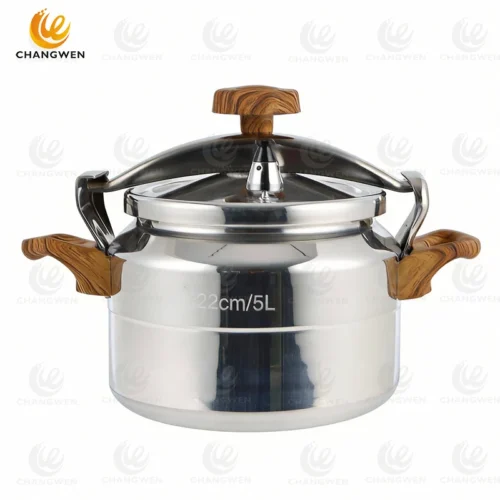
Pressure Cooker Stainless Steel for Healthy Cooking
-
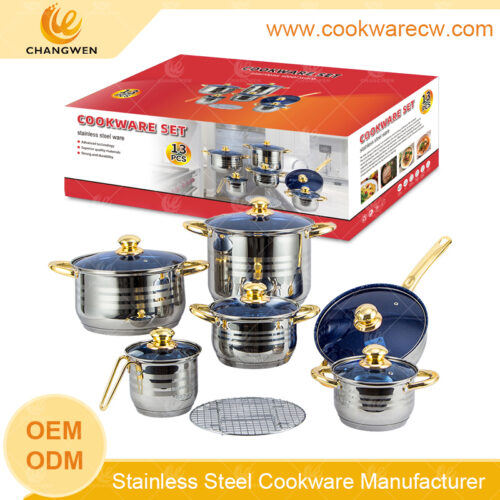
Wholesale price stainless steel pots and pans streamer rack cookware set coating inside golden wire handle milk pot with blue glass lid CW-M1304
-
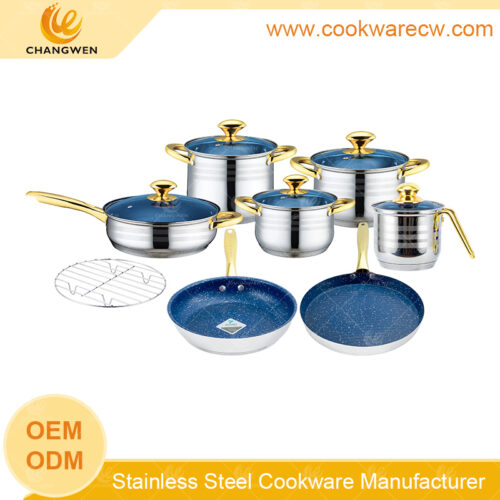
Best Tri Ply Stainless Steel Cookware
-
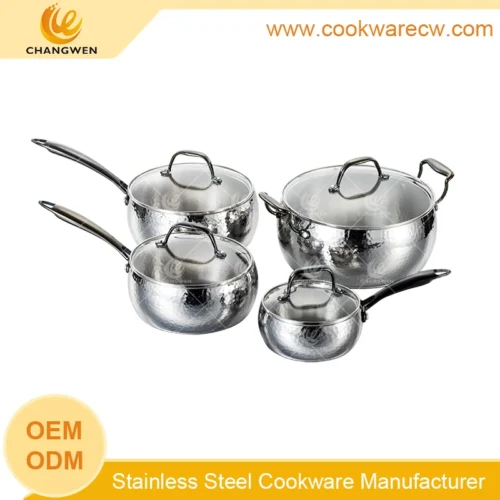
Apple-Shaped Hammered Stainless Steel Cookware Set CW-TP0802
-
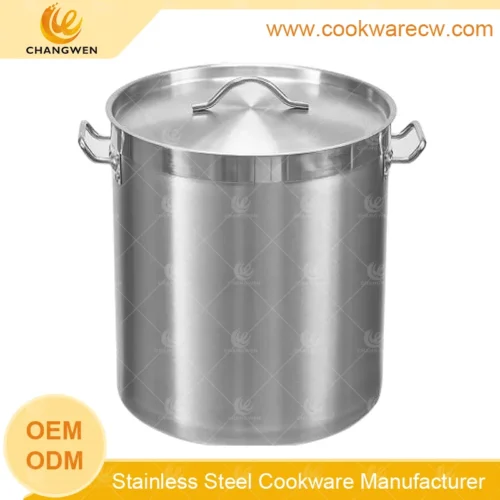
Wholesale Large Stock Pot CW-SP001
-
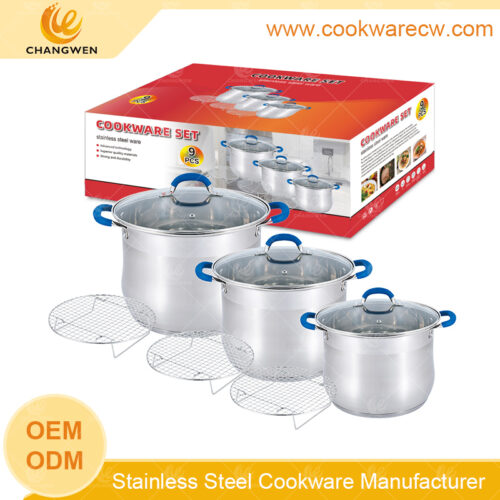
heavy weight stainless steel stock pots set with tube handles & knobs covered silicon wire steamers kitchenware manufactured in China CW-M0902
-
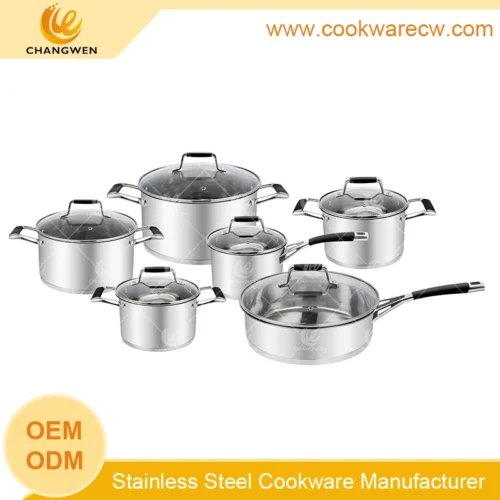
Premium 12-Piece Stainless Steel Cookware with Black Handles CW-ES1204G
-
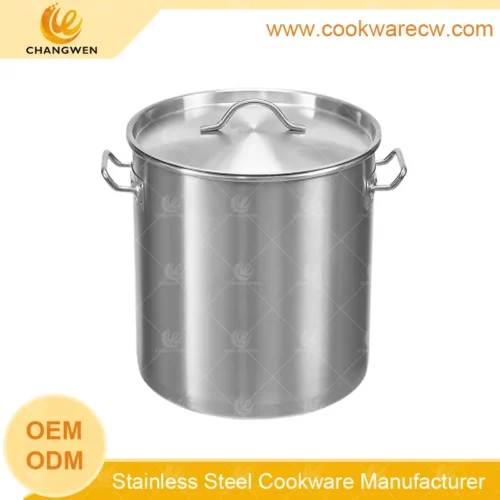
Stainless Steel Large Cook Pot CW-SP001