
Read time: 10 minutes
Introduction
Hammered cookware is one of the fastest-growing aesthetic categories in kitchenware retail. Consumers who have lived with smooth brushed stainless steel for a decade are reaching for something different — something that looks handcrafted, artisanal, and premium. Hammered pots and pans are selling at price points significantly above their functional equivalents in standard finishes.
For cookware importers, distributors, and brand owners, that retail premium is the opportunity. The question is: how do you source it properly?
Hammered finish cookware is not a single category. It spans stainless steel, carbon steel, aluminum, and copper. It includes machine-applied industrial texture and genuinely hand-forged artisan pieces. The construction, care requirements, and performance characteristics differ significantly by material. The OEM/ODM options available to importers depend entirely on which category they are building for.
This guide covers everything: what hammered cookware actually means, the main materials and their trade-offs, how the hammered texture is applied and what it does functionally, what OEM and ODM options are available, and how to evaluate a hammered cookware manufacturer.

Key Takeaways
- Hammered cookware meaning: A surface treatment where the metal is worked with a hammer — either by hand or machine — to create a distinctive dimpled or textured surface. The technique is both aesthetic and functional.
- Hammered stainless steel cookware is the most commercially accessible hammered category for importers. Machine-hammered finish is available from most established cookware factories at standard OEM minimums.
- Hammered carbon steel cookware — particularly the hammered wok — is the most performance-oriented hammered category. The texture aids seasoning adhesion and reduces sticking.
- Hammered cream cookware and other color finishes are applied via powder coating or enamel over a hammered base, and are currently among the fastest-moving aesthetics in Western home kitchen retail.
- A cookware factory capable of producing quality hammered stainless steel cookware sets will have mechanical texture equipment, polishing lines for the non-textured areas, and experience managing the finish consistency required for retail products.
- MOQ for hammered stainless steel cookware sets from established OEM manufacturers starts at 1,000 units for existing tooling programs.
What Does Hammered Cookware Mean?
Hammered cookware means the metal surface has been textured through a hammering process — creating a pattern of concave dimples or irregular deformations across some or all of the cooking vessel’s exterior, interior, or both.
The technique originated in traditional metalworking. Hand-hammered woks and pots have been produced in China and across Asia for centuries. The Zhang Qiu district in Shandong province has a documented tradition of hand-forged carbon steel wok production stretching back through the Qing Dynasty. Traditional craftsmen strike a heated steel disc thousands of times with a specialized hammer to form the shape and create the characteristic texture.
Modern production uses both methods:
Hand hammering: Each piece is individually worked by a craftsperson. Produces unique, non-repeating texture. Extremely labor-intensive. Pricing reflects the craft investment. Primarily relevant for artisan market segments and high-end copper cookware.
Machine hammering: A mechanical press applies a textured die to the metal surface, replicating the hammered appearance with consistent, repeatable patterns. Standard production process for commercial-scale hammered stainless steel cookware sets. Efficient and cost-effective. The texture is consistent across production batches — important for retail presentation where every piece in a set must match.
For most cookware importers building a brand, machine-hammered OEM products are the practical commercial option. Hand-hammered products occupy a specific artisan segment with different pricing, marketing, and supply chain requirements.
The Four Main Materials for Hammered Cookware
1. Hammered Stainless Steel Cookware
This is the most commercially significant category for importers. Hammered stainless steel cookware sets — pots, pans, saucepans, frying pans, and complete sets — are the dominant hammered category in EU, North American, Middle Eastern, and Latin American retail.
Construction options:
- Single-layer with composite disc base: Stainless steel body with multi-layer aluminum disc bonded to the base. Standard for mid-range hammered cookware. The hammered texture is applied to the exterior.
- Tri-ply full-clad (304-aluminum-430): Three bonded layers running through base and sidewalls. The food contact surface (304 inner layer) is typically smooth. The exterior 430 layer carries the hammered finish.
What the hammered finish does on stainless:
Functionally, the hammered exterior texture on stainless steel cookware has limited performance effect — it is primarily aesthetic. The cooking surface (304 inner layer) is smooth. The heat distribution depends on the construction (disc base or tri-ply), not the exterior finish.
Aesthetically, the hammered finish creates a distinctive premium appearance that photographs well, presents well at retail, and commands higher prices than equivalent smooth-finish cookware. For e-commerce brands where product photography is a primary sales driver, hammered stainless steel is a high-return aesthetic investment.
Available OEM options: Machine-hammered exterior on standard cookware shapes. Multiple pattern options — coarse dimple, fine dimple, irregular artisan-style, geometric patterns. Typically combined with brushed or mirror-polished interior surfaces and smooth or brushed handle finishes.
2. Hammered Carbon Steel Cookware
Hammered carbon steel is the performance-oriented hammered category. The hammered wok is the flagship product — and genuinely functional, not just aesthetic.
Why the hammered texture matters in carbon steel:
Carbon steel cookware relies on seasoning — a polymerized oil layer built up through cooking — to develop non-stick properties and corrosion resistance. The hammered dimples in a carbon steel wok or pan create microscopic surface area that holds seasoning more effectively than a smooth surface. The texture literally improves the pan’s performance over time: a well-seasoned hammered carbon steel wok develops a more robust, even patina than a smooth equivalent.
Additionally, for stir-frying techniques, the textured surface creates micro-turbulence in the oil layer that some chefs believe enhances wok hei — the characteristic smoky, high-heat flavor produced in professional wok cooking.
Care requirements for hammered carbon steel: Carbon steel requires seasoning and specific maintenance. It will rust if not dried properly after washing. It should not be soaked in water or put in a dishwasher. It improves with use — the more you cook in it, the better it performs. These care requirements must be communicated clearly in retail packaging and instructions.
OEM options: Hammered carbon steel woks, frying pans, and skillets are available from manufacturers in the major carbon steel production regions of China. Thickness typically ranges from 1.5mm to 2.5mm; thicker gauge provides better heat retention but increases weight.
3. Hammered Stainless Steel Cookware Sets — Premium Configurations
For the premium retail segment, hammered stainless steel cookware sets in larger configurations (8-piece, 10-piece, 12-piece) are a strong commercial category. A hammered cookware set 12 pc at a premium retail price point is a common high-value SKU for cookware brands targeting weddings, upscale houseware retail, and premium gifting.
The key specifications for premium hammered stainless sets:
- Interior: Smooth 304 stainless steel (18/8 or 18/10), food-grade
- Exterior: Machine-hammered 430 stainless steel
- Construction: Tri-ply full-clad for premium positioning; disc base for mid-range
- Handles: Cast stainless steel (oven-safe) or premium silicone-coated handles
- Lids: Stainless steel lids with hammered finish to match, or glass lids with stainless rim
4. Hammered Cream Cookware and Color Finishes
Hammered cream cookware — and hammered cookware in colors including matte black, sage green, slate blue, and terracotta — is one of the fastest-growing segments in the Western home kitchen market. The combination of artisanal hammered texture with contemporary matte color creates an aesthetic that performs exceptionally well in social media-driven retail channels.
How it is made:
The base pan (typically steel or aluminum) is machine-hammered to create the textured surface, then powder-coated or enamel-coated in the desired color. The coating fills the dimples partially, creating a three-dimensional visual effect where the hammered texture interacts with the color.
Important specification consideration: Powder coating and enamel have temperature limitations and durability considerations distinct from stainless steel. For any hammered color cookware program, specify:
- Coating type and thickness (powder coat vs enamel vs PTFE non-stick over hammered base)
- Maximum oven temperature rating
- Induction compatibility (requires magnetic base material)
- Dishwasher safety (powder-coated finishes typically require hand washing)
- Chip and scratch resistance testing
Hammered Cookware Performance: What Actually Changes?
A question every importer should be able to answer for their retail buyers: does the hammered texture affect cooking performance?
For stainless steel cookware: The hammered exterior finish does not affect cooking performance. Heat distribution, cooking surface reactivity, and cleaning behavior are determined by the construction (tri-ply vs disc base) and inner surface material, not the exterior texture. The hammered finish on stainless steel is a pure aesthetic decision.
For carbon steel cookware: The hammered texture is genuinely functional. It increases the micro-surface area of the metal, improving seasoning adhesion and creating a more durable non-stick patina over time. Traditional hand-forged hammered woks are prized by professional Chinese chefs specifically for the cooking quality of a well-seasoned hammered surface.
For copper cookware: Traditional hand-hammered copper is both aesthetic and structurally functional — the hammering work-hardens the copper, increasing strength and resistance to deformation. The texture is also part of the traditional craft identity of this category.
OEM/ODM Hammered Cookware: What Is Actually Available?
Standard ODM (Catalog Selection)
Most established cookware factories have hammered finish products in their ODM catalog — meaning the tooling, texture dies, and production processes already exist. You select the product, specify branding (logo engraving, custom packaging, handle color selection) and place an order.
Standard catalog availability:
- Hammered exterior stainless steel cookware sets (various piece counts)
- Hammered wok in carbon steel or stainless steel
- Individual hammered pans: frying pan, saucepan, sauté pan, stock pot
- Hammered cream and color cookware on aluminum or steel base
OEM Customization Options
Beyond selecting from existing catalog products, OEM customization for hammered cookware includes:
Texture pattern selection: Most factories offer multiple hammer pattern options — coarse artisan-style, fine uniform dimple, geometric or honeycomb pattern, mixed texture zones. The texture die is existing tooling so no new tooling investment is required to select between available patterns.
Color and finish: Hammered stainless in brushed, mirror, matte, or PVD color (black, gold, rose gold). Hammered color cookware via powder coat or enamel in any specified Pantone color.
Handle customization: Handle shape, material, and color selection. Available handle options (silicone, cast stainless, Bakelite, wood for specific products) without new tooling. Custom handle shapes require tooling investment.
Logo application: Laser engraving on the exterior, embossing on the handle, or printed label. Laser engraving on hammered surfaces requires adjustment for the uneven surface — confirm with factory that their engraving equipment handles this.
Packaging: Full custom retail packaging — box design, hang tags, care instruction cards.
Set composition: Configure which pieces constitute your set. A hammered cookware set does not have to follow factory defaults — specify exactly which pieces and sizes you need.
Custom ODM/OEM (New Tooling)
For brands seeking proprietary hammered cookware products that competitors cannot replicate, custom tooling programs are available:
- Proprietary texture die (creates a unique hammer pattern exclusive to your brand)
- Custom handle shape or silhouette
- Non-standard vessel shapes or dimensions
Custom tooling requires upfront investment ($3,000–$15,000 per tool depending on complexity), higher MOQ to amortize the cost, and 4–6 additional weeks of lead time for tool development and sample approval.
Hammered Steel: Technical Specifications to Verify
For any hammered cookware OEM program, confirm these specifications in writing:
Material grade:
- Inner cooking surface: 304 stainless steel (18/8) for food contact
- Outer hammered layer: 430 stainless steel for induction compatibility
- Carbon steel: specify thickness and grade (typically SAE 1020 or equivalent)
Construction:
- Full-clad tri-ply (layers through sidewalls) or disc base — specify explicitly
- Total wall thickness in mm
- Disc thickness and composition for disc-base products
Texture specification:
- Pattern type and depth (shallow vs deep hammer marks)
- Coverage area (exterior only, or interior texture for carbon steel)
- Consistency standard — how much variation between pieces is acceptable
Surface finish at non-hammered areas:
- Interior: smooth brushed or polished
- Handle: brushed, mirror, or matte
- Lid rim and knob finish
Certifications:
- LFGB (EU food contact standard)
- FDA (US food contact compliance)
- ISO 9001 (manufacturing quality management)
For hammered color cookware:
- Coating type, thickness, and temperature rating
- PFOA-free / PFAS-free certification for any non-stick coating
- Dishwasher safety rating
How to Evaluate a Hammered Cookware Factory
Not every cookware factory produces hammered finishes well. The process requires specific texture equipment and experience managing finish consistency at scale. Here is how to evaluate a factory’s capability before committing to an order.
Request samples of their existing hammered products. Evaluate: texture consistency across the surface, texture uniformity between pieces, sharpness and depth of the hammer marks, finish quality at transitions between hammered and smooth areas, logo engraving quality on the hammered surface.
Ask about texture die inventory. How many hammer patterns do they have available? Factories with invested tooling in hammered textures have experience in this specific finish. A factory that offers one basic pattern as their only hammered option has limited depth in this category.
Verify material traceability. Hammered finish should not change your material verification requirements. Request mill certificates confirming 304 stainless inner layer grade. Hammered exterior finish does not change what the food contacts.
Check certifications. LFGB, FDA, ISO 9001. For color cookware, request PFOA-free and PFAS-free certificates for any coating.
Confirm QC process for texture consistency. How does the factory measure texture consistency? What are the rejection criteria for surface defects? A hammered surface creates more opportunity for defects (deep marks that penetrate through, uneven pattern, scratching during production) than a standard polished finish.
Review packaging capability. Premium hammered cookware requires packaging that communicates the premium. Confirm the factory can produce custom packaging — or that they have reliable packaging suppliers they work with.
Hammered Cookware: Market and Positioning
Understanding the retail context helps importers position and price hammered cookware correctly.
Who buys hammered cookware:
The hammered cookware consumer is buying primarily on aesthetics. They want a kitchen that looks designed. The hammered texture signals handcraft, quality, and non-mass-production — even when the product is machine-made. This consumer is willing to pay a 30–60% premium over smooth-finish equivalents.
Where hammered cookware sells best:
- Premium houseware retail (both in-store and online)
- Wedding registry and gifting
- Interior design-adjacent retail (home furnishings stores, lifestyle boutiques)
- E-commerce with strong product photography
- Social media-driven consumer brands where visual differentiation drives discovery
Seasonal and trending notes (2026):
Hammered cream cookware sets are currently among the fastest-moving aesthetics in UK, EU, and Australian home kitchen retail. Sage green, slate, and warm neutrals follow closely. For North American retail, hammered black and hammered stainless remain strong, with color hammered growing rapidly in the under-35 buyer demographic.
FAQ
What does hammered mean in cookware?
Hammered cookware refers to a surface treatment where the metal body has been worked with a hammer — either by hand or machine — creating a distinctive pattern of dimples or concave marks. In stainless steel cookware, the hammered finish is primarily aesthetic. In carbon steel cookware (particularly woks), the hammered texture is also functional — it creates surface area that holds seasoning better and develops a more durable non-stick patina over time.
What is the difference between hammered stainless steel cookware and regular stainless steel cookware?
The primary difference is aesthetic. The cooking performance of hammered stainless steel cookware is determined by the construction (tri-ply vs disc base) and inner surface material, not by the exterior hammered finish. Both hammered and smooth stainless steel cookware with the same tri-ply construction perform identically. The hammered exterior commands a retail premium due to its premium visual appearance.
Is hammered carbon steel cookware good?
Yes — and the hammered texture is a genuine functional benefit, not just aesthetic. The dimpled surface created by hammering creates better adhesion for the seasoning layer that carbon steel cookware relies on for non-stick performance and rust resistance. A well-seasoned hammered carbon steel wok or skillet performs better over time than a smooth equivalent.
What is hammered cream cookware?
Hammered cream cookware refers to cookware with a hammered metal base (typically steel or aluminum) that has been powder-coated or enameled in a cream or off-white color. The combination of hammered texture and warm matte color has become one of the most popular aesthetics in contemporary home kitchen retail. It is primarily an aesthetic product — performance depends on the underlying construction and any cooking surface treatment, not the color finish.
What is the minimum order quantity for OEM hammered cookware?
For catalog hammered stainless steel cookware with OEM branding (logo, custom packaging), most established cookware factories work from 1,000 units per item. Hammered carbon steel woks may have similar or higher MOQs depending on production method. Custom texture pattern tooling programs require higher minimums to amortize tooling investment.
Can the hammered finish be applied to any cookware shape?
The machine hammering process is applied before forming in some cases, and after forming in others, depending on the geometry. Flat surfaces and gently curved surfaces take hammered texture most cleanly. Deep vessel shapes may have texture depth variation from the forming process. Request samples of your specific product shape to verify texture consistency before committing to a production order.
Is hammered cookware dishwasher safe?
For hammered stainless steel: technically dishwasher safe, but hand washing is recommended to preserve the surface finish long-term. For hammered carbon steel: not dishwasher safe — carbon steel must be dried immediately after washing to prevent rust. For hammered color cookware with powder coat or enamel: typically hand wash only to prevent coating degradation.
Conclusion
Hammered cookware is not a trend that will fade. The aesthetic addresses a durable consumer desire for kitchenware that looks crafted rather than mass-produced. As long as that desire exists — and it is not going away — hammered cookware sets will command the retail premium that makes the sourcing investment worthwhile.
For importers, the opportunity is straightforward: find a cookware factory with genuine hammered finish capability, specify the right construction for your market, and build a brand story that connects the visual quality to real performance credentials.
Machine-hammered stainless steel cookware is accessible, commercially proven, and available from established OEM manufacturers at standard minimums. Hammered carbon steel woks are a performance category with strong positioning. Hammered color cookware is a growing category with significant e-commerce upside.
The differentiation between brands in this space comes down to material specification, finish quality, and packaging — not which factory they use. Get all three right.
Source Hammered Cookware with Changwen
Changwen is a stainless steel cookware manufacturer based in Jiangmen, Guangdong, China, with over 22 years of OEM and ODM experience. We produce hammered stainless steel cookware sets, hammered woks, frying pans, stock pots for brands and distributors across South America, Southeast Asia, the Middle East, and Europe.
Available hammered finish options include machine-hammered exterior in multiple pattern depths, PVD color over hammered stainless, and powder-coat color over hammered steel base. Full OEM capability: custom logo, packaging design, set composition. Contact us for a quote
-
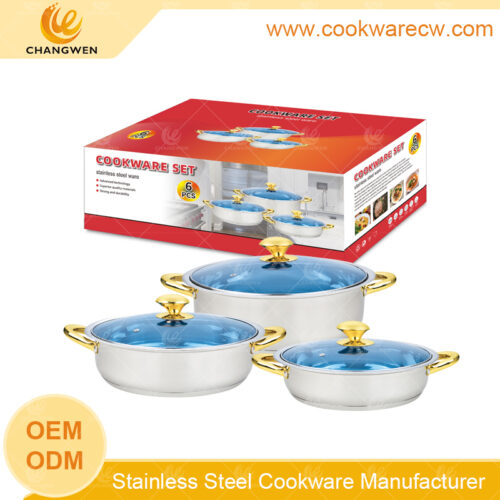
Stainless Steel Cook Pot Set CW-M0606
-
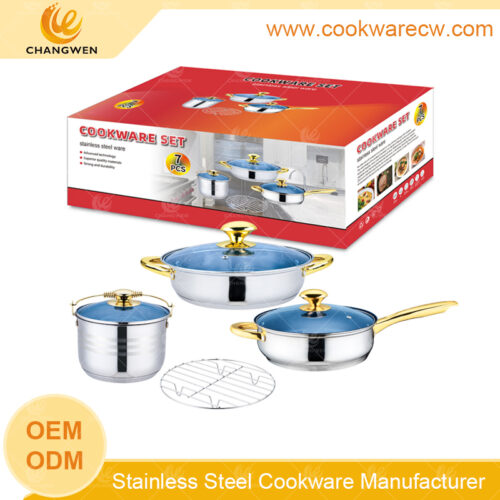
Stainless steel kitchen 7pcs cookware rice cooker with capsule bottom frypan with helper gold plated hollow handle and blue glass wire rack CW-M0701
-
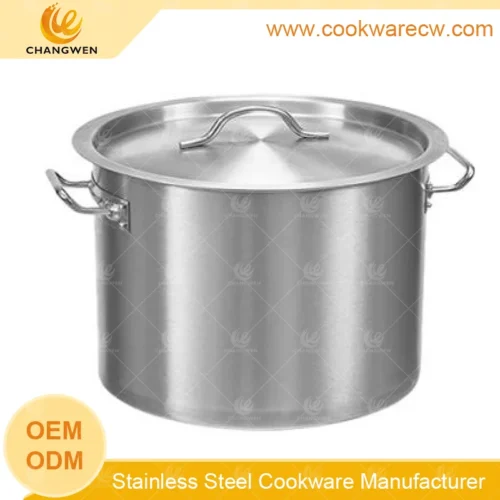
Stainless Steel Stock Pot For Restaurants CW-SP002
-
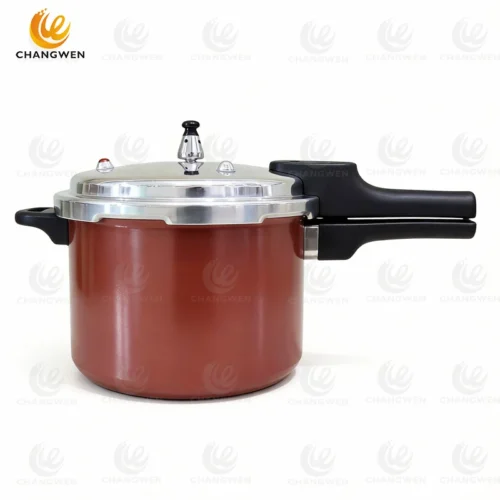
Pressure Cooker Aluminum – Single-Hand Rotation & Safety
-
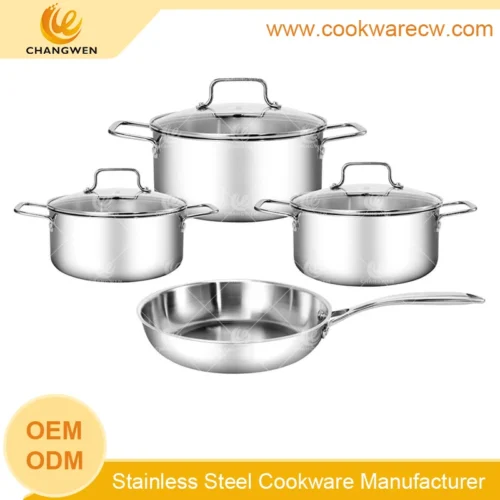
Premium Stainless Steel Cookware Set for Modern Kitchens CW-ETP0703
-
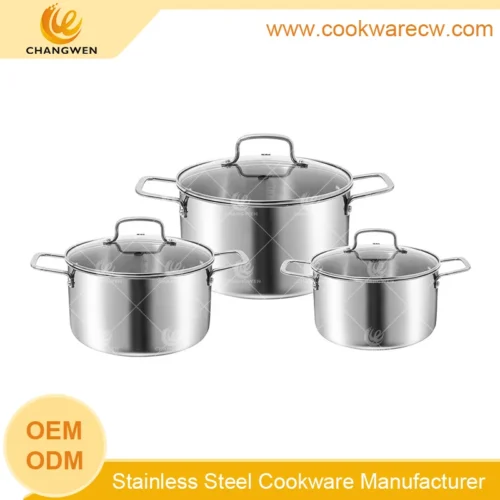
Stainless Steel Pot Set for Professional Cooking Performance CW-TP0605
-
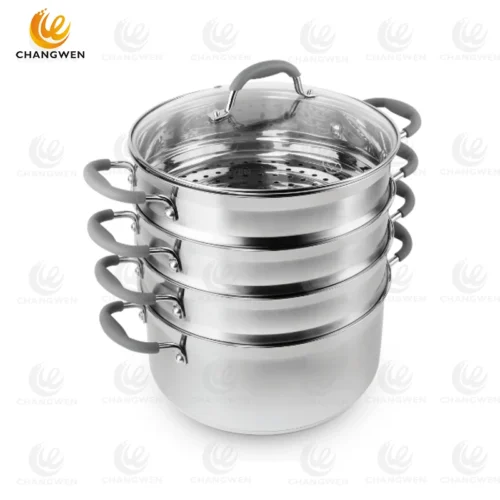
Stainless Steel Steamer Pot for Home and Commercial Kitchens CW-ES034
-
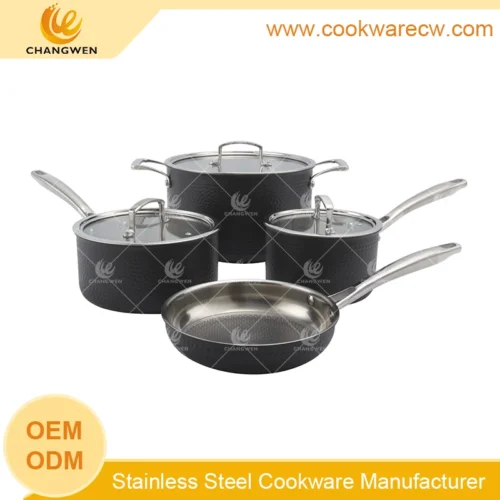
Black Hammered Stainless Steel Cookware Set CW-ETP0702