Introduction
When sourcing stainless steel cookware for your brand, understanding the difference between construction types is one of the most important decisions you’ll make. The wrong choice doesn’t just affect performance — it directly determines your price point, your target market, and whether your product will sell.
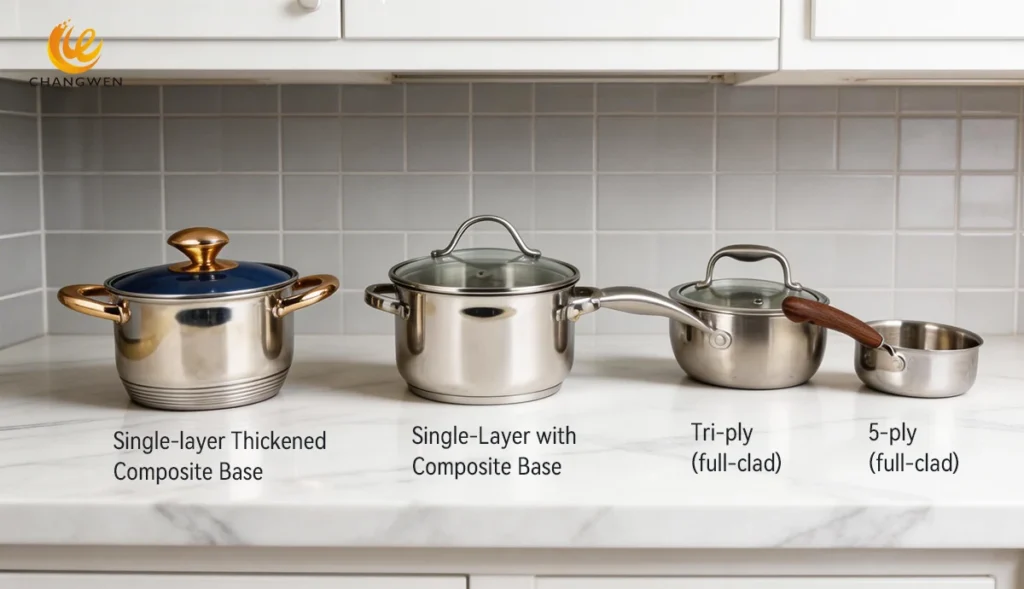
There are three main constructions you’ll encounter when working with a stainless steel cookware manufacturer:
- Single-layer with composite base— the entry to mid-range standard for most markets
- Tri-ply (full-clad)— a genuine premium product, with meaningfully higher performance and price
- 5-ply— ultra-premium, rarely ordered, reserved for the highest-end segment
As a manufacturer with over 22 years of experience producing all three constructions for brands across South America, Southeast Asia, the Middle East, Europe, and North America, this guide gives you the honest factory perspective on what each construction actually means for your business.
Key Takeaways
- Single-layer with composite base is the dominant construction for South American markets — cost-effective and well-matched to regional buyer expectations.
- Tri-ply is a genuine premium product. It costs significantly more than single-layer composite base cookware and is the standard for US, European, and higher-end Asian markets.
- 5-ply is 9–10 times more expensive than tri-ply at the factory price level. Almost no buyers order it. It is only relevant for ultra-premium brand positioning.
Construction Type 1: Single-Layer with Composite Base
This is the most common stainless steel cookware construction in the world by volume. It consists of a single layer of stainless steel for the body of the pot or pan, with a separate multi-layer disc bonded to the base.

What the composite base looks like:
- Outer layer: stainless steel (201/304) thickness 1.2-2.0mm
- Core: aluminum (for heat distribution) thickness 0.5mm
- Magnetic layer: stainless steel (430, required for induction compatibility) thickness 1.5-2.0mm
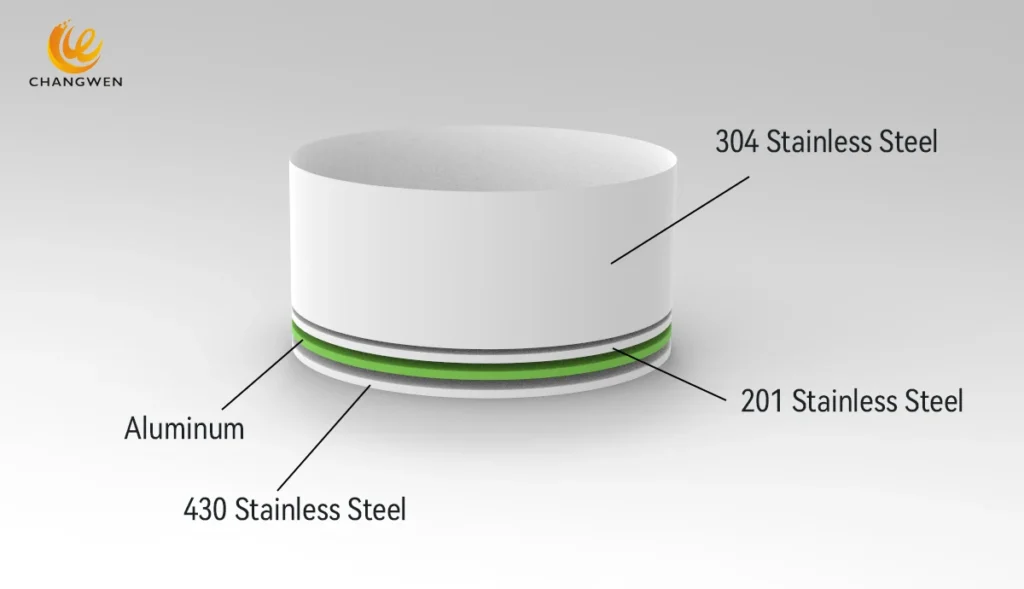
The composite base solves the core weakness of single-layer stainless steel — uneven heat distribution at the bottom — by using an aluminum disc to spread heat across the cooking surface. The sides of the pan, however, remain single-layer stainless steel.
This is the dominant construction in South America. Buyers in Brazil, Chile, Colombia, and Argentina typically specify single-layer cookware with a composite base — either a standard three-layer disc or an extra-thick version for improved heat retention. The pan body is usually 201 or 304 stainless steel.
Strengths:
- Significantly lower production cost than tri-ply
- Good heat distribution at the base
- Works on induction (due to 430 magnetic layer in the base disc)
- Well-matched to price expectations in South American markets
Limitations:
- Heat does not distribute up the sides of the pan
- Thinner sidewalls compared to full-clad tri-ply
- Not positioned as a premium product in discerning markets
Construction Type 2: Tri-Ply (Full-Clad)
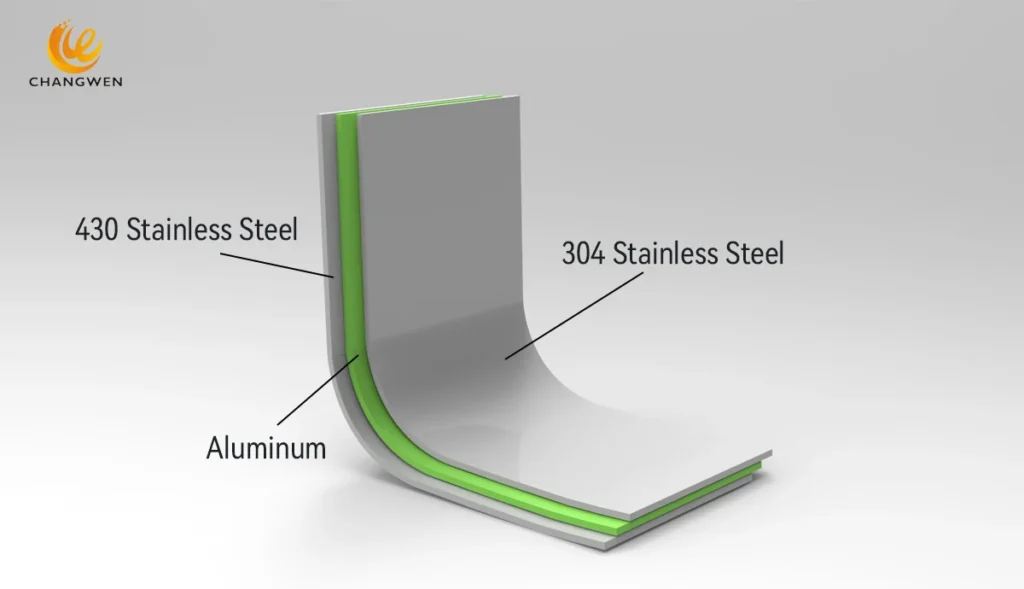
Tri-ply is a fundamentally different product from single-layer with composite base. The three layers — stainless steel, aluminum, stainless steel — run continuously through the entire body of the pan, from base to rim. This is what “full-clad” means.

The result: heat distributes evenly not just across the bottom, but up the sides of the pan. This matters for sautéing, reducing sauces, and any cooking where food contacts the sidewalls.
Tri-ply is a premium product. The production process is more complex, raw material costs are higher, and the finished product commands a significantly higher price than single-layer composite base cookware. If you are selling tri-ply, you are selling a high-end product and should price and market it accordingly.
Material Grade: The Industry Standard Is 304 – Aluminum – 430
Tri-ply cookware uses the same material specification across all markets: 304 stainless steel (18/8) on the inner cooking surface, an aluminum core, and 430 stainless steel on the outer layer. This is the global standard regardless of whether you are selling in Southeast Asia, the US, or Europe.
Why 304 on the inside? 304 stainless steel offers excellent corrosion resistance, is dishwasher safe, and meets international food safety standards including LFGB (EU) and FDA (US). It is the appropriate grade for any food-contact surface.
Why 430 on the outside? 430 stainless steel is magnetic, which is essential for induction cooktop compatibility. 304 is non-magnetic, so the outer layer must use 430 to ensure the pan works on induction.
Why aluminum in the core? Aluminum conducts heat approximately five times better than stainless steel. The aluminum core is what gives tri-ply its defining characteristic: even heat distribution across the entire cooking surface and up the sides of the pan.
This 304-aluminum-430 construction is what makes tri-ply a genuine premium product, and it is the same specification whether the pan ends up in a kitchen in Bangkok, São Paulo, or Berlin.
Tri-Ply Specifications to Confirm With Your Manufacturer
- Inner layer: 304 stainless steel
- Outer layer: 430 stainless steel (for induction compatibility)
- Total wall thickness (we recommend 2.6mm minimum for quality positioning)
- Full-clad confirmation — the layers must run up the sides, not just the base
Construction Type 3:
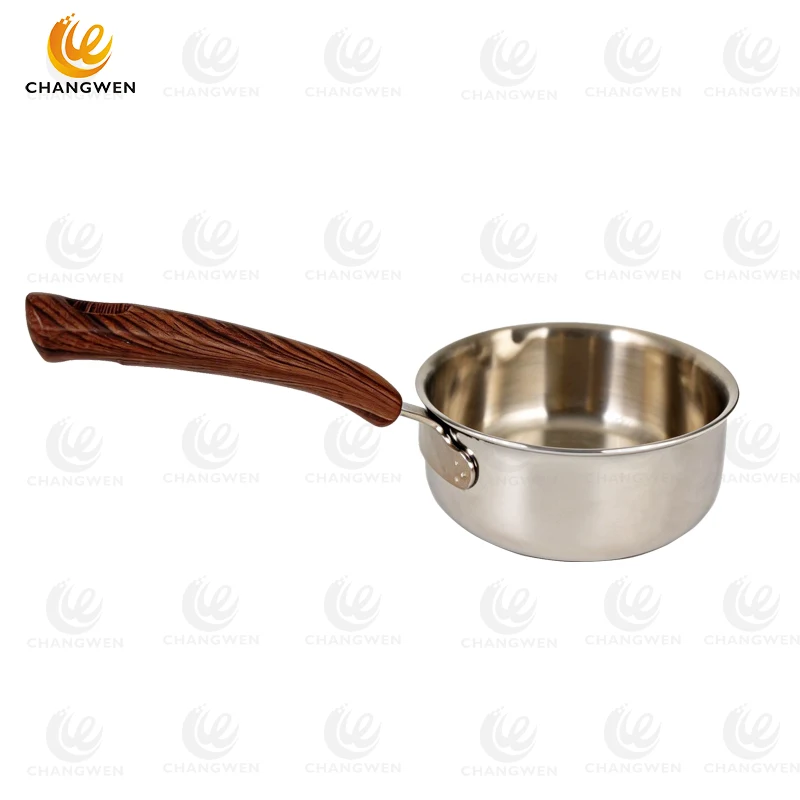
5-ply adds two additional layers to tri-ply construction — typically an extra stainless steel layer and an additional aluminum layer:
- Outer stainless steel (430)
- Aluminum layer
- Stainless steel middle layer
- Aluminum layer
- Inner stainless steel (304)
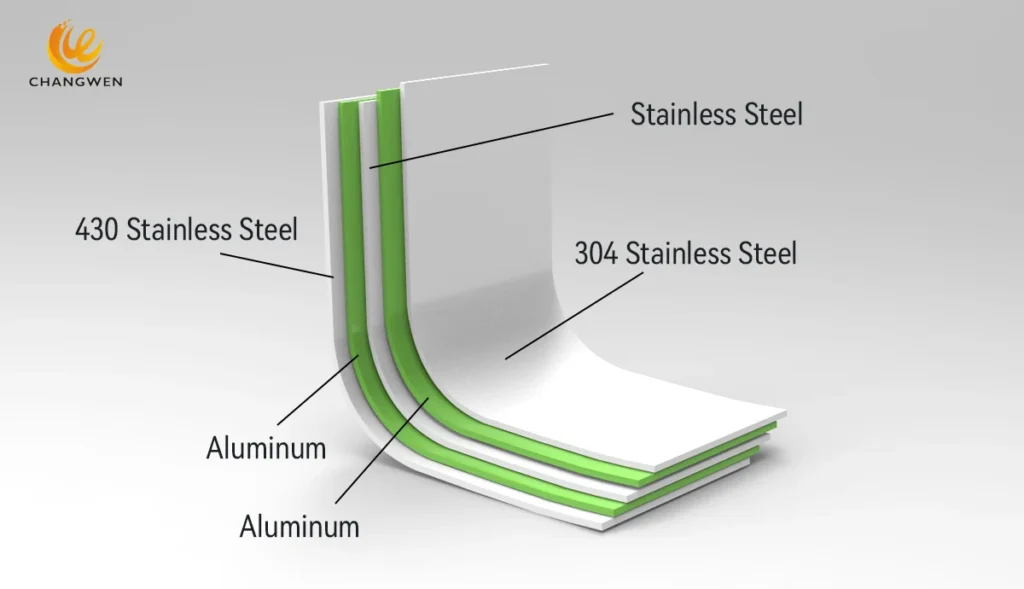
The additional layers provide marginally better heat retention and slightly improved structural rigidity over very long-term use.
The honest reality about 5-ply: almost nobody orders it.
At our factory, 5-ply accounts for a very small fraction of total production. The reason is simple: 5-ply cookware costs 9–10 times more than tri-ply at the factory price level. The performance difference does not come close to justifying that price gap for most brands and most consumers.
To put this in concrete terms: if a tri-ply set leaves the factory at $X, a comparable 5-ply set costs $9X–$10X. That cost difference flows directly into your retail pricing and makes building a commercially viable product extremely challenging in almost any market.
When does 5-ply make sense?
Only in specific ultra-premium brand scenarios where “5-ply” is a central part of the product’s marketing story and the target consumer is genuinely in the top tier of cookware buyers — think specialty kitchen retailers, ultra-premium gifting collections, or professional-grade positioning. Even in these cases, most successful premium brands build their reputation on 304-aluminum-430 tri-ply, not 5-ply.
If a supplier suggests 5-ply as a routine upgrade, ask them to justify the cost structure in detail. In most cases, investing the same budget into better finishing, packaging, or brand building will deliver more commercial value.
Side-by-Side Comparison
| Factor | Single-Layer + Composite Base | Tri-Ply (Full-Clad) | 5-Ply |
| Construction | Single body + base disc | Full-clad 3 layers | Full-clad 5 layers |
| Heat distribution | Base only | Full surface + sides | Full surface + sides |
| Typical material spec | 201/304 body / 201+Al+430 base | 304-Al-430 (all markets) | 304-Al-SS-Al-430 |
| Relative factory price | Baseline | Significantly higher | 9–10× tri-ply price |
| Induction compatible | Yes | Yes | Yes |
| Best market fit | South America | SE Asia, EU, US | Ultra-premium only |
| MOQ (Changwen) | 1,000 units | 1,000 units | 1,000 units |
Which Construction Is Right for Your Market?
Sourcing for South America? Single-layer with composite base is the established standard. Buyers in Brazil, Chile, Colombia, and Argentina are well-acquainted with this construction. Specify 201/304 stainless body with a 201+aluminum+430 composite base disc. Some buyers prefer an extra-thick base disc for improved heat retention — worth discussing if your market positions on cooking performance.
Sourcing for Southeast Asia? Tri-ply (304-aluminum-430) is the standard for mid to premium positioning. The same construction used in the US and European markets applies here — tri-ply is tri-ply regardless of destination market.
Sourcing for the US or Europe? 304-aluminum-430 tri-ply is the required standard, the same specification as Southeast Asia. LFGB certification (EU) or FDA compliance (US) is non-negotiable — confirm in writing and request actual documentation.
Building an ultra-premium brand? Strong 304-aluminum-430 tri-ply with premium finishing (brushed, mirror, or PVD coating) and a compelling brand story will outperform 5-ply commercially in almost every scenario. Reserve 5-ply only if you have specific market validation that the extreme price premium is viable for your customers.
FAQ
What is the real difference between full-clad tri-ply and composite base cookware?
Full-clad tri-ply has three bonded layers running through the entire body of the pan — base and sides. Composite base cookware has a single-layer stainless steel body with a multi-layer disc bonded only to the bottom. For everyday cooking the composite base performs well at the bottom of the pan, but tri-ply provides even heat across the full cooking surface including the sidewalls.
Why does the stainless steel grade matter so much?
For tri-ply cookware, the industry standard is 304 stainless steel (18/8) on the inner cooking surface across all markets. 304 offers excellent corrosion resistance, is dishwasher safe, and meets EU (LFGB) and US (FDA) food safety requirements. The outer layer uses 430 stainless steel for induction compatibility. Always confirm these grades in writing with your manufacturer before placing an order.
Is 5-ply ever worth ordering?
Almost never, for most brands. At 9–10 times the factory price of tri-ply, it is extraordinarily difficult to build a commercially viable retail price structure. The world’s most respected premium cookware brands are built on tri-ply, not 5-ply. The only scenario where 5-ply makes sense is an ultra-premium brand where the product’s entire identity is built around this specification and the customer base can genuinely support the price point.
What certifications do I need to sell in the EU and US?
For the EU: LFGB is the key cookware standard. For the US: FDA compliance for food-contact materials. Always request actual certification documents from your manufacturer — verbal confirmation is not sufficient. At Changwen, we can produce to LFGB and FDA standards and provide full documentation.
What is the MOQ at Changwen?
Our MOQ is 1,000 units for all construction types. Standard catalog items in both single-layer composite base and tri-ply are available from this MOQ. Custom designs requiring new tooling (proprietary handles, shapes, or exclusive finishes) may have different requirements depending on tooling investment. Standard production lead time is 40 days, plus 4–6 weeks for any new mold development.
Can I get custom branding on all construction types?
Yes. We offer full OEM/ODM services including custom logos, handle design, color and surface finishing, and packaging for all construction types. NDAs are available for brands requiring confidentiality.
Conclusion
The right construction for your brand depends almost entirely on where you are selling and who your end customer is.
Single-layer with composite base is the right choice for South American markets — cost-effective, familiar to buyers in that region, and well-suited to the market’s price expectations. Tri-ply is a genuine premium product, and material grade selection (201 vs 304) should be driven by your target market’s standards and price tolerance. And 5-ply, at 9–10 times the factory price of tri-ply, is a niche ultra-premium construction that very few brands will ever need or be able to sell effectively.
Understanding these distinctions precisely — and specifying them clearly in your purchase order — is what separates brands that receive exactly what they expect from those that face expensive surprises when the shipment arrives.
Work With Changwen
Changwen has manufactured stainless steel cookware for brands across 30+ countries since 2002. We produce single-layer composite base, tri-ply, and 5-ply constructions with full OEM/ODM capabilities, MOQ from 1,000 units, and 40-day production lead times.
Ready to discuss your project? Contact our team for a free quote, product samples, or a factory audit. We respond within 24 hours.
📧 changwen@cwcooking.com 📞 0086-18022963948 🌐 www.cookwarecw.com/contact-us

12pcs stainless steel cooking pots & pans set with color silicon handles coating conic frypan 24cm pasta pot in China CW-M1311
Wholesale Soup Pots CW-SP001
Stainless Steel Stock Pot 8 Qt/20l/30 Litre/60 Qt CW-M0802
New design stainless steel 12pcs pots wholesale wire handle and knob cookware mirror polished saucepan casserole kitchen pots nonstick coated frypan CW-M1218
China cookware set 12pcs pots wholesale stainless steel lids black handle and knob frypan casserole saucepan CW-M1229B
6-Piece Stainless Steel Pot Set with Orange Silicone-Edge Lids CW-ES0611
Factory Wholesaler 13 pcs nonstick stainless steel cookware set fry pan saucepan casserole steamer rack black mats CW-M1301
Wholesale stainless steel pots mirror polished cooking pot set nonstick frypan milk pot casseroles saucepan with blue glass lids and silicone iron wire rack CW-M1307G-02