
Reading time: 10 minutes
Introduction
Here is the problem with sourcing stainless steel cookware at wholesale: the terminology is a mess.
“Tri-ply.” “Fully clad.” “Clad stainless.” “Impact bonded.” “Encapsulated base.” “Disc bottom.” These terms appear in supplier catalogs, get used interchangeably by salespeople, and mean very different things — yet they determine the performance, retail positioning, and acceptable price point of every stainless steel cookware set you sell.
Get the construction right and you have a product that performs as promised, holds its retail price, and earns repeat business. Get it wrong and you have customer complaints about hot spots, returns on pans that warp, and a brand story you cannot support.
This guide explains exactly what each construction type means, how they differ in manufacturing, performance, and cost, and how to specify the right construction for your market.

The Core Question: Where Are the Layers?
Before anything else, understand this one distinction. It explains every argument about stainless steel cookware construction.
Fully clad cookware has its metal layers — typically stainless steel, aluminum, stainless steel — bonded together and running continuously from the base of the pan through the entire sidewall, all the way to the rim. The layers are present everywhere food or heat contacts the pan.
Encapsulated base (disc base) cookware has a single-layer stainless steel body with a separate multi-layer disc bonded only to the bottom. The sidewalls are single-layer stainless with no conductive core.
That is the structural difference. Everything else — heat performance, cooking behavior, manufacturing cost, retail positioning — follows from this one architectural choice.
Construction Type 1: Fully Clad Tri-Ply Stainless Steel
What It Is
Tri-ply clad stainless steel cookware (also called “three-ply,” “3-ply,” or “tri ply stainless steel”) consists of three bonded metal layers that extend through the entire body of the pan:
- Outer layer: 430 stainless steel (ferritic, magnetic — enables induction compatibility)
- Core: Aluminum alloy (high thermal conductivity, heat distribution)
- Inner layer: 304 stainless steel (food-grade, non-reactive cooking surface)
The bonding process — called cladding or roll bonding — permanently fuses these layers into a single composite sheet under high pressure. This sheet is then deep-drawn into the shape of a pot or pan. The result is a pan where every surface, including the sidewalls, contains the aluminum core.
Why the Sidewalls Matter
This is the performance difference most buyers miss.
When you put a fully clad tri-ply stainless steel pan on the heat, the aluminum core conducts heat rapidly up the sidewalls — not just across the base. For sautéing, reducing sauces, simmering, or any technique where food contacts the sides of the pan, this means even, consistent temperature across the entire cooking surface.
In a disc-base pan, the sidewalls are single-layer stainless steel — a poor heat conductor. Heat moves across the base where the disc is, but does not efficiently travel up the walls. You get a hot base and relatively cool sides.
Manufacturing Requirements
Full-clad tri-ply production requires specialized equipment that not all factories possess. The key steps:
- Cladding/roll-bonding: A specialty mill bonds the three-layer composite sheet. The quality of this bond — measured by delamination resistance and bonding strength — determines the long-term durability of the cookware.
- Deep drawing: The bonded sheet is pressed into shape using heavy hydraulic presses designed for multi-layer material. The formability of the composite sheet is more demanding than single-layer steel.
- Rim formation and finishing: Edges must be sealed cleanly to prevent any exposure of the aluminum core. A properly finished tri-ply pan has no visible aluminum at the rim.
This production complexity means full-clad tri-ply cookware costs more to manufacture and requires factories with appropriate capital equipment. When evaluating suppliers, confirm they have cladding capability — not just disc-bonding capability.
Specifications to Confirm
When ordering a triply cookware set, nail down these numbers in writing:
- Total wall thickness: 2.4mm–3.0mm is the range for quality tri-ply. Under 2.0mm indicates a thin, lightweight construction that will warp faster and perform less evenly.
- Aluminum core thickness: Directly affects heat distribution performance. Core thickness should be confirmed, not just total wall thickness.
- Inner layer grade: Must be 304 stainless steel (18/8 or 18/10) for food safety and corrosion resistance.
- Outer layer grade: 430 stainless steel for induction compatibility.
- Rim seal: Confirm the rim is fully sealed — no exposed aluminum edge.
Construction Type 2: Encapsulated Base (Disc Bottom)
What It Is
Encapsulated base cookware, also called disc-bottom, sandwich base, or impact-bonded base, combines:
- A single-layer stainless steel body (typically 304 or 201 stainless)
- A multi-layer disc permanently bonded to the base
The disc itself is multi-layered — typically stainless steel / aluminum / 430 stainless steel — which provides heat distribution at the base and the magnetic outer layer required for induction compatibility.
This is the most widely sold stainless steel cookware construction globally. It is the dominant construction in South American and Southeast Asian markets, and the standard for mid-range retail worldwide.
Performance Characteristics
Disc-base cookware performs well for most everyday cooking tasks:
- Boiling, simmering, steaming: Excellent — concentrated base heat is exactly what these tasks need
- Sautéing at low to medium heat: Acceptable
- Reducing sauces or cooking that involves the sidewalls: Heat distribution is less even than full-clad
The practical limitation: if you are making a thick béchamel sauce, cooking custard, or any preparation where food spends time against the sidewalls at varying temperatures, the single-layer steel sides will create uneven results compared to fully clad tri ply stainless steel pan options.
Why It Dominates Volume Production
Three reasons disc-base construction dominates wholesale volume:
Lower manufacturing cost. Bonding a disc to the base requires less specialized equipment than full-clad cladding. The single-layer body is stamped from standard stainless sheet. This makes disc-base cookware significantly more cost-effective to produce at scale.
Market fit. For price-sensitive markets — South America, Southeast Asia, mass-market retail — disc-base cookware hits an accessible price point while delivering genuine cooking performance. It is not an inferior product; it is the right product for its intended use and price tier.
Flexibility. The body thickness, disc composition, and disc thickness can be adjusted independently to optimize cost and performance for each specific market.
Specifications to Confirm
For disc-base cookware:
- Body material: 304 stainless steel is the food-safe standard. 201 is acceptable for some markets but has lower corrosion resistance.
- Disc composition: The disc layers (stainless / aluminum / 430 magnetic stainless) and total disc thickness determine heat distribution performance.
- Disc diameter: Should cover the majority of the base. A small disc with large uncovered stainless areas creates pronounced hot spots.
- Bonding method: Impact bonding (hydraulic press) is the standard. Adhesive bonding is not appropriate for cookware.
Tri-Ply vs Disc Base: Head-to-Head Comparison
| Factor | Tri-Ply Fully Clad | Disc Base |
|---|---|---|
| Heat at base | Even | Even |
| Heat at sidewalls | Even (aluminum in walls) | Uneven (bare steel) |
| Hot spot risk | Low | Moderate to high at walls |
| Cooking performance | Premium across all tasks | Excellent for boiling/simmering |
| Warp resistance | High (rigid bonded composite) | Good (thick disc base) |
| Manufacturing complexity | High | Moderate |
| Factory price | Higher | Lower |
| Retail positioning | Premium | Mid-range to mainstream |
| Best market | EU, North America, premium segments | South America, SE Asia, mass retail |
| Induction compatible | Yes (430 outer layer) | Yes (430 in disc) |
Tri-Ply Clad vs 5-Ply: Does More Layers Mean Better?
A common question from wholesale buyers evaluating triply cookware sets is whether to specify 5-ply instead.
The honest answer: for most cookware applications and most consumer markets, the performance difference between well-made 3-ply and 5-ply is not dramatic enough to justify the price premium. After 3-ply, performance gains from additional layers are limited unless the core material or core thickness improves significantly.
Where 5-ply genuinely adds value:
- Rigidity and warp resistance: Additional steel layers increase structural stiffness, relevant for large-diameter pans used at high heat.
- Heat retention: Slightly better thermal mass for techniques requiring sustained high-temperature cooking.
- Premium retail story: “5-ply” is a communicable differentiation for market segments where technical specification drives purchase decisions.
For the vast majority of wholesale cookware programs targeting standard household or professional kitchen use, quality tri-ply clad stainless steel with appropriate core thickness delivers excellent results at better economics than 5-ply.
“Fully Clad” vs “Clad Base”: The Terminology Trap
One confusion point worth addressing directly: some suppliers describe disc-base cookware as having a “clad base” or “tri-ply base.” This language is technically accurate — the base disc may indeed have three layers — but it is not the same as fully clad tri-ply stainless steel cookware.
When a supplier says “tri-ply,” ask specifically: do the three layers extend through the sidewalls, or only through the base? If only the base, you have disc-base construction. If through the sidewalls, you have full-clad construction.
This distinction matters for product descriptions, retail marketing, and most importantly, customer expectations. A customer who buys a “tri-ply” cookware set expecting full-clad performance but receives disc-base construction will notice the difference when making sauces.
Put the construction specification in writing. “Full-clad tri-ply, layers extending through sidewalls to rim” is unambiguous. “Tri-ply construction” without this qualification is not.
Which Construction to Source for Which Market
EU and North American premium retail:
Full-clad tri-ply (304-aluminum-430) is the expected standard for premium retail positioning. Informed buyers in these markets understand the distinction between full-clad and disc-base, and premium pricing requires full-clad construction. Total wall thickness minimum 2.6mm. Certify to LFGB for EU, FDA for US.
South American markets:
Disc-base construction dominates. The market is well-established and price-sensitive. Specify 304 stainless body, proper disc composition (including 430 magnetic layer for induction), and adequate disc diameter. Full-clad exists in the premium segment but represents a small share of volume.
Southeast Asian markets:
Both constructions sell. Disc-base at mid-price, full-clad tri-ply at premium. 201 stainless body is acceptable for disc-base in this market; 304 is required for full-clad.
Hospitality and food service:
Full-clad tri-ply for professional kitchens where even heat and pan longevity matter. Heavy-gauge disc-base for high-volume food service where cost per unit drives purchasing decisions. NSF certification relevant for US commercial foodservice.
What to Put in Your Purchase Order
Ambiguous specifications lead to disputes. Here is what to specify explicitly for any stainless steel cookware order:
For tri-ply fully clad cookware:
- Construction: Full-clad tri-ply, layers extending through sidewalls and base to rim
- Inner layer: 304 stainless steel (18/8)
- Core: Aluminum alloy
- Outer layer: 430 stainless steel
- Total wall thickness: specify in mm (recommend minimum 2.6mm)
- Core thickness: specify in mm
- Rim: sealed, no exposed aluminum
For disc-base cookware:
- Body material: 304 stainless steel (or 201 where applicable)
- Disc composition: layers and materials
- Disc thickness: specify in mm
- Disc diameter: specify as percentage of base diameter
- Outer base layer: 430 stainless steel for induction compatibility
Both types:
- Certifications required: LFGB / FDA / ISO 9001
- Surface finish: brushed / mirror / matte / PVD
- Handle material and attachment method
- Lid specification (glass or stainless, fit tolerance)
FAQ
Is tri-ply the same as fully clad?
Tri-ply describes a three-layer construction. Fully clad describes where those layers are. Tri-ply fully clad means three layers running through the entire body of the pan including sidewalls. A tri-ply base or disc-base pan may also have three layers — but only at the bottom. When sourcing, always confirm whether layers extend through the sidewalls.
What is the difference between a tri-ply stainless steel pan and a disc-base pan for cooking?
In a tri-ply fully clad pan, heat distributes evenly across the base and up the sidewalls. In a disc-base pan, heat is well-distributed at the base but the single-layer steel sidewalls conduct heat less efficiently. For boiling and simmering, both perform comparably. For sautéing, sauces, and anything where food contacts the sides, full-clad provides more even results.
Does more ply always mean better quality?
Not necessarily. After 3-ply, the performance advantage of additional layers depends on core material quality and thickness rather than layer count. Quality tri-ply with proper aluminum core thickness outperforms poorly specified 5-ply. Core thickness matters more than the number.
Which construction do professional kitchens use?
Professional kitchens predominantly use full-clad multi-ply stainless steel — typically tri-ply or heavier — for the pan surface evenness and warp resistance required under sustained high-heat use. Disc-base is found in high-volume food service where cost per unit is the primary driver.
How do I verify that a supplier is genuinely producing full-clad and not disc-base?
Request a cross-section cut of a sample pan. The cut will show whether aluminum layers are present in the sidewall or only in the base disc. This is the definitive verification — no marketing language can substitute for it.
What is the standard material for tri-ply stainless steel cookware?
The global standard for quality tri-ply clad stainless steel cookware is 304 stainless (18/8) on the inner cooking surface, aluminum alloy core, and 430 stainless on the outer layer for induction compatibility. This 304-aluminum-430 construction is the specification used across premium cookware globally.
Conclusion
The tri-ply vs clad vs disc-base question is not about which construction is objectively better. It is about matching the construction to your market, your retail positioning, and your customer’s expectations.
Full-clad tri-ply stainless steel delivers premium performance, justifies premium retail pricing, and is the right specification for EU and North American premium segments. Disc-base construction delivers solid everyday cooking performance at accessible pricing, and is the right specification for South American, mass-market, and price-sensitive segments.
The mistake is not choosing one over the other. The mistake is misrepresenting one as the other, underspecifying in your purchase order, or selecting based on supplier language rather than verified construction details.
Specify clearly. Verify with cross-section samples. And build your product story around what you actually source.
Source Tri-Ply Stainless Steel Cookware with Changwen
Changwen is a stainless steel cookware manufacturer based in Jiangmen, Guangdong, China, with over 22 years of OEM and ODM experience. We produce full-clad tri-ply stainless steel cookware sets (304-aluminum-430 construction), disc-base stainless steel cookware sets, frying pans, stock pots, steamer pots, pressure cookers for brands and distributors across South America, Southeast Asia, the Middle East, and Europe.
Material test reports available for every production batch. Cross-section samples provided on request.
📧 changwen@cwcooking.com 📞 0086-18022963948 🌐 www.cookwarecw.com/contact-us
-
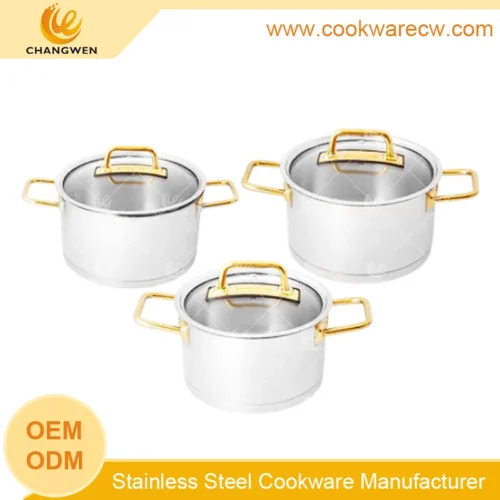
6-Piece Stainless Steel Pot Set with Gold Handles CW-ES0610
-
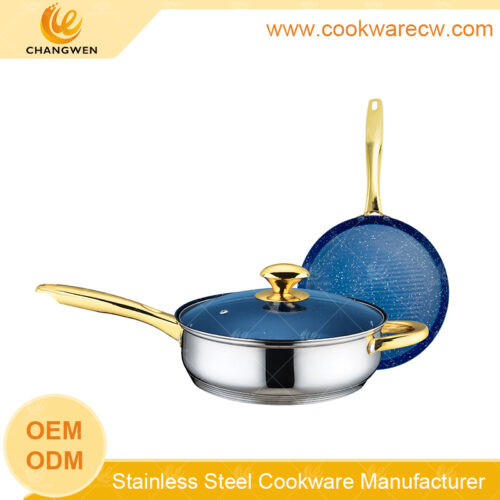
Best Quality Stainless Steel Pans
-

Professional Honeycomb Stainless Steel Fry Pan CW-ETP021
-

Honeycomb Structure Stainless Steel Frying Pan CW-ETP014
-
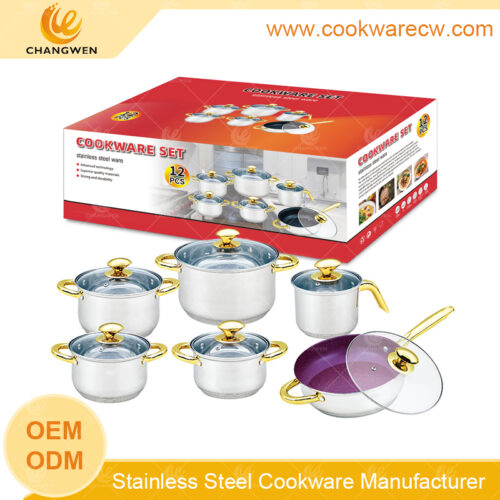
Factory pots wholesale cooking pot set mirror polished stainless steel pots nonstick frypan blue marble coating frying pan golden plated handles and knobs capsule bottom CW-M1212
-
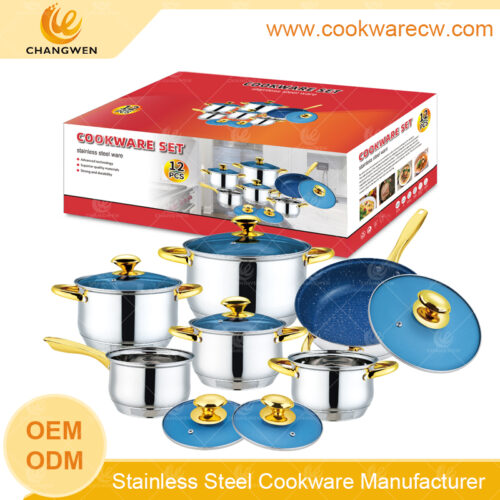
China manufacturer stainless steel 12pcs cookware set non-stick frying pan blue glass lid golden handles & knobs CW-M1209N
-
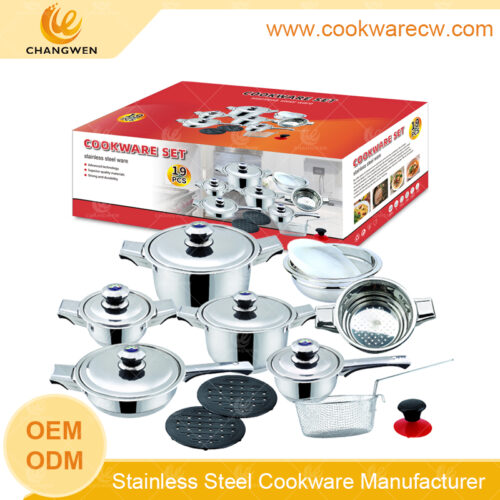
Heavy weight cookware set steamer pot 19pcs stainless steel pots and pans with thermal knobs and heat insulation handle frying basket salad bowl with PP lid kitchen utensil fire mats suction knob CW-M1901G
-
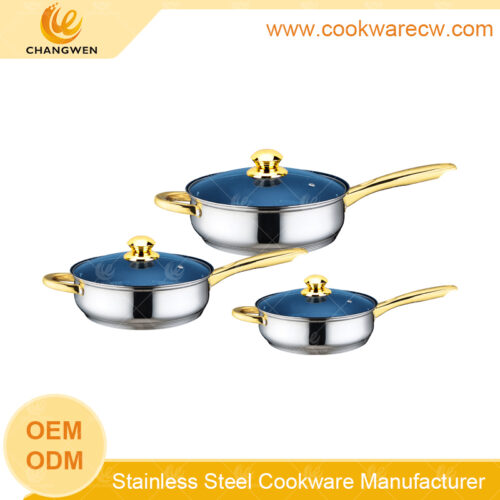
Best Nonstick Stainless Steel Pan