
Read time: 10 minutes
Introduction
Most commercial kitchens do not have a cooking problem. They have an equipment problem.
The wrong pots warp after three months of high-volume service. Pans that look professional in the catalogue develop hot spots that create inconsistency across the line. Stock pots that flex under full load become a liability, not a tool. Frying pans that do not hold temperature during a rush force line cooks to compensate constantly — and compensation slows everything down.
Wholesale restaurant cookware is not about buying the most or spending the least. It is about building a kitchen equipment program where every piece performs reliably under sustained commercial use, fits the workflow your chefs actually operate, and survives long enough to justify the price.
This guide is written for restaurant operators, foodservice distributors, hotel procurement teams, and wholesale restaurant supply buyers who need to get this decision right. You will learn which materials belong in which applications, how to specify commercial-grade stainless steel stock pots and fry pan sets correctly, what wholesale supply options exist, and how to build an equipment program that improves kitchen efficiency rather than just replacing broken pans.

Key Takeaways
- Material selection drives efficiency more than any other single decision. Stainless steel for durability, versatility, and non-reactive cooking surfaces. Aluminum for speed and heat distribution at lower cost. Each has a defined commercial role.
- Heavy-gauge construction is non-negotiable for restaurant cookware wholesale. Residential-grade pans that look similar will warp, lose heat distribution performance, and fail within months of commercial service.
- Commercial stainless steel stock pots are the highest-volume, hardest-working vessels in any professional kitchen. Gauge, capacity planning, and handle design directly affect service speed and staff safety.
- Commercial fry pan sets need to be specified as a complete station package — not individual pans — to achieve the standardization that reduces training time and improves line consistency.
- Standardization across the kitchen — same sizes, same handle designs, same materials throughout — reduces errors, simplifies training, and makes cookware interchangeable across stations.
- For high-volume purchasing, sourcing direct from a stainless steel cookware manufacturer provides better pricing, greater specification control, and more consistent quality across large orders than multi-layer distribution.
Why Cookware Is a Kitchen Efficiency Variable
The connection between cookware quality and kitchen efficiency is direct and measurable.
Heat distribution affects consistency. A pan with hot spots forces the line cook to compensate constantly — moving food, adjusting flame, watching for uneven browning. Quality cookware with even heat distribution means food behaves predictably, technique becomes repeatable, and output is consistent across every service.
Durability affects workflow. Warped pans do not sit flat on the stovetop. They rock, distribute heat unevenly, and create safety risks under load. A kitchen running warped stock pots and frying pans is a kitchen where the equipment is actively working against the team.
Ergonomics affect speed. Handle weight, balance, and grip geometry compound across every lift during a service. A heavy, poorly balanced stock pot slows movement and increases the risk of spills. Well-engineered commercial handles are a speed and safety variable, not a cosmetic detail.
Standardization affects training. When every fry pan on the line is the same size, weight, and handle type, new staff can work any station. Non-standardized kitchens with mixed brands, sizes, and handle types require station-specific training and break down when staff rotate.
One restaurant group that standardized its kitchen equipment across locations — switching from mixed residential-grade pans to a single commercial-grade stainless steel program — reported a 30% reduction in new staff training time and approximately 20% improvement in cooking efficiency within six months. The improvement came not from better chefs, but from equipment that performed consistently and predictably.
The Right Material for Each Commercial Kitchen Application
Stainless Steel: The Commercial Kitchen Workhorse
Stainless steel is the primary material in professional commercial kitchens for a reason: it handles everything. Non-reactive with acidic foods. Resistant to warping at high temperatures. Survives industrial dishwasher cycles. Maintains professional appearance over years of heavy service.
When to specify stainless steel:
- Stock pots for stocks, soups, blanching, pasta (acidic foods, wine, tomato-based preparations)
- Sauce pots and saucepans for reductions and finishing sauces
- Fry pans for searing, sautéing, and deglaze applications
- Any vessel going from stovetop to oven
- Any application where longevity justifies the higher unit cost over aluminum
Specification minimum for commercial stainless steel cookware:
- Inner cooking surface: 304 stainless steel (18/8) — food-grade, non-reactive, corrosion-resistant
- Wall thickness: 1.0mm minimum for sauce pots and light-duty fry pans; 1.2mm+ for stock pots and heavy-duty applications
- Handles: riveted for maximum strength under repeated heavy loading in commercial use
- Certification: NSF/ANSI 51 for US foodservice operations; LFGB compliance for EU and international hotel and restaurant chains
Aluminum: Speed and Even Heat at Lower Cost
Aluminum conducts heat significantly better than single-layer stainless steel and costs less per unit. For applications where speed and even heat matter more than durability or corrosion resistance, aluminum is appropriate.
When to specify aluminum:
- Baking pans and sheet pans (oven heat distribution)
- High-turnover frying where rapid heat recovery is the priority
- Large-batch preparation where lighter weight reduces staff fatigue
Important limitation: Raw aluminum reacts with acidic foods — tomato-based preparations, citrus, wine reductions. Specify hard-anodized aluminum for any acidic application. For stock work involving tomatoes or wine, stainless steel is the correct specification regardless of cost.
Tri-Ply for Precision Cooking Stations
Full-clad tri-ply stainless steel (304-aluminum-430) delivers even temperature across base and sidewalls simultaneously. For sauce work, reduction cooking, and any station where temperature consistency directly affects dish quality, tri-ply is an efficiency investment.
The aluminum core in tri-ply distributes heat up the sidewalls — eliminating the cold-edge problem in single-layer pans where food touching the sides drops in temperature. For a sauce station handling 200+ covers, this consistency matters.
Commercial Stainless Steel Stock Pots: Specification Guide
The stock pot is the highest-volume, hardest-working vessel in most commercial kitchens. It runs from first prep to last clean-up. It carries the heaviest loads. It handles the most temperature cycles. Getting stock pot specification right directly affects kitchen productivity.
Gauge and Wall Thickness
For commercial stainless steel stock pots, wall thickness is the most critical specification. Thin-wall pots used under commercial load warp at the base, develop hot spots, and lose structural integrity at handles.
Minimum specifications by volume:
| Pot Volume | Minimum Wall Thickness | Minimum Base Thickness |
|---|---|---|
| Up to 12L | 0.8mm | 3.0mm base disc |
| 12L – 30L | 1.0mm | 4.0mm base disc |
| 30L – 60L | 1.2mm | 5.0mm base disc |
| 60L+ | 1.5mm+ | 6.0mm+ base disc |
Thicker walls cost more per unit. For operations running stock pots 12–16 hours daily, the durability difference between 0.8mm and 1.2mm is the difference between 18-month replacement cycles and 5-year service life. The total cost of ownership calculation almost always favors heavy-gauge specification.
Capacity Planning for Restaurant Stock Pots
Capacity planning prevents the two common stock pot mistakes: too small (requiring multiple batches that slow prep) and too large (too heavy when full, too slow to heat when partial).
Planning formula: Calculate your maximum single-batch volume for each preparation — stock, soup, pasta water — and specify the pot at 75–80% of that volume. A fully loaded stock pot is harder to handle, slower to heat, and creates spillage risk.
Reference volumes by operation type:
- Full-service restaurant (80–120 covers): 20L stock pot for daily stock production; 12L for pasta service; 8L for sauce work
- High-volume restaurant or hotel kitchen (150–300 covers): 40L for primary stock; 20L for daily pasta; two 12L for active sauce production
- Central kitchen or catering operation (500+ covers): 60–80L for primary production; 40L for secondary; multiple 20L for batch cooking stations
Handle Design for Commercial Stock Pots
Handle failure under full-load stock pots is a serious safety incident. Commercial handle specifications:
- Loop handles (ear handles): Welded or riveted loops on both sides of the pot. The standard configuration for large stock pots. Allows two-handed carrying and ladling from a stable position.
- Long side handle: Appropriate for pots up to approximately 12L. Longer handles provide better leverage but increase the risk of catching on adjacent equipment in tight kitchen layouts.
- Handle riveting vs welding: Riveted handles tolerate lateral stress better than welded handles under repeated heavy loading. For stock pots regularly carried when full, riveted loop handles are the correct specification.
Lid Design
Stock pot lids for commercial use should be:
- Heavy-gauge stainless steel — glass lids are not appropriate for high-volume commercial stock pot service
- Slightly domed — dome shape channels condensation back into the pot rather than running down the exterior
- Fitted with a solid stainless knob — no plastic or silicone knob components that degrade at sustained high temperatures
Induction Compatibility
For operations with induction or mixed stovetop configurations, specify stock pots with 430 stainless steel base layer or composite induction-compatible base. 304 stainless steel is not magnetic and will not work on induction without a magnetic outer layer.
Commercial Fry Pan Sets: Building Your Station Package
The fry pan is where most service failures happen. It is the most heavily used piece of equipment on the line. A commercial fry pan set specified as a complete station package — rather than individual pans purchased ad hoc — delivers the standardization and redundancy that keeps the line running.
Why Fry Pan Sets, Not Individual Pans
Buying individual fry pans creates a mixed inventory problem within 12 months. Different handle weights, different wall thicknesses, different heat distribution characteristics across the same nominal size. Line cooks learn one pan’s behavior and get inconsistent results when they grab a different pan of the same size.
A commercial fry pan set defined as a station specification — the same model, same gauge, same handle, across all pans in that size category — eliminates this. Every cook on every shift works with identical tools.
Fry Pan Sizes for Commercial Station Configuration
A complete commercial fry pan set for a full-service restaurant line typically includes:
18cm (7 inch) — mise en place and single-serve finishing: Sauce finishing, butter basting, single-portion searing. Should be stainless steel for non-reactive sauce work. Minimum 1.0mm wall.
24cm (9.5 inch) — the primary line pan: The most-used pan on any line. Sautéing, pan sauces, protein finishing, egg work. Tri-ply construction provides better sauce-work performance. Minimum 1.0mm wall, tri-ply recommended.
28cm (11 inch) — high-volume sautéing and searing: Volume protein searing, large-portion sautéing, high-turnover fish work. Heavy single-layer or tri-ply. Minimum 1.2mm wall.
32cm (12.5 inch) — station anchor for volume stations: Multiple-portion simultaneous searing, family-style preparation, large-format presentations. Heavy-gauge stainless only. Minimum 1.2mm wall.
Stainless Steel vs Non-Stick in Commercial Fry Pan Sets
This is the most common specification debate in commercial fry pan procurement.
Stainless steel fry pans (uncoated):
- No coating to degrade — lasts years in commercial service with proper care
- Superior searing and browning (Maillard reaction is more consistent on bare metal)
- Required for deglaze techniques — the browned fond left on stainless is the base of pan sauces
- Metal utensil safe
- Requires technique (hot pan, cold oil, allow food to release naturally)
Non-stick coated fry pans (PTFE or ceramic):
- Egg work, delicate fish, pancakes — easier without technique mastery
- Less suitable for high-heat searing (coating degrades above 260°C)
- Metal utensils damage coating — requires silicone or nylon tools
- Shorter service life in commercial use (typically 6–18 months before coating degrades)
The commercial kitchen answer: Run both. Specify a stainless steel fry pan set as the primary station equipment for searing, sautéing, and sauce work. Add a dedicated non-stick pan set in each size needed for egg and delicate protein work. Treat the non-stick pans as consumables with a predictable replacement cycle — budget accordingly.
Handle Specification for Commercial Fry Pans
Commercial fry pan handles receive more stress than any other kitchen equipment handle — hundreds of lifts per service, exposure to high heat, stress from tossing and sautéing technique.
Specification requirements:
- Cast stainless steel handle: Oven-safe to full temperature range. Heaviest-duty option. Required for any pan moving from stovetop to oven during service.
- Hollow stainless handle: Lighter than cast, stays cooler during service. Appropriate for stovetop-only applications.
- Riveted attachment: Not welded. Riveted handles tolerate the lateral and torsional stress of sautéing technique over years of service. Welded handles are appropriate for light-duty applications only.
- Handle angle: Slightly upward angle reduces wrist strain during sautéing. Confirm handle geometry with sample evaluation before committing to volume purchase.
How to Evaluate Wholesale Restaurant Supply Sources
Local vs. Direct Import: Choosing the Right Supply Model
Wholesale restaurant supply stores (local or regional): Fastest way to fill urgent needs. Stock on hand, immediate availability, no import lead time. Pricing reflects multiple distribution layers. Appropriate for urgent replacements, low-volume operations, and testing unfamiliar products before volume commitment.
National wholesale restaurant supply distributors: Broader range, more consistent availability, better volume pricing. Still carries distribution margin. Appropriate for mid-size operations with established equipment programs and regular reorder needs.
Direct from manufacturer (China factory): Lowest per-unit cost for defined volume. Full specification control — you specify materials, grades, gauge, handle design, and certifications rather than accepting whatever is on the shelf. Lead time of 40–50 days plus freight. The right model for multi-unit operators, hospitality groups, foodservice distributors building supply programs, and any operation with consistent, predictable equipment needs at 1,000+ units per SKU annually.
For operations purchasing 1,000+ units of the same specification annually, direct manufacturer sourcing typically delivers 30–50% cost savings over local wholesale supply pricing. Lead time and MOQ commitment are the trade-offs.
What to Verify Before Any Wholesale Purchase
Material grade documentation. For stainless steel cookware, require material test reports confirming 304 stainless steel (18/8) for all food contact surfaces. The most common quality issue in commercial cookware procurement is 201-grade steel represented as 304. Request mill certificates or XRF testing reports for any significant volume purchase.
NSF certification. For US commercial foodservice operations, NSF/ANSI 51 certification confirms the product meets the material safety standards required by state health departments for commercial kitchens. Do not accept verbal assurances — request the certificate with issuing body identification.
Construction gauge. Ask for wall thickness specifications in millimeters. “Heavy-gauge commercial” is a marketing claim without a number behind it. The actual wall thickness is the verifiable specification that determines how long the product survives commercial service.
Handle attachment method. Riveted or welded. Ask specifically. For stock pots and fry pans under commercial load, riveted handles are the correct specification.
Replacement availability. A wholesale restaurant supply relationship is only as valuable as the supplier’s ability to fill identical reorders. Confirm the specific product specification will be available for reorder — not just the general category. Equipment standardization has no value if replacements are different products.
Building an Equipment Standardization Program
Step 1: Audit Current Equipment
Catalog every stock pot and fry pan currently in service by station: size, material, age, condition, frequency of use, and failure rate. Most kitchens discover 20% of their equipment handles 80% of the cooking load. The audit reveals what to prioritize.
Step 2: Define Standard Specifications
Choose one specification per category and size. One stock pot specification for each capacity tier in your kitchen. One fry pan specification for each diameter. Document wall thickness, material grade, handle type, and certification requirements. This document becomes your procurement specification — everything purchased for that category must match it.
Step 3: Establish Supply Relationships
For your standard items, establish a supply relationship that guarantees identical reorders. Standardization only delivers efficiency if replacement pieces are identical to existing stock. A supplier who changes product specifications between orders destroys the value of the program.
For multi-unit restaurant groups and distributors, a direct manufacturer relationship with locked specifications provides the strongest guarantee of reorder consistency.
Step 4: Build a Replacement Budget
Commercial cookware has a predictable service life in high-volume environments:
- Stainless steel fry pans (heavy-gauge): 2–4 years
- Non-stick fry pans: 6–18 months depending on volume and care
- Commercial stainless steel stock pots (heavy-gauge): 5–10 years
- Light-duty stainless stock pots: 2–4 years
Budget replacement volume into annual operating costs. Operations that treat equipment replacement as an unplanned expense purchase reactively — usually at retail prices under time pressure — and break their standardization program in the process.
FAQ
What gauge stainless steel is best for commercial stock pots?
For commercial kitchen use, specify minimum 1.0mm wall thickness for stock pots up to 30L, and 1.2mm+ for larger volumes. The base should be at minimum 3.0mm–5.0mm depending on pot size. Heavy-gauge stock pots cost more per unit but deliver significantly longer service life under daily commercial use. In high-volume kitchens running pots 12+ hours daily, 1.2mm wall construction often has lower total cost of ownership than 0.8mm pots requiring more frequent replacement.
Should commercial fry pans be stainless steel or non-stick?
Both have a defined role in a commercial kitchen. Stainless steel fry pans are the primary specification for searing, sautéing, deglaze, and pan sauce work — no coating to degrade, superior Maillard browning, metal utensil safe. Non-stick pans are appropriate for egg work and delicate proteins. The right approach is a stainless steel fry pan set as the primary station equipment plus a separate non-stick pan set as managed consumables with a planned replacement cycle.
Where can I find wholesale restaurant supply near me?
Local restaurant supply stores and regional wholesale restaurant supply distributors serve immediate needs and allow physical inspection before purchase. Search “wholesale restaurant supply near me” or “wholesale restaurant supply store” for local distributors in your area. For volume purchasing at 1,000+ units with full specification control, direct manufacturer sourcing from China provides significantly better unit economics with 40-day production lead time plus freight.
What certifications should commercial restaurant cookware have?
For US commercial foodservice, NSF/ANSI 51 (food equipment materials) is the standard certification required by most state health departments. For international hotel chains and operations with EU market requirements, LFGB compliance documentation covers food contact material safety comprehensively. ISO 9001 at the manufacturer level confirms quality management systems. Request original certificates — not copies or verbal confirmation.
What is the difference between commercial and residential stainless steel cookware?
Commercial-grade restaurant cookware is specified for sustained high-volume use: heavier gauge metal (1.0mm–1.2mm versus 0.6mm–0.8mm residential), riveted handle attachment (versus light-duty welded), higher temperature ratings, and construction that maintains shape and performance through daily industrial dishwasher cycling. Residential cookware sold through retail channels will typically fail within months of commercial kitchen service — warping under sustained heat, losing handle security, and developing surface degradation that creates food safety issues.
What is a standard commercial fry pan set configuration for a full-service restaurant?
A complete commercial fry pan set for a full-service restaurant line typically includes 18cm (single-serve finishing), 24cm (primary line pan — highest quantity), 28cm (volume searing), and optionally 32cm (high-volume stations). The 24cm is usually specified in the largest quantity — plan for 3–4 per cooking station plus backup. Specify all sizes in the same model for interchangeability across stations and consistent heat behavior for line cooks rotating stations.
Conclusion
Wholesale restaurant cookware is an operational decision, not just a purchasing decision.
The difference between a commercial kitchen that runs smoothly through a 200-cover service and one that fights its equipment all night comes down to specification quality, construction gauge, material selection, and standardization. None of those outcomes happen automatically from buying cheap or buying in volume — they happen from buying correctly.
Specify heavy-gauge stainless steel stock pots sized for your actual production volumes. Build a standardized commercial fry pan set that every cook on every shift works with identically. Require material documentation and NSF certification from every wholesale supplier. Establish supply relationships that guarantee identical reorders.
Get those elements right and your kitchen equipment becomes a competitive advantage, not an operational liability.
Wholesale Restaurant Cookware from Changwen
Changwen is a stainless steel cookware manufacturer based in Jiangmen, Guangdong, China, with over 22 years of OEM and ODM manufacturing experience. We supply wholesale restaurant cookware programs to restaurant groups, hotel chains, hospitality distributors, and foodservice supply companies across South America, Southeast Asia, the Middle East, and Europe.
Our wholesale range covers:
- Commercial stainless steel stock pots: Full range from 8L to 60L+, heavy-gauge 304 stainless, loop handles, induction-compatible base options
- Commercial fry pan sets: 18cm–32cm, single-layer and tri-ply configurations, cast stainless or Bakelite handle options
- Complete stainless steel cookware programs: Sauce pots, saucepans, steamer pots, pressure cookers
All production uses verified 304 stainless steel with material test reports per batch. ISO 9001:2015 certified. LFGB and FDA compliant. Private label and OEM branding available.
-
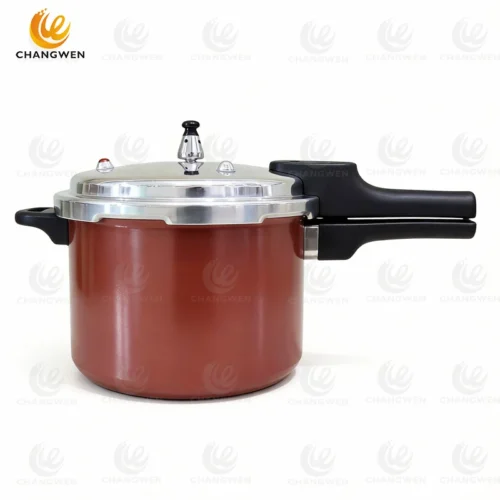
Pressure Cooker Aluminum – Single-Hand Rotation & Safety
-
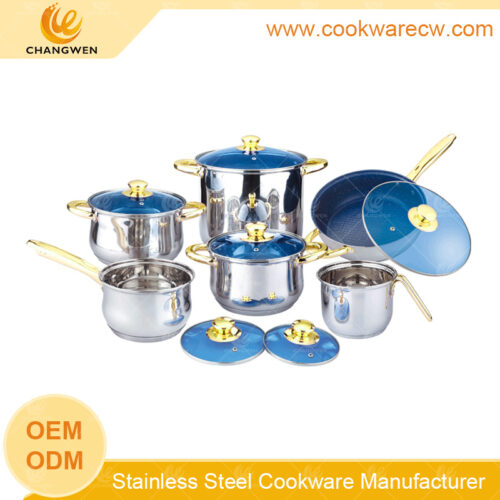
Safest Stainless Steel Cookware
-
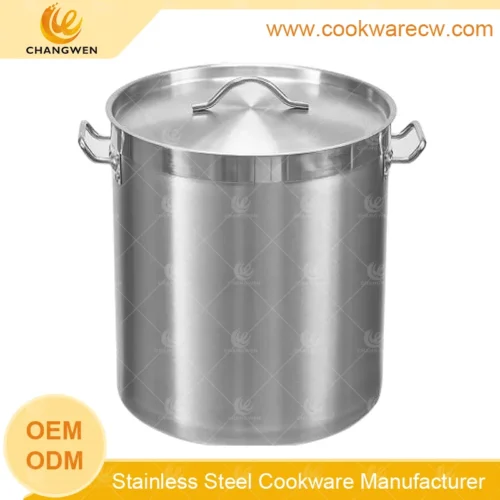
Wholesale Large Stock Pot CW-SP001
-
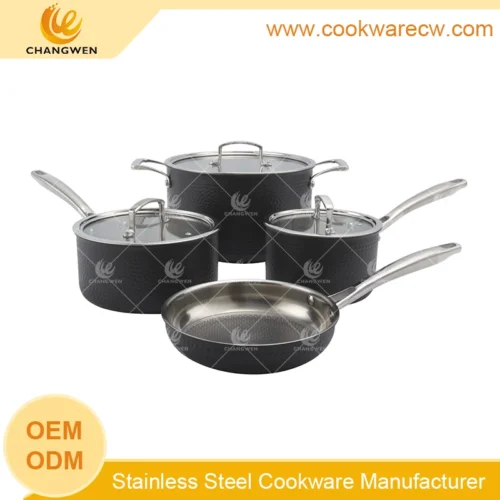
Black Hammered Stainless Steel Cookware Set CW-ETP0702
-
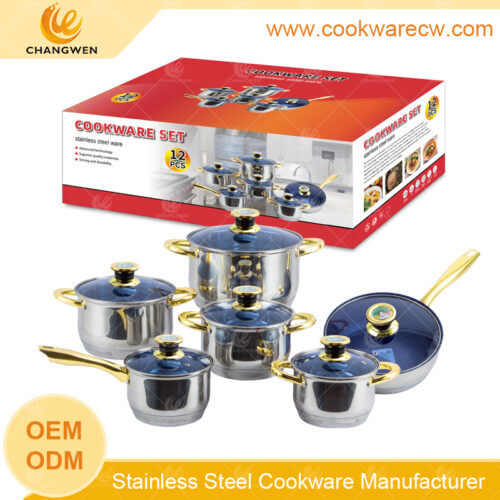
Pots wholesale cookware set 12pcs stainless steel pots and pans nonstick fry pan with thermal knobs and golden handles blue glass lids CW-M1215
-
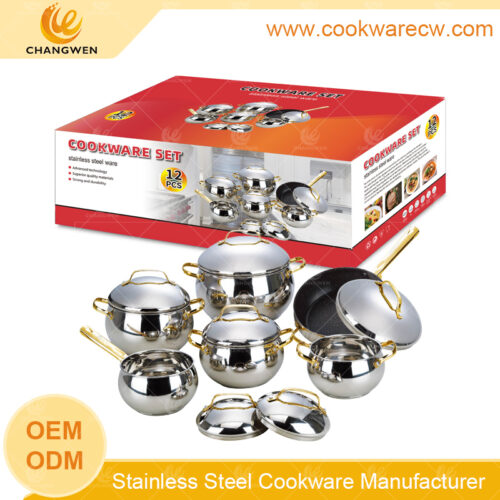
Pots wholesale apple shape cookware set mirror polished stainless steel lids golden wire handles and knobs nonstick frypan CW-M1220
-
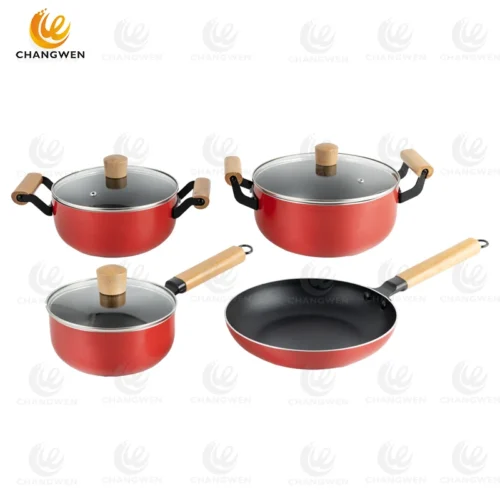
7pcs Fluorine-Free Ceramic Nonstick Aluminum Cookware Set for Kitchenware Brands
-
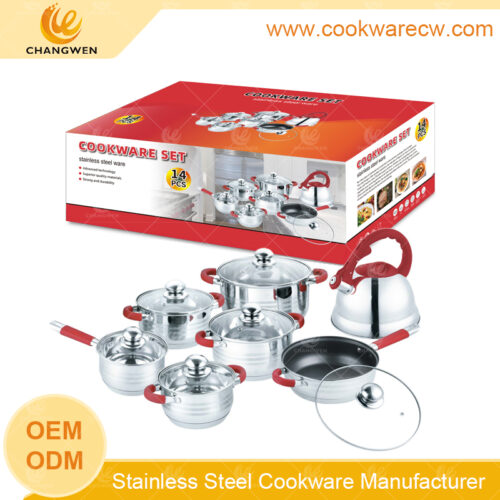
5 Ply Stainless Steel Cookware CW-M1401G