Reading time: 9 minutes
Introduction
Glass cookware has been making a strong comeback in kitchens worldwide — and for good reason. As concerns grow around non-stick coatings, PFAS chemicals, and leaching from low-grade metals, glass pots and pans offer something increasingly rare: a cooking surface that is completely non-reactive, non-porous, and chemically inert. You can see what you are cooking through the walls. There is nothing to season, coat, or replace.
But glass cookware is also genuinely different from metal cookware. It behaves differently on the stovetop, has specific limitations, and comes in several types that are not interchangeable. Buying the wrong type of glass pot — or using the right type incorrectly — can result in cracked or shattered cookware.
This guide covers everything you need to know: the different types of glass cookware, which are safe for stovetop use, how glass pots and pans compare to metal alternatives, their real advantages and disadvantages, and how to choose the best glass cookware set for your kitchen.
Key Takeaways
- Not all glass cookware is stovetop-safe. Only glass pots and pans specifically manufactured and labeled for stovetop use should be used on a burner — never assume oven-safe glassware is also stovetop-safe.
- Borosilicate glass is the gold standard for glass cookware. Its low thermal expansion coefficient makes it significantly more resistant to thermal shock than regular or tempered soda-lime glass.
- Tempered glass cookware is stronger than regular glass but is not suitable for direct stovetop flame — it can shatter unexpectedly when exposed to the concentrated heat of a burner.
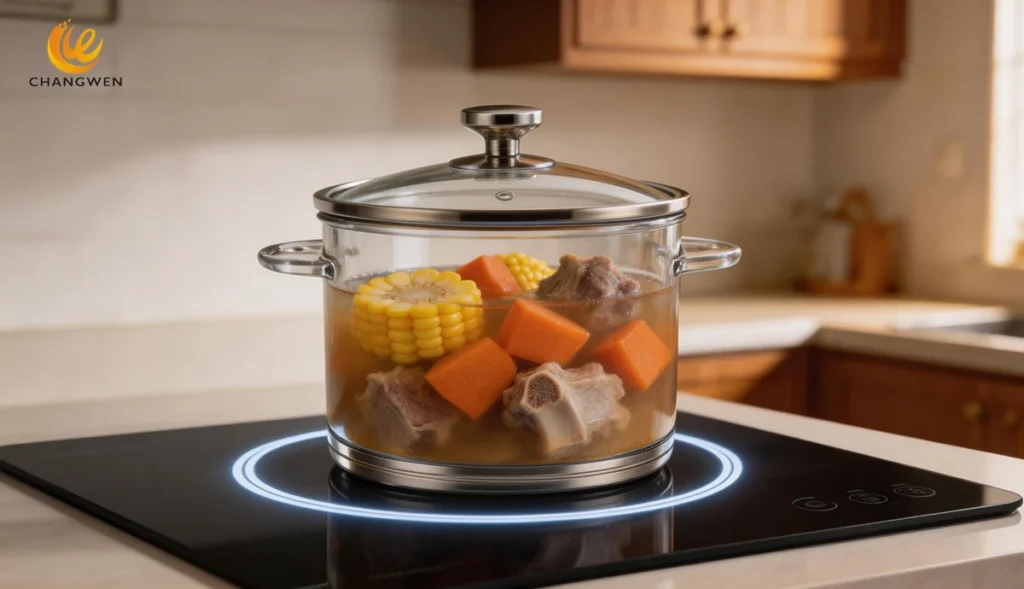
- Glass cookware is not induction compatible because glass does not conduct electricity. Our stainless steel-bottomed glass cookware, however, is suitable for induction cooktops.
- Glass pots and pans are completely non-reactive with acidic foods — tomatoes, citrus, vinegar, and wine will not affect the cooking surface or the food’s flavor.
- The main disadvantages of glass cookware are fragility, slower and less even heat distribution compared to metal, and incompatibility with high-heat cooking techniques.
Types of Glass Cookware: What the Labels Actually Mean
Before purchasing any glass pot or glass cooking pan, understanding the four main glass types is essential.
1. Borosilicate Glass
Borosilicate glass is made from approximately 80% silica and 13% boron oxide. This composition gives it a very low coefficient of thermal expansion — roughly one-third that of ordinary glass. In practical terms, borosilicate glass cookware can withstand temperature changes of approximately 170°C (330°F) without cracking.
This is why borosilicate glass is the material of choice for laboratory glassware, pharmaceutical containers, and quality glass cooking pots. It can transition from refrigerator to oven without shattering. It is non-reactive with acids, bases, and essentially all food ingredients. It contains no lead or cadmium. When borosilicate glass does break, it tends to crack in larger, more contained pieces rather than exploding into fine shards.
Best for: Glass pot for stove top use, glass saucepan, glass cooking pot, oven-to-table serving, glass pot set for health-conscious cooks.
2. Tempered Glass (Soda-Lime)
Tempered glass — sometimes called toughened glass — is ordinary soda-lime glass that has been heat-treated at approximately 650°C and then rapidly cooled. This treatment makes it significantly stronger than untreated glass and causes it to break into small rounded pieces rather than sharp shards when it does fail.
However, tempered glass does NOT have good thermal shock resistance for direct stovetop heat. The concentrated heat of a gas burner or electric coil creates stress points in the glass that can cause unexpected shattering. Tempered glass is appropriate for oven use, glass lids, and glass cookware with lids — but should never be placed directly on a burner.
Important note: When tempered glass fails, it shatters explosively into hundreds of small pieces. This is very different from borosilicate glass, which cracks more predictably.
Best for: Oven baking dishes, glass cookware for oven, lids for metal pots, glass cookware set for oven use.
3. Glass-Ceramic
Glass-ceramic materials (sometimes called Pyroceram or by similar trade names) are not purely glass — they are a hybrid material produced by controlled crystallization of glass. Glass-ceramic has extremely high thermal shock resistance and can withstand direct flame contact and rapid temperature changes that would shatter borosilicate glass.
Glass-ceramic cookware can typically withstand temperatures from below freezing to above 800°C (1,472°F). It is the only glass-type material genuinely suitable for direct gas flame cooking. However, glass-ceramic cookware is heavier than borosilicate and is more expensive.
Best for: Glass cookware for stovetop, glass cookware set for stovetop, best glass cookware for stovetop, campfire use.
4. Regular (Soda-Lime) Glass
Standard soda-lime glass — used in windows, drinking glasses, and many inexpensive glass containers — should never be used as cookware on any heat source. It has poor thermal shock resistance and will crack or shatter when exposed to stovetop or oven heat. Never use regular glass containers or jars for cooking.
Glass Cookware for Stovetop: The Critical Safety Rule
This is the most important section in this guide.
Oven-safe does not mean stovetop-safe.
Many glass baking dishes, casseroles, and glass cookware sets are labeled as oven-safe — meaning they can go inside an oven at temperatures up to 218°C–230°C (425°F–450°F). This does not mean they can be placed on a stovetop burner.
The reason is the nature of the heat: an oven heats glass gradually and relatively evenly from all directions. A stovetop burner applies concentrated, intense heat to a small area at the bottom of the pot. This localized thermal stress is what causes glass to crack or shatter.
Safe for stovetop use:
- Borosilicate glass pots specifically labeled as stovetop-safe by the manufacturer
- Glass-ceramic cookware labeled for stovetop use
Not safe for stovetop use:
- Standard tempered glass bakeware
- Oven-safe glass dishes not specifically labeled for stovetop use
- Any glass cookware that does not have explicit stovetop-safe labeling
Rule of thumb: If the product packaging does not specifically say “stovetop safe” or “for use on gas/electric/ceramic stovetop,” do not use it on a burner.
Glass Cookware and Induction
Standard glass cookware — including borosilicate glass pots and glass-ceramic cookware — is not compatible with induction cooktops. Induction heating works by creating a magnetic field that induces an electrical current in the cookware base. Glass does not conduct electricity, so it cannot respond to an induction field.
Our this glass pot features a stainless steel induction base, ensuring strong magnetic conductivity and full compatibility with all induction cookers.
Glass Cookware Advantages
Completely Non-Reactive Cooking Surface
Glass is chemically inert — it does not react with any food ingredient under normal cooking conditions. This means:
- Acidic foods (tomatoes, citrus, vinegar, wine) will not cause leaching or flavor changes
- No metallic taste from the cooking surface
- No nickel, chromium, or other metals migrating into food
- Safe for long-term food storage as well as cooking
Studies have confirmed that quality glass pots and pans show no detectable levels of potentially toxic metals when used with foods at pH 3–7.
Transparent — You Can See What Is Cooking
This is a genuinely useful cooking advantage. A glass cooking pot allows you to monitor the food without lifting the lid — you can see when water is boiling, when a sauce is starting to bubble, or when food is sticking to the bottom. This is particularly valuable for simmering soups, sauces, and stocks that require attention without constant stirring.
Non-Porous — No Flavor Absorption
Glass does not absorb flavors, odors, or stains. A glass saucepan used for tomato sauce one day will not impart any tomato flavor to milk the next day. This makes glass cookware sets particularly useful for households that cook a wide variety of dishes.
No Coating to Degrade
Unlike non-stick cookware with PTFE or ceramic coatings that wear down over time, glass cookware has no coating to scratch, peel, or release. The cooking surface is the same material throughout — it does not degrade with use.
Easy to Clean
The smooth, non-porous glass surface is easy to clean and does not require special treatment. Most glass cookware with lids and glass pot sets are dishwasher safe.
Oven-to-Table Presentation
Glass cookware can go directly from oven to table for serving — it looks presentable and keeps food warm. This is a practical advantage for casseroles, soups, and baked dishes.
Glass Cookware Disadvantages
Honest assessment of the limitations is essential for any buying decision.
Fragility — The Most Significant Disadvantage
Glass is brittle. A glass cooking pot dropped on a hard floor will very likely break. Glass frying pans and glass saucepans require more careful handling than metal equivalents. The risk of breakage increases in busy kitchens where cookware is moved frequently.
This is the primary reason why glass cookware remains a niche category rather than the mainstream choice for active home cooks and professional kitchens.
Thermal Shock Risk
Even borosilicate glass cookware — the most thermally stable option — can crack if subjected to extreme thermal shock: placing a hot glass pot directly on a cold wet surface, adding cold water to a very hot glass pan, or moving glass directly from freezer to high heat.
The risk is manageable with careful handling but requires more attention than metal cookware.
Slower and Less Even Heat Distribution
Glass is a poor conductor of heat compared to metals. Aluminum conducts heat approximately 10 times better than glass. This means:
- Glass pots take longer to reach cooking temperature
- Hot spots can develop, particularly in thinner glass
- High-heat cooking techniques (searing, stir-frying) are not suitable for glass cookware
Glass cookware is best suited for lower-heat cooking: simmering, steaming, slow cooking, and oven baking.
Not Suitable for High-Heat Cooking
Glass pots and pans cannot withstand the high heat required for searing, browning, or stir-frying. Even glass-ceramic — the most heat-resistant glass type — does not perform well for techniques requiring very high, dry heat. Glass is not the right material for cooking that starts with a very hot, oil-free pan.
Induction Incompatibility (Without Special Base)
As noted above, standard glass cookware does not work on induction cooktops. This is a significant limitation in markets where induction cooking is common.
Weight
Glass cookware is heavier than aluminum equivalents and comparable to stainless steel. A full glass cooking pot filled with liquid requires some care when moving from stovetop to sink.
Glass Cookware Comparison: Borosilicate vs Tempered vs Glass-Ceramic
| Feature | Borosilicate | Tempered (Soda-Lime) | Glass-Ceramic |
|---|---|---|---|
| Thermal shock resistance | Excellent | Poor | Exceptional |
| Stovetop safe | Yes (with care) | No | Yes |
| Oven safe | Yes (up to 450°F) | Yes (up to 425°F) | Yes (very high temp) |
| Induction compatible | No (unless special base) | No | No |
| Breakage pattern | Larger cracks | Explosive shatter | Larger cracks |
| Chemical inertness | Excellent | Good | Excellent |
| Price | Mid range | Lower | Higher |
| Weight | Moderate | Moderate | Heavy |
| Best use | Stovetop simmering, oven | Oven only | Stovetop + oven |
How to Choose the Best Glass Cookware Set
Step 1: Identify Your Primary Use
For oven baking and roasting: Tempered glass cookware for oven use is appropriate and cost-effective. You do not need borosilicate for oven-only use.
For stovetop cooking: You need borosilicate glass cookware specifically labeled as stovetop-safe, or glass-ceramic cookware. Do not purchase a tempered glass set for stovetop use.
For glass cookware set for stovetop versatility: Look for glass-ceramic or borosilicate sets that explicitly state stovetop, oven, and microwave compatibility.
Step 2: Verify the Glass Type
Check the product description carefully:
- “Borosilicate glass” — suitable for gentle stovetop use and oven
- “Tempered glass” or “soda-lime glass” — oven only, not stovetop
- “Glass-ceramic” — best stovetop and oven versatility
- No specification listed — treat as oven-only and do not use on stovetop
Step 3: Check Included Accessories
A quality glass cookware set should include:
- Glass cookware with lids — lids are essential for simmering and slow cooking; confirm lids are the same glass type as the pot
- Heat-resistant handles — typically silicone or heat-treated metal; avoid wooden handles for stovetop use as they can be damaged by sustained heat
- Pot sizes suited to your cooking — a glass pot set typically includes 1L, 1.5L, and 2.5L sizes for household use
Step 4: Confirm Stovetop Compatibility
Check which stovetop types the glass cookware is rated for:
- Gas stove: Requires glass cookware specifically rated for direct flame — typically glass-ceramic
- Electric coil: Borosilicate glass with stovetop labeling can be used on low-medium heat
- Ceramic/glass-top electric: Borosilicate works well; ensure the base is flat
- Induction: Standard glass does not work; requires magnetic base layer
Step 5: Consider Your Cooking Style
Glass cookware is best matched to cooks who:
- Prioritize food safety and non-reactive cooking surfaces
- Cook at lower temperatures (soups, sauces, stews, poaching)
- Value visual monitoring of cooking progress
- Cook a variety of dishes where flavor cross-contamination from the pan is a concern
- Bake and want to go directly from oven to table
Glass cookware is not the right choice for cooks who:
- Frequently sear, stir-fry, or cook at very high heat
- Need induction compatibility without a special base
- Have a busy kitchen where cookware is handled roughly
Safe Use Rules for Glass Pots and Pans
Following these guidelines significantly reduces the risk of breakage and extends the life of your glass cookware:
Never expose to sudden temperature changes. Let glass come to room temperature before placing on heat, and never place hot glass on cold or wet surfaces.
Start with low heat. Always preheat glass cookware gradually on low heat before increasing to medium. Never start cooking on high heat.
Never use on empty on high heat. Always have liquid or oil in a glass cooking pot before applying heat.
Avoid direct contact with gas flame on non-glass-ceramic pots. For borosilicate glass pots, use a heat diffuser on gas burners to distribute the flame.
Inspect before use. Check for chips, cracks, or scratches before each use. Damaged glass cookware should be replaced — a small chip significantly increases the risk of breakage during cooking.
Use silicone, wood, or nylon utensils. Metal utensils can scratch glass surfaces, weakening the material over time.
Do not use glass cookware near a sink when hot. Cold water droplets on a hot glass surface can cause thermal shock.
FAQ
Is glass cookware safe for stovetop use?
Only specific types are stovetop-safe. Borosilicate glass pots labeled as stovetop-safe can be used on gas, electric, and ceramic stovetops with care. Glass-ceramic cookware is the most stovetop-compatible glass type. Standard tempered glass bakeware should never be used on a stovetop — it can shatter from the concentrated heat. Always check the manufacturer’s labeling before placing any glass cookware on a burner.
What is the best glass cookware for stovetop cooking?
Glass-ceramic is the best glass cookware for stovetop use due to its exceptional thermal shock resistance and compatibility with all heat sources including gas. Borosilicate glass is a good second choice for gentle stovetop cooking (simmering, low-medium heat) and is more widely available. Neither type is suitable for high-heat cooking techniques.
Can I use a glass pot on an induction stove?
Standard glass cookware does not work on induction cooktops because glass does not conduct electricity. Some glass pots have a magnetic stainless steel base added for induction compatibility — check the product specifications carefully. Most glass pots and pans are not induction-compatible.
What are the disadvantages of glass cookware?
The main glass cookware disadvantages are: fragility (it breaks if dropped), thermal shock vulnerability (sudden temperature changes can cause cracking), slower and less even heat distribution than metal, incompatibility with high-heat cooking, and typically no induction compatibility. These limitations mean glass cookware is best suited for specific cooking styles rather than as a complete replacement for metal cookware.
Is borosilicate glass safer than tempered glass for cooking?
Yes, in terms of thermal performance. Borosilicate glass has significantly better thermal shock resistance than tempered soda-lime glass — it can withstand much larger temperature swings without cracking. When borosilicate glass does break, it tends to crack in larger pieces rather than shattering into small fragments. Borosilicate is the recommended glass type for any cookware used near heat sources.
Can glass cookware go in the oven?
Yes — most glass cookware is oven-safe up to approximately 218–230°C (425–450°F). Borosilicate glass can typically handle up to 230°C (450°F). Glass-ceramic can handle much higher oven temperatures. Always check the manufacturer’s temperature rating for your specific product. Never place glass cookware in a broiler or under direct top heat.
How do I clean glass pots and pans?
Most glass cookware is dishwasher safe. For stubborn residue, soak in warm soapy water before washing — avoid abrasive scrubbers that can scratch the surface. For baked-on food, a baking soda paste left for 20 minutes before scrubbing with a soft sponge is effective. Never use steel wool on glass cookware.
Is glass cookware near me available to buy locally?
Glass cookware is available at most major kitchen and homeware retailers. Borosilicate glass pots and glass-ceramic cookware sets are also widely available through online retailers with delivery. When searching locally, use “glass cookware near me” with your city or postcode in search engines to find kitchen stores carrying these products.
Conclusion
Glass pots and pans offer a genuinely compelling option for cooks who prioritize a non-reactive, non-toxic, and visually transparent cooking experience. Borosilicate glass cookware with proper stovetop ratings handles everyday simmering, sauces, and soups beautifully. Glass-ceramic cookware goes further — handling direct flame and rapid temperature changes that would defeat ordinary glass.
The key is matching the type to the use. Buy borosilicate or glass-ceramic for stovetop cooking — never tempered glass. Start with low heat and increase gradually. Inspect your glass cookware regularly for chips or cracks. And accept that glass cookware is not a replacement for metal in high-heat applications — it is a complement to it.
Used correctly within its genuine capabilities, a quality glass pot set will last for years, never leach, never stain, never absorb flavors, and let you watch your food cook. For certain cooking tasks, nothing else does what glass does.
Looking for a glass pot supplier? We provide glass cookware to OEM and wholesale customers worldwide.
Wholesale or private label? Message us to get the catalog and best quote.

Stainless Steel Steamer Pot for Home and Commercial Kitchens CW-ES034
Stainless Steel Cookware Sets 10-Piece CW-M1228
China manufacturer stainless steel pots and pans 12pcs cooking set fry pan nonstick set mirror polished cookware 3.0L whistling tea kettle soup stock pot kitchen set steamer rack CW-M1206G
Red Silicone-Handle Stainless Steel Cookware Set CW-ES1202
Mercado Libre hotsale cookware 7pcs cooking pot set stainless steel lids silicone handle kitchen tool solid serving spoon CW-M0702G
Stainless Steel Steamer Pot for Tamales – Large Capacity Design CW-ES019
Professional Honeycomb Stainless Steel Fry Pan CW-ETP021
Complete Stainless Steel Cookware Set for Home & Commercial Use CW-TP0901