
Read time: 11 minutes
Introduction
Titanium cookware is one of the most technically demanding product categories to source correctly — and one of the most commercially rewarding when done right.
The demand is real and growing. Ultralight backpackers will pay $80 for a titanium pot that weighs 90 grams. Health-conscious home cooks are moving away from coated surfaces toward the most inert material available. Professional outdoor brands need custom titanium sets that reflect their identity and perform at their retail price point. The market is there.
The manufacturing supply chain for titanium cookware is not as simple as stainless steel or aluminum. Titanium is harder to machine, weld, and form than common cookware metals. Not every factory that claims titanium capability actually has the equipment and material sourcing to produce quality titanium products at commercial scale. And the gap between “titanium-coated” and “pure titanium” — which matters enormously to the end consumer — is exactly the kind of detail that gets blurred in supplier communication.
This guide gives you a practical, step-by-step framework for finding, evaluating, and working with a titanium cookware manufacturer in China for custom orders. By the end, you will know where to look, what questions to ask, what specifications to require, and how to verify that what you are paying for is what you are actually getting.
Part 1: Understanding What “Titanium Cookware” Actually Means
Before searching for a titanium cookware manufacturer, you need to know exactly which product category you are in. “Titanium cookware” describes four fundamentally different products with different materials, different manufacturers, and different price points.
Type 1: Pure Titanium Cookware (100% Solid Titanium Body)
The entire vessel body is manufactured from commercially pure titanium — Grade 1 (99.5%+ purity, highest ductility, easiest to form) or Grade 2 (slightly higher strength, still high purity, excellent weldability). The walls are thin — typically 0.6mm to 1.0mm — producing a remarkably lightweight product. A 750ml pure titanium pot weighs approximately 90–130 grams.
Pure titanium cookware is completely coating-free. The cooking surface is the metal itself — which has zero reactivity with food, survives direct campfire heat, and will not degrade over any reasonable product lifespan. This is the category used by serious backpackers, ultralight hikers, and health-conscious consumers who want the most inert cooking surface available.
Who manufactures this: Specialized outdoor and camping gear factories with titanium sheet forming, welding (typically argon-atmosphere TIG welding to prevent oxidation), and surface finishing capability. Primary production clusters: Xuzhou, Jiangsu; Shaanxi province; Guangdong (Jieyang area).
Type 2: Titanium-Coated Non-Stick Cookware
An aluminum or stainless steel base pan with a non-stick coating that contains titanium particles — marketed as “titanium cookware” or “titanium reinforced non-stick.” The titanium content in the coating increases its hardness and scratch resistance compared to standard PTFE or ceramic coatings.
The base material is aluminum or stainless steel, not titanium. The cooking surface is a coating, not the metal. This is fundamentally non-stick cookware with a harder coating — it is not pure titanium.
Who manufactures this: Standard cookware factories with coating application capability. This category overlaps substantially with ceramic and granite coating cookware manufacturing. Changwen manufactures products in this category.
Type 3: Tri-Ply Stainless Steel with Titanium Inner Layer
Some premium cookware uses a titanium inner cooking surface in a multi-ply construction — titanium inner layer, aluminum core, stainless steel outer layer. This provides the most inert possible cooking surface in a full-clad construction that solves titanium’s heat distribution limitations.
Who manufactures this: Premium cookware manufacturers with multi-ply cladding capability and access to titanium sheet stock. This is a niche category with higher production costs than standard tri-ply.
Type 4: Titanium Alloy Cookware
Uses titanium alloys (Grade 5 Ti-6Al-4V being the most common) rather than commercially pure titanium. Grade 5 titanium contains 6% aluminum and 4% vanadium and is primarily used in aerospace and medical applications. It is not appropriate for food contact cookware because aluminum and vanadium content in the alloy creates potential leaching concerns.
Any supplier offering “titanium alloy cookware” for food use should be asked specifically which alloy grade is used and to provide food contact certification. Grade 1 and Grade 2 commercially pure titanium are the correct specifications for cookware.
Part 2: Where Titanium Cookware Is Manufactured in China
China’s titanium cookware manufacturing is geographically specialized in a way that differs from stainless steel cookware (which concentrates in Jiangmen and Chaozhou, Guangdong). Understanding the geography focuses your search on the right clusters.
Shaanxi Province (Xi’an area)
Shaanxi is a significant titanium manufacturing hub in China because of its proximity to titanium ore and sponge production in the region. Some established OEM titanium cookware factories operate here, particularly for outdoor and industrial titanium applications. Lead times from Shaanxi to export ports (typically Shanghai or Tianjin) are longer than Guangdong-based manufacturers.
Xuzhou, Jiangsu Province
Xuzhou has developed into a notable outdoor equipment and camping gear manufacturing cluster. Several titanium camping cookware manufacturers operate here, focused primarily on the outdoor and ultralight market. Strong reorder rates suggest established quality systems.
Jieyang, Guangdong Province
Jieyang is traditionally a stainless steel kitchenware and hardware cluster, with some manufacturers expanding into titanium cookware production, particularly for kitchen utensils, titanium-coated pans, and hybrid titanium-stainless products.
Zhejiang Province (Yongkang and Ningbo areas)
Zhejiang hosts manufacturers producing both titanium-coated cookware and multi-ply titanium constructions. Some established cookware set manufacturers here have moved into titanium-reinforced product lines to serve premium market positioning.
Part 3: How to Find a Titanium Cookware Manufacturer
Sourcing Platforms
Alibaba.com is the primary starting point for discovering titanium cookware manufacturers in China. Search specifically:
- “pure titanium camping cookware factory” — filters for outdoor/camping segment
- “titanium Grade 1 pot manufacturer” — filters for material-specific capability
- “titanium cookware OEM China” — general custom order discovery
Filter results by: Verified Supplier status, years in operation, response rate. Prioritize factories with 5+ years of operational history and specific titanium product listings (not general cookware factories that have added “titanium” as a search term).
Made-in-China.com provides a similar supplier directory. The advantage over Alibaba for titanium specifically is that Made-in-China’s industrial sections include more pure titanium manufacturing companies from aerospace and industrial sectors that also produce cookware, giving you access to factories with more serious titanium material handling infrastructure.
Global Sources serves the mid-to-premium segment and tends to list manufacturers with stronger OEM track records and more developed export documentation systems.
Canton Fair
The Canton Fair (Guangzhou, April and October) has a dedicated outdoor and camping equipment section where pure titanium cookware manufacturers exhibit. For buyers sourcing pure titanium camping cookware, this is the most efficient face-to-face evaluation opportunity — you can handle products, assess finish quality, and begin direct manufacturer relationships with multiple companies in a single trip.
Industry Trade Shows
ISPO (Munich, February) is the most important trade show for outdoor equipment brands globally and includes Chinese titanium cookware manufacturers targeting European and North American outdoor brands.
OR (Outdoor Retailer, US) is relevant if you are sourcing for the North American outdoor market and want to see Chinese titanium manufacturers who have invested in US market positioning.
Direct Web Search
Established titanium cookware manufacturers with genuine export capability maintain English-language websites. Search:
- “titanium cookware manufacturer China OEM”
- “pure titanium pot factory China custom”
- “Grade 1 titanium cookware supplier”
Manufacturers who appear in direct web searches (not just platform listings) have typically invested in export market development, which correlates with better English communication, more established documentation systems, and more export experience.
Part 4: Evaluating a Titanium Cookware Manufacturer — The Right Questions
Question 1: What Titanium Grade Do You Use?
This is the first and most important question. The correct answer for food contact cookware is Grade 1 or Grade 2 commercially pure titanium. A supplier who cannot answer this specifically — or who answers with “high quality titanium” or “industrial grade titanium” without a numerical grade designation — should be investigated further before proceeding.
Grade 5 (Ti-6Al-4V) is not appropriate for food contact surfaces because of the aluminum and vanadium content. Require written confirmation of the titanium grade in the product specification.
Question 2: What Is Your Welding Process?
Titanium requires argon-atmosphere TIG welding to prevent oxidation during the welding process. Exposed titanium welds that are oxidized (turning gold, blue, or brown rather than silver-grey) indicate incorrect welding technique — the oxidized weld area has inferior properties. Pure titanium weld seams on quality products are silver-grey, smooth, and corrosion-resistant.
Ask the manufacturer to describe their welding process. “Argon-atmosphere TIG welding” or “inert gas shielded welding” is the correct answer. Ask for weld inspection photos on production samples.
Question 3: Can You Provide Titanium Material Certificates?
A quality titanium cookware manufacturer sources titanium sheet from documented mill suppliers and can provide material certificates showing the alloy composition and purity of the specific titanium batch used in production. This is the equivalent of the mill certificate (Material Test Report) required for stainless steel cookware.
A manufacturer who cannot provide titanium material certificates is a manufacturer whose material sourcing is unverifiable. For premium titanium cookware products where grade authenticity is a core marketing claim, this documentation is non-negotiable.
Question 4: What Surface Treatments Are Available?
Pure titanium can receive several surface treatments that are relevant for OEM customization:
Sandblast finish: Matte, non-reflective surface created by abrasive blasting. Popular for outdoor products. Hides minor surface marks. Most common finish on premium pure titanium cookware.
Brushed finish: Directional linear texture. Less common than sandblast for titanium but available.
Mirror polish: High-reflective finish. Requires more polishing stages and is more expensive. Used for premium consumer and display products.
Anodized titanium: Titanium’s oxide layer changes color based on the voltage applied during anodizing — producing blue, gold, purple, and other colors without dye or coating. Anodized titanium colors are interference colors from the oxide layer thickness, not pigment. They fade with heavy abrasion over time but are durable in normal use.
Laser engraving: Logo, text, and design application on titanium surface. Lasers produce a clean, permanent mark on titanium that is more resistant to wear than on softer materials. Standard for brand OEM programs.
Question 5: What Is Your Minimum Order Quantity for Custom Products?
Titanium cookware MOQs vary significantly by product type:
- Catalog products with logo engraving only: As low as 200–500 units from specialized manufacturers
- Modified catalog products (custom size, accessory changes): 500–1,000 units
- New product development (new mold, unique shape): 1,000–2,000 units minimum, with tooling investment
MOQs for titanium are generally lower than for stainless steel cookware because titanium cookware is typically thinner-walled and simpler in construction (no cladding, no disc-base bonding) — production setup is faster for simple shapes.
Question 6: What Certifications Do You Hold?
For pure titanium cookware sold into food contact applications, the relevant certifications are:
FDA compliance: Commercially pure titanium (Grade 1 and Grade 2) is generally recognized as safe for food contact. Request FDA compliance documentation specifically for titanium, not just a general FDA compliance letter.
LFGB: EU food contact standard. More comprehensive testing than FDA for migration testing. If targeting EU markets, LFGB certification is the expected standard.
ISO 9001: Quality management system certification. Baseline for any serious manufacturing partner.
For titanium camping cookware that will be primarily used for outdoor cooking rather than serving food, the certification requirements may be less stringent than for kitchen tabletop use — but food contact certification remains best practice.
Part 5: Verifying Titanium Grade — Quality Control You Cannot Skip
The most common quality fraud in titanium cookware is straightforward: selling stainless steel or aluminum as titanium. The products look superficially similar, particularly at the thinner gauges used in camping cookware. A stainless steel pot can be finished to look like titanium and sold at a titanium price point by an unscrupulous supplier.
The magnet test (limited but quick): Commercially pure titanium is not magnetic. 304 stainless steel is also not magnetic. 430 stainless steel is magnetic. The magnet test can rule out 430 stainless masquerading as titanium but cannot distinguish pure titanium from 304 stainless steel.
Weight comparison (useful for order inspection): Titanium has a density of approximately 4.5 g/cm³. Stainless steel has a density of approximately 8.0 g/cm³. Aluminum has a density of approximately 2.7 g/cm³. A titanium pot weighs approximately half what an equivalent stainless steel pot would weigh. If a product claimed as titanium weighs more than expected, investigate.
XRF (X-ray Fluorescence) analysis: The most reliable non-destructive verification method. An XRF analyzer can identify the elemental composition of a metal surface in seconds without damaging the product. Request XRF testing on production samples before approving an order. Many third-party inspection companies (SGS, Bureau Veritas, Intertek) include XRF analysis in pre-shipment inspection services.
Laboratory analysis: For definitive titanium grade confirmation, a metallurgical laboratory can perform detailed compositional analysis. This is appropriate for high-value or high-volume programs where the grade claim is a core product marketing point.
Part 6: Custom Order Process — From Inquiry to Production
Step 1: Write a Detailed Product Brief
Before contacting manufacturers, document your custom order requirements:
- Product type: pure titanium camping pot / titanium-coated frying pan / tri-ply titanium construction
- Titanium grade required: Grade 1 or Grade 2 (specify)
- Dimensions: diameter, height, capacity in liters or milliliters
- Wall thickness: specify in mm (typical range for pure titanium camping pots: 0.6–1.0mm)
- Handle type: folding wire handle / fixed looped handle / detachable
- Surface finish: sandblast / brushed / anodized (specify color if anodized)
- Logo/branding: laser engraving preferred; position and artwork specifications
- Accessories: lid, stuff sack, carry bag, utensil set
- Certifications required: FDA, LFGB, ISO 9001
- Target quantity and budget range
- Required lead time and target shipment date
Step 2: Request Quotations from 3–5 Manufacturers
Send your product brief to shortlisted manufacturers and request:
- Unit FOB price at your target quantity
- Sample price and lead time
- Confirmation of titanium grade used
- Certification documentation available
- Production lead time for bulk order
Compare quotations on the same specification basis — a lower price may reflect lower titanium grade, thinner walls, or less precise manufacturing tolerances.
Step 3: Order and Evaluate Samples
Request production-grade samples, not showroom display pieces. Evaluate:
- Weight (compare against expected weight for stated dimensions and wall thickness)
- Weld seam appearance (silver-grey, smooth, no discoloration)
- Surface finish consistency
- Handle mechanism operation (for folding handles)
- Lid fit quality
- Logo engraving quality
Commission XRF testing on samples if grade verification is important for your product positioning.
Step 4: Confirm Specifications in Writing
A confirmed order specification document should include: titanium grade, wall thickness, dimensions, handle type, surface finish specification, logo engraving position and method, packaging specification, required certifications, price per unit, MOQ, payment terms, and production lead time.
Step 5: Pre-Shipment Inspection
For any first order or significant volume order, commission a pre-shipment inspection from SGS, Bureau Veritas, or Intertek before authorizing container loading. The inspection should include dimensional verification, visual quality check, weld seam inspection, and weight verification to confirm titanium construction.
FAQ
What is the difference between pure titanium cookware and titanium-coated cookware?
Pure titanium cookware has a body made entirely from commercially pure titanium metal (Grade 1 or Grade 2). The cooking surface is the titanium metal itself — no coating. Titanium-coated cookware has an aluminum or stainless steel base with a non-stick coating that contains titanium particles for added hardness and scratch resistance. The cooking surface is the coating, not titanium metal. These are fundamentally different products manufactured by different factory types.
Which titanium grade is safe for food contact cookware?
Grade 1 and Grade 2 commercially pure titanium are the correct specifications for food contact cookware. Both are extremely high-purity titanium with excellent corrosion resistance and biocompatibility. Grade 5 (Ti-6Al-4V) contains aluminum and vanadium alloys and is not recommended for food contact surfaces. Always request material certificates confirming Grade 1 or Grade 2 specification.
How do I verify that a product is actually titanium and not stainless steel?
Weight comparison provides a quick field check — titanium weighs approximately half of equivalent stainless steel at the same dimensions. The magnet test rules out magnetic stainless steel (430 grade) but cannot distinguish titanium from 304 stainless. The definitive verification is XRF (X-ray Fluorescence) analysis, available through third-party inspection companies. Request XRF testing on production samples before approving bulk orders.
What is the typical MOQ for custom titanium cookware from a Chinese manufacturer?
MOQs vary by product complexity and customization level. For catalog titanium camping pots with logo engraving: as low as 200–500 units from specialized manufacturers. For modified catalog designs: 500–1,000 units. For new product development requiring new tooling: 1,000–2,000 units. Titanium cookware MOQs are generally lower than stainless steel OEM MOQs because the simpler construction (no cladding, thinner walls) allows faster setup for smaller runs.
What certifications should a titanium cookware manufacturer hold?
ISO 9001 is the baseline quality management certification for any serious manufacturer. For food contact applications, LFGB (EU food safety standard) and FDA compliance documentation are appropriate. Pure titanium is generally recognized as safe for food contact, but third-party certification provides the documentation that retail buyers and customs authorities may require. Always request original documents, not marketing assertions.
Is titanium cookware induction compatible?
Standard commercially pure titanium is not magnetic and therefore not induction-compatible. For induction compatibility, a titanium cookware product needs either a stainless steel induction base disc bonded to the titanium bottom, or a multi-ply construction with a magnetic outer layer. Pure titanium camping cookware is designed for open flame and gas burner use, not induction cooking. If your target market uses induction cooktops, confirm this requirement upfront with any titanium cookware manufacturer.
Conclusion
Finding a titanium cookware manufacturer in China for custom orders is a focused, systematic process — not a random browse through sourcing platforms. The titanium cookware category is specialized enough that manufacturer capability varies significantly, and the most common failure mode is receiving a product that is not what was specified.
Define your product type first — pure titanium for camping/outdoor use, or titanium-coated for home kitchen non-stick positioning. Find manufacturers in the relevant production clusters. Ask the specific questions about titanium grade, welding process, and material certification before submitting a purchase order. Verify samples with XRF testing if grade authenticity is a marketing claim. Commission pre-shipment inspection on first orders.
The titanium cookware market has strong margins at both the camping premium segment and the health-conscious home kitchen segment. The brands that dominate it are the ones that specified correctly from the beginning.
About Changwen
Changwen is a stainless steel and aluminum cookware manufacturer based in Jiangmen, Guangdong, China, with over 22 years of OEM and ODM manufacturing experience. Our primary product range includes tri-ply 304 stainless steel cookware sets, titanium-coated non-stick cookware, and honeycomb surface stainless steel frying pans for OEM brand programs worldwide.
-
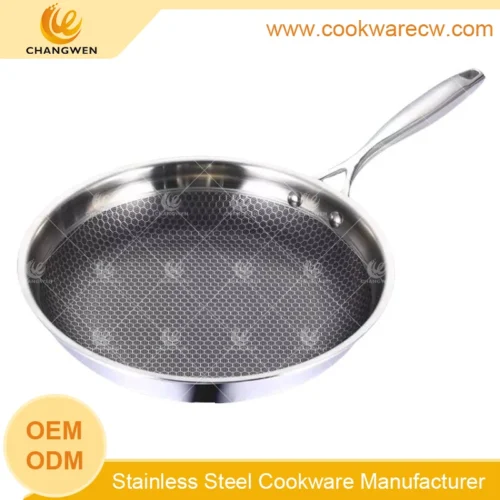
Honeycomb Stainless Steel Frying Pan for Even Cooking CW-TP011
-
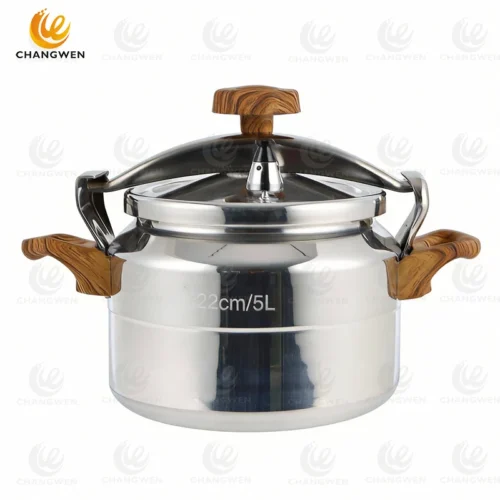
Pressure Cooker Stainless Steel for Healthy Cooking
-
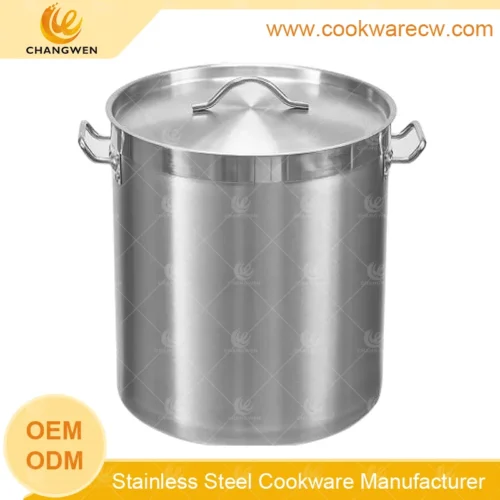
Wholesale Large Stock Pot CW-SP001
-
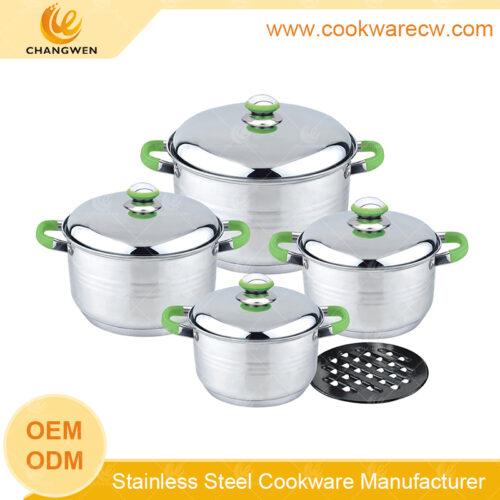
Stainless Steel Cookware Sets 9-Piece CW-M0903G
-
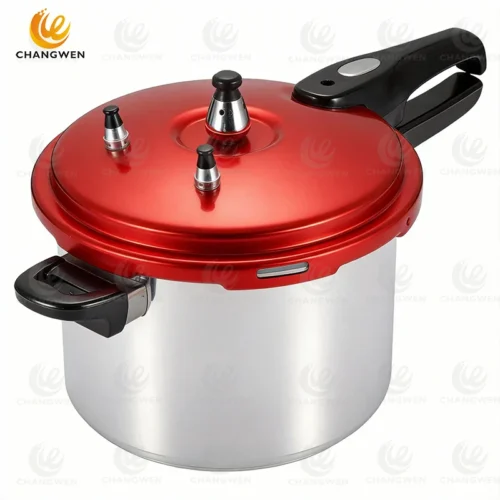
8 Qt Aluminum Pressure Cooker – Durable, Even-Heating, Easy-to-Use
-
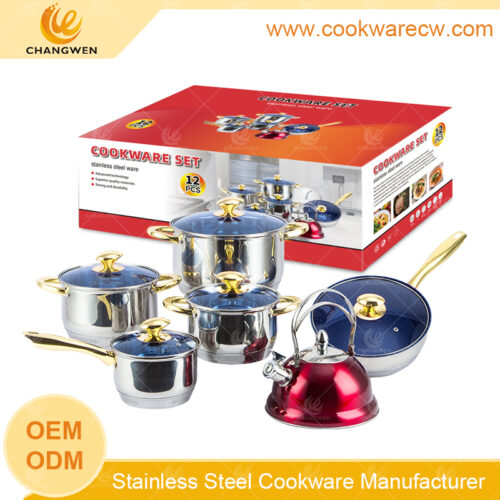
hot sales cookware supplier 12pcs cooking pots and pans stainless steel cookware set fry pan saucepan coating tea kettle CW-M1223
-
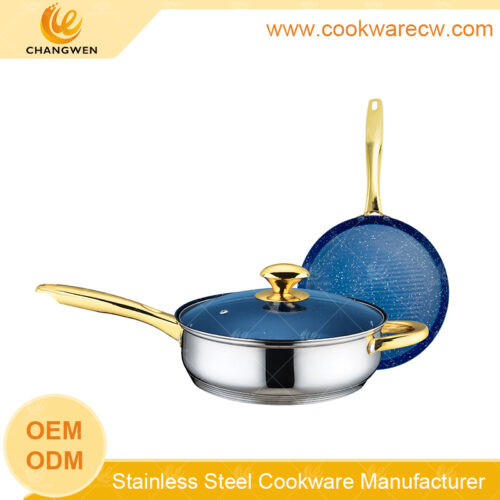
Best Quality Stainless Steel Pans
-
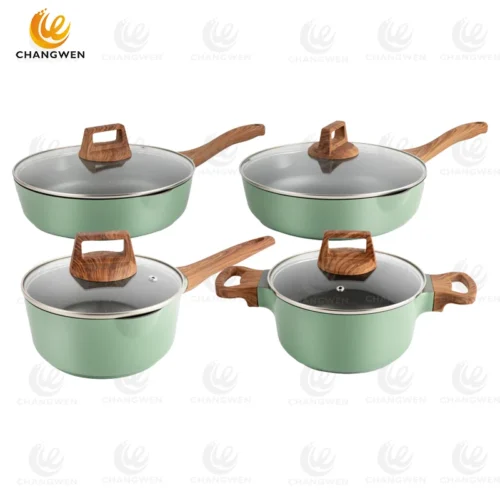
7pcs Die Cast Aluminum Cookware Set with Marble Nonstick Coating