Blog
Changwen is a leading cooking utensils manufacturers. We supply high quality stainless steel cooking pots and pans to all over the world. We can also customize the local hot-selling stainless steel pots and pans. Please send your requirements to Changwen.
How to Evaluate a Stainless Steel Cookware Supplier
Published by Changwen Cookware | Reading time: 10 minutes
Introduction
Choosing the wrong stainless steel cookware supplier is expensive. The consequences range from delayed shipments and quality disputes to product recalls, customs rejections, and lasting damage to your brand. And in the stainless steel kitchenware industry specifically, the risks are higher than in many other product categories — because the quality variables are harder to detect without proper verification.
A pan labeled “304 stainless steel cookware” may contain 201-grade steel. A supplier claiming LFGB certification may be showing a document from a different product batch. A factory presenting professional photos on Alibaba may outsource production to subcontractors with no quality control. None of these problems are visible until your products arrive at the warehouse or — worse — until your customers start complaining.
This guide gives you a systematic 10-point framework for evaluating any stainless steel cookware manufacturer before committing to a purchase order. It covers material verification, certifications, production capability, quality control systems, and the specific questions that distinguish reliable stainless steel kitchenware manufacturers from those that will cost you more than the money you saved on price.
Key Takeaways
- The most common fraud in stainless steel cookware supply chains is selling 201-grade steel as 304. Material grade verification is non-negotiable for any serious procurement program.
- 304 stainless steel cookware is the industry standard for cooking surfaces. 316 stainless steel cookware provides superior corrosion resistance for specific high-salt or high-acid applications and commands a price premium.
- Certifications must be verified against actual production batches — not just confirmed as existing documents.
- Factory capability must match your product specification: a stainless steel pot manufacturer optimized for composite-base construction is not the right partner for a full-clad tri-ply program.
- The safest stainless steel cookware comes from manufacturers with traceable material sourcing, documented QC processes, and verifiable third-party certifications — not from those with the lowest price.
- 5-ply 316 stainless steel cookware exists as a premium segment, but most buyers are better served by correctly specified 3-ply 304 cookware than by paying a premium for 5-ply 316 that may not be genuine.
Point 1: Verify Factory vs. Trading Company Status
The first question to answer before anything else: are you dealing with a manufacturer or a trading company?
A stainless steel cookware manufacturer owns production equipment and controls the manufacturing process directly. A trading company sources from multiple factories and adds a margin. Trading companies are not inherently bad — but they add cost, reduce your control over specifications, and create an additional layer between you and the actual production process.
How to verify:
- Ask directly: “Do you manufacture this product in your own facility?”
- Request photos of the actual production floor, stamping equipment, polishing lines, and assembly area
- Check business registration documents — manufacturing companies and trading companies are registered differently in China
- Look for the production address and cross-reference it with the factory location on maps
- Request a factory audit (see Point 9)
For any serious stainless steel cookware program, factory-direct relationships are strongly preferred over trading company intermediaries.
Point 2: Verify Stainless Steel Grade — The Most Critical Step
This is where most buyers fail — and where the most common quality fraud in the stainless steel supplies industry occurs.
The 201 vs 304 problem: 201 stainless steel is a lower-nickel alloy that looks identical to 304 on visual inspection. It is cheaper to produce, has lower corrosion resistance, and is not suitable for cookware marketed as food-grade 304. Unscrupulous suppliers sell 201 as 304 because buyers cannot tell the difference by looking at or handling the finished product.
What you need to know about the grades:
Stainless Steel Cookware Grade 304 (also marketed as 18/8 or 18/10):
- Contains 18% chromium, 8–10% nickel
- Food-grade, non-reactive, corrosion-resistant
- The global standard for quality stainless steel cookware inner surfaces
- Best 304 stainless steel cookware uses 18/10 (higher nickel content for better corrosion resistance and surface finish)
316 Stainless Steel Cookware:
- Contains 16–18% chromium, 10–14% nickel, plus 2–3% molybdenum
- Superior resistance to chloride pitting and acid corrosion
- Best 316 stainless steel cookware is appropriate for environments involving heavy salt, brine, or aggressive cleaning chemicals
- 316 stainless steel cookware brands position this as a premium product — price is 15–25% higher than 304
- 304 vs 316 stainless steel cookware: for most household and professional use, 304 is sufficient; 316 is a genuine upgrade for specific applications
How to verify material grade:
- Request the Material Test Report (MTR) from the supplier, showing heat number, chemical composition, and mechanical properties of the specific steel batch
- Use an XRF (X-ray Fluorescence) analyzer during factory inspection or third-party audit — this provides on-site elemental analysis confirming whether the steel is 304, 201, or another grade
- Send samples to an independent laboratory for chemical analysis
- Never accept verbal assurance or marketing claims as verification of steel grade
Point 3: Verify Certifications — And Check the Specifics
Certifications matter — but only when they are genuine, current, and applicable to your specific product. A supplier showing LFGB documentation for a product tested three years ago on a different product line is not the same as having current certification for your product.
Key certifications to verify for stainless steel cookware:
ISO 9001 — Quality management system certification. Confirms the manufacturer has documented quality processes. Required as a baseline for any serious supplier relationship.
LFGB (Germany / EU) — The key food contact standard for cookware in the European market. Tests for heavy metal migration (including nickel, lead, cadmium), corrosion resistance, and food safety. Essential for EU market entry.
FDA (US) — Confirms compliance with 21 CFR for food contact materials. Required for US market distribution.
NSF/ANSI 51 — Food equipment construction certification, relevant for commercial foodservice supply chains.
BSCI / SMETA — Social compliance auditing, relevant for buyers with corporate responsibility requirements.
How to verify certifications:
- Request original certificate documents, not scans of certificates
- Confirm the certificate issuing body is accredited (SGS, TÜV, Intertek, Bureau Veritas are recognized testing organizations)
- Check that the certificate scope covers your specific product type
- Verify the certificate validity date — certificates expire and must be renewed
- For LFGB specifically, confirm which metals and leaching limits were tested
Point 4: Evaluate Construction Capability Against Your Specification
Not all stainless steel cookware manufacturers produce the same constructions. A factory optimized for single-layer composite-base cookware is not the right partner for a full-clad tri-ply program. Mismatch between factory capability and your specification is a common source of quality problems.
The main construction types and what they require:
Single-layer with composite base (entry to mid-range): Stainless steel body with a multi-layer disc (201+aluminum+430) bonded to the bottom. Standard production equipment. Widely available from most stainless steel pot manufacturers.
Tri-ply full-clad (304-aluminum-430): Three layers running continuously from base through sidewalls. Requires cladding/rolling equipment and deep-drawing production lines. Not all factories have this capability. This is the construction for best 304 stainless steel cookware in the mid-to-premium segment.
5-ply 316 stainless steel cookware: Five bonded layers with 316L inner surface. Requires premium cladding equipment and 316L material sourcing. Very few factories genuinely produce this — most factories claiming 5-ply 316 production should be verified carefully.
How to evaluate construction capability:
- Request product samples with cross-section cuts showing the actual layer construction
- Ask to see production equipment during a factory visit or audit
- For tri-ply products, confirm the layers run up the sides of the pan, not just the base
- For 5-ply products, request material certificates specifically for the 316L steel layer
Point 5: Check Quality Control Processes
A supplier’s quality control system determines whether the product you ordered is the product you receive — consistently, across every production batch.
Three stages of QC to evaluate:
IQC (Incoming Quality Control): Does the factory verify the steel grade and thickness of incoming raw materials? A factory that accepts steel without incoming inspection cannot guarantee the grade of the finished product.
IPQC (In-Process Quality Control): Are there quality checkpoints during production — after forming, after polishing, after handle attachment? Or is QC only a final inspection?
OQC (Outgoing Quality Control): What is the sampling rate for final inspection? What are the acceptance criteria? What happens to rejected pieces?
How to evaluate:
- Ask to see QC documentation for a recent production batch
- Request the sampling plan and AQL (Acceptable Quality Level) standard used
- Ask what the most common defects found in production are, and how they are handled — a supplier who answers this question honestly has a real QC system; a supplier who claims “we never have defects” does not
- For stainless steel supplies specifically, ask how incoming steel grade is verified (XRF, mill certificates, or neither)
Point 6: Evaluate Production Capacity and Lead Times
Capacity verification matters in two directions: confirming the factory can handle your order volume, and confirming they will not be so overloaded that your order becomes a low-priority run.
Questions to ask:
- What is your monthly production capacity for this product type?
- What percentage of your current capacity is booked for the next 60–90 days?
- What is the standard lead time from order confirmation to shipment?
- What lead time applies during peak season (Q3–Q4)?
- Do you have backup suppliers for critical components (handles, lids, gaskets)?
Standard lead times for stainless steel cookware from China:
- Catalog products with no customization: 35–45 days
- OEM branding on existing product: 40–50 days
- Custom handle design requiring new tooling: add 4–6 weeks for mold development
- New product development from scratch: negotiate specifically
Point 7: Sample Testing Before Committing to Volume
Never commit to a production order without testing physical samples under real use conditions. This applies regardless of supplier reputation, certification claims, or price level.
What to test in samples:
Material verification: Use XRF testing on samples to confirm the steel grade matches the specification. This is the only reliable way to verify 304 vs 201 without laboratory analysis.
Construction verification: For tri-ply and multi-ply products, request a cross-section cut of a sample piece to visually confirm layer construction and thickness.
Heat distribution: Cook with the sample on the stovetop. Uneven heating, hot spots, or rapid burning in one area indicates inadequate construction or thin base material.
Warp resistance: Heat the pan to high temperature, then place on a flat surface. Quality stainless steel cookware should remain flat without warping.
Handle security: Test handle attachment under load and after thermal cycling. Riveted and welded handles should show no movement.
Finish consistency: Check polishing quality across the entire surface — brush marks, scratches, and inconsistent finishes indicate poor surface finishing processes.
Corrosion resistance: For extended testing, expose samples to dilute acidic solutions (vinegar, lemon juice) over 24–48 hours to check for surface staining or pitting.
Point 8: Assess Communication Quality and Responsiveness
Communication quality is a reliable predictor of the working relationship you will have with a stainless steel kitchenware manufacturer throughout production, inspection, and delivery.
Indicators of a reliable supplier:
- Responds to technical specification questions with specific, accurate answers (not generic marketing responses)
- Proactively flags potential issues with your specification (e.g., “this handle design will require a new mold — lead time adds 6 weeks”)
- Provides organized documentation when requested — material certificates, quality reports, packing specifications
- Has a dedicated export/sales contact who can follow through on commitments across the production cycle
Red flags in communication:
- Vague or evasive answers to direct questions about steel grade or construction
- Reluctance to provide material certificates or factory audit access
- Overly aggressive on price without engaging on specification details
- Long delays in responding to technical questions
Point 9: Factory Audit — On-Site or Third-Party
A factory audit is the most reliable verification method for any significant stainless steel cookware program. It confirms or refutes everything the supplier has claimed in their presentation.
Options:
- On-site visit: You or a representative visit the factory directly. Most reliable but requires travel.
- Third-party audit: Commission an audit through SGS, Bureau Veritas, Intertek, or a similar inspection company. Practical for initial supplier qualification without travel.
- Virtual factory tour: Acceptable for initial evaluation but not a substitute for physical audit in a serious program.
What to verify during an audit:
- Production floor layout and actual equipment on-site
- Material storage and incoming inspection procedures
- Production capacity against claimed output
- QC checkpoints in the production process
- Worker conditions and social compliance (for BSCI-required supply chains)
- Sample testing on finished goods from current production
Point 10: Review Commercial Terms and After-Sales Policies
Even an excellent manufacturer can create problems through unclear commercial terms. Confirm these in writing before signing any purchase order.
Payment terms: Standard in stainless steel kitchenware manufacturing is 30% deposit upon order confirmation, 70% balance before shipment. Avoid any supplier requiring 100% upfront payment for a first order.
Quality dispute process: What is the procedure if goods arrive with quality defects? What remedies are available — replacement, credit, refund? What documentation is required to initiate a claim?
Packaging specification: Confirm inner box, master carton, and packing quantity specifications in writing. Packaging errors are a common source of customs and logistics problems.
MOQ and pricing structure: Confirm MOQ per item, mixed-item order policies, and whether pricing tiers exist for higher volumes.
NDA availability: For OEM programs with proprietary designs, confirm the supplier will sign a non-disclosure agreement.
The Safest Stainless Steel Cookware: What It Takes to Qualify
The term “safest stainless steel cookware” is used extensively in consumer marketing — but for procurement teams, it has a specific technical meaning.
Truly safe stainless steel cookware requires:
- Verified food-grade inner surface: 304 (18/8 or 18/10) or 316 stainless steel confirmed by material test report and/or third-party testing — not claimed by the seller
- No heavy metal migration beyond regulatory limits: Confirmed by LFGB (EU) or FDA (US) food contact testing
- Intact surface integrity: No pitting, scratching, or coating damage that would expose base metal
- Traceable material sourcing: The manufacturer can provide mill certificates linking the raw material to the finished product
316 stainless steel cookware brands often use food safety as a marketing differentiator. 316 does provide better corrosion resistance than 304 in chloride-heavy environments. But the key point for procurement teams is this: a genuine 304 product from a certified manufacturer is safer than a fraudulent 316 claim from an unverified supplier. Grade verification matters more than grade selection.
FAQ
How do I tell if stainless steel cookware is really 304 and not 201?
Visual inspection and the magnet test cannot distinguish 304 from 201. The reliable methods are: XRF (X-ray Fluorescence) analyzer testing on-site during inspection, optical emission spectrometry in a laboratory, or review of the manufacturer’s material test report showing the chemical composition of the specific steel batch. Always request material certificates from any stainless steel cookware supplier.
What is the difference between 304 and 316 stainless steel cookware?
304 stainless steel cookware uses 18/8 steel (18% chromium, 8–10% nickel) and is the global standard for quality cookware cooking surfaces. 316 stainless steel cookware adds 2–3% molybdenum, providing superior resistance to chloride corrosion and pitting — particularly relevant for heavy-salt cooking environments. 316 costs 15–25% more than 304. For most household and standard professional use, 304 is the correct and sufficient specification.
Is 5-ply 316 stainless steel cookware genuinely worth the premium?
Only if the 316L claim is verified by material testing and the product is positioned for a genuine use case requiring superior chloride resistance. Most of the 5-ply 316 stainless steel cookware marketing is positioning — the construction upgrade from 3-ply to 5-ply provides modest real-world performance improvement, and the 316 material claim must be independently verified. Pay the premium only with verified documentation.
What certifications should a stainless steel cookware supplier in China hold?
At minimum: ISO 9001 (quality management), LFGB (EU market), FDA compliance (US market). For commercial foodservice supply: NSF/ANSI 51. For socially conscious supply chains: BSCI or SMETA. Always request original certificate documents and verify they are current and cover your specific product type.
How do I find reliable stainless steel cookware manufacturers in China?
Start with sourcing platforms (Alibaba, Made-in-China, Global Sources) for initial discovery, then move to direct factory contact. Key production clusters for stainless steel kitchenware manufacturers are Jiangmen and Chaozhou in Guangdong province. Attend the Canton Fair for face-to-face evaluation. Commission a third-party audit before placing a significant first order. The evaluation framework in this guide applies regardless of how you discover the supplier.
What should I specify in writing before placing a stainless steel cookware order?
The minimum written specification for any stainless steel cookware order should include: material grade and layer construction (e.g., 304 inner layer, aluminum core, 430 outer layer for tri-ply), wall thickness, handle material and attachment method, surface finish specification, induction compatibility requirements, certifications required (LFGB, FDA), packaging specification (inner box, master carton, packing quantity), MOQ, lead time, payment terms, and quality dispute process.
Conclusion
Evaluating a stainless steel cookware supplier is a structured process, not a gut-feel decision. The 10-point framework in this guide — factory verification, material grade confirmation, certification review, construction capability assessment, QC process evaluation, capacity verification, sample testing, communication quality, factory audit, and commercial terms — covers everything needed to distinguish reliable stainless steel pot manufacturers from those that will create problems after the purchase order is signed.
The most important single step is material grade verification. Everything else in the evaluation matters — but no amount of good communication or strong certifications compensates for a product built from the wrong steel. Verify the grade, verify the certifications, test the samples, and build the supplier relationship on documented agreements rather than verbal assurances.
The stainless steel kitchenware industry has excellent manufacturers producing genuinely high-quality products. The evaluation framework in this guide is designed to find them — and to avoid the ones that are not.
About Changwen
Changwen is a stainless steel cookware manufacturer based in Jiangmen, Guangdong, China, with over 22 years of OEM and ODM experience. We produce tri-ply 304 stainless steel cookware sets, frying pans, stock pots, steamer pots, pressure cookers, and GN pans for brands and distributors across South America, Southeast Asia, the Middle East, and Europe.
All production uses verified food-grade 304 stainless steel (18/8) with material certificates available for every batch. ISO 9001:2015 certified. LFGB and FDA compliant. Factory audits welcome.
MOQ from 1,000 units. 40-day lead time. Full OEM/ODM capability.
📧 changwen@cwcooking.com 📞 0086-18022963948 🌐 www.cookwarecw.com/contact-us
Popular Blog
Which is better S/S 410 or S/S 201?
How to distinguish true and fake stainless steel pots?
The Correct Ways to Use Stainless Steel Pots and Its Precautions
Things to Consider When Buying Stainless Steel Cookware
What are the popular advantages of stainless steel cookware?
304 vs 316L Stainless Steel Cookware Buyer’s Guide
How to repair stainless steel composite pot bottom?
What Materials are Used in Frying Pans, and Which are Good?
Why do stainless steel pots stick?
Why choose stainless steel cookers and what should be paid attention to?
Tags
Recommend Products

Premium Stainless Steel Frying Pan for Daily Cooking CW-TP010
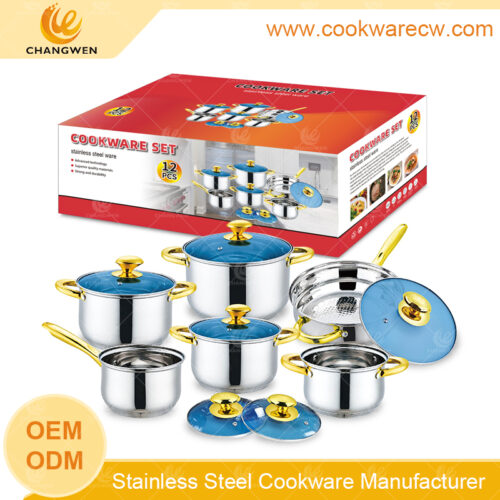
Mexican hottest stainless steel 12pcs cook pot frying pan with blue glass lid golden handle & knobs and 7 steps capsuled bottom CW-M1209
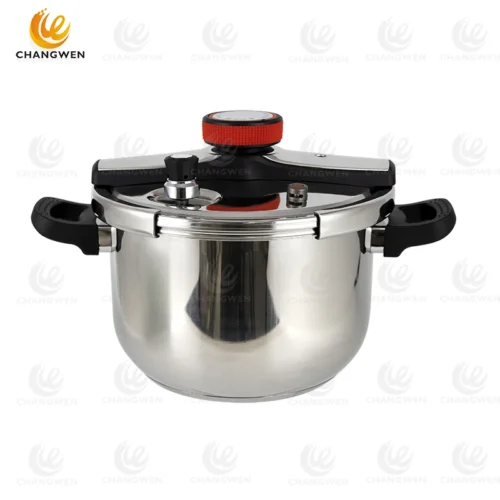
Wholesale Stainless Steel Stovetop Pressure Cooker
Best Quality Stainless Steel Pots And Pans
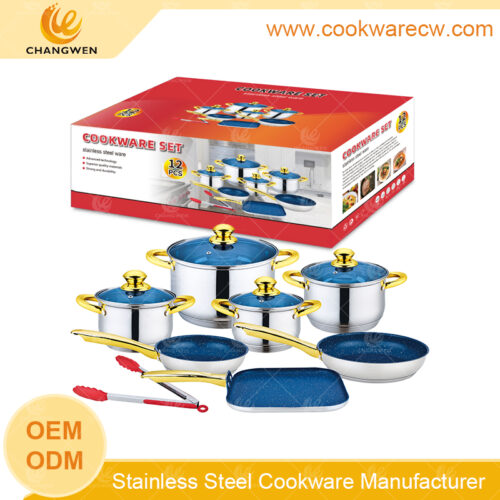
Hot sale SS ollas non-stick coated frying pans and pots stock pot with a kitchenware clip CW-M1204
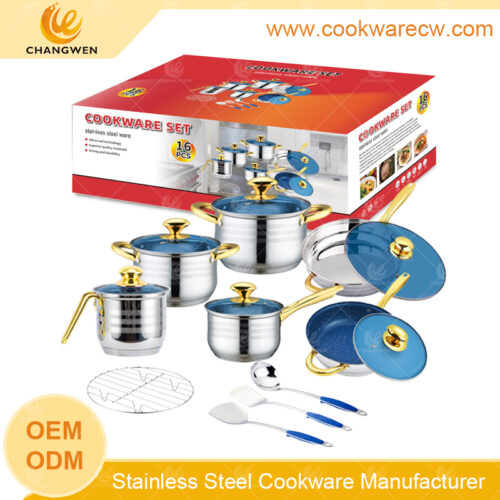
Heavy high quality stainless steel pots and pans 16pcs cookware set with gold plated nonstick fry pan steamer rack and slotted turner spatula ladle CW-M1601
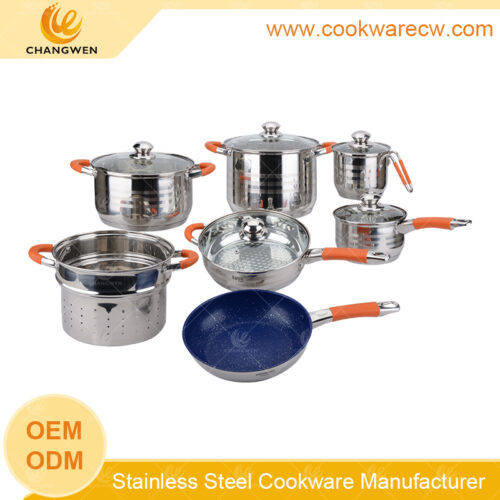
High-Quality Stainless Steel Pot Set with Heat-Resistant Handles CW-TP0603
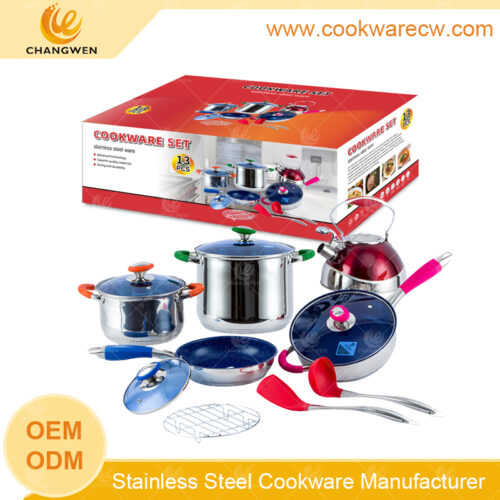
Heavy weight pots wholesale 13pcs stainless steel cookware colored silicone pots nonstick grilled frypan set with 5 steps capsule bottom 3L whistling tea kettle with frying basket kitchen tools spatula ladle CW-M1302G