
Read time: 12 minutes
Introduction
Sourcing stainless steel cookware from China is not complicated. But it is precise.
Every year, importers pay too much, receive the wrong product, or end up with quality disputes that cost more than the savings on the original order. Almost every one of these failures has the same root cause: a sourcing process that skipped a step or accepted a vague answer where a documented fact was required.
This guide gives you a complete, step-by-step sourcing process — from writing your first product specification through to loading your container. Each step has a specific output. Each output protects you from the failures that happen when that step is skipped.
China produces the majority of the world’s stainless steel cookware. The factories, the supply chains, and the export infrastructure are mature. The risk is not that quality cookware from China does not exist. The risk is that without a structured sourcing process, you will not reliably find it.

Key Takeaways
- Build your specification before you contact a single factory. Vague briefs produce vague quotes, wrong samples, and unreliable production runs.
- China’s stainless steel cookware manufacturing is geographically concentrated. Jiangmen (Guangdong) is the primary cluster for stainless steel cookware. Knowing where to look narrows the field from thousands of generic results to a specific, qualified manufacturing ecosystem.
- The 201-for-304 substitution is the most common quality fraud in stainless steel cookware sourcing. XRF testing and mill certificate requirements are the only reliable countermeasures.
- Factory vs trading company is a decision that determines your level of specification control, pricing, and problem-resolution capability. For any serious sourcing program, factory-direct is the correct model.
- Sample sign-off in writing before any production order is non-negotiable. Samples approved verbally or by implication are not binding on the factory.
- MOQ from 1,000 units is the standard entry point for OEM programs at established stainless steel cookware factories.
- The complete sourcing cycle — specification to shipment — takes 8–14 weeks for catalog OEM products.
Step 1: Write Your Product Specification Before Anything Else
This is the step most importers skip. It is the step that causes most of the problems that come later.
A product specification is a written document that defines exactly what you are ordering. Not a description of a competitor product. Not a mood board. A document with specific, measurable parameters that a factory can quote against, produce to, and be held accountable for.
What a Complete Cookware Specification Includes
Product type and set composition What specific product or products are you ordering? A 5-piece cookware set? Individual 24cm frying pans? A stock pot in a specific capacity? For sets, list every piece, size, and quantity.
Material grade
- Inner cooking surface: 304 stainless steel (18/8) is the standard. 316L for specific applications requiring higher corrosion resistance.
- Construction: full-clad tri-ply (304-aluminum-430, layers through base and sidewalls) or disc-base (single-layer body with composite disc bonded to base).
- For tri-ply: specify aluminum core thickness. For disc-base: specify disc composition and thickness.
- Outer layer: 430 stainless steel for induction compatibility.
Dimensions and wall thickness Diameter, height, and capacity in liters. Wall thickness in millimeters — this is the most important structural specification and the one most commonly left vague. Minimum 2.4mm total wall for tri-ply; minimum 0.8mm body wall plus 3mm+ disc for disc-base.
Surface finish Exterior and interior specified separately. Brushed, mirror polish, matte, PVD color, hammered. Reference standard: “brushed 180-grit directional finish, no cross-hatching” is a specification; “brushed” alone is not.
Handle specification Material (cast stainless steel, hollow stainless steel, Bakelite, silicone-coated Bakelite), attachment method (riveted or welded), oven-safe temperature rating if applicable, handle angle geometry.
Lid specification Glass or stainless steel. Rim fit tolerance. Knob material and oven-safe temperature. Pour holes: yes or no.
Branding Logo application method (laser engraving, embossing, etching). Placement (pot body, handle, lid). Logo file format (vector AI or EPS required for engraving).
Packaging Standard white box, custom printed retail box, gift configuration. Dimensions, language requirements, barcode specification, carton count.
Certifications required LFGB for EU/German market. FDA compliance for US market. NSF/ANSI 51 for US commercial foodservice. ISO 9001 as baseline. List every certification required for your target market.
Target quantity and Incoterms FOB quantity, preferred Incoterms (FOB is standard for importer-arranged freight), and target shipment date.
Why This Step Determines Everything That Follows
A factory that receives a complete specification produces an accurate quote. A factory that receives a vague brief guesses — and when their guess differs from your expectation, the dispute about who is responsible begins.
Write the specification. Every decision you make while writing it is a decision you would otherwise make in reaction to a problem.
Step 2: Understand Where China’s Stainless Steel Cookware Is Made
China’s cookware manufacturing is not uniformly distributed. It is concentrated in specific regional clusters, each with distinct specialization. Knowing which cluster produces what you need focuses your search before you contact a single factory.
The Primary Manufacturing Clusters
Jiangmen, Guangdong (Xinhui District, Sanjiang Town) China’s primary cluster for stainless steel cookware. Over 300 dedicated kitchenware factories. Specialization in tri-ply full-clad cookware sets, stock pots, steamer pots, pressure cookers, and frying pans. Deep supply chain integration: 304 stainless coil suppliers, aluminum disc manufacturers, handle foundries, lid stampers, and packaging manufacturers are all within a 20-kilometer radius.
The supply chain concentration in Jiangmen means a FOB price from a Jiangmen factory is typically 15–25% lower than equivalent specification from a more isolated factory, with shorter component procurement lead times.
Chaozhou (Caitang Town), Guangdong Over 300 factories. Specialization in saucepans, frying pans, composite-base cookware, and premium surface finish products. Strong export infrastructure to European and North American markets. Caitang manufacturers are a significant source for branded OEM programs targeting premium retail.
Yongkang, Zhejiang Large manufacturing base with diverse product range. Strong in pressure cookers, vacuum flasks, and kitchen accessories. Less specialized in premium stainless steel cookware than Jiangmen or Chaozhou.
Yangjiang, Guangdong The knife capital of China. Dominant in kitchen knives, scissors, and cutting tools. If you are sourcing cutting tools, this is the correct cluster. For stainless steel cookware, Jiangmen and Chaozhou are the relevant regions.
The Practical Implication
When searching for stainless steel cookware manufacturers, filter search results by location. A factory in Jiangmen with 20 years of export experience is a fundamentally different proposition from a general metal fabricator in an unrelated manufacturing region claiming to produce cookware.
Step 3: Find and Shortlist Factories — Factory vs Trading Company
Where to Find Factories
Alibaba, Made-in-China, Global Sources: Starting points for discovery. Search with product-specific terms (“tri-ply stainless steel cookware manufacturer Jiangmen”, “304 stainless cookware set OEM factory”). Filter by “manufacturer” designation, years in operation, and export experience.
Canton Fair (Guangzhou, twice yearly — April and October): The most comprehensive face-to-face sourcing event for cookware. Hundreds of stainless steel, non-stick, and cast iron manufacturers exhibit. Evaluating multiple factories in a single trip accelerates the shortlisting process significantly.
Industry referrals: Other importers in your network who source kitchenware from China are the most reliable source of factory recommendations. A factory that has delivered for a trusted peer is a validated starting point.
Google: Direct searches for specific factories in specific clusters. Established factories with export experience maintain websites in English. A factory without any English-language web presence is less likely to have the export infrastructure for international programs.
Factory vs Trading Company: The Most Important Distinction
This question determines your specification control, pricing, and problem-resolution capability throughout the sourcing relationship.
A factory (manufacturer):
- Owns production equipment and controls the manufacturing process
- Can implement and verify specific material grades and construction details
- Provides traceable material test reports (mill certificates) for the actual production batch
- Has production personnel who can answer technical questions accurately
- Can accommodate factory audits — the visitor sees real production, not a showroom
A trading company:
- Sources from multiple factories, adding a margin
- Cannot directly control production specifications — they relay your requirements to their factory contacts
- Material certificates may not be batch-specific
- Cannot authorize factory audits to the actual production facility
- Appropriate for buyers who need product variety from multiple categories — not for buyers who need specification control and traceable quality
How to distinguish them: Ask directly: “Is this product manufactured in your own factory?” Ask for the factory address and cross-reference it with the business address. Request photos of the production floor, stamping equipment, and polishing lines. Ask which factory produced a specific batch of samples — a factory can answer this; a trading company often cannot.
Shortlisting Criteria
From an initial list of 10–20 potential suppliers, narrow to 3–5 based on:
- Specialization match: Does the factory’s core production align with your product type? A factory that produces 80% non-stick aluminum may not be the right partner for a tri-ply stainless program.
- Certifications visible: ISO 9001, LFGB, FDA — can they show certificates at the inquiry stage?
- OEM track record: Have they executed private label programs? Can they show examples?
- Communication quality: Technical questions answered accurately and promptly, not with generic marketing responses.
- Location: Jiangmen or Chaozhou for stainless steel cookware.
Step 4: Send an RFQ and Evaluate Responses
An RFQ (Request for Quotation) is your product specification document sent to shortlisted factories with a request for pricing, lead time, and sample offer.
What Your RFQ Should Include
- Your complete product specification (see Step 1)
- Target quantity for first order and annual volume projection
- Required Incoterms (FOB is standard)
- Required certifications
- Sample requirements (how many, which items, any specific test requirements)
- Response deadline
How to Evaluate RFQ Responses
Price: FOB factory price per unit at your target quantity. Compare like-for-like: ensure each factory is quoting the same specification. A lower price that reflects a lower wall thickness or different steel grade is not a comparable quote.
Specification confirmation: Did the factory confirm they can produce to your exact specification, or did they substitute elements? Any substitution should be flagged and discussed before proceeding.
Certification confirmation: Can they confirm all required certifications with original documentation?
Sample lead time: 7–21 days for catalog products; 4–6 weeks for custom tooling.
Communication quality: How thoroughly did they answer your RFQ? Factories that respond with accurate, detailed quotes have the engineering attention required for a reliable OEM program.
Red flags in RFQ responses:
- Price significantly below market (current FOB for tri-ply cookware sets: $18–$35 per set for mid-premium specification) — investigate before proceeding
- Reluctance to confirm material grade in writing
- No mention of certifications until pushed
- Generic response that does not address your specific requirements
Step 5: Order and Evaluate Samples
Samples are the physical test of whether the factory can produce what they claimed to quote.
How to Order Samples That Reveal the Truth
When ordering samples, include your specification document and specify that you require samples produced to that specification — not the factory’s standard catalog product unless it matches.
Request the factory’s Sample Specification Sheet with the sample: a document confirming the material grade, wall thickness, construction type, surface finish reference, and handle attachment method of the specific sample being sent.
Technical Sample Evaluation
Material grade: The only reliable way to verify 304 vs 201 stainless steel in a sample is XRF (X-ray Fluorescence) testing or laboratory chemical analysis. Visual inspection and the magnet test cannot distinguish 304 from 201. For any significant sourcing program, commission XRF testing on samples before approving production.
Wall thickness: Measure with a micrometer at multiple points — base, sidewalls at 1/4 height, sidewalls at 3/4 height. Confirm measurements match the specification.
Base flatness: Place the pan on a precision flat surface and check for rocking. A quality cookware base is flat within 0.5mm.
Heat distribution: Heat the pan on a stove and use an infrared thermometer to map temperature across the surface at 30-second intervals. An even temperature distribution within 10°C across the base and sidewalls indicates quality construction. Hot spots indicate single-layer construction or thin base disc.
Warp resistance: Heat the pan to high temperature, then check flatness. Quality construction does not warp under normal use conditions.
Handle security: Apply lateral and torsional load to the handle. There should be no movement at the attachment point.
Surface finish: Check polishing consistency — brush marks, scratches, uneven texture zones. For brushed finish, confirm the directional consistency across the entire surface.
Logo quality: If the sample includes your logo, check depth, clarity, placement accuracy, and whether the edges are sharp or ragged.
Sample Sign-Off: The Critical Written Step
Verbal sample approval does not protect you. When you are satisfied with the sample, send a written approval email that confirms:
- We approve the sample received “date” as the production standard for “product specification”
- List any specific deviations from the original specification that are acceptable
- List any remaining open items that must be confirmed before production begins
This email, combined with the factory’s Sample Specification Sheet, forms the written production standard. Any deviation in production from this standard is a verifiable quality issue.
Step 6: Negotiate and Sign a Purchase Order
The purchase order (PO) is the contractual document that governs the production run. Verbal agreements about price, specification, and delivery do not protect you.
What Must Be in the Purchase Order
Product specification: Reference the approved sample and Sample Specification Sheet. Include key specifications explicitly — steel grade, wall thickness, surface finish, construction type.
Certifications: List every required certification. Confirm the factory will provide original documents (not photocopies) with the shipment.
MOQ and quantity: Units per item, total units.
Price: FOB price per unit and total order value, currency.
Payment terms: Industry standard is 30% deposit on order confirmation, 70% balance before shipment after pre-shipment inspection approval. Never pay 100% upfront for a first order with a new factory.
Lead time: Production completion date from deposit receipt.
Pre-shipment inspection: Specify whether you will commission third-party pre-shipment inspection (recommended for first orders). State that shipment is conditional on passing inspection.
Quality dispute process: Define what constitutes a quality defect, what documentation is required to raise a claim, and what remedies are available (replacement, credit, refund).
NDA (if applicable): If you are sharing proprietary packaging designs, logo artwork, or product designs, sign an NDA before sharing and reference it in the PO.
Step 7: Monitor Production and Quality Control
Understanding the Factory’s QC System
Reliable factories operate three quality control stages:
IQC (Incoming Quality Control): Incoming raw materials are inspected before entering production. For stainless steel cookware, this means XRF verification of steel grade on incoming coil, thickness measurement, and mill certificate review. Ask to see the IQC procedure and recent IQC records.
IPQC (In-Process Quality Control): Quality checkpoints during production. Dimensional inspection after forming. Surface finish inspection after polishing. Handle attachment verification after assembly. Factories with IPQC catch problems while the production run can still be corrected.
OQC (Outgoing Quality Control): Final AQL sampling inspection before packaging. The OQC report should list the parameters checked, sample size, and results. Request the OQC report as part of your shipment documentation.
Production Progress Communication
Establish a communication cadence at the time of PO confirmation:
- Confirmation when raw material is received and IQC passed
- Update when production begins
- Notification when production is complete and goods are ready for inspection
For time-sensitive programs, weekly updates during production are appropriate. A factory that resists providing production updates is a factory without systems — not a factory with nothing to report.
Step 8: Pre-Shipment Inspection
Pre-shipment inspection is the last opportunity to catch quality problems before goods are loaded into a container and shipped internationally.
When Pre-Shipment Inspection Is Non-Negotiable
- First order with any new factory, regardless of sample quality
- Any order above 5,000 units
- Any order where the production run has involved substitutions or changes from the approved sample
How to Commission a Pre-Shipment Inspection
Contact SGS, Bureau Veritas, Intertek, or a similar accredited inspection organization. Provide them with:
- Your product specification and approved sample specification sheet
- AQL standard (typically AQL 2.5 for general consumer goods)
- Specific inspection criteria (dimensional tolerances, surface defect classification, handle attachment test)
- Factory name and address, contact person, and appointment window
The inspection company sends an inspector to the factory, conducts sampling and testing, and provides a written inspection report within 24–48 hours of the inspection.
If the inspection passes, authorize shipment. If it fails, require rework and re-inspection before release.
The cost of a pre-shipment inspection (typically $200–$400) is the lowest-cost quality assurance step in the entire sourcing process.
Step 9: Export Documentation and Shipment
Standard Documentation Package
A complete export documentation package for stainless steel cookware includes:
- Commercial invoice: FOB price, HS code, country of origin, Incoterms, total value
- Packing list: Carton count, pieces per carton, net and gross weight, total CBM
- Bill of lading: Issued by the freight forwarder after container loading
- Certificate of origin: Chinese origin for customs purposes; Form E for ASEAN-China FTA; Form N for ChAFTA (Australia)
- LFGB test reports: For EU/German market — original test reports from accredited laboratory
- FDA compliance documentation: For US market
- Material test reports (MTRs): Mill certificates confirming steel grade for the production batch
Freight and Incoterms
FOB (standard): The factory delivers to the vessel at the origin port. You arrange and pay for ocean freight, insurance, and all costs from the origin port onward.
CIF (Cost Insurance Freight): The factory arranges and pays for freight and insurance to the destination port. You pay customs and inland delivery. More convenient but less control over freight quality and cost.
For importers with established freight relationships, FOB is generally preferred. For first-time importers or smaller programs, CIF reduces coordination burden.
Ocean Freight Lead Times from Jiangmen to Key Markets
| Destination | Transit Time (Port-to-Port) |
|---|---|
| South America (Brazil, Chile) | 30–40 days |
| Southeast Asia (Vietnam, Thailand, Philippines) | 7–12 days |
| Middle East (UAE, Saudi Arabia) | 18–25 days |
| Europe (Germany, UK, Netherlands) | 28–35 days |
| Australia (Sydney, Melbourne) | 12–18 days |
| US East Coast | 25–32 days |
| US West Coast | 15–20 days |
The Complete Sourcing Timeline
| Step | Activity | Timeline |
|---|---|---|
| 1 | Write product specification | 1–3 days |
| 2 | Research manufacturing clusters | 1 day |
| 3 | Identify and shortlist 3–5 factories | 3–7 days |
| 4 | Send RFQ, evaluate responses | 5–10 days |
| 5 | Order samples, evaluate, request revisions | 10–30 days |
| 6 | Sample sign-off, PO negotiation and issuance | 5–10 days |
| 7 | Production (standard OEM program) | 40 days |
| 8 | Pre-shipment inspection | 2–5 days |
| 9 | Documentation preparation, container loading | 3–5 days |
| 10 | Ocean freight to destination | 7–40 days |
| Total (catalog OEM, EU/US destination) | 13–20 weeks |
Common Sourcing Mistakes and How to Avoid Them
Accepting verbal specification confirmations. Every material grade claim, wall thickness commitment, and certification promise must be in writing. Email is sufficient; verbal conversations are not.
Skipping material verification on samples. Visual inspection cannot distinguish 304 from 201 stainless steel. XRF testing on samples costs $50–$150 and is the only reliable verification. Skip it and you are trusting the factory’s word on the most fraud-prone specification in the category.
Approving samples informally. A sample that is approved without a written sign-off document and a Sample Specification Sheet is not a binding production standard. The factory may interpret “looks good” differently when production begins.
Choosing on price alone. The landed cost of a cookware shipment includes import duties (25–37% total effective rate for US-bound China-origin goods in 2026), freight, insurance, and customs fees. A factory that saves $2/unit on FOB price but cannot provide LFGB documentation, ships late, or delivers below specification costs far more than $2/unit to remediate.
Not reading the Incoterms. FOB means the factory’s responsibility ends when goods are on the vessel. CIF means they arrange freight to your destination port. DDP means they handle everything including customs at your destination. Know which one you are buying and what that means for your cost and control.
Treating the first order as the end of due diligence. A factory that delivers a good first order is not necessarily a reliable long-term partner. Build ongoing QC processes — consistent material verification, periodic pre-shipment inspections — into your sourcing program, not just the first shipment.
FAQ
How do I find a reliable stainless steel cookware manufacturer in China?
Start with sourcing platforms (Alibaba, Made-in-China) filtered by location (Jiangmen or Chaozhou for stainless steel specialists) and supplier type (manufacturer, not trading company). Attend the Canton Fair for face-to-face evaluation. Shortlist 3–5 factories based on specialization match, certifications, OEM track record, and communication quality. Commission a factory audit before your first significant order.
How do I verify the steel grade is really 304 and not 201?
XRF (X-ray Fluorescence) testing on finished goods is the only reliable method. Visual inspection and the magnet test cannot distinguish 304 from 201. Commission XRF testing on samples before approving production. Require mill certificates (Material Test Reports) from the steel supplier showing chemical composition for every production batch.
What is the standard MOQ for stainless steel cookware from China?
For catalog products with OEM branding (logo, custom packaging), the standard MOQ at established factories is 1,000 units per item. Custom tooling programs (new handle shapes, proprietary designs) typically require 3,000–5,000 units per SKU to amortize tooling costs.
What certifications do I need for different markets?
For EU/German market: LFGB food contact certification (test reports from accredited laboratory — SGS, TÜV, Bureau Veritas). For US retail: FDA compliance documentation. For US commercial foodservice: NSF/ANSI 51. For Australia: LFGB test reports satisfy FSANZ food contact requirements; certificate of origin for ChAFTA duty reduction. ISO 9001 is the baseline quality management standard expected in all markets.
What is the total time from first inquiry to product in my warehouse?
For catalog OEM products: 8–14 weeks from first inquiry to shipment, plus freight transit. With ocean freight, total time to warehouse is 13–20 weeks depending on destination. Custom tooling programs add 4–6 weeks for tooling development before production begins.
Is it better to use FOB or CIF pricing?
FOB (Free on Board) gives you control over freight selection, insurance, and cost from the origin port. CIF (Cost Insurance Freight) includes freight and insurance to the destination port in the factory’s price — more convenient but less control. For importers with established freight relationships, FOB is preferred. For new importers or small programs where freight coordination is burdensome, CIF is acceptable.
Conclusion
Sourcing stainless steel cookware from China is a process, not a search.
The factories with genuine capability are in Jiangmen and Chaozhou. The materials are verifiable by XRF and mill certificates. The certifications are documentable with original test reports from accredited laboratories. The quality control is auditable. The process from specification to shipment takes 13–20 weeks for a catalog OEM program.
What separates importers who build reliable, profitable supply chains from those who manage quality disputes is the discipline to follow the process: write the specification, verify the materials, get sample sign-off in writing, commission pre-shipment inspection, and document every agreement.
None of these steps are complicated. All of them are necessary.
Source Stainless Steel Cookware Directly from Changwen
Changwen is a stainless steel cookware manufacturer based in Jiangmen, Guangdong, China, with over 22 years of OEM and ODM export experience. We produce tri-ply 304 stainless steel cookware sets (304-aluminum-430 full-clad construction), frying pans, stock pots, steamer pots, pressure cookers for brands and distributors across South America, Southeast Asia, the Middle East, Europe, and Australia.
What we provide with every order:
- XRF-verified 304 stainless steel, mill certificates for every production batch
- IQC + IPQC + OQC quality control with written reports
- LFGB test reports from accredited laboratories
- FDA compliance documentation
- ISO 9001:2015 certification
- Complete export documentation package
- Pre-shipment inspection supported and welcomed
-
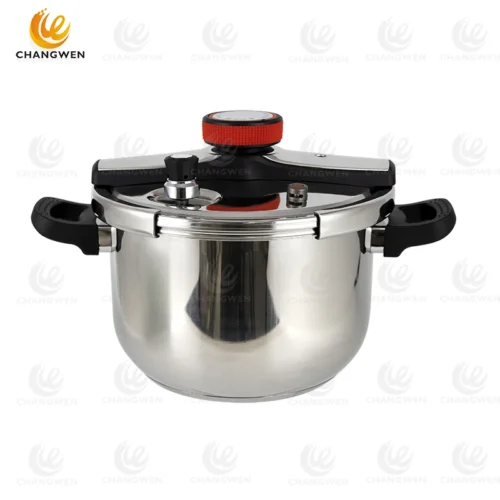
Wholesale Stainless Steel Stovetop Pressure Cooker
-
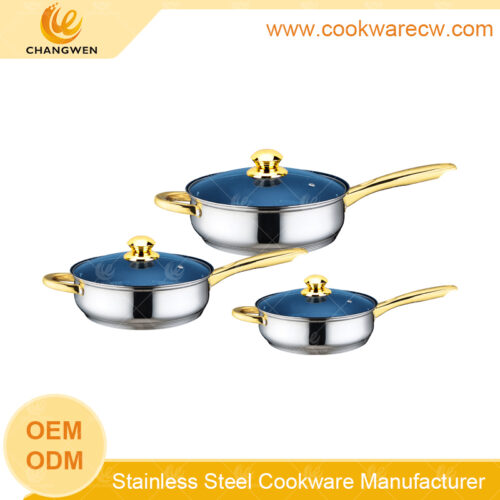
Best Nonstick Stainless Steel Pan
-
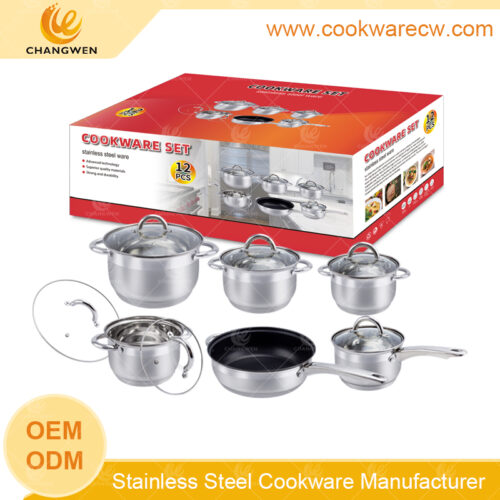
Stainless Steel Cookware Sets 10-Piece CW-M1228
-
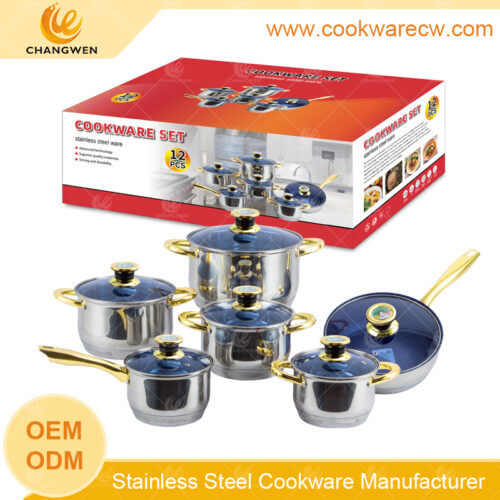
Pots wholesale cookware set 12pcs stainless steel pots and pans nonstick fry pan with thermal knobs and golden handles blue glass lids CW-M1215
-
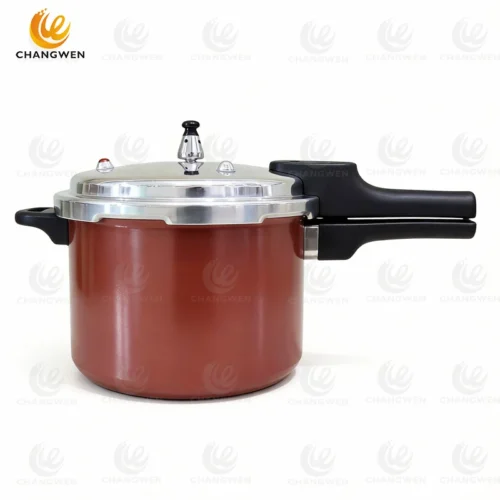
Pressure Cooker Aluminum – Single-Hand Rotation & Safety
-
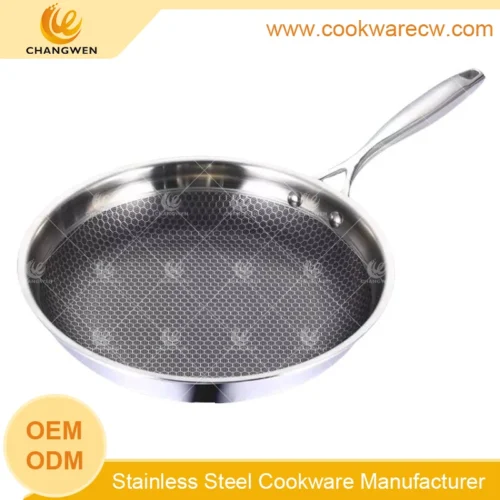
Honeycomb Stainless Steel Frying Pan for Even Cooking CW-TP011
-
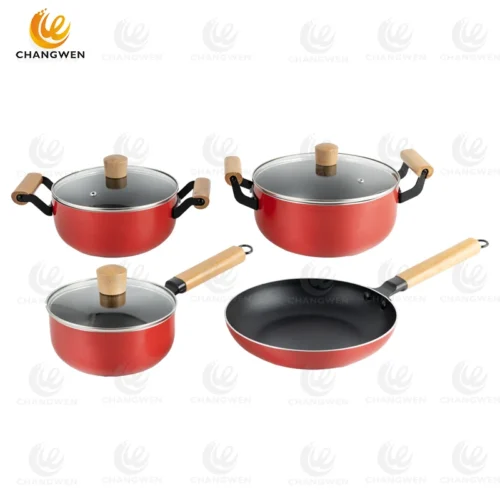
7pcs Fluorine-Free Ceramic Nonstick Aluminum Cookware Set for Kitchenware Brands
-
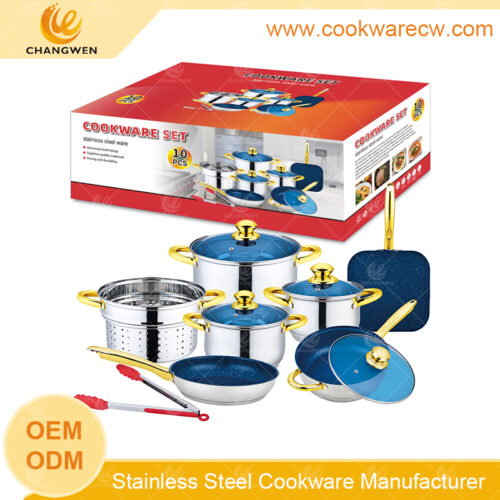
Stainless steel cookware set nonstick pans and pots casserole pot frying pan steamer with glass blue lid and a kitchenware clip CW-M1203