Blog
Changwen is a leading cooking utensils manufacturers. We supply high quality stainless steel cooking pots and pans to all over the world. We can also customize the local hot-selling stainless steel pots and pans. Please send your requirements to Changwen.
Top 10 Aluminum Cookware Manufacturers In China
Challenge for importers sourcing aluminum cookware suppliers is not finding factories in China. It is identifying which manufacturers have the production capability, proper certifications, and export experience to be reliable long-term partners. China has long been a global leader in cookware production, and aluminum cookware is favored for its durability, heat conductivity, and affordability. This guide ranks the top 10 aluminum cookware manufacturers in China, covers key selection factors including safety certifications and customization capabilities, and provides a practical buying guide for wholesalers and brand owners.
Key Takeaways
Chinese aluminum cookware manufacturers offer compelling advantages for global importers, combining cost-effectiveness with advanced production capabilities and comprehensive customization options.
• Chinese manufacturers provide 30-40% cost advantages through lower labor costs while maintaining ISO 9001 and FDA certifications for international market access.
• Production capacity averages 500 metric tons annually with 40-day lead times, though MOQs typically start at 1,000 units per item for standard products.
• Successful sourcing requires verifying factory credentials, negotiating comprehensive contracts, and implementing four-stage quality inspection protocols from raw materials to pre-shipment.
• Material quality matters significantly – look for 3mm bottom thickness, hard-anodized surfaces, and third-party safety certifications rather than relying on internal quality claims alone.
When selecting aluminum cookware suppliers, prioritize manufacturers with proven export experience, proper certifications, and production capabilities that match your volume requirements. The combination of competitive pricing, technical expertise, and customization flexibility makes Chinese manufacturers attractive partners for building sustainable cookware supply chains.
Why choose aluminum cookware manufacturers from China
China’s aluminum cookware manufacturing sector offers distinct advantages that extend beyond basic production capacity. Understanding these benefits helps explain why global importers and wholesalers continue to prioritize Chinese aluminum cookware suppliers for their sourcing needs.
Cost-effectiveness and competitive pricing
Lower labor and manufacturing costs give Chinese aluminum cookware manufacturers a competitive edge in international markets. China supplies a substantial portion of global demand for aluminum cookware, serving diverse markets from North America to Europe. The cost-effectiveness of production allows manufacturers to offer competitive pricing while maintaining acceptable profit margins. Export revenues from pressed aluminum cookware contribute significantly to China’s GDP, supporting economic growth and industrial development.
Advanced manufacturing technology
China’s aluminum kitchenware industry operates with extensive experience and mature manufacturing processes. Manufacturers employ multiple techniques including casting, die-casting, stamping, and welding. Many cookware factory China operations have invested in modern production facilities with full-automatic die casting lines, reciprocating coating lines, and automated packing systems. Advancements in manufacturing technologies have enhanced both production efficiency and product quality, driving increased export volumes.
Quality certifications and standards
Chinese manufacturers have improved quality management to meet domestic and international standards. Major producers hold ISO 9001 certifications for quality management systems alongside BSCI (Business Social Compliance Initiative) compliance. Aluminum cookware brands targeting Western markets obtain FDA food contact materials certifications and LFGB approval for European distribution. The Cookware Company Ltd achieved ASI Performance Standard V3 (2022) Certification at its Jiangmen facility, demonstrating commitment to environmental, social, and governance criteria. These certifications provide documented assurance that products meet regulatory expectations for safety and quality.
Customization capabilities
Chinese aluminum cookware suppliers offer OEM and ODM services, allowing buyers to create products matching specific requirements. Manufacturers provide customization spanning design, molding, and production phases. This flexibility supports wholesalers developing private label aluminum cookware sets or brands requiring unique specifications for target markets.
Key factors to consider when selecting aluminum cookware manufacturers
Sourcing decisions hinge on multiple technical and operational factors that directly impact product quality and business viability. Evaluating aluminum cookware suppliers requires examining material specifications, regulatory compliance, and logistical capabilities.
Material quality and durability
Aluminum offers superior heat conductivity compared to other materials, enabling even heat distribution and faster cooking. The metal is naturally lightweight, corrosion-resistant due to its protective oxide layer, and cost-effective compared to stainless steel or copper alternatives. Raw material consumption, particularly aluminum ingots and scrap, accounts for approximately 60-70% of total operating expenses in manufacturing. Thickness specifications matter, as bottom width of at least 3mm prevents warping during high-heat cooking. Heavy-gage aluminum resists deformation better than thinner variants and provides longer product life. Hard-anodized aluminum delivers enhanced surface hardness, scratch resistance, and non-reactive cooking surfaces.
Safety certifications
Regulatory compliance separates reliable china cookware manufacturers from risky suppliers. FDA certification under 21 CFR 175.300 is mandatory for US market access, while LFGB approval opens European distribution channels. ISO 9001:2015 certification demonstrates quality management system standards. Third-party testing through organizations like SGS and Intertek provides documented verification of safety standards. Buyers should request heavy metal migration test reports based on recognized protocols rather than relying solely on internal quality claims [5]. Safety protocols and advanced monitoring systems detect process deviations during production.
Production capacity
Facilities with higher annual output achieve economies of scale while maintaining operational flexibility. Gross profit margins for aluminum cookware manufacturers range between 30-40% under normal conditions. Production efficiency depends on machine setup capabilities, material preparation systems, and quality control checkpoints.
Minimum order quantity (MOQ)
Most cookware factories in China set MOQ at 1,000 units per item for standard catalog products. Custom designs requiring new tooling typically carry higher minimums or additional fees. Some suppliers accept 500-unit orders, while larger operations may require 3,000-5,000 units.
Lead time and delivery
Production lead time averages 40 days from order confirmation for standard products. New tooling adds 4-6 weeks to timelines. Sample production requires 3-7 days, while mass production takes 2-4 weeks. Delivery timeframes range from 15-45 days depending on product complexity.
Aluminum Cookware Types: What Each Requires from a Factory
Understanding the production differences between aluminum cookware types helps you identify which cookware factory china is the right match for your product.
Die-Cast Aluminum Cookware
Molten aluminum is poured into molds under high pressure to create thick-walled, heavy pots and pans. Die-cast cookware offers excellent heat retention and is more rigid than pressed aluminum. Casseroles, Dutch ovens, and deep frying pans are commonly die-cast. Requires specialized foundry equipment. Production clusters: Yongkang (Zhejiang), Wuyi (Zhejiang).
Forged Aluminum Cookware
Aluminum alloy sheets are pressed under extreme hydraulic pressure, creating a denser, stronger structure with fewer microscopic pores than die-cast. Forged aluminum is the premium choice for frying pans and woks — lighter than die-cast, with excellent surface hardness for coating adhesion. This is the base used in most quality non-stick aluminum cookware sets.
Hard-Anodized Aluminum Cookware
An electrochemical treatment applied to the aluminum surface creates a hardened, non-reactive oxide layer. Hard-anodized aluminum is two to three times harder than stainless steel by surface hardness, does not leach under normal cooking conditions, and is significantly more durable than standard coated aluminum. Premium aluminum cookware sets for European and American markets often use hard-anodized construction.
Pressed / Stamped Aluminum Cookware
Sheet aluminum is stamped into shape — the most cost-effective production method and the most common for entry-level aluminum cookware. Wall thickness is thinner than die-cast or forged, making these pans more prone to warping under high heat. Suitable for value-price market segments.
Top 10 Aluminum Cookware Manufacturers in China 2026
1. ASD (Guangdong)
One of China’s oldest cookware manufacturers with over 2,000 patents and facilities spanning 1 million square meters. ASD produces 80 million pieces annually, exporting 50 million to over 100 countries. Its aluminum cookware lines include hard-anodized sets, non-stick ceramic, and granite-finish aluminum cookware. ISO 9001, ISO 14001, ISO 45001, BSCI, SEDEX, and CNAS certified. Best for very high-volume buyers across multiple aluminum cookware categories.
2. ADC Cookware (Guangdong)
Specialist aluminum cookware manufacturer with over 30 years focused on non-stick aluminum production. ADC operates on 50,000 square meters with in-house R&D. Product range includes non-stick aluminum frying pans, oval roasters, smart grill pans, griddle plates, and master pans. ISO 9001 certified. Exports to the US, Europe, Japan, Middle East, and Southeast Asia.
3. Dreeko / Yongkang Mifun (Zhejiang, Yongkang)
A wholesale-focused aluminum cookware manufacturer with over 13 years of experience in die-casting, forging, and pressing. Monthly production capacity of 450,000+ pieces. Product range covers casseroles, skillets, frying pans, baking pans, grill pans, saucepans, pancake pans, griddles, and roasters. Certified: ISO 9001, LFGB, SGS, REACH. Offers Greblon, ILAG, Teflon, and Pfluon coating options. Strong OEM capability with flexible MOQ.
4. Sanho Kitchenware (Zhejiang, Cixi)
Located in Longshan Industry Zone, Cixi, Sanho produces mid to high-grade aluminum and stainless steel cookware on 290,000 square meters of facilities with over 2,000 employees. Annual production capacity of 36 million pieces. Certified: ISO 9001, ISO 14001, ROSH, FDA. Automated pressing, coating, and assembly lines produce consistent quality across large runs. Exports to Europe, North America, Middle East, Southeast Asia.
5. Zhejiang Kala Cookware (Zhejiang)
Two decades of specialization in die-cast aluminum frying pans, tri-ply stainless steel pots, and ceramic-coated non-stick cookware. Kala’s engineering focus is on material thickness optimization and heat conduction performance. Flexible OEM services including design adjustment, color matching, and private labeling. Preferred partner for brands demanding precision at scale.
6. CANZO Kitchenware (Guangdong)
Produces hard-anodized aluminum frying pans and oven-safe non-stick bakeware alongside stainless steel lines. CANZO combines advanced surface coating technology with ergonomic design — its aluminum cookware sets are positioned for mid-to-premium retail markets. ISO certified. LFGB and FDA compliant.
7. Zhejiang Hongtai Technology (Zhejiang, Wuyi)
Established in 2006, covering 20,000 square meters. Specializes in aluminum non-stick frying pans, woks, saucepans, and cookware sets in non-stick and ceramic coating variants. Strong export infrastructure for European and North American markets. Consistent quality across high-volume runs.
8. Yongkang Huanxin Industry & Trade (Zhejiang, Yongkang)
One of the largest die-cast aluminum cookware manufacturers in Yongkang. Established in 1997 with deep specialization in die-casting production technology. Wide product range for domestic and export markets. Suitable for buyers requiring large-volume die-cast aluminum cookware sets.
9. Zhejiang Honghai Commodity (Zhejiang)
Specializes in non-stick aluminum cookware for international markets. Operates under rigid quality control throughout the production process. Covers frying pans, woks, saucepans, and aluminum cooker options with multiple coating finishes.
10. Changwen (Jiangmen, Guangdong)
Based in Jiangmen, Guangdong — one of China’s primary cookware production regions — Changwen has over 22 years of OEM and ODM manufacturing experience producing stainless steel cookware sets and aluminum cookware . ISO 9001:2015 certified, LFGB and FDA compliant. MOQ from 1,000 units, 40-day lead time. Best fit for buyers who want to combine aluminum cookware program sourcing with stainless steel products under a single reliable manufacturer relationship.
Comparison of the top aluminum cookware manufacturers
Evaluating aluminum cookware suppliers requires direct comparison across parameters that affect procurement decisions and long-term partnership viability. Chinese manufacturers demonstrate varying strengths in pricing structures, output capabilities, and design flexibility.
Price range and value for money
China benefits from relatively lower labor and manufacturing costs, giving Chinese aluminum cookware manufacturers a competitive edge in international markets. The cost efficiency allows them to offer reasonably priced products. Gross profit margins typically range between 30-40% under normal conditions, creating room for price negotiation while maintaining supplier sustainability. Correspondingly, buyers sourcing aluminum cookware sets find pricing varies based on material specifications, with hard-anodized and forged aluminum commanding premium rates compared to pressed variants.
Production capacity comparison
Chinese manufacturing enterprises often operate on a large scale, enabling them to produce large quantities of products in a short time and meet demands of both domestic and international markets. Typical facilities operate with 500 metric tons annual capacity, though larger operations exceed this baseline significantly. Production speed matters equally, as Chinese manufacturers are known for their fast production times, which may be useful if you have a tight deadline.
Customization options available
Many Chinese manufacturers offer customization options, allowing you to create aluminum kitchenware that meets your specific needs and preferences. Customization spans materials (die cast aluminum, forged aluminum, pressed aluminum), handle designs, coating selections from premium brands, and packaging configurations.
Aluminum cookware buying guide for wholesalers and importers
Procurement success depends on systematic evaluation protocols that protect investment and ensure supplier reliability. Following structured procedures reduces risks associated with overseas manufacturing partnerships.
Understanding your business needs
Define product specifications, target quality levels, and budget parameters before contacting aluminum cookware suppliers. Establish whether you require OEM production following your designs or ODM services including product development. Clarify volume requirements across initial orders and projected annual purchases, as this determines which cookware factory China operations can accommodate your scale.
Verifying factory credentials
Factory verification reports check business licenses, expiration dates, establishment history, and company registration type. Request copies of compliance certificates for materials and coatings, verifying the certificate issuer is accredited and credible. Confirm certificate numbers are valid and issued to the specific supplier presenting them. Check whether suppliers hold foreign trade registration enabling legal overseas sales.
Negotiating terms and contracts
Negotiate total lead time, shipment dates, Incoterms, IP rights ownership, and transparency regarding manufacturing sites. Establish quality standards, product specifications, required certifications, and payment terms. Define responsibility for inspection costs, laboratory testing fees, and penalties for defective pieces or late deliveries. Secure pricing structure visibility to protect against arbitrary increases.
Quality inspection procedures
Quality control must occur during raw material inspection, pre-production inspection, production inspection, and pre-shipment inspection stages. Request third-party test reports rather than accepting internal quality claims alone. ASTM B660-08 verifies packaging standards, while ASTM E34-11 chemical analysis determines aluminum purity and safety.
FAQ
Is aluminum cookware safe for daily use?
Yes — coated or anodized aluminum cookware from certified manufacturers is safe for everyday use. The key is avoiding acidic foods in bare uncoated aluminum and replacing heavily scratched or damaged cookware. Buy from manufacturers with LFGB or FDA certification to ensure food safety compliance.
Is aluminum cookware toxic?
No — food-grade aluminum cookware is not toxic. The health risk identified in recent research is lead contamination in very low-quality cookware made from recycled scrap metal, not in certified cookware from established manufacturers. There is no proven link between quality aluminum cookware use and Alzheimer’s disease or other neurological conditions.
What is the difference between aluminum cookware and stainless steel cookware?
Aluminum heats faster and distributes heat more evenly. Stainless steel is more durable, non-reactive with all foods, and does not require a protective coating. Tri-ply stainless steel (with an aluminum core) combines the heat conductivity of aluminum with the durability and food safety of stainless steel — making it the premium cookware choice.
What certifications should an aluminum cookware manufacturer hold?
At minimum: ISO 9001 for quality management. LFGB for EU market supply. FDA compliance for US market. REACH and SGS or equivalent third-party testing for chemical safety. Always request original certification documents from any aluminum cookware manufacturer before committing to an order.
Where are the best aluminum cookware factories in China?
Major aluminum cookware production clusters are in Zhejiang province (Yongkang and Wuyi — known as China’s hardware capital) for die-cast and forged aluminum, and in Guangdong province (Foshan, Jiangmen) for a broader range of cookware materials. Both regions have well-developed supplier ecosystems and export infrastructure.
What is the MOQ for aluminum cookware sets from China?
MOQ varies by factory size and product type. Most established aluminum cookware manufacturers in China work with MOQ from 500–1,000 units for standard catalog products. Custom designs requiring new molds or tooling carry higher MOQs to recover tooling investment. Contact specific factories for current pricing and MOQ terms.
Can I get an aluminum cooker or pressure cooker from the same factory?
Many Chinese cookware factories produce both aluminum cookware sets and aluminum pressure cookers under the same roof — particularly in Yongkang, which is a major aluminum pressure cooker production hub. If you need both products, sourcing from a factory that produces both reduces logistics complexity and supplier management overhead.
Conclusion
China’s aluminum cookware manufacturing sector offers significant opportunities for importers and wholesalers who approach sourcing methodically. Above all, successful procurement depends on verifying certifications, evaluating production capabilities, and establishing clear quality standards before committing to supplier partnerships.
The manufacturers featured here represent diverse strengths across pricing, specialization, and export experience. Your selection should align with your specific business requirements, whether that means prioritizing cost-effectiveness, customization capabilities, or regulatory compliance for target markets.
Take time to verify factory credentials and negotiate comprehensive contracts. These foundational steps protect your investment and establish reliable supply chains that support long-term business growth.
Popular Blog
Can Stainless Steel Cookware Go In The Oven
Stainless Steel Stock Pot: Sizes, Features & Buying Tips
What is the difference between stainless steel 18/8, 18/10, 304, and 306
Detachable Handle Stainless Steel Cookware Complete Guide
What are the popular advantages of stainless steel cookware?
Can Stainless Steel Be Used in a Microwave?
Where To Buy Stainless Steel Cookware?
Which parts of cookware can be customized?
Advantages and disadvantages of stainless steel cookware
Tags
Recommend Products

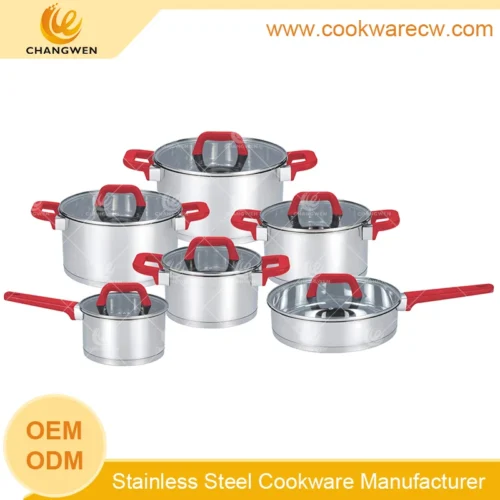
12-Piece Stainless Steel Cookware Set with Red Silicone Handles CW-ES1203G
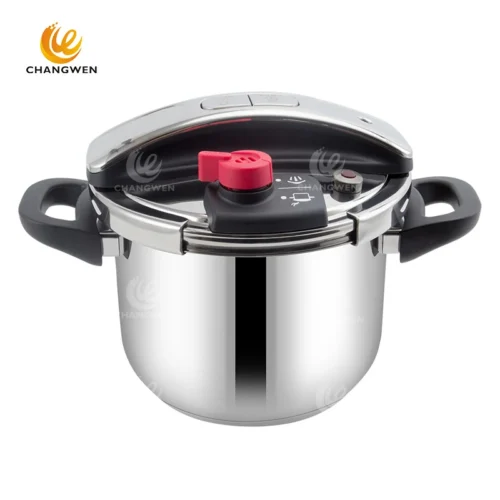
Stainless Steel Pressure Cooker for Safe Home Cooking CW-PC010
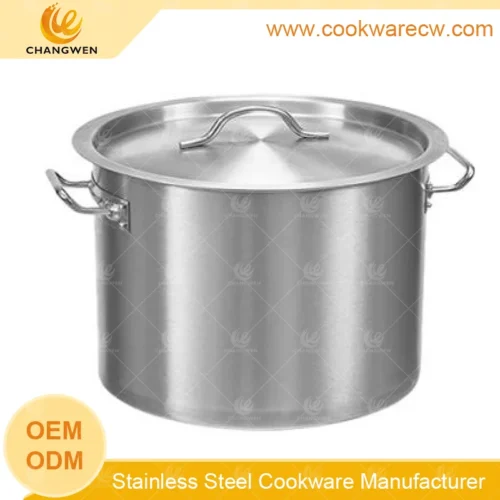
Stainless Steel Stock Pot For Restaurants CW-SP002
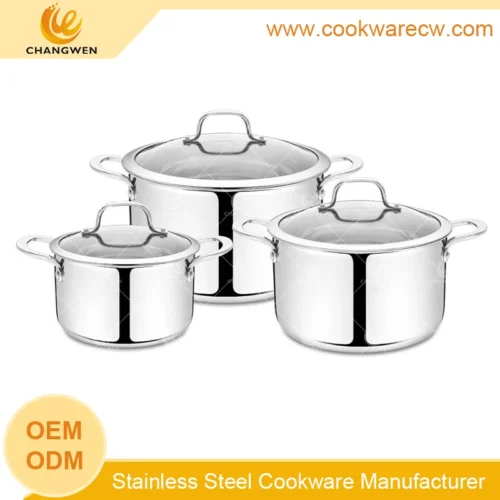
Premium Stainless Steel Pot Set for Home & Commercial Kitchens CW-TP0601
8-Piece Stainless Steel Pot Set with Black Silicone Handles CW-ES0810G
High-Quality Stainless Steel Pot Set with Heat-Resistant Handles CW-TP0603
Camping Pot Stainless Steel
Wholesale new design stainless steel cookware 3pcs blue marble coating nonstick frypan set golden handles and knobs adjustable size CW-M0614