
Read time: 9 minutes
Introduction
You are comparing two products that look almost identical on the shelf, share the same material name, and often sit next to each other at similar prices. Yet one is fundamentally better for most cooking tasks.
The question “tri-ply stainless steel vs stainless steel” is actually asking: what is the structural difference, does it matter for cooking, is it safe, and is it worth paying more?
All fair questions. This guide answers every single one — including whether tri-ply is non-stick, whether it is dishwasher safe, how it compares to ceramic and non-stick, and whether it is actually better for your health.
No fluff. Let us start with the core difference.

The Core Difference: Construction
Single-Layer (Regular) Stainless Steel Cookware
Standard stainless steel cookware has one layer of stainless steel for the body of the pan. Sometimes a separate thick disc of aluminum is bonded to the base — this is the “disc base” or “encapsulated base” construction. The sides of the pan are single-layer stainless steel.
Stainless steel on its own conducts heat poorly. Its thermal conductivity is approximately 16 W/m·K — far below aluminum (237 W/m·K) or copper (401 W/m·K). This means single-layer pans heat unevenly: the area directly over the flame gets much hotter than the rest of the surface, creating hot spots.
The disc base construction improves this at the bottom of the pan. But the sidewalls — where food also contacts the pan when sautéing or making sauces — remain single-layer steel and do not distribute heat evenly.
Tri-Ply Stainless Steel Cookware
Tri-ply (also written triply, three-ply, or 3-ply) cookware uses three metal layers bonded together, running continuously through the entire body of the pan from base to rim:
- Outer layer: 430 stainless steel (ferritic, magnetic — enables induction compatibility)
- Core: Aluminum alloy (high thermal conductivity — distributes heat evenly)
- Inner layer: 304 stainless steel (food-grade 18/8 or 18/10 — the cooking surface you use every day)
The aluminum core is bonded under high pressure between the two stainless layers — a process called cladding. The layers cannot be separated in normal use. This construction runs through the base and up the sidewalls of every pot and pan in a triply cookware set.
The result: heat from the burner travels through the 430 outer layer, into the aluminum core, which distributes it rapidly and evenly across the entire cooking surface — base and sides. No hot spots. Consistent temperature from center to edge.
Head-to-Head: Tri-Ply vs Standard Stainless Steel
| Factor | Tri-Ply Stainless Steel | Single-Layer Stainless Steel |
|---|---|---|
| Heat distribution at base | Excellent | Moderate (disc base) or poor |
| Heat distribution at sidewalls | Excellent | Poor |
| Hot spots | Minimal | Common |
| Warp resistance | High (rigid composite structure) | Moderate |
| Induction compatible | Yes (430 outer layer) | Depends on construction |
| Food reactivity | None | None |
| Non-stick behavior | No (requires technique) | No |
| Oven safe | Yes (typically 260°C+) | Yes |
| Dishwasher safe | Yes (hand wash recommended) | Yes |
| Manufacturing cost | Higher | Lower |
| Retail price | Higher | Lower |
Is Tri-Ply Stainless Steel Good? (The Real Performance Difference)
For the vast majority of cooking tasks, tri-ply stainless steel is measurably better than single-layer stainless steel. Here is where the difference is most apparent:
Sautéing and stir-frying. When you toss vegetables in a tri-ply pan, the food that moves up the sides stays at roughly the same temperature as the food at the base. In a single-layer pan, food touching the sides drops in temperature. This affects browning consistency and overall flavor development.
Reducing sauces. Sauces that reduce in a single-layer pan often scorch at the edges and center while undercooking at the sides. In a tri-ply pan, the even temperature profile means sauces reduce uniformly without catching.
Searing and browning. Even temperature across the entire cooking surface creates more consistent Maillard reaction (browning). The difference between a unevenly seared steak and a beautifully even crust comes down substantially to even pan temperature.
Delicate cooking. Custards, risottos, béchamels — dishes that require sustained, precise low heat — are significantly easier in tri-ply because the aluminum core damps temperature spikes and distributes heat gently.
Where single-layer stainless performs fine: Boiling pasta water, steaming, blanching. For any task where even stovetop heat is not critical, single-layer stainless steel with a good disc base performs adequately.
Is Tri-Ply Stainless Steel Safe?
Yes. Tri-ply stainless steel is one of the safest cookware materials available.
The inner cooking surface — the layer your food actually contacts — is 304 stainless steel (18/8 or 18/10). This grade contains 18% chromium and 8-10% nickel. Chromium forms a stable, passive oxide layer on the surface that prevents corrosion and stops the underlying metal from reacting with food. This is why stainless steel is called “stainless” — the chromium oxide layer is self-repairing when scratched.
The aluminum core never touches your food. This is a critical point. A common concern about tri-ply cookware is whether the aluminum layer is safe. The answer is straightforward: the aluminum layer is fully encapsulated between the two stainless steel layers. It has no food contact surface. You are cooking on 304 stainless steel, not aluminum.
Certifications. Quality tri-ply stainless steel cookware should carry LFGB certification (EU standard for food contact materials) or FDA compliance (US standard). These tests specifically measure metal migration from the cooking surface into food. 304 stainless steel consistently passes these tests.
Compared to alternatives: Tri-ply stainless steel does not use synthetic coatings that can degrade over time. There are no PFOA, PFAS, or other chemical compounds involved. The cooking surface is solid metal that will not chip, peel, or release particles into food.
Is Tri-Ply Stainless Steel Toxic?
No. Tri-ply stainless steel is not toxic.
This question typically arises from two concerns:
1. Nickel in the steel. 304 stainless steel contains approximately 8-10% nickel. There is a very small percentage of people with nickel sensitivity or nickel allergy who may experience contact reactions from metal cookware. For the general population, the trace amounts of nickel that might migrate from an intact stainless steel surface are not a health concern. Health authorities, including the FDA and EFSA, consider food-grade stainless steel safe for regular cooking.
If you have a confirmed nickel allergy and are concerned, note that 18/0 stainless steel contains no nickel. Alternatively, other cookware materials including cast iron and carbon steel are nickel-free.
2. The aluminum core. Concerns about aluminum and health (historically linked to unfounded theories about Alzheimer’s) sometimes arise when buyers learn that tri-ply has an aluminum layer. As stated above, the aluminum in tri-ply construction has zero contact with food. The stainless steel inner layer is a complete barrier between the aluminum and anything you cook.
Is Tri-Ply Stainless Steel Non-Stick?
No — and understanding this properly will prevent frustration.
Tri-ply stainless steel pans are not non-stick. Food will stick to a bare tri-ply stainless steel cooking surface if the pan is not used correctly. This is the same behavior as any metal pan without a synthetic coating.
However: with the right technique, stainless steel is far less sticky than it seems. The key is the “hot pan, cold oil” method:
- Preheat the empty pan over medium heat for 2-3 minutes
- Test by flicking a few drops of water onto the surface — they should bead and dance (Leidenfrost effect)
- Add oil to the hot pan and let it heat for 30 seconds
- Add food
When you do this, the food will initially stick to the pan, then release naturally as it finishes browning. Proteins, in particular, will stick initially and release cleanly when the sear is complete. Trying to move food too early is the primary cause of sticking.
Some tri-ply cookware sets include non-stick options. Manufacturers sometimes add a PTFE or ceramic non-stick coating to one or more pieces in the set — typically the frying pan — while leaving the pots and saucepans uncoated. If you need non-stick performance for eggs or delicate fish, look for triply cookware sets that include a coated non-stick pan alongside uncoated stainless pieces.
Is Tri-Ply Stainless Steel Dishwasher Safe?
Yes — with a qualification.
The materials used in tri-ply stainless steel cookware (304 stainless, aluminum core, 430 outer layer) are technically dishwasher safe. The construction will not be damaged by a dishwasher cycle.
However, most manufacturers and experienced cooks recommend hand washing for two reasons:
Surface appearance. Dishwasher detergents contain strong alkaline compounds that can cause discoloration and dull the polished surface over time. A mirror-polished or brushed stainless steel pan will maintain its appearance much longer if hand-washed.
Long-term bond integrity. While modern tri-ply bonding is robust, repeated cycles of aggressive heat and chemical exposure in a dishwasher add cumulative stress. Hand washing preserves the pan’s condition over its full lifespan.
Practical rule: Hand wash for appearance and longevity, but the occasional dishwasher cycle will not destroy your cookware.
Tri-Ply Stainless Steel vs Ceramic Cookware
This is one of the most common comparisons for health-conscious buyers moving away from traditional non-stick.
Ceramic cookware is typically aluminum with a ceramic-based non-stick coating (sol-gel coating). It is marketed as a PFOA-free, PTFE-free non-stick option.
| Factor | Tri-Ply Stainless Steel | Ceramic Non-Stick |
|---|---|---|
| Cooking surface | Solid 304 stainless steel | Ceramic coating over aluminum |
| Non-stick | No (technique required) | Yes (initially) |
| Coating degradation | None (no coating) | Coating degrades over 1-3 years |
| High-heat performance | Excellent | Limited (coating degrades above 260°C) |
| Metal utensil safe | Yes | No |
| Longevity | Decades | 1-5 years before re-coating |
| Food reactivity | None | None |
| Induction compatible | Yes (430 outer) | Depends on base |
The practical conclusion: Ceramic is easier to cook in because food does not stick initially. Tri-ply stainless steel is more durable because there is no coating to degrade. Most serious home cooks eventually own both — ceramic non-stick for eggs and delicate fish, tri-ply stainless for everything else.
Tri-Ply Stainless Steel vs Non-Stick
This comparison follows the same logic as ceramic, with PTFE (Teflon-type) non-stick added:
Non-stick (PTFE) advantages over tri-ply stainless:
- Food releases without technique — ideal for eggs, fish, pancakes
- Easier cleanup with less oil
- Lower barrier to entry for new cooks
Tri-ply stainless advantages over non-stick:
- No coating to scratch, chip, or degrade — lasts decades
- Safe with metal utensils, abrasive cleaning, high heat
- Better searing and browning — the Maillard reaction works better on bare metal
- No PFAS concern (even PFOA-free PTFE has ongoing research attention)
- Induction compatible without compromise
The verdict: For everyday use where you cook a wide range of dishes, a triply cookware set is more versatile and more durable. For specific tasks requiring effortless non-stick — the fried egg test — a dedicated non-stick pan alongside your tri-ply set is the most practical combination.
Is Triply Stainless Steel Cookware Worth It?
Yes, for most serious home cooks.
The value calculation is straightforward: a quality triply cookware set costs more upfront than single-layer stainless steel. But it performs better for almost every cooking technique that benefits from controlled, even heat. It is safer than coated alternatives because there is no coating to degrade. And it will outlast any coated pan by decades.
The situations where single-layer stainless steel is the right choice:
- Budget is the primary constraint. A well-made single-layer stainless pot with a quality disc base handles boiling, steaming, and stewing well at lower cost.
- Large stock pots. For a large stock pot used primarily for boiling pasta or making stock, the heat distribution advantage of tri-ply matters less than for pans used for sautéing.
For any pan where sautéing, browning, or sauce-making is a regular use case — frying pans, sauté pans, saucepans — tri-ply is worth the premium.
What to Look for in a Triply Cookware Set
If you have decided that tri-ply is right for you, these are the specifications to verify:
Full-clad construction. Confirm the three layers run through the sidewalls, not just the base. “Full-clad” or “fully bonded” construction means the aluminum core is present throughout the entire pan, not just a disc at the bottom.
304 stainless inner layer. The food contact surface should be 304 stainless steel (18/8 or 18/10), not 201. Request material specifications if not clearly stated.
Total wall thickness. 2.4mm–3.0mm is the range for quality tri-ply pans. Thinner than 2.0mm indicates a lightweight construction prone to warping.
Certifications. LFGB for EU market products, FDA compliance for US market products, ISO 9001 for manufacturing quality.
Handle quality. Riveted handles are standard and durable. Check that handles have comfortable ergonomics and heat-resistance for your typical cooking duration.
Induction compatibility. Confirmed by the 430 stainless outer layer. Most quality tri-ply cookware sets are induction-compatible, but verify before purchase.
FAQ
What is the difference between tri-ply stainless steel and regular stainless steel?
Regular stainless steel cookware has a single layer of steel — either the full body or with a disc bonded to the base. Tri-ply (three-ply) cookware has three layers bonded together: 304 stainless inside, aluminum core in the middle, 430 stainless outside. These layers run through the base and sidewalls. The aluminum core distributes heat evenly across the entire pan, eliminating hot spots.
Is tri-ply stainless steel safe to cook with?
Yes. The cooking surface is 304 food-grade stainless steel, which is non-reactive and approved for food contact by FDA and LFGB. The aluminum core is fully encapsulated and never contacts food. Tri-ply stainless steel is one of the safest cooking materials available.
Is tri-ply stainless steel toxic?
No. 304 stainless steel is not toxic. There is a trace amount of nickel in the steel (approximately 8-10%), which is not a concern for the vast majority of people. The aluminum core, sometimes raised as a concern, has zero food contact.
Does tri-ply stainless steel stick?
Yes, food will stick without proper technique. Using the “hot pan, cold oil” method — preheating the pan, adding oil to a hot pan, and allowing food to release naturally when searing is complete — significantly reduces sticking. Tri-ply is not non-stick, but it is manageable with technique.
Is tri-ply stainless steel dishwasher safe?
The materials are dishwasher-safe, but hand washing is recommended to preserve the surface finish and extend the pan’s lifespan. Dishwasher detergents can cause discoloration of polished stainless steel surfaces over time.
Is tri-ply stainless steel better than ceramic cookware?
For longevity and high-heat performance, yes. Tri-ply has no coating to degrade, can handle any heat level and metal utensils, and lasts decades. Ceramic is easier for non-stick tasks initially but its coating degrades within 1-3 years. Both are food-safe. The best kitchen has both.
Is tri-ply stainless steel better than non-stick?
For searing, browning, and long-term durability, yes. For effortless food release with minimal oil, non-stick is easier. Most experienced cooks use tri-ply stainless for high-heat and precision cooking, plus a dedicated non-stick pan for eggs and delicate foods.
Conclusion
The difference between tri-ply stainless steel and regular stainless steel comes down to one thing: the aluminum core and where it is.
In standard stainless steel cookware, heat concentrates where the burner hits the pan. In tri-ply clad stainless steel, the aluminum core distributes that heat instantly and evenly across every surface the food touches.
That difference matters for sautéing, searing, and sauce-making. It does not matter much for boiling water.
Tri-ply stainless steel is safe, not toxic, not non-stick but manageable with technique, generally dishwasher-safe though better hand-washed, and significantly better than ceramic and non-stick for longevity and high-heat performance.
For a serious home cook building a long-term kitchen, a quality triply cookware set is one of the most durable and versatile investments you can make.
About Changwen
Changwen is a stainless steel cookware manufacturer based in Jiangmen, Guangdong, China, with over 22 years of OEM and ODM experience. We produce full-clad tri-ply stainless steel cookware sets (304-aluminum-430 construction), frying pans, stock pots, steamer pots, pressure cookers for brands and distributors across South America, Southeast Asia, the Middle East, and Europe.
📧 changwen@cwcooking.com 📞 0086-18022963948 🌐 www.cookwarecw.com/contact-us
-
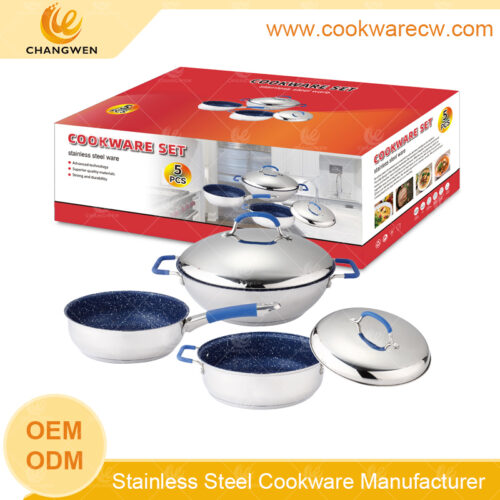
non-stick fry pans coating wok stainless steel wire handles & knobs with silicon cover high quality material lid CW-M0502G
-
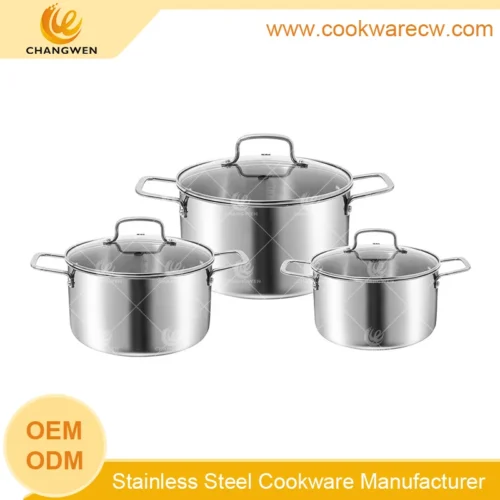
Stainless Steel Pot Set for Professional Cooking Performance CW-TP0605
-
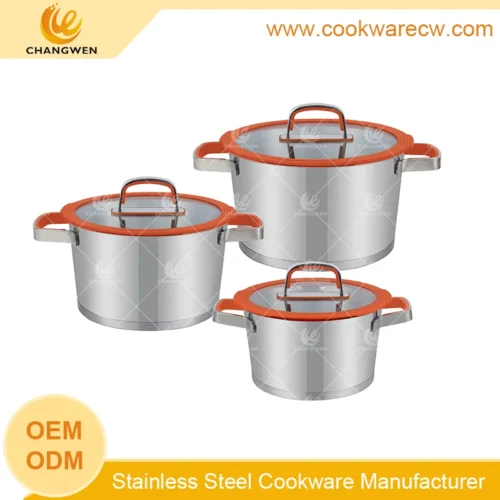
6-Piece Stainless Steel Pot Set with Orange Silicone-Edge Lids CW-ES0611
-
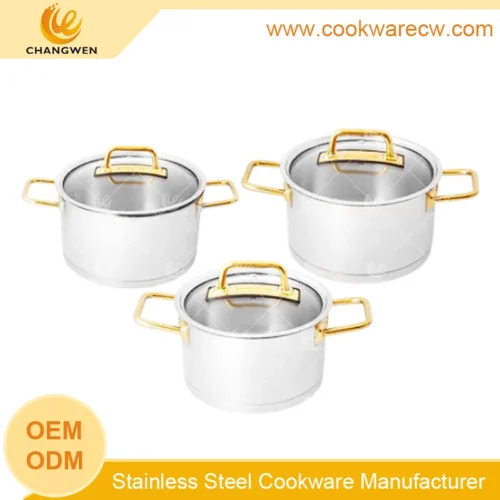
6-Piece Stainless Steel Pot Set with Gold Handles CW-ES0610
-

Professional Honeycomb Stainless Steel Fry Pan CW-ETP021
-
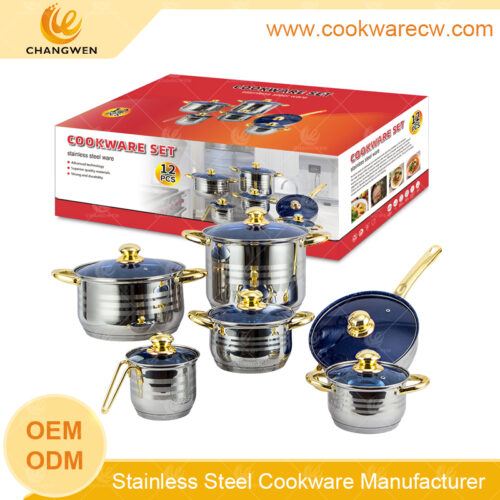
heavy S/S 12pcs cookware set pots wholesale nonstick fry pan blue glass lid golden handle cooking pan milk pot CW-M1222
-
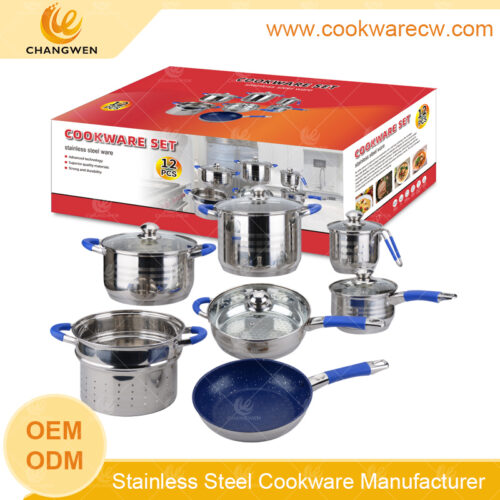
12pcs stainless steel cooking pots & pans set with color silicon handles coating conic frypan 24cm pasta pot in China CW-M1311
-
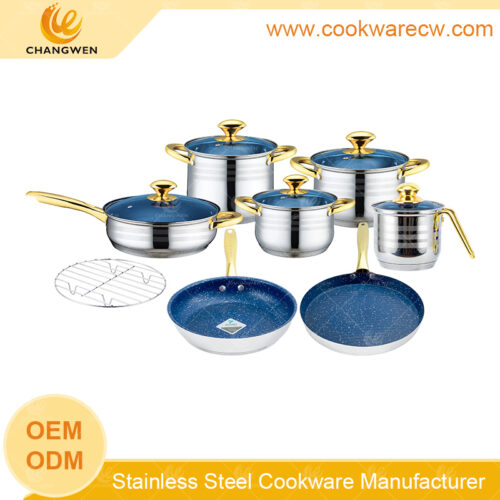
Best Tri Ply Stainless Steel Cookware