
Read time: 9 minutes
Introduction
You’re standing in a kitchen store, staring at two large pots that look almost identical, both claiming to be essential. One is taller. One is wider. One costs twice as much. The labels say “stock pot” and “soup pot” as if that explains everything.
It does not explain everything. Not even close.
Here is a confession from every home cook who has ever made stock in a soup pot or soup in a stock pot: the results were fine. Not perfect, but fine. The real issue is that using the wrong pot makes cooking harder than it needs to be — the stock evaporates too fast, the soup scorches at the bottom, or you run out of room exactly when you need more. And since nobody explained the difference properly, you have been winging it.
This guide fixes that. You will understand exactly what a stock pot is, what it is used for, and why the shape is not just aesthetics but engineering. You will know when to reach for a soup pot instead. And you will find out where a Dutch oven fits into all of this, because at some point someone will tell you a Dutch oven can replace both, and that person is only half right.

What Is a Stock Pot?
A stock pot is a large, tall, cylindrical cooking vessel with straight sides, a flat bottom, and two loop handles. It is specifically engineered to hold and maintain large volumes of liquid over long cooking periods without significant evaporation. Most stock pots range from 8 to 30 liters (8 to 30 quarts) in capacity, though commercial models go considerably larger.

Stock pots are distinguished by their large size, deep side walls, and wide base — but what truly defines a stock pot is the relationship between height and width. A stock pot is significantly taller than it is wide, with a height-to-diameter ratio of roughly 1:1 or even taller. This vertical orientation is the functional core of the design: tall walls minimize the surface area exposed to air relative to the volume of liquid inside, which dramatically slows evaporation.
Think about what that means in practice. When you simmer chicken bones for six hours, you do not want to lose half your liquid to steam. A stock pot’s tall, narrow shape keeps the liquid in the pot and the flavor concentrated inside, not evaporated into your kitchen ceiling. The shape is not arbitrary — it is physics working for you.
Most stock pots are made from stainless steel, aluminum, or stainless steel with an aluminum or copper core. For home use, an 8 to 12 quart (8 to 12 liter) stainless steel stock pot covers the majority of cooking tasks. Professional and commercial kitchens typically start at 20 liters and go up from there.
What Is a Stock Pot Used For?
A stock pot’s name tells you its primary purpose, but it undersells its range. It’s the pot you reach for when boiling a box of pasta, simmering homemade chicken broth, building a big batch of stew or blanching vegetables.
Here is the complete list of what a stock pot handles well:
Making stocks and broths. This is the original purpose and the one the shape is engineered for. Chicken stock, beef stock, fish stock, vegetable broth — anything that requires simmering bones, vegetables, and aromatics in a large volume of water for 2 to 8 hours. The tall walls minimize evaporation and the large capacity accommodates a whole chicken carcass, several pounds of beef bones, or a full vegetable harvest without crowding.
Boiling pasta. Pasta needs to move freely in water to cook evenly. A large stock pot gives you the volume and depth for a full pound of pasta to circulate without sticking together. The rule of thumb is 4 to 6 liters of water per 500 grams of pasta — which is exactly the kind of volume a stock pot was built for.
Large-batch soup and stew. When you are cooking for a crowd or meal-prepping for the week, a stock pot accommodates quantities that would overflow a smaller pot. The depth allows for generous liquid levels without spillover risk.
Blanching and par-boiling vegetables. Large volumes of rapidly boiling water, enough to blanch vegetables in batches while maintaining temperature after each addition. A stock pot recovers its boil faster than smaller pots after each batch goes in, because the sheer thermal mass of that much water stabilizes the temperature.
Canning and preserving. Home canning requires fully submerging sealed jars in boiling water. The depth of a stock pot accommodates tall jars with adequate water coverage above them.
Boiling lobster, crab, and corn. Any large ingredient that needs to be fully submerged in water gets its own pot: the stock pot.
What a stock pot is not designed for is browning, reducing sauces, or sautéing. The tall, narrow shape that makes it excellent at retaining liquid makes it poor at those techniques. Steam gets trapped in the tall vessel, ingredients at the bottom steam rather than brown, and the narrow mouth makes stirring difficult during reduction. If your recipe starts with “brown the meat and vegetables,” reach for a different pot.
What Is a Soup Pot? And How Is It Different?
A soup pot looks like a stock pot’s shorter, wider sibling. It shares the same basic form — two handles, straight sides, flat bottom — but the proportions are fundamentally different. Soup pots are short and wide, designed to hold and heat dense ingredients.

The key difference is the height-to-width ratio. Where a stock pot is taller than it is wide, a soup pot is roughly as wide as it is tall, or even wider. This wider, shallower profile changes what the pot does well:
More surface area means more evaporation and reduction. A soup pot’s wider mouth allows steam to escape more freely, which is exactly what you want when making a thick minestrone, a hearty beef stew, or a potato soup that needs to reduce and concentrate in flavor. Evaporation is the enemy in stock-making and the friend in soup-making.
Better heat distribution across the base. Soup pots often have a more heavy material as the base, allowing the pot to heat consistently and prevent burning during slow simmers. Since you are often building flavor by keeping the soup at a gentle, sustained simmer for 45 minutes to an hour (not 6 hours), a heavier base with better heat distribution matters more than volume capacity.
Easier stirring and access. The lower walls of a soup pot mean your spoon, ladle, or immersion blender can reach the bottom easily. When you are blending a tomato bisque or fishing out a bay leaf, the soup pot does not fight you.
Capacity for a soup pot typically ranges from 4 to 8 liters — enough for family-sized batches without the overwhelming scale of a full stock pot.
The honest answer is that most home cooks use these terms interchangeably, and for everyday cooking, the distinction rarely causes disaster. But if you are making a proper stock — something that simmers for hours and demands minimal evaporation — the stock pot’s tall shape does something a soup pot cannot replicate efficiently.
Stock Pot vs Dutch Oven: The Comparison Nobody Asked For But Everyone Needs
At some point, someone who owns a Dutch oven will tell you it can replace your stock pot. They are not entirely wrong. They are also missing the point.
A Dutch oven is a heavy, thick-walled pot with a tight-fitting lid, typically made from cast iron (enameled or bare) or heavy cast aluminum. It retains heat extremely well, distributes heat evenly through its thick walls, and transitions from stovetop to oven without complaint. It is the best pot in the kitchen for braising — long, low-and-slow cooking with a modest amount of liquid.
Here is where the comparison breaks down:
Capacity. Most Dutch ovens max out at 6 to 7 quarts (6 to 7 liters). A stock pot starts where a Dutch oven ends. If you want to make two gallons of chicken stock or boil pasta for eight people, the Dutch oven simply does not have the volume.
Weight when full. A 6-quart cast iron Dutch oven weighs 5 to 6 kilograms empty. Fill it with stock or soup and you have 10+ kilograms to carry to the sink. A stainless steel stock pot is significantly lighter per volume.
Heat distribution for liquid cooking. The Dutch oven’s thick, heavy walls are engineered for dry and moist-heat braising, not for heating large volumes of liquid efficiently. A thin-wall stainless stock pot with an aluminum core brings a large volume of water to boil faster than a heavy Dutch oven.
The Dutch oven wins at: Braising short ribs, making French onion soup (the small batch kind), slow-cooking chicken thighs, baking bread, making pot roast. Anything that goes in the oven, benefits from high heat retention, and involves modest liquid volumes.
The stock pot wins at: Everything requiring more than 6 liters of liquid, long-simmer stocks, pasta, canning, and batch cooking at volume.
They are not competitors. They are different tools for different jobs. The cook who claims one can replace the other is the cook who has never tried to make a full bone broth in a 5-quart Dutch oven and ran out of room.
How to Choose the Best Soup Pot for Your Kitchen
Since “soup pot” is both a specific product category and a general term cooks use for any large pot used to make soup, let us focus on what actually makes a pot work well for soup:
The right size for your household. Most home cooks do well with a 6 to 8 quart pot for everyday soups and stews. For families, meal prep, or entertaining, a 10 to 12 quart pot is ideal. Bigger is not always better — a half-empty large pot is less efficient and harder to store.
A heavy base that prevents scorching. Soup simmers for a long time over relatively low heat. A pot with a thin, single-layer base concentrates heat at the contact point and can scorch the bottom of thick soups. Look for a pot with a disc-base or full-clad construction, both of which distribute heat more evenly.
Material: stainless steel with aluminum core or cast iron. Stainless steel with an aluminum or copper core (disc-base or full-clad) provides even heat distribution, non-reactive cooking surface, and easy cleanup. Cast iron or enameled cast iron provides superior heat retention for soups that benefit from residual heat keeping the pot warm after the flame is off. Both are valid — stainless is lighter and heats faster; cast iron holds heat longer.
A lid that seals reasonably well. Soup simmers with the lid on or partially on. A poorly fitting lid that lets too much steam escape defeats the purpose.
Two handles or one long handle? Soup pots often have one long handle, making it easy to pick up the pot when your soup is ready. Stock pots are designed with double handles, making it easy to grip when pouring and lifting. For a pot you primarily use on the stove and serve from at the table, a single long handle is more convenient. For a pot you primarily use for large-volume liquid cooking and carry to the sink to drain, double loop handles are safer.
Stock Pot Sizes: How Much Do You Actually Need?
Sizing a stock pot is straightforward once you know what you are cooking.
| Use Case | Recommended Capacity |
|---|---|
| Solo cook or couple, everyday use | 6–8 liters (6–8 quarts) |
| Family of 4, pasta and soups | 8–12 liters (8–12 quarts) |
| Large family or batch cooking | 12–16 liters (12–16 quarts) |
| Home canning and preserving | 16–20 liters (16–20 quarts) |
| Commercial kitchen, small operation | 20–30 liters (20–30 quarts) |
Most home cooks will be well served by an eight-quart stockpot, which can handle a full pound box of pasta, soup, broth and moderate batch cooking. A 10 to 12 quart pot is more ideal for canning, entertaining or large-batch meal prep.
The mistake most people make is buying too large. A 24-liter stock pot sounds impressively capable until you realize it takes 20 minutes to heat the water for your Tuesday night pasta. Match the size to your actual cooking habits, not to the most ambitious thing you might theoretically do someday.
Why Stainless Steel Is the Best Material for Stock Pots
A stock pot sits on high heat for hours. It holds acidic stocks, salty broths, and wine-based sauces. It gets hauled to the sink, filled with cold water, and heated again. The material specification matters more than almost any other purchase decision you will make in cookware.
Stainless steel — specifically 304 stainless steel (18/8) with an aluminum core — is the gold standard for stock pots because it combines everything a long-simmer pot needs:
Non-reactive cooking surface. Chicken stock with tomatoes, wine broth, citrus-spiked fish stock — 304 stainless steel does not react with acidic ingredients. The chromium oxide passive layer on the surface is chemically inert under any normal cooking condition. Your stock tastes like your ingredients, not like the pot.
Durability under sustained heat. A stock pot stays on the burner for 4 to 8 hours at a stretch. Stainless steel handles this without warping, discoloring, or degrading. Properly passivated 304 stainless steel will look and perform the same after 1,000 uses as it did on the first day.
Easy cleaning despite long simmering. The smooth interior of stainless steel releases food residue with hot water and a light scrub. No seasoning to maintain, no coating to protect, no rust to prevent.
Aluminum core for heat distribution. A stock pot with a disc-base (aluminum disc bonded to the stainless base) or full-clad construction (aluminum running through base and sidewalls) distributes heat evenly and prevents hot spots at the base — the place most likely to scorch a thick stock or stew if heat concentrates too intensely.
A quality stainless steel stock pot from a reputable stainless steel cookware manufacturer with verified 304 steel and documented LFGB food contact certification is the most reliable, long-lasting choice for any stock pot investment.
FAQ
What is a stock pot used for, exactly?
A stock pot’s primary uses are making stocks and broths (chicken, beef, vegetable, fish), boiling large quantities of pasta, batch-cooking soups and stews, blanching vegetables, canning and preserving, and boiling shellfish or corn. The tall, narrow design minimizes evaporation during long-simmer cooking, which is the functional characteristic that makes it the right tool for these tasks.
What is the main difference between a stock pot and a soup pot?
The key difference is shape. A stock pot is taller than it is wide, which minimizes evaporation during long simmering — ideal for stocks and large-volume liquid cooking. A soup pot is wider relative to its height, which allows more evaporation and makes it better for soups and stews that benefit from reduction and thickening. A soup pot typically has a heavier base for more even heat; a stock pot prioritizes capacity and evaporation control.
Can I use a stock pot as a soup pot?
Yes, with awareness. A stock pot works for soup, but the tall sides make stirring more awkward and the narrow mouth slows evaporation more than a soup typically needs. For everyday soups the difference is marginal. For a thick, creamy bisque or a stew you want to reduce significantly, the wider soup pot performs better.
What is the best soup pot material?
Stainless steel with an aluminum core (disc-base or full-clad) is the most versatile choice — non-reactive, easy to clean, even heat distribution, and durable for daily use. Enameled cast iron offers superior heat retention and is excellent for rich, slow-simmered soups, but it is heavier and more expensive. For most home cooks, stainless steel with a quality aluminum disc base is the right balance of performance, weight, and longevity.
How does a stock pot compare to a Dutch oven?
A Dutch oven is heavier, thicker-walled, and better at retaining heat for braising. It typically maxes out at 6 to 7 liters of capacity. A stock pot is larger (8 to 30+ liters), thinner-walled, and engineered for high-volume liquid cooking. A Dutch oven is superior for braising meats and oven dishes; a stock pot is necessary for making full batches of stock, boiling large pasta quantities, or canning. They serve different primary purposes and neither fully replaces the other.
What size stock pot do I need?
An 8 to 10 liter (8 to 10 quart) stock pot handles the majority of home cooking tasks: pasta for 4 to 6 people, a full chicken stock, a large batch of soup for the week. If you can or make stock regularly, a 12 to 16 liter pot provides more working room. Commercial or serious home cooking programs benefit from 20 liters and above.
Conclusion
A stock pot is a tall vessel built to hold large volumes of liquid with minimal evaporation over long cooking times. A soup pot is a shorter, wider vessel built for easier stirring, faster reduction, and everyday batch cooking. A Dutch oven is a heavy, heat-retaining pot built for braising and oven cooking — not a replacement for either.
None of these is the “best” pot in the abstract. Each is the best pot for a specific set of tasks. The cook who owns all three makes better stock, better soup, and better braises than the cook who forces one pot to do everything.
Start with an 8 to 10 liter stainless steel stock pot if you cook stock, pasta, or batch soups regularly. Add a 6 to 8 liter soup pot when the tall stock pot feels clumsy for everyday weeknight soups. Add a Dutch oven when braising becomes a regular cooking method.
Equip the kitchen for what you actually cook. Everything else is storage.
About Changwen
Changwen is a stainless steel cookware manufacturer based in Jiangmen, Guangdong, China, with over 22 years of OEM and ODM manufacturing experience. We produce stainless steel stock pots, soup pots, frying pans, saucepans, steamer pots, pressure cookers, and complete cookware sets for brands and distributors across South America, Southeast Asia, the Middle East, Europe, and Australia.
-
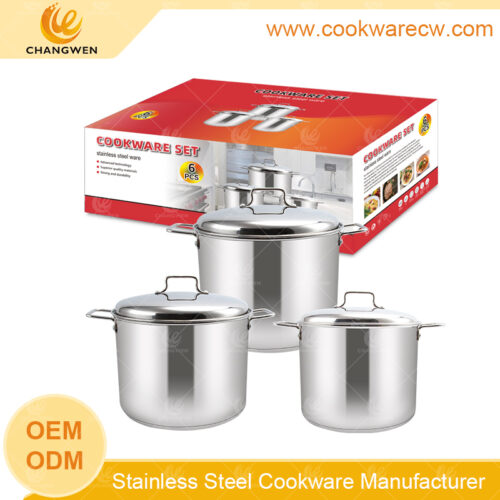
Customize color box high soup stock pot set stainless steel lids and knobs large volume 10L 13L 15L cookware pots wholesale CW-M0602
-

Premium Stainless Steel Frying Pan for Daily Cooking CW-TP010
-
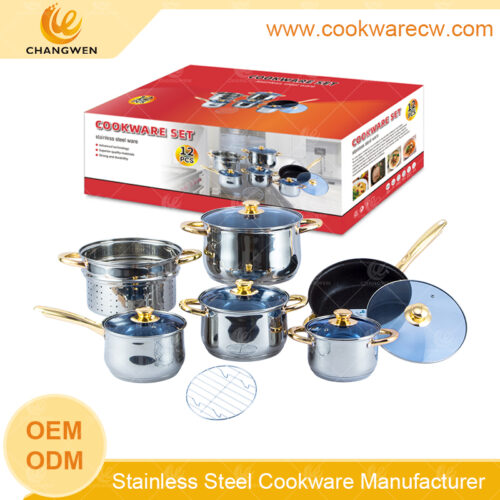
olla de cocina 12pcs cookware set non-stick coating frypan 24cm steamer pot with a stainless steel kitchenware wire rack CW-M1205
-
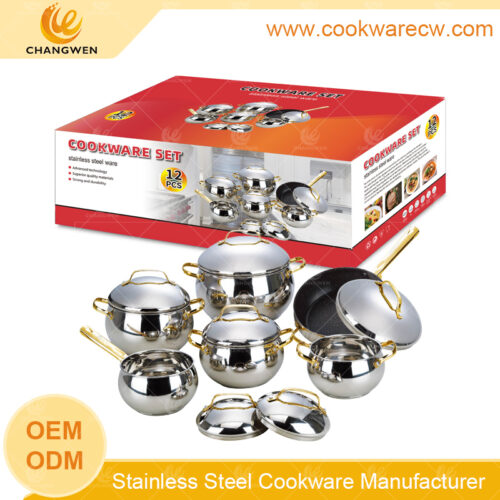
Pots wholesale apple shape cookware set mirror polished stainless steel lids golden wire handles and knobs nonstick frypan CW-M1220
-
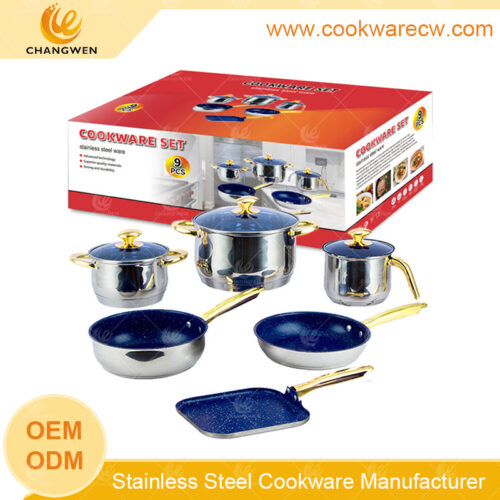
9pcs stainless steel cookware set pots and pans with non-stick coating golden hollow handle and knob with rivets wholesaler factory CW-M0901
-
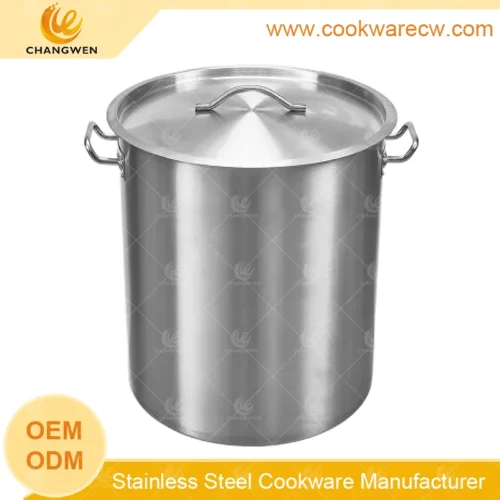
Commercial Stainless Steel Stock Pot CW-SP001
-
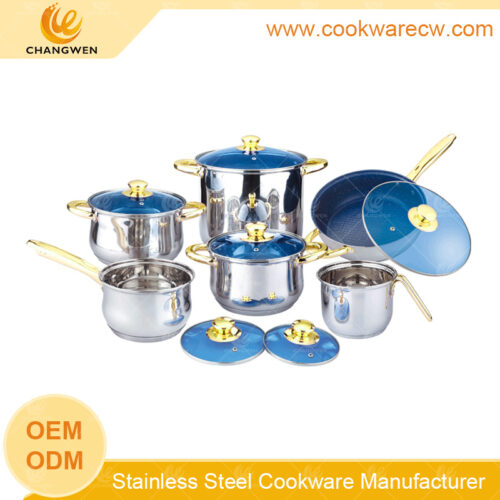
Safest Stainless Steel Cookware
-
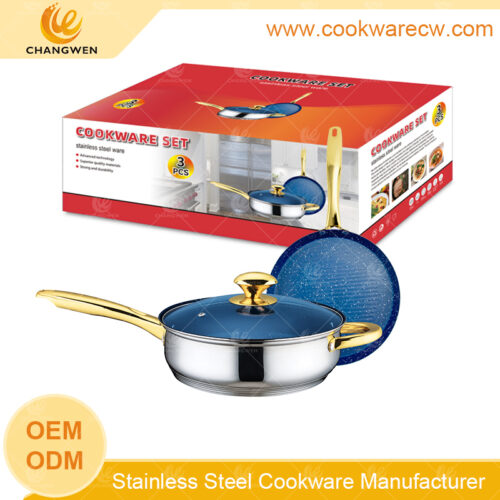
China factory wholesale blue marble nonstick coating fry pan set stainless steel mirror polished frypans golden handles and knobs CW-M0303