
Read time: 11 minutes
Introduction
Two stainless steel pots leave the same factory on the same day. Same 304 stainless steel. Same tri-ply construction. Same wall thickness. One sells for $35. One sells for $120.
The difference is surface treatment.
Surface treatment in stainless steel cookware manufacturing is not cosmetic finishing applied after the “real” work is done. It is an engineering process that determines food safety compliance, corrosion resistance, cooking performance, brand positioning, and retail price. For OEM buyers, importers, and stainless steel cookware manufacturers, understanding surface treatment is the difference between specifying a product and specifying it correctly.
This guide covers every surface treatment used in stainless steel cookware production — what each process does, why it matters functionally, how interior and exterior treatments differ in their requirements, the quality metrics that separate good surface treatment from bad, and how to specify surface treatment correctly in an OEM program.

Key Takeaways
- Interior and exterior surfaces have fundamentally different requirements. The interior (food contact) surface requires food safety compliance, low Ra roughness for cleanability, and passivation for corrosion resistance. The exterior surface requires visual consistency, brand finish, and durability under handling and heat.
- Ra value (surface roughness) is the measurable specification that determines whether an interior surface is food-safe and easy to clean. Specifying Ra ≤ 0.8 µm for interior surfaces is the industry standard for compliant cookware.
- Passivation is the chemical or electrochemical process that removes embedded iron from the stainless steel surface and strengthens the chromium oxide layer that makes stainless “stainless.” It is not optional — it is the foundation of corrosion resistance.
- Mirror polish, brushed/satin, matte, hammered, and PVD are the main exterior finish options. Each carries different production costs, different brand positioning signals, and different care requirements.
- PVD (Physical Vapor Deposition) applies a 1–5 µm color coating in a vacuum chamber. It is 2–4 times harder than stainless steel and enables black, gold, rose gold, gunmetal, and other premium finishes without paint or plating.
- Surface treatment failures — embedded iron causing rust, inadequate passivation, coating delamination — are among the most common quality defects in stainless steel cookware from China. The right specification prevents them.
Why Surface Treatment Is an Engineering Decision, Not a Finishing Step
In most manufacturing contexts, surface finishing is the last step — the aesthetic layer applied after the structural work is complete. In stainless steel cookware, surface treatment is an engineering decision with direct consequences for product performance.
The Interior Surface: Food Safety and Function
The interior cooking surface is where food contacts the metal. The surface treatment applied here determines:
Migration compliance. A poorly prepared interior surface traps iron particles and organic residues from the forming process. These particles accelerate corrosion, produce surface contamination, and can cause the cookware to fail LFGB heavy metal migration testing. Proper electropolishing or controlled mechanical polishing removes these particles and produces a surface that meets food contact standards.
Cleanability. Surface roughness at the microscopic level (measured as Ra — arithmetic mean roughness) determines how easily food residue, oils, and bacteria are removed during washing. A rough surface traps contaminants in microscopic peaks and valleys. A smooth interior surface (Ra ≤ 0.8 µm) cleans with a single wipe. This is not a minor convenience — in commercial and foodservice applications, cleanability is a hygiene standard.
Passive layer integrity. Stainless steel’s corrosion resistance depends on the chromium oxide passive layer that forms naturally on the surface. Forming, welding, and machining operations during cookware production disrupt this layer and embed iron particles that do not have the passive layer’s corrosion resistance. Passivation treatment removes these iron particles and restores the passive layer — without it, the cookware will develop rust spots within months in acidic or salt-heavy cooking environments.
Cooking performance. Interior surface roughness affects how food behaves in the pan. A smoother interior surface reduces micro-adhesion points, making the “hot pan, cold oil” technique more effective. Inconsistent interior roughness creates uneven cooking behavior across the surface.
The Exterior Surface: Brand and Durability
The exterior surface (the outside of the pot or pan) serves different goals:
Visual brand signal. The exterior finish is the first quality signal to buyers at retail. Consistent brushed texture, deep mirror polish, or even PVD color communicates manufacturing precision and premium positioning before the product is touched.
Durability under handling. The exterior is what gets stacked, dropped, and scraped in kitchen and retail environments. The surface treatment must maintain its appearance under this handling.
Thermal behavior. Exterior coatings (PVD, paint) must withstand sustained stovetop temperatures and repeated thermal cycling without delamination or color change.
The Main Interior Surface Treatments
Mechanical Polishing (Controlled Ra)
The most fundamental interior surface treatment. Abrasive polishing removes the rougher surface left by forming and stamping, bringing Ra values down to food-safe levels.
How it works: Sequential polishing with progressively finer abrasives — grinding wheels, sanding belts, polishing compounds — reduces surface roughness systematically. Each stage removes the marks left by the previous stage. The final stage produces the smooth, consistent interior surface of a quality cookware piece.
Ra specification for cookware interiors:
- Ra ≤ 0.8 µm: Food-contact standard, compliant with LFGB requirements
- Ra ≤ 0.4 µm: Premium specification, found in high-end cookware and commercial foodservice equipment
- Ra > 1.6 µm: Rough surface — traps food, harder to clean, higher contamination risk
What to specify: “Interior Ra ≤ 0.8 µm, mechanically polished, scratch-free finish.” This is a measurable, verifiable specification that cannot be faked with visual inspection alone.
Electropolishing
Electropolishing is an electrochemical process in which the cookware piece is immersed in an electrolytic bath and connected as the anode. An electrical current removes material selectively from micro-peaks on the surface — the high points are removed preferentially, leaving an exceptionally smooth, bright finish.
What electropolishing does:
- Reduces surface roughness by 30–50% compared to mechanical polishing alone
- Removes embedded iron particles more thoroughly than passivation alone
- Creates a surface richer in chromium at the outermost layer — improving corrosion resistance
- Produces a brighter, more reflective surface than mechanical polishing
When electropolishing is specified: Premium interior finishes, pharmaceutical-grade standards applied to commercial cookware, and situations where maximum corrosion resistance is required (marine environments, high-salt commercial kitchens).
The limitation: Electropolishing costs more than mechanical polishing and requires chemical handling and disposal infrastructure. It is standard at premium and professional cookware manufacturers but not universal.
Passivation
Passivation is the most important interior surface treatment that buyers almost never see on specification sheets — yet its absence causes some of the most common quality failures in stainless steel cookware.
What passivation is: A chemical treatment (typically citric acid or nitric acid solution) that removes free iron and iron compounds embedded in the stainless steel surface during forming, welding, and machining. After passivation, the surface is rich in chromium relative to iron — the condition required for the protective chromium oxide passive layer to form reliably.
Why embedded iron is a problem: During forming and stamping, tool steel particles and iron oxide can embed in the stainless steel surface. These embedded particles do not have the corrosion resistance of the bulk stainless steel — they rust. Rust spots on new stainless steel cookware, or accelerated corrosion near welds and handle attachment points, are almost always passivation failures.
What to require: A passivation certificate confirming the treatment was applied after forming and after any welding operations. Post-weld passivation is particularly important because weld heat-affected zones are especially vulnerable to embedded iron and passive layer disruption.
ASTM A967 is the standard for passivation of stainless steel. A factory that cannot reference this standard or equivalent when discussing passivation is a factory that does not take it seriously.
The Main Exterior Surface Treatments
Mirror Polish (No. 8 Finish)
Mirror polishing brings the exterior surface to a reflective, high-gloss finish through multiple progressive polishing stages — coarse grinding, fine grinding, polishing compound application, and buffing with high-speed polishing wheels. The result is a surface where Ra values are below 0.1 µm and the reflection is essentially specular (mirror-like).
Production requirements: Labor-intensive. Multiple polishing stages with progressively finer media. Equipment-intensive — requires proper polishing lines. A mirror finish that looks right requires skilled operators and consistent process control, because any remaining scratches or contamination are highly visible.
Retail positioning: Mirror finish communicates premium and luxury. It photographs exceptionally well for e-commerce and catalog. In markets where cookware is displayed on open shelves (South America, Middle East, parts of Southeast Asia), mirror finish has strong visual retail impact.
Care consideration: Mirror finish shows fingerprints and watermarks easily. Scratches from normal use are visible as dull marks against the reflective background. For retail channels where customers handle products extensively, this is worth communicating in product instructions.
Typical markets: South American retail, Middle Eastern premium market, gifting and wedding registry configurations.
Brushed / Satin Finish (No. 4 Finish)
The most common exterior finish for mid-to-premium stainless steel cookware globally. Abrasive belts or pads create a directional linear texture across the surface — a consistent grain that gives the pan its characteristic satin appearance.
Production requirements: Faster to produce than mirror polish. The directional grain is more forgiving — minor process variations blend into the texture rather than showing as distinct defects. Requires consistent grain direction across all surfaces of the same piece.
Retail positioning: Professional, durable, contemporary. The finish that most consumers associate with “good stainless steel cookware.” Less ostentatious than mirror, but communicates quality through consistency.
Care advantage: Brushed finish hides fingerprints, minor scratches, and normal kitchen wear significantly better than mirror. In professional kitchens and everyday home use, the appearance holds up well over time without special maintenance.
Typical markets: European retail, North American mid-to-premium, Australian premium, commercial foodservice.
Matte / Sandblast Finish
A low-gloss, uniform matte surface created by sandblasting or bead-blasting the exterior. The abrasive media impacts the surface at high velocity, creating a consistent matte texture without directionality.
Retail positioning: Contemporary, understated, artisan. Growing in demand in European and Australian markets where kitchen aesthetics trend toward matte and texture-forward design. Pairs well with colored silicone handles and lifestyle brand positioning.
Production note: Sandblast finish must be followed by passivation to ensure the blast media has not embedded iron particles in the surface. The blast process can contaminate the surface if not followed by proper passivation.
Hammered Finish
A mechanical dimple pattern applied to the exterior, replicating the appearance of hand-forged metalwork. Applied either before or after forming, using a textured die or mechanical hammer process.
Retail positioning: The fastest-growing exterior finish in Western kitchenware retail (2024–2026). The hammered texture communicates craftsmanship, premium positioning, and visual interest. Particularly strong in UK, European, and Middle Eastern markets. Compatible with PVD color (hammered + matte black or hammered cream is a leading current aesthetic).
Production consideration: Logo engraving on hammered surfaces requires adjustment — laser engraving equipment must compensate for the uneven surface to produce clean, consistent marks. Confirm with the factory that their engraving capability handles hammered exteriors.
PVD Coating (Physical Vapor Deposition)
PVD is the premium exterior treatment that enables colored finishes — black, gold, rose gold, gunmetal, bronze, copper-look — on stainless steel cookware without paint, plating, or spray coating.
How PVD works: In a vacuum chamber, a metal or ceramic target material (titanium, zirconium, or chromium) is vaporized by arc or sputtering processes. The vaporized material condenses onto the cookware surface, forming an extremely thin (1–5 µm) but exceptionally hard coating. The low-temperature vacuum process does not affect the stainless steel substrate’s properties.
PVD coating properties:
- Hardness: 2–4 times harder than the stainless steel substrate. PVD-coated cookware resists scratches significantly better than uncoated stainless steel.
- Adhesion: The vacuum deposition process creates a metallurgical bond between the coating and the substrate — not a physical layer applied on top, but a material integrated into the surface.
- Food safety: PVD coatings used in cookware are food-contact safe. The coating does not contain PFOA, PFAS, or other regulated compounds.
- Color range: Black (TiN + carbon), gold (TiN), rose gold (ZrN), gunmetal, and custom colors by adjusting target material and deposition conditions.
- Thickness: 1–5 µm — thin enough that the surface texture of the base material (brushed, mirror, hammered) shows through the coating. A hammered black PVD pan has the texture of the hammered base plus the deep matte black of the PVD color.
Quality requirements for PVD on cookware:
- Pre-treatment: the base surface must be clean, polished to specified Ra, and free of contamination before entering the vacuum chamber. Poor pre-treatment produces coating adhesion failures.
- Adhesion testing: the coating should pass a cross-hatch adhesion test (ASTM D3359 or equivalent)
- Color fastness under heat: PVD cookware coatings should maintain color stability up to the temperature the cookware is rated for (typically 260°C)
- Abrasion resistance: the coating should pass abrasion testing without significant color degradation
For OEM buyers: PVD enables the strongest exterior brand differentiation available in stainless steel cookware. A matte black hammered PVD exterior with brushed 304 interior and silicone handles is a distinctive product that competes at premium retail price points.
Interior vs Exterior: The Two-Surface Framework
The most important conceptual shift for OEM buyers specifying surface treatment is treating interior and exterior surfaces as separate engineering deliverables with different performance goals.
| Requirement | Interior (Food Contact) | Exterior (Non-Food Contact) |
|---|---|---|
| Primary goal | Food safety, cleanability, corrosion resistance | Brand identity, durability, visual consistency |
| Ra specification | ≤ 0.8 µm (LFGB standard) | Varies by finish type |
| Passivation | Required | Required after welding, recommended throughout |
| Electropolishing | Premium specification | Not typically applied |
| Coatings | No decorative coatings on food contact surface | PVD, paint as applicable |
| Key test | Migration testing (LFGB, FDA), cleanability | Adhesion, abrasion, color fastness, thermal stability |
| Failure mode | Corrosion, rust spots, migration failures | Visual defects, coating delamination, discoloration |
A common specification mistake is applying exterior finish language to the interior, or failing to specify the interior treatment separately from the exterior. “Brushed finish” on an exterior surface means a directional satin texture. “Brushed finish” on an interior surface is meaningless as a food-safety specification — Ra value and passivation certification are the required specifications.
Surface Treatment Quality Failures: What to Watch For
Understanding what goes wrong helps importers evaluate factories and inspect incoming goods.
Embedded iron causing rust spots. Rust spots on new stainless steel cookware — particularly near welds or handle attachment points — are almost always the result of inadequate passivation. A passivation certificate for the specific production batch is the documentation that prevents this.
Inconsistent Ra across batches. If interior surface roughness varies between production runs, coating adhesion and food-contact compliance vary too. Consistent Ra requires documented process SOPs (Standard Operating Procedures) for the polishing stage, with periodic Ra measurement to confirm consistency.
Weld heat-affected zone corrosion. Welding operations (handle attachment) create heat-affected zones where the passive layer is disrupted. These zones corrode faster than the surrounding material if post-weld passivation is not applied. Require passivation to be specified as a post-welding process, not just a one-time end-of-process treatment.
PVD delamination. PVD coating that peels or flakes after moderate use indicates inadequate surface preparation before coating, contamination in the vacuum chamber, or insufficient coating thickness. Request adhesion test results (cross-hatch adhesion, tape test) and thermal stability test results before accepting PVD-coated samples.
Inconsistent brushed grain direction. On large cookware pieces, maintaining consistent grain direction across the curved surface requires skilled operators and proper equipment setup. Visible grain direction inconsistencies are a manufacturing quality signal, not a cosmetic detail.
How to Specify Surface Treatment in an OEM Program
A complete surface treatment specification for a stainless steel cookware OEM order:
Interior specification:
- Ra value: ≤ 0.8 µm (specify measurement method: profilometer)
- Passivation: Required, per ASTM A967 or equivalent, with certificate
- Post-weld passivation: Required at all welded joints
- Visual: scratch-free, no embedded particles, no tool marks visible
Exterior specification:
- Finish type: Brushed (specify grit direction and grain consistency) / Mirror / Matte / Hammered / PVD
- For PVD: specify color (with Pantone or color chip reference), adhesion test required, thermal stability to rated temperature
- Visual tolerance: specify acceptable variation — “no visible scratches within 30cm at normal illumination” is a usable standard
- Consistency standard: finish must be consistent across all pieces in the same production batch
Verification documentation required:
- Passivation certificate (issued per batch, not per product line)
- Ra measurement records for interior surfaces
- For PVD: adhesion test results, color fastness report
- LFGB migration test report confirming food-contact compliance of interior surface
Changwen: Stainless Steel Cookware Manufacturer in China
Changwen is a stainless steel cookware manufacturer in China based in Jiangmen, Guangdong, with over 22 years of OEM and ODM manufacturing experience. Our production capability spans the full range of surface treatments used in premium stainless steel cookware:
Interior surface treatments: Controlled mechanical polishing to Ra ≤ 0.8 µm specification, passivation (post-forming and post-weld), food-contact surface compliance for LFGB and FDA market entry.
Exterior surface treatments available for OEM programs:
- Brushed/satin (standard for most programs)
- Mirror polish
- Matte/sandblast
- Hammered (machine-applied, multiple pattern depths available)
- PVD color coating (matte black, gold, rose gold, gunmetal — on hammered or smooth base)
All production uses verified 304 stainless steel (18/8) with material test reports per batch. ISO 9001:2015 certified. LFGB test reports from accredited laboratories. FDA compliant.
FAQ
Why does surface treatment matter for stainless steel cookware safety?
The interior surface treatment directly affects food safety in two ways. First, inadequate polishing leaves a rough surface (high Ra) that traps food residue and bacteria, compromising hygiene and cleanability. Second, poor passivation leaves embedded iron particles that accelerate corrosion, can cause rust spots, and may cause the cookware to fail LFGB or FDA heavy metal migration tests. Surface treatment is an engineering requirement for food-safe cookware, not a cosmetic step.
What is Ra value and why does it matter for cookware?
Ra (arithmetic mean roughness) is the standard measurement of surface roughness. It measures the average deviation of the surface profile from its mean line, in micrometers (µm). For stainless steel cookware interiors, Ra ≤ 0.8 µm is the standard specification for food-contact compliance — it produces a surface that is easy to clean and does not trap contaminants. Ra values above 1.6 µm indicate a rough surface that is harder to clean and more prone to bacterial adhesion.
What is passivation and does every stainless steel cookware piece need it?
Passivation is a chemical treatment (typically citric or nitric acid) that removes free iron and iron oxide particles embedded in the stainless steel surface during manufacturing. These particles cause rust spots because they lack the corrosion resistance of the bulk stainless steel. Yes — every piece of stainless steel cookware should be passivated after forming and after any welding operations. A passivation certificate for the production batch is the documentation that confirms this was done.
What is PVD coating on stainless steel cookware?
PVD (Physical Vapor Deposition) is a vacuum coating process that deposits an extremely thin (1–5 µm) hard color layer onto the stainless steel exterior. It enables black, gold, rose gold, gunmetal, and other premium finishes that are 2–4 times harder than the base stainless steel. PVD is food-contact safe, does not contain PFOA or PFAS, and maintains color stability under cookware-use temperatures. It is the premium exterior treatment option for stainless steel OEM cookware.
What is the difference between brushed and mirror polish on stainless steel cookware?
Brushed (satin) finish has a directional linear texture created by abrasive polishing. It hides fingerprints and minor scratches well, requires less production time than mirror, and communicates professional durability. Mirror polish is multi-stage polishing to a reflective, specular surface. It photographs beautifully and communicates luxury but shows fingerprints and scratches more easily in daily use. For most retail cookware programs, brushed is the more practical specification. Mirror is appropriate for premium gifting and display-focused retail.
How do I verify surface treatment quality when evaluating a stainless steel cookware manufacturer in China?
Request: (1) Ra measurement records for interior surfaces, (2) passivation certificate for the batch, (3) for PVD products — adhesion test results and color fastness documentation, (4) LFGB test report confirming the interior surface passes food-contact migration testing. Ask the factory which standard they apply for passivation (ASTM A967 or equivalent). A factory that can produce this documentation has the surface treatment systems in place. A factory that responds with vague assurances about “high quality” without documentation does not.
Conclusion
Surface treatment in stainless steel cookware production is not polish applied at the end. It is an engineering sequence — mechanical polishing, passivation, electropolishing, exterior finishing — that determines food safety, corrosion resistance, cooking performance, and brand positioning simultaneously.
Interior and exterior surfaces have different requirements, different specifications, and different failure modes. Treating them as a single “finish” decision is how quality problems get baked into OEM programs before production begins.
For importers and brands sourcing from stainless steel cookware manufacturers in China, the surface treatment specification is one of the highest-leverage items in the purchase order. Get it right — in writing, with measurable Ra values, passivation certification, and LFGB test report requirements — and the production run reflects what you intended to order.
The finish is not just how it looks. It is whether it performs, whether it is safe, and whether it lasts.
-
Wholesale new design stainless steel cookware 3pcs blue marble coating nonstick frypan set golden handles and knobs adjustable size CW-M0614
-
Best Stainless Steel Cookware In India
-
5 Ply Stainless Steel Cookware CW-M1401G
-
Customize color box high soup stock pot set stainless steel lids and knobs large volume 10L 13L 15L cookware pots wholesale CW-M0602
-
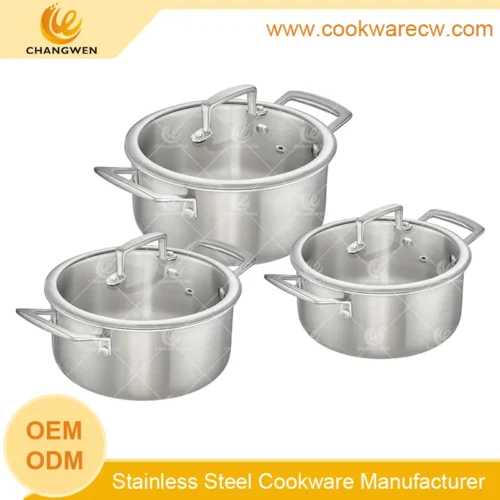
Versatile Stainless Steel Pot Set with Multiple Capacity Options CW-ETP018
-
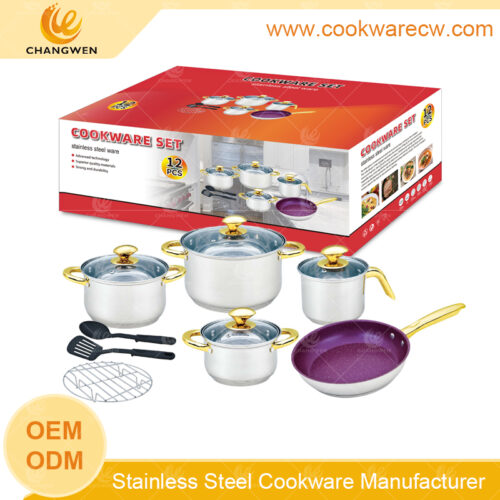
Cookware wholesaler 12pcs pots and pans stainless steel cooking sets kitchenware tools and steamer CW-M1211
-
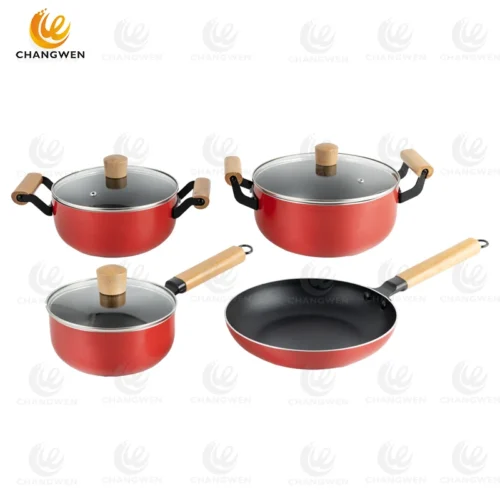
7pcs Fluorine-Free Ceramic Nonstick Aluminum Cookware Set for Kitchenware Brands
-
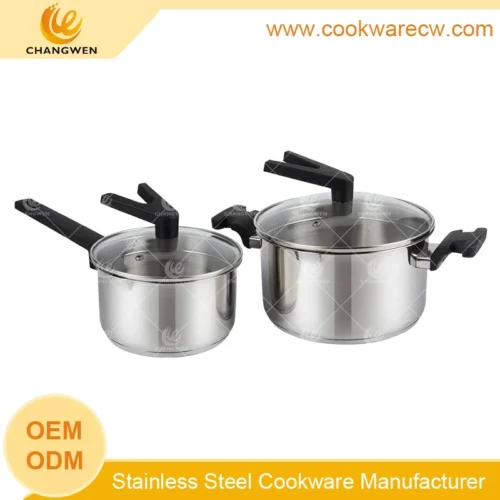
4-Piece Stainless Steel Pot Set with Glass Lids Stand Upright CW-ES0402G