
Reading time: 13 minutes.
The right cookware set is the smallest configuration that covers your target customer's regular meals, fits the local cooktop and storage space, and leaves a viable margin after packaging and delivery. A 5-piece starter kit may outperform a 12-piece box in a compact urban market, while a 10-piece family set may suit a retailer whose customers cook several dishes at once. The number on the carton is a contents count, not a measure of cooking capability. For an importer or private-label buyer, the useful question is: which vessels, lids, and sizes will earn a reorder in this specific channel?
This guide compares practical 5-, 7-, 10-, and 12-piece bills of materials. The configurations are planning examples, not universal industry standards or sales forecasts. Use them to brief a supplier, test a sample, and compare quotations on the same basis. If you need a deeper explanation of stainless steel construction and price tiers, see our separate stainless steel cookware set guide; the decision here is how to build a set for a defined market.
What does the piece count actually measure?
A cookware set's advertised count generally includes each pot or pan, each separate lid, and any insert or utensil named on the packing list. A seven-piece set can therefore contain four cooking vessels and three lids, while another seven-piece set might contain three vessels, three lids, and a steamer. Both labels can be accurate, but the two boxes solve different cooking tasks. Independent consumer guidance from CHOICE also advises buyers to assess the pans they will use rather than treat the headline count as value.
For a wholesale comparison, record four figures beside the advertised count: active vessels, lids, accessories, and distinct cooking jobs. A second 16 cm saucepan adds a vessel but may add little practical range if the first is already 18 cm. A well-fitting lid adds simmering and steaming utility, so it should be valued as a functional part rather than dismissed as count inflation. An accessory is useful only when the target customer would otherwise buy or use it.
State the contents visibly on the carton and product page, such as "4 vessels + 3 lids = 7 pieces." List vessel diameter and usable capacity next to each item. This approach reduces ambiguity for retailers and helps consumers compare sets with the same label. It also gives a factory a precise bill of materials for quotation, sample control, and packing inspection.
Which 5-, 7-, 10-, or 12-piece configuration should you start with?
Start with the buyer's meal pattern and storage limits, then select a count that can carry the necessary cookware. The examples below assume separate lids count as pieces, no utensils are added to inflate the label, and sizes are illustrative. Actual diameters, capacities, and lid fit must be confirmed in the approved sample. A shared lid should be counted once even if it fits two vessels.
| Advertised set | Illustrative contents | Best starting use case | Main trade-off to test |
|---|---|---|---|
| 5 pieces | 3 vessels: 24 cm frying pan, 18 cm saucepan, 22 cm casserole; 2 lids | First apartment, compact kitchen, entry price point | One lid may need to serve two cooking tasks; no large batch pot |
| 7 pieces | 4 vessels: 24 cm frying pan, 18 cm saucepan, 24 cm saute pan, 24 cm casserole; 3 lids | Everyday small-family or core retail offer | Two 24 cm bodies may overlap if the saute pan has too little depth |
| 10 pieces | 5 vessels: 20 cm and 26 cm frying pans, 18 cm and 20 cm saucepans, 24 cm stockpot; 5 lids | Broader family range or gift-ready mainline set | Small pan and second saucepan must justify their space and cost |
| 12 pieces | 6 vessels: 20 cm and 26 cm frying pans, 18 cm and 20 cm saucepans, 24 cm saute pan, 26 cm stockpot; 6 lids | Large-household or premium complete-kitchen offer | Box weight, duplicate functions, and shelf space rise quickly |
The table is a configuration worksheet, not a prescription. A five-piece range for a market that cooks rice and soup daily might swap the open frying pan for a covered deep pan. A seven-piece set for a stir-fry market may need a wok-shaped vessel instead of a saute pan. Change the vessel mix to fit demonstrated demand while keeping the count arithmetic and product claims clear.
When does a 5-piece starter set make commercial sense?
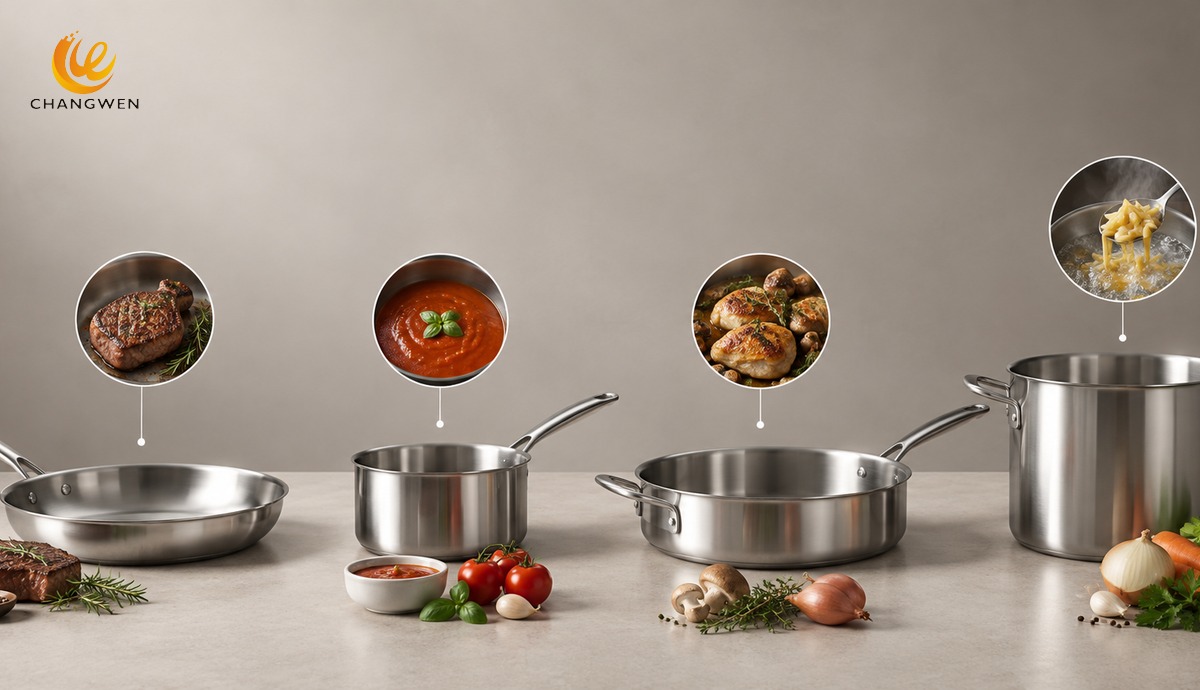
A five-piece cookware set works when the target customer needs a credible first kitchen at a controlled entry price. Three distinct vessels can cover frying, small-volume boiling, and family-size simmering, while two lids support covered cooking. This compact offer can fit smaller retail shelves and parcel shipments more easily than a larger set, but only if the selected bodies are genuinely useful.
Do not let a five-piece label conceal a weak cooking kit. A small saucepan, another near-identical small saucepan, and a narrow frying pan may meet the count while leaving the customer without a pot for soup or pasta. Check the finished 5-piece sample against three real meal scenarios: a quick breakfast, a one-pot dinner, and a meal with two components cooking at once. If the set cannot handle the target household's common week, the low ticket price will not rescue repeat sales.
When is a 7-piece set the strongest core offer?
A seven-piece set often gives a distributor enough room for four active vessels and three lids without moving into the carton size of a full family bundle. It is a useful candidate for the core assortment when customers expect a frying pan, saucepan, deeper one-pan cooker, and stockpot or casserole in one purchase. The fourth vessel should add a new cooking job rather than repeat a size already present.
To test a seven-piece design, compare the fourth vessel with the likely alternative. A deep saute pan adds one-pan meals and shallow braising; a stockpot adds volume for soup, pasta, or batch cooking; a second frying pan helps when two burners are used at once. Ask retail partners which absence produces the most lost sales or returns in their current range. The answer may vary by household size and cuisine, so a global default is unreliable.
When should a 10-piece set become the main family SKU?
A ten-piece set is a sensible mainline candidate when buyers want multiple pan sizes and enough covered vessels for simultaneous cooking. Five vessels and five lids can accommodate a small and large frying pan, two saucepan sizes, and a larger pot. The expanded range supports different serving counts, but it can also introduce the first redundant item. A second saucepan should have a clearly different capacity and purpose, not simply a slightly different diameter.
Before committing to a 10-piece program, test whether the fifth vessel creates incremental value after its effect on freight, packaging, and shelf price. A fifth body increases more than metal cost: it may change the carton footprint, protective inserts, handling weight, and parcel tier. Compare the 10-piece configuration with a seven-piece core plus one open-stock add-on using landed cost and expected order mix rather than headline count alone.
When does a 12-piece set deserve shelf space?
A twelve-piece set fits a customer who wants to equip a larger kitchen in one transaction and has storage for six useful vessels. It can be effective as a premium or gifting SKU when the extra vessels solve clearly different jobs, such as searing, shallow sauteing, and batch boiling. The count itself does not establish a premium position; construction, reliable sizing, lid fit, finish, and presentation do.
The main risk in a twelve-piece offer is paying for apparent completeness without enough extra utility. If a second frying pan is too small to serve the household or a second saucepan is nearly the same capacity as the first, the box becomes heavier without making the kitchen more capable. Require a one-sentence cooking role for each vessel on the design sheet. If the team cannot name a distinct role, remove or replace that vessel before approving the set.
How do you match a set to a market without relying on stereotypes?
Use observed cooking tasks, appliance mix, household size, selling channel, and acceptable shelf price to define a market. A country's name is too broad to settle a cookware bill of materials. Urban apartments, suburban families, and hospitality buyers in the same country can require different diameters, capacities, and packaging. Treat regional claims as hypotheses until your own retailer data or customer research supports them.
Cooking appliance compatibility must be verified at the product level. An induction market needs a suitable magnetic base and a base diameter that works with common cooking zones; a gas-heavy market may place more weight on handle comfort and flame exposure. Do not assume every item in a set has the same heat-source performance merely because the carton says "induction compatible." Test each body on the intended appliance and document any exceptions.
Material affects the set's use and care story. Stainless steel can support a durable multi-vessel range, while coated cookware may be chosen for easy release on specific tasks. Those choices change cleaning instructions, utensil guidance, and replacement expectations. A mixed-material set can be useful, but the packaging must identify which vessel carries which care and oven restrictions. Our cookware set range shows available forms that can be used as a starting point for a tailored specification.
How should retail, e-commerce, and hospitality channels change the configuration?
Physical retail rewards a set that can be understood quickly and handled at a manageable carton size. Put the vessel list, key dimensions, compatible hobs, and warranty or service route where a shopper can see them. A seven- or ten-piece core often gives enough visual substance, but the right size depends on the retailer's shelf depth, target price band, and customer feedback. Ask the retailer to approve a real packed carton, not only a product rendering.
E-commerce requires even more explicit contents and packaging. Display every pot, pan, lid, and insert individually; include capacity, diameter, weight, and packed dimensions; and distinguish the photographed props from included pieces. A compact five-piece set may have a lower parcel burden, whereas a twelve-piece set may command a higher order value but create more damage exposure and return shipping cost. The actual answer depends on your carrier's dimensional rules and the tested packaging.
What is a practical market-fit scorecard?
Score candidate sets against the needs of one defined buyer group before discussing aesthetics. The following five-question worksheet is a decision aid, not a scientific sales model. Give each question a score from 0 to 2, where 0 means the requirement is unmet, 1 means it is partly met, and 2 means it is demonstrated by evidence. Record the evidence next to the score so a design meeting cannot hide a weak assumption.
- Cooking coverage: Can the vessels prepare the three meals or cooking tasks your target buyers perform most often?
- Fit: Do the diameters, capacities, weight, and handles work with the intended cooktops, cupboards, and users?
- Distinct roles: Does each added vessel solve a new problem, with no expensive near-duplicate?
- Channel economics: Does the packed set meet the target shelf price and landed contribution after realistic freight and returns?
- Serviceability: Can buyers obtain compatible replacement lids or matching open-stock items?

How do you compare prices without being fooled by the piece count?
Quote comparison should begin with the same bill of materials. Ask each supplier to specify each body, lid, handle, base construction, finish, packaging component, and packed dimensions. A lower quote for a 10-piece set may reflect smaller vessels, lighter bodies, fewer functional lids, or a weaker gift box. Without a normalized specification, price per advertised piece compares labels rather than products.
Calculate an indicative landed cost per sellable set as factory price plus packaging changes, freight, duty and taxes where applicable, inspection, expected damage allowance, and local delivery. Then estimate contribution per set as net selling price minus landed cost and channel fees. Use your own actual quotes and current destination rules; this formula is a planning tool, not a forecast of duties or profit. A five-piece set can produce better contribution than a larger set if its lower freight and return exposure offset the lower shelf price.
For example, compare a seven-piece candidate at a hypothetical net selling price of 60 currency units with 38 units of landed and channel cost, giving 22 units of contribution. If a ten-piece candidate sells for 75 but costs 56 to land and sell, its contribution is 19. The larger carton creates a higher ticket but a lower contribution in this illustration. Replace every figure with documented quotes and test whether the retail price is acceptable in your channel before choosing the seven-piece set.
What must be locked in the specification before sampling?
A useful set specification is a controlled list of components, not a mood board. Give every vessel a diameter, height, stated capacity method, construction, base dimension, handle design, finish, and lid pairing. Add approved tolerances and identify the component that defines each advertised piece. This lets the sample team, quotation team, packaging team, and final inspector evaluate the same product.
Specify the claims you intend to make before the label is designed. If the package says the set is induction compatible, oven safe, dishwasher safe, or suitable for a particular food-contact market, obtain product-specific support for that claim and check the limiting component. A glass lid, knob, coating, or handle may have a different use limit from the metal body. A broad claim based on one test item should never be applied to the whole bundle without checking every relevant component.
Changwen's OEM sourcing overview explains how a factory brief can cover dimensions, materials, branding, and packaging. For this article's purpose, the key action is to freeze the configuration and its documentation before requesting a production quote; otherwise supplier comparisons can drift as items are substituted.
How should you approve the sample and packed carton?
Approve a golden sample that contains the exact vessels, lids, finishes, logo positions, inserts, and printed packaging intended for the order. Measure vessel dimensions and capacity by the agreed method, test lid seating, handle attachment, stacking order, and appliance compatibility, then record photographs and results. A tabletop sample that omits the retail box is incomplete because the finished pack is part of what the retailer buys.
Check the set as a system. Place every lid on every claimed compatible vessel, stack the cookware in the planned order, verify that protective materials prevent rim and surface contact, and close the carton using the production method. Repeat the inspection after the agreed transport simulation or shipping trial. A heavier ten- or twelve-piece set may need different internal supports from a five-piece set even when it uses the same outer artwork.

How can a pilot tell you which configuration actually sells?
Test a small number of clearly different configurations in one channel before expanding to every count. A practical first comparison might be a seven-piece core set against a ten-piece family set, with the same construction and finish where possible. If the materials and styling also change, the sales result cannot isolate the effect of configuration. Agree on a test period that covers the channel's normal buying cycle rather than judging a seasonal SKU after a few days.
Track more than first-week sales. Record sell-through by SKU, gross contribution after returns, reasons for returns, questions about missing pieces, damage rate, and whether the buyer places a reorder without a special promotion. Reorders are stronger evidence of fit than a discounted first shipment. Review feedback on the actual vessel mix: customers may love the finish but still ask for a larger frying pan or fewer small pots.
Set an exit rule before the pilot. For example, the team may decide that a set will be revised if a specific missing vessel appears repeatedly in customer feedback, or dropped if its contribution remains below an agreed threshold after a full sales cycle. The threshold must come from your business economics; there is no universal percentage that proves a 5-, 7-, 10-, or 12-piece set will succeed. Document the decision and feed it into the next sample rather than ordering all variants indefinitely.
What should you send a factory for a comparable quotation?
A complete RFQ should describe the destination market, selling channel, target customer, target shelf price, planned order volume, proposed piece count, and a line-by-line vessel and lid list. Attach a specification table with diameters, capacities, construction, handles, finish, hob compatibility, required claims, logo position, and packaging format. Ask for unit price, tooling or artwork charges, sample cost, minimum order quantity, lead time, carton dimensions, and replacement-part availability as separate fields.
Before approval, check that the carton artwork, product page, purchase order, and golden sample all show the same count and contents. This final cross-check prevents a common source of confusion: marketing calls the box "10 pieces," while the approved physical set or marketplace listing counts a shared lid differently. Consistency helps the consumer understand the offer and gives the inspector a clear acceptance standard.
Which count should you choose?
Choose five pieces for a compact, credible starter kit; seven for a balanced core offer; ten for a broader family assortment; and twelve only when every additional vessel has a distinct job and the packed economics hold. These are starting roles, not fixed rules. A market with small kitchens or expensive parcel delivery may favor fewer pieces, while a channel serving larger households may justify a fuller box. The winner is the set whose measured function, price, packaging, and reorder evidence agree.
If you are building a wholesale or private-label cookware range, send Changwen your target market, sales channel, preferred vessel sizes, proposed 5-, 7-, 10-, or 12-piece bill of materials, packaging needs, and expected order quantity. Changwen can discuss configuration, OEM branding, samples, and a comparable quotation. Explore the cookware set catalog or contact the team with your specification to move from a headline count to a set designed for your buyers.
-
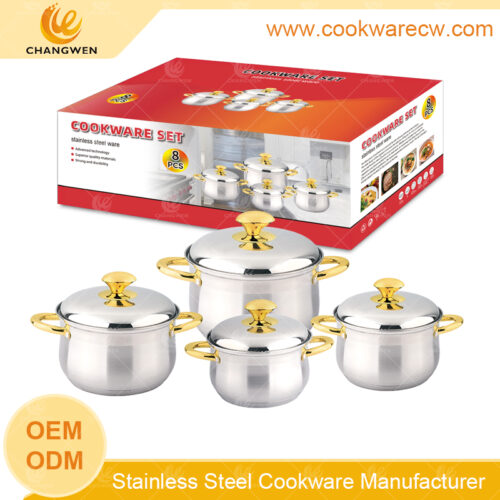
Stainless Steel Stock Pot 8 Qt/20l/30 Litre/60 Qt CW-M0802
-
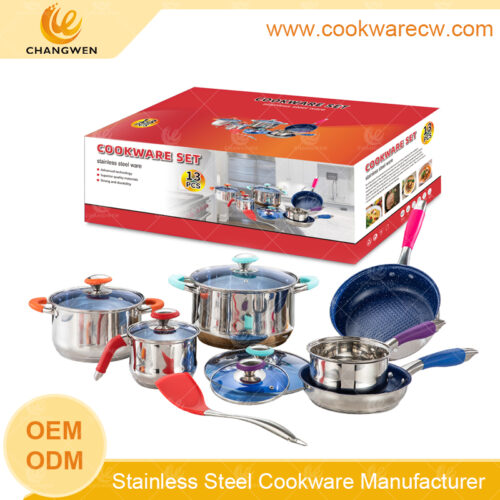
China manufacturer stainless steel pots and pans 12pcs cooking set fry pan nonstick set mirror polished cookware 3.0L whistling tea kettle soup stock pot kitchen set steamer rack CW-M1206G
-
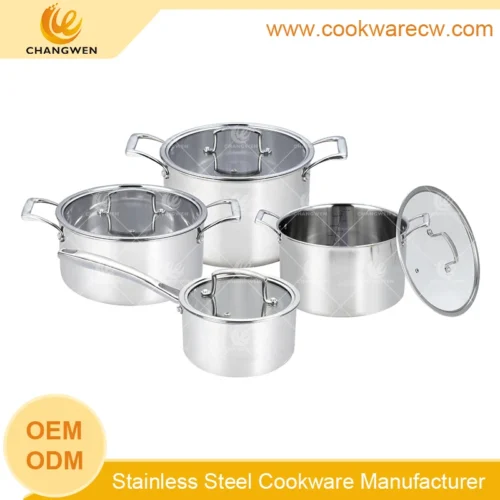
Premium Stainless Steel Cookware Set for Modern Kitchens CW-ETP0801
-
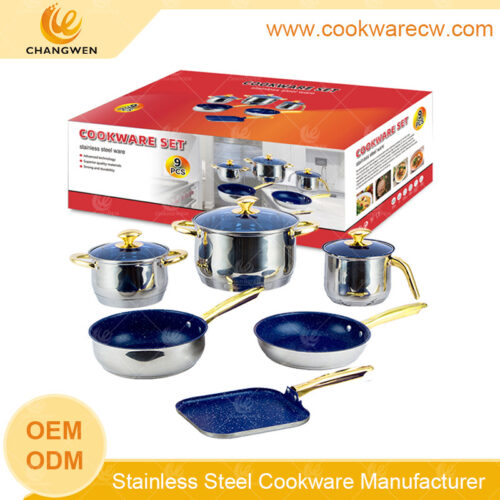
9pcs stainless steel cookware set pots and pans with non-stick coating golden hollow handle and knob with rivets wholesaler factory CW-M0901
-
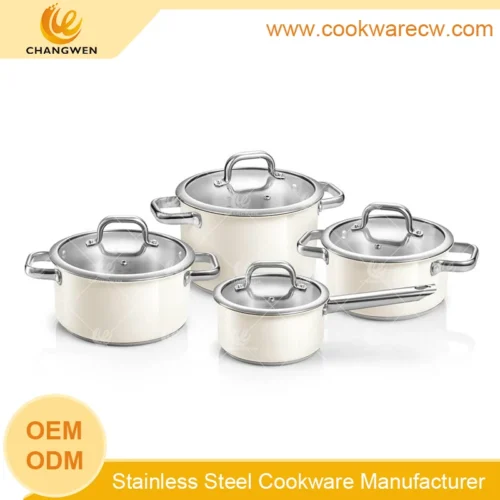
8-Piece Cream White Stainless Steel Cookware Set with Saucepan CW-ES0803
-
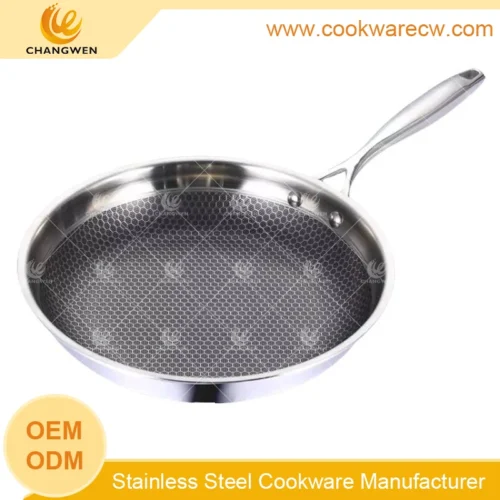
Honeycomb Stainless Steel Frying Pan for Even Cooking CW-TP011
-
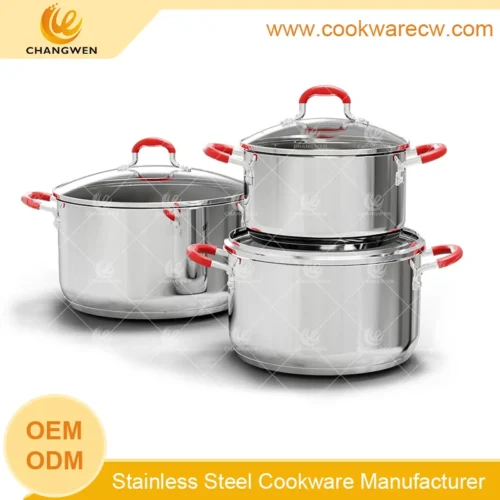
6-Piece Stainless Steel Pot Set with Red Silicone Handles CW-ES0613G
-

Stainless Steel Frying Pan with Professional Heat Control CW-ETP020