
Read time: 13 minutes
Cookware manufacturers should be compared by giving each shortlisted factory the same controlled trial project, not by collecting another round of promises. A useful trial asks every factory to interpret one product brief, produce evidence against the same acceptance criteria, respond to one controlled change, and prove repeatability through a sample or pilot order. This method reveals engineering discipline, quality control, communication, packaging competence, and recovery behavior before a buyer commits to full production.
A lower unit price can still create a higher business cost when specifications drift, approvals take too long, defects escape inspection, or delivery dates move without warning. A proof-based comparison turns those risks into observable events. The winning cookware manufacturer is therefore the factory that produces the strongest repeatable evidence at an acceptable total cost, rather than the factory that makes the most confident presentation.
What makes a trial-based comparison different from a supplier checklist?
A supplier checklist records what a manufacturer says it can do, while a controlled trial records what the manufacturer actually does under the same conditions as competing factories. Certificates, equipment lists, factory videos, and customer references remain useful screening evidence, but those documents do not prove that the team assigned to a new cookware project can translate a brief into consistent production.
A controlled trial also separates capability from sales presentation. Two factories may claim strong engineering support, yet only one may identify an incompatible handle attachment, calculate the packaging consequences of a larger lid knob, or document how a coating change affects testing. A real task exposes the quality of the manufacturer’s reasoning because every recommendation must connect to a measurable product or commercial consequence.
Buyers who need a conventional overview of selection criteria can first review the ten factors for choosing a cookware manufacturer. The method in this article begins after that initial screening and focuses on how to test the final two or three candidates without repeating a generic factor list.
Which manufacturers should enter the controlled trial?
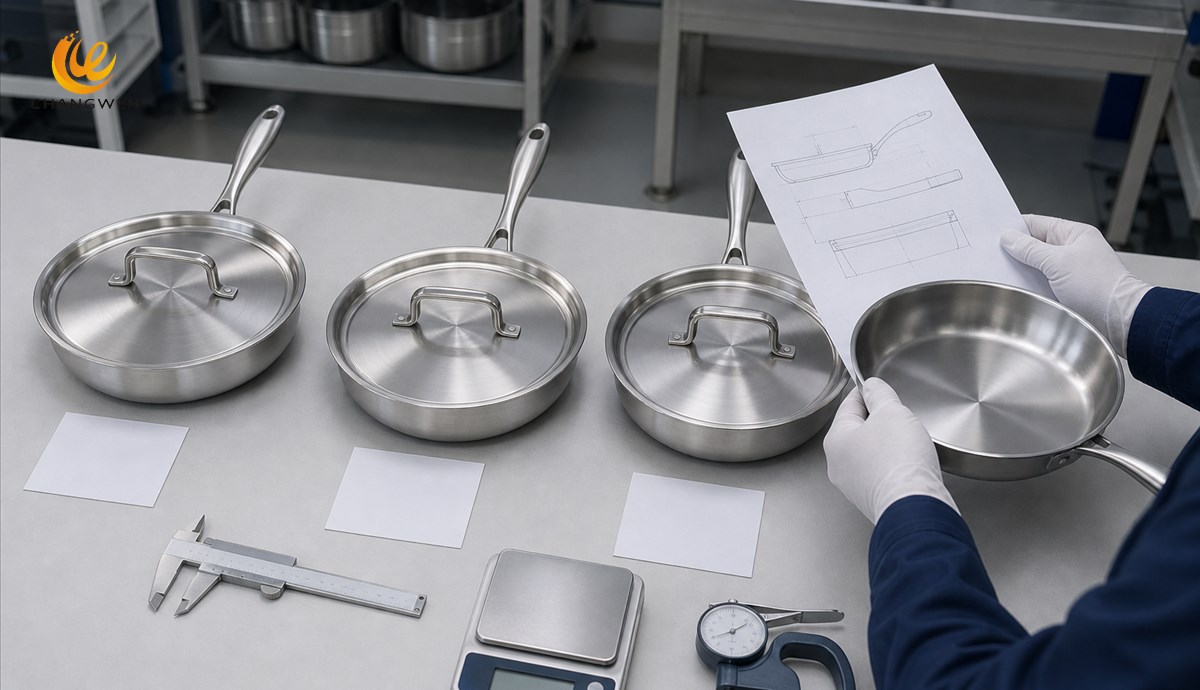
A controlled trial should normally include two or three manufacturers that have already passed non-negotiable checks. A large candidate pool makes the exercise slow and expensive, while a single candidate provides no comparative evidence. The shortlist should include only factories that can make the required cookware category, accept the commercial range, support the destination market, and communicate through an accountable project contact.
Pass-or-fail gates should be applied before scoring begins. A factory that cannot provide relevant business registration, material traceability, process capability, or credible food-contact documentation should not receive extra points elsewhere to compensate. Compliance is a permission to compete, not a bonus feature. The cookware food-grade certification guide explains why a document must match the product construction, target market, and responsible company instead of merely containing a familiar test name.
How should buyers create one fair cookware trial brief?
A fair trial brief defines the required outcome without solving every engineering decision for the factory. The brief should state the product type, dimensions, construction, target weight, material grades, surface finish, handle and lid requirements, heating compatibility, packaging objective, target market, order range, and required delivery window. The brief should also identify which dimensions are fixed and which features may be optimized.
Every candidate must receive the same revision of the brief at the same time. A buyer who gives one supplier clearer drawings, faster answers, or more flexible tolerances creates an uneven test. The comparison record should therefore include a revision number, issue date, question deadline, buyer response log, and final submission deadline. This simple discipline prevents later debate about whether a weak response resulted from missing information.
The brief should request evidence, not adjectives. Instead of asking whether quality control is strict, the buyer should request an incoming-material record, an in-process inspection example, a final inspection plan, measuring-equipment details, and a sample corrective-action report with confidential information removed. Instead of asking whether capacity is sufficient, the buyer should request the proposed production route, bottleneck process, available line time, and recovery plan for a defined delay.
A buyer comparing quotations before the trial should normalize construction, accessories, packaging, testing, Incoterms, payment terms, tooling, and included services. The existing guide on normalizing cookware manufacturer quotations and total cost provides the commercial foundation; the controlled trial adds behavioral proof after the quotations are comparable.
What should be measured during the clarification stage?
The clarification stage should measure question quality rather than response speed alone. A fast reply that confirms an impossible tolerance is weaker than a thoughtful reply that identifies the process limit, explains the consequence, and proposes a testable alternative. High-value questions usually concern material definition, tolerance interactions, handle temperature, induction-base flatness, surface appearance standards, packaging geometry, inspection sampling, or destination-market requirements.
A useful clarification log records each question, the reason for the question, the affected specification, the proposed resolution, and the decision owner. The log reveals whether a manufacturer manages requirements as a system or treats each message as an isolated request. A factory with disciplined requirement control is less likely to manufacture from an obsolete drawing or overlook a change that affects testing and packaging.
How can an engineering change reveal hidden manufacturer capability?
A controlled engineering change is one of the most useful elements in a supplier trial because cookware projects rarely remain unchanged from inquiry to production. After every candidate has reviewed the original brief, the buyer can introduce the same realistic modification, such as a heavier handle, a different lid profile, a lower carton-height target, a revised surface finish, or an induction requirement for another market.
The manufacturer should explain how the change affects tooling, sample timing, unit cost, test scope, packaging, lead time, and existing approvals. A capable engineering team maps the change across connected processes instead of responding only to the visible feature. For example, a heavier handle may improve perceived value but increase balance risk, attachment load, carton support needs, and drop-test stress.
The buyer should not reward a manufacturer merely for accepting every change. Automatic agreement can indicate weak feasibility control. A stronger response may reject part of the request, show the physical or process constraint, and offer two alternatives with clear tradeoffs. The purpose of the change test is to discover whether the factory protects the product outcome when commercial pressure encourages a quick yes.
How should the sample round test repeatability rather than appearance?
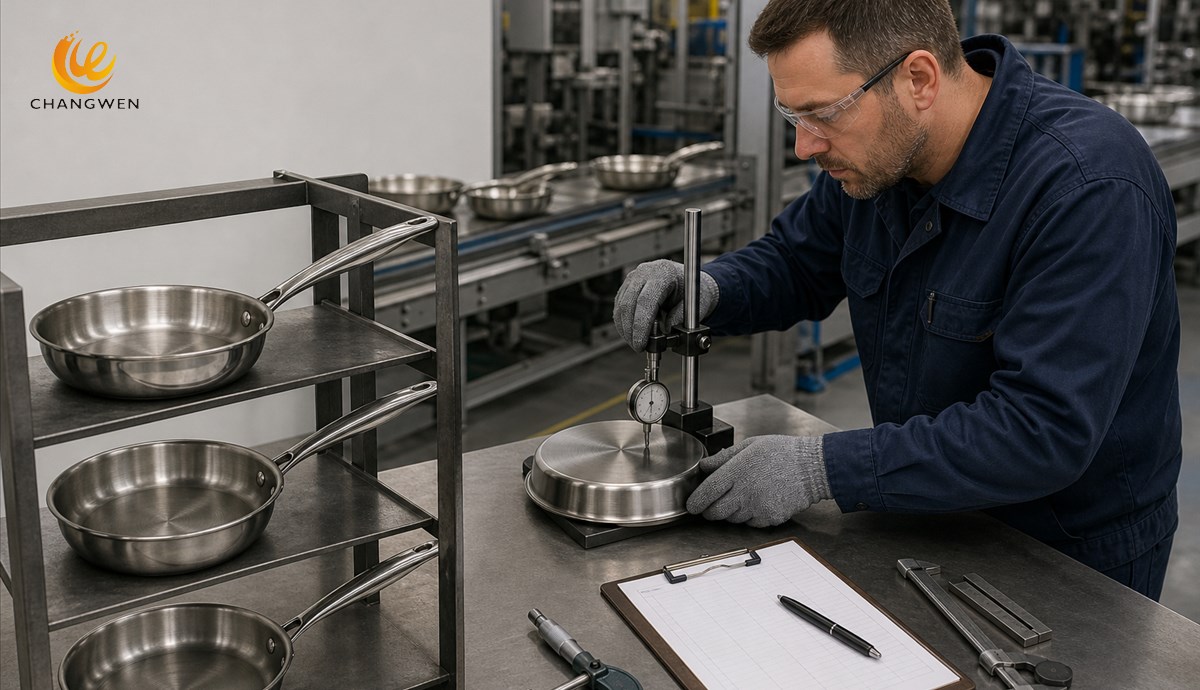
A beautiful presentation sample proves that one item can be made well, but a production decision requires evidence that the approved result can be repeated. Each manufacturer should submit more than one sample when practical, and the buyer should measure the same critical-to-quality characteristics on every unit. Relevant characteristics may include wall thickness, base flatness, weight, rim geometry, handle alignment, attachment strength, lid fit, surface finish, coating thickness, and induction response.
Sample results should be recorded as numbers or defined visual grades instead of general impressions. A five-gram weight range, a documented wobble method, or an agreed surface limit sample creates a reproducible decision. Statements such as “looks premium” or “feels solid” can support merchandising judgment, but those statements cannot tell a production inspector when a unit passes or fails.
The sample review should compare the product with the manufacturer’s own documents. A supplier that provides a correct drawing, bill of materials, control plan, and inspection report demonstrates stronger transfer readiness than a supplier that sends an attractive pan without a reliable technical record. The stainless steel cookware supplier evaluation guide offers additional checks for material grade, construction capability, samples, and factory verification.
Which practical tests should be identical for every candidate?
Every candidate should face the same product-specific test plan, test sequence, conditioning method, equipment definition, and pass criteria. Identical testing prevents a supplier from selecting only the easiest evidence. The plan should focus on failure modes that matter to the product, such as base distortion, attachment loosening, lid mismatch, coating damage, corrosion, staining, thermal cycling, dishwasher exposure, or packaging damage.
Test severity should match the claim and intended use instead of becoming an arbitrary torture test. A test that is unrealistically harsh can eliminate suitable products without predicting field performance, while a weak demonstration can create false confidence. The buyer should connect every test to a stated claim, market requirement, customer use pattern, or known return risk.
Dishwasher suitability illustrates why test definitions matter. The words “dishwasher-safe” do not define detergent chemistry, cycle count, temperature, evaluation point, or acceptable appearance change. Buyers can use the dishwasher-safe cookware testing guide to convert a broad marketing claim into measurable acceptance criteria.
Why should the trial include a problem-response simulation?
A problem-response simulation shows how a manufacturer behaves when the project stops following the ideal plan. The buyer can present the same hypothetical event to each candidate, such as a late raw-material batch, a failed handle test, a color mismatch near the shipment date, or a packaging defect found during pre-shipment inspection. The event should be realistic, bounded, and unrelated to confidential customer information.
Each manufacturer should return a containment plan, affected-quantity estimate, root-cause approach, corrective-action owner, communication schedule, and recovery timeline. A weak response jumps directly to reassurance or replacement. A strong response first protects the buyer from additional exposure, separates confirmed facts from assumptions, and explains how effectiveness will be verified before normal production resumes.
The simulation should test escalation discipline as well as technical skill. Buyers need to know who can stop production, who can approve a deviation, how quickly senior operations personnel become involved, and whether bad news is reported early. A factory that hides a manageable issue until shipment creates more risk than a factory that reports the issue promptly with a controlled recovery plan.
How does a pilot order expose risks that samples cannot show?
A pilot order tests the transition from engineering attention to routine production. The pilot quantity should be large enough to involve normal materials, production operators, inspection records, packaging work, and shipment preparation, but small enough to limit exposure. The correct quantity varies by tooling, process, SKU count, and packaging method, so the pilot should be defined by learning objectives rather than a universal number.
The pilot should compare the approved sample with units taken from the beginning, middle, and end of the run. This time-based sampling reveals tool warm-up effects, coating drift, polishing variation, assembly inconsistency, and operator changes that a single finished sample cannot expose. The buyer should also reconcile input material, output quantity, scrap, rework, and final packed quantity to understand process stability.
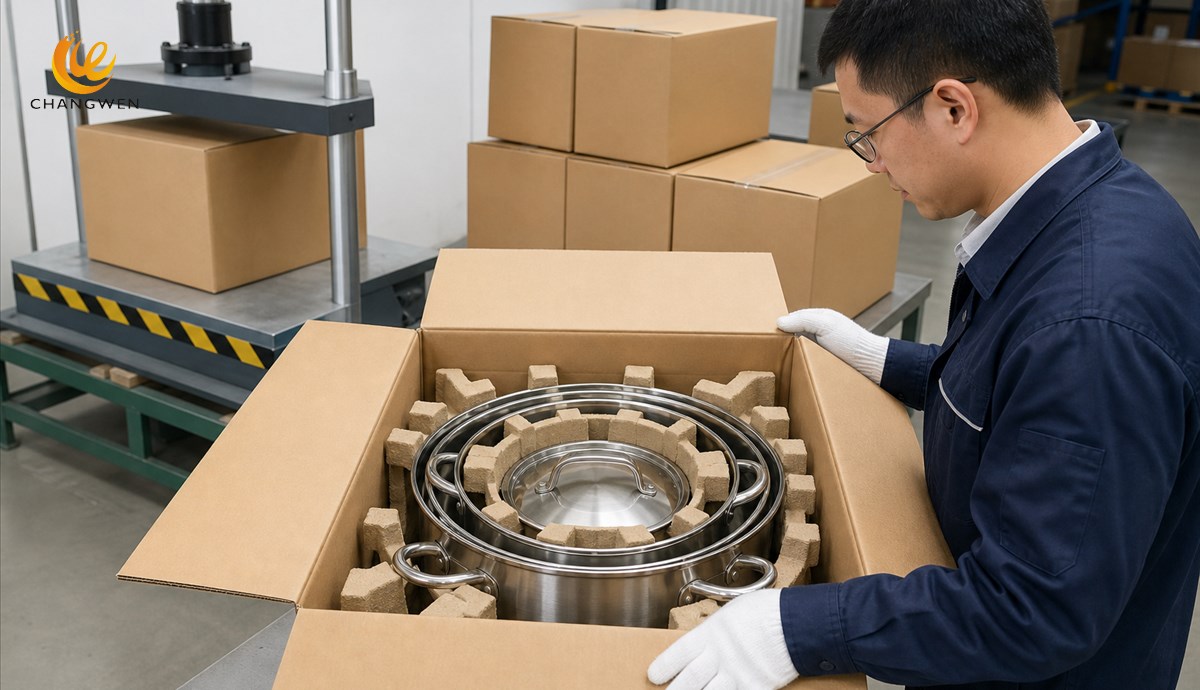
The pilot order should use realistic packaging because packout can change product risk and landed economics. Carton dimensions, nesting, separators, handle protection, accessory placement, label accuracy, and pallet or container loading affect damage, warehouse handling, and freight efficiency. The cookware MOQ, packaging, and shipping guide explains how production quantity and carton design interact with the importer’s real cost.
What evidence packet should each cookware manufacturer submit?
An evidence packet should make the supplier decision auditable after the meetings are over. The packet can include the final quotation, marked drawings, bill of materials, process route, sample report, critical measurement data, material documents, applicable test reports, packaging specification, change log, inspection plan, pilot summary, corrective-action exercise, lead-time commitment, and named project owners.
How should buyers score evidence without recreating a generic factor list?
A trial score should rate the strength of proof produced during the controlled tasks rather than assign points for broad claims. Each trial event can be scored on a five-level evidence scale: no answer, unsupported answer, partial evidence, complete evidence, or repeatable verified evidence. The scale keeps the comparison focused on observable performance while allowing different cookware projects to emphasize different failure modes.
| Trial event | Question answered | Strong evidence | Weak signal |
|---|---|---|---|
| Brief review | Can the factory control requirements? | Traceable questions, marked drawings, closed decisions | Fast quotation with hidden assumptions |
| Engineering change | Can the factory manage connected consequences? | Impact on tooling, testing, cost, timing, and packaging | Automatic approval without feasibility analysis |
| Sample round | Can the factory reproduce the intended product? | Multiple measured units tied to controlled documents | One polished sample with no data |
| Problem simulation | Can the factory contain and solve an issue? | Containment, root cause, owner, timing, verification | Reassurance without a controlled action plan |
| Pilot order | Can the factory transfer approval into normal production? | Run data, time-based samples, packout and traceability | Selected good units without production records |
Critical gates should remain outside the weighted total. Food-contact compliance, confirmed material identity, intellectual-property obligations, and unacceptable safety failures should not be averaged away by strong communication or a favorable quote. A high total score cannot repair a missing legal or product-safety requirement.
How can buyers convert trial results into a commercial decision?
The final decision should combine the trial evidence, normalized commercial offer, and cost of unresolved actions. A supplier with a slightly higher unit price may create more value when the pilot shows stable output, accurate documents, lower inspection effort, reliable packout, and faster issue closure. A cheaper supplier may remain competitive when the identified gaps are minor, measurable, and inexpensive to close before production.
Unresolved actions should be written as conditions rather than buried in meeting notes. A condition might require a revised fixture, another test, a packaging change, a second pilot, or an updated control plan before the purchase order becomes effective. Each condition needs an owner, due date, acceptance evidence, and consequence if the action fails.
A phased award can protect both the buyer and the manufacturer. The buyer can approve tooling, then samples, then a pilot, and only then release the full quantity. The manufacturer receives clear decision points, while the buyer avoids committing all volume before the highest-risk assumptions have been tested. The custom cookware OEM process guide shows where specification, sample, customization, production, inspection, and shipment decisions normally occur.
What does a proof-based comparison look like in practice?
Consider two factories responding to the same frying-pan project. Manufacturer A offers the lower unit price and sends an attractive first sample quickly. Manufacturer B asks more questions, identifies that the requested handle weight may create a balance problem, and proposes two attachment options with different test and tooling consequences. The first round makes Manufacturer A look faster and Manufacturer B look more cautious.
The controlled change asks both factories to reduce packed carton height without changing the retail set. Manufacturer A reduces protective material and confirms the target immediately. Manufacturer B redraws the nesting arrangement, changes accessory placement, and requests a packaging test before approval. The change trial shows that Manufacturer B treats carton dimensions as both a cost and product-protection decision.
The sample and pilot stages then determine whether the extra caution creates measurable value. If Manufacturer B delivers more consistent base flatness, traceable inspection records, and a stable packout, the higher quote may represent the lower-risk choice. If Manufacturer A closes the documentation and packaging gaps during the pilot while maintaining acceptable output, the lower quote may still win. The trial does not predetermine the result; the trial makes the result defensible.
Which mistakes can invalidate a controlled supplier trial?
A controlled trial becomes unreliable when candidates receive different information or are judged by changing criteria. Buyers should avoid private side conversations that alter one candidate’s scope, undocumented drawing revisions, different sample quantities, inconsistent test methods, and weights assigned after results are visible. Fair inputs are necessary for fair conclusions.
Another mistake is demanding extensive unpaid development from too many factories. A serious trial should be proportionate to the expected program and transparent about compensation, tooling ownership, sample charges, confidentiality, and use of the submitted work. Fair commercial treatment improves participation quality and helps the buyer observe how a long-term working relationship may function.
Frequently asked questions
How many cookware manufacturers should enter a trial project?
Two or three qualified cookware manufacturers usually create enough comparison without making the process unmanageable. Every participant should first pass basic capability, compliance, commercial-range, and communication checks.
Should the lowest-priced manufacturer be removed before testing?
The lowest-priced manufacturer should remain in the trial when the quotation covers the same specification and no critical gate has failed. The trial determines whether the low price reflects efficiency or whether the quote depends on hidden assumptions, weak controls, or excluded work.
Is a sample order enough to compare cookware manufacturers?
A sample order is useful but incomplete because sample teams can apply attention that normal production will not receive. A stronger comparison combines controlled clarification, an engineering change, repeatability measurements, a problem-response exercise, and a pilot order when project scale justifies the cost.
How long should a manufacturer comparison trial take?
The trial duration should follow the real product process rather than an arbitrary calendar target. Existing tooling and simple customization may allow a short trial, while new tooling, coatings, complex packaging, or market-specific testing can require several production and approval cycles.
Can a factory audit replace the controlled trial?
A factory audit and a controlled trial answer different questions. An audit verifies the facility, systems, records, and general controls, while the trial verifies how the manufacturer applies those capabilities to the buyer’s exact cookware project. High-risk programs benefit from both forms of evidence.
What should happen when two manufacturers achieve similar results?
When trial results are similar, the buyer should compare the unresolved conditions, commercial flexibility, capacity timing, communication load, and long-term product roadmap. A split pilot or limited initial award can generate additional evidence without forcing a premature full-volume commitment.
What is the final decision rule?
The best cookware manufacturer is the qualified factory that produces the most repeatable evidence under the buyer’s actual project conditions at an acceptable total cost. Price remains important because a product must meet its market position, but price should be evaluated after scope is equal and before risk is ignored.
A controlled brief, engineering change, sample comparison, problem simulation, and pilot order turn supplier selection into a sequence of testable decisions. This proof-based method reduces dependence on sales claims, exposes hidden execution differences, and gives the buyer a documented reason for awarding the program.
-
Wholesale Stock Pot CW-SP002
-
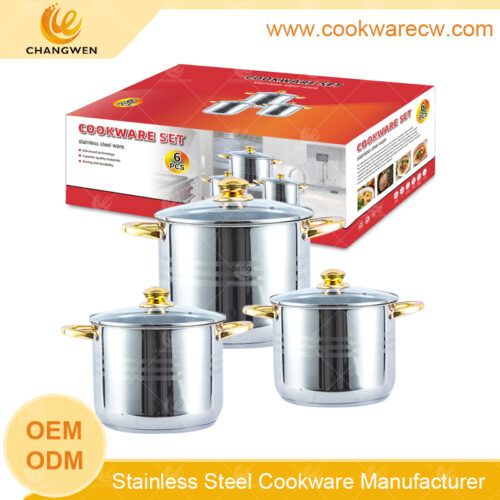
Heavy Duty Stock Pots Stainless Steel CW-M0607
-
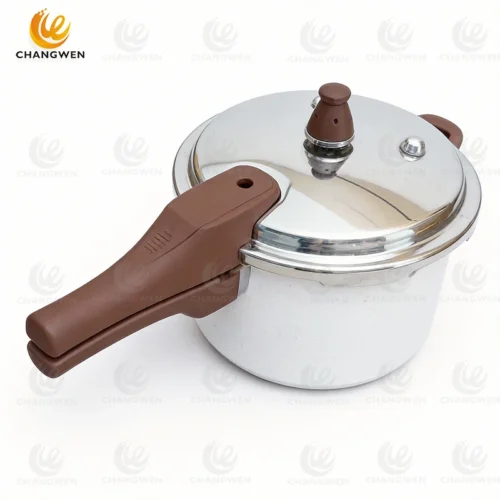
Small Aluminum Pressure Cooker for Fast & Safe Home Cooking
-
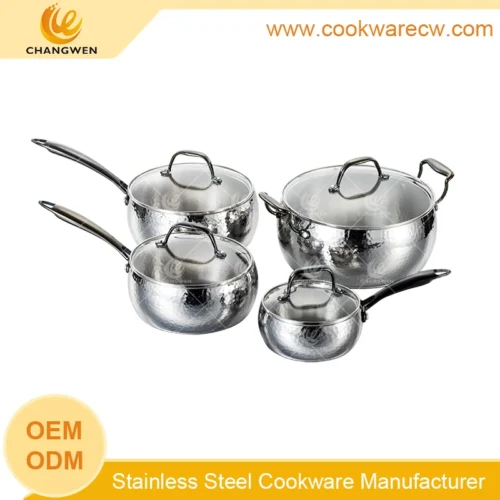
Apple-Shaped Hammered Stainless Steel Cookware Set CW-TP0802
-
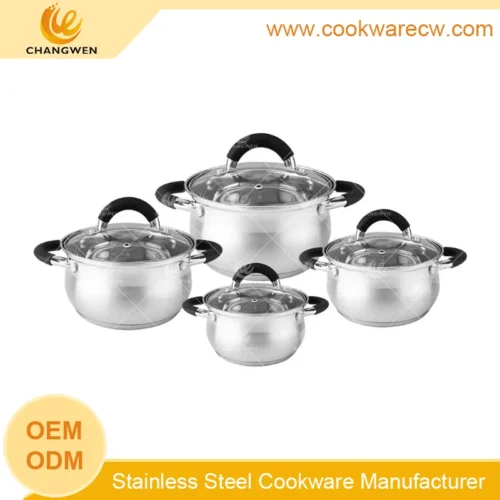
8-Piece Stainless Steel Pot Set with Black Silicone Handles CW-ES0810G
-

Hotsale 12pcs stainless steel cooking sets soup stock pot kitchen ollas saucepan casserole and milkpot fry pan nonstick CW-M1209
-
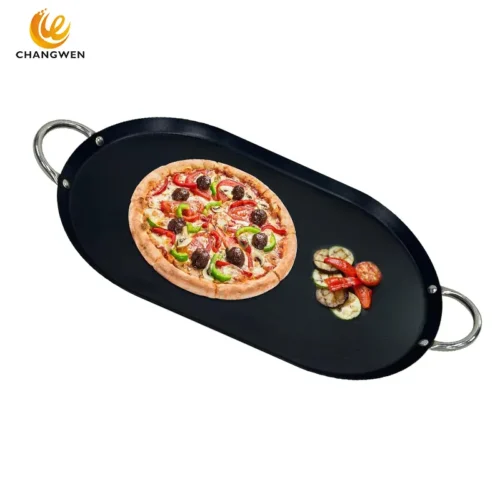
Stainless Steel Griddle For BBQ Grills
-
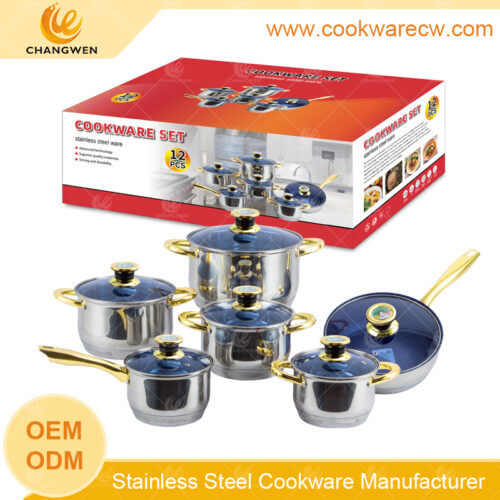
Pots wholesale cookware set 12pcs stainless steel pots and pans nonstick fry pan with thermal knobs and golden handles blue glass lids CW-M1215