
Read time: 13 min
Introduction
Here is a fact that catches most first-time cookware brand owners off guard:
The packaging decision is made before the product decision.
Not in chronological order, necessarily — but in terms of impact on your retail success, the box your cookware arrives in communicates quality, price positioning, brand story, and purchase permission before a single buyer touches the product. A beautifully engineered tri-ply stainless steel pan packaged in a generic brown box sends a clear signal to the shelf browser: commodity.
Packaging customization for cookware is not a cosmetic detail. It is a core commercial decision — one that affects your retail price, your margin, your MOQ commitments, your production timeline, and whether a shopper picks up your product or the one beside it.
This guide covers the full landscape of cookware packaging customization: every packaging type available, every print method and finish option, what each actually costs at realistic order quantities, the MOQ realities that most packaging guides don’t tell you, and how to avoid the mistakes that cost brands real money on their first packaging run.
Whether you are launching a private-label cookware line, sourcing cookware sets for retail distribution, building a hotel or restaurant brand’s house cookware program, or already selling cookware and ready to upgrade your packaging — this is the guide you need.

Key Takeaways
- Packaging type drives cost more than printing does. The gap between a standard brown outer carton and a full-color custom retail box is less about printing cost and more about structural complexity, board grade, and finish level.
- MOQ and unit cost move in opposite directions. Lower MOQs carry higher per-unit cost. The right MOQ is not the lowest one — it is the one that matches your sell-through velocity and available cash flow.
- Offset printing has high setup cost but low per-unit cost at volume. Digital printing has no setup cost but higher per-unit cost. For cookware packaging above 1,000 units, offset almost always wins on total cost.
- Surface finishes (soft-touch laminate, foil stamping, embossing) are not luxury add-ons. At retail price points above $40–50, premium finishes are what justify the price to the customer before they open the box.
- Custom packaging adds 2–4 weeks to your production timeline. This is not optional to plan around — packaging production must run parallel to product production, not after it.
- The OEM/ODM distinction matters for packaging control. ODM programs typically use standard factory packaging. OEM programs give you full packaging ownership. Mixing the two is the most cost-efficient starting point for new brands.
Why Cookware Packaging Is Your Loudest Salesperson
Before we get into specs and costs, let’s establish why this matters enough to spend time on.
Walk through any cookware aisle — or scroll through any e-commerce category page — and observe your own decision behavior. You do not read every spec. You do not look up every review. You make a shortlist based on packaging first: which products visually signal quality, which signal value, and which you skip entirely without conscious thought.
This is not a soft insight. The packaging is doing the job of a salesperson who is never there.
For a cookware brand specifically, packaging carries three commercial functions:
Function 1: Communicating construction quality before the product is touched. Tri-ply construction, 304 stainless, PFOA-free coatings, induction compatibility — these are complex benefits that a buyer cannot assess visually on a store shelf. Packaging that clearly communicates these features (and does so with visual credibility — not just text on a plain background) directly influences willingness to pay.
Function 2: Justifying price at the shelf. A $75 pan in premium matte-finish packaging with foil-stamped branding, a window cut showing the actual product, and structured information hierarchy reads as worth $75. The same pan in a standard color-printed box reads as worth $45. The packaging is pricing the product as much as the price tag is.
Function 3: Creating brand recall for repeat purchases. In e-commerce particularly, the unboxing experience — the moment the packaging opens — is a documented driver of repeat purchase and social sharing. Packaging that creates a deliberate, considered experience at opening builds brand loyalty that generic packaging never can.
For professional wholesale buyers, hospitality operators building house cookware programs, and retail distributors sourcing private-label lines: packaging customization is the difference between building a recognizable brand asset and selling a commodity.
Types of Cookware Packaging: Which One Fits Your Brand?
Cookware packaging divides into four structural types, each with different cost profiles, brand positioning signals, and appropriate use cases.
1. Outer Carton (Export/Master Carton)
The standard shipping and logistics carton. Corrugated board, plain kraft or printed with basic product information. Not a consumer-facing package.
When it’s appropriate: Restaurant supply, hotel procurement, B2B wholesale where the end buyer is a commercial kitchen operator and the packaging is purely functional.
Cost signal to end user: None — this packaging does not reach the end consumer.
Typical cost per unit: Low. Standard corrugated export carton costs $0.30–$1.50 per unit depending on size and quantity, with minimal or no printing.
2. Color Box (Standard Retail Box)
A folding carton (paperboard) with full-color printing, typically gloss or matte laminated. The standard retail cookware package. Can accommodate product photography, feature callouts, certifications, and brand story.
When it’s appropriate: Retail distribution, e-commerce (Amazon, DTC), mid-market price positioning ($20–$80 retail). The volume workhorse of cookware retail packaging.
Cost signal to end user: Mid-range. A well-executed color box signals a real brand — not luxury, but not commodity.
Typical cost per unit: $0.80–$2.50 per unit at 1,000–5,000 units, depending on size, board grade, printing complexity, and finish. At 10,000+ units, cost drops to $0.40–$1.20 per unit.
3. Gift Box / Premium Retail Box
Rigid or semi-rigid construction with premium finishes: embossing, soft-touch laminate, foil stamping, magnetic closure, or drawer-pull designs. Higher material cost, longer production time, dramatically stronger shelf and gift-purchase appeal.
When it’s appropriate: Premium cookware sets ($80+), gift sets for holiday retail, wedding registry product lines, brand launches targeting the premium tier.
Cost signal to end user: High. Premium rigid packaging immediately signals gift-worthy and high-end quality. It works in both retail and e-commerce (the unboxing experience for gift buyers).
Typical cost per unit: $2.50–$8.00 per unit at 500–2,000 units depending on construction and finishes. At 5,000+ units, cost typically drops to $1.50–$4.00 per unit.
4. Blister Pack / Window Box
Plastic window cut into a paperboard backer, allowing the product or part of it to be visible through the packaging. More common for individual utensils, small accessories, or single-piece items than for full cookware sets.
When it’s appropriate: Point-of-sale impulse purchase items, utensil sets, individual pan purchases where product visibility drives purchase decision.
Typical cost per unit: $0.60–$2.00 per unit depending on window size, plastic type, and printing.
5. Poly Bag + Hang Tag
Polyethylene or polypropylene bag with a printed or plain hang tag. The lowest-cost packaging option. Almost exclusively for low-price-point items, bulk packs, or warehouse club formats where packaging simplicity is the selling point.
When it’s appropriate: Warehouse club/bulk retail, low-price-point utensil sets, items sold as commodity rather than brand.
Typical cost per unit: $0.10–$0.40 per unit.
Customization Options at Every Budget Level
Packaging customization is not all-or-nothing. The options below are roughly organized from lowest to highest investment, with realistic starting costs and what each delivers commercially.
Level 1: Logo + Product Info on Standard Factory Box (Lowest Investment)
The factory’s standard neutral box with your logo printed via single-color or two-color silk screen or sticker application. Minimum change to the factory’s standard packaging.
What you get: Basic brand identification. Your name on the box.
What you don’t get: Any meaningful brand story, quality communication, or shelf differentiation.
Cost addition over standard packaging: Minimal — $0.05–$0.20 per unit for sticker or simple logo print.
Best for: First orders where you’re validating market demand before packaging investment. Hotel and restaurant supply where packaging is discarded on receipt.
Level 2: Full-Color Custom Box (Core Brand Investment)
Completely custom-designed folding carton with four-color (CMYK) process printing, your brand design, product photography or illustration, feature callouts, certification marks, and brand story. Standard matte or gloss laminate.
What you get: A real brand on the shelf. Products that look like they belong in a retail environment.
Cost range: $1.00–$2.50 per unit at 1,000–3,000 units.
Best for: Most retail and e-commerce brands launching a cookware line for the first time.
Design requirements: High-resolution logo, brand color specifications (Pantone or CMYK values), product photography at retail quality, copywriting for features and certifications.
Level 3: Full-Color Box + Premium Surface Finish
Everything in Level 2 plus one or more premium surface treatments: matte soft-touch laminate, spot UV coating, foil stamping (gold, silver, rose gold, holographic), embossing or debossing.
What you get: Packaging that feels expensive to hold. Tactile experience that reinforces premium pricing. Dramatically stronger performance at the premium tier.
Cost addition over Level 2: $0.30–$1.20 per unit for standard finishes (soft-touch, spot UV). $0.60–$2.00 per unit for foil stamping or embossing, depending on coverage area.
Best for: Cookware sets priced above $60 retail, gift sets, holiday collections, premium brand positioning.
Level 4: Custom Structural Design (New Dieline)
Creating a new box structure — unique opening mechanism, window cuts in non-standard positions, drawer-pull design, magnetic closure, or unusual footprint. Requires new structural die-cutting tooling.
What you get: Packaging that nobody else in the category has. True structural differentiation.
Tooling cost: $300–$1,500 per new dieline depending on complexity.
Best for: Established brands investing in long-term packaging distinctiveness. Programs with sufficient volume to amortize tooling cost over production runs.
Level 5: Full Rigid Gift Box Program
Custom rigid boxes (non-folding, chipboard construction) with all surface finishes, insert trays custom-formed to product dimensions, premium unboxing design.
What you get: The absolute premium unboxing experience. Products that function as gifts before they function as cookware.
Cost range: $3.00–$8.00+ per unit at 500–2,000 units.
Best for: Premium cookware sets at $100+ retail, bridal/wedding programs, holiday gift collections, brand flagship products.
Printing Methods Explained: Offset, Digital, Screen & More
The print method determines both cost and quality. Understanding these options prevents common over-spending and under-specification mistakes.
Offset Lithography (CMYK)
The industry standard for production-volume retail packaging. Ink is transferred from metal plates to a rubber blanket to the substrate (paperboard). High setup cost, lowest per-unit cost at volume.
Setup cost: $200–$600 per color (typically 4–6 colors for full-color packaging).
Per-unit cost contribution at volume: Very low — at 3,000+ units, setup cost is amortized to $0.07–$0.20 per unit.
Quality: Excellent. Consistent color reproduction across large print runs.
Best for: Any production run above 1,000 units where consistent color reproduction and cost efficiency are priorities.
Not ideal for: Short runs under 500 units (setup cost is not economically justified) or jobs needing variable data (different SKU codes per unit).
Digital Printing
No printing plates required. Design is sent directly to the printer. No setup cost or minimal setup charge.
Setup cost: Minimal to zero.
Per-unit cost: Higher than offset at volume — but the total cost is lower for small runs.
Quality: Good and improving rapidly. Slight color variation between runs is more likely than with offset.
Best for: Sample runs, market testing, short-run specialty products, SKU variants, or first orders before committing to offset tooling.
Break-even point vs offset: Typically at 500–800 units. Below that quantity, digital is cheaper. Above it, offset wins on total cost.
Screen Printing (Silk Screen)
Ink is pushed through a mesh screen onto the substrate. Common for:
- Logo printing on product surface (pans, handles, pot bodies)
- Packaging with Pantone-specific color requirements where offset CMYK can’t match precisely
- Metallic inks and fluorescent colors
Best for: Direct product branding (printing logo on pan handle or body), Pantone-critical brand colors, simple 1–4 color designs on packaging.
Pad Printing
A silicone pad picks up ink from a plate and deposits it on irregular or curved surfaces. Used for:
- Printing logos on handles
- Marking curved surfaces of pots or pans
- Hard-to-reach areas that screen printing cannot access
Best for: Product surface branding on curved or irregular cookware surfaces.
Laser Engraving
A laser etches a permanent mark into the material surface. No ink. Creates a permanent brand mark that survives dishwashers, heat, and abrasion.
Best for: High-end product branding where permanence is the priority. Logo on knife blades, pot bases, handle inserts. Premium positioning.
Cost note: Higher per-unit cost than printed marks, but the durability and prestige justification are strong for premium products.
Surface Finishes & Special Effects That Win on the Shelf
Surface finishes are applied after printing. They are among the highest-ROI investments in cookware packaging — a few cents per unit that can justify multiple dollars in retail price increase.
Matte Laminate
A flat, non-reflective coating applied over the printed surface. Creates a sophisticated, modern aesthetic. Fingerprint-resistant. The dominant finish in premium cookware packaging at the $50–$100 retail tier.
Cost addition: $0.05–$0.15 per unit.
When to use: Premium positioning, minimalist design aesthetics, when you want the product to look considered rather than commercial.
Gloss Laminate
A shiny, reflective coating. Enhances color vibrancy and visual impact in bright retail lighting. More “commercial” feel than matte.
Cost addition: $0.04–$0.12 per unit.
When to use: Mid-market retail, value positioning where vivid color impact is the priority, product photography-heavy packaging.
Soft-Touch Laminate
A velvet-like tactile coating that feels luxurious to the touch. One of the most effective single investments in premium cookware packaging. Customers who touch soft-touch packaging perceive the product as higher quality, regardless of other variables.
Cost addition: $0.12–$0.30 per unit.
When to use: Any product priced above $60 retail where premium positioning matters. Gift sets. Hotel amenity programs.
Spot UV
UV coating applied selectively to specific design elements — logos, product images, brand marks. Creates a contrast between matte or satin background and glossy accented elements. Sophisticated and eye-catching without the full-surface gloss look.
Cost addition: $0.15–$0.40 per unit depending on coverage area.
When to use: When you want premium finishing at moderate cost. Works particularly well for logo highlights on otherwise matte packaging.
Foil Stamping
Metallic foil (gold, silver, rose gold, holographic, or colored) is transferred to the substrate under heat and pressure. Creates a metallic element that cannot be replicated by any printing process.
Cost addition: $0.25–$0.80 per unit depending on stamp area.
When to use: Premium gift boxes, holiday collections, any program targeting gifting occasion purchase. Particularly effective for brand name treatment and logo marks.
Embossing / Debossing
A die presses the substrate to create a raised (embossed) or recessed (debossed) tactile element. Usually applied to logos, brand marks, or structural design elements.
Tooling cost: $200–$600 per die.
Per-unit cost addition: $0.10–$0.30 per unit.
When to use: Premium rigid boxes and high-end retail packaging. The tactile element of embossed branding communicates craft and quality more effectively than any printed treatment.
Real Cost Breakdown: What Cookware Packaging Actually Costs
Here is the practical cost reference for cookware packaging at realistic wholesale quantities. All figures are approximate factory-direct costs from Chinese packaging manufacturers, excluding shipping.
Standard Color Box (Full CMYK, Matte Laminate)
| Order Quantity | Est. Cost Per Unit |
|---|---|
| 500 units | $1.80–$2.80 |
| 1,000 units | $1.20–$2.00 |
| 3,000 units | $0.80–$1.40 |
| 5,000 units | $0.60–$1.10 |
| 10,000 units | $0.45–$0.85 |
Premium Color Box (CMYK + Soft-Touch + Spot UV)
| Order Quantity | Est. Cost Per Unit |
|---|---|
| 500 units | $2.80–$4.50 |
| 1,000 units | $2.00–$3.20 |
| 3,000 units | $1.40–$2.20 |
| 5,000 units | $1.00–$1.70 |
Rigid Gift Box (Chipboard, Matte Laminate, Ribbon Pull)
| Order Quantity | Est. Cost Per Unit |
|---|---|
| 200 units | $5.50–$9.00 |
| 500 units | $3.80–$6.50 |
| 1,000 units | $2.80–$5.00 |
| 3,000 units | $2.00–$3.50 |
Export/Master Carton (Plain or Basic Print)
| Order Quantity | Est. Cost Per Unit |
|---|---|
| Any commercial volume | $0.30–$1.20 |
Key Cost Factors
These variables move your cost within each range above:
Box dimensions: Larger boxes cost more due to material consumption. A large stock pot box costs more than a small frying pan box at the same finish level.
Number of colors: Four-color CMYK process is standard. Additional Pantone spot colors add setup cost. Metallics (gold, silver) add both setup and ink cost.
Insert trays: Custom-formed foam or cardboard inserts to protect the product inside the box add $0.20–$0.80 per unit depending on complexity.
Instruction manual/insert card: A 4-page folded instruction insert typically adds $0.05–$0.15 per unit.
Barcode printing and certification marks: Included in standard design at no additional cost if provided as print-ready artwork.
MOQ Guide: Understanding Minimums Before You Commit
MOQ (Minimum Order Quantity) in packaging exists for a straightforward economic reason: the setup cost of a print run (plate production, press setup, make-ready, color calibration) is a fixed cost that must be distributed across units. Below a certain quantity, the setup cost exceeds what a reasonable per-unit price can cover.
Typical MOQ Ranges by Packaging Type
| Packaging Type | Typical MOQ Range |
|---|---|
| Plain/neutral color box (stock) | 100–500 units |
| Custom color box (offset print) | 500–1,000 units |
| Custom color box (digital print) | 100–300 units |
| Premium box with special finishes | 300–1,000 units |
| Rigid gift box | 200–500 units |
| Custom structural dieline (new tooling) | 1,000–3,000 units |
| Export master carton (plain) | 100–500 units |
The MOQ Decision Framework
The right MOQ is not the lowest available — it is the one that matches your business model:
If you are testing a new market or SKU: Accept the higher per-unit cost of a lower MOQ. Validate sell-through before committing to large packaging runs.
If you have a proven SKU with predictable velocity: Commit to higher MOQs and capture the unit cost reduction. The savings at 5,000 units versus 1,000 units are typically 30–40%.
If your products are seasonal (holiday gift sets, etc.): Match your packaging MOQ to your seasonal demand forecast with a 15–20% buffer, not your optimistic ceiling.
Cash flow consideration: High MOQs tie up cash in packaging inventory. Factor packaging inventory carrying cost into your total economics, not just the per-unit cost.
Packaging Lead Times: Planning Your Production Calendar
This is where most first-time brand launches run into trouble.
The most common packaging mistake is treating packaging production as something that happens after product production is confirmed. It does not. Packaging lead time must run parallel to — or ideally before — product production lead time.
Typical Lead Times by Stage
| Stage | Duration |
|---|---|
| Design finalization and approval | 1–2 weeks |
| Structural sample (dieline + print proof) | 7–15 days |
| Sample revision and approval | 3–7 days |
| Production tooling (new dieline) | 5–10 additional days |
| Full production run | 10–20 days (standard box); 15–30 days (rigid/premium) |
| Quality inspection and packing | 2–5 days |
| Shipping (factory to port + freight) | 5–30 days depending on method |
Total from design approval to delivery: 6–12 weeks for a standard custom color box. 8–14 weeks for premium or rigid packaging.
The Calendar Math
If your product production takes 30 days and your packaging takes 60 days, you need to start packaging development 30 days before your product production confirmation — not after it.
The practical instruction: initiate packaging design briefing at the same time you begin supplier sourcing. Do not wait until you have a product sample approved before starting the packaging process.
OEM vs ODM: Choosing the Right Model for Your Program
Understanding this distinction clarifies which packaging options are actually available to you based on your relationship with your manufacturer.
ODM (Original Design Manufacturing)
The manufacturer produces a product from their own existing design library. You select a product from their catalog, potentially customize the finish or handle, and add your brand mark to their existing packaging design.
Packaging implications: You typically use the manufacturer’s standard packaging with your logo applied. Limited customization — usually logo, color adjustment, and basic copy changes. You do not own the packaging design.
Advantage: Fastest time to market. Lowest packaging investment. Good for market validation.
Limitation: Your packaging may resemble competitors sourcing from the same factory. No true brand differentiation.
OEM (Original Equipment Manufacturing)
You own the product specification and (crucially) the packaging design. The manufacturer produces to your specification. You control every element.
Packaging implications: Full custom packaging is possible. You supply the design files, specify materials and finishes, and own the result. The packaging is your intellectual property.
Advantage: True brand differentiation. Long-term brand asset building.
Cost and time: Higher investment (tooling, design, longer lead time). Typically requires higher MOQ commitments.
The Hybrid Approach (Most Practical for New Brands)
Most successful new cookware brands use a hybrid: ODM product selection (choose proven construction and materials from the factory’s range) + OEM packaging (full custom packaging design and production).
This reaches market faster than fully custom OEM, creates real brand differentiation through packaging, and avoids the tooling costs of new product development. It is the recommended starting point for most private-label programs.
Mistakes That Cost Brands Money on Their First Packaging Run
These are documented patterns from cookware brand launches — not hypotheticals.
Mistake 1: Ordering packaging before product samples are approved. If your product specification changes after packaging is in production, the packaging may need to be redesigned. Always have an approved product sample in hand before approving final packaging production.
Mistake 2: Underestimating packaging lead time. See the lead time section above. Packaging that arrives two weeks after product is ready means two weeks of delayed sales and potential rushed air freight costs.
Mistake 3: Using low-resolution or incorrect-format artwork. Packaging production requires print-ready artwork: vector files, correct color profiles, correct bleed and safety margins, high-resolution photography. Consumer-grade or screen-optimized files will print poorly. Budget for professional artwork preparation if you don’t have in-house design capability.
Mistake 4: Forgetting barcode registration. If your product is going to retail, it needs a valid registered barcode (GS1 in the US and globally). Applying someone else’s barcode or a fake barcode is not a solution — retailers and distributors will reject the product. Register before packaging production.
Mistake 5: Ignoring shipping carton design. The retail box is designed to sell. The master carton is designed to survive shipping. These are different engineering problems. An inner box that looks beautiful but is not properly protected in the master carton results in product damage claims. Confirm inner-to-master carton fit and protection before production.
Mistake 6: Not requesting a structural sample before full production. A pre-production structural sample — actual packaging produced to your approved dieline before the full run — catches assembly issues, material problems, and fit issues before they multiply across thousands of units. Always request and approve a structural sample.
Mistake 7: Specifying premium finishes without confirming the impact on stack height and weight. Rigid boxes and thick boards add height and weight. A pallet of products you planned to fit in a 20-foot container may not fit if the premium packaging adds 15% to per-unit volume. Confirm CBM implications before finalizing packaging specifications.
FAQ
How much does custom cookware packaging cost per unit?
Custom cookware packaging cost depends primarily on packaging type, order quantity, and finish level. A standard full-color retail box (CMYK, matte laminate) typically costs $0.80–$2.50 per unit at 1,000–3,000 units, dropping to $0.45–$0.85 at 10,000 units. Premium boxes with soft-touch laminate, spot UV, or foil stamping range from $2.00–$4.50 per unit at 1,000 units. Rigid gift boxes typically run $2.80–$6.50 per unit at 500–1,000 units. See the detailed cost breakdown table in this guide for full range by quantity and type.
What is the minimum order quantity for custom cookware packaging?
MOQ for custom cookware packaging varies by type and print method. Digital printing on standard color boxes can start from 100–300 units. Offset printing (the industry standard for volume production) typically requires 500–1,000 units minimum. Rigid gift boxes usually require 200–500 units. New structural dielines (custom box design) typically require 1,000–3,000 units to justify tooling cost. MOQ and per-unit cost are inversely related — accepting a higher MOQ significantly reduces cost per unit.
How long does custom cookware packaging production take?
From design approval to delivery at your warehouse, expect 6–12 weeks for standard custom color boxes and 8–14 weeks for rigid or premium packaging. This includes 7–15 days for a structural sample, 3–7 days for sample approval, 10–20 days for production (standard box) or 15–30 days (premium/rigid), and shipping time. The most common error is starting packaging development too late — initiate packaging design at the same time you begin product sourcing, not after you have an approved product sample.
What is the difference between OEM and ODM cookware packaging?
ODM packaging means you use the factory’s existing packaging design with your logo applied. OEM packaging means you own and control the full packaging design — materials, structure, printing, finishes. ODM is faster and lower cost but provides limited brand differentiation. OEM requires more investment and time but creates true brand ownership and shelf differentiation. Most successful new cookware brands use a hybrid: ODM product selection + OEM packaging design. This balances speed to market with brand control.
What printing method is best for cookware packaging?
For production runs above 1,000 units: offset lithography (CMYK) delivers the best quality-to-cost ratio. For runs below 500 units or market testing: digital printing is more cost-effective because there are no printing plate setup costs. For product surface branding (logo on pan handle or body): pad printing or laser engraving are the appropriate methods. For Pantone-critical brand colors that must match exactly: screen printing with matched Pantone inks is preferred. For premium metallic effects (gold, silver, holographic): foil stamping cannot be replicated by any ink printing process.
What information must be on cookware retail packaging for compliance?
This varies by destination market, but the general commercial requirements for retail cookware packaging include: product name and description, material specification (e.g., “304 stainless steel”), capacity/dimensions, country of origin, manufacturer or importer name and address, care instructions, relevant certification marks (NSF, CE, LFGB, FDA), registered barcode (GS1 format), compatible heat source icons (gas, induction, oven-safe, etc.), and age/safety warnings if applicable. For products sold in the US, EU, UK, or Australian markets, consult the applicable market’s specific labeling requirements or a compliance consultant before finalizing packaging artwork.
Conclusion
Cookware packaging customization is one of the most impactful leverage points available to a brand — and one of the most systematically underestimated by new brand owners who focus on the product and treat the package as an afterthought.
The packaging communicates your quality before the product is touched. It justifies your price before it is compared to competitors. It creates the unboxing experience that drives review sentiment and repeat purchase. Done correctly, it is a durable brand asset that compounds in value as your brand builds recognition.
The framework is straightforward:
- Match packaging type to retail price point and channel — not all products need the same solution
- Plan packaging development parallel to product development — never after
- Match MOQ to your realistic sell-through velocity, not your optimistic forecast
- Invest in surface finishes that justify your pricing — matte laminate and spot UV at $40+ retail, soft-touch and foil at $80+
- Use the OEM/ODM hybrid for fastest time to market with full packaging control
- Request a structural sample before committing to full production
We manufacture and supply commercial cookware with full custom packaging capability — OEM color boxes, premium gift boxes, rigid sets, and complete retail-ready packaging programs in 304 stainless steel cookware and smallwares. Packaging samples, design consultation, and wholesale pricing available for programs from 1000 units.
-
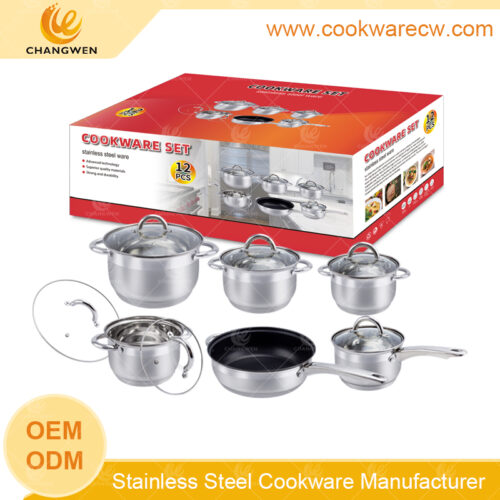
Stainless Steel Cookware Sets 10-Piece CW-M1228
-
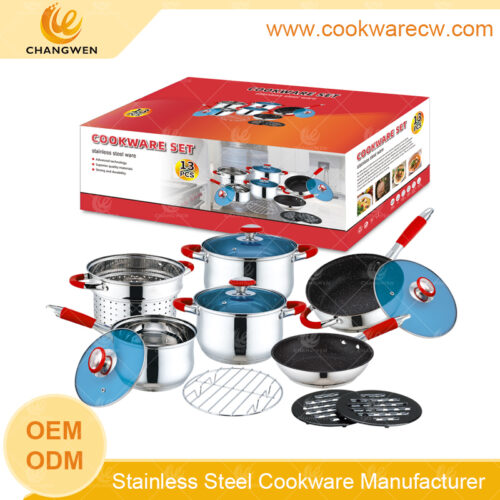
High quality pots wholsesale stainless steel pasta pot fry pan nonstick set saucepan casseroles with red silicone steamer rack heat insulation black mats CW-M1303G
-
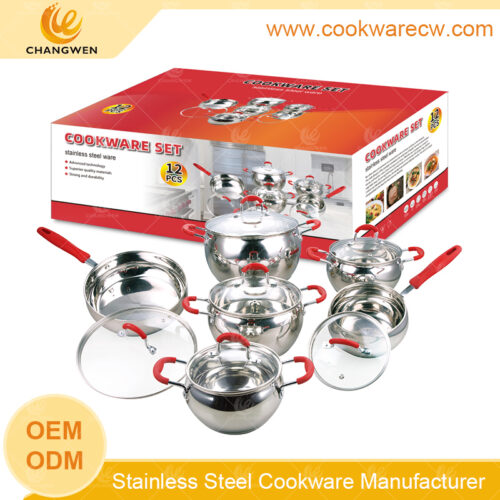
Hot sale stainless steel apple shape cookware set red silicone cover glass lid mirror polished kitchen pots and pans CW-M1219G
-
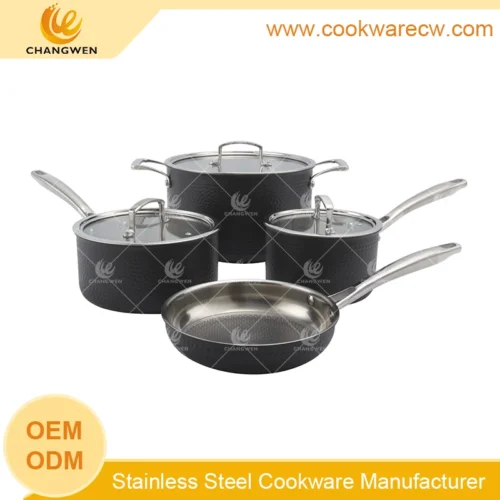
Black Hammered Stainless Steel Cookware Set CW-ETP0702
-
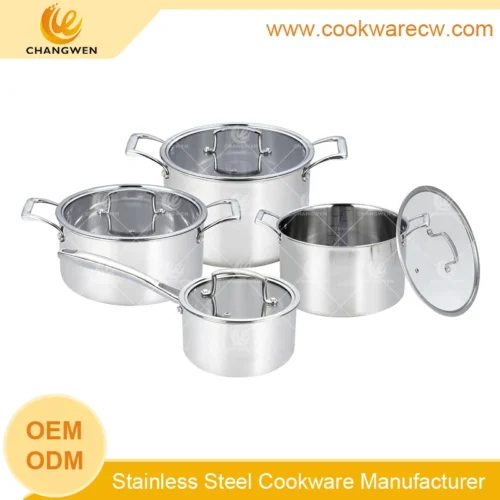
Premium Stainless Steel Cookware Set for Modern Kitchens CW-ETP0801
-
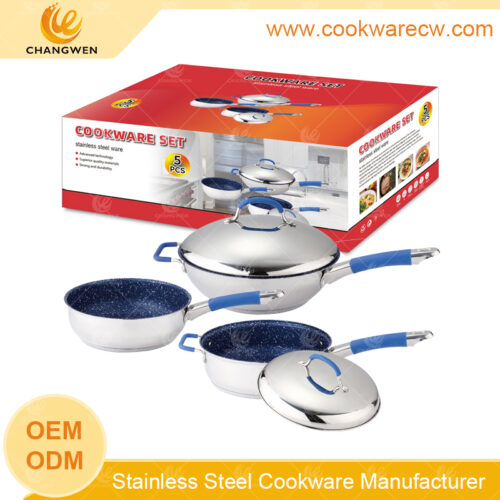
Customize color box 3pcs fry pan set blue marble nonstick coating frying pans stainless steel lids and blue silicone cover CW-M0501G
-
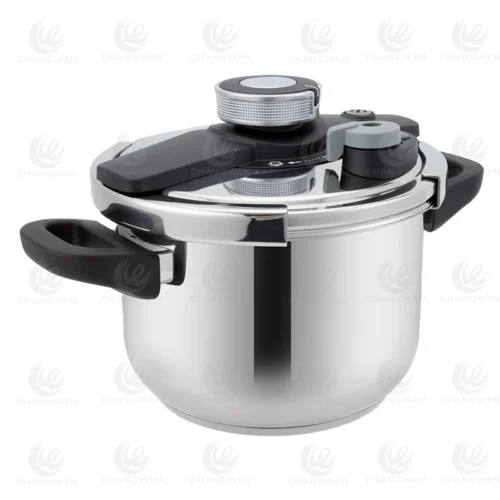
Large Pressure Cooker for Family Meals and Batch Cooking
-
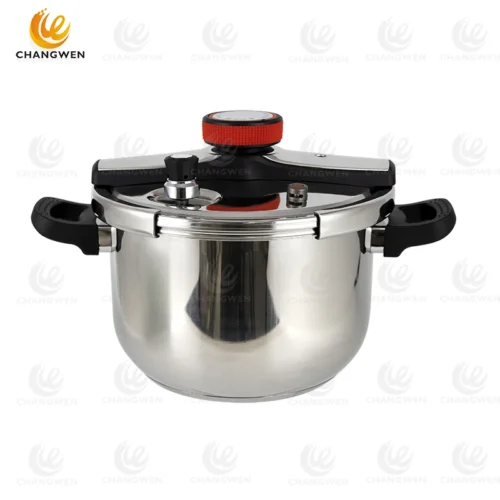
Wholesale Stainless Steel Stovetop Pressure Cooker