
Read time: 11 minutes
Introduction
You want to sell cookware under your own brand. You do not want to build a factory. So you are researching private label.
But the more you research, the more confused the terminology gets. Private label. White label. OEM. ODM. Contract manufacturing. Everyone uses these terms differently, and choosing the wrong model — or the wrong manufacturer — can cost you months of delays and tens of thousands of dollars.
This guide cuts through all of it.
By the end, you will know exactly what a private label cookware manufacturer is, how it differs from white label and contract manufacturing, what real private label examples look like in the cookware industry, and how to find and evaluate the right manufacturing partner for your specific situation.

Key Takeaways
- Private label means a manufacturer produces a product and you sell it under your own brand name. You control the brand. The manufacturer controls the production.
- White label is a specific type of private label where the product is identical for multiple buyers — only the branding changes. Private label often implies more customization than pure white label.
- Contract manufacturing gives you full control over the product specification. You design it, the manufacturer builds it.
- For cookware importers, most practical programs sit between pure white label (fastest, least differentiated) and full contract manufacturing (slowest, most differentiated). The middle ground — OEM and ODM — is where most successful brands operate.
- Choosing a private label cookware manufacturer is not just about price. Material verification, certification capability, and QC processes determine whether your brand builds trust or destroys it.
What Is a Private Label Brand?
A private label brand is a brand that sells products made by a third-party manufacturer under its own label. The brand owner controls marketing, pricing, and distribution. The manufacturer controls production.
Private label is not a new concept. Supermarket house brands are private label. Store-brand electronics, clothing, and supplements are private label. The model exists because not every company that wants to sell a product needs to — or should — own a factory.
In cookware specifically, private label means: a stainless steel cookware manufacturer in China (or elsewhere) produces pots and pans that carry your brand name, your logo, and your packaging. To the end customer, the product is entirely yours. The manufacturer’s name appears nowhere on it.
What makes it “your brand”:
- Your logo on the product and packaging
- Your brand story in the marketing materials
- Your quality standards specified in the purchase order
- Your customer service relationship with buyers
What the manufacturer controls:
- Raw materials and sourcing
- Production processes and equipment
- Factory-level quality control
- Certifications (LFGB, FDA, ISO 9001) held at the factory level
Private Label vs White Label: What Is the Actual Difference?
These two terms are used interchangeably in everyday business conversation, but they have a meaningful distinction that matters for cookware importers.
White Label
White label is the most basic form of private label. The manufacturer produces a standardized product — the same product, with the same specifications — and sells it to multiple buyers. Each buyer applies their own branding. The product itself is identical across all buyers.
White label cookware example: A Chinese factory produces a standard 5-piece stainless steel cookware set. Ten different brands buy the exact same set and put their own logos and packaging on it. The products are indistinguishable except for the branding.
White label characteristics:
- Fastest to market — product already exists
- Lowest minimum order quantity
- No customization of the product itself
- Multiple competitors may sell the exact same product
- Brand differentiation comes entirely from marketing, not the product
Private Label (with Customization)
True private label goes further than white label. You select a base product from the manufacturer’s catalog and customize it — changing handles, surface finish, set composition, packaging, or other elements to make it distinct.
Private label cookware example: You select a manufacturer’s tri-ply stainless steel pan construction, specify a custom matte black exterior finish, choose a specific silicone handle design from their available options, add your logo via laser engraving, and create custom retail packaging. Another brand cannot buy the exact same product because the finish and handle combination is your specification.
Private label characteristics:
- Some product customization without custom tooling investment
- Takes longer than white label but faster than full custom
- More product differentiation than pure white label
- Moderate MOQ requirements
The Practical Difference for Cookware Importers
For most cookware importers launching a brand, the distinction between white label and private label matters primarily as a question of differentiation. If your competitive advantage is your brand story, marketing, and distribution (not the product itself), white label gets you to market fastest. If your brand depends on a product experience that competitors cannot easily replicate, you need private label customization.
Private Label vs Branded: Understanding the Spectrum
Branded products are manufactured by a company under its own brand — the company both manufactures and brands the product. A Japanese cookware manufacturer that makes, brands, and markets its own products is a branded manufacturer.
Private label products are manufactured by one company and sold under another company’s brand.
The interesting reality in cookware: most “branded” products at retail are actually private label. The brand that appears on the box is rarely the company that operates the factory. This is not a secret — it is simply how the global cookware industry is structured. China manufactures the majority of stainless steel cookware sold worldwide. The brand is built separately from the factory.
The strategic implication: when you build a private label cookware brand, you are participating in the same model used by most of the brands you see at retail. The brands that succeed are the ones that take private label seriously — investing in specifications, certifications, and quality control rather than treating it as simply “put my logo on their product.”
Private Label vs Contract Manufacturing: The Key Distinction
This is the comparison that matters most for importers planning a cookware brand.
Contract Manufacturing
In contract manufacturing, you own the product specification entirely. You design the product — its construction, dimensions, materials, handle geometry, surface treatment — and then contract a manufacturer to produce it to your design. The intellectual property is yours.
Contract manufacturing in cookware looks like this: You develop a proprietary handle design with an ergonomic grip and integrated pour spout. You specify the exact wall thickness, layer construction, and surface treatment. You commission the tooling (the molds and dies required to make your specific design). The manufacturer produces your exact design, and because you own the tooling, no other buyer can produce the same product.
Contract manufacturing advantages:
- Full product differentiation — your product cannot be replicated by competitors
- You own the design IP and tooling
- Strongest brand moat at the product level
Contract manufacturing challenges:
- Higher upfront investment (tooling costs, development time)
- Longer lead time to first product (4–6 months for new designs)
- Higher MOQ to amortize tooling costs
- More technical expertise required to manage product development
Private Label Manufacturing
In private label manufacturing, you select from products the manufacturer already knows how to make — existing constructions, existing tooling — and customize the presentation (branding, finish, packaging, handle color selection from available options).
Private label advantages:
- Faster to market (no tooling development required)
- Lower upfront investment
- Lower MOQ for catalog products
- Less technical expertise needed
Private label challenges:
- Limited product differentiation
- Multiple brands may sell similar products
- Less control over core product design
Which Is Right for Your Cookware Brand?
| Business situation | Recommended model |
|---|---|
| Launching first cookware brand, testing market | White label or basic private label |
| Growing brand with budget for customization | Private label with customization |
| Established brand seeking genuine differentiation | Contract manufacturing with proprietary design |
| Large retailer building house brand | Contract manufacturing or deep private label |
Most successful cookware brand programs use an OEM/ODM hybrid approach: start with the manufacturer’s existing construction and tooling (ODM — Original Design Manufacturer), add OEM elements like custom logo, exclusive surface finish, custom packaging, and specific handle selections. This delivers meaningful product differentiation at reasonable cost and lead time.
Private Label Products for Small Business: Is It Viable?
Yes — private label cookware is one of the most accessible product categories for small business brand launches, for several reasons.
Lower Entry Barriers Than You Think
Minimum order quantities from established stainless steel cookware manufacturers in China start at 1,000 units for catalog products with OEM branding. At an average FOB cost of $25–$40 per cookware set, an initial private label order requires $25,000–$40,000 in product investment plus shipping, duties, and launch costs.
This is meaningfully less capital than developing a proprietary product from scratch, and substantially less than any manufacturing infrastructure investment.
E-Commerce Has Changed the Economics
Selling cookware direct-to-consumer through e-commerce platforms has lowered the distribution barrier for small brands. You do not need a retail relationship with a major chain to launch a cookware brand. A well-positioned private label product on a major marketplace, or a branded direct-to-consumer site, can generate sustainable revenue from a single container order.
What Small Business Private Label Cookware Requires
Clear product specification. Even for small initial orders, specify in writing: steel grade (304 stainless for food contact surface), construction type (tri-ply or disc base), total wall thickness, surface finish, and certifications required.
Material verification. The most common quality issue in small-volume private label cookware is steel grade substitution — receiving 201-grade steel when you ordered 304. Require material test reports for every order, regardless of order size.
Packaging investment. The biggest missed opportunity in small business private label cookware is generic packaging. Professional packaging that communicates your brand story, product construction, and certifications converts browsers into buyers on e-commerce platforms. The packaging design investment is often more impactful than any product customization.
Realistic margin planning. Calculate your full landed cost before committing — FOB factory price plus ocean freight, import duties (currently 25–37% total effective tariff for China-origin cookware entering the US), customs fees, and delivery to warehouse. Many small business importers underestimate total landed cost and discover their margin does not work after the first order.
What Is a Private Label Manufacturer (in Cookware Specifically)?
A private label cookware manufacturer is a factory that produces cookware to buyer specifications and ships it ready to sell under the buyer’s brand. In the cookware context, this typically means:
OEM capability: Applying your brand logo via laser engraving, embossing, or etching. Producing with your specified construction (material grades, layer structure, dimensions). Packaging in your custom-designed boxes.
ODM catalog: Offering an existing range of cookware designs — sets, individual pans, specialty pieces — that buyers can select from and brand.
Export infrastructure: Preparing all documentation for international shipment (commercial invoice, packing list, bill of lading, certificates of origin, LFGB/FDA test reports as required).
Quality control: Inspecting finished goods before shipment against agreed specifications.
Factory vs Trading Company
This distinction is critical and often missed by first-time importers.
A factory (manufacturer) owns its production equipment and controls the manufacturing process. When you specify a material grade or construction detail, the factory can implement and verify it. Material test reports are traceable to the actual production run.
A trading company sources from multiple factories and adds a margin. Trading companies do not control production — they facilitate it. When quality problems arise, a trading company cannot fix them at source; they can only negotiate with the factory on your behalf. Material certificates from trading companies are often not batch-specific.
For any serious private label cookware program, work directly with the factory. The price premium of going factory-direct (if any) is paid back many times in quality consistency, traceable materials, and direct problem resolution.
How to Verify You Are Talking to a Factory
- Ask for photos of the production floor, including stamping equipment, polishing lines, and assembly areas
- Request the factory’s business registration documents — manufacturing and trading companies are registered differently in China
- Cross-reference the stated production address on maps
- Commission a factory audit through a third-party inspection company (SGS, Bureau Veritas, Intertek)
Real Private Label Examples in Cookware
Understanding how the model works in practice helps clarify what you are actually building.
The retailer house brand: A major European homeware chain sources a tri-ply stainless steel cookware set from a Jiangmen manufacturer. They specify their handle color, exclusive brushed exterior finish, and packaging design. The product sells under the retailer’s own house brand at a premium that reflects the tri-ply construction and their store’s quality reputation. The manufacturer is never mentioned to consumers.
The e-commerce brand launch: An entrepreneur identifies that health-conscious consumers are willing to pay premium prices for verified food-safe cookware. They source 304 stainless tri-ply sets with material test reports from a certified manufacturer, build a brand story around documented quality, and launch on a major e-commerce platform. The product differentiation comes not from the construction (which is standard tri-ply) but from the brand’s commitment to transparency about materials.
The restaurant supplier: A foodservice equipment distributor adds a private label cookware line to complement their professional kitchen supply business. They source heavy-gauge disc-base stainless steel sets designed for commercial durability, brand them under their company’s name, and sell to restaurant clients who trust their brand relationship more than they care about the manufacturer’s identity.
In each of these cases, the private label manufacturer does the same things: produce to specification, apply the buyer’s brand, ship export-ready goods. The brand owner does the positioning, marketing, and selling.
What to Look for in a Private Label Cookware Manufacturer
Non-Negotiable Requirements
Material traceability. The manufacturer must be able to provide mill certificates — laboratory documents from the steel supplier confirming the chemical composition of the specific batch of steel used in your production run. Without this, claims about 304 stainless steel construction are unverifiable. This is the most important single verification in cookware sourcing.
Relevant certifications. For EU markets: LFGB food contact certification. For US markets: FDA compliance documentation. For all markets: ISO 9001 quality management certification. Request original documents with visible validity dates and accredited testing laboratory names.
OEM capability that matches your needs. Confirm the factory can execute your specific customization requirements — logo application method, surface finish options, packaging production.
Production capacity. Confirm monthly capacity and current booking level. A factory at 100% capacity cannot give your order adequate attention.
Evaluation Process
- Initial shortlist from sourcing platforms or industry referrals
- Technical questionnaire covering materials, certifications, and OEM experience
- Sample request with written specifications — test samples on all key performance criteria
- Material verification on samples (XRF testing or laboratory analysis)
- Reference check — request examples of past OEM programs
- Factory audit (on-site or third-party) before first significant order
- Written contract covering specifications, certifications, payment terms, quality dispute process, and NDA for proprietary information
FAQ
What is the difference between private label and white label in cookware?
White label means identical products sold by multiple brands — only the label differs. Private label typically implies more customization: handle selection, surface finish, set composition, packaging design. In cookware, white label is fastest to market with the least differentiation. Private label with customization takes longer but creates a more distinctive product.
What is the difference between private label and contract manufacturing?
In private label, you select from a manufacturer’s existing products and brand them. The manufacturer owns the product design. In contract manufacturing, you own the product design and the manufacturer produces it to your specification. Contract manufacturing requires higher upfront investment and longer lead time, but produces a product that competitors cannot easily replicate.
Can a small business do private label cookware?
Yes. MOQs for catalog private label cookware products start at 1,000 units with most established manufacturers. E-commerce distribution has made it viable for small brands to launch and sell direct-to-consumer without retail chain relationships. The key requirements are clear specifications, material verification, professional packaging, and accurate landed cost calculation including all import duties and fees.
How do I find a private label cookware manufacturer?
Start with sourcing platforms (Alibaba, Made-in-China) for initial discovery. Attend the Canton Fair for face-to-face evaluation. Key production clusters for stainless steel cookware in China are Jiangmen and Chaozhou in Guangdong province. Always verify you are dealing directly with a factory rather than a trading company — request business registration documents and commission a factory audit before placing a significant order.
What should I include in a private label cookware specification?
At minimum: inner layer material grade (304 stainless steel), construction type (tri-ply full-clad vs disc base), total wall thickness in mm, outer layer material (430 stainless for induction compatibility), surface finish, logo placement and application method, set composition, packaging specification, required certifications (LFGB for EU, FDA for US), and quality dispute process.
How long does private label cookware take from first contact to delivery?
For catalog products with OEM branding: approximately 10–14 weeks total — 2–4 weeks for sampling and spec confirmation, 40–45 days production, 3–5 weeks ocean freight to the US or EU. Custom tooling programs (new handle shapes, proprietary designs) add 4–6 weeks for tooling development.
Is private label cookware profitable?
Yes, when the business model is built on accurate landed cost. The full cost to import cookware from China includes FOB factory price, ocean freight, import duties (currently approximately 25–37% total effective tariff for US-bound China-origin cookware), customs fees, and delivery. Calculate this before negotiating retail pricing. Tri-ply stainless steel private label cookware supports retail pricing that sustains healthy margins when total landed cost is accounted for correctly.
Conclusion
A private label cookware manufacturer is a factory that produces cookware to your specifications and ships it ready to sell under your brand. The model is used by most of the cookware brands you see at retail — from supermarket house brands to premium kitchen specialists.
The critical distinction for importers is this: private label is not just “put my logo on their product.” The brands that build durable businesses through private label manufacturing invest in specifications, verify materials, require certifications, and treat the manufacturer as a technical partner rather than a commodity supplier.
White label gives you the fastest path to market with minimal investment. Contract manufacturing gives you maximum differentiation with maximum investment. For most cookware brand programs, the OEM/ODM hybrid — existing construction, custom branding and finish, proprietary packaging — is the right balance of speed, cost, and differentiation.
Choose the model that matches your business stage. Specify materials in writing. Verify what you are buying. Build the brand story on documented quality.
Partner with Changwen for Your Private Label Cookware Program
Changwen is a stainless steel cookware manufacturer based in Jiangmen, Guangdong, China, with over 22 years of OEM and ODM experience. We produce tri-ply 304 stainless steel cookware sets, frying pans, stock pots, steamer pots, pressure cookers for private label programs across South America, Southeast Asia, the Middle East, and Europe.
Every production batch includes material test reports confirming 304 stainless steel grade. Full OEM capability: logo engraving, surface finish selection, custom packaging, set composition. NDA available for proprietary programs.
📧 changwen@cwcooking.com 📞 0086-18022963948 🌐 www.cookwarecw.com/contact-us
-
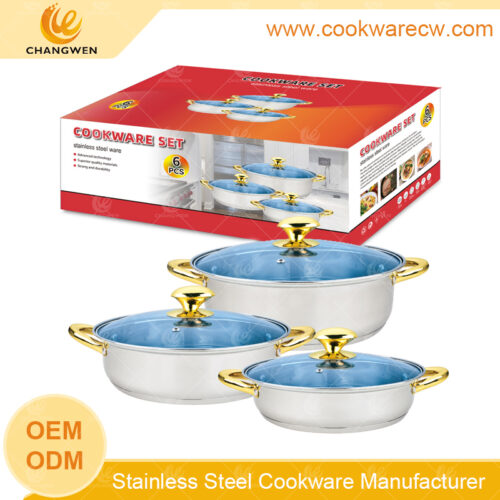
Cook Stainless Steel Stock Pot CW-M0606
-
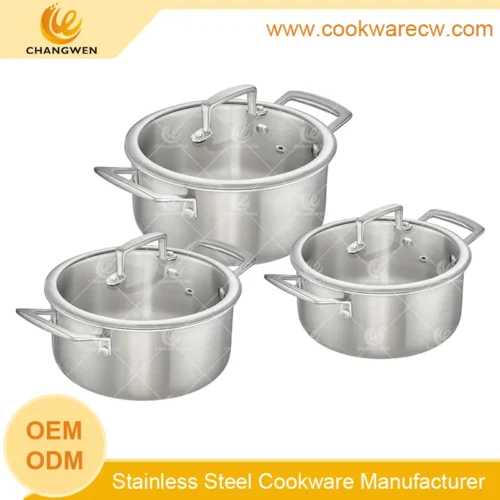
Versatile Stainless Steel Pot Set with Multiple Capacity Options CW-ETP018
-
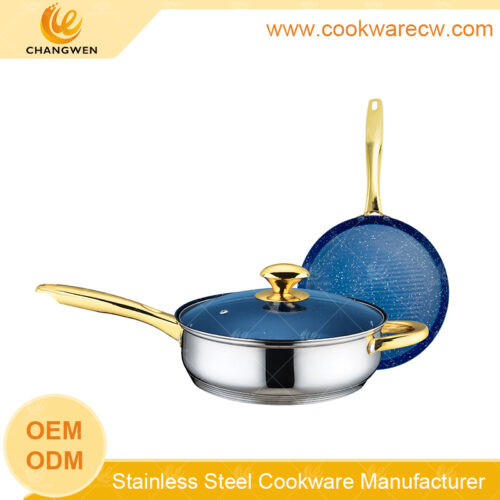
Best Quality Stainless Steel Pans
-
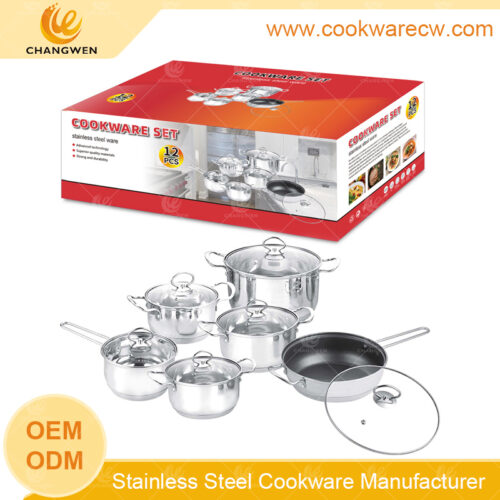
New design stainless steel 12pcs pots wholesale wire handle and knob cookware mirror polished saucepan casserole kitchen pots nonstick coated frypan CW-M1218
-
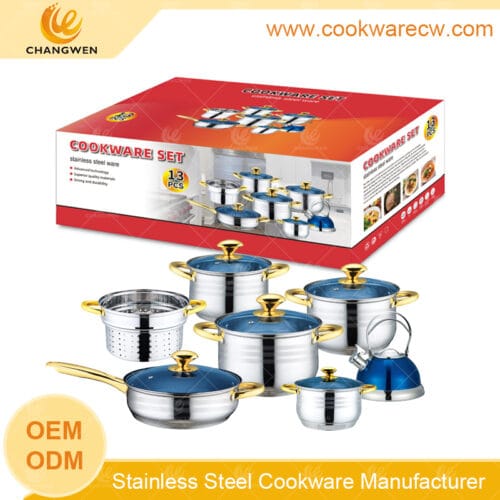
Mercado Libre stainless steel 13pcs cookware set tea kettle pasta pot nonstick frying pan golden handle blue coating CW-M1305
-
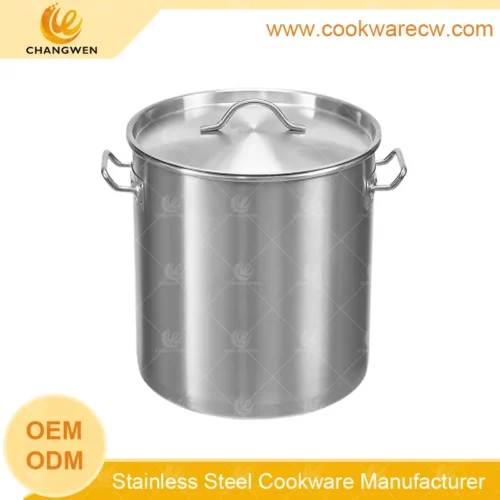
Wholesale Stainless Steel Stock Pot CW-SP001
-
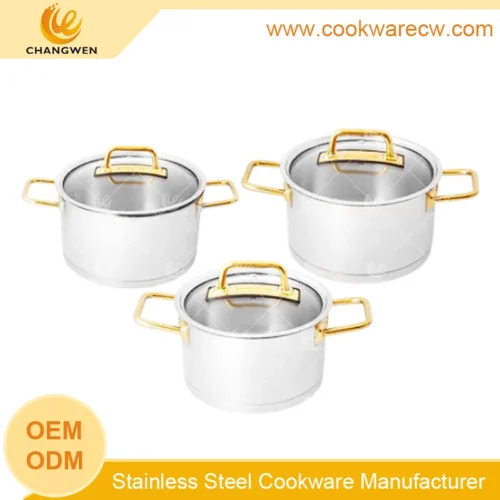
6-Piece Stainless Steel Pot Set with Gold Handles CW-ES0610
-

Hotsale 12pcs stainless steel cooking sets soup stock pot kitchen ollas saucepan casserole and milkpot fry pan nonstick CW-M1209