
Read time: 9 minutes
Introduction
Walk into any kitchenware store and you will see “titanium cookware” everywhere. Titanium frying pans, titanium pots and pans, titanium non-stick frying pans, titanium woks, titanium skillets. Some are $30. Some are $300. They all say “titanium” on the box.
Here is the problem: most of them are not actually made of titanium.
The word “titanium” has become a marketing label rather than a material description. And unless you know exactly what to look for, you will pay premium prices for cookware that has very little titanium in it — and miss out on the genuine advantages that real titanium cookware delivers.
This guide cuts through the marketing. You will learn the three fundamentally different things sold as “titanium cookware,” understand what tri-ply titanium cookware actually is and when it outperforms other types, and know exactly what questions to ask before you buy.

The Three Types of Titanium Cookware (And Why This Matters First)
Before comparing any titanium pots or pans, you need to know which of these three completely different products you are evaluating.
Type 1: Pure Titanium Cookware (100% Titanium)
This is cookware where the entire body is made from solid titanium metal — commercially pure Grade 1 or Grade 2 titanium. No coatings. No aluminum base. Just titanium.
What it looks like: Distinctively light, matte grey metallic appearance. Noticeably thinner walls than stainless steel pots of the same size. Very light to hold.
Who uses it: Primarily backpackers and ultralight campers. Pure titanium camping cookware — titanium camping pots, titanium cooking sets for the trail — is where this material dominates. A titanium camping pot can weigh under 80 grams.
The key limitation: Pure titanium conducts heat poorly. It is one of the worst heat conductors of any cookware metal. This creates hot spots — the center of the pan gets extremely hot while the edges lag behind. For boiling water, this does not matter much. For actual cooking (sautéing, frying, simmering sauces), it creates real problems.
Type 2: Titanium-Coated Cookware
This is aluminum or stainless steel cookware with a non-stick coating that contains titanium particles — marketed as “titanium reinforced non-stick,” “titanium ceramic,” or just “titanium cookware.”
The titanium in these products is in the coating, not the pan body. The coating is harder and more scratch-resistant than standard PTFE because of the titanium particles, but the underlying pan is aluminum or steel.
What it looks like: Looks like any non-stick pan. Smooth dark coating inside. Usually the same weight as regular aluminum non-stick pans.
The reality: These are non-stick pans with a premium coating. The performance depends entirely on the coating quality, not on titanium’s material properties. They are not “titanium cookware” in any meaningful structural sense.
Health consideration: Titanium-coated non-stick pans carry the same considerations as any coated non-stick: avoid overheating, replace when coating degrades, and ensure the coating is PFOA-free and PFAS-free. The titanium reinforcement does not make them safer than standard non-stick — it makes the coating more durable, which is a genuine benefit.
Type 3: Tri-Ply Titanium Cookware
This is where it gets interesting for serious home cooks.
Tri-ply titanium cookware uses a three-layer construction with pure titanium as the inner cooking surface, an aluminum alloy core for heat distribution, and a stainless steel or titanium outer layer.
This construction solves the fundamental limitation of pure titanium (poor heat conductivity) while preserving its best property (a completely inert, non-reactive, non-toxic cooking surface with no coatings).
The result: a pan that heats as evenly as stainless steel clad cookware, with a cooking surface that is biologically inert and will never chip, peel, or degrade.
What Is Tri-Ply Titanium Cookware, Exactly?
The tri-ply titanium construction typically consists of:
- Inner layer (food contact surface): Commercially pure titanium (Grade 1 or Grade 2)
- Core: Aluminum alloy (high thermal conductivity — distributes heat evenly)
- Outer layer: Stainless steel (430 for induction compatibility, or a titanium-steel alloy)
The aluminum core solves what is otherwise titanium’s main cooking weakness. Aluminum conducts heat approximately 14 times better than titanium. By sandwiching an aluminum core between titanium layers, the manufacturer gets:
- Even heat distribution from the aluminum
- A food-safe, non-reactive cooking surface from the titanium inner layer
- Structural rigidity from the steel or titanium outer layer
- No synthetic coating — the cooking surface is the metal itself
This is meaningfully different from both pure titanium cookware (which has heat distribution problems) and titanium-coated non-stick (which has a coating that will eventually degrade).
Tri-Ply Titanium vs Standard Tri-Ply Stainless Steel
The more familiar tri-ply construction is 304 stainless steel / aluminum / 430 stainless steel — the global standard for premium cookware. Both are excellent cookware constructions. The difference is the inner cooking surface:
- 304 stainless steel inner layer: Non-reactive, durable, excellent food safety. Requires the “hot pan, cold oil” technique to prevent sticking. Less expensive to manufacture.
- Pure titanium inner layer: Equally non-reactive, stronger than stainless steel for its weight, resists scratching by metal utensils. More expensive to source and manufacture due to titanium’s higher material cost.
For most cooking applications, quality tri-ply stainless steel performs comparably to tri-ply titanium. The genuine advantage of the titanium inner surface is scratch resistance and the absence of nickel — relevant for cooks with nickel sensitivity.
Titanium Cookware Pros and Cons: The Honest Assessment
Pros
Chemically inert and non-reactive. Pure titanium naturally forms a stable, passive oxide layer (TiO₂) when exposed to air. This oxide layer makes titanium one of the most chemically inert cooking surfaces available. It does not react with acidic foods (tomatoes, citrus, vinegar), alkaline foods, or anything else you cook. Your food tastes like your food.
No coatings to degrade. In tri-ply titanium and pure titanium cookware (not titanium-coated), there is no synthetic surface treatment to scratch, peel, chip, or release. The cooking surface is the material itself. This is a genuine long-term advantage over all coated cookware.
Exceptional durability. Titanium has the highest strength-to-weight ratio of any metal. A properly made titanium pot or pan will not warp, will not rust, and will not corrode. With proper care, it will outlast virtually any coated cookware.
Lightweight. Titanium has a density of approximately 4.5 g/cm³, compared to 8.0 g/cm³ for steel. A titanium pan or titanium cooking pot weighs roughly half what a steel equivalent would weigh for the same structural strength. For titanium camping cookware, this weight advantage is decisive.
No nickel content. Unlike 304 stainless steel (which contains 8-10% nickel), pure titanium contains no nickel. For the small percentage of people with nickel sensitivity or nickel allergy, titanium cookware is an important option.
High temperature tolerance. Titanium melts at 1,668°C — far above any stovetop or oven temperature. There is no risk of thermal degradation of the cooking surface under normal use.
Cons
Heat distribution in pure titanium. This is the significant limitation. Pure titanium’s thermal conductivity is approximately 22 W/m·K — poor compared to aluminum (237 W/m·K) or copper (401 W/m·K). Without a conductive core (as in tri-ply construction), pure titanium pans develop hot spots. Food at the center of the pan over the flame gets much hotter than food at the edges.
This limitation is largely resolved in tri-ply titanium cookware with an aluminum core, but it remains the defining characteristic of pure titanium pots for camping — they are excellent for boiling, less ideal for technique-sensitive cooking.
Not naturally non-stick. Pure titanium and tri-ply titanium do not have non-stick properties. Food will stick to the bare metal surface, particularly proteins like eggs and fish. Proper technique (preheating the pan, using sufficient fat, not moving food before it naturally releases) is necessary. This is the same behavior as stainless steel, and requires the same adaptation.
High price. Titanium is more expensive to mine, process, and manufacture than stainless steel or aluminum. Quality pure titanium cookware and genuine tri-ply titanium cookware sets carry a significant price premium over comparable stainless steel options.
Induction compatibility requires attention. Pure titanium is not magnetic and will not work on induction cooktops. Tri-ply titanium cookware with a 430 stainless outer layer is induction-compatible. Always confirm induction compatibility specifically if you cook on an induction cooktop.
Titanium Cookware Health Risks: What the Science Says
This is the most searched question about titanium cookware, and it deserves a direct answer.
Pure titanium is one of the safest materials ever used for food contact. Titanium is biocompatible — it is the material used for surgical implants, bone replacements, and dental fixtures precisely because the human body does not react to it. The TiO₂ passive layer on the surface prevents any metal from migrating into food under cooking conditions.
Major food safety authorities classify titanium as safe for food contact. The FDA permits titanium for food use. Research on titanium cookware has not identified meaningful health risks from the material itself.
The health risks come from other factors:
“Titanium” non-stick pans with low-quality coatings. If your “titanium cookware” is actually a coated non-stick pan, the relevant health considerations are those of the coating, not the titanium. Ensure any coated pan is PFOA-free, PFAS-free, and replace it when the coating shows significant wear.
Cheap “titanium” products made from unverified alloys. Some very low-cost products marketed as titanium may contain other metals. For genuine safety assurance, verify that products use commercially pure titanium (Grade 1 or Grade 2) and hold appropriate food contact certifications (FDA, LFGB).
Summary: If you are using genuine pure titanium cookware or tri-ply titanium cookware with a titanium cooking surface, the material presents no meaningful health risks. The concerns about titanium cookware health risks in online discussions typically relate to titanium-coated non-stick pans, not true titanium cookware.
Titanium Cookware by Use Case
Titanium Camping Cookware: The Natural Habitat
This is where titanium’s advantages are most decisive. For backpacking, thru-hiking, and ultralight camping, a titanium camping pot or titanium cooking set is hard to beat:
- A 750ml titanium pot weighs approximately 100-130 grams — roughly half the weight of an equivalent aluminum pot
- Titanium camping cookware survives being jammed in a pack, dropped on rocks, and used on open flames without significant damage
- Lifetime durability means one titanium camping pot may last your entire outdoor career
- No coating to worry about in rough-use environments
For camp cooking that is primarily boiling water for freeze-dried meals, making hot drinks, or simple soups, pure titanium is the ideal material. The heat distribution limitation is not relevant for boiling.
For camp cooking involving real sautéing or temperature-sensitive foods, hard-anodized aluminum typically outperforms pure titanium due to its better heat distribution.
Tri-Ply Titanium for Home Kitchens
For home kitchen use, tri-ply titanium cookware occupies the premium segment of what most cooks need from stainless steel cookware. The aluminum core solves the heat distribution problem, and the titanium inner surface provides a genuinely coating-free, non-reactive cooking surface.
Ideal for:
- Health-conscious cooks who want a coating-free cooking surface
- Cooks with nickel sensitivity who cannot use standard 304 stainless steel
- Long-term investors in cookware who want the most durable material available
- Anyone moving away from coated non-stick who wants the most inert cooking surface possible
Not the priority choice if:
- Your budget is the primary constraint — quality tri-ply stainless steel (304-aluminum-430) performs similarly at lower cost
- You need induction compatibility and are unsure which titanium products support it
- You need a non-stick surface for eggs and delicate foods — titanium is not non-stick and requires technique adjustment
Material Comparison: Where Titanium Fits
| Factor | Pure Titanium | Tri-Ply Titanium | Tri-Ply Stainless | Coated Non-Stick |
|---|---|---|---|---|
| Heat distribution | Poor (hot spots) | Excellent | Excellent | Good |
| Food reactivity | None | None | None | None (coating) |
| Coating required | No | No | No | Yes |
| Coating durability | N/A | N/A | N/A | 3-7 years |
| Weight | Ultralight | Light-medium | Medium | Light |
| Induction compatible | No (usually) | Yes (430 outer) | Yes (430 outer) | No (unless added base) |
| Campfire safe | Yes | Yes | Yes | No |
| Nickel-free | Yes | Yes | No (304 contains Ni) | Depends on base |
| Price | High | Very high | Medium-high | Low-medium |
| Best use | Camping/backpacking | Premium home kitchen | Premium home kitchen | Everyday non-stick |
What to Check Before Buying Titanium Cookware
For Pure Titanium Camping Cookware
- Titanium grade: Grade 1 (commercially pure) or Grade 2 (slightly stronger). Both are appropriate for cookware. Avoid products that do not specify the grade.
- Wall thickness: Thicker walls = better heat distribution and durability. 0.5mm-0.6mm is standard for titanium pots; some ultralight models go thinner.
- Handle design: Folding handles are essential for backpacking — confirm the fold mechanism is robust.
- Volume marking: Lines inside the pot for measuring water are genuinely useful in the field.
- Set contents: A complete titanium cooking set typically includes a pot, lid (which doubles as a frying pan), and a storage bag.
For Tri-Ply Titanium Home Cookware
- Construction verification: Confirm the inner cooking surface is pure titanium, not titanium-coated. Ask specifically: “Is the food contact surface solid titanium or a titanium coating over another base metal?”
- Core material and thickness: The aluminum core thickness determines heat distribution performance. Request this specification.
- Induction compatibility: Verify the outer layer contains 430 stainless steel or another magnetic material if you cook on induction.
- Certification: FDA (US) or LFGB (EU) food contact certification for the titanium material.
For Titanium-Coated Non-Stick
- Coating certification: PFOA-free, PFAS-free. Request documentation.
- Base material: Aluminum or stainless steel base. Aluminum heats faster; stainless is more durable.
- Coating layers: More layers generally means more durable coating.
- Induction compatibility: Check the base, not the coating.
FAQ
Is 100% titanium cookware really 100% titanium?
For commercially pure titanium cookware (Grade 1 or Grade 2), the body is effectively 100% titanium with trace alloying elements below 0.1%. However, handles, rivets, and lids may be different materials. Tri-ply titanium cookware is not 100% titanium — it uses titanium as the cooking surface with an aluminum core and steel or titanium outer layer. Always clarify what “100% titanium” refers to in any product description.
Is titanium cookware non-stick?
Pure titanium and tri-ply titanium cookware are not naturally non-stick. Proteins and carbohydrates will stick to bare titanium surfaces. Proper technique — preheating the pan, adding oil to a hot pan, allowing food to release naturally before moving it — is required. Titanium-coated non-stick pans have a coating that provides non-stick properties, but this coating will eventually wear.
Can titanium cookware be used on induction?
Pure titanium is not magnetic and will not work on induction cooktops. Tri-ply titanium cookware with a 430 stainless steel outer layer is induction-compatible. Titanium-coated pans depend on their base material — aluminum bases are not induction-compatible unless a magnetic disc is added. Always verify induction compatibility specifically for any titanium cookware you are considering.
What are the actual health risks of titanium cookware?
Pure titanium and tri-ply titanium with a titanium cooking surface present no meaningful health risks. Titanium is biocompatible, used in surgical implants, and classified as safe for food contact by major health authorities. Health concerns associated with “titanium cookware” typically relate to low-quality titanium-coated non-stick products with PFAS-based coatings, not genuine titanium.
Is titanium cookware worth the price premium?
For camping and backpacking: yes, if weight is a priority. The weight advantage of titanium camping cookware over aluminum or stainless is significant on multi-day trips, and the durability means the pan may last a lifetime. For home kitchen use: it depends. If you want the most inert cooking surface available, or have nickel sensitivity, tri-ply titanium is worth the investment. If you want excellent performance at lower cost, quality tri-ply stainless steel (304-aluminum-430) delivers comparable cooking results.
How do I tell if titanium cookware is genuine?
Genuine pure titanium cookware is distinctively light, has a matte grey metallic appearance, and feels different from aluminum or stainless steel. Titanium-coated non-stick pans look like any other non-stick pan. For confirmation, request product specifications stating the titanium grade and food contact certification. Very low prices are a reliable indicator that a “titanium” pan is coated non-stick rather than genuine titanium.
Conclusion
Titanium cookware is a genuine category — not just a marketing word — but only when you know which type you are actually buying.
Pure titanium cookware is the right choice for camping and backpacking where weight matters above all else. It is durable, non-reactive, and will outlast any coated alternative.
Tri-ply titanium cookware is the premium option for health-conscious home cooks who want a coating-free, biologically inert cooking surface with proper heat distribution. It is more expensive than quality stainless steel and performs comparably for most cooking tasks — the premium pays for material purity and the absence of any coating.
Titanium-coated non-stick is just non-stick cookware with a harder coating. It has its place, but it is not the same product as titanium pots and pans made from solid titanium.
Buy what you actually need, not what the label implies.
About Changwen
Changwen is a cookware manufacturer located in Jiangmen City, Guangdong Province, China, with over 22 years of OEM and ODM experience. Our core product is three-layer composite 304 stainless steel cookware (304-aluminum-430), a proven and high-quality construction favored by global brands and distributors. Our newly developed three-layer titanium cookware is also well-received in the market. Contact us for a quote.
-
6-Piece Stainless Steel Pot Set with Gold Handles CW-ES0610
-
Mercado Libre hotsale cookware 7pcs cooking pot set stainless steel lids silicone handle kitchen tool solid serving spoon CW-M0702G
-
Mexican cookware set olla milk pot high stock pot kitchen wire rack and non-stick coating frypans CW-M1308
-
4-Piece Stainless Steel Pot Set with Glass Lids Stand Upright CW-ES0402G
-
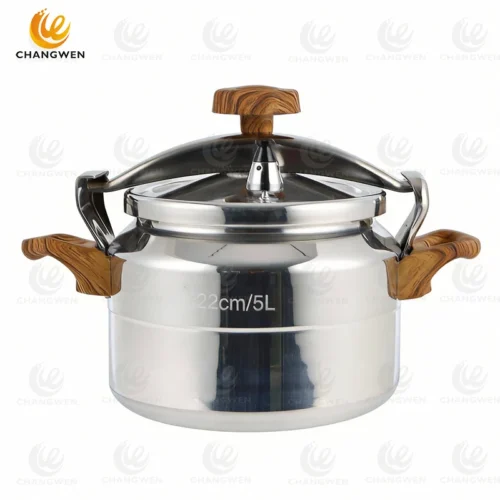
Pressure Cooker Stainless Steel for Healthy Cooking
-
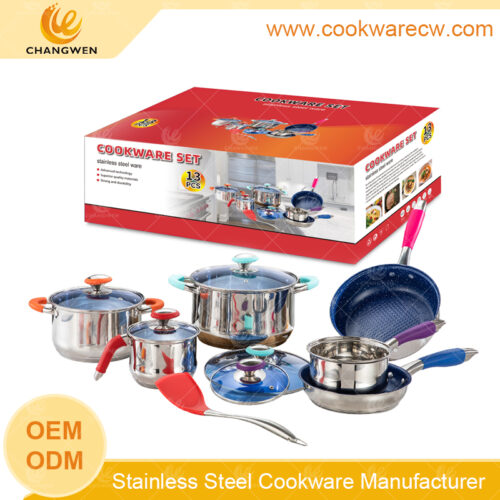
popular stainless steel pots 13pcs cookware set with heat insulated colored silicone and glass lids milkpot casseroles nonstick frypan set CW-M1206G
-
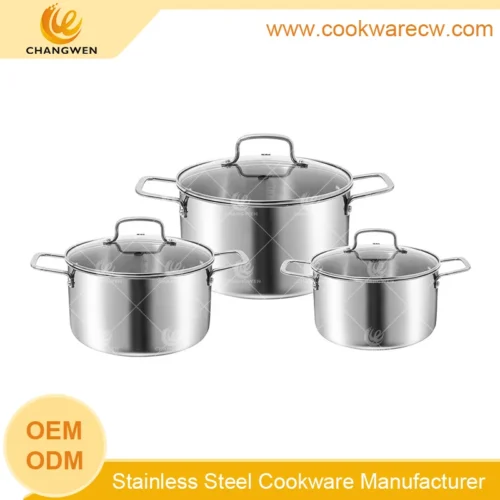
Stainless Steel Pot Set for Professional Cooking Performance CW-TP0605
-
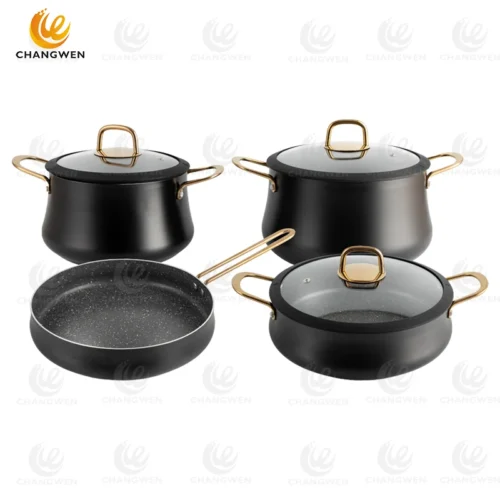
7pcs Nonstick Embossed Aluminum Cookware Set for Import from China