
Read time: 13 minutes
Quick answer: To cook eggs in a stainless steel frying pan without heavy sticking, preheat a clean, dry pan over medium-low or medium heat, add enough butter or oil to cover the cooking area, let the fat become hot but not smoke, then add the eggs and reduce the heat. Leave a fried egg undisturbed until the white sets and releases with gentle spatula pressure. For scrambled eggs, stir slowly and remove the pan from the burner while the eggs still look slightly moist. The reliable method is controlled heat plus a continuous fat layer, not maximum heat.
Why Do Eggs Stick to a Stainless Steel Frying Pan?
Eggs stick to stainless steel because liquid egg protein can make close contact with microscopic surface irregularities before the protein sets. Heat then changes the protein structure, and the cooked protein grips the metal wherever the protective fat film is thin or broken. A clean stainless steel surface looks smooth, but it is not perfectly flat at a microscopic scale.
Three conditions increase sticking: a pan that is too cool, a pan that is too hot, and a cooking surface with too little fat. A cool pan allows raw egg to spread into the surface texture before it firms. An overheated pan can burn butter, make the egg white seize too quickly, and create dry contact points. Insufficient fat leaves patches where egg protein touches steel directly.
Stainless steel is different from coated cookware because stainless steel does not depend on a manufactured low-friction coating. The cook creates temporary release by balancing preheat, fat, food temperature, and timing. That technique takes more attention, but the same pan can also brown food, build fond, tolerate metal utensils, and handle a wide range of cooking tasks.
What Equipment Produces the Most Consistent Eggs?
A heavy stainless steel frying pan with an aluminum or copper core produces more consistent eggs than a thin single-layer pan. The conductive core spreads heat across the base, while the stainless steel cooking surface provides durability. A stable temperature matters because eggs are delicate and can stick when one area is much hotter or cooler than another.
An 8-inch pan is usually suitable for one or two fried eggs, while a 10-inch pan provides more working space for two to four eggs or a small omelet. A pan that is much larger than the burner can develop a cool outer zone. A pan that is overcrowded can lose heat suddenly and force liquid egg into a thick layer that cooks unevenly.
Pan construction affects control more than a polished appearance does. Readers comparing wall thickness, core design, handle balance, and base stability can use this stainless steel frying pan buying guide before selecting a pan for eggs and other delicate foods.
Should Eggs Be at Room Temperature?
Eggs do not have to reach room temperature, but very cold eggs cool the pan more sharply. A large temperature drop can weaken the fat barrier and delay setting, especially in a light pan. Taking eggs out of the refrigerator for several minutes while preparing the pan can make the process more forgiving.
Should You Use Butter or Oil for Eggs?
Butter is often the easiest fat for eggs because its foaming provides a visible temperature signal and its flavor suits fried and scrambled eggs. Add butter after preheating. When the butter melts and foams gently without turning dark immediately, the pan is usually in a workable range for eggs.
Cooking oil tolerates more heat and can create a thin, continuous film across the pan. A neutral oil is useful for crisp-edged fried eggs, while olive oil adds a distinct flavor. Oil should shimmer lightly but should not smoke. Smoke indicates that the pan or oil is hotter than necessary for tender eggs.
A combination of oil and butter provides the heat tolerance of oil with the flavor and visual feedback of butter. Add a small amount of oil first, then add butter. The combination does not make excessive heat safe, but it gives the cook a wider practical window than butter alone.
The correct amount of fat depends on pan diameter, egg style, and surface condition. The goal is not a deep pool. The goal is a continuous film that remains under the entire egg. Tilt the pan after adding fat; if dry islands remain, add a little more before the egg touches the steel.
What Is the Best Pan Temperature for Eggs?
The best temperature for eggs is hot enough to set the contacting protein promptly but gentle enough to keep the fat intact and the egg tender. On most home stoves, this means preheating over medium-low or medium heat and cooking at low to medium-low heat after the egg enters. Burner labels are not standardized, so visual and sound cues are more useful than a dial number.
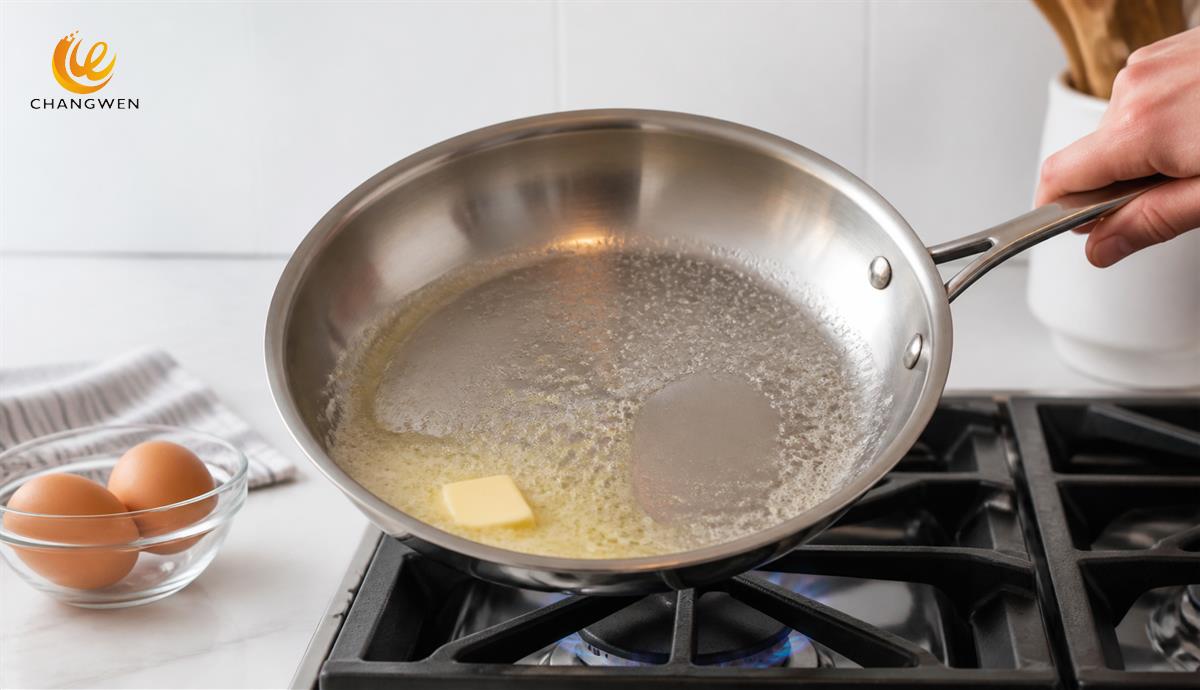
Correctly heated butter should melt quickly and foam across the surface without blackening. A fried egg should make a quiet, steady sizzle rather than a violent crackle. Scrambled eggs should begin forming soft curds within moments, not brown on contact. These signals show that the pan is transferring heat without scorching the fat or protein.
The water-drop test can show when a stainless steel pan has entered the Leidenfrost range, where a water droplet beads and skates on a vapor layer. That temperature is useful for some high-heat cooking, but it can be too hot for tender eggs. If a cook uses the test, the pan should be taken off the heat briefly and the burner should be reduced before adding butter and eggs.
A water droplet that evaporates instantly with an aggressive hiss can indicate excessive heat. A droplet that sits and bubbles slowly indicates a cooler surface. Neither observation replaces the butter test for eggs. Butter behavior gives more direct feedback about the actual cooking fat and the temperature the egg will experience.
How Do You Preheat Stainless Steel Without Overheating It?
Place the clean, dry pan on a burner that matches the base diameter. Heat the empty pan over medium-low or medium heat for about one to three minutes, depending on pan thickness, burner power, and stove type. A heavy clad pan needs more time than a light pan but also holds a stable temperature more effectively.
Preheating should be gradual because stainless steel retains heat after the burner is lowered. Starting at maximum power can overshoot the useful range before the cook notices. Moderate preheating allows the base and sidewalls to warm more evenly and gives the cook time to observe the fat when it is added.
Induction responds faster than many electric or gas systems, so induction users may need a lower setting and shorter preheat. Gas flames should remain under the base rather than climbing the sidewalls. Electric elements should be similar in diameter to the pan base to reduce hot centers and cool edges.
Multi-layer construction makes temperature control easier because the conductive core spreads burner energy. This tri-ply stainless steel cookware comparison explains why a layered pan usually responds more evenly than a thin stainless steel body.
How to Fry an Egg in a Stainless Steel Pan Without Sticking
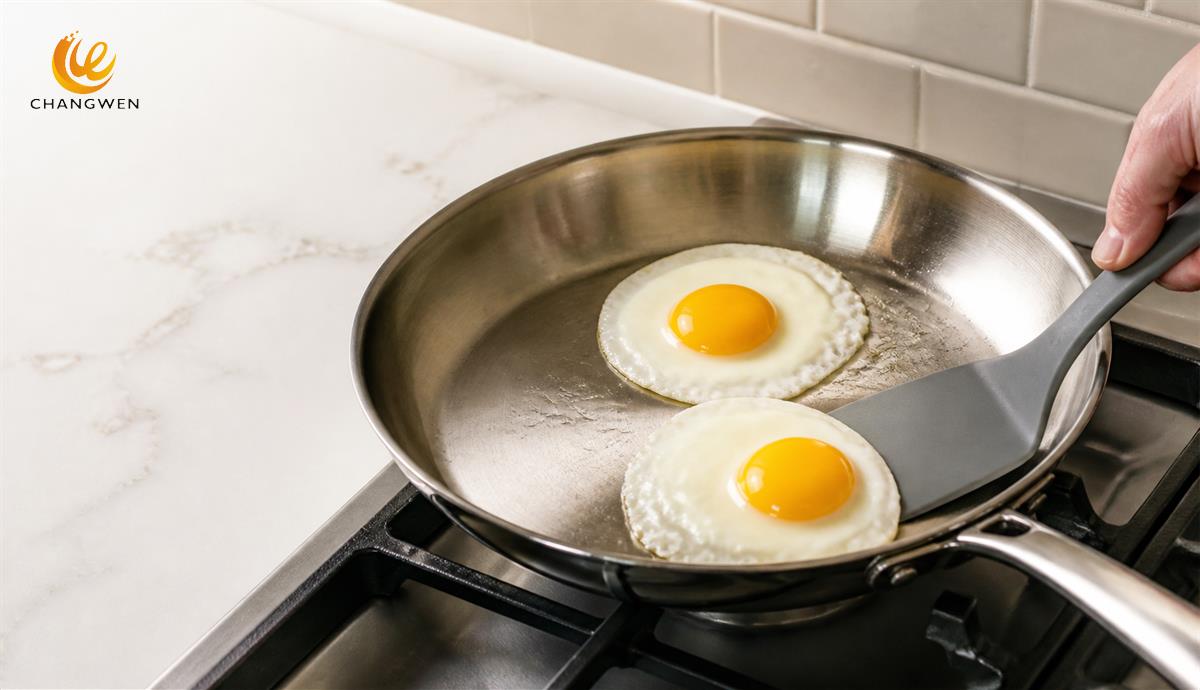
- Dry the egg and prepare it first. Crack the egg into a small bowl so it can be added quickly and so shell fragments can be removed before cooking.
- Preheat the clean pan gradually. Use medium-low or medium heat and allow the entire base to warm rather than heating one spot aggressively.
- Add butter or oil. Swirl the fat until it covers the area where the egg will cook. Wait for butter to foam gently or oil to shimmer lightly.
- Reduce the heat. Lower the burner before or immediately after adding the egg so the white sets without burning underneath.
- Slide in the egg. Bring the bowl close to the pan and let the egg enter gently. A high drop can spread the white beyond the fat film.
- Leave the egg alone. Do not push a spatula under wet white. Wait until the outer white turns opaque and the underside develops enough structure to release.
- Test the edge. Slide a thin spatula under one edge. If the egg resists strongly, wait a little longer or add a few drops of fat near the stuck area.
- Finish to preference. Cover briefly for a set top, spoon warm fat over the white, or flip carefully for over-easy eggs.
- Remove the egg promptly. Residual pan heat continues cooking after the burner changes, so transfer the egg when it is slightly less done than the final target.
A fried egg releases when its contacting proteins have set and a stable fat layer remains underneath. Patience matters because moving the egg too early tears the fragile white and exposes fresh protein to the pan. Forced release is usually a timing problem rather than proof that stainless steel cannot cook eggs.
How Do You Scramble Eggs in a Stainless Steel Frying Pan?
Scrambled eggs need lower heat than fried eggs because the egg repeatedly contacts new areas of the pan as it is stirred. Whisk the eggs before heating the pan, preheat gently, add butter, and lower the burner when the butter foams. Pour in the eggs and wait a few seconds until a thin layer begins to set.
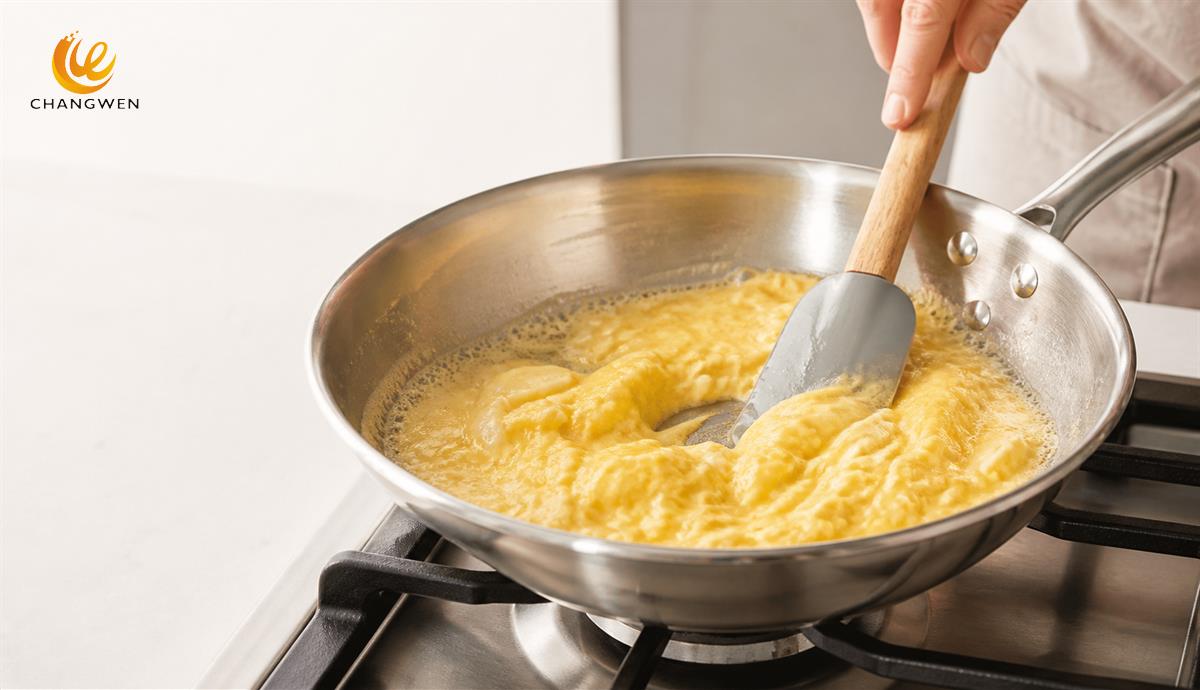
Use a silicone spatula to push the set egg from the edge toward the center. Tilt the pan so uncooked egg flows onto the newly exposed surface. Slow folds produce larger, softer curds, while frequent stirring produces smaller curds. Aggressive stirring can wipe away the butter film and increase sticking.
Remove the pan from the burner while the scrambled eggs still look slightly glossy. The stored heat in a clad stainless steel pan will finish the eggs during the final folds. Waiting until the eggs look completely dry in the pan usually produces overcooked curds and a bonded film on the surface.
For very soft scrambled eggs, alternate short periods on and off the burner. Heat starts curd formation, while off-heat stirring slows the process and redistributes temperature. This approach is more controllable than keeping the pan on a high burner and trying to stir faster.
How Do You Cook an Omelet in Stainless Steel?
An omelet requires an even fat film, moderate heat, and early movement. Preheat the pan gently, add butter, and pour in well-beaten eggs when the butter foams. Stir the liquid egg briefly while shaking the pan, then stop stirring when a soft, even layer covers the base.
Run a thin spatula around the edge as the omelet sets. Add a modest amount of filling so the pan does not cool sharply and the omelet can fold without breaking. Fold while the top is still slightly moist, then slide the omelet onto a plate before carryover heat dries it.
Wet vegetables should be cooked separately before they enter an omelet. Raw mushrooms, tomatoes, spinach, or frozen vegetables release water that dilutes the fat film and cools the pan. Pre-cooked, drained filling preserves both the egg texture and the release layer.
What Are the Most Common Reasons Eggs Still Stick?
| Problem | What happens | Better adjustment |
|---|---|---|
| Pan is too cool | Liquid egg spreads into surface irregularities before setting | Preheat gradually before adding fat and egg |
| Pan is too hot | Butter burns and egg protein seizes into dry contact points | Lower the heat and let the pan cool briefly |
| Too little fat | Dry areas allow direct protein-to-metal contact | Swirl a continuous film across the cooking area |
| Egg moved too early | Unset white tears and bonds again | Wait for an opaque, structured underside |
| Pan has cooked-on residue | Rough carbonized deposits interrupt the fat layer | Clean and dry the surface completely |
| Cold ingredients overload the pan | Surface temperature falls suddenly | Use a suitable pan size and avoid crowding |
| Cooking spray leaves residue | Additives can build a sticky film over repeated use | Use measured butter or plain cooking oil |
| Egg is cooked until dry | Extended heat strengthens the stuck protein layer | Remove eggs while slightly moist |
General sticking problems often come from the same heat-fat-timing relationship. This guide on keeping food from sticking to stainless steel extends the method to meat, fish, vegetables, and other proteins.
Does a Stainless Steel Pan Need Seasoning for Eggs?
A stainless steel frying pan does not require permanent seasoning to cook eggs. Temporary oil conditioning can reduce sticking for a cooking session, but the pan remains usable after ordinary cleaning. Good preheating, fresh fat, and correct heat provide a more repeatable method than depending on an old oil film.
Importers and home cooks who want a broader technique comparison can review these non-stick tips for stainless steel frying pans. The important distinction is that technique-based release is not the same as a factory-applied non-stick coating.
How Do You Clean Stuck Egg From Stainless Steel?
Let the pan cool until it is safe to handle, then add warm water and dish soap. Soak for several minutes so water can soften the protein layer. Use a non-scratch sponge or flexible scraper to lift the residue. Avoid attacking a hot pan with cold water because rapid temperature change can stress or distort some cookware.
For stubborn egg film, add a shallow layer of water and bring it to a gentle simmer. Scrape the softened residue with a wooden or silicone utensil, discard the water, and wash normally. A paste of baking soda and water can remove remaining marks without the aggressive scratching caused by steel wool.
Dry stainless steel after washing to reduce water spots. If the pan has burnt oil rather than egg protein, use a cleaner approved for stainless steel and follow its instructions. The stainless steel frying pan maintenance guide explains routine care, stain removal, and storage in more detail.
Is Stainless Steel Better Than Non-Stick for Eggs?
Stainless steel offers durability, high-heat capability, browning, and freedom from a delicate release coating. Coated cookware offers easier egg release with less fat and a wider margin for beginner error. Neither material is universally better; the better choice depends on cooking priorities, care habits, and desired texture.
A cook who wants crisp edges, strong durability, and one versatile pan may prefer stainless steel. A cook who prepares delicate eggs daily with minimal fat may value a coated pan for that narrow task. The practical comparison should include lifespan, heat tolerance, utensils, cleaning, cooking style, and the user’s willingness to control temperature.
Stainless steel does not need to imitate a coating to be useful. Its advantage is that controlled technique can produce clean release while retaining the surface properties needed for searing and pan sauces. This complete stainless steel cookware guide explains where stainless steel performs best across broader cooking tasks.
Does Pan Quality Affect Egg Release?
Pan quality affects egg release through heat distribution, surface finishing, flatness, and thermal stability. A well-bonded core reduces hot spots, a flat base maintains burner contact, and a smooth clean finish makes the fat film easier to maintain. Quality does not eliminate the need for technique, but it makes correct technique more repeatable.
Frequently Asked Questions
Can you cook eggs in a stainless steel frying pan?
Yes. Stainless steel can cook fried eggs, scrambled eggs, and omelets successfully when the pan is preheated gradually, covered with a continuous fat film, and kept at a controlled temperature. The egg should set before it is moved.
Why does my egg stick even after the water-drop test?
The water-drop test may indicate a temperature that is hotter than eggs require. After the droplet beads and moves, reduce the burner or remove the pan briefly, then add butter. Cook when the butter foams gently rather than burning or smoking.
Should I add oil before or after heating a stainless steel pan?
For eggs, preheat the clean pan first and add oil or butter immediately before cooking. Adding fat after preheating makes its behavior visible and helps the cook judge temperature. Do not leave an empty pan unattended or heat it at maximum power.
Why do scrambled eggs stick more than fried eggs?
Scrambled eggs repeatedly expose wet protein to new areas while stirring, so the fat film can be displaced. Use lower heat, enough butter, slower folds, and off-heat finishing. Remove the eggs while they remain slightly glossy.
Can I use a metal spatula with stainless steel?
Yes, stainless steel generally tolerates metal utensils, but a thin tool should slide under the egg rather than scrape aggressively. A silicone spatula is often better for scrambled eggs because it follows the curved sides and preserves the fat film.
How do I know when a fried egg will release?
The underside should be structured, the outer white should look opaque, and a thin spatula should enter with gentle pressure. If the egg resists strongly, wait briefly and check the heat instead of forcing it free.
Can I cook eggs on induction with a stainless steel pan?
Yes, if the pan has a magnetic induction-compatible base. Induction changes temperature quickly, so use a moderate setting, shorten the preheat, and reduce power before the egg overcooks or the butter browns.
Do older stainless steel pans become better for eggs?
An older pan can perform well if it remains flat, clean, and smooth enough to hold an even fat film. Age alone does not create reliable release. Technique and surface cleanliness matter more than the number of times the pan has been used.
Final Method to Remember
The repeatable sequence is simple: clean pan, moderate preheat, continuous fat film, lower cooking heat, patient release, and early removal. When eggs stick, change one variable at a time. Reduce excessive heat, increase fat coverage slightly, allow more setting time, or use a pan size that better matches the egg quantity.
Stainless steel rewards observation rather than rigid timing. Butter foam, oil movement, the sound of the sizzle, the opacity of the white, and the resistance under the spatula provide direct information about the pan. Once those signals become familiar, cooking eggs in a stainless steel frying pan becomes a controlled technique instead of a guessing game.
-
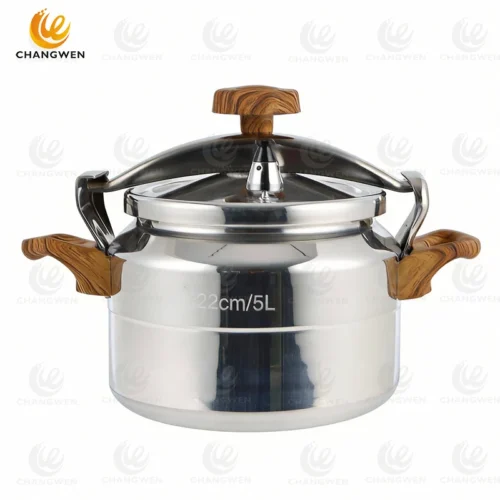
Pressure Cooker Stainless Steel for Healthy Cooking
-
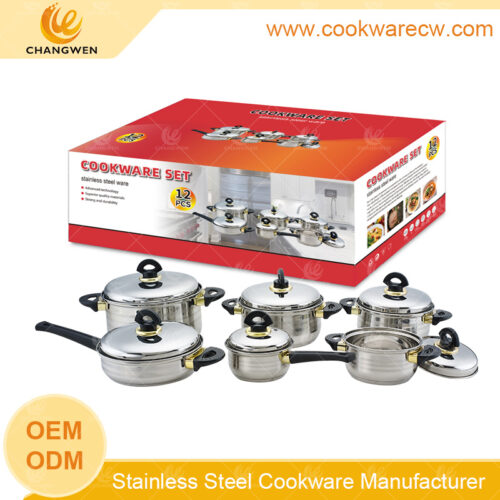
China cookware set 12pcs pots wholesale stainless steel lids black handle and knob frypan casserole saucepan CW-M1229B
-
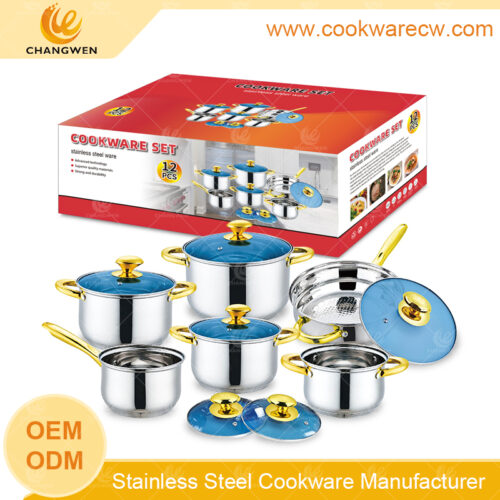
Mexican hottest stainless steel 12pcs cook pot frying pan with blue glass lid golden handle & knobs and 7 steps capsuled bottom CW-M1209
-
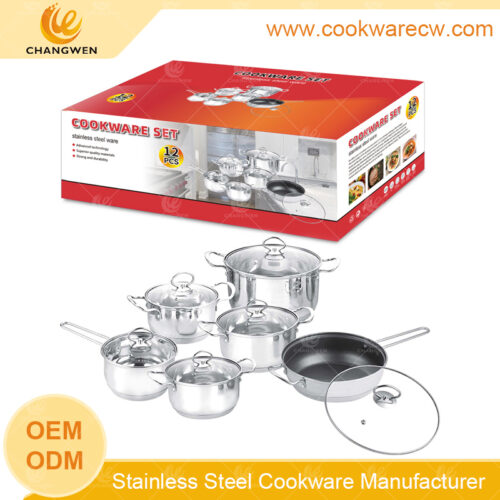
New design stainless steel 12pcs pots wholesale wire handle and knob cookware mirror polished saucepan casserole kitchen pots nonstick coated frypan CW-M1218
-
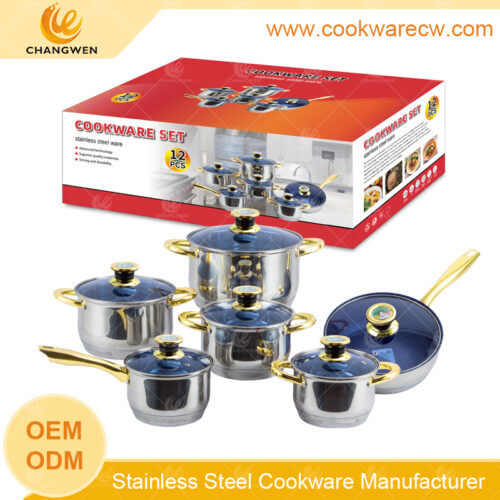
Pots wholesale cookware set 12pcs stainless steel pots and pans nonstick fry pan with thermal knobs and golden handles blue glass lids CW-M1215
-
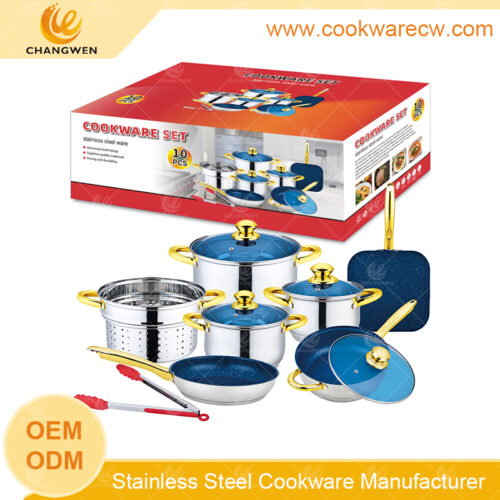
Stainless steel cookware set nonstick pans and pots casserole pot frying pan steamer with glass blue lid and a kitchenware clip CW-M1203
-
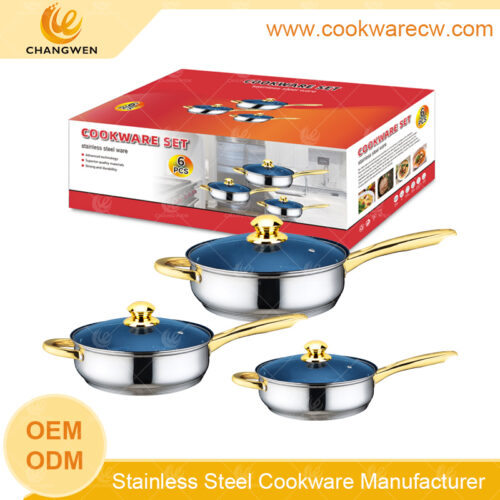
Wholesale new design stainless steel cookware 3pcs blue marble coating nonstick frypan set golden handles and knobs adjustable size CW-M0614
-
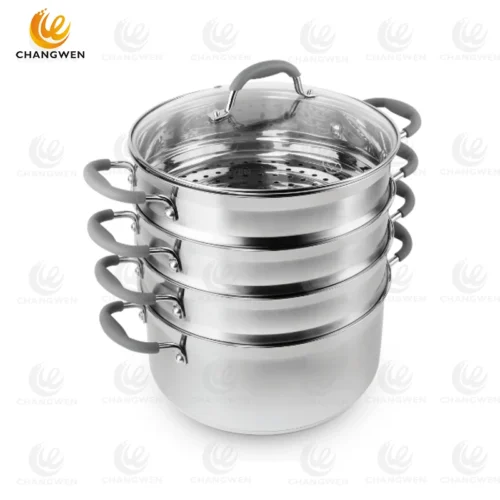
Stainless Steel Steamer Pot for Home and Commercial Kitchens CW-ES034