
Die cast aluminum cookware is the right choice when a buyer needs shaped, relatively thick bodies, repeatable geometry, good heat distribution, and design features that are difficult to form from sheet metal. The best product is not defined by weight or coating name alone. A reliable specification connects the casting alloy, body geometry, porosity limit, surface preparation, coating system, induction base, hardware, testing, and shipment inspection into one measurable approval standard.
This guide is written for importers, wholesalers, retailers, and private label teams that need comparable quotations and consistent production. It focuses on product engineering and acceptance criteria rather than repeating general aluminum safety advice or generic supplier-selection tips. Buyers developing a new range can also review Changwen’s custom kitchenware capabilities and quality control process while converting the framework below into an RFQ.
What Is Die Cast Aluminum Cookware?
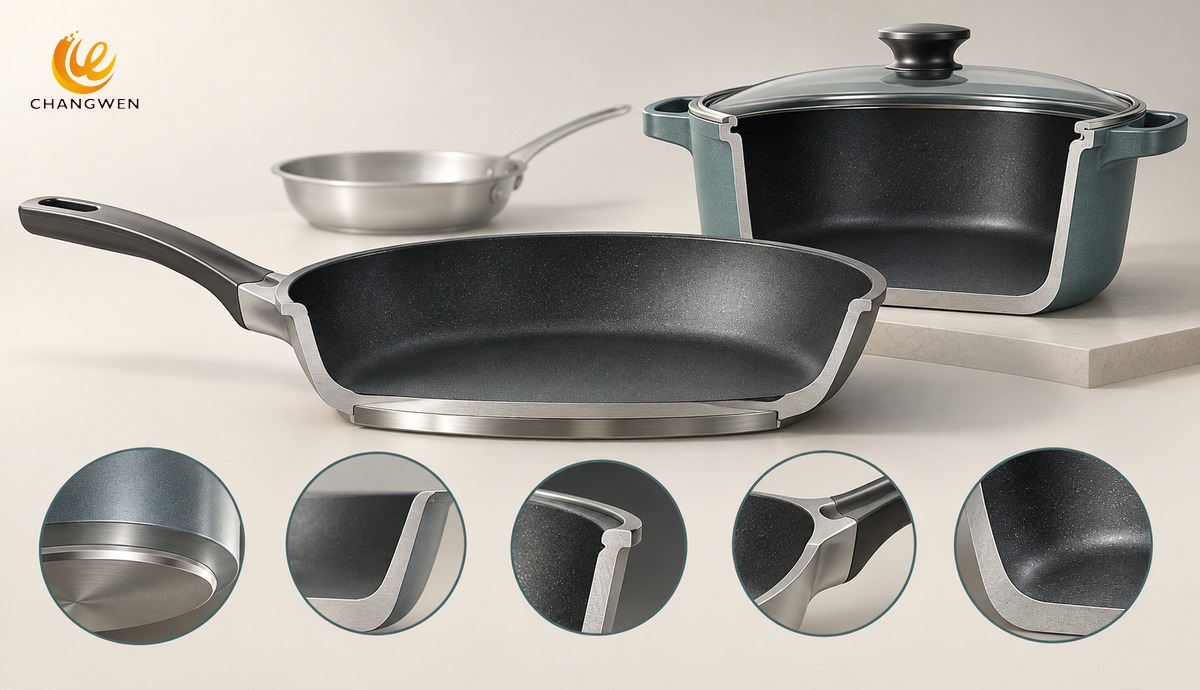
Die cast aluminum cookware is made by forcing molten aluminum into a shaped steel mold under pressure, then trimming and finishing the solidified casting. The method can create a thicker base, thinner upper walls, reinforced rims, ribs, handle bosses, pour spouts, and decorative exterior geometry in one body. Stamped cookware begins as sheet metal and is mechanically drawn into shape, while forged cookware starts from a heated blank that is compressed into form.
Die casting is therefore a geometry decision before it is a material decision. Stamping is efficient for smooth, relatively uniform shapes and high-volume value products. Forging can produce dense, strong bodies with controlled profiles. Die casting becomes attractive when the design needs integrated features, substantial walls, deep forms, or a distinctive silhouette without welding multiple aluminum components together.
Quick Decision: When Does Die Casting Make Commercial Sense?
| Buying requirement | Die cast aluminum | Stamped aluminum | Forged aluminum |
|---|---|---|---|
| Complex body geometry | Strong fit because ribs, bosses, and variable sections can be molded | Limited by drawing and forming | Good for controlled shapes but usually less intricate |
| Lightest possible vessel | Usually not the first choice | Often the lightest option | Typically between stamped and heavy cast designs |
| Thick, stable base | Easy to design into the casting | May require a separate bonded base | Can be formed with a strong base profile |
| Low tooling commitment | Weaker fit because dedicated molds are required | Better for simpler programs | Depends on geometry and tooling |
| Premium tactile feel | Strong when weight, finish, and details are controlled | Depends heavily on gauge and finishing | Strong with disciplined forming and finishing |
Die casting makes commercial sense when the product’s perceived value and functional geometry justify mold cost and process control. A basic promotional frying pan may not recover that investment. A coordinated retail family with sculpted bodies, integrated mounting points, stable induction bases, and several colors can spread tooling value across more SKUs and create a clearer shelf identity.
1. Specify the Alloy Before Comparing Prices
An RFQ should identify an aluminum alloy or an agreed chemical-composition range rather than using the phrase “food-grade aluminum” as the complete requirement. That phrase does not define casting behavior, iron content, mechanical response, surface quality, or traceability. The supplier should declare the material standard used, the alloy designation, whether recycled input is controlled, and how incoming metal or melt chemistry is verified.
Alloy choice affects more than strength. Silicon content influences fluidity and mold filling, while iron and other elements can influence die release, machining, corrosion behavior, and finish appearance. A buyer does not need to become a metallurgist, but the purchase specification should prevent silent material substitution. Require a composition certificate for the approved sample and define the frequency of batch or melt verification for production.
2. Control Geometry Instead of Asking Only for Thickness
A single wall-thickness number is incomplete because a die-cast pan can intentionally use different sections. The base may be thicker for stability and heat spreading, the upper wall may taper to reduce weight, and the rim or handle zone may be reinforced. A useful drawing identifies nominal base thickness, lower-wall thickness, upper-wall thickness, rim profile, internal corner radius, handle-boss dimensions, overall height, top diameter, and bottom contact diameter.
More metal is not automatically better. Excessive thickness increases weight, heating time, freight cost, and user fatigue. Sections that change abruptly can also make filling and solidification harder to control. Gradual transitions and generous internal radii generally create a more manufacturable body than sharp steps. The practical target is enough material where the cookware carries load or receives heat, without turning the product into an unnecessarily heavy casting.
3. Evaluate Weight as a Controlled Result
Weight is useful as a production control only after the geometry and alloy are fixed. A narrow weight tolerance can reveal incomplete filling, excess trimming, machining variation, or unauthorized section changes. Weight cannot prove that the base is flat, the walls are uniform, or internal porosity is acceptable, so it should support dimensional inspection rather than replace it.
For a cookware family, define target body weight by size before handles, lids, discs, and packaging are added. Compare supplier quotations using the same drawing revision and target mass. If one quote is much lighter, request the cross-section drawing and tolerance table before assuming the supplier has simply become more efficient.
4. Define Visible Casting Defects with Samples and Limits
Common casting defects include cold shuts, misruns, flow marks, shrinkage cavities, gas porosity, inclusions, flash, ejector marks, and trimming damage. Some marks disappear during blasting and coating, while others remain visible or weaken a critical area. A buyer should classify surfaces as food-contact, exterior cosmetic, rim, base, handle interface, and concealed areas because the same defect may have different consequences in each zone.
A written defect list becomes far more reliable when paired with boundary samples or annotated photographs. “No defects” is impossible to apply consistently, but “no open pores on the food-contact surface; no sharp flash; no crack-like cold shut; and no visible pit above the agreed size in Zone A” gives inspectors an observable decision rule. Critical defects should trigger rejection, while minor cosmetic limits can follow an agreed sampling plan.
5. Set a Porosity Strategy for Critical Areas
Porosity matters because a coated surface can look acceptable while voids remain inside the casting. Internal pores near a machined base, induction-disc interface, handle boss, or thin transition can reduce strength or become exposed after machining. The risk depends on pore size, distribution, depth, location, and the loads placed on the area; a pore in a noncritical decorative rib is not equivalent to a pore beside a handle fastener.
Choose the verification method according to risk. Visual checks and leak testing can find open defects. Cross-sectioning can reveal internal structure but destroys the sample. X-ray inspection can examine critical zones without cutting the body, although sensitivity and interpretation must be agreed. A strong specification states which zones are critical, which method is used, how often samples are tested, and what happens when the limit is exceeded.

6. Require Flatness in Both Cold and Heated Conditions
Cold flatness confirms that a finished vessel sits correctly before use, but thermal behavior determines whether it remains stable on a hob. A pan can pass a room-temperature check and distort after repeated heating and cooling because of residual stress, uneven sections, induction-disc attachment, or incompatible expansion between materials. The test method should define the support surface, measurement points, permitted gap, heating power, target temperature, dwell time, cooling method, and number of cycles.
Base contact diameter should also be specified separately from the pan’s advertised diameter. A 28 cm frying pan may have a much smaller active base, which affects burner matching and perceived heating speed. Buyers should compare like-for-like contact areas when evaluating samples rather than comparing only the rim diameter printed on the package.
7. Engineer the Induction Base as a System
Aluminum is not inherently suitable for standard induction heating, so induction-ready die-cast cookware usually needs a ferromagnetic component at the base. Common approaches include an attached stainless steel plate or a composite base construction. The buying decision should cover magnetic material grade, disc diameter, thickness, attachment method, exposed-edge finish, flatness, corrosion resistance, and performance after thermal cycling.
A large disc may improve coupling and visual coverage, but edge-to-edge appearance alone does not prove uniform heating. The disc must remain secure and flat, and the aluminum above it must distribute energy without creating an unstable hot zone. Test startup on the intended hob classes, observe power recognition, map heating behavior, and repeat the test after cycling. Cosmetic inspection should also look for separation, discoloration, sharp edges, and trapped residues around the interface.
8. Treat Pretreatment as Part of the Coating
A premium nonstick coating can fail early if the cast substrate is contaminated or poorly prepared. Degreasing, cleaning, blasting or roughening, rinsing, drying, primer application, flash-off, and curing form one connected process. Oil, release agent, oxide, dust, or inconsistent surface profile can reduce adhesion even when the final color and gloss look correct.
The coating specification should name the system type, supplier-approved layer structure, target dry-film thickness by layer or total system, cure window, color, gloss range, and permitted appearance limits. It should also identify food-contact compliance documents for the destination market. The U.S. Food and Drug Administration explains that cookware coatings are food-contact substances whose authorized use depends on intended conditions, while the EU framework requires food-contact articles to protect human health and supports traceability and documented good manufacturing practice. See the FDA overview of food-contact substances, Regulation (EC) No 1935/2004, and Regulation (EC) No 2023/2006 on GMP.
9. Match the Nonstick System to the Use Claim
Coating selection should begin with the promised use, not a marketing adjective. A value program used at moderate heat has different durability expectations from a premium line promoted for frequent cooking. Specify compatible utensils, maximum recommended use temperature, cleaning method, dishwasher claim if any, stain expectations, abrasion target, release performance, and test sequence.
A longer test list does not automatically create a better product. Tests must reproduce the claim and use a controlled method. Abrasion results depend on the pad, load, stroke length, speed, temperature, and failure definition. Adhesion depends on cut spacing, tape, conditioning, and grading. Food-release tests depend on ingredients, heat, oil, and cleaning between cycles. Record every parameter so results from two suppliers are actually comparable.
10. Separate Functional Performance from Cosmetic Appearance
Functional tests answer whether the cookware heats, remains stable, releases food, and survives intended use. Cosmetic standards answer whether color, texture, gloss, speckle distribution, printing, and exterior marks match the approved look. Combining both into a vague requirement such as “high quality” creates disputes because a visually attractive pan can underperform and a sound pan can still miss the retail color standard.
Approve color under a defined light source and viewing distance, and retain a physical master sample rather than relying only on screen images. For metallic, granite, or speckled finishes, define acceptable variation across the pan and between pieces in a set. The golden sample should represent the center of the acceptable range, not the most flawless item the factory can produce once.
11. Design Handles, Knobs, and Fasteners Around Heat and Load
Handle approval should consider grip geometry, balance, heat transfer, torsion, pull strength, repeated loading, fastener retention, and damage after thermal cycles. A comfortable cold sample can become unsafe when its metal insert conducts heat or when a flame reaches an exposed connection. Long handles should be evaluated with the vessel filled to a defined load, while side handles should allow a gloved grip without contacting a hot body.
Integrated cast bosses can create a strong attachment platform, but they still need dimensional and porosity control. Screws require thread engagement and anti-loosening strategy; rivets require controlled setting; detachable handles require lock-cycle and misuse tests. If the range includes soft-touch, wood-effect, or painted components, specify heat resistance, color stability, odor limits, and cleaning compatibility separately from mechanical strength.
12. Specify Lids as a Functional Assembly
A lid specification should define material, thickness, rim construction, fit clearance, rocking limit, knob attachment, steam vent, thermal-shock requirement, and packing protection. A glass lid provides visibility but introduces breakage and fit considerations. A cast or aluminum lid can feel robust but changes weight and heat behavior. Neither option is universally superior; the right choice follows the product claim and target price.
Check every lid against bodies from different points in the production batch, not only the paired sample on the inspection table. Interchangeability matters in retail sets and replacement service. When several diameters share a family design, verify that knob position, vent orientation, rim finish, and logo placement remain consistent across sizes.
13. Build a Golden Sample That Can Be Measured
A golden sample should be supported by a signed specification pack. The pack should include the current drawing, bill of materials, body weight, critical dimensions, coating system, color standard, approved artwork, handle and lid specifications, packaging construction, defect boundaries, performance methods, and required compliance records. A sample without documents cannot explain which characteristics are mandatory and which occurred by chance.
Keep at least one approved reference with the buyer and one sealed reference with the manufacturer. Photograph identifying details and record approval date, revision, and sample code. When a material, mold, coating, induction plate, handle, or packaging component changes, use a documented change-control process and decide whether partial or full requalification is required.
14. Use a Batch Inspection Plan That Follows Risk
A shipment inspection should not give every characteristic the same weight. Safety and functional failures, such as a loose handle, sharp edge, cracked body, detached base, exposed food-contact defect, or incorrect material, require stricter treatment than a small exterior shade variation. Classify critical, major, and minor defects, select a recognized sampling approach, and write the acceptance numbers into the purchase agreement.
Some checks are suitable for every unit, including obvious damage, missing parts, and basic assembly. Other checks are sample-based, including dimensions, flatness, coating thickness, leak behavior, handle loading, and carton drop evaluation. Destructive coating, sectioning, or long thermal-cycle tests need a planned frequency tied to lots, shifts, material changes, or risk signals. Changwen’s R&D and manufacturing overview provides additional context for aligning prototype approval with production control.

15. Test Packaging with the Real Product Weight
Die-cast cookware is often heavier than a visually similar stamped item, so packaging must be tested with the final vessel, lid, handles, accessories, and retail inserts. The packaging specification should control how the rim, coating, glass, handle, and induction base are isolated from impact and abrasion. Molded pulp, corrugated partitions, sleeves, bags, and surface films should be selected around the actual damage risks rather than appearance alone.
Transit testing should reflect the sales channel. A master carton prepared for palletized wholesale faces different hazards from a single retail set shipped through parcel delivery. Define carton material, dimensions, gross weight, stacking orientation, barcode placement, drop or vibration protocol, and the failure criteria for product, gift box, and master carton. A package can protect the pan but still fail if the retail box becomes unsalable.
What Should a Comparable Die Cast Cookware RFQ Include?
- Market and use: destination countries, household or commercial use, hob types, target retail tier, and intended claims.
- Product scope: vessel type, top diameter, usable capacity, body height, base contact diameter, lid, handles, and set composition.
- Casting specification: alloy or composition standard, target body weight, sectional dimensions, tolerances, critical zones, and traceability.
- Defect limits: boundary samples for pores, flow marks, flash, trimming, pits, scratches, color, gloss, and printing.
- Surface system: pretreatment, coating construction, dry-film thickness, cure control, exterior finish, and compliance documents.
- Induction system: magnetic component, diameter, thickness, attachment, flatness, recognition, and thermal-cycle criteria.
- Hardware: handle material, fastening method, load test, torque or pull requirement, heat behavior, and interchangeability.
- Performance: cold and hot flatness, heating behavior, food release, abrasion, adhesion, thermal cycling, and cleaning claims.
- Packaging: unit pack, protective materials, retail artwork, master carton, barcode, transit method, and acceptance criteria.
- Commercial data: tooling ownership, mold life expectation, MOQ by size and color, lead time, sample charges, spare parts, and change control.
Comparable quotations require suppliers to price the same specification revision. Ask each supplier to list deviations instead of quietly substituting its standard construction. Tooling, testing, packaging, and compliance costs should be separated where practical, because a lower unit price may exclude work that another supplier has included.
How Should Buyers Compare Samples?
Use a weighted scorecard that reflects the product promise. A performance-led pan may give more weight to flatness, heating, release, and handle stability. A design-led retail set may also assign meaningful weight to color consistency, lid fit, tactile quality, and shelf presentation. Price should be scored only after technical deviations have been normalized, otherwise the cheapest sample may simply represent a different product.
Run the same test sequence on all samples and record raw observations, not only pass or fail. Measure mass, dimensions, contact area, heat-up behavior, temperature spread, flatness before and after cycling, coating appearance, adhesion, abrasion, handle movement, lid fit, and packaging damage. The resulting evidence makes negotiation faster and creates a baseline for pre-shipment inspection.
Frequently Asked Questions
Is die cast aluminum cookware better than stamped aluminum?
Die cast aluminum is better for complex shapes, reinforced features, substantial walls, and a premium tactile feel, while stamped aluminum is often better for lighter weight, simpler forms, and lower tooling or unit cost. The better process is the one that meets the product’s geometry, performance, volume, and price requirements with controlled variation.
Does a heavier die cast pan always heat more evenly?
A heavier pan can store more heat, but evenness also depends on base geometry, wall transitions, induction-disc design, burner size, and material consistency. Compare temperature maps and contact diameter under the same test conditions instead of treating total weight as proof of thermal quality.
How can a buyer check casting porosity?
Open porosity can be found through visual or leak-related checks, while internal porosity may require sectioning or X-ray inspection. The buyer should identify critical zones, test sensitivity, sampling frequency, pore limits, and the response to a failed sample before production begins.
What coating documents should an importer request?
Request the coating system identity, layer structure, technical data, intended use conditions, batch traceability, application and cure records, and food-contact compliance support relevant to the destination market. A generic certificate that does not match the exact system, color, substrate, or intended conditions is not a complete approval package.
What causes an induction base to become uneven?
Unevenness can result from residual stress, attachment variation, incompatible thermal expansion, overheating, machining error, or insufficient support in the body design. Verify room-temperature flatness and repeat the measurement after a defined heating and cooling cycle.
How many samples are needed before bulk production?
The sample quantity depends on product complexity and risk, but one showroom-perfect pan is rarely enough. Buyers should retain golden samples, test multiple sizes where geometry changes, evaluate components from production-intent tooling, and use pilot output to confirm process capability before authorizing the full order.
Final Buying Recommendation
The strongest die cast aluminum cookware program begins with a measurable product definition, not a catalog photo. Lock the alloy, geometry, critical casting zones, pretreatment, coating, induction base, handles, lid, test methods, defect boundaries, packaging, and change-control rules before comparing final prices. This approach turns subjective quality discussions into repeatable decisions and reduces costly surprises between sample approval and shipment.
Changwen supports cookware wholesale, private label, and OEM development for buyers that need coordinated product design and production control. To discuss a die-cast aluminum cookware project, prepare your target market, sizes, hob requirements, coating claim, quantity, packaging format, and reference design, then contact Changwen for a project review and quotation. You can also browse the cookware product range to identify starting formats for customization.
-
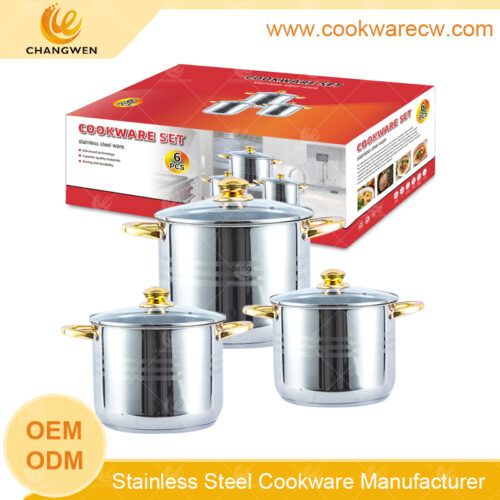
Heavy Duty Stock Pots Stainless Steel CW-M0607
-
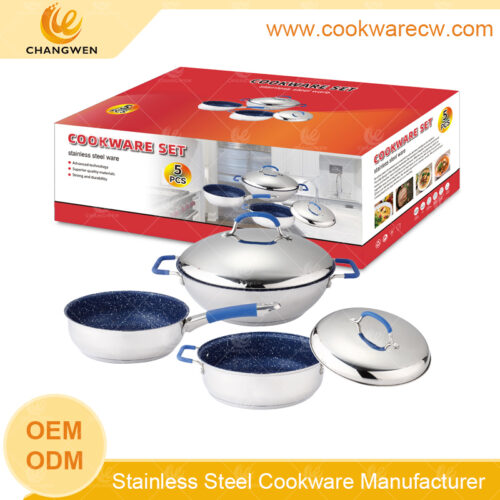
non-stick fry pans coating wok stainless steel wire handles & knobs with silicon cover high quality material lid CW-M0502G
-
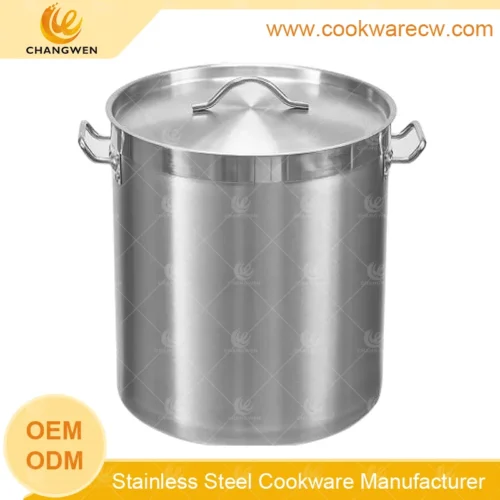
Wholesale Large Stock Pot CW-SP001
-
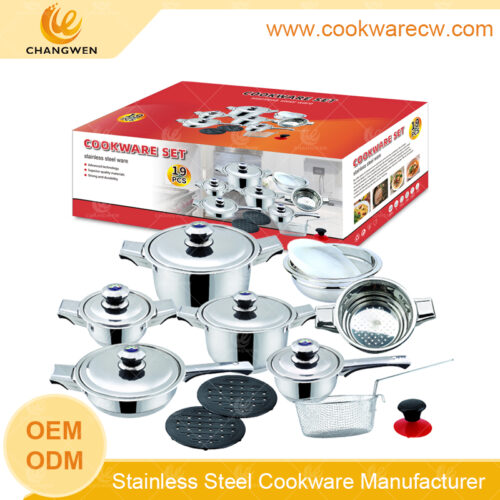
Heavy weight cookware set steamer pot 19pcs stainless steel pots and pans with thermal knobs and heat insulation handle frying basket salad bowl with PP lid kitchen utensil fire mats suction knob CW-M1901G
-
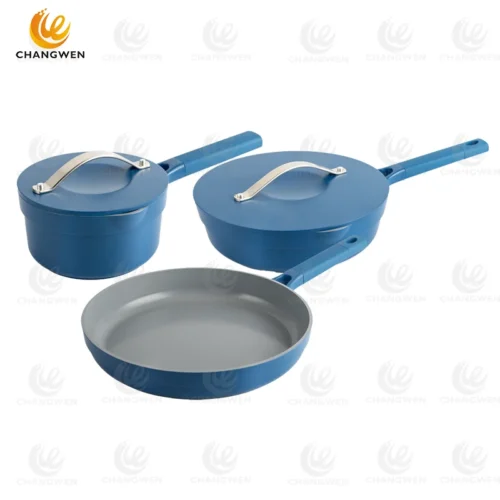
5pcs Ceramic Nonstick Aluminum Cookware Set OEM Manufacturer China | Aluminum Cookware Factory
-
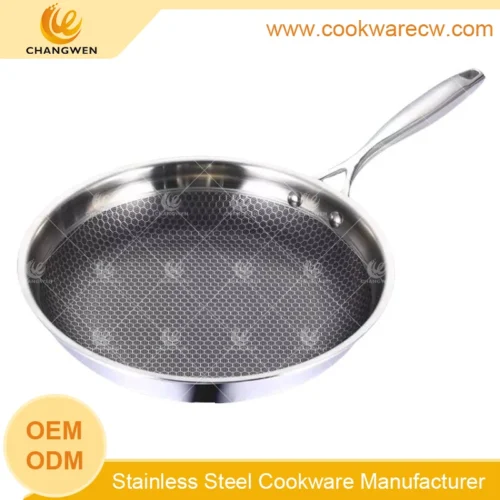
Honeycomb Stainless Steel Frying Pan for Even Cooking CW-TP011
-
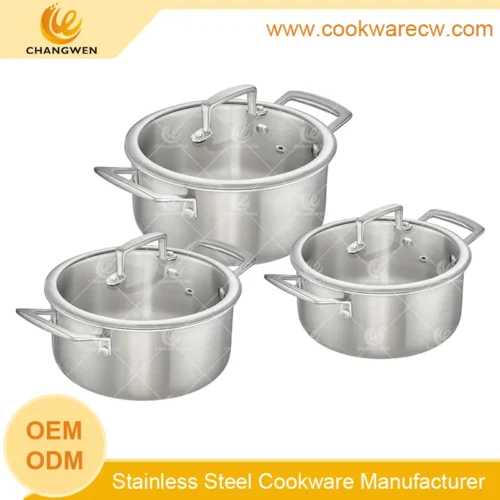
Versatile Stainless Steel Pot Set with Multiple Capacity Options CW-ETP018
-
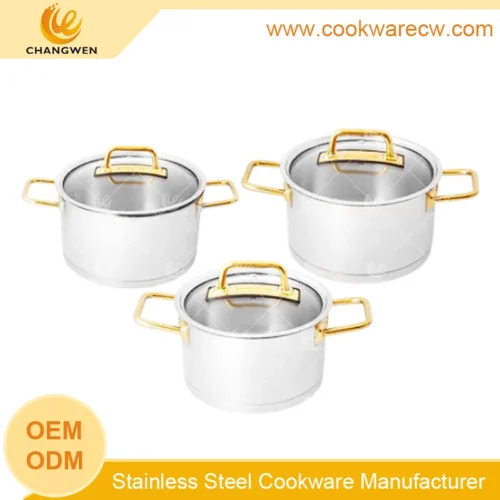
6-Piece Stainless Steel Pot Set with Gold Handles CW-ES0610