
Read time: 11 minutes
Quick answer: 430 stainless steel cookware is an affordable, magnetic option that works naturally with induction cooktops because 430 belongs to the ferritic stainless steel family. Its low-nickel composition helps control material cost, but it provides less corrosion resistance than common austenitic cooking-surface grades. The best use of 430 stainless steel is often an induction-ready exterior or base layer, although well-made 430 cookware can also serve everyday kitchens when it is kept clean, dry, and away from prolonged exposure to salt or acid.
What Is 430 Stainless Steel Cookware?
430 stainless steel cookware uses an iron-and-chromium alloy classified as ferritic stainless steel. Type 430 typically contains about 16–18% chromium and little or no nickel, so it differs from nickel-bearing austenitic grades in both structure and behavior. Chromium creates a thin passive layer that helps protect the steel from oxidation, while the ferritic crystal structure gives the material its strong magnetic response.
The phrase “430 stainless steel cookware” can describe more than one construction. A vessel may use 430 steel throughout its body, place 430 only on the exterior, or bond a 430 base to a more corrosion-resistant interior and a heat-conductive core. A buyer should therefore ask where the 430 layer is located instead of assuming that one grade describes every layer of the pan.
Why Is 430 Stainless Steel Magnetic?
430 stainless steel is magnetic because its atoms form a body-centered cubic ferritic structure. That structure allows magnetic domains to align readily with an external magnetic field. The reliable magnetic response makes 430 steel useful on induction cooktops, where an alternating magnetic field generates heat in the cookware rather than heating the cooking zone first.
A refrigerator magnet provides a useful first check for induction compatibility, but magnetism alone does not prove excellent cooking performance. A pan also needs a flat base, sufficient magnetic material, stable construction, and a heat-spreading layer to heat evenly. A strong magnetic attraction confirms a necessary condition for induction, not the complete quality of the cookware.
Why Does 430 Stainless Steel Usually Cost Less?
430 stainless steel is usually more affordable because it contains little or no nickel. Nickel is a comparatively costly alloying element, and reducing it lowers both raw-material cost and exposure to nickel-price volatility. Manufacturers can use that cost advantage to produce induction-compatible cookware at a more accessible price or allocate more of the budget to thickness, handles, lids, and bonding quality.
A lower alloy cost does not automatically mean low-quality cookware. Value depends on the complete design: steel thickness, base flatness, core material, bonding method, rim finish, handle attachment, and quality control all affect service life. A solidly built 430 pan can be a better purchase than a thin pan made from a more expensive grade if the thin pan warps or heats unevenly.
Is 430 Stainless Steel Safe for Cooking?
430 stainless steel can be suitable for food-contact cookware when the finished product is made to applicable food-contact requirements and used as directed. The alloy does not rely on a synthetic nonstick coating, and its low-nickel composition may appeal to buyers who prefer to minimize nickel in cookware. Material grade alone, however, cannot certify a finished product; compliance documentation, surface finish, manufacturing controls, and intended use still matter.
People with a diagnosed metal allergy should seek individualized medical advice rather than treating any alloy label as a medical guarantee. Low nickel does not mean that every finished pan is identical, and cookware may contain multiple metals in its body, base, fasteners, or handles. For general buyers, traceable specifications and food-contact test documentation provide stronger evidence than broad “non-toxic” marketing claims.
430 vs 304 vs 316 Stainless Steel Cookware
430, 304, and 316 stainless steels solve different cookware problems. Type 430 prioritizes magnetism and affordability; type 304 provides a broad balance of corrosion resistance and formability; type 316 adds stronger resistance to pitting in chloride-rich or demanding environments. The best grade depends on the layer’s job rather than on a single universal ranking.
A broader stainless steel grades comparison can help buyers distinguish grade names from chromium-and-nickel labels before evaluating a finished pan.
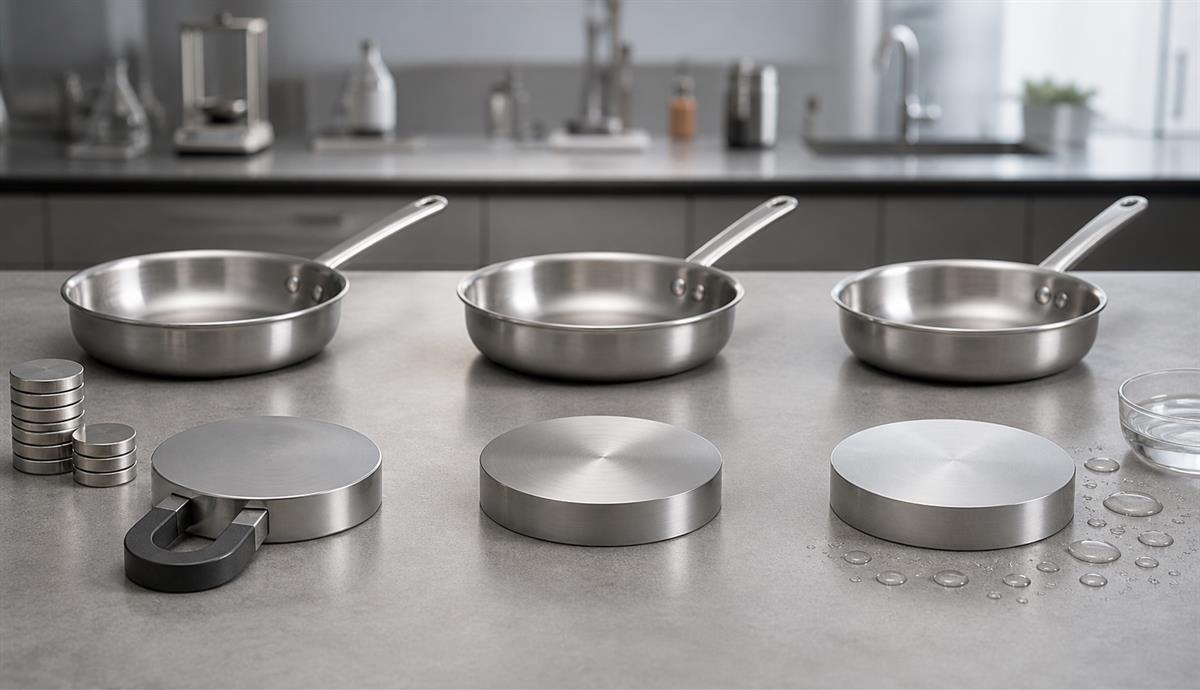
| Decision factor | 430 stainless steel | 304 stainless steel | 316 stainless steel |
|---|---|---|---|
| Steel family | Ferritic | Austenitic | Austenitic |
| Typical magnetic response | Strong | Usually weak or non-magnetic before cold working | Usually weak or non-magnetic before cold working |
| Nickel content | Little or none | Commonly contains nickel | Commonly contains nickel |
| Relative corrosion resistance | Good in mild conditions, but lower | Very good for everyday cookware | Higher, especially in chloride exposure |
| Relative material cost | Lower | Moderate | Higher |
| Most logical cookware role | Induction exterior, magnetic base, value cookware | General cooking surface | Premium cooking surface for demanding exposure |
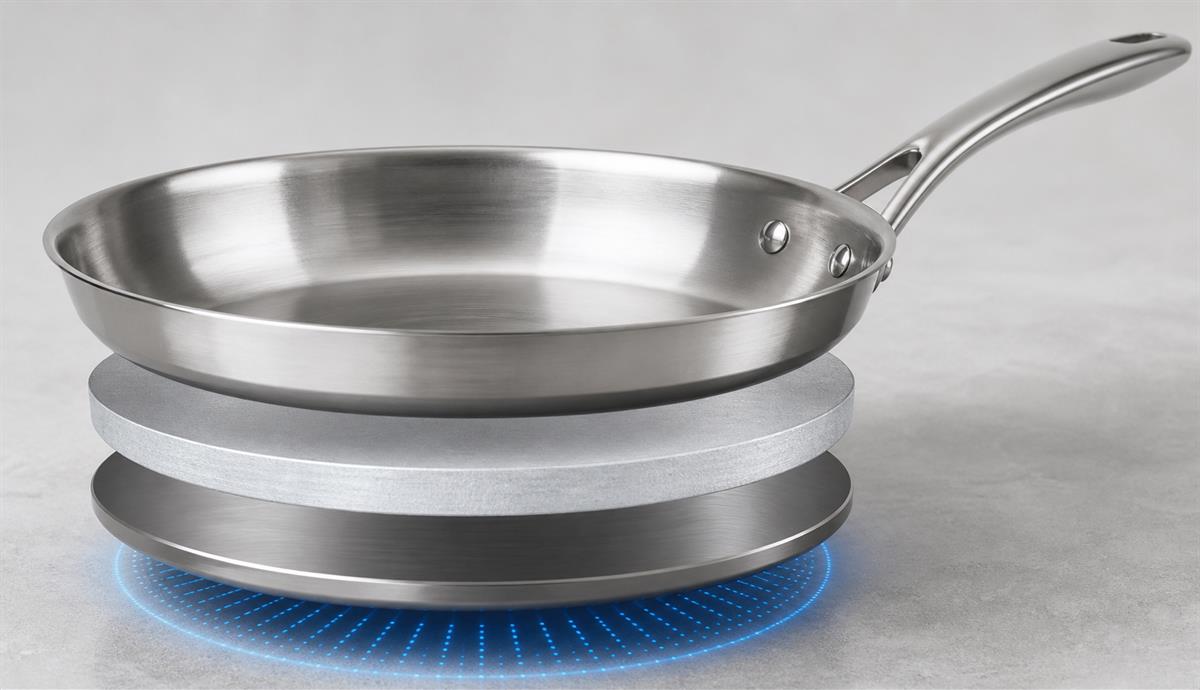
The comparison explains why layered cookware can be more rational than a one-grade design. A magnetic 430 exterior can couple with induction, an aluminum core can distribute heat, and a more corrosion-resistant interior can contact food. Each layer performs the task that matches its material properties, so the construction can deliver better overall value than selecting one expensive metal for every function. Buyers who want to compare additional layer arrangements can use this 5-ply stainless steel cookware guide.
Does 430 Stainless Steel Cookware Work on Induction?
430 stainless steel works naturally on induction because its ferritic structure responds strongly to a magnetic field. The pan must still have a broad, flat magnetic base that aligns closely with the cooking zone. A warped, undersized, or interrupted base may trigger poor detection, uneven heating, noise, or reduced power even when the steel itself is magnetic.
The most practical induction test combines three observations. First, a magnet should cling firmly across the base rather than only at a small center point. Second, the base should sit flat without rocking. Third, the product specifications should explicitly state induction compatibility. Together, these checks are more reliable than judging the pan by appearance.
How Does 430 Stainless Steel Affect Cooking Performance?
430 stainless steel is durable and heat tolerant, but stainless steel by itself is not an efficient heat spreader. A pan made from a single thin sheet can develop hot spots because heat moves slowly across the steel. Thickness and a conductive core therefore influence browning, simmering, and temperature recovery more directly than the 430 label alone.
A bonded aluminum core improves responsiveness and lateral heat distribution, while a thicker base increases stability and heat capacity. Fully clad construction spreads the conductive layer up the sidewalls, whereas a disc base concentrates heat management at the bottom. Fully clad cookware can offer more uniform sidewall heating, but a well-bonded disc base may provide good value for boiling, steaming, and everyday stovetop tasks.
What Are the Main Advantages of 430 Stainless Steel Cookware?
- Reliable induction compatibility: 430 steel provides a strong magnetic exterior without requiring a separate magnetic adapter.
- Lower material cost: Minimal nickel content supports affordable cookware and more predictable sourcing costs.
- Low-nickel composition: The alloy offers a practical choice for buyers who intentionally seek reduced-nickel materials.
- Heat and wear resistance: A properly finished surface tolerates normal cookware temperatures and routine cleaning.
- Recyclable metal construction: Stainless steel has established recycling value and can support long product life when the cookware is maintained.
The strongest purchasing case for 430 stainless steel is not “cheapest metal.” The stronger case is “purpose-matched metal”: 430 supplies magnetism where induction requires it, while thoughtful construction compensates for its lower thermal conductivity and corrosion resistance.
What Are the Limitations of 430 Stainless Steel?
430 stainless steel offers less corrosion resistance than 304 or 316 stainless steel, especially when salt, acidic food, moisture, or harsh cleaning chemicals remain on the surface. Chloride exposure can encourage localized corrosion, while trapped water can cause staining. These risks do not make 430 unsuitable, but they make prompt cleaning and drying more important.
430 steel can also be less formable and less tough than common austenitic grades. Complex shapes, severe forming, or weak manufacturing control may create stress points. A buyer should inspect rolled rims, welded areas, handle joints, and base bonding because workmanship can determine whether an affordable pan remains stable through repeated heating and cooling.
When Is 430 Stainless Steel the Right Choice?
430 stainless steel is a logical choice when induction compatibility, low nickel, and budget control matter more than maximum resistance to aggressive cooking conditions. It suits dry cooking, boiling, steaming, short-duration sautéing, and general meal preparation when the vessel is cleaned soon after use. It is especially effective as the magnetic outer layer in multi-layer cookware.
Buyers comparing 430 steel with entirely different cookware families can consult this guide to cookware materials and their pros and cons to separate alloy decisions from broader material choices.
A more corrosion-resistant cooking surface is the better choice when food will be stored in the pan, salty water will stand for long periods, acidic sauces will simmer frequently, or commercial cleaning chemicals will be used. This distinction is based on exposure, not prestige: mild daily conditions favor 430’s value, while severe chemical conditions justify a higher-corrosion-resistance interior.
How Can Buyers Evaluate 430 Cookware Quality?
A useful evaluation starts with a written material map. The supplier should identify the grade used on the food-contact interior, core, exterior, and induction base. A vague statement such as “stainless steel construction” does not reveal whether 430 touches food or serves only as the magnetic layer.
Physical construction should then support the material claim. The base should be flat, the pan should feel stable, the handle should resist twisting, the rim should be smooth, and the layers should show no gaps. Thickness measurements, bonding tests, thermal-uniformity tests, and repeated heat-cycle tests provide more meaningful evidence than weight or shine alone. The same checks are explained in greater depth in this stainless steel frying pan buyer’s guide.
Food-contact documentation should match the exact product and production material. Useful records may include alloy composition reports, migration testing where required, factory quality-control procedures, and test reports tied to the model or material lot. A certificate for an unrelated sample cannot establish the compliance of every item that shares a similar appearance.
How Should 430 Stainless Steel Cookware Be Used?
Moderate heat provides the most controllable results because a bonded base continues storing energy after the power setting changes. Preheat the empty pan briefly over low-to-medium heat, add cooking fat when appropriate, and add food after the fat becomes fluid. Excessive empty preheating can discolor the surface and stress the bonded layers without improving cooking performance.
Food release depends on temperature control rather than on a permanent nonstick layer. Protein often releases more easily after its surface has browned, while premature movement can tear or stick it. If fond forms on the pan, a small amount of liquid can dissolve it into a sauce; this technique turns controlled sticking into flavor rather than treating every browned residue as a defect.
How Should 430 Stainless Steel Cookware Be Cleaned?
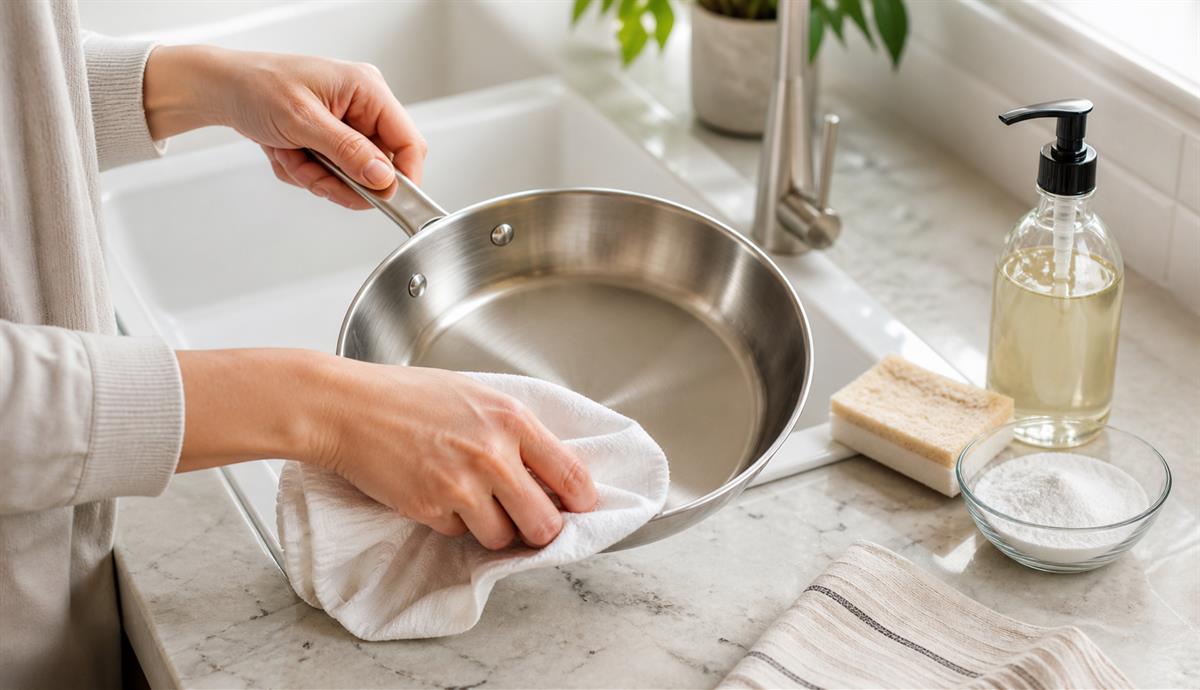
Clean 430 stainless steel after the cookware has cooled enough to handle safely, using warm water, mild dish soap, and a non-scratching sponge. Dry the pan immediately instead of leaving droplets or salty residue on the surface. Prompt drying is the simplest way to protect a lower-nickel stainless alloy from spots and avoidable corrosion. For additional stain-removal methods, follow this practical stainless steel cleaning guide.
For stuck food, soak the pan briefly or simmer a shallow layer of water before cleaning. A paste of baking soda and water can lift many marks without aggressive abrasion. Avoid prolonged contact with chlorine bleach, chloride-heavy cleaners, and steel wool because these methods can damage the passive surface or leave particles that later appear as rust.
Rainbow heat tint is usually an oxide-color effect rather than structural damage. A diluted food-safe acidic cleaner can often remove it, followed by thorough rinsing and drying. Pitting, flaking, deep cracks, or separation between bonded layers is different from cosmetic tint and should prompt the user to stop and assess the cookware.
Is 430 Stainless Steel Sustainable?
430 stainless steel can support a resource-efficient design because it reduces reliance on nickel and remains recyclable through established stainless-steel recovery streams. The environmental value of any pan, however, depends more on useful life than on one alloy claim. A durable pan used for many years usually avoids more replacement material than a lightweight product that fails early.
Sustainable procurement should therefore evaluate thickness, repairability of handles, packaging, production yield, quality consistency, and expected service life alongside alloy composition. A lower-cost material becomes a genuine sustainability advantage only when engineering and care prevent premature disposal.
Buyer Decision: Is 430 Stainless Steel Cookware Worth It?
430 stainless steel cookware is worth considering when the product uses the alloy for its real strengths: magnetism, low-nickel composition, affordability, and induction performance. The value proposition is strongest in a multi-layer pan with a flat 430 exterior, a conductive core, and a food-contact surface selected for the intended cooking conditions.
430 stainless steel is less compelling when a product is extremely thin, lacks traceable specifications, has weak bonding, or will face repeated salt and acid exposure without careful cleaning. Buyers should choose the complete construction, not a grade number in isolation. The best affordable cookware is the design that balances material, geometry, testing, and maintenance for the actual kitchen task.
Frequently Asked Questions
Is 430 stainless steel the same as 18/0 stainless steel?
430 stainless steel is commonly associated with the 18/0 label because it contains substantial chromium and little or no nickel. The shorthand is approximate, so a formal grade specification or composition report provides more precise identification than the 18/0 label alone.
Will 430 stainless steel rust?
430 stainless steel resists rust through its chromium-rich passive layer, but it is not corrosion-proof. Standing salt, acidic residue, chlorine cleaners, trapped moisture, and surface contamination increase the risk of staining or corrosion, so prompt washing and drying are important.
Can 430 stainless steel go in a dishwasher?
Dishwasher suitability depends on the complete pan and its care instructions, not only on the steel grade. Harsh detergents, chlorides, wet storage, decorative finishes, and non-stainless components may make hand washing the safer method for preserving appearance and service life.
Is every magnetic stainless steel pan made from 430?
No. Several stainless-steel families and engineered constructions can show magnetism, and cold working can make some normally non-magnetic steels respond weakly to a magnet. Strong magnetism suggests an induction-capable layer, but material certification is required to identify the exact grade.
Is 430 stainless steel better than 304 stainless steel?
430 is better when strong magnetism, low nickel, and lower material cost are the primary goals. 304 is better when the cooking surface needs stronger general corrosion resistance and formability. A layered pan can use both properties efficiently instead of forcing one grade to perform every role.
What is the best construction for 430 stainless steel cookware?
A practical construction uses a flat 430 stainless steel exterior for induction coupling, a bonded aluminum core for even heat distribution, and a corrosion-resistant food-contact interior suited to the intended recipes. Adequate thickness and reliable bonding are essential to prevent hot spots and warping.
Final Verdict
430 stainless steel cookware offers a credible combination of magnetic induction performance, low-nickel composition, and accessible cost. Its trade-off is lower corrosion resistance, which makes construction details and care habits especially important. Buyers who verify each layer, prioritize a conductive core, and clean the cookware promptly can turn 430 stainless steel from a budget label into a purposeful engineering choice.
-
Mexican hottest stainless steel 12pcs cook pot frying pan with blue glass lid golden handle & knobs and 7 steps capsuled bottom CW-M1209
-

Honeycomb Structure Stainless Steel Frying Pan CW-ETP014
-
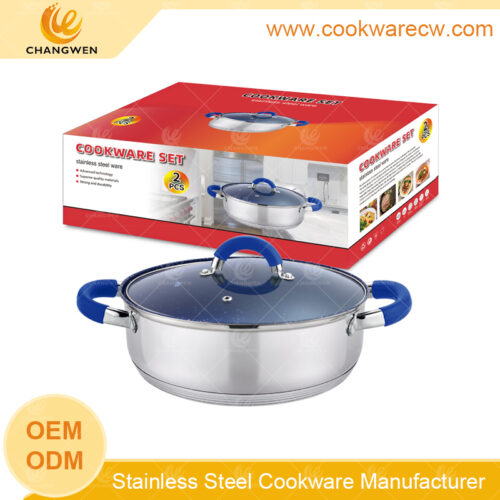
high stainless steel material 2pcs casserole cookware pot with 5-stepped induction bottom rice cooker low pot CW-M0204
-
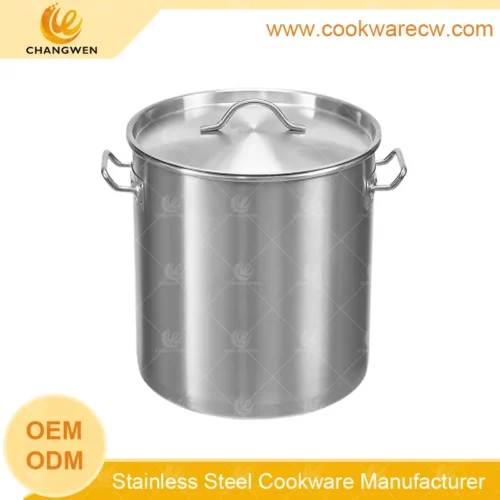
Stainless Steel Large Cook Pot CW-SP001
-
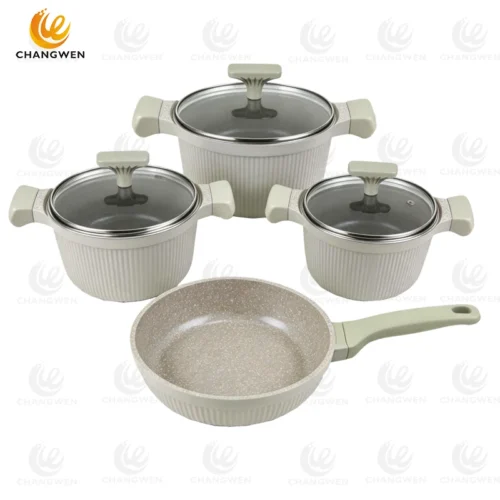
7pcs Vertical Stripe Nonstick Aluminum Cookware Set with Silicone Lid | Changwen Aluminum Cookware Factory China
-
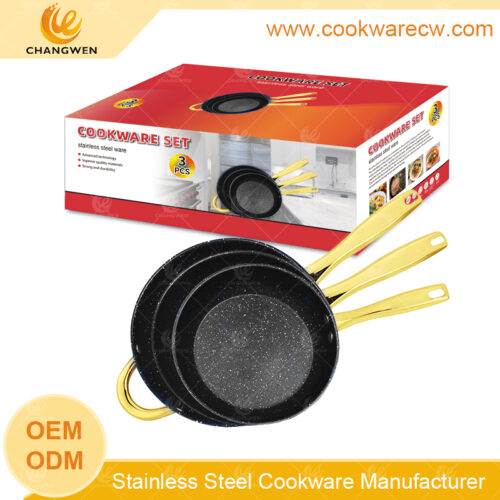
Hot sale 3pcs stainless steel nonstick fry pan set golden plated handles black coating cookware CW-M0301-01
-
Wholesale Stainless Steel Stock Pot CW-SP001
-
Gold Hammered Stainless Steel Cookware for Luxury Kitchens CW-ETP0501