
Read time: 11 minutes
Introduction
There is a quiet engineering revolution happening inside cookware cabinets around the world.
Fixed handles used to be the obvious answer. A handle on a pot makes the pot easy to move. End of discussion. But then urban apartments got smaller. RVs got more popular. Meal prep culture asked why the same pan cannot go from stovetop to oven to refrigerator without occupying three times the shelf space it actually needs. Online cookware brands discovered that detachable handle sets ship in 40% less box volume. And health-conscious consumers noticed that a pan without a fixed handle can go into an oven, onto a table, and into a dishwasher in a way that a fixed-handle pan simply cannot.
The removable and folding handle cookware category has moved from camping gear niche to mainstream premium positioning in a remarkably short time. Research from the National Kitchen and Bath Association identifies “efficient storage and multi-functional tools” as the top trends for 2026 — and detachable handle cookware sits at the intersection of both.
For OEM brands, importers, and distributors evaluating this category in 2026, this guide covers everything: the three handle types and their engineering differences, the construction specifications that determine real-world quality, the commercial advantages for e-commerce brands, and what to require from any removable handle cookware manufacturer before placing an order.

Key Takeaways
- Three distinct handle systems serve different market segments: clip-lock (most common, widest compatibility), magnetic detach (premium positioning), and folding/integrated (camping and space optimization). Each has different manufacturing requirements and retail positioning.
- Detachable handle cookware sets ship more securely, with handles packed separately to prevent damage during transit, reducing logistics costs by 30–40%. This is a significant commercial advantage for e-commerce brands.
- Detachable handle sets save up to 70% of cabinet space — the most-cited consumer benefit and the strongest retail marketing claim in the category.
- The quality of the locking mechanism is the single most critical manufacturing variable. A locking system rated to hold at least 10kg (22 lbs) with no lateral wobble under load is the minimum acceptable standard for consumer-grade cookware.
- Tri-ply full-clad construction (304-aluminum-430) is the correct specification for premium detachable handle cookware sets. The premium positioning of the handle system deserves a pan body that performs at the same level.
- For OEM programs, the detachable handle system can be sourced as a separate component and applied to an existing pan body spec — which means a brand can add removable handle capability to an existing cookware line without redesigning the pan itself.
Part 1: The Three Handle Systems — Engineering, Advantages, and OEM Implications
Type 1: Clip-Lock Detachable Handle (Most Common)
The clip-lock system is the dominant mechanism in the detachable handle cookware market. A spring-loaded clamp attaches to the rim of the pot or pan, typically using a two-point or three-point contact system that grips the vessel securely when squeezed closed.
How it works: The handle has a jaw mechanism operated by squeezing a lever or pressing a button. The user positions the handle’s contact points on the vessel rim, then releases the lever to lock. To remove, the lever is squeezed again. The locking force is provided by an internal spring that maintains constant clamping pressure during use.
Engineering requirements: The quality of a clip-lock handle is determined by three variables: the spring tension (must maintain grip under the full weight of a loaded vessel without slipping), the contact surface material (heat-resistant polymer or stainless steel pads that grip the rim without marring it), and the internal mechanism tolerance (loose tolerances create wobble; precision manufacturing eliminates it).
The detachable mechanism’s functionality depends entirely on the precision of the stainless steel connection. Manufacturers must ensure a tight, secure fit between the handle and the cookware body, eliminating wobble or looseness that could cause spills or burns.
Load rating: Consumer-grade clip-lock handles should be rated to at least 10kg (22 lbs) of vertical load without slipping. Most modern designs use a triple-point locking system that can support up to 22 pounds safely without wobbling or slipping during use. Require load testing documentation — not just a claim — when evaluating any removable handle cookware manufacturer.
OEM positioning: Clip-lock handles are available in stainless steel or heat-resistant polymer with multiple color options. They are the most customizable handle type for brand differentiation and are available from multiple manufacturers, giving OEM buyers leverage in specification and pricing.
Best for: Mainstream consumer cookware sets, family kitchen products, restaurant supply programs where the handle is shared across multiple vessel sizes.
Type 2: Magnetic Detachable Handle (Premium Positioning)
Magnetic detachable handles use a powerful rare-earth magnet embedded in the handle to connect to a ferromagnetic receiver plate on the vessel. The magnetic connection is supplemented by a mechanical safety lock that prevents the handle from releasing under load without deliberate user action.
How it works: The handle magnet aligns with the receiver plate on the vessel rim through a self-guiding attraction. The mechanical safety engagement clicks into position automatically when the handle seats correctly. Releasing requires pressing a specific release button or mechanism.
The premium positioning: Magnetic handles have a premium one-handed engagement and release experience that clip-lock handles cannot replicate. The click-and-go attachment feels more refined at retail demonstration and in product photography. This is why magnetic detachable handle systems appear in the highest-priced detachable handle cookware sets and are consistently associated with premium brand positioning.
OEM considerations: Magnetic handle systems require a specific receiver plate to be integrated into the vessel design — this is a manufacturing difference from clip-lock handles, which attach to standard vessel rims. OEM programs adopting magnetic handles must specify the receiver plate integration at the pan body level, not just as a separate handle accessory. This makes magnetic handle programs slightly more complex to set up but delivers a more premium product outcome.
Best for: Premium consumer cookware sets, lifestyle brands with strong visual identity, brands targeting the upper end of the detachable handle market.
Type 3: Folding Handle (Space Optimization and Camping)
Folding handles are permanently attached to the vessel but designed to fold flat when not in use — reducing the pan’s footprint to a fraction of its fixed-handle equivalent. The handle folds against the pan body via a pivot point, locking in the extended position for cooking and folding flat for storage or transport.
How it works: A pivot joint at the handle’s base allows it to rotate from cooking position (extended, locked) to storage position (folded flat). The locking mechanism prevents unintended folding during use; deliberate release allows the fold.
Engineering requirements: The pivot joint must tolerate thousands of fold/unfold cycles without loosening. The locking mechanism must be secure enough that the handle cannot accidentally fold during a hot cooking application. Heat insulation at the pivot and handle grip must prevent heat transfer to the user’s hand from the folded handle’s proximity to the pan body.
OEM positioning: Folding handles are particularly strong for camping cookware, RV cookware, and space-saving kitchen product lines. They are permanently integrated into the pan design, which simplifies the user experience (no separate handle component to store or misplace) at the cost of full removability.
Best for: Camping cookware, RV and outdoor product lines, compact kitchen solutions, travel cookware programs.
Part 2: The Pan Body — Construction That Matches the Handle System
The detachable handle is the differentiator. The pan body is where the cooking happens. Getting the pan body specification right is as important as the handle engineering.
Why Construction Matters for Detachable Handle Cookware
A detachable handle cookware set is typically positioned as a premium product — the handle system adds manufacturing complexity and retail value that positions it above standard fixed-handle cookware. A premium-positioned pan body must perform at the level the brand story implies.
The most common construction for quality detachable handle cookware stainless steel products is tri-ply full-clad (304-aluminum-430):
- 304 stainless steel inner layer (18/8 or 18/10): Food-contact surface. Non-reactive with acidic foods. Verifiable as 304 by material test report (mill certificate) from the steel supplier. Do not accept 201 stainless steel substituted for 304 — the two are visually identical but 201 has lower nickel content and inferior corrosion resistance.
- Aluminum core: Distributes heat evenly from the center to the edges of the base and up the sidewalls. Prevents the hot spots that force cooks to compensate constantly. Thickness and alloy quality determine heat distribution performance.
- 430 stainless steel outer layer: Magnetic. Required for induction compatibility. Every pan in a detachable handle cookware set for the modern market should be induction-compatible — oven safe to 600°F and works on all cooktops, including induction.
Full-clad vs disc-base: Full-clad construction runs all three layers continuously through the base and sidewalls. Disc-base bonds a multi-layer disc only to the bottom of a single-layer body. For detachable handle cookware sets at premium price points, full-clad is the appropriate specification — the even heat distribution up the sidewalls makes a practical cooking difference for techniques that matter (sautéing, searing, sauce reduction).
Vessel Rim Design for Detachable Handle Compatibility
This is a specification point that most OEM buyers miss entirely, then discover too late.
The rim of the pan body — the edge where a clip-lock handle attaches — must be designed to accommodate the handle mechanism being used. Key considerations:
Rim profile: A rolled rim (common on stamped cookware) may not provide the flat gripping surface a clip-lock handle requires for full contact. Confirm that the rim profile of your pan body matches the contact surface geometry of your handle system.
Rim thickness: Too thick and the handle jaws cannot close fully; too thin and the clamping force is concentrated on a small area, potentially distorting the rim over time. Confirm handle manufacturer’s rim thickness specification and match it in the pan body spec.
Rim material and finish: Highly polished rims can reduce grip friction. A slightly brushed or matte rim finish on the grip area provides better mechanical grip for clip-lock systems.
For magnetic systems: The receiver plate must be integrated into the rim during manufacturing. This is not a retrofit operation — it requires a specific manufacturing step during pan body production.
Work with your manufacturer to have them test your specific handle system on your specific pan body before production begins. A mismatch discovered during a 10,000-unit production run is an expensive problem.
Part 3: Why Detachable Handle Cookware Is a Commercial Opportunity for OEM Brands
The Storage Argument Converts Browsers to Buyers
Detachable handles reduce storage space by up to 75% compared to fixed-handle designs, making them ideal for urban apartments, tiny homes, and RVs. This is a claim that is immediately credible and visually demonstrable in product photography. A photo of a stacked detachable handle cookware set occupying one-quarter the cabinet space of an equivalent fixed-handle set is a stronger sales argument than any number of technical specifications.
For e-commerce brands where photography is the primary purchase driver, the detachable handle cookware category offers stronger visual storytelling than almost any other cookware product type. The before-and-after storage comparison, the one-handle-serves-all-pots demonstration, the stovetop-to-oven-to-table-to-fridge sequence — all of these communicate product value immediately and convincingly.
The Logistics Advantage Is Real
Detachable handle stainless steel cookware sets ship more securely, with handles packed separately to prevent damage during transit. The compact packaging also reduces the likelihood of box damage and improves the customer’s first impression.
For OEM brands selling through e-commerce, this is not a minor advantage. Cookware with fixed handles is difficult to pack efficiently — the handles create dead space in cartons and are vulnerable to impact damage during shipping. Detachable handle sets pack flat, handle and vessel separately, in a more compact and more protective configuration. Lower damage rates mean lower return rates. Lower return rates mean better unit economics and better customer review profiles.
The shipping volume reduction of 30–40% also means lower per-unit freight costs on both domestic and international shipping — a measurable improvement in margin for any volume e-commerce program.
The Versatility Story Has Genuine Consumer Appeal
A detachable handle cookware set is genuinely more versatile than a fixed-handle equivalent. The same vessel can be used:
- As a stovetop cooking vessel (with handle attached)
- As an oven dish (handle removed, rated for oven temperatures)
- As a serving dish at the table (without the handle’s industrial appearance)
- As a storage container in the refrigerator (flat lid, compact stack)
Clip the removable handle from pan to pot and vice versa. Unclip and bake, store leftovers in the fridge, save space in the dishwasher and serve at the table. One handle system serves an entire cookware set — which is also a retail economics story: the consumer buys a multi-piece set knowing that one or two handles serve all the vessels, rather than paying for redundant fixed handles on every piece.
Part 4: Detachable Handle Cookware Set Configurations for OEM Programs
Standard Set Compositions
A best detachable handle cookware set for mainstream retail typically includes:
- Frying pan 24cm or 26cm — the highest-frequency use piece
- Sauté pan or deep frying pan 28cm — versatile primary cooking vessel
- Saucepan 16cm or 18cm (1.5–2L) — sauces, small batches, reheating
- Saucepan 20cm (2.5–3L) — medium-batch cooking, soups, grains
- Stock pot or Dutch oven 24cm (4–5L) — large batch, pasta, stock
- One or two detachable handles — shared across all vessels
- Glass or stainless lids — fitting multiple vessel sizes
The key set architecture decision is how many handles to include. Most programs include one universal handle in entry sets and two in premium sets. Some programs include a silicone pot holder alongside the handle for oven applications.
Pots with Removable Handles and Lids
The combination of removable handles and compatible lids is the specification that enables the fullest range of use cases. Cristel’s unique removable handle system and tri-ply construction create powerful, space-efficient cookware that transitions seamlessly from stovetop to oven to table.
For OEM programs, lids should be specified to:
- Fit multiple vessel sizes where possible (reduces lid count, reduces cost)
- Be glass with stainless steel rim for cooking visibility (consumer preference)
- Be stackable on nested vessel bodies for storage efficiency
- Be rated for the same oven temperature as the vessels themselves
Material Options for Detachable Handle Cookware Stainless Steel Programs
Tri-ply full-clad 304 stainless steel — premium positioning, highest cooking performance, non-reactive, induction-compatible, dishwasher safe. The correct specification for mid-to-premium market positioning.
Disc-base 304 stainless steel — accessible price point, good everyday performance, slightly less even heat distribution than full-clad. Appropriate for value market positioning.
Aluminum with non-stick coating — lighter weight, lower price point, faster heat-up. Appropriate for brands where non-stick performance is the primary consumer value proposition. Note: non-stick coatings reduce the oven temperature rating of the vessel.
Part 5: What to Require from Any Detachable Handle Cookware Manufacturer
Handle System Requirements
Load rating documentation: Every detachable handle should have a tested load rating — the maximum weight it can hold without slipping or releasing under normal use conditions. Request the test protocol and results, not just the marketing claim. Minimum acceptable: 10kg (22 lbs).
Cycle testing: How many attach/detach cycles has the handle mechanism been tested to? Handle mechanisms that wear out after 500 cycles are not appropriate for household use (a household cook might attach and detach a handle 2–5 times per day). Request cycle testing documentation — minimum 5,000 cycles without mechanism degradation.
Heat resistance rating: The handle grip material must be rated for temperatures the user will encounter during stovetop cooking. Minimum 200°C for handle grip material. For oven-safe programs, the handle or its absence defines the oven safety of the set.
Safety certification: CE marking (EU), UL or NSF (US), or equivalent for your target market. These certifications require third-party verification of safety claims.
Pan Body Requirements
Steel grade documentation: Mill certificate from the steel supplier confirming 304 stainless steel (18/8) for the inner cooking surface. Manufacturers prioritize food-grade stainless steel alloys, typically 18/8 or 304 stainless steel, for their non-toxic properties, resistance to rust and corrosion, and ability to withstand temperatures up to 260°C — compatible with both stovetop and oven use. Lower-grade stainless steel can lead to premature wear, discoloration, or even connection failure over time.
Food contact certification: LFGB (EU food safety standard — includes migration testing and sensory evaluation) or FDA compliance documentation for US market. These are third-party test reports from accredited laboratories — not self-declarations.
Wall thickness specification: Confirm in millimeters. Minimum 2.4mm total wall for tri-ply quality.
Rim compatibility confirmation: Request that the manufacturer test your specific handle system on the specific pan body you are ordering before production begins. Get written confirmation of compatibility.
OEM Program Requirements
MOQ and lead time: Standard OEM programs with existing handle systems: from 1,000 units per item. Lead time: 40–50 days for catalog products with branding. Custom handle designs requiring new tooling: add 6–8 weeks.
Packaging specification: Detachable handle cookware sets require specific packaging that properly separates handles from vessels for safe shipping. Confirm packaging design before production — the compact shipping advantage of the category is only realized with properly designed packaging.
NDA for proprietary handle designs: If you are developing a proprietary handle mechanism or magnetic system, sign an NDA before sharing design files.
FAQ
What is the difference between removable handle, detachable handle, and folding handle cookware?
Removable handle and detachable handle are interchangeable terms — they both describe a handle that can be completely separated from the cooking vessel. A folding handle stays attached to the vessel but folds flat when not in use. Removable/detachable handle systems use a clip-lock or magnetic mechanism; folding handles use a pivot joint. All three serve the space-saving and multi-use goals of the category; the best choice depends on how much versatility vs. simplicity you want in the product design.
What is the best detachable handle cookware construction for premium OEM programs?
Tri-ply full-clad construction (304 stainless steel inner layer, aluminum core, 430 stainless steel outer layer for induction compatibility) is the appropriate specification for premium detachable handle cookware sets. The full-clad construction distributes heat evenly through base and sidewalls, delivering consistent cooking performance across all vessel sizes in the set. Combined with a well-engineered clip-lock or magnetic handle system, this construction supports premium retail positioning.
Are detachable handle cookware sets dishwasher safe?
The pan bodies typically are. The detachable handles typically should be hand-washed. The high heat and harsh detergents in a dishwasher can damage the internal spring mechanisms and plastic components of detachable handles. This should be clearly communicated in product instructions and on packaging. Pan bodies without handles are fully dishwasher safe and often easier to clean than fixed-handle equivalents because there are no handle crevices to clean around.
How do I verify that a detachable handle is safe under load?
Request load testing documentation from the manufacturer — a test report showing the handle mechanism has been tested to a rated load (minimum 10kg / 22 lbs) without slipping, releasing, or mechanism failure. Also request cycle testing data showing the mechanism performs to specification after a minimum of 5,000 attach/detach cycles. Both are standard quality verification requirements for any serious detachable handle cookware manufacturer.
What is the MOQ for OEM detachable handle cookware programs?
For catalog products with OEM branding (logo, custom packaging), most established manufacturers work from 1,000 units per item. Complete set programs with multiple vessels plus handles are typically structured at set-level MOQ. Custom handle designs or proprietary mechanisms require higher MOQs to amortize tooling investment.
Can a detachable handle cookware set work on induction?
Yes — if the pan body’s outer layer is 430 stainless steel or another ferromagnetic material. Confirm induction compatibility specifically in the product specification. Tri-ply full-clad cookware with a 430 stainless outer layer is induction-compatible by construction. Aluminum bodies with a separate stainless steel induction disc bonded to the base are also induction-compatible. Purely aluminum or 304 stainless steel bodies without a magnetic outer layer are not.
Conclusion
Removable and folding handle cookware is not a novelty category. It is a response to how people actually live in 2026 — smaller kitchens, more versatile cooking, online purchasing where shipping and packaging efficiency matter, and a growing consumer preference for cookware that does more with less space.
For OEM brands, the category offers a clear commercial advantage: better shipping economics, stronger visual marketing story, genuine consumer utility, and premium positioning that justifies higher retail pricing than equivalent fixed-handle cookware. The engineering is more complex than standard cookware — handle load ratings, rim compatibility, cycle testing, and integration between handle system and pan body all require specification attention that fixed-handle programs do not. Get the specifications right and the product story tells itself.
The handle system differentiates. The pan body performs. Specify both correctly.
Source Detachable Handle Cookware from Changwen
Changwen is a stainless steel cookware manufacturer based in Jiangmen, Guangdong, China, with over 22 years of OEM and ODM manufacturing experience. We produce detachable handle stainless steel cookware sets, frying pans, saucepans, and stock pots with tri-ply full-clad construction for OEM brand programs across Europe, Australia, the Middle East, South America, and Southeast Asia.
Detachable handle program specifications:
- Pan body: tri-ply full-clad (304-aluminum-430) or disc-base, customer choice
- Handle system: clip-lock (multiple style options) or folding handle configurations
- Steel grade: 304 stainless steel (18/8), mill certificates per batch
- Induction compatible: 430 outer layer standard
- Custom logo, packaging, and set composition
- LFGB and FDA food contact compliance
- ISO 9001:2015 certified
-
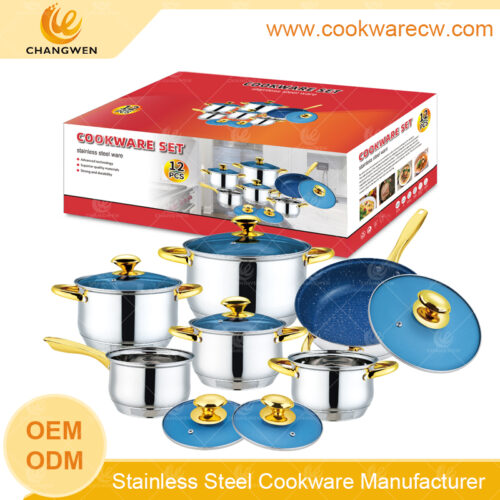
China manufacturer stainless steel 12pcs cookware set non-stick frying pan blue glass lid golden handles & knobs CW-M1209N
-
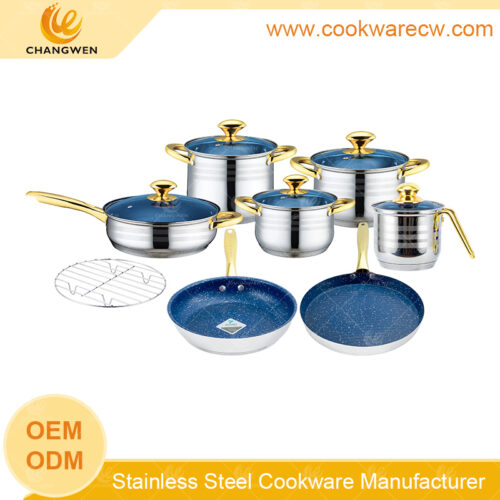
Best Tri Ply Stainless Steel Cookware
-
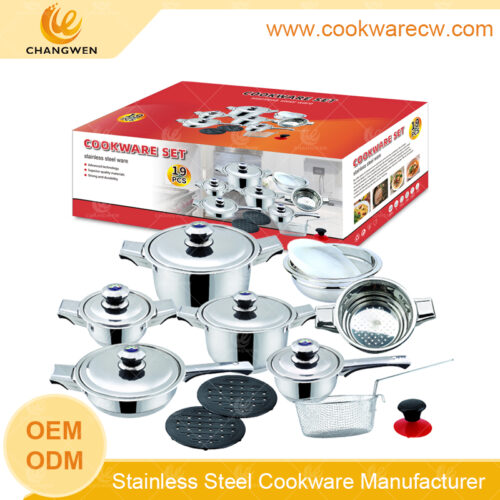
Heavy weight cookware set steamer pot 19pcs stainless steel pots and pans with thermal knobs and heat insulation handle frying basket salad bowl with PP lid kitchen utensil fire mats suction knob CW-M1901G
-
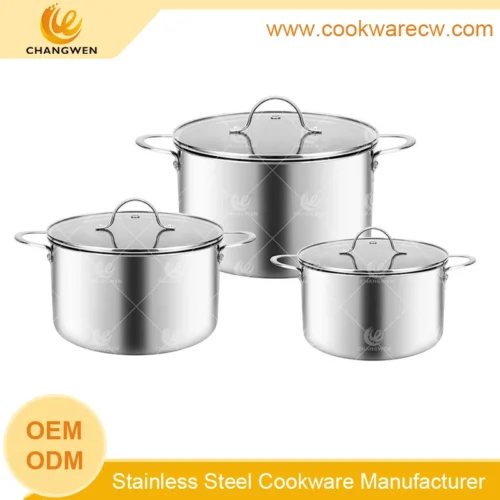
High-Quality Stainless Steel Pot Set with Heat-Resistant Handles CW-TP0603
-
Stainless Steel Griddle For BBQ Grills
-
Large Stainless Steel Cazo
-
popular stainless steel pots 13pcs cookware set with heat insulated colored silicone and glass lids milkpot casseroles nonstick frypan set CW-M1206G
-
Hot sale 3pcs stainless steel nonstick fry pan set golden plated handles black coating cookware CW-M0301-01