
Read time: 11 minutes
Some cookware products are aspirational. Others are essential. The saucepan is essential.
It is the first piece of cookware someone reaches for when making pasta sauce at 7 PM on a Tuesday. It is the vessel for warming milk for a child, cooking oatmeal before work, and preparing the hollandaise that elevates a weekend brunch. It does not require a special occasion or a particular cooking ambition. It requires nothing more than the intention to eat — which is to say, it is used every day, by nearly every cook, in every market in the world.
For cookware retailers and kitchenware brands, this frequency of use translates into a specific commercial opportunity: consistent demand, strong replacement cycles, and a product category that sells both as part of a set and as an individual purchase. The global cookware market is projected to grow from USD 38.34 billion in 2026 to USD 67.87 billion by 2034, with premiumization and the shift toward durable, non-toxic materials driving the expansion. Saucepans sit at the intersection of all these growth drivers.
This guide covers why saucepan is a strategic product category for cookware retailers, what market data says about demand and construction trends, how to build a saucepan product line that serves multiple consumer segments, and what to require from an OEM saucepan manufacturer to compete at the quality level the market is moving toward.
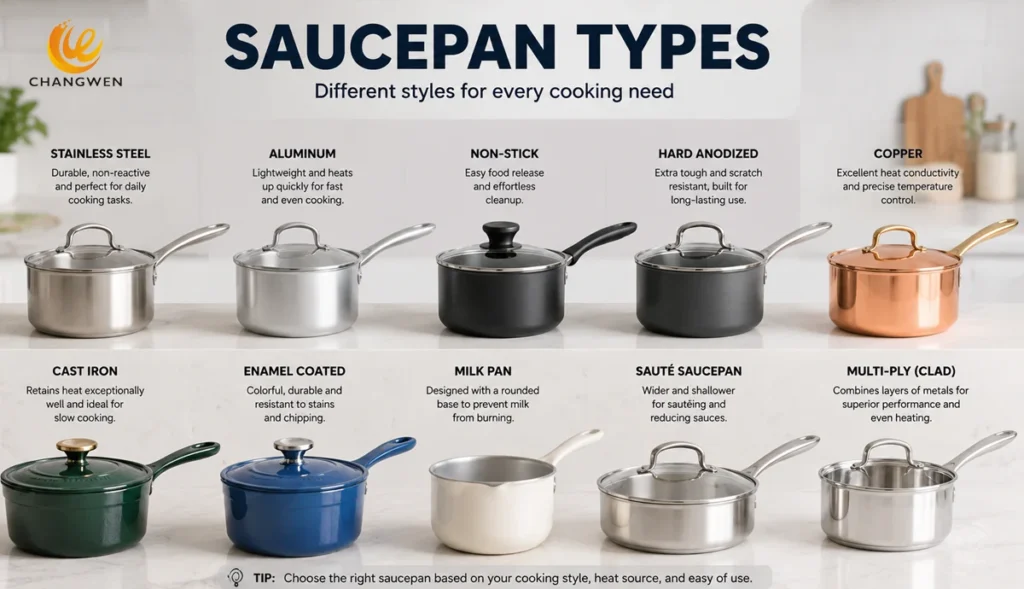
What Makes a Saucepan Different From Other Cookware Products?
Saucepan vs Cooking Pot: Understanding the Category Difference
A saucepan and a cooking pot (soup pot, stock pot) are both liquid-centric cookware, but they serve fundamentally different cooking functions and are rarely purchased as substitutes for each other.
| Feature | Saucepan | Cooking Pot |
|---|---|---|
| Shape | Deep body with one long handle | Larger capacity with two loop handles |
| Primary purpose | Precision liquid cooking for small batches | High-volume liquid cooking for batches |
| Typical capacity | 1–4 quarts (1–4L) | 4+ quarts (4L+) |
| Heat control precision | High — small volume responds quickly | Moderate — larger thermal mass |
| Best applications | Sauces, grains, heating milk, small soups | Soups, stocks, pasta, batch cooking |
| Stovetop behavior | Rapid temperature response | Sustained temperature over long periods |
| Consumer purchase pattern | Individual item and set addition | Usually purchased as single large item |
Consumers typically need both — and typically buy them separately. A saucepan does not replace a cooking pot, and a cooking pot cannot efficiently do what a saucepan does. This means a retailer carrying saucepans does not cannibalize pot sales — the two products serve different purchasing occasions.
Saucepan vs Frying Pan: Different Cooking Purposes
Saucepans and frying pans are the two most frequently used cooking vessels in most home kitchens, but their design and cooking purpose are distinct.
A frying pan has shallow sides and a large, open cooking surface — designed to release moisture rapidly for browning, searing, and sautéing. A saucepan has deeper sides and a narrower opening — designed to contain liquid, prevent evaporation, and give the cook precise control over temperature and reduction.
Consumers who cook regularly will own both. Retailers who carry both in coordinated designs (matching finish, handle style, material specification) convert single-piece buyers into set buyers and increase basket value. The saucepan is the natural companion piece to the frying pan in any cookware collection architecture.
Why Saucepan Is an Essential Kitchen Product for Consumers
Versatility Across Everyday Cooking Applications
The commercial case for saucepans starts with their frequency of use. Unlike a roasting pan (used seasonally), a stockpot (used for batch cooking), or a specialized gratin dish (used occasionally), the saucepan is in daily rotation in most households.
The breadth of applications a saucepan handles explains this frequency:
- Sauces: The primary application — pasta sauce, béchamel, hollandaise, reduction sauces. The deep sides prevent splatter during active reduction; the long handle gives control during stirring.
- Grains: Rice, quinoa, oats, polenta, couscous. All require controlled liquid-to-grain ratios and sustained simmer with a lid — the saucepan’s design handles this precisely.
- Heating liquids: Milk, broth, soup, coffee. Simple applications, but performed daily.
- Pasta: For 1–2 servings, a 3-quart saucepan is more efficient than a full stock pot — faster heat-up, less water, less energy.
- Boiling eggs: Depth is needed to fully submerge eggs; the saucepan provides this at the right volume.
- Baby food preparation: Small-batch cooking at precise temperatures — the saucepan is the standard vessel.
This breadth of application is the product’s core retail value proposition: one purchase, daily use, multiple applications. This multifunctionality directly increases the consumer’s perceived value of the product relative to price — which in turn supports retail margin.
The Perfect Size for Modern Household Cooking
The structural trend reshaping the saucepan market is household size. Single-person and two-person households are growing as a share of total households in every developed market — and smaller households need smaller, more efficient cookware.
Modular cookware designs and stackable solutions appeal to urban households with limited storage space, and the shift toward smaller households is driving demand for compact cookware that performs efficiently for 1–3 portions.
Recommended retail saucepan size portfolio by consumer segment:
| Size | Capacity | Target Consumer |
|---|---|---|
| 1 quart (1L) | Small batch sauces, single portions | Single-person households, urban studio apartments |
| 1.5 quart (1.5L) | Everyday heating, oats, small soups | Singles and couples, daily use |
| 2 quart (2L) | Family single-dish cooking, pasta portions | The most versatile household size — highest volume seller |
| 3 quart (3L) | Larger batches, family-scale | Families and frequent home cooks |
For a retailer building a saucepan range, the 2-quart is the priority SKU — the size that handles the widest range of everyday cooking tasks for the widest household demographic. Build the range from there.
Suitable for Different Consumer Segments
The saucepan category serves multiple distinct buyer segments, each with different purchasing motivations:
Home cooks (everyday consumers): Prioritize reliable performance, easy cleaning, and value for price. The replacement buyer is a major volume driver — saucepans used daily wear out or lose their non-stick surface, and this consumer replaces on a regular cycle.
Health-conscious buyers: Consumers increasingly prefer cookware made from stainless steel, ceramic, and cast iron due to concerns around chemical coatings. Non-toxic and PFAS-free labeling has become a decisive purchase factor. Stainless steel saucepans address this segment directly — no coating, no PFAS concern, no degradation.
Premium buyers: Seek stainless steel construction with visible quality indicators — tri-ply design, premium handle ergonomics, stainless steel lid, professional finish. Willing to pay significantly more for longer-lasting, better-performing products.
Professional and commercial kitchens: Require heavy-gauge saucepans for sustained daily use — preparation sauces, reductions, holding stations. Commercial buyers prioritize durability and consistency over aesthetics.
Why Saucepan Is a Profitable Product Category for Cookware Retailers
Strong Demand as an Everyday Replacement Product
One of the most commercially attractive characteristics of the saucepan is its replacement cycle. Unlike a knife set (replaced once a decade) or a cast iron pan (practically never), saucepans — particularly non-stick saucepans — are replaced regularly.
Replacement cycles of five to eight years for saucepan cookware represent 60–70% of annual demand volume, making the saucepan category uniquely resistant to the one-time-purchase dynamic that limits some cookware categories.A consumer who bought a saucepan set five years ago is a saucepan buyer again today, regardless of whether she has purchased anything else in your store recently.
This replacement dynamic creates consistent year-round demand. Unlike seasonally driven categories (BBQ in summer, casseroles in autumn), saucepans sell steadily. A retailer who establishes category authority in saucepans builds a consistent returning customer base.
Easy to Bundle With Other Cookware Products
Saucepans are natural combination partners for other cookware categories. They are rarely the only cookware purchase — they are purchased alongside frying pans, stockpots, and kitchen tool sets. This creates retail bundling opportunities that increase transaction value.
Starter Kitchen Bundle (entry consumer):
- 2-quart saucepan
- 24cm frying pan
- 20cm stockpot
- Basic utensil set
Premium Cookware Collection (mid-to-premium consumer):
- 1.5-quart + 2-quart + 3-quart stainless steel saucepan set
- Tri-ply stainless steel frying pan
- Dutch oven or covered casserole
- Steamer insert (compatible with saucepan)
Bundling saucepans into sets consistently increases average order value. The consumer who intended to buy only a frying pan sees the saucepan bundle and adds it because the combination makes functional sense — and the matching design makes the decision easy.
Multiple Price Positioning Opportunities
The saucepan category spans a wide price range, allowing a single retail brand to serve multiple consumer segments without inventory complexity:
Entry level ($20–$40 per unit): Aluminum construction with PTFE or ceramic non-stick coating. Single-layer aluminum body. Appeals to budget-conscious buyers and replacement-cycle purchases. Highest unit volume; lower margin per unit.
Mid-range ($40–$80 per unit): Stainless steel body with disc-base construction (encapsulated aluminum disc). 304 stainless inner surface. Higher margin. Attracts the growing health-conscious segment that wants stainless steel without premium price commitment.
Premium ($80–$200+ per unit): Tri-ply full-clad stainless steel (304-aluminum-430 construction). Layers running through base and sidewalls. Induction-compatible. Premium handle design. The fastest-growing segment. Multi-ply cladding is emerging as the dominant construction standard, with projections showing it reaching 40–45% of unit sales by 2035, up from roughly 25% in 2026.
Key Features Retailers Should Consider When Selecting Saucepan Products
Material Selection: Why Stainless Steel Saucepan Has Strong Market Potential
In 2026, stainless steel saucepans hold a market share of over 40%, driven by their durability, heat conduction, and non-reactivity with foods. The material is not trending — it is consolidating. Consumers who once accepted aluminum non-stick are actively researching alternatives, and stainless steel is the primary beneficiary.
The commercial case for stainless steel saucepans in a retail range:
Durability and longevity: No coating to degrade, peel, or scratch. A quality stainless steel saucepan purchased today will still perform in 15 years. This supports premium pricing because the cost per year of use is genuinely low.
Non-reactive cooking surface: 304 stainless steel (18/8) does not interact with acidic foods — tomatoes, wine, citrus, vinegar. No metallic taste. No surface degradation from acidic ingredients.
Induction compatibility (with 430 outer layer): Smart cookware compatibility with induction and energy-efficient stovetops is shaping product development strategies across the category. A stainless steel saucepan with a 430 stainless outer layer is compatible with all stovetop types — induction, gas, electric, ceramic — without modification.
Premium appearance: Brushed or polished stainless steel communicates quality at a glance. In an era where cookware is visible in kitchen design and social media food content, the visual quality of a saucepan matters to purchase decisions in ways that were not true 10 years ago.
Capacity and Size Range
For a retailer building a product line, capacity variety serves multiple buyer segments from a single product family. The recommended portfolio:
| Size | Capacity | Primary Target |
|---|---|---|
| 1 quart | 1L | Single users, baby food, small sauces |
| 1.5 quart | 1.5L | Daily cooking for 1–2 people |
| 2 quart | 2L | Most common household purchase |
| 3 quart | 3L | Family cooking, larger batches |
Offering a range of sizes as a coordinated set — same finish, same handle design, same construction — allows the consumer to build a complete saucepan collection from the same brand, increasing lifetime customer value.
Lid Design and Handle Quality
Two features that consumers evaluate at point of sale — and write about in reviews — are lid quality and handle ergonomics.
Lid: A tempered glass lid with a stainless steel rim allows the cook to monitor cooking progress without lifting the lid and losing temperature. A steam vent prevents pressure buildup. The lid fit should be tested — a poorly fitting lid that rocks or gaps is a product defect that drives negative reviews. Stainless steel lids offer a more premium appearance and are appropriate for fully all-stainless sets.
Handle: The handle communicates quality before a single meal is cooked. Key requirements: heat-resistant material or hollow stainless steel construction (to stay cool during stovetop use), comfortable grip ergonomics, and riveted attachment (for load-bearing security). A handle that wobbles, feels cheap, or gets uncomfortably hot during a 20-minute sauce reduction generates the exact negative feedback that drives returns and poor reviews.
Compatibility With Modern Cooktops
Any saucepan marketed for sale in 2026 should be compatible with induction cooktops. This is not a premium feature — it is a baseline expectation in most developed markets.
The 430 stainless steel outer layer in tri-ply construction provides induction compatibility by design. For disc-base stainless saucepans, a magnetic stainless steel disc must be bonded to the base. For aluminum saucepans, a separate magnetic stainless base disc is required.
Specify induction compatibility explicitly in product descriptions and confirm it with a magnet test on production samples. A stainless steel saucepan that is not induction-compatible will generate customer complaints in markets with significant induction penetration.
How Cookware Brands Can Build a Competitive Saucepan Product Line
Create Different Collections Based on Customer Needs
A saucepan product line built around three clearly positioned collections serves the maximum range of buyer segments without competing against itself:
Essential Series: Affordable daily cookware for the entry consumer. Single-layer stainless with disc base. 304 inner surface. Basic brushed exterior. Priced for accessibility. Targets first-time buyers, replacement buyers, and gift givers. Volume-driven.
Premium Stainless Steel Series: Mid-to-premium for health-conscious and serious home cooks. Tri-ply full-clad (304-aluminum-430). Brushed or PVD exterior finish option. Riveted stainless handle. Induction-compatible. Targets the fast-growing premium segment. Margin-driven.
Private Label Series: OEM-customized products for retailers building their own brand identity. Same construction options as Essential or Premium Series, with custom logo, packaging, handle color, and set composition. Enables a retailer to offer brand-specific saucepans that are not available elsewhere.
Customization Opportunities for Retailers
OEM saucepan programs support the following customization options, allowing retailers to create differentiated products rather than competing on generic offerings:
- Logo: Laser engraving on pot body or handle — permanent, dishwasher-safe
- Packaging design: Custom retail box with brand identity, certification claims, and size specifications
- Handle: Material (stainless or Bakelite), color, grip geometry
- Surface finish: Brushed, mirror, matte, PVD color (black, gold, cream)
- Size combinations: Custom set compositions (e.g., 1.5L + 2.5L two-piece for a specific retailer’s catalog requirement)
- Lid style: Glass or stainless
These customization options allow a retailer to own the saucepan category visually and functionally, rather than stocking products identical to what every other channel sells.
Saucepan Buying Trends Retailers Should Watch in 2026
Growing Demand for Durable Stainless Steel Cookware
There is a strong trend toward cookware made from stainless steel, cast iron, and ceramic coatings, driven by increasing health consciousness and demand for PFAS-free non-stick. For saucepans specifically, this shift means consumers who previously bought aluminum non-stick are actively seeking alternatives — and stainless steel is the primary beneficiary because it is the most credible answer to “what can I use instead of non-stick?”
The retailer implication: stainless steel saucepans need to be front and center in any health-conscious or PFAS-free product narrative. Not as a niche product, but as the recommended primary category.
Preference for Multi-Purpose Cookware
Asia-Pacific’s compact apartments fuel demand for multi-purpose cookware, and this trend is visible across urban markets globally. Consumers increasingly prefer products that save kitchen space, serve multiple cooking functions, and provide better value per square centimeter of storage space.
A 2-quart saucepan is a perfect multi-purpose vessel — it makes sauce, cooks grains, heats soup, boils eggs, and steams with a compatible insert. In compact kitchen contexts, this versatility drives purchase preference over single-purpose products.
For retailers, the messaging opportunity is clear: market saucepans on their versatility, not just their primary function. A product page that lists seven everyday applications converts more browsers than one that describes cooking sauce only.
Premium Kitchenware Market Growth
North America and Europe are characterized by strong premiumization trends and frequent replacement cycles. Consumers are trading up to stainless steel and high-performance sets, while sustainability is an emerging driver.
The premiumization trend creates a specific opportunity for retailers: the consumer who bought an entry-level saucepan set three years ago is now willing to spend more on the replacement. This is a significant upgrade opportunity — if the retailer can present a credible premium stainless steel alternative alongside the entry-level option.
How to Choose a Reliable Saucepan Supplier or Manufacturer
Evaluate Manufacturing Capability
Before selecting a saucepan supplier, verify:
Production capacity: Can the supplier handle your initial order volume and scale to meet growth demand? Request monthly production capacity figures and current booking levels.
Quality control systems: Does the factory operate IQC (incoming material inspection), IPQC (in-process), and OQC (outgoing AQL sampling)? Request QC documentation for a recent production batch.
Material certification: For stainless steel saucepans, require mill certificates confirming 304 stainless steel grade for the food-contact inner surface. This is the non-negotiable verification that protects against the 201-for-304 substitution that is the most common quality fraud in stainless steel cookware manufacturing.
Export experience: A supplier with documented export history to your target market will have established relationships with the certification bodies, freight forwarders, and customs agents that make international supply chains work reliably.
Look for OEM and Private Label Support
Retailers who build their own brand identity in the saucepan category — rather than reselling generic products — achieve better margin and stronger customer loyalty. Look for an OEM saucepan manufacturer who offers:
- Custom designs: Ability to modify standard products (handle selection, finish, set composition) without new tooling investment
- Packaging solutions: Custom retail box design, insert cards, care instructions
- Product development support: Guidance on which construction tiers and specifications are appropriate for your target retail price points
- Flexible MOQ: A manufacturer who will work with initial orders of 1,000 units per SKU allows smaller brands to test new saucepan products without excessive inventory risk
FAQ
What is the most popular saucepan size for retailers to carry?
The 2-quart (2L) saucepan is the highest-volume retail seller across most markets. It handles the widest range of everyday cooking applications — pasta portions, sauces, soups, grains — for the most common household sizes (1–4 people). A saucepan retail range built from 1.5-quart to 3-quart covers the full consumer demand spectrum.
Why is stainless steel the preferred material for premium saucepans?
Stainless steel (304 grade) is non-reactive with all food types, does not degrade or need replacement due to coating wear, and is compatible with all stovetop types including induction. It holds a 40%+ market share in the saucepan category in 2026 and is growing as consumers shift away from coated non-stick over PFAS concerns. For premium market positioning, stainless steel is the material with the most credible durability and health-safety story.
What is tri-ply construction and why does it matter for saucepans?
Tri-ply saucepans have three bonded layers — 304 stainless steel inner surface, aluminum core, 430 stainless steel outer layer — that run continuously through the base and sidewalls. The aluminum core distributes heat evenly, eliminating hot spots that can scorch sauces or burn grains. The 430 outer layer provides induction compatibility. This construction is the correct specification for mid-to-premium saucepan positioning.
How can retailers differentiate their saucepan product line?
Through OEM customization: proprietary exterior finish (brushed, PVD black, hammered), custom logo engraving, custom handle color and material, and packaging designed to communicate brand values. A saucepan with verified 304 stainless specification, documented food-contact certification (LFGB for EU, FDA for US), and a distinctive visual identity is not competing on price — it is competing on brand value.
Conclusion: Saucepan Is a Strategic Product Category for Future Cookware Growth
The saucepan combines three commercial advantages that most cookware categories do not: daily use frequency, a predictable replacement cycle, and a wide consumer demographic from entry buyers to premium enthusiasts.
The global stainless steel cookware market is valued at USD 9.43 billion in 2026 and is expected to reach USD 14.93 billion by 2035, with 72% of consumers citing durability and corrosion resistance as essential factors. Saucepans are a central part of this growth — and the premiumization trend means the unit values are rising alongside the volumes.
A well-designed saucepan collection — offering entry, mid-range, and premium tiers in a coordinated design family, with OEM customization for brand identity — positions a retailer to capture multiple consumer segments within a single, high-frequency category.
The retailers and brands who build genuine saucepan category authority now will be well positioned as the market expands over the next decade. Building that authority starts with the right product specification and the right manufacturing partner.
Work With Changwen for Your Saucepan Program
Changwen is a stainless steel cookware manufacturer based in Jiangmen, Guangdong, China, with over 22 years of OEM and wholesale manufacturing experience. We produce stainless steel saucepans — in single-layer and tri-ply full-clad constructions — for brands, distributors, and retailers across South America, Southeast Asia, the Middle East, Europe, and Australia.
-
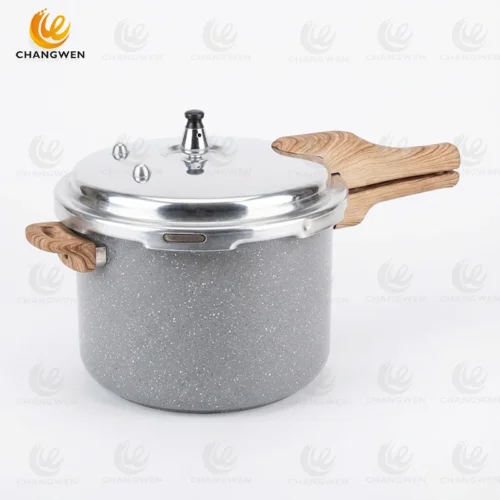
4 Quart Aluminum Pressure Cooker – Safe & Explodable-Proof Design
-
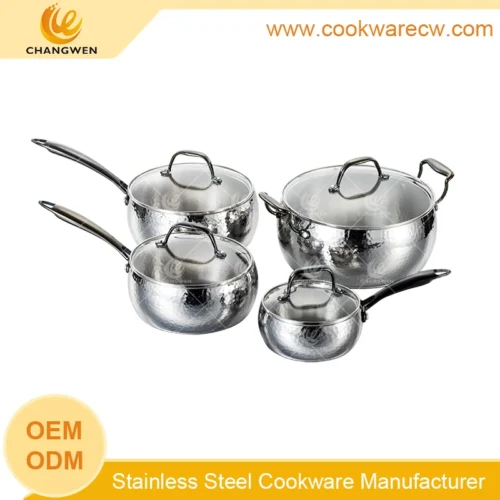
Apple-Shaped Hammered Stainless Steel Cookware Set CW-TP0802
-
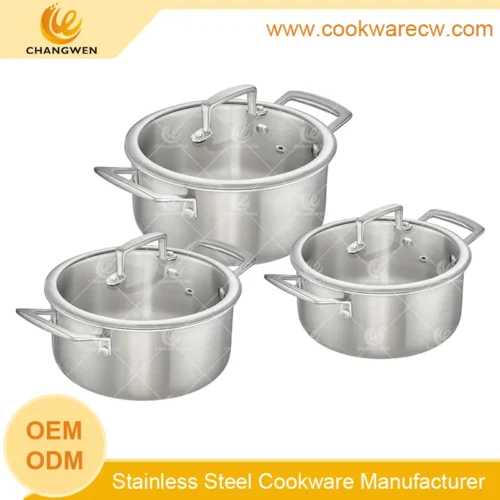
Versatile Stainless Steel Pot Set with Multiple Capacity Options CW-ETP018
-
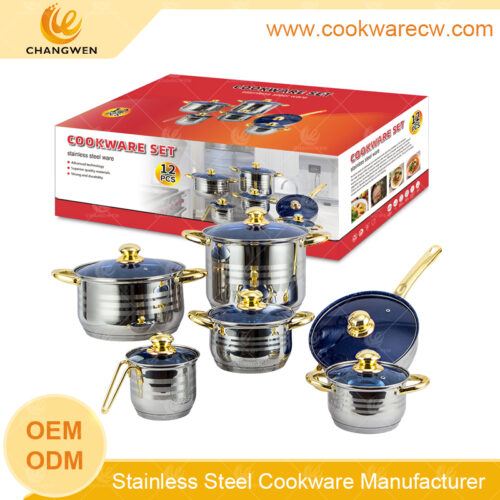
heavy S/S 12pcs cookware set pots wholesale nonstick fry pan blue glass lid golden handle cooking pan milk pot CW-M1222
-
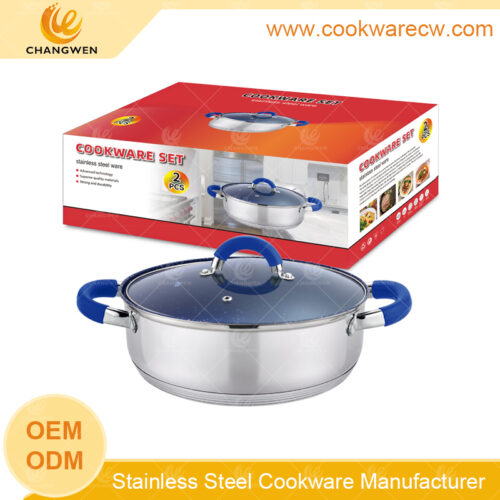
high stainless steel material 2pcs casserole cookware pot with 5-stepped induction bottom rice cooker low pot CW-M0204
-
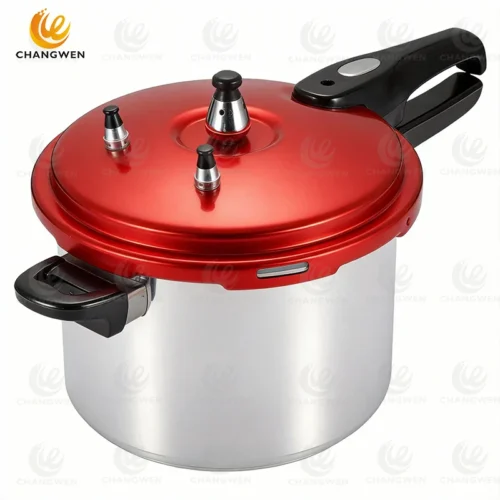
8 Qt Aluminum Pressure Cooker – Durable, Even-Heating, Easy-to-Use
-
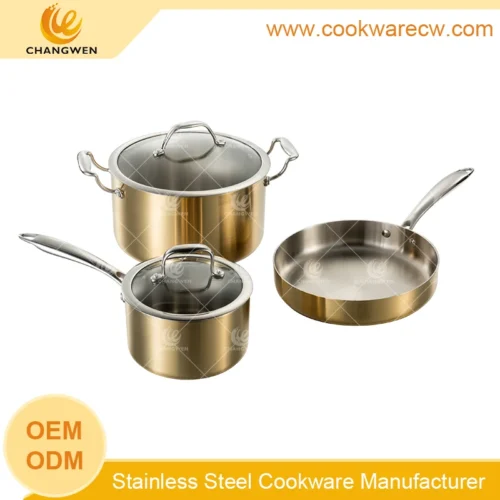
Copper-Colored Stainless Steel Cookware Set CW-ETP0502
-
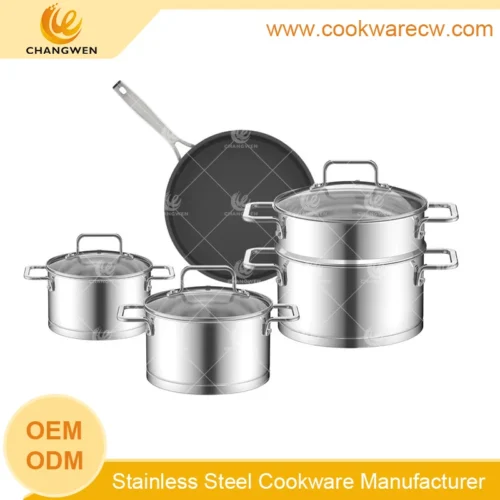
8-Piece Stainless Steel Cookware Set with Nonstick Pan & Steamer CW-ES0907