
Read time: 11 minutes
Introduction
Let us have an honest conversation about 5-ply stainless steel cookware.
The marketing around it is enthusiastic. “Five bonded layers of superior performance.” “Professional-grade construction used in Michelin kitchens worldwide.” “The last pan you will ever buy.” All of which might be technically accurate — and also might be applied to a product that is not meaningfully better than a well-made 3-ply pan for most home cooks.
Here is the thing: 5-ply stainless steel cookware genuinely can be better than 3-ply. It also genuinely can be a more expensive version of the same performance with two extra layers of aluminum and a marketing premium attached. The difference between these outcomes is not the number “5” on the box. It is the quality of those five layers, the total thickness of the conductive core, and whether the construction was engineered for performance or engineered for a selling point.
This guide gives you the complete picture. What 5-ply stainless steel cookware actually is. What the real performance differences are between 3-ply and 5-ply. The stainless steel cookware grades that matter. How to use stainless steel pots and pans correctly to get the most from whichever construction you choose. And what to look for when buying a 5-ply stainless steel cookware set — whether you are a home cook, a distributor, or an OEM buyer sourcing from a 5 ply stainless steel manufacturer.

What Is 5-Ply Stainless Steel Cookware?
Five-ply stainless steel cookware consists of five bonded metal layers that run continuously through the base and sidewalls of every pot and pan — not just the bottom. “Ply” simply means layer. A 5-ply pan is a five-layer pan.
The typical layer configuration for a 5-ply stainless steel pan looks like this, from outside to inside:
- 430 stainless steel (outer layer) — magnetic, enables induction compatibility, durable exterior
- Aluminum alloy (first conductive layer) — high thermal conductivity, distributes heat rapidly
- Stainless steel or aluminum (middle layer) — structural rigidity, varies by manufacturer
- Aluminum alloy (second conductive layer) — extends the conductive core
- 304 stainless steel (18/8) (inner layer) — food contact surface, non-reactive, food-safe, corrosion-resistant
Some 5-ply constructions use copper in one of the core layers — a configuration sometimes called “5-ply copper core stainless steel cookware.” Copper conducts heat approximately 1.7 times faster than aluminum, which improves thermal responsiveness. Copper-core 5-ply is the premium tier within the 5-ply category and is priced accordingly.
The defining characteristic that distinguishes genuine 5-ply clad stainless steel cookware from disc-base cookware is that all five layers extend through the sidewalls of the pan, not just the base. If the layers only appear in the base disc, the product is disc-base construction regardless of how many layers that disc contains. Real clad 5 ply stainless steel cookware has layers running from the base through the full sidewall to the rim.
3-Ply vs 5-Ply Stainless Steel Cookware: The Real Difference
This is the question at the center of every 5-ply buying decision. Does 5-ply actually perform better than 3-ply, or is it primarily a marketing distinction?
The honest answer: it depends on the specific products being compared, and the performance difference is smaller than 5-ply marketing implies.
Where 5-Ply Is Genuinely Better
Heat retention under thermal load. When you place cold food in a hot pan, the temperature drops. A 5-ply pan, which has more total metal mass than a thinner 3-ply pan, rebounds faster from this thermal shock. This matters most for searing — the even heat from the thicker 5-ply core creates a more consistent crust on a steak, particularly when searing multiple pieces simultaneously. Five-ply pans have extra mass that stabilizes temperature when you add cold food to a hot pan.
Warp resistance. The additional stainless steel layer in a 5-ply construction increases the pan’s structural rigidity. More stainless steel layers mean more resistance to thermal warping — the pan-bending phenomenon that happens when thin-walled cookware is subjected to repeated high-heat cycles. For pans used at commercial intensity or subjected to aggressive heat, 5-ply is more durable over time.
Hot spot reduction. Five-ply cookware generally spreads heat more evenly across the cooking surface. Multiple conductive layers mean the heat has more distribution pathways before it reaches the cooking surface. This reduces the pronounced hot spots that can develop in lighter-gauge constructions.
Where 3-Ply Is Equally Good (Or Better)
Everyday cooking performance. For sautéing vegetables, making pasta sauce, boiling water, simmering soups, or any technique where the subtle temperature stability advantage of 5-ply does not come into play, well-made 3-ply performs identically in practice.
Quick temperature changes. A lighter 3-ply pan responds faster to burner adjustments because it has less thermal mass to overcome. For cooking that requires rapid heat changes — reducing a sauce, adjusting temperature for delicate proteins — a lighter pan can actually be more responsive than a heavier 5-ply pan.
Weight and maneuverability. Five-ply cookware is heavier than equivalent 3-ply. The difference in individual pans is measured in ounces, but across a full cookware set, it adds up. For cooks who toss or flip food frequently — sautéing techniques, wok-style cooking — lighter 3-ply pans can be easier to maneuver.
Cost. Quality 3-ply stainless steel with adequate aluminum core thickness delivers excellent cooking performance at lower cost than 5-ply. The price premium for 5-ply is real; so is the performance advantage — but the advantage is incremental, not transformative.
The Most Important Insight: Thickness Matters More Than Layer Count
A well-built 3-ply pan with a quality aluminum or copper core can perform just as well — or better — than a 5-ply pan if it’s thicker or uses superior materials. More plies often add weight and cost but don’t guarantee better results.
This is the single most important thing to understand when comparing 3-ply vs 5-ply stainless steel cookware. The number of layers is secondary to the quality and thickness of those layers. A 5-ply pan with thin, low-grade aluminum layers performs worse than a well-specified 3-ply pan with a thick, high-quality aluminum core.
Many people assume that 5-ply cookware is always thicker than tri-ply, but this is not always the case. Some 5-ply configurations are actually thinner overall than their 3-ply counterparts. This happens when manufacturers use 5-ply construction as a marketing feature without increasing the total core thickness to match.
The practical specification check: Look at total wall thickness and core material quality, not just layer count. A tri-ply pan with 2.6mm total wall thickness will outperform a 5-ply pan with 2.2mm total wall thickness for most cooking applications.
Stainless Steel Cookware Grades: What You Actually Need to Specify
Not all stainless steel is the same. The grade determines corrosion resistance, food safety, and whether the cookware will hold up over years of use. Here is the quick guide to stainless steel cookware grades.
304 Stainless Steel (18/8 and 18/10)
The global food-contact standard for quality stainless steel cookware. Contains 18% chromium and 8–10% nickel. Non-reactive with all food types including acidic dishes. Forms a stable passive oxide layer that protects against corrosion. Food-safe and approved by FDA, LFGB, and all major food safety standards.
18/8 (8% nickel) and 18/10 (10% nickel) are both 304 grade. The 18/10 designation has slightly higher nickel content, producing marginally better corrosion resistance and a brighter surface finish. For cookware inner surfaces, either is appropriate — 18/10 is the premium specification and the one used in the best 5-ply stainless steel pan products.
430 Stainless Steel
Used for the outer layer of induction-compatible cookware. 430 is ferritic (magnetic) stainless — required for induction cooktops to detect the pan. Contains 17% chromium but no nickel, which is why it is magnetic (nickel makes steel non-magnetic). Less corrosion-resistant than 304 but performs well as an exterior layer that is not in direct food contact.
Any 5-ply stainless steel cookware set that claims induction compatibility should have a 430 outer layer — confirm this in the product specification.
201 Stainless Steel
The grade to avoid. Contains lower nickel (1–4% vs 8–10% in 304) and uses manganese as a substitute. Looks identical to 304 visually. Costs less. Has lower corrosion resistance and higher potential for leaching under acidic food conditions. The most common quality fraud in stainless steel cookware manufacturing is selling 201 as 304 — they are visually indistinguishable without testing.
For any 5-ply stainless steel cookware purchase — consumer or OEM — require documentation that the inner cooking surface is 304 stainless steel. Material test reports (mill certificates) confirming the chemical composition are the only reliable verification.
316L (Marine Grade)
Contains 2–3% molybdenum in addition to chromium and nickel, providing superior resistance to chloride corrosion. Found in premium 5-ply 304 stainless steel cookware sets where the inner layer is upgraded to 316L for health-conscious buyers. Genuinely better corrosion resistance than 304, relevant for high-salt cooking environments. Priced higher than 304. For most household cooking, 304 is sufficient — 316L is a genuine upgrade, not marketing.
Stainless Steel Cookware Disadvantages: What Nobody Tells You Before You Buy
Buying a 5-ply stainless steel cookware set is a commitment. You should know what you are committing to — including the parts that are less fun.
Food sticks. Stainless steel is not non-stick. Proteins, eggs, fish, and sticky carbohydrates will adhere to a stainless steel cooking surface if used incorrectly. This is not a defect — it is a material property. Managing it requires technique (see the “How to Use Stainless Steel Pots” section below). If you are not willing to learn and apply the technique, stainless steel will frustrate you regardless of whether it is 3-ply or 5-ply.
It shows every mark. Stainless steel develops heat tinting (rainbow discoloration from high-temperature cooking), water spots from hard water, and scratches from metal utensils. None of these affect performance, but all of them affect appearance. Restoring a stainless steel pan to showroom condition requires either a stainless steel cleaner or significant elbow grease. This is a feature some cooks embrace (the seasoned look of a well-used pan) and one others find frustrating.
It is heavy. A 5-ply stainless steel pan is heavier than a non-stick aluminum pan of the same diameter. A full 5 ply stainless steel cookware set weighs significantly more than an equivalent aluminum set. For cooks with wrist issues or who do a lot of pan-lifting, this is worth considering before committing.
The price. Quality 5-ply stainless steel cookware sets are not cheap. The construction, the material grade, the certification, the manufacturing precision — it all costs. The good news is that a quality uncoated stainless steel pan does not have a coating to degrade, so the product can last 20+ years. The total cost of ownership calculation is actually favorable compared to replacing non-stick pans every 3–5 years. But the upfront cost is real.
Learning curve. An uncoated stainless steel pan requires a different approach than non-stick. Temperature preheating, fat application, patience waiting for food to release — these are learnable techniques, but they require adjustment if you are coming from a non-stick background.
How to Use Stainless Steel Pots and Pans Correctly
The “sticking problem” of stainless steel cookware has a solution that every cookbook ignored for 50 years: the Leidenfrost effect. Once you understand it, stainless steel stops being frustrating and starts being the best cooking surface you have ever used.
The Hot Pan, Cold Oil Method
Step 1: Preheat the empty pan over medium heat for 2–3 minutes. The pan needs to reach a consistent temperature before oil is added. An unevenly heated pan creates uneven cooking spots regardless of construction quality.
Step 2: Test the heat with the water droplet test. Flick a few drops of water onto the surface. At the right temperature, they bead up and skitter across the surface (the Leidenfrost effect) rather than evaporating immediately or pooling. This is the signal.
Step 3: Add oil to the hot pan and let it heat for 30 seconds until it shimmers. The hot pan + fresh oil creates a near-non-stick effect as the oil fills the microscopic surface irregularities in the steel.
Step 4: Add food — and do not move it immediately. Proteins stick initially and release naturally when the sear is complete. Trying to move food that has not finished searing is the primary cause of tearing and sticking. Wait. The food will tell you when it is ready to move by releasing cleanly.
This technique works with 3-ply, 5-ply, or any uncoated stainless steel pan. The 5-ply advantage here is temperature stability — when you add cold protein to a hot 5-ply pan, the pan recovers its temperature faster, producing a more consistent sear.
Temperature Control Across Stovetops
Five-ply stainless steel responds similarly across all heat sources, but the starting approach differs:
- Gas: Bring up heat gradually. Gas flames with high BTU output can overshoot the target temperature quickly on a thick 5-ply pan.
- Electric coil: Slower response means longer preheat — allow an extra minute.
- Induction: Fastest and most precise. Confirm the 430 outer layer for compatibility. 5-ply performs particularly well on induction because the even heat distribution compounds with induction’s precision control.
- Ceramic/glass-top: Treat like electric — allow adequate preheat time, use flat-based pans to maximize surface contact.
5-Ply Copper Core Stainless Steel Cookware: Is Copper Worth It?
Copper-core 5-ply cookware replaces one aluminum layer with copper in the core. Copper has higher thermal conductivity than aluminum — approximately 385 W/m·K vs 237 W/m·K — which means faster heat distribution and more responsive temperature control.
What copper core actually delivers: Faster heating to temperature. More precise responsiveness when you adjust the burner. The copper layer acts like a thermal transmission system — it picks up burner changes instantly and broadcasts them across the cooking surface.
What copper core does not deliver: Magic. The cooking surface you actually cook on is still 304 stainless steel. The food does not know there is copper in the layers beneath. The performance advantage is in heat speed and responsiveness, which matters for technique-sensitive cooking and is less relevant for everyday tasks.
The price reality: Copper is significantly more expensive than aluminum. A copper-core 5-ply cookware set costs substantially more than an equivalent aluminum-core 5-ply set. The performance premium is real but incremental. For professional cooks and serious enthusiasts who will use that responsiveness, copper core is worth it. For casual home cooks, aluminum-core 5-ply delivers excellent performance without the copper premium.
5-Ply Stainless Steel Cookware vs 3-Ply: Who Should Buy Which
Buy a 5-ply stainless steel cookware set if:
- You sear proteins regularly and want the temperature stability advantage when adding cold food to a hot pan
- You cook at high heat frequently and want maximum warp resistance over years of use
- You want the best and are happy to pay for an incremental performance upgrade over quality 3-ply
- You are equipping a semi-professional or professional kitchen where every performance variable compounds across hundreds of cooking sessions
- You are building an OEM brand at the premium tier and need the specification story to justify premium retail pricing
Buy 3-ply if:
- Your budget is a real constraint — quality 3-ply 304-aluminum-430 performs excellently at lower cost
- Weight matters — you toss and maneuver pans frequently
- Your cooking style is everyday home cooking — sauces, soups, stews, pasta, sautéed vegetables — where the 5-ply performance advantage is marginal
- You want to put money into construction quality (total wall thickness, aluminum core grade) rather than layer count
The honest answer for most people:
A quality 3-ply stainless steel pan with 2.6mm+ total wall thickness and verified 304 inner layer will produce excellent cooking results in any home kitchen. The step up to 5-ply is real, but it is the difference between very good and excellent — not the difference between bad and good.
How to Evaluate a 5-Ply Stainless Steel Manufacturer
For OEM buyers, distributors, and brands sourcing 5-ply stainless steel cookware from China, the layer count on the spec sheet is only the starting point.
Verify the construction is full-clad: Request a cross-section cut of a sample pan. The cut should show five distinct bonded layers running from the base through the sidewalls. If layers only appear in the base disc, the product is disc-base, not full-clad 5-ply, regardless of what the marketing says.
Verify the inner layer grade: Require mill certificates (material test reports) confirming 304 or 18/10 stainless steel for the inner food-contact surface. XRF (X-ray Fluorescence) testing on samples confirms this independently if you do not want to rely solely on documentation.
Check total wall thickness: Measure with a micrometer at the sidewall — not just the base. For quality 5-ply, total wall thickness should be 2.6mm minimum, with a meaningful portion of that being the aluminum core layers. Thin 5-ply (total 2.0mm) provides no real performance advantage over thin 3-ply.
Core layer verification: Ask specifically for the thickness of each core layer. A 5-ply pan with two thin aluminum layers totaling 1.0mm core thickness is not better than a 3-ply pan with a single 1.5mm aluminum core.
Certifications: LFGB (EU food contact certification — includes heavy metal migration testing and sensory evaluation), FDA compliance for US market, ISO 9001 from the manufacturer. These should be original documents from accredited testing laboratories, not self-declarations.
FAQ
What is 5-ply stainless steel cookware?
Five-ply stainless steel cookware is made from five bonded metal layers that run continuously through the base and sidewalls of the pan. A typical configuration is: 430 stainless (outer, induction-compatible), aluminum (first conductive layer), stainless steel or aluminum (middle layer), aluminum (second conductive layer), 304 stainless steel (inner food-contact layer). The continuous multi-layer construction distributes heat evenly from base to sidewalls, reducing hot spots and improving cooking consistency.
What is the difference between 3-ply and 5-ply stainless steel cookware?
Three-ply has three bonded layers (typically 304 stainless / aluminum / 430 stainless). Five-ply has five bonded layers with additional conductive material in the core. The performance difference centers on heat retention and warp resistance — 5-ply’s greater mass maintains temperature better when cold food is added, and the additional stainless steel layer resists warping better under sustained high heat. However, total core thickness and material quality matter more than layer count alone. A thick 3-ply pan can outperform a thin 5-ply pan.
Is 5-ply stainless steel cookware worth the extra cost over 3-ply?
For cooks who sear proteins regularly, cook at high heat frequently, or want maximum durability, yes — the performance advantages of 5-ply are real and the construction is more durable. For everyday home cooking (soups, sauces, pasta, sautéed vegetables), the incremental performance advantage of 5-ply over quality 3-ply is small. The extra cost is more justifiable when you will actually use the higher performance ceiling.
What stainless steel grade should 5-ply cookware use?
The inner food-contact surface should be 304 stainless steel (18/8 or 18/10). The outer induction-compatible layer should be 430 stainless steel. The middle layers are typically aluminum or stainless steel. Some premium 5-ply cookware uses 316L (marine grade) for the inner layer, providing superior chloride corrosion resistance. Never accept 201-grade steel as the inner surface — require material test reports confirming grade.
How do I use a 5-ply stainless steel pan without food sticking?
Preheat the empty pan over medium heat for 2–3 minutes until water droplets bead and skitter (the Leidenfrost effect). Add oil and heat until it shimmers. Add food, then wait — do not attempt to move it until it releases naturally. The sticking that new stainless steel users experience is almost always from insufficient preheating or moving food too early. With proper technique, stainless steel performs as a near-non-stick surface.
Is 5-ply stainless steel cookware dishwasher safe?
The materials are dishwasher-safe, but hand washing is recommended to preserve the surface finish. Dishwasher detergents contain harsh alkaline compounds that can cause discoloration and dull polished stainless steel surfaces over time. Occasional dishwasher use will not damage the pan structurally, but regular dishwasher washing will gradually affect the exterior appearance.
Conclusion
Five-ply stainless steel cookware is genuinely excellent cookware. The multi-layer construction distributes heat evenly, the greater mass stabilizes temperature during high-heat cooking, and the additional stainless steel layer improves long-term warp resistance. All of this is real.
It is also not magic. The performance advantage over quality 3-ply is incremental — most pronounced when searing proteins and cooking techniques that stress the pan’s temperature stability. For everyday cooking, the difference is smaller than 5-ply marketing implies.
The specifications that matter: total wall thickness (2.6mm+ for quality 5-ply), verified 304 stainless inner layer with material documentation, full-clad construction confirmed by cross-section (not disc-base), and 430 outer layer for induction compatibility. A 5-ply pan that meets these specifications is excellent cookware. A 5-ply pan that uses thin layers of questionable grade with a disc-base construction is just a marketing exercise.
Buy the construction, not the number on the box.
Source 5-Ply Stainless Steel Cookware from Changwen
Changwen is a stainless steel cookware manufacturer based in Jiangmen, Guangdong, China, with over 22 years of OEM and ODM manufacturing experience. We produce tri-ply and 5-ply stainless steel cookware sets for brands and distributors across South America, Southeast Asia, the Middle East, Europe, and Australia.
5-ply program specifications:
- Full-clad construction — five layers running through base and sidewalls
- Inner layer: 304 stainless steel (18/8), confirmed by mill certificates
- Core: aluminum alloy, thickness specified per program
- Outer layer: 430 stainless steel, induction-compatible
- Total wall thickness: 2.6mm+ standard; custom specification available
- Cross-section sample available for construction verification
-
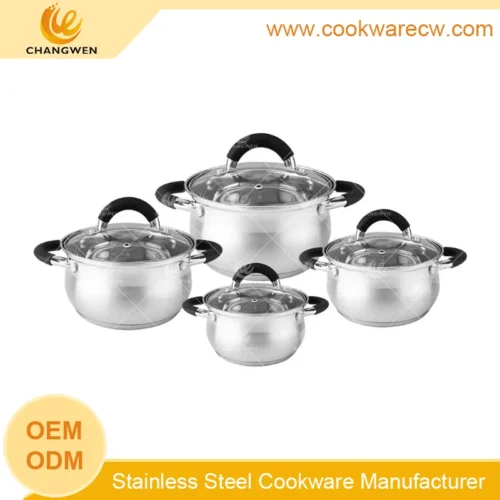
8-Piece Stainless Steel Pot Set with Black Silicone Handles CW-ES0810G
-
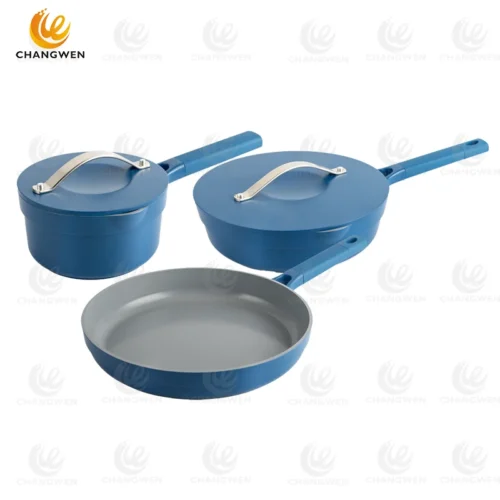
5pcs Ceramic Nonstick Aluminum Cookware Set OEM Manufacturer China | Aluminum Cookware Factory
-
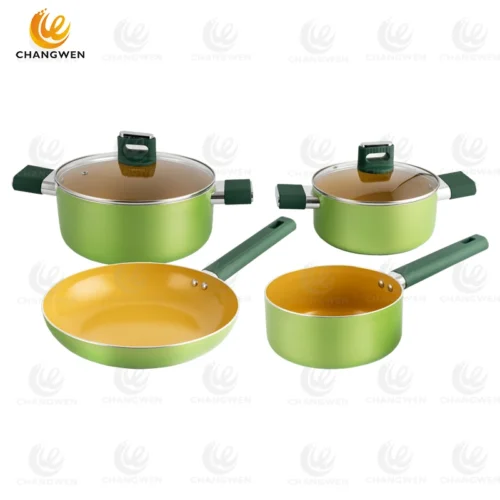
Custom Aluminum Cookware 6pcs Green Granite Nonstick l Manufacturer China
-
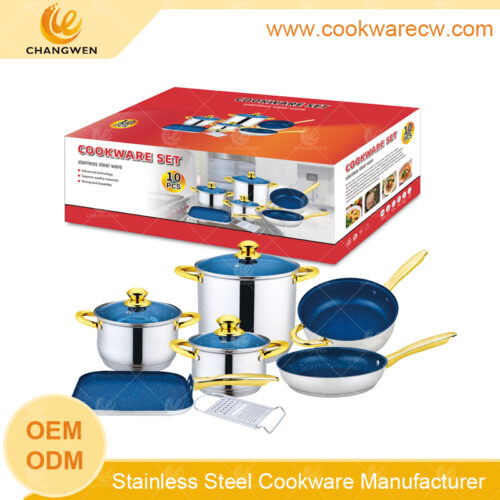
Wholesaler stainless steel cookware set conic fry pan square aluminum coated frypan with a kitchenware grater CW-M1003
-
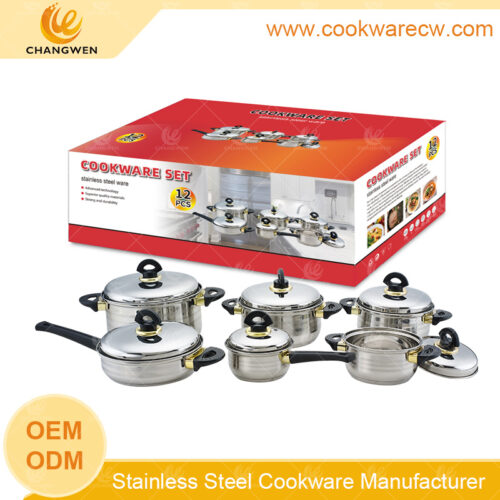
China cookware set 12pcs pots wholesale stainless steel lids black handle and knob frypan casserole saucepan CW-M1229B
-
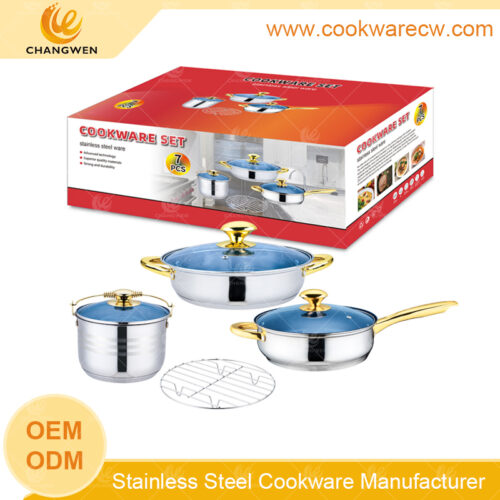
Stainless steel kitchen 7pcs cookware rice cooker with capsule bottom frypan with helper gold plated hollow handle and blue glass wire rack CW-M0701
-
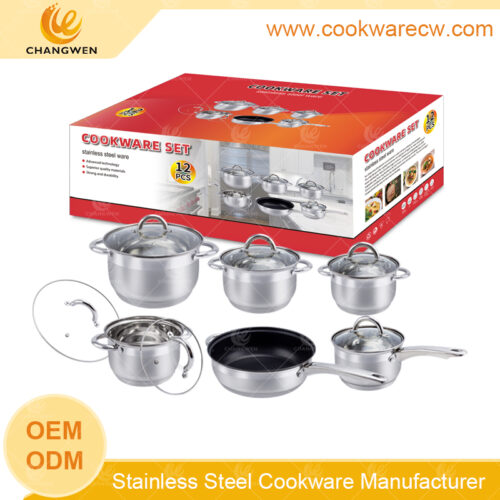
Stainless Steel Cookware Sets 10-Piece CW-M1228
-
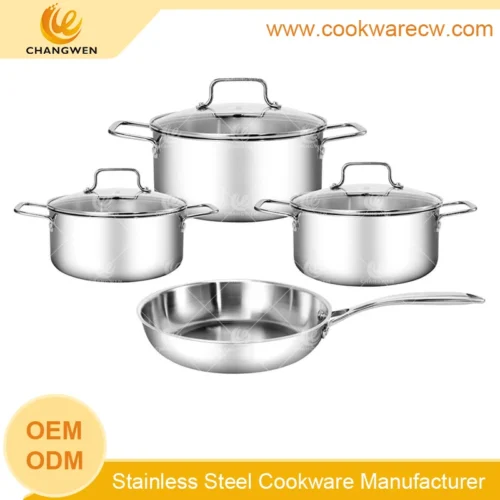
Premium Stainless Steel Cookware Set for Modern Kitchens CW-ETP0703