
Read time: 12 minutes
Introduction: The Wok Is No Longer a Regional Cookware Product
Forty years ago, a wok in a kitchen outside Asia would have been a specialty purchase — the equipment of a dedicated cook who sought out specific ingredients and techniques. Today, wok cooking is mainstream. Recipe platforms feature stir-fry as a weeknight staple. Restaurant-style techniques appear in home cooking media. The wok’s ability to cook faster, at higher heat, with less oil than a conventional pan resonates with consumers across continents who have never cooked traditional Chinese food in their lives.
The wok is not a Chinese cooking tool that happened to travel. It is a high-heat, high-versatility cooking vessel that handles stir-frying, sautéing, deep-frying, steaming, braising, boiling, and one-pan cooking. Its curved sides and concentrated cooking zone make it the most technique-flexible single vessel in any kitchen. That versatility is exactly what global consumers are actively seeking in 2026.
For cookware retailers, distributors, and private-label brands, the commercial question is specific: stainless steel woks represent around 14% of the global stainless steel cookware market in 2026, driven by the global expansion of Asian and fusion cuisines, with approximately 47% of urban households using a wok at least once per week. Is this a category to build, expand, or ignore?
The data argues strongly for building. This guide gives you the complete commercial picture.
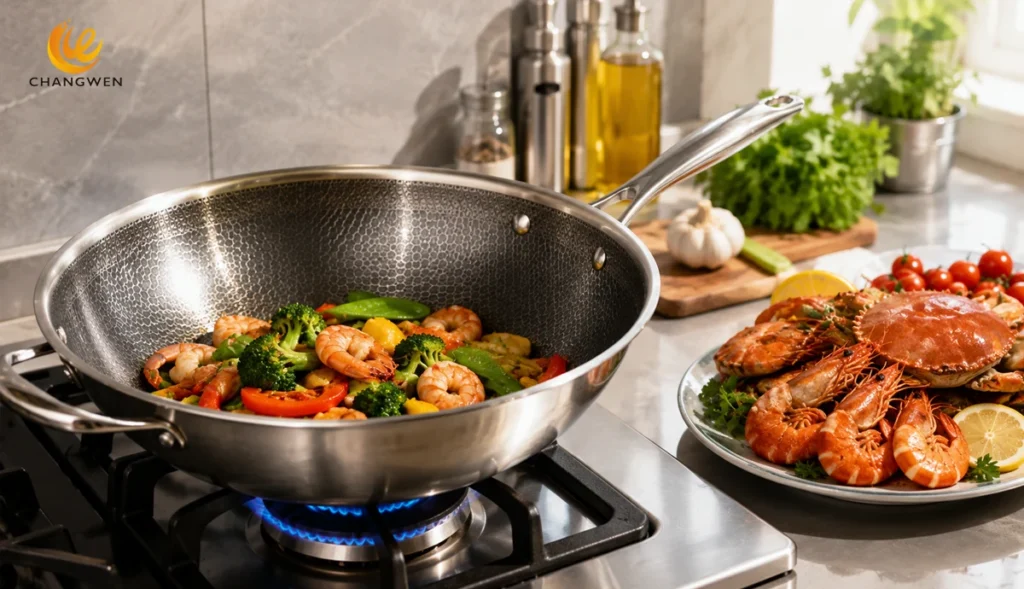
What Is a Stainless Steel Wok?
How the Traditional Wok Shape Supports Multiple Cooking Methods
The wok’s physical design is the source of its versatility. Unlike a frying pan (designed for flat, surface-contact cooking) or a pot (designed for volume liquid cooking), the wok’s geometry enables multiple techniques from the same vessel:
Deep curved sides create a range of heat zones — the base is the hottest point (direct heat contact), the lower sides are medium-hot, and the upper sides are cooler. A skilled cook moves food between these zones to control doneness. This gradient is impossible to replicate in a flat-bottomed pan with straight sides.
Wide cooking surface relative to depth allows large quantities of ingredients to be spread across the base for stir-frying while containing the cooking action within the vessel’s walls.
Concentrated cooking zone at the base provides the intense localized heat required for proper stir-fry technique — what is described in Chinese cooking as wok hei, the characteristic breath-of-the-wok smokiness that develops when food is cooked rapidly at high heat.
Easy tossing and stirring — the sloped sides allow food to be tossed and turned continuously without spilling, which is the motion-intensive cooking style that stir-frying requires.
Large usable capacity relative to the vessel’s diameter — a 12-inch wok holds significantly more than a 12-inch frying pan because of the depth provided by the curved walls.
These physical properties explain why the wok handles techniques that would require multiple pans otherwise: stir-fry, deep-fry, steam (with a rack and lid), braise, and boil all happen effectively in a single vessel.
Stainless Steel Wok vs Traditional Wok Materials: A Complete Comparison
“Wok” is a vessel shape, not a material. Woks are manufactured in carbon steel, cast iron, aluminum (coated), and stainless steel — each with different performance and maintenance profiles. Understanding how stainless steel compares to other wok materials is the foundation for building a retail product strategy.
| Feature | Stainless Steel | Carbon Steel | Cast Iron | Non-Stick (Aluminum) |
|---|---|---|---|---|
| Durability | Excellent | Excellent | Excellent | Moderate (coating) |
| Rust resistance | Excellent | Requires care | Requires care | Good |
| Seasoning required | No | Yes | Yes | No |
| Maintenance | Easy — dishwasher safe | Moderate | Moderate | Easy but fragile |
| Induction compatible | High* | High | High | Depends on base |
| Premium visual appearance | High | Traditional/craft | Traditional/heavy | Varies |
| No-coating option | Yes | Yes | Yes | No |
| Private label potential | High | High | Moderate | High |
| Consumer PFAS concern | None | None | None | Present for PTFE |
*Requires 430 magnetic base layer or magnetic disc in construction.
The key retail insight: Stainless steel woks are preferred over carbon steel in modern kitchens due to rust resistance and easier maintenance. This preference is not about cooking performance — experienced wok cooks know carbon steel develops a seasoning layer that enhances cooking over time. It is about the reality of how modern households use and care for cookware: most consumers do not season and maintain carbon steel consistently, which leads to rust and product disappointment. Stainless steel eliminates this friction.
Why Are Stainless Steel Woks Becoming More Popular Globally?
Global Consumers Are Becoming More Familiar With Wok Cooking
The expansion of wok cooking outside its traditional markets is driven by several compounding forces:
Culinary media has made wok technique accessible. Video-based recipe content has demonstrated high-heat stir-frying to audiences who had never seen a wok used. The technique — fast, visually dramatic, producing restaurant-quality results quickly — appeals strongly to home cooks looking to improve their skills.
Food culture has become genuinely global. International cuisines are no longer restaurant-only experiences in most urban markets. Home cooks in Germany make Thai stir-fry. Home cooks in Brazil cook Korean-inspired dishes. The wok is the correct equipment for a wide range of these cuisines.
One-pan cooking is a dominant trend. The wok’s versatility as a single vessel for stir-frying, sauce-making, steaming, and deep-frying aligns precisely with the “fewer pieces, more capability” philosophy that urban consumers with compact kitchens increasingly express.
Restaurant cooking at home. Across North America, Europe, and Australia, the “restaurant-quality results at home” aspiration is a consistent purchase motivator for cookware. The wok is strongly associated with restaurant-style cooking — high heat, quick preparation, bold flavors.
Consumers Want Cookware That Performs More Than One Function
Multi-functional cookware sets usage has increased by 41%, reflecting consumer interest in versatile cooking solutions. The wok is one of the best examples of this demand being met by a single product. A stainless steel wok with a lid can handle:
- Stir-frying (high heat, minimal liquid)
- Sautéing (medium heat, fat and aromatics)
- Deep-frying (oil volume up to the lower sides)
- Steaming (rack and lid, water in base)
- Braising (liquid and lid, lower heat)
- Boiling (full volume of water for noodles or blanching)
- Tossing noodles or pasta
This breadth of technique is genuinely rare in a single vessel. Most pans do one or two things well. A well-designed wok does seven.
Why Multi-Purpose Cookware Matters to Retailers
For cookware retailers, a product that replaces multiple single-function vessels has a specific commercial advantage: it sells to a broader buyer. A dedicated stir-fry pan only appeals to consumers who stir-fry. A wok that also deep-fries, steams, and braises appeals to any cook who values efficiency and versatility. More applications mean a broader target audience, which means stronger category positioning and larger potential customer base.
Why Stainless Steel Is Well Positioned for the Modern Wok Market
Durability Makes Stainless Steel Attractive for Long-Term Use
72% of consumers consider durability and corrosion resistance essential, driving stainless steel cookware adoption. For woks specifically, this durability advantage is amplified by the cooking conditions woks are subjected to: high heat, rapid temperature changes, and oil splatter.
Carbon steel woks, when properly seasoned and maintained, are also durable. But improper care — leaving the wok wet, cleaning with soap that strips seasoning, not re-oiling after use — leads to rust and surface degradation. Stainless steel woks carry none of these maintenance burdens. The surface does not rust. It does not require seasoning. It tolerates soap and even dishwasher cleaning. For busy households where proper cast iron or carbon steel maintenance is not practical, stainless steel woks deliver durability without the maintenance barrier.
Stainless Steel Fits the Growing Preference for Long-Lasting Cookware
Stainless steel held the largest material market share of 33.9% in 2025, with growing consumer awareness of potential risks from chemical coatings shifting purchasing behavior toward non-toxic, non-reactive cooking surfaces.
This shift from replacement-cycle cookware (non-stick pans replaced every few years) to durable long-term cookware (stainless steel used for decades) is visible in every major market. The consumer making this shift is looking for products that justify a higher initial investment with a longer service life — and will not need to think about coating degradation, PFAS concerns, or replacement cycles.
A stainless steel wok positioned on these terms — no coating, no PFAS, no rust, no seasoning, 15-year service life — addresses this consumer directly and compellingly.
Stainless Steel Creates a Premium Product Position
The three-tier retail strategy for stainless steel woks maps clearly onto different buyer segments:
Entry-Level Stainless Steel Wok ($30–$60): Single-layer 304 stainless steel with encapsulated aluminum disc base. Basic brushed finish. Suitable for induction with 430 magnetic disc. Appeals to the value buyer who wants the maintenance advantages of stainless without premium price commitment.
Mid-Market Stainless Steel Wok ($60–$120): Heavier gauge construction, disc-base or partial-clad. Better handle ergonomics (riveted stainless or Bakelite). Tempered glass lid. Strong fit with mid-range stainless steel cookware set programs. The highest-volume retail tier.
Premium Multi-Ply Stainless Steel Wok ($120–$250+): Full tri-ply or 5-ply construction (304-aluminum-430 layers through base and lower sidewalls). Restaurant chains in Singapore and Hong Kong are specifying five-ply stainless steel-copper-aluminum laminates for induction-gas dual compatibility. Premium handle and finish. Positions as professional-grade cookware for serious home cooks.
How Induction Cooking Is Creating New Opportunities for Stainless Steel Woks
Why Traditional Round-Bottom Woks Can Be Challenging on Modern Cooktops
Traditional wok design — a round bottom that sits over a ring burner at high gas heat — is not compatible with most modern residential cooktops. Flat electric, ceramic glass-top, and induction cooktops require flat-bottomed cookware that sits flush against the cooking surface for efficient heat transfer.
This design mismatch has historically limited wok adoption in kitchens with non-gas cooktops. The flat-bottom stainless steel wok solves this directly — maintaining the wok’s high sides and curved interior geometry while providing a flat base for full surface contact with modern cooktops.
Why Flat-Bottom Stainless Steel Woks Fit Modern Kitchens
A flat-bottom stainless steel wok with a 430 magnetic outer base layer is compatible with all modern cooktops:
- Gas: The flat bottom is stable on gas grates while the curved sides still function as intended
- Electric coil: Full base contact for efficient heat transfer
- Ceramic glass-top: Flat bottom required — round-bottom wok is incompatible
- Induction: Requires magnetic base material — 430 stainless or magnetic disc
Important clarification for product specification: Not every stainless steel wok is automatically induction-compatible. Standard 304 stainless steel is not magnetic. Induction compatibility requires a 430 stainless steel outer base layer (in tri-ply or disc-base construction) or a separately bonded magnetic stainless steel disc. Always specify and verify induction compatibility explicitly.
The induction cookware market was valued at USD 1,648 million in 2025 and is projected to reach USD 2,249 million by 2032, reflecting adoption growing by approximately 45%. Induction-compatible stainless steel woks have seen adoption growth of over 33% compared to traditional gas-only models. Induction compatibility is not a premium feature for the wok category — it is an increasingly essential specification for any market with significant induction penetration.
Stainless Steel Wok vs Carbon Steel Wok: What Should Retailers Stock?
Where Carbon Steel Woks Remain Strong
Carbon steel is the professional chef’s material of choice for wok cooking. Thin walls (typically 1.5–2mm), fast heat response, and the ability to develop a polymerized seasoning layer that improves with every use make carbon steel woks the most technically capable tool for high-heat stir-fry technique.
Carbon steel woks remain the correct specification for:
- Professional kitchen applications (restaurants, commercial kitchens)
- Serious home cooks who maintain their equipment properly
- Traditional wok cooking on high-BTU gas burners
- Buyers who value the craft aspect of a seasoned cooking surface
Where Stainless Steel Woks Offer Retail Advantages
For the broader consumer market, stainless steel offers advantages that carbon steel cannot:
No seasoning requirement. The consumer who buys a carbon steel wok, uses it twice without properly seasoning it, leaves it wet, and finds rust six weeks later will blame the product — not their maintenance practice. Stainless steel eliminates this failure mode entirely.
Rust resistance. A stainless steel wok stored in a humid climate, used near saltwater, or washed and not immediately dried will not rust. Carbon steel will.
Premium visual consistency. A carbon steel wok’s appearance changes over time as the seasoning develops. A stainless steel wok maintains consistent, professional-looking finish indefinitely. For retail display and e-commerce photography, this visual consistency has commercial value.
Integration with stainless steel cookware sets. A stainless steel wok fits naturally into a coordinated stainless steel cookware collection — matching finish, matching handle design, matching material. A carbon steel wok does not.
The Retail Strategy: Different Woks for Different Buyers
A sophisticated retailer does not have to choose between stainless steel and carbon steel — they stock both for different buyer segments:
- Carbon steel wok: Position for enthusiasts, traditional wok cooks, and professional kitchens. Communicate the maintenance requirement honestly.
- Stainless steel wok: Position for the mainstream household buyer who values versatility and low-maintenance performance. Emphasize no seasoning, no rust, induction compatible.
The two products serve different buyers and drive different purchase motivations. Carrying both expands the category’s total addressable market.
Which Stainless Steel Wok Designs Have the Strongest Market Potential?
Flat-Bottom Stainless Steel Woks
The most commercially viable design for the global retail market. Compatible with all modern cooktop types. Stable on any surface. Appropriate for gas, electric, ceramic, and induction cooking. For any retail program targeting mixed-cooktop markets (which is essentially all markets outside dedicated gas-only culinary contexts), flat-bottom is the correct specification.
Multi-Ply (Tri-Ply) Stainless Steel Woks
Tri-ply construction — 304 stainless steel inner, aluminum core, 430 stainless outer — distributes heat from the base more evenly than single-layer stainless. For a wok, which is used at high heat with food concentrated at the base, even heat distribution at the cooking zone is a meaningful performance variable.
The aluminum core in tri-ply construction does not need to run through the full sidewalls of a wok (the curved sides function as a heat gradient by design), but the tri-ply base provides significantly better heat distribution than single-layer stainless, which would develop pronounced hot spots at the base center.
Encapsulated-Bottom Stainless Steel Woks
A single-layer 304 stainless steel wok body with a multi-layer disc bonded to the base (similar to disc-base saucepan construction). More cost-effective than full tri-ply. Provides improved heat distribution at the base versus single-layer. Induction-compatible with a 430 magnetic disc layer.
This construction is the most appropriate for entry-to-mid market positioning — it captures the maintenance and appearance advantages of stainless steel while maintaining accessible pricing.
Stainless Steel Woks With Lids
A tempered glass lid or stainless steel lid transforms the wok from a stir-fry vessel to a full multi-technique cooking system. Braising requires a lid. Steaming requires a lid. The lid addition increases retail price, increases perceived value, and broadens the product’s marketing claims.
For retail programs, offering both lid-included and lid-separate configurations gives buyers flexibility without maintaining excess SKUs.
What Sizes Should Cookware Buyers Consider?
A practical size guide for stainless steel wok retail programs:
| Wok Size | Typical Positioning | Primary Target Market |
|---|---|---|
| 10 inch (25cm) | Compact / individual | Single-person households, compact kitchens |
| 12 inch (30cm) | Everyday versatile | Mainstream households — highest volume seller |
| 13–14 inch (32–36cm) | Family-size | Families, cooking enthusiasts, regular entertainers |
| 16 inch+ (40cm+) | Heavy-duty | Commercial kitchens, foodservice, institutional |
The 12-inch (30cm) wok is the equivalent of the 10-inch skillet in the frying pan category: the size that handles the widest range of everyday cooking tasks for the widest household demographic. Any retail program should prioritize this size.
Commercial foodservice establishments account for nearly 38% of wok demand, particularly in quick-service restaurants and catering operations, so a dedicated commercial tier at 16-inch+ serves a meaningful B2B segment alongside the consumer product line.
What Features Should Retailers Look for When Sourcing Stainless Steel Woks?
Stainless Steel Grade
304 stainless steel (18/8 or 18/10): The correct specification for the inner food-contact surface of any quality stainless steel wok. Non-reactive with acidic ingredients, corrosion-resistant, food-safe, and verified by LFGB (EU) or FDA (US) food contact certification.
430 stainless steel (magnetic): Required for the outer base layer of any induction-compatible wok. 430 is ferritic stainless — its magnetic properties allow induction cooktops to detect the vessel and transfer energy.
The 201 fraud risk: 201 stainless steel looks identical to 304, costs less, and is commonly substituted without disclosure. Require mill certificates (Material Test Reports) from the steel supplier confirming 304 grade for every production batch.
Body Thickness and Construction
For single-layer stainless steel woks: minimum 0.8mm sidewall thickness for consumer use, 1.0mm+ for commercial. For disc-base woks: disc thickness should be 3mm+. For tri-ply: total wall thickness 2.0–2.4mm with meaningful aluminum core layer.
Thicker construction increases weight, durability, and cost. The correct specification depends on market positioning — thinner for lightweight camping/travel wok programs, thicker for home and commercial quality programs.
Handle Design
Long handle: Essential for stir-frying technique — the cook holds the long handle to toss and maneuver the wok. Helper handle (small loop handle on the opposite side) provides additional support when the wok is heavy with contents.
Material: Stainless steel (oven-safe, premium appearance); Bakelite or silicone-coated (heat-resistant, comfortable grip for extended sautéing).
Attachment: Riveted handles are the correct specification for commercial durability. The lateral and torsional stress of active stir-frying technique places significant load on handle attachment points.
Lid Options
A tempered glass lid allows the cook to monitor contents without lifting the lid. A stainless steel lid provides better heat retention and more durable construction. Both have appropriate retail applications — glass for consumer cooking visibility, stainless for professional appearance.
Surface Finish
Brushed satin finish is the most practical for stainless steel woks — hides minor use marks, fingerprint-resistant, consistent appearance after repeated use. Mirror polish is appropriate for premium display positioning but shows marks from daily cooking use. PVD color coating (matte black, copper-look) creates distinctive retail visual differentiation for lifestyle brands.
How Retailers Can Build a Stainless Steel Wok Product Line
Good-Better-Best Product Strategy
A three-tier wok product line allows a retailer to serve entry, mid-range, and premium buyer segments from a single coherent category:
Good (Entry): Single-layer 304 stainless steel, encapsulated aluminum disc base, induction-compatible 430 disc, Bakelite handle, brushed finish. 12-inch primary size. Competitive pricing.
Better (Mid-Range): Heavier-gauge disc-base construction, glass lid included, riveted stainless or silicone-coated handle, brushed exterior. 12-inch + 14-inch size options. Mid-range pricing.
Best (Premium): Tri-ply or 5-ply construction, stainless steel lid, cast stainless oven-safe handle, mirror or PVD finish. 12-inch and 14-inch. Premium pricing, positioned for serious home cooks and cooking enthusiasts.
Add Woks to Existing Stainless Steel Cookware Collections
A stainless steel wok is a natural extension of an existing stainless steel cookware program. The wok completes a product ecosystem:
Frying Pan → Saucepan → Stockpot → Sauté Pan → Stainless Steel Wok
For a retailer with an established stainless steel cookware collection, adding a coordinated wok — same handle design, same finish, same material specification — increases average basket value and gives existing cookware customers a reason to return.
Private Label Stainless Steel Woks: Opportunities for Cookware Brands
Logo and Branding Customization
OEM stainless steel wok programs support full brand identity application: laser logo engraving on the wok body or handle (permanent, dishwasher-safe), embossed brand marks, and custom handle designs from available tooling options.
Packaging Customization
Custom retail packaging — box design, brand story insert cards, care instructions, certification claims — creates the premium unboxing experience that supports premium retail pricing and DTC brand building. E-commerce optimized packaging (designed for FBA standard-size limits and protective transit packaging) reduces damage rates and return costs.
Product Specification Customization
OEM wok programs can customize: diameter and depth dimensions, handle material and color, lid inclusion and style, surface finish (brushed, mirror, PVD), base construction (single-layer, disc-base, tri-ply), and set composition (individual or multi-piece wok programs with steamer rack, lid, and spatula).
How to Choose a Stainless Steel Wok Manufacturer
Evaluate Stainless Steel Material Specifications
Before selecting a wok manufacturer, verify:
- Steel grade documentation: mill certificate confirming 304 inner surface grade per production batch
- Base construction: disc-base or tri-ply (request cross-section cut of a sample wok)
- Food contact certification: LFGB (EU) or FDA (US) — original test reports from accredited laboratories
- Induction compatibility confirmation: magnet test on production samples
Check Manufacturing and Quality Control Capabilities
Wok production involves forming (deep-drawing the curved body from flat sheet), polishing (particularly important for the curved surfaces of a wok body), handle attachment (welding or riveting), and base bonding (for disc-base and encapsulated constructions). Quality control at forming (dimensional check), surface finishing (visual inspection for polishing consistency), and outgoing (AQL sampling) stages is the minimum standard for an OEM program.
Evaluate OEM and Private Label Capabilities
Key questions for any stainless steel wok manufacturer:
- What is the MOQ for catalog woks with OEM branding?
- Can different sizes be combined in a single minimum order?
- Is custom packaging design and production available?
- What are the available logo application methods?
- Which food contact certifications are currently held (LFGB, FDA, ISO 9001)?
- What is the standard production lead time?
Which Global Markets Offer Opportunities for Stainless Steel Woks?
Asia-Pacific: Established Wok Cooking Demand
Asia Pacific leads the global stainless wok market with 46% market share. Within Asia-Pacific, the consumer landscape is diverse — established wok cooking culture in China, Hong Kong, and Singapore; growing premium cookware markets in South Korea and Japan; rapid urbanization and rising disposable incomes driving cookware growth in India, Vietnam, and Indonesia.
Stainless steel woks in Asia-Pacific compete on quality positioning — the carbon steel wok is deeply established for traditional cooking, so stainless steel’s competitive claim must be maintenance convenience, modern kitchen compatibility, and premium aesthetics.
North America: Opportunity Through International Cooking
North America accounts for 28% of the global stainless wok market. The growth driver is multicultural cuisine adoption — home cooks in the US and Canada are increasingly comfortable with stir-fry technique and Asian-inspired meals. The induction wok opportunity is significant in urban North American markets, where induction cooktops are growing rapidly in upscale residential construction.
Europe: Induction Compatibility Creates an Important Buying Factor
Europe’s high induction cooktop penetration — particularly in Germany, France, and Scandinavia — makes flat-bottom induction-compatible wok specification effectively mandatory for mainstream retail. Premium retail channels in Germany and France are responding to REACH restrictions on PFAS by emphasizing bare metal cookware alternatives — exactly the positioning that stainless steel woks occupy.
Middle East, Latin America, and Emerging Markets
Latin America and the Middle East offer growth opportunities through expanding cookware retail, rising middle-class purchasing power, and increasing exposure to international cooking techniques. Stainless steel’s appearance advantages — professional, modern, premium-looking — resonate in markets where kitchen aesthetics are increasingly important to purchase decisions.
Stainless Steel Wok Trends to Watch
Flat-bottom designs for residential compatibility: The conversion from round-bottom to flat-bottom woks for modern cooktop compatibility is ongoing, and flat-bottom will increasingly dominate the retail segment.
Induction-compatible construction: Adoption of induction-ready cookware has increased by approximately 45%. Induction-compatible woks are moving from premium add-on to standard expectation in developed markets.
Multi-ply stainless steel: The performance and premium positioning advantages of tri-ply and 5-ply are driving premiumization within the stainless wok category, as they have in the broader stainless cookware market.
Multi-functional wok designs: Wok-plus-lid configurations marketed explicitly for steaming, braising, and simmering — not just stir-frying — expand the product’s perceived value and appeal to non-stir-fry cooks.
Private label and customized cookware: Innovation is driven by multifunctional and ergonomic designs, improved heat-distribution technologies, and induction-compatible bases. Private-label programs that incorporate these features differentiate from generic competition in a category where visual differentiation drives purchase.
Is a Stainless Steel Wok a Good Category for Cookware Retailers?
The commercial argument is built on five compounding factors:
Consumer versatility — a product that handles 7+ cooking techniques serves a broader buyer than single-technique cookware.
Stainless steel durability — no coating to degrade, no seasoning requirement, rust-proof, dishwasher-safe. Supports premium pricing and long service life marketing.
Modern cooktop compatibility — flat-bottom, induction-compatible construction removes the barrier that prevented traditional round-bottom woks from entering the mainstream residential market.
Premium positioning opportunity — stainless steel woks represent 14% of the stainless steel cookware market, growing at above-category rates driven by urbanization and dietary diversification. The category is growing and the premium tier is growing faster.
Private label potential — strong OEM customization options allow brands to build differentiated wok products without proprietary tooling investment.
Stainless steel will not replace carbon steel for serious wok cooking enthusiasts. But stainless steel expands the wok category to the much larger group of consumers who want wok versatility without wok maintenance — and that is a commercially significant expansion.
Conclusion: Stainless Steel Woks Are Moving From Specialty to Global Product Opportunity
The stainless steel wok is no longer a niche product for specialty kitchen retailers. The global stainless wok market is expected to reach USD 0.34 billion by 2035, growing at 6.5% CAGR, with 52% of consumers preferring stainless cookware for health safety and 33% of products now incorporating induction-compatible bases.
Wok cooking supports a wider range of techniques than any other single-vessel category. Stainless steel provides durability, easy maintenance, and premium aesthetics that address exactly what modern consumers are seeking. Flat-bottom, induction-compatible construction removes the cooktop barrier that limited wok adoption. And multiple construction tiers — entry, mid-range, premium — allow retailers to serve every buyer segment within a coherent product line.
The retailers and brands who build stainless steel wok category authority now are positioning for a market that is growing, premiumizing, and expanding geographically.
Source Stainless Steel Woks from Changwen
Changwen is a stainless steel cookware manufacturer based in Jiangmen, Guangdong, China, with over 22 years of OEM and wholesale manufacturing experience. We produce stainless steel woks — in single-layer, disc-base, and tri-ply construction — for brands, distributors, and retailers across South America, Southeast Asia, the Middle East, Europe, and Australia.
Stainless steel wok program capabilities:
- Sizes: 10-inch (25cm), 12-inch (30cm), 14-inch (36cm), 16-inch (40cm)+
- Constructions: disc-base and tri-ply full-clad (304-aluminum-430)
- Flat-bottom design — compatible with gas, electric, ceramic, and induction
- Handle options: stainless steel or Bakelite, riveted, with helper handle
- Lid options: tempered glass or stainless steel
- Surface finish: brushed, mirror, matte, PVD color
- OEM: custom logo (laser engraving, embossing), packaging design, handle color
- Certifications: ISO 9001:2015, LFGB compliant, FDA compliant
- Material test reports (mill certificates) per production batch
Looking to add stainless steel woks to your cookware collection? Work with Changwen to develop the right sizes, construction, finishes, packaging, and private-label specifications for your target market.
-
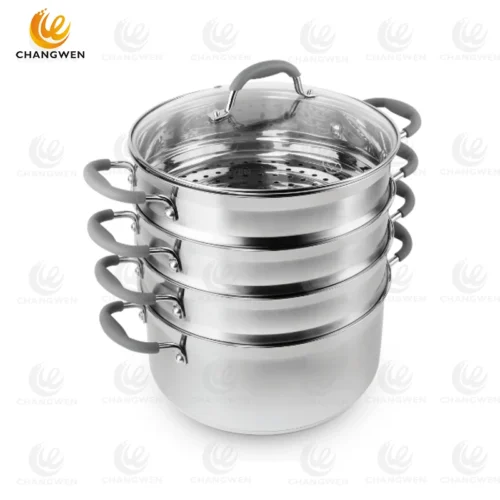
Stainless Steel Steamer Pot for Home and Commercial Kitchens CW-ES034
-
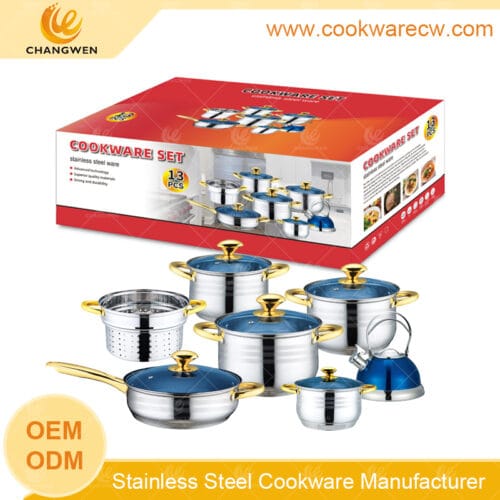
Mercado Libre stainless steel 13pcs cookware set tea kettle pasta pot nonstick frying pan golden handle blue coating CW-M1305
-
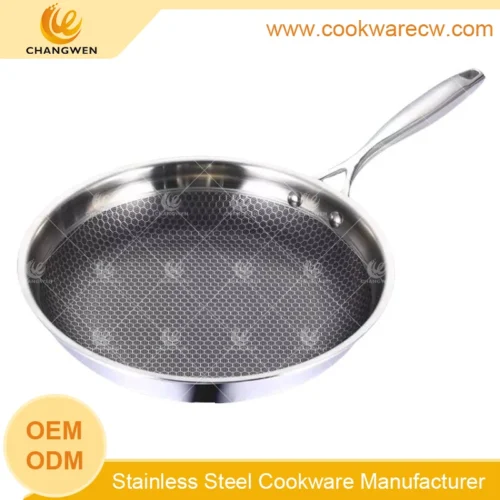
Honeycomb Stainless Steel Frying Pan for Even Cooking CW-TP011
-
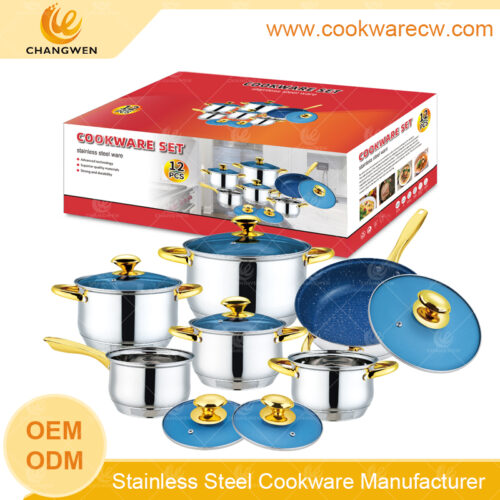
China manufacturer stainless steel 12pcs cookware set non-stick frying pan blue glass lid golden handles & knobs CW-M1209N
-

Honeycomb Structure Stainless Steel Frying Pan CW-ETP014
-
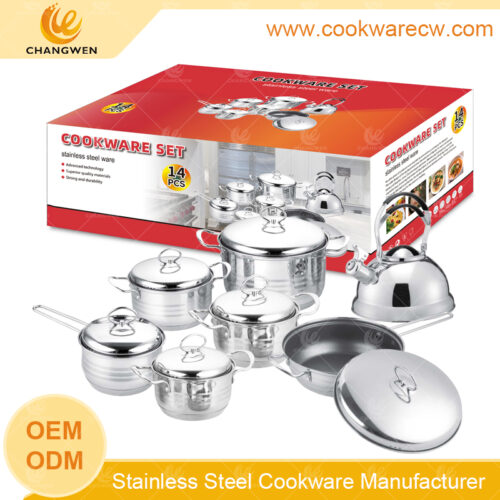
18/10 Stainless Steel Cookware CW-M1402G
-
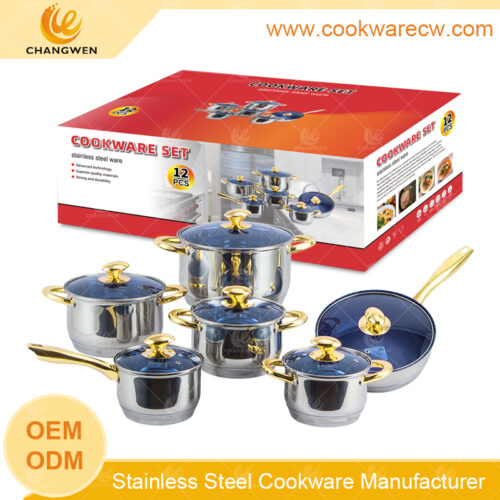
hot sales 12pcs stainless steel cookware set cooking pots set 16cm saucepan 24cm casserole & non-stick frypan with induction usage bottom CW-M1214
-
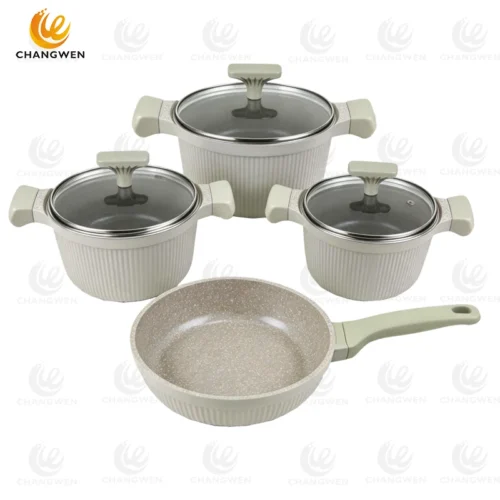
7pcs Vertical Stripe Nonstick Aluminum Cookware Set with Silicone Lid | Changwen Aluminum Cookware Factory China