
Read time: 12 minutes
Introduction
This is not a cooking performance guide. This is a business guide.
If you are building an OEM cookware brand, the stainless steel vs aluminum question is not primarily about which material heats more evenly or which one lasts longer. It is about which material category delivers better margin, supports stronger retail positioning, attracts the right customer segment for your target market, and builds a brand that compounds over time rather than competing purely on price.
The answer depends on your market, your target price point, and what you are willing to invest in product specification and brand development. And the answer is not the same for every OEM brand.
This guide gives you the complete commercial comparison — FOB costs, retail price ranges, margin structures, customer demographics, supply chain differences, and the strategic cases for each material. By the end, you will have a framework for deciding which category — or which combination of both — makes sense for your specific program.

Key Takeaways
- Stainless steel commands 30–45% higher retail pricing than aluminum or coated non-stick alternatives at comparable construction quality. Stainless steel cookware products are priced 30–45% higher on average due to material quality and manufacturing complexity.
- Aluminum has lower FOB cost and faster production — the right choice for high-volume, price-sensitive markets and non-stick product lines where coating performance drives the value proposition.
- Stainless steel has higher customer lifetime value — no coating to replace means customers can expand the collection rather than replace the full set. The repeat purchase opportunity is in collection extension, not product replacement.
- Premium-grade 18/10 stainless steel is approximately 40% more expensive to produce than aluminum alternatives. That manufacturing cost premium is recoverable through retail pricing — but only if the brand story justifies it.
- The most profitable OEM brands often carry both. Aluminum non-stick for the entry product (lower barrier, higher trial rate), stainless steel for the premium tier (higher margin, collection architecture).
- Around 32% of households in emerging economies still prefer non-stick alternatives due to affordability — while developed market consumers are actively moving toward stainless steel for health and durability reasons. Market selection determines which material wins.
The Numbers: FOB Cost, Retail Price, and Margin
Before any strategic analysis, you need the commercial reality. Here are the approximate numbers for OEM cookware programs in 2026.
Stainless Steel Cookware — The Price Architecture
FOB factory price (China, Jiangmen, standard OEM program):
| Product | Construction | FOB Price Range |
|---|---|---|
| 5-piece stainless steel set | Disc-base, 304 inner | $18–$28 |
| 5-piece stainless steel set | Tri-ply full-clad | $28–$45 |
| 10-piece stainless steel set | Tri-ply full-clad | $55–$85 |
| Individual tri-ply frying pan (24cm) | Full-clad 304-Al-430 | $12–$20 |
| Stock pot (20cm, disc-base) | 304 stainless | $8–$15 |
Typical retail price ranges (US/EU mid-premium market):
| Product | Mid-market retail | Premium retail |
|---|---|---|
| 5-piece stainless set | $89–$129 | $149–$249 |
| 10-piece stainless set | $149–$249 | $299–$499 |
| Individual tri-ply frying pan (24cm) | $45–$79 | $89–$149 |
Gross margin range at retail:
- Mid-market stainless steel: 55–68% gross margin (retail price vs landed cost)
- Premium stainless steel: 65–75% gross margin
Aluminum / Non-Stick Cookware — The Price Architecture
FOB factory price (China, standard OEM program):
| Product | Construction | FOB Price Range |
|---|---|---|
| 5-piece non-stick set | Stamped aluminum + PTFE | $12–$20 |
| 5-piece non-stick set | Die-cast aluminum + granite coating | $18–$30 |
| 10-piece non-stick set | Die-cast + ceramic coating | $28–$48 |
| Individual non-stick frying pan (24cm) | Die-cast + PTFE | $7–$14 |
| Individual non-stick frying pan (24cm) | Forged + granite | $12–$20 |
Typical retail price ranges (US/EU market):
| Product | Entry retail | Mid retail |
|---|---|---|
| 5-piece non-stick set | $39–$69 | $79–$129 |
| 10-piece non-stick set | $69–$119 | $129–$199 |
| Individual non-stick frying pan (24cm) | $19–$39 | $39–$69 |
Gross margin range at retail:
- Entry non-stick: 45–58% gross margin
- Mid-range non-stick: 55–65% gross margin
The Margin Analysis
At first look, the gross margin percentages are similar between categories. The commercial difference is in the absolute dollar margin per unit.
A tri-ply stainless steel 10-piece set with a $70 FOB cost and $350 retail price generates $280 absolute margin (before marketing, shipping, and overheads). A non-stick 10-piece set with a $38 FOB cost and $150 retail price generates $112 absolute margin.
The stainless steel brand does not need to sell three times the volume to generate three times the margin. It generates 2.5x the dollar margin per transaction.
This is why stainless steel brands can sustain higher customer acquisition costs, invest more in packaging and content marketing, and build more sustainable unit economics than non-stick brands competing on price.
Material Comparison: The Commercial Variables
Manufacturing Cost
Manufacturing stainless steel cookware involves significant material and energy costs, with premium-grade 18/10 stainless steel being approximately 40% more expensive to produce than aluminum alternatives.
This manufacturing cost premium is real and relevant for OEM buyers. At equivalent construction quality, a stainless steel pan costs more to make than an aluminum pan. The commercial question is whether the retail price premium covers and exceeds the manufacturing cost premium.
For well-positioned brands in developed markets: yes, decisively. Quality stainless steel pans command significant price premiums over aluminum or non-stick alternatives, with average retail prices 2–3 times higher than entry-level cookware sets.
For price-sensitive emerging market brands: the premium is harder to recover. Around 32% of households in emerging economies still prefer non-stick alternatives due to affordability.
The implication for OEM brand selection: In developed market channels (US, EU, Australia, Japan), the stainless steel premium pays. In price-sensitive channels (parts of South America, Southeast Asia, Sub-Saharan Africa), aluminum non-stick at lower price points reaches more of the market.
Product Longevity and Customer Lifetime Value
This is where the stainless steel commercial case diverges most clearly from aluminum.
A stainless steel cookware set has no coating to degrade. The product does not have a built-in replacement cycle. With proper care, a quality tri-ply stainless steel set lasts 10–20 years. For the customer, this is a feature. For the brand, it requires a different retention model — repeat revenue comes from collection extension (the customer buys the stock pot to go with the frying pan they love), not product replacement.
A non-stick cookware set has a coating with a service life. PTFE coatings typically last 3–7 years with careful use; ceramic coatings 1–3 years under normal home cooking conditions. When the coating visibly degrades, the customer replaces — and if the brand’s retention program is active, that replacement comes back to the same brand.
The CLV calculation:
- Stainless steel: higher initial transaction, lower natural replacement frequency, higher collection extension potential. Lifetime value is captured through collection breadth (more pieces) and brand loyalty (customer buys your stock pot because they love your frying pan).
- Non-stick: lower initial transaction, built-in replacement cycle every 3–5 years, moderate collection extension potential. Lifetime value is captured through replacement frequency and program loyalty.
Neither model is inherently superior. But stainless steel brands that build collection architecture effectively can achieve higher lifetime values despite fewer replacement transactions.
Supply Chain and Quality Control
For OEM brands building a manufacturing relationship, the supply chain and quality control differences between materials are operationally relevant.
Stainless steel:
- Primary quality risk: steel grade substitution (201 sold as 304). Requires XRF testing and mill certificate verification.
- Construction quality variable: wall thickness, base disc specification (disc-base), or cladding quality (tri-ply). Measurable and verifiable with physical testing.
- No coating degradation risk — the product ships and performs at the same specification regardless of handling.
- LFGB food contact certification covers interior surface compliance; no coating-specific certification needed.
Aluminum non-stick:
- Primary quality risk: coating delamination, undisclosed PFAS compounds in coating. Requires coating adhesion testing and PFOA/PFAS-free certification.
- Construction quality variable: wall thickness (stamped vs die-cast vs forged), coating layer count. Measurable.
- Coating quality affects the product’s entire service life — a coating adhesion failure in transit or warehouse creates a quality issue before the customer even uses the product.
- LFGB certification must cover both the aluminum body and the coating material — more complex testing than stainless steel.
For OEM brands new to the category: Stainless steel has a simpler quality control profile — fewer failure modes, more straightforward certification. Non-stick has more complex QC requirements due to coating performance variables.
Market Positioning and Consumer Trend Alignment
Consumer trends in 2026 favor stainless steel in developed markets. Health consciousness, PFAS awareness, and sustainability positioning all work in stainless steel’s direction.
Urban households increasingly prefer stainless steel over traditional aluminum cookware due to health consciousness and durability concerns.
The PFAS concern is a genuine commercial driver. Non-stick coatings — even PFOA-free modern versions — are under sustained consumer scrutiny because of historical PFAS contamination and ongoing regulatory attention. Brands that can position on “no coatings, no PFAS, no replacement cycle” have a health-conscious messaging framework that resonates in premium consumer segments.
Premium stainless steel sets cost approximately 35%–45% more than aluminum or non-stick cookware, limiting mass adoption in price-sensitive regions. The flip side: in premium segments where this pricing is appropriate, the premium is the positioning.
The Market-by-Market Analysis
The stainless steel vs aluminum decision is not universal — it depends significantly on where you sell.
United States and Canada
The US premium cookware market strongly favors stainless steel at mid-to-premium price points. Health-conscious consumers, high PFAS awareness, and cooking culture that values technique have all contributed to stainless steel’s market share growth.
However, the US market is also the most tariff-affected for China-sourced products. The effective tariff rate for stainless steel cookware from China to the US is approximately 25–37% of customs value in 2026. This affects the landed cost calculation for both materials, but proportionally more for stainless steel (which has higher absolute FOB values).
US market recommendation: Stainless steel for mid-to-premium positioning. Non-stick aluminum for entry-level and replacement-cycle programs.
European Union (Germany, UK, France, Netherlands)
Europe is the strongest market for premium stainless steel cookware. LFGB certification is effectively mandatory. German and UK consumers have high awareness of material quality and strong preference for durable, non-coated cookware.
Germany 2025 stainless steel cookware market size: USD 79.12 million, with 4.8% CAGR. Sustainability messaging, recycled steel use, and energy-efficient bases strengthen retail positioning.
EU market recommendation: Stainless steel with LFGB certification is the most commercially aligned choice for premium EU retail. Non-stick has a place but faces more scrutiny under PFAS regulatory focus.
South America (Brazil, Chile, Colombia, Argentina)
South America is a mixed market. Brazil’s large consumer base includes both price-sensitive mid-market buyers (aluminum non-stick dominant) and a growing premium segment. The single-layer stainless steel disc-base construction dominates volume; tri-ply is a premium niche.
South America market recommendation: Disc-base stainless steel sets and aluminum non-stick for volume programs. Tri-ply stainless for emerging premium retail positioning.
Southeast Asia (Vietnam, Thailand, Philippines, Indonesia)
Fast-growing market with increasing premiumization. Non-stick aluminum dominates by volume; stainless steel is growing in the premium tier as urban household income rises.
Southeast Asia recommendation: Lead with aluminum non-stick for volume; develop stainless steel as the premiumization tier for growing urban middle-class segment.
Middle East (UAE, Saudi Arabia, Kuwait)
The Middle East premium retail market has strong affinity for stainless steel with mirror polish or hammered finish — aesthetically-oriented purchasing combined with genuine preference for durable, non-coated cookware. The GCC consumer base supports premium pricing across cookware categories.
Middle East recommendation: Stainless steel with premium exterior finishes (mirror, hammered, PVD) for premium retail. Non-stick for mid-market volume.
Australia
Australia’s premium retail market strongly favors stainless steel. Urban households increasingly prefer stainless steel over traditional aluminum cookware due to health consciousness and durability concerns. ChAFTA (China-Australia Free Trade Agreement) provides competitive import duty advantages for China-origin goods.
Australia recommendation: Stainless steel tri-ply as the primary OEM focus. LFGB test reports are increasingly expected by Australian retail channels.
The Strategic Cases
The Case for Stainless Steel OEM
Best fit for brands that:
- Target mid-to-premium retail price points ($80+ for a 5-piece set)
- Serve health-conscious, material-aware consumers
- Build collection architecture (multiple pieces sold to the same customer over time)
- Prioritize brand durability and long-term positioning over initial trial rate
- Are entering EU, North American, or Australian premium retail channels
- Want to build a brand story around verifiable quality (certifications, material documentation)
The commercial case:
- Higher absolute dollar margin per transaction
- No built-in product replacement cycle — loyalty comes from collection depth
- Premium retail pricing sustainable with brand story investment
- Growing consumer trend alignment (health, sustainability, PFAS avoidance)
- Stainless steel cookware market projected at USD 9.2 billion in 2026, growing at 5.4% CAGR
The manufacturing requirements:
- 304 stainless steel confirmed by mill certificates (mandatory — 201 substitution is the primary fraud risk)
- Tri-ply full-clad construction for premium positioning
- LFGB and FDA certification
- Wall thickness specification in purchase order
The Case for Aluminum Non-Stick OEM
Best fit for brands that:
- Target entry-to-mid retail price points ($30–$79 for a 5-piece set)
- Serve convenience-focused consumers who prioritize easy food release
- Accept a product replacement cycle as a retention mechanism
- Enter price-sensitive market segments (emerging market volume)
- Build a portfolio that includes non-stick as the accessible tier
The commercial case:
- Lower FOB cost enables lower retail entry price — higher trial rate
- Built-in replacement cycle (3–5 years) creates predictable repeat purchase opportunity
- Non-stick remains the largest cookware category by volume globally
- Around 34% of consumers still prefer aluminum or non-stick cookware due to cost advantages
- Granite and ceramic coating premiumization allows margin improvement without full stainless steel pricing
The manufacturing requirements:
- Hard-anodized aluminum base for non-reactive food contact (not raw aluminum)
- PFOA-free, PFAS-free coating certification — non-negotiable for developed market retail
- Coating adhesion testing and layer count specification
- Die-cast or forged construction for premium tier (not stamped)
The Case for Both: The Full Portfolio Strategy
The most commercially resilient OEM cookware brands carry both materials. The portfolio serves different consumers, different price points, and different market segments — and each tier supports the other.
The two-tier portfolio model:
| Tier | Material | Price position | Function |
|---|---|---|---|
| Entry/accessible | Aluminum non-stick | $39–$99 retail | Trial acquisition, high volume |
| Premium | Stainless steel tri-ply | $99–$299 retail | Margin optimization, brand positioning |
The aluminum tier captures the customer who is not yet ready for stainless steel pricing. Brand experience with the non-stick product creates a pathway to stainless steel when the customer is ready to invest in the full premium collection. This is collection architecture operating across material tiers rather than just within a single material.
The Decision Framework
Use these questions to determine the right material strategy for your OEM program:
1. What is your target retail price point?
- Under $60 for a 5-piece set: Aluminum non-stick
- $80–$150 for a 5-piece set: Stainless steel disc-base or entry tri-ply
- $150+ for a 5-piece set: Tri-ply stainless steel or full portfolio
2. What market are you entering?
- EU, US premium, Australia, Middle East premium: Stainless steel primary
- South America volume, Southeast Asia volume: Aluminum non-stick primary
- Any market premium tier: Stainless steel
3. What is your brand story?
- Health, material transparency, durability: Stainless steel
- Convenience, ease of use, accessible price: Aluminum non-stick
- Both: Portfolio approach
4. What is your customer lifetime value model?
- Collection extension (higher LTV per customer, longer cycles): Stainless steel
- Replacement frequency (lower LTV per cycle, more frequent): Aluminum non-stick
5. What supply chain complexity can you manage?
- Simpler QC, fewer certification variables: Stainless steel
- Higher coating QC complexity, PFAS regulatory monitoring: Aluminum non-stick
FAQ
Is stainless steel or aluminum cookware more profitable for OEM brands?
Stainless steel generates higher absolute dollar margin per transaction — retail prices are 30–45% higher while the FOB cost premium is approximately 40% over aluminum. In developed market channels (US, EU, Australia), the margin recovery is strong. In price-sensitive emerging markets, aluminum non-stick is more commercially accessible. The most profitable OEM brands typically carry both, with aluminum as the accessible tier and stainless steel as the premium tier.
What is the typical FOB price difference between stainless steel and aluminum cookware?
A comparable 5-piece set: stamped aluminum non-stick FOB runs $12–$20; tri-ply stainless steel FOB runs $28–$45. The stainless steel premium at FOB is approximately 40–50%. At retail, the premium is 50–100%. This means the retail margin recovery more than covers the manufacturing cost premium for stainless steel in premium market positioning.
Which material has better customer lifetime value?
Stainless steel generates higher lifetime value through collection extension — no coating replacement cycle means the repeat purchase comes from buying additional pieces (saucepan, stock pot, sauté pan) rather than replacing a worn set. Aluminum non-stick has a built-in replacement cycle (3–7 years) that generates predictable repeat purchases but at lower transaction values. Both models work — the difference is in the retention mechanism.
Which markets favor stainless steel vs aluminum cookware?
Stainless steel dominates premium positioning in EU (particularly Germany), North America (premium tier), Australia, Middle East, and Japan. Aluminum non-stick dominates by volume in price-sensitive markets including South America, Southeast Asia, and Sub-Saharan Africa. In most markets, there is a stainless steel premium tier alongside a larger aluminum volume tier — the question is which tier your OEM brand targets.
What certifications are required for each material?
Stainless steel: LFGB (EU food contact, covers heavy metal migration and sensory testing), FDA compliance (US), ISO 9001 from manufacturer. Material test reports (mill certificates) confirming 304 grade. Aluminum non-stick: LFGB for both the aluminum substrate and the coating material, PFOA-free and PFAS-free certification from accredited laboratory, FDA compliance, ISO 9001. The coating certification requirement makes aluminum non-stick certification more complex.
Can an OEM brand carry both stainless steel and aluminum cookware?
Yes, and this is often the most commercially resilient strategy. Aluminum non-stick at entry price points drives trial and volume; stainless steel at premium price points drives margin and collection lifetime value. The two tiers can be positioned as the same brand’s accessible and premium lines, creating a natural customer upgrade pathway.
Conclusion
The stainless steel vs aluminum profitability question does not have a single answer. It has a market-dependent answer.
In premium developed market channels, stainless steel wins on absolute margin and brand positioning. The manufacturing cost premium is recoverable through retail pricing, the consumer trend alignment is favorable, and the collection architecture opportunity supports long-term customer lifetime value.
In price-sensitive volume markets, aluminum non-stick wins on accessibility, trial rate, and replacement cycle revenue. The lower FOB cost enables competitive retail pricing, and non-stick remains the largest cookware category by volume.
The brands with the strongest commercial position carry both — and think of them as complementary, not competing. The non-stick tier acquires the customer. The stainless steel tier builds the relationship.
Build the right specification for each. Verify the materials. Document the certifications. Position the product in the tier where the price-to-quality story is most convincing.
That is the profitability equation.
Source Both Materials from Changwen
Changwen is a cookware manufacturer based in Jiangmen, Guangdong, China, with over 22 years of OEM and ODM experience. We produce both stainless steel and aluminum cookware for OEM brand programs across South America, Southeast Asia, the Middle East, Europe, and Australia.
Stainless steel program: Tri-ply 304 stainless steel cookware sets (304-aluminum-430 full-clad), frying pans, stock pots, saucepans, steamer pots, pressure cookers. Verified 304 steel with mill certificates. LFGB and FDA compliant. ISO 9001:2015 certified.
Aluminum program: Die-cast aluminum cookware, forged aluminum series, granite non-stick coating (PFOA-free, PFAS-free), ceramic coating options, complete non-stick cookware sets. Soup pots, frying pans, woks, grill pans, sauté pans.
-
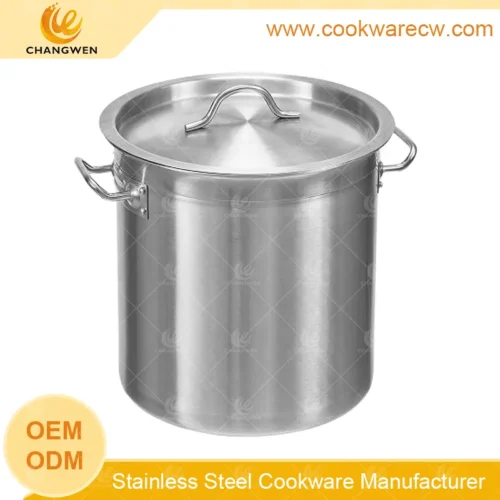
Heavy Duty Stainless Steel Cooking Utensils
-
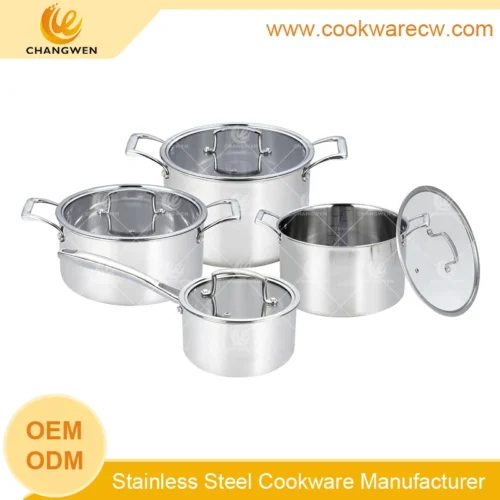
Premium Stainless Steel Cookware Set for Modern Kitchens CW-ETP0801
-

Hotsale 12pcs stainless steel cooking sets soup stock pot kitchen ollas saucepan casserole and milkpot fry pan nonstick CW-M1209
-
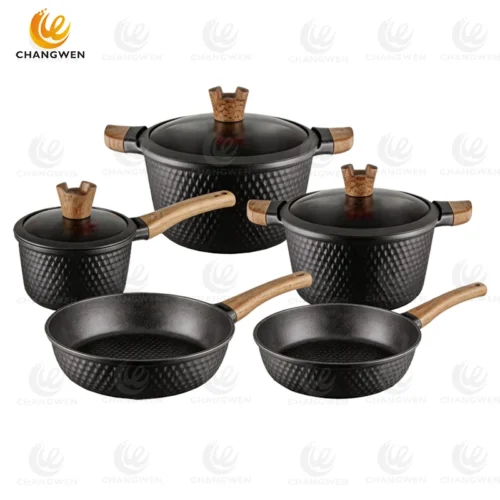
8pcs Die Cast Aluminum Cooking Set with Marble Ceramic Nonstick Coating
-
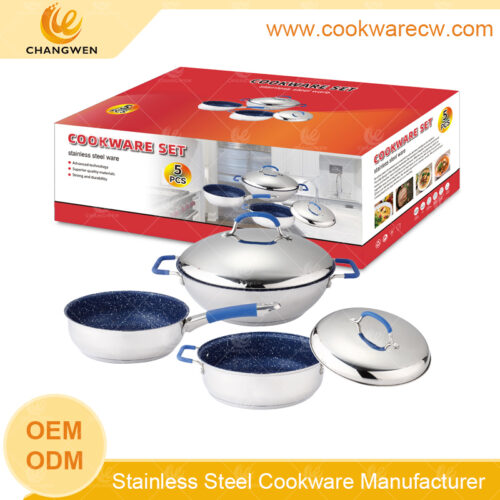
non-stick fry pans coating wok stainless steel wire handles & knobs with silicon cover high quality material lid CW-M0502G
-
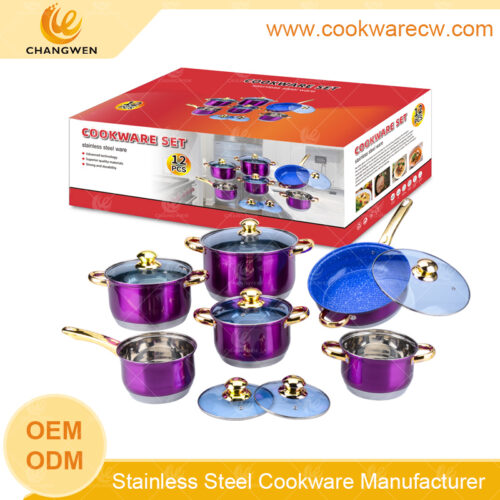
color coating surface stainless steel pots non-stick frypan golden S/S handles and knobs 430 protector for induction CW-M1225
-
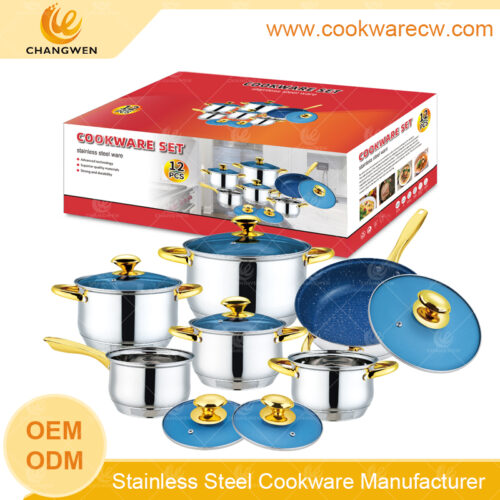
China manufacturer stainless steel 12pcs cookware set non-stick frying pan blue glass lid golden handles & knobs CW-M1209N
-
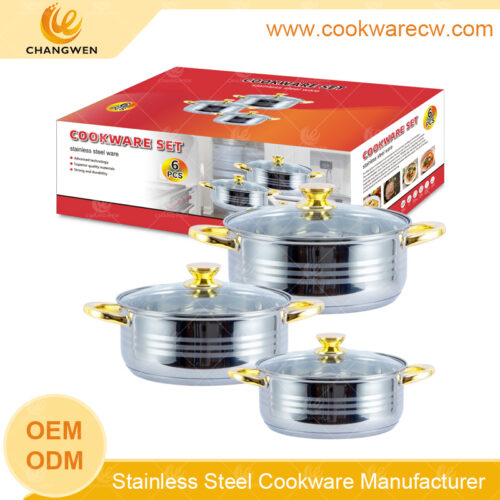
Stainless Steel Pot Cook Rice CW-M0608