
Quick answer: For most stainless steel cookware programs, specify 304 for the exposed cooking surface, consider 316 only when a documented chloride-rich or unusually demanding use case justifies its premium, and evaluate 430 primarily where a magnetic exterior or base layer helps the induction design. Those are starting points, not universal rules. The best purchasing decision assigns a grade to each component, holds the construction and finish constant when comparing quotes, and verifies the finished sample against the intended market’s food-contact requirements.
Choosing between 304, 316, and 430 is not a contest to find the highest number. A saucepan can contain more than one stainless grade, plus an aluminum heat-spreading layer, a coating, a glass lid, and separately sourced hardware. A buyer who asks only for a “316 pot” may pay for an unnecessary upgrade while overlooking the base geometry, surface condition, or documentation that actually determines the product’s performance and commercial risk.
Reading time: about 14 minutes. This guide concentrates on cost-versus-performance decisions for importers and private label buyers. For a broader introduction to alloy families, see our stainless steel grades comparison.
What is the practical difference between 304, 316, and 430 in cookware?
304 is an austenitic stainless steel commonly selected for food-contact interiors because it offers a useful balance of corrosion resistance, formability, availability, and cost. 316 is also austenitic, but its molybdenum addition improves resistance to localized corrosion in chloride-containing environments. 430 is a ferritic, nickel-free stainless steel that is normally magnetic and can be useful as an induction-facing layer. These differences describe material tendencies; they do not guarantee how a complete pan will behave after forming, polishing, bonding, coating, cleaning, and years of use. The British Stainless Steel Association’s grade guide and its corrosion-resistance guidance explain the underlying distinctions.
| Buying question | 304 | 316 | 430 |
|---|---|---|---|
| Typical role in a cookware design | General-purpose exposed cooking surface | Exposed surface for a justified higher-corrosion-resistance specification | Magnetic exterior or base; selected mild-duty food-contact applications when validated |
| Main performance advantage | Balanced corrosion resistance and fabrication | Better resistance to chloride-related pitting under comparable conditions | Useful magnetic response and a different alloy-cost structure |
| Main purchasing caution | Not immune to salt damage, poor cleaning, or rough finishing | Higher specification is not a substitute for good construction and maintenance | Generally less corrosion-tolerant than 304/316 in demanding wet or salty service |
| Cost decision | Benchmark the finished design | Pay the premium only for a measurable requirement | Assess the whole component and manufacturing cost, not just nominal alloy price |
Steel grade is only one variable in the total product. The same nominal grade can deliver different outcomes if one supplier uses a smooth, cleanable interior and another leaves embedded polishing contamination or crevices around rivets. Buyers should compare finished samples under the same conditions rather than treating a grade name as a warranty of heat distribution, durability, or hygiene.
Should every part of a pan use the same stainless grade?
No. The food-facing interior, structural shell, induction exterior, handles, lid rim, rivets, and base layers perform different jobs. Specifying the entire assembly as one grade can add cost without improving the part that matters. A component-level bill of materials makes supplier quotes comparable and prevents the phrase “304 cookware” from concealing an unapproved substitution in the interior or base.
Food-contact interior: The inside of an uncoated stockpot or pan is directly exposed to food, salt, acids, water, and cleaning. 304 is a rational default for many ordinary cooking programs. A 316 interior becomes a candidate if the intended use, cleaning regime, or corrosion testing identifies a clear risk that 304 cannot meet. A coated pan requires a separate assessment of the coating and exposed edges; the steel grade underneath does not establish the coating’s compliance.
Exterior wall: The outside may face burner heat, dishwasher chemistry, fingerprints, and abrasion rather than direct food contact. Its grade can be chosen independently if the construction permits it. The buyer should still specify appearance, cleaning resistance, and any exposed seams because an attractive exterior can fail commercially through discoloration or difficult maintenance even when the food-contact interior is sound.
Induction-facing layer: A ferritic stainless exterior such as 430 is frequently considered for magnetic coupling. However, the complete base must also have adequate flatness, diameter, attachment quality, and thermal design. A magnet sticking to a disc confirms magnetic response at that spot; it does not prove that the pan will heat evenly, work on every induction hob, or contain 430 throughout the disc.
Heat-spreading core: Aluminum or another conductive layer often does more to spread heat laterally than changing the exposed stainless grade. Compare core thickness, coverage, bonding, and the pan’s shape before attributing a hot spot to 304 versus 316. Our base-disc coverage discussion explains why disc diameter can change the heated area.
Handles, fasteners, and lids: These components need their own materials, attachment, heat, and cleanability requirements. A handle can create a crevice or loosen over time regardless of whether the vessel body is 304. Buyers should request the material and finish of all exposed hardware, not assume that the headline grade applies to every accessory.
When is paying for 316 worth it?
316 earns its premium when the extra corrosion margin solves a defined exposure problem, not when a specification simply needs to sound premium. Chloride-rich residues, prolonged wet storage, aggressive cleaning, and certain food-processing routines can raise the risk of localized corrosion. The British Stainless Steel Association identifies molybdenum as an important reason for 316’s stronger pitting resistance in chloride environments; it does not imply that 316 is corrosion-proof. A buyer should define the actual exposure and a pass/fail test before approving the upgrade.
For a standard household saucepan that is cleaned promptly and dried after ordinary use, the incremental benefit of 316 may be hard to demonstrate. For a commercial vessel repeatedly exposed to salty ingredients, long holding times, and rigorous cleaning, the buyer may justify a 316 food-contact interior if comparative testing shows fewer failures. In both cases, the right answer depends on the finished surface, design details, and care instructions, not the alloy alone.
Avoid the shortcut that “316 is always food-safe and 304 is not.” Food-contact suitability depends on the complete article, its intended use, applicable regulations, and appropriate testing. Likewise, do not infer a medical or nutritional benefit from the number stamped on a base. The purchase order should identify the target market and the evidence required for that market, while the technical file should show the exact component and material to which each test result applies.
Before approving a 316 surcharge, ask suppliers to quote the same pan with only the relevant component changed. If a proposed 316 version also has thicker walls, a larger disc, a different finish, or more expensive packaging, the price difference cannot be attributed to grade. A controlled comparison is the only defensible way to decide whether the upgrade is valuable.
When is 430 a good choice, and when is it a false economy?
430 is a sensible candidate for an induction-facing exterior when the base design needs a ferromagnetic layer and the supplier can demonstrate reliable hob compatibility, bonding, flatness, and corrosion performance. It is a false economy if the lower material quote leads to more staining, product returns, or rework in the actual service environment. It is also a false economy when buyers accept a thin or undersized base merely because the pan passes a quick magnet check.
430 should not be described as inherently unsuitable for all food contact. The worldstainless food-preparation study evaluated several stainless grades, including 430, under its defined test conditions. That study is not a blanket approval for every finished 430 pan, food, market, or cleaning method. The correct buying question is whether the specific article and use case meet the relevant performance and regulatory requirements.
Nickel-free alloy composition can be commercially relevant, but buyers must not turn it into an unqualified “allergy-safe” claim. A finished product may contain other nickel-bearing components, and a steel grade declaration is not a medical assurance. If low-nickel positioning matters, specify every food-contact component, require appropriate supporting evidence, and have marketing claims reviewed for the destination market.
430 may be less attractive for a constantly wet, salty, or hard-to-clean exposed interior because its corrosion margin is generally lower than that of 304 or 316. Conversely, paying for 304 in a protected magnetic exterior may add little benefit if it compromises induction response or requires another magnetic layer. The economical design puts each material where its properties actually contribute value.
Can a magnet, a label, or a photo prove the stainless grade?
No. A magnet is a useful screening tool for magnetic behavior, not an alloy certificate. 430 is usually strongly magnetic, while annealed 304 and 316 are normally much less magnetic; forming and cold work can make parts of an austenitic component respond to a magnet. A weakly magnetic 304 rim is not automatic evidence of fraud, and a strongly magnetic base does not reveal the composition of the inner cooking surface. The BSSA stainless guide discusses this magnetic behavior.
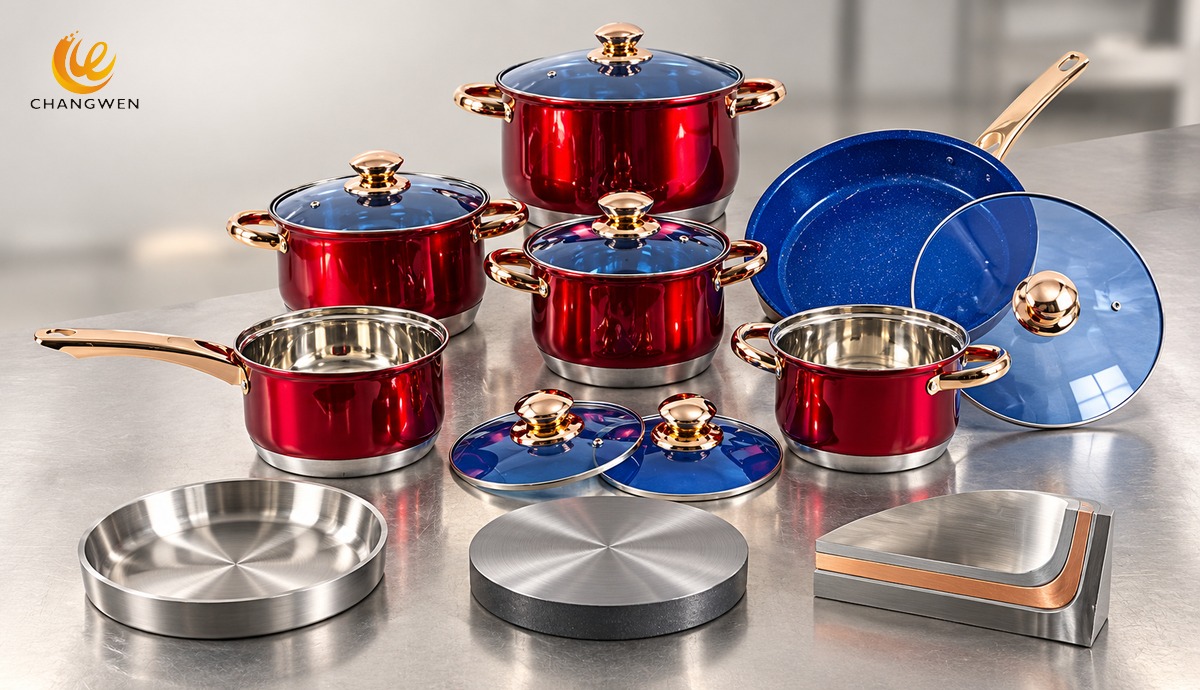
A polished red-and-blue cookware image, including the product reference used for the illustrations in this article, cannot establish stainless grade, layer sequence, or coating chemistry. Color and styling can support a retail range, but material identification requires traceable documentation and testing. Buyers should ask exactly which photographed component is being represented and whether the sample is the same construction as the quoted production item.
Portable X-ray fluorescence (XRF) can help distinguish alloy families on accessible metal surfaces by measuring elements such as chromium, nickel, and molybdenum. XRF does not, by itself, prove a buried layer’s composition or measure carbon reliably enough to distinguish every grade variant. Test the relevant exposed locations, correlate results with mill certificates and lot traceability, and use a qualified laboratory when a dispute requires deeper analysis. Our XRF guide for cookware covers the inspection workflow in more detail.
How should buyers compare the real cost of 304, 316, and 430?
Compare the landed cost of equivalent, acceptable cookware, not the price per kilogram of raw steel. The finished price combines metal mass, core material, forming scrap, tooling, bonding, polishing, handles, lids, coating if any, packaging, testing, freight, duties, and expected defect costs. Nickel and molybdenum markets can move, so a fixed percentage premium for 316 or discount for 430 is not a reliable purchasing rule. Ask for date-stamped quotes on the same specification.
Use a normalized quote matrix with one row per SKU and one column for each cost driver: vessel diameter and usable capacity; interior and exterior grade; wall gauge; base construction and measured coverage; handle and lid specification; surface finish; food-contact testing; packaging; order quantity; Incoterm; lead time; and warranty or defect policy. If any field differs, mark the quote as non-equivalent before comparing the totals. Our 304 versus 316L buyer’s guide provides additional context for comparing upgraded interiors.
Calculate the incremental landed cost of the grade change only after holding the rest of the product constant. For example, if a hypothetical 304 pan lands at $20.00 and a truly equivalent 316 version lands at $22.00, the upgrade costs $2.00 per unit. If documented corrosion-related returns and handling for the intended channel are expected to exceed that incremental cost, 316 deserves consideration. If the expected avoided loss is only $0.40, the upgrade may not be justified. These figures are an arithmetic illustration, not market prices or predicted failure rates.
For 430, consider whether a proposed cost saving affects the part that will actually be visible or wet. A lower-cost magnetic exterior can make sense in a well-designed base; a cheaper exposed interior may require more conservative use instructions or fail a demanding test. Include likely inspection, rejection, replacement, and reputation costs in the comparison. The cheapest unit price is not the cheapest successful product launch.
Weight also needs interpretation. A heavier pan may have a thicker heat-spreading core, a thicker stainless shell, a larger base, or simply oversized handles. Request a component weight breakdown when differences are material. Buying by total weight alone can reward metal in the wrong place and hide a small induction disc.
Which grade mix fits common buyer scenarios?
| Program | Starting specification | Reason to test or change it |
|---|---|---|
| Everyday household stainless saucepan | 304 exposed interior; base and exterior optimized separately | Change only if corrosion, induction, price, or market testing demands it |
| Induction-focused cookware set | 304 interior with validated magnetic exterior or base, often considering 430 | Verify hob coverage, flatness, bonding, heat pattern, and corrosion |
| Salty or prolonged wet-use commercial vessel | Compare 304 and 316 food-contact surfaces on matched samples | Select 316 if defined exposure testing demonstrates a material advantage |
| Value private-label line | 304 where exposed food contact demands it; avoid paying for hidden prestige | Do not reduce core coverage or finish quality to fund an alloy claim |
| Low-nickel material brief | Assess 430 or another appropriate design with full component disclosure | Validate market compliance and avoid unsupported health claims |
These are procurement starting points, not prescribed recipes. A tri-ply frying pan, a deep stockpot, and a capsule-bottom saucepan expose their materials to different stresses. Buyers should approve the final architecture against their cooking, cleaning, induction, and claim requirements. For an overview of body construction, compare our tri-ply buying guide with the capsule-bottom buying guide.
What should a supplier’s sample and test file contain?
Start with a drawing that identifies each material-bearing component, its nominal grade, thickness, and location. A statement such as “304/430 stainless” is incomplete unless the supplier maps 304 and 430 to specific layers and surfaces. Ask whether the outer disc, rim, rivets, handles, and lid fittings differ from the vessel wall. If the pan is coated, document the coating system and substrate separately.
Next, link the sample to its production records. A useful file contains a part number and revision, approved golden sample, material certificates tied to supplier lots, process and finish specifications, and inspection results for the actual sample. A certificate for a coil somewhere in the factory is weaker evidence than a traceable record connecting that coil to the delivered batch.
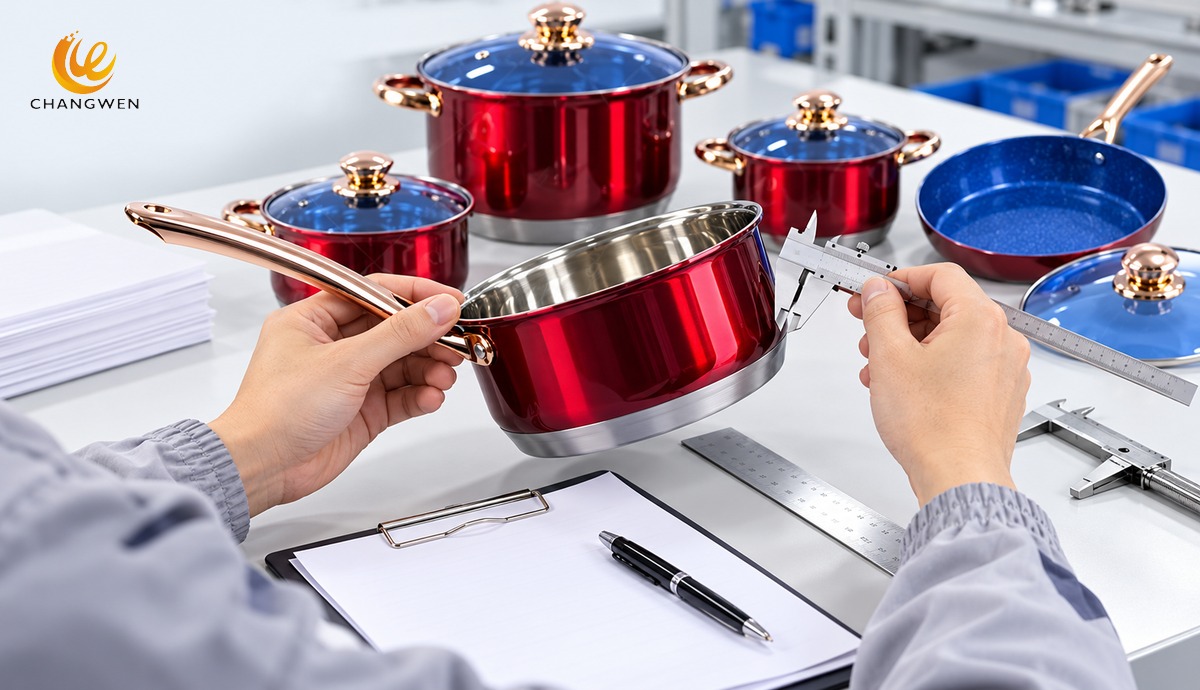
Confirm dimensions and construction with agreed measurements: wall gauge at defined locations, base thickness, disc diameter, base flatness, handle attachment, rim condition, and finished weight. Test heat distribution under the same burner and loading conditions for every candidate. Document the method before comparing results; different cookware sizes and burner settings can make a grade comparison meaningless.
Corrosion and cleaning trials should mirror the intended use rather than an arbitrary extreme. Specify solution, concentration, temperature, duration, drying and cleaning cycle, and acceptance criteria, then photograph the same defined surfaces before and after. When food-contact migration testing is required, use the destination market’s applicable rules and a competent laboratory. A generic “food grade” phrase is not an adequate substitute for a product-specific compliance file.
Finally, compare pre-production and mass-production samples. Material substitution is only one possible drift; finish, base bonding, handle alignment, and packaging can also change. Establish a change-control rule requiring written approval before any grade, source, thickness, coating, or construction alteration. This is especially important when several grades coexist in one SKU.
How can an importer write a concise grade-specific RFQ?
Ask for a controlled base design and priced alternatives, rather than three loosely described “304,” “316,” and “430” products. The RFQ should state the target country, intended food and cleaning exposure, cooktop types, expected order quantity, and whether the supplier may propose a different architecture. Separate mandatory conditions from options so suppliers can quote equivalent products without guessing which features are negotiable.
- Define the baseline SKU: geometry, capacity, wall and base measurements, finish, handle, lid, packaging, and quantities.
- Map every grade: specify inner surface, outer wall, induction layer, rim, rivets, and other relevant metal parts.
- Request controlled alternatives: change only one grade or component at a time and show the resulting price difference.
- State performance gates: food-contact evidence, induction compatibility, heat-pattern test, corrosion test, and mechanical inspection.
- Demand traceability: lot-linked certificates, approved sample identity, change-control procedure, and production inspection plan.
- Normalize commercial terms: currency, Incoterm, tooling, sample fees, testing cost, MOQ, lead time, carton specification, and warranty.
A useful supplier response identifies assumptions rather than silently replacing a grade, shrinking a base disc, or changing the lid. If a supplier believes 430 is appropriate for a particular food-contact component, request the service limits and supporting tests. If a supplier recommends 316, ask which failure mode it addresses and how the improvement will be measured. The result is a decision based on evidence rather than an alloy label.
Frequently asked questions about stainless grades in cookware
Is 316 always better than 304 for a frying pan?
No. 316 provides an additional corrosion-resistance margin in relevant environments, but it does not automatically improve heat spreading, handle comfort, coating durability, or cooking results. If ordinary use and testing show 304 meets the product brief, spending more on 316 may deliver less value than improving the core, base coverage, or finish.
Does an induction pan have to be made entirely from 430?
No. An induction pan can combine a magnetic base or exterior with a different inner food-contact material. Some other magnetic materials or constructions may also work. Confirm actual hob performance with the finished pan rather than relying on a single alloy name or a magnet touched to one location.
Is 430 automatically unsafe for cookware?
No. 430 can be appropriate in selected food-contact applications when the finished article meets the relevant requirements. Its lower corrosion margin in demanding environments means the buyer must consider exposure, finish, cleaning, and testing rather than applying an absolute safe/unsafe label to the grade.
Can “18/10” packaging prove that a pan is 316?
No. “18/10” is a common shorthand for approximate chromium and nickel content, not a complete specification for 316 or proof of molybdenum content. Buyers should require an explicit grade and component mapping backed by appropriate certificates and verification. The BSSA notes that the 18/10 designation is often a marketing convention for austenitic cookware or cutlery grades.
What matters more for heating: 304 versus 316, or the base design?
For many cookware comparisons, conductive-core geometry, base coverage, thickness, flatness, and cooktop coupling have a more direct effect on heat distribution than changing the stainless food-contact grade. Test complete pans under identical conditions to determine the actual difference rather than assuming a grade number predicts hot spots.
What is the first check when a supplier claims “304 inside, 430 outside”?
Request a layer and component drawing tied to the sample revision, then verify accessible inner and outer metal surfaces with an agreed method and review lot-linked material records. A magnet can help locate a magnetic layer but cannot alone identify every alloy or buried component.
Bottom line: buy the right grade in the right place
The most economical stainless cookware is not necessarily the pan with the lowest steel grade or the one with the most 316. It is the pan whose food-contact surface, magnetic layer, heat-spreading construction, finish, and documentation match the intended channel. Begin with 304 as a common exposed-interior benchmark, test whether 316 solves a real corrosion concern, and use 430 where its magnetic and commercial characteristics support a validated design. Then compare equivalent landed quotes and approve a traceable production sample.
Changwen supports cookware wholesale and OEM/private-label programs. If you are building a new range, contact the Changwen team with your target market, cookware sizes, cooking-surface requirements, induction needs, expected volumes, and preferred price tier. We can discuss component-level grade options, sample specifications, and a quote that makes the cost-versus-performance tradeoff visible before production.
-
hot sales 12pcs stainless steel cookware set cooking pots set 16cm saucepan 24cm casserole & non-stick frypan with induction usage bottom CW-M1214
-
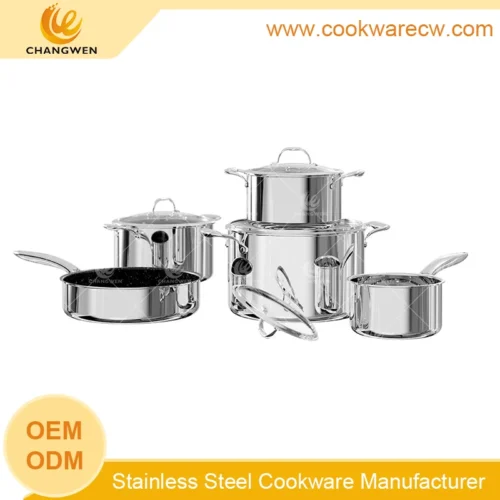
Complete Stainless Steel Cookware Set for Home & Commercial Use CW-TP0901
-
Pressure Cooker Aluminum – Single-Hand Rotation & Safety
-
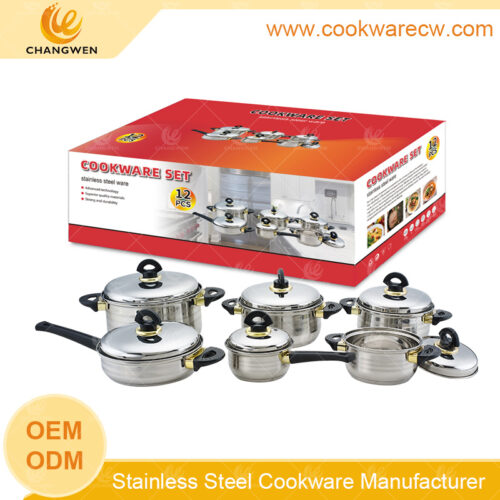
China cookware set 12pcs pots wholesale stainless steel lids black handle and knob frypan casserole saucepan CW-M1229B
-
10pcs Embossed Deep Drawn Aluminum Cookware Set with Nonstick Coating | Aluminum Cookware Supplier China
-
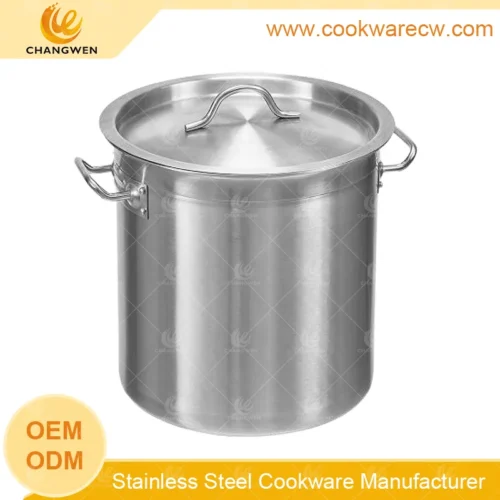
Heavy Duty Stainless Steel Cooking Utensils
-
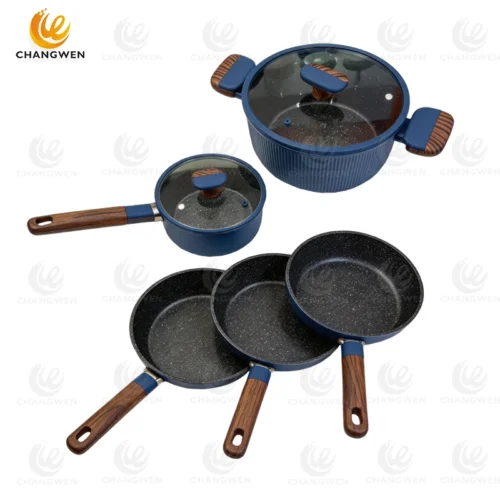
5 Piece Vertical Stripe Nonstick Die-Cast Aluminum Cookware Set | Custom Aluminum Cookware Manufacturer China
-
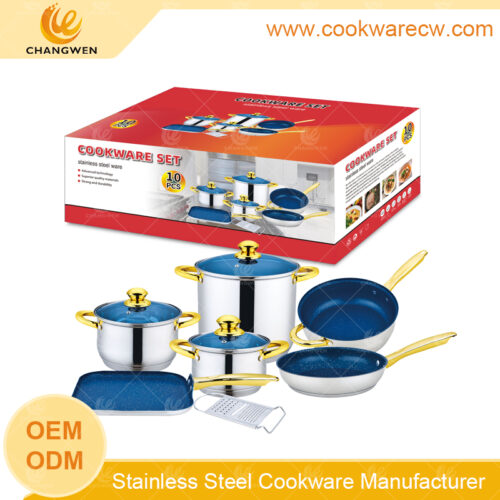
Wholesaler stainless steel cookware set conic fry pan square aluminum coated frypan with a kitchenware grater CW-M1003