
Quick answer: Cookware base disc diameter determines how far a conductive layer supports the cooking floor. When an aluminum or copper core extends close to the floor perimeter, heat can spread through that layer toward more of the usable surface. A smaller core leaves a wider outer band dependent on thinner stainless steel and the local heat source. Edge-to-edge coverage can therefore improve temperature distribution, but it does not guarantee uniform heating: core thickness, bonding, burner size, flatness, and food load still matter.
Estimated reading time: 13 minutes. This guide helps cookware buyers compare base geometry, ask for measurable specifications, and evaluate samples. Every numerical example is illustrative geometry, not a measured Changwen heating result. Product illustrations explain inspection concepts and are not certified construction drawings.
What does cookware base disc diameter actually measure?
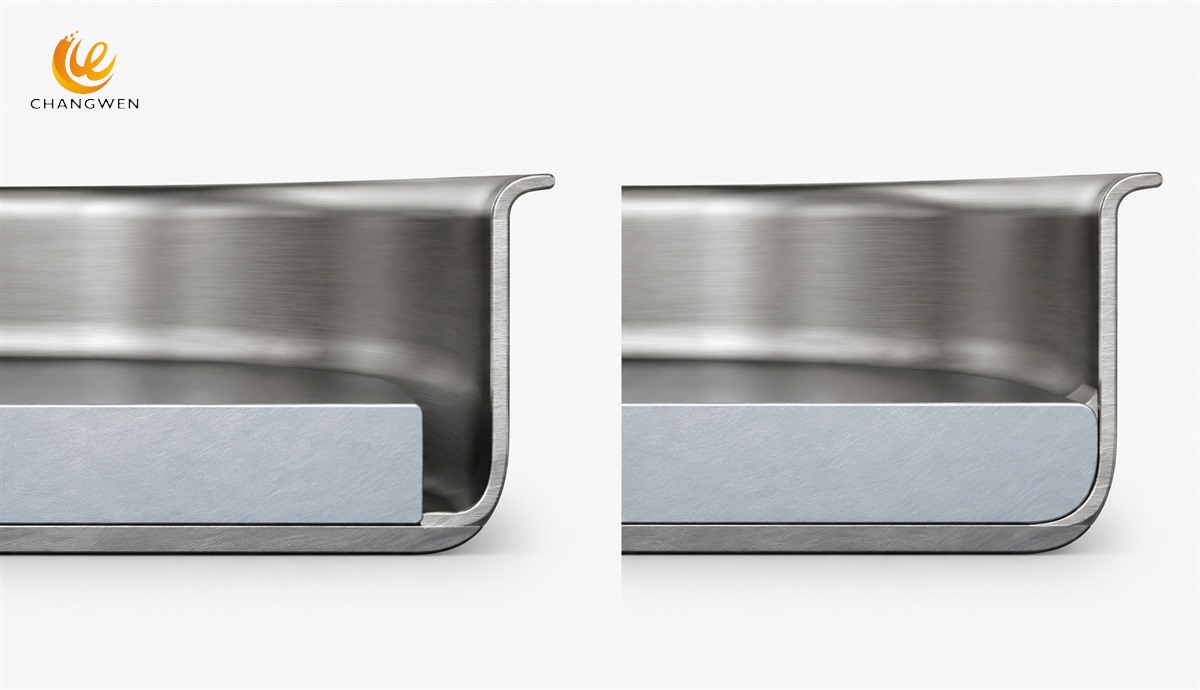
Cookware base disc diameter should identify the width of a particular circular component beneath the vessel. In a capsule base, the visible stainless steel cover and the hidden conductive core can have different diameters. A supplier quoting only the outside cover dimension has not necessarily described how much aluminum supports the cooking floor. Buyers should request both dimensions with a drawing that names the measurement boundaries.
The diameter printed on a pan label usually refers to the opening or another nominal product dimension. A flared frying pan can have a much smaller flat cooking floor than its rim. Comparing a base disc with the advertised rim diameter therefore exaggerates the apparent uncovered region. Base coverage should be calculated against a defined floor footprint, with the curved transition to the sidewall shown separately.
Which diameters belong on a cookware specification?
| Dimension | What it describes | Why the distinction matters |
|---|---|---|
| Rim diameter | Nominal opening width | Helps identify size and lid fit, but not conductive coverage |
| Cooking floor diameter | Defined flat interior footprint | Provides the reference area for food contact and coverage |
| Core diameter | Actual aluminum or copper spreader width | Shows where the conductive layer ends |
| Cover diameter | Visible outer base cap width | Can conceal a smaller internal spreader |
| Contact footprint | Area designed to face or contact the cooktop | Affects stability, hob matching, and contact heating |
The relevant dimensions should share a centerline and an agreed reference plane. A round disc that is large enough but off-center leaves a wider unsupported band on one side. Diameter alone cannot detect that asymmetry, so the drawing should also define concentricity or maximum allowable offset and identify how production inspection will check it.
Why does the conductive core change edge heating?
A conductive core redistributes heat laterally between hotter and cooler regions of the base. Aluminum and copper conduct heat much more readily than stainless steel; the representative material values in OpenStax guidance on heat transfer explain that physical difference. Extending the core reduces the distance that heat must travel through the thin stainless-only region near the floor edge. Actual performance still depends on alloy, thickness, geometry, and temperature.
The outer band does not become thermally disconnected when a core ends. Stainless steel still conducts heat, and food, liquid, radiation, and the burner can transfer energy there. The change is a less effective lateral conduction path, which can create a stronger temperature difference under some operating conditions. Describing the band as completely unheated would be inaccurate.
Does a smaller disc create a cold ring or a hot ring?
A smaller disc can contribute to either pattern because the heat source determines where energy enters. With concentrated heating beneath the center, an outer stainless-only band may lag behind the core-supported floor. With gas flames or hot combustion gases reaching the shoulder, the thin perimeter can receive strong direct heating without the same local spreading mass. A universal claim that every narrow disc creates a cold ring misses this difference.
The useful evaluation question is where the temperature changes sharply under the intended cooking conditions. A pan used for shallow frying should be assessed across the food-contact floor, while a saucepan used for reduction also needs attention near the base-to-wall transition. Report the observed pattern and test conditions rather than assigning a fixed temperature behavior from appearance alone.
How much area can a small diameter difference remove?
For concentric circular footprints, projected area coverage equals the square of core diameter divided by floor diameter, multiplied by 100. A core measuring 90 percent of the floor diameter covers approximately 81 percent of that projected circular area. Diameter percentages and area percentages are therefore different. Neither percentage directly measures heating efficiency, temperature uniformity, or energy consumption.
| Illustrative floor diameter | Core diameter | Radial setback | Projected coverage |
|---|---|---|---|
| 200 mm | 160 mm | 20 mm per side | 64 percent |
| 200 mm | 180 mm | 10 mm per side | 81 percent |
| 200 mm | 190 mm | 5 mm per side | 90.25 percent |
| 200 mm | 200 mm | 0 mm in projection | 100 percent |
The setback calculation is half the difference between floor diameter and core diameter. These examples assume flat, concentric circles and ignore corner curvature. A production drawing may need a different reference boundary for a rounded vessel. Even nominal 100 percent projected coverage does not mean the conductive layer continues up the sidewall or that every point reaches the same temperature.
What should edge-to-edge coverage mean in a purchase order?
Edge-to-edge coverage should mean that the specified conductive material reaches a defined boundary beneath the usable floor within agreed tolerances. The phrase becomes measurable only when the drawing identifies the material, minimum finished core diameter, corner reference, thickness profile, and maximum setback. A large decorative cap is not sufficient evidence for the claim.
Buyers can request a dimensioned base section showing where the core terminates relative to the internal floor and outer shoulder. The drawing should distinguish finished dimensions from the original blank dimensions because forming and bonding may change geometry. Describing the base as encapsulated or impact bonded identifies construction features, but neither term establishes full coverage by itself.
Can greater thickness compensate for a smaller disc?
A thicker conductive disc can spread heat effectively within its own footprint and add thermal mass, but it does not physically extend the conductive layer into the uncovered perimeter. Increasing thickness and increasing diameter address different parts of the design. A thick narrow disc may perform well centrally while a thinner broad core supports more of the floor; neither design wins every application without testing.
Thickness must also be assigned to the correct material. Total base height includes layers that contribute differently to heat distribution. The stainless steel cookware thickness guide provides broader context for specifying thickness. For disc comparisons, request finished core thickness and steel layer thickness separately, alongside diameter and coverage.
Why do bonding and flatness matter alongside diameter?
A broad core needs effective thermal contact with the surrounding layers. Local separation, voids, or inconsistent bonding can interrupt heat transfer even when the external dimensions look correct. A polished underside cannot verify hidden bond continuity. Suppliers should explain their process controls and the sample inspection method used to evaluate internal construction.
Flatness affects stability and contact with electric cooking surfaces, while thermal deformation can change that contact during use. Cold flatness alone does not describe hot behavior. Buyers should agree on the inspection temperature, reference surface, loading condition, and relevant thermal cycling checks. Those checks complement diameter verification rather than being replaced by a larger disc.
How does gas cooking change the coverage decision?
Gas cooking exposes a vessel to a flame pattern and hot gases that can extend beyond the base center. A core reaching closer to the floor perimeter can help moderate local differences near the shoulder, but excessive flame spread can still overheat edges and handles. The burner should be matched to the vessel, with operation following the cookware and appliance instructions.
For gas-focused product lines, test representative low and moderate settings and the actual burner geometry expected in the target market. A compact domestic burner and a powerful restaurant burner create different boundary conditions. Claims based on one burner should not be presented as universal evidence for every gas installation.
Does a larger disc improve induction performance?
Induction performance depends on the magnetic layer, the appliance coil and controls, and the conductive spreader working together. A wide aluminum core can redistribute heat generated in a compatible magnetic layer, but aluminum coverage alone does not establish induction compatibility. A larger visible base also does not prove that the appliance energizes the whole area uniformly.
Induction buyers should verify the magnetic footprint, supported vessel dimensions, stable detection, and heating distribution on representative appliances. The article what cookware works on induction covers compatibility fundamentals. A magnet check is a useful screening step, but it cannot replace an appliance test or identify hidden core dimensions.
How do electric and radiant cooktops affect edge temperatures?
Electric and radiant cooktops impose their own heating footprint, cycling behavior, and contact conditions. A wide pan placed on a small zone may develop a warm center and cooler perimeter even with extensive conductive coverage. A broader core can distribute incoming energy, but it cannot make an undersized or low-powered heat source behave like a larger one.
Tests should record the selected zone, vessel position, power setting, starting temperature, and measurement time. Rotating or shifting the pan between runs can change the result. Comparing two bases fairly requires the same setup and load, with repeat runs to distinguish consistent construction differences from positioning or control-cycle variation.
Which cooking tasks benefit most from broad floor coverage?
Broad coverage is especially relevant when food remains in contact with much of the cooking floor. Pancakes, shallow frying, sauteing, and thick sauces expose local differences more directly than a vigorously stirred liquid. A perimeter that heats differently can change browning or encourage sticking in particular areas, although food moisture, contact pressure, and technique also influence the result.
Boiling water can conceal floor differences because liquid movement redistributes heat. A satisfactory boil-time result therefore does not prove even browning. For a stockpot primarily used with large liquid loads, a well-designed disc base may be appropriate; a product marketed for broad-surface frying needs a test that represents that cooking task.
Is full base coverage equivalent to fully clad cookware?
Full base coverage describes conductive reach beneath the floor, while fully clad cookware extends a layered construction through the body and sidewalls. A disc base with excellent floor coverage can still have single-layer stainless walls. The two descriptions answer different design questions and should not be used interchangeably in product listings.
The existing tri-ply and fully clad cookware guide discusses broader construction choices. For a base-focused buying decision, first establish where the conductive layer runs, then evaluate the intended task. Layer count alone does not identify coverage, total conductive material, response time, or demonstrated heating uniformity.
How can buyers inspect a sample without cutting it?
External inspection can confirm cover diameter, contact footprint, visible setback, centering, and obvious damage. Use appropriate measuring tools and record the reference points on photographs. External measurements cannot reliably reveal a hidden aluminum core that ends inside the cover, so the inspection report should label visible dimensions accurately rather than treating them as internal measurements.
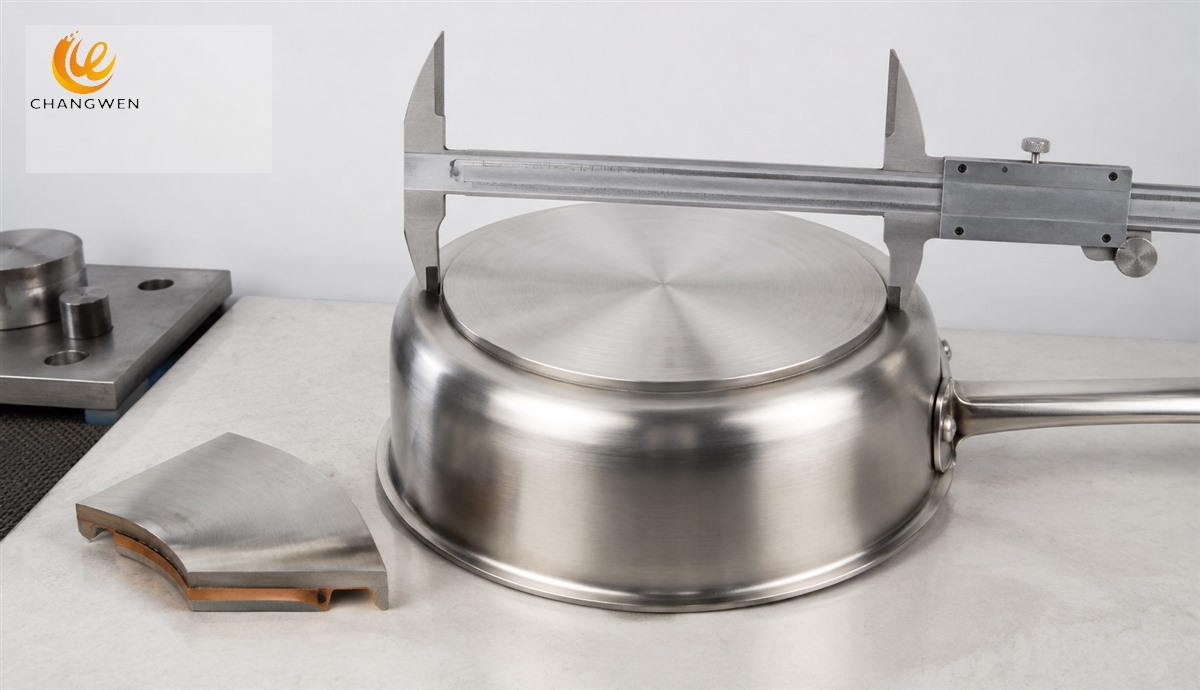
When internal coverage is commercially important, request traceable construction records and an agreed verification method. A sectioned representative sample can reveal geometry directly, while suitable nondestructive methods require appropriate equipment and interpretation. A single approved section does not prove every production unit; ongoing control still needs sampling and process evidence.
What should a useful heating comparison measure?
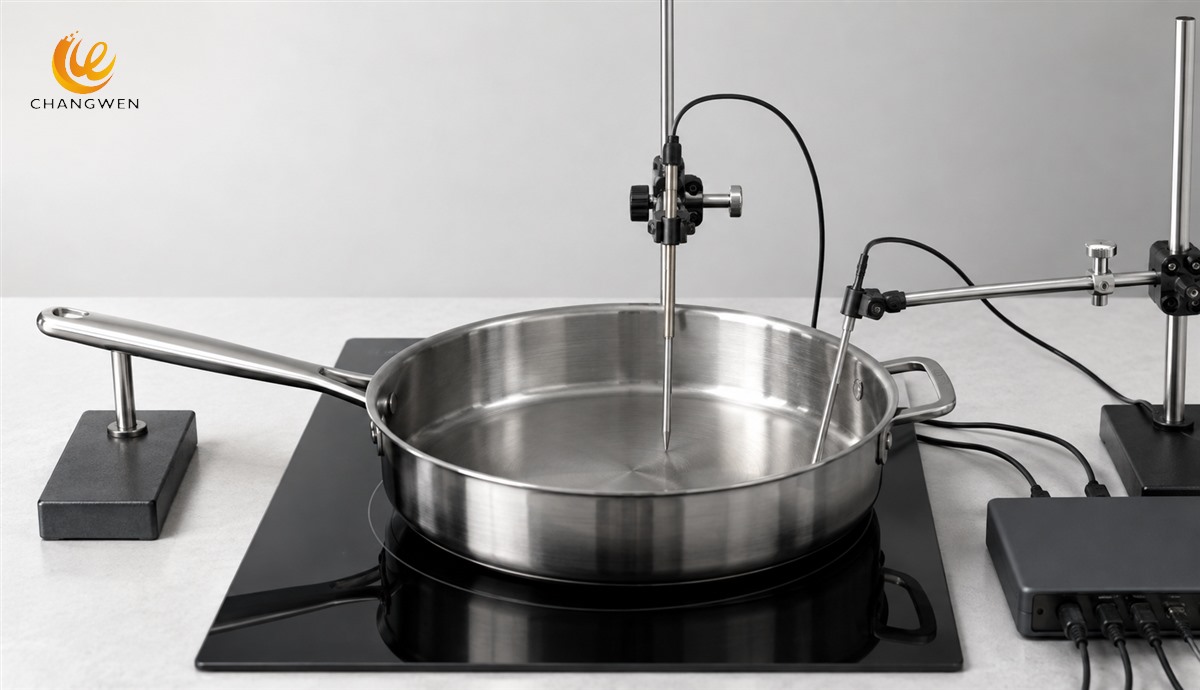
A useful heating comparison measures the center, intermediate radii, and near-edge locations over time under a defined load. Include more than one direction because off-center construction or burner asymmetry may affect only part of the perimeter. Record both warm-up behavior and the temperature spread during the relevant cooking interval, not just one attractive final image.
A buyer can compare maximum minus minimum temperature across the agreed measurement locations, time to a target condition, and recovery after a standardized load is added. Acceptance limits should come from the product brief and validated method. No universal temperature-spread threshold or mandatory coverage percentage applies to every cookware design described here.
Why can thermal camera images mislead cookware buyers?
Polished stainless steel reflects infrared radiation and can produce misleading apparent temperatures. Thermal-camera results require suitable control of emissivity, reflections, measurement geometry, and surface condition. The instrument manufacturer explanation of emissivity describes why reflective metal is difficult to measure. A colorful image without measurement settings is insufficient evidence of uniform heating.
Qualified testing can use validated contact sensors or an appropriate calibrated thermography method. Any surface treatment used for measurement must suit the temperature and test purpose; ordinary tape is not a general solution for a hot food-contact surface. AI-generated heat maps, marketing gradients, and edited images must never be presented as laboratory measurements.
How should buyers compare supplier quotations?
Supplier quotations should use the same finished floor diameter, minimum core diameter, material, thickness, cover specification, and test conditions. Otherwise, a lower price may reflect less conductive material, a different body geometry, or a different inspection commitment. Ask suppliers to state deviations explicitly so the purchasing team can compare the actual construction being offered.
Request an itemized construction drawing with revision control and make the accepted dimensions part of the order. The trial-based method for comparing cookware manufacturers explains how controlled samples strengthen supplier evaluation. A common test brief is more informative than independent demonstrations performed with different burners, loads, and timing.
Should every size in a cookware family use the same disc?
Using one disc across several vessel sizes can simplify manufacturing, but the coverage ratio falls as the cooking floor becomes wider. A disc approved beneath a small saucepan may leave a substantial perimeter band beneath a larger saute pan. Evaluate each size against its own floor geometry instead of assuming that a shared component produces equivalent heating throughout the collection.
A size matrix should list floor diameter, core diameter, radial setback, and intended appliance for every SKU. Prioritize sample testing at the largest floor-to-core mismatch and any change in construction. Testing only the smallest vessel can overlook the design most likely to expose a weak perimeter. Shared components remain reasonable when each affected product meets its agreed performance requirements.
What are the cost and weight tradeoffs of wider coverage?
Increasing core diameter at constant thickness adds conductive material and mass. In the illustrative 160 mm versus 190 mm comparison, circular core area increases by approximately 41 percent. That calculation describes material geometry, not a 41 percent heating improvement or an equivalent increase in finished product cost. Tooling, bonding, cover design, finishing, yield, and purchasing volume also influence price.
More mass can change warm-up and cooling response as well as handling weight. A buyer choosing broad coverage should therefore state acceptable response and weight alongside uniformity expectations. A pan that distributes heat well but is uncomfortable to lift may fail the intended customer brief. The engineering decision balances cooking results, usable size, handling, and cost through a sample evaluation rather than maximizing one dimension.
What should the base approval checklist contain?
- Defined cooking floor diameter and corner reference.
- Finished conductive core material, diameter, and thickness profile.
- Visible cover diameter and magnetic layer specification where relevant.
- Maximum edge setback and allowable offset from the centerline.
- Bond inspection method and representative sample identification.
- Cold and relevant heated stability or flatness requirements.
- Named appliances, loads, sensor positions, and operating settings.
- Repeat-test requirements and agreed heating acceptance criteria.
- Approved drawing revision and controls for production changes.
The checklist should identify which characteristics are inspected on samples, which are controlled during production, and which require periodic verification. A signed sample alone does not prevent a later material or tooling change. Buyers should require notification and approval when changes affect core reach, thickness, bonding, or the promised heating behavior.
Frequently asked questions about cookware base discs
Can the core diameter be identified with a magnet?
A magnet can reveal attraction at the outer magnetic layer, but it cannot map the diameter of a hidden aluminum or copper spreader. Magnetic response and conductive coverage are separate properties. Use the magnet only for an appropriate compatibility screen and obtain internal geometry evidence separately.
Does a heavier pan always have better coverage?
A heavier pan may contain thicker steel, larger handles, a heavier lid, or a thicker narrow core. Weight cannot identify where the material is located. Comparing base coverage requires dimensions and construction details even when two samples have noticeably different masses.
Can a visible seam prove poor bonding?
A visible perimeter seam may be a normal construction feature and does not independently establish internal separation. Conversely, a seamless-looking cover cannot prove a sound bond. Evaluate the approved design, surface condition, and suitable inspection evidence before accepting or rejecting a sample.
Can longer preheating correct an undersized disc?
Longer preheating may reduce some transient temperature differences, but it does not change the underlying geometry or guarantee uniformity under food load. Excessive empty heating can damage cookware. Follow product instructions and select a construction that performs adequately during normal use.
What is the purchasing conclusion?
Cookware base disc diameter matters because conductive coverage changes the path available for heat to reach the floor perimeter. Buyers should define the actual core boundary, compare coverage against the cooking floor, and validate performance on the intended cooktop. Wider coverage is a useful design attribute when supported by suitable thickness, bonding, stability, and controlled testing.
For a Changwen cookware inquiry, include the target vessel size, cooking floor dimensions, core material and coverage requirements, intended appliances, order quantity, and sample test brief. The capsule-bottom construction overview provides background for that discussion. A precise specification makes supplier proposals easier to compare and gives production approval a measurable basis.
-
Stainless Steel Pot Cook Rice CW-M0608
-
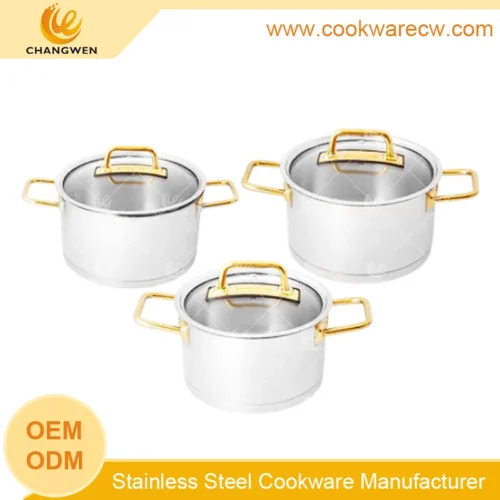
6-Piece Stainless Steel Pot Set with Gold Handles CW-ES0610
-
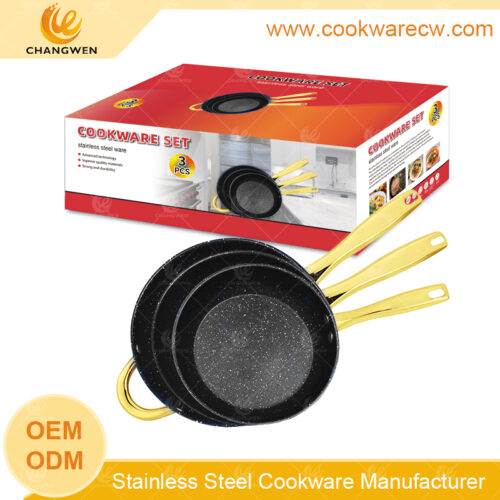
Hot sale 3pcs stainless steel nonstick fry pan set golden plated handles black coating cookware CW-M0301-01
-
Pressure Cooker Stainless Steel for Healthy Cooking
-
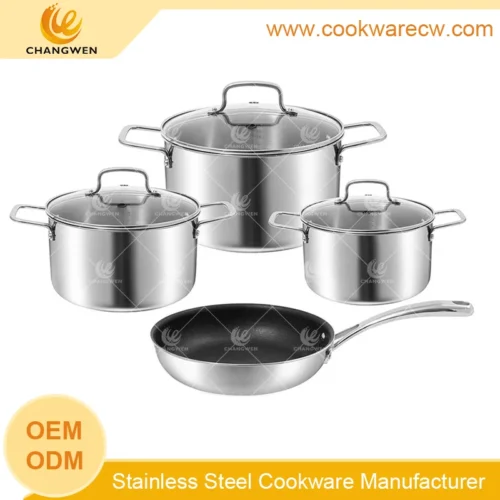
Professional Stainless Steel Cookware Set for Daily Cooking CW-ETP0704
-
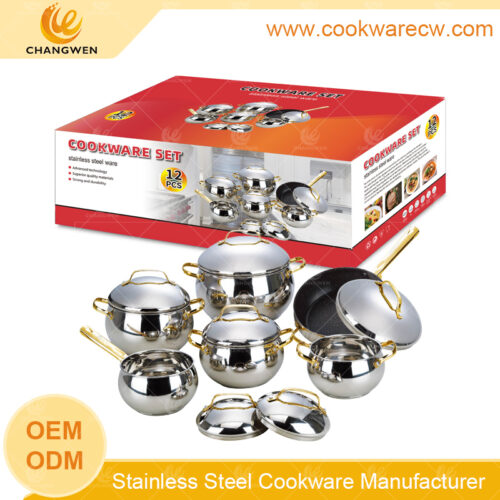
Pots wholesale apple shape cookware set mirror polished stainless steel lids golden wire handles and knobs nonstick frypan CW-M1220
-
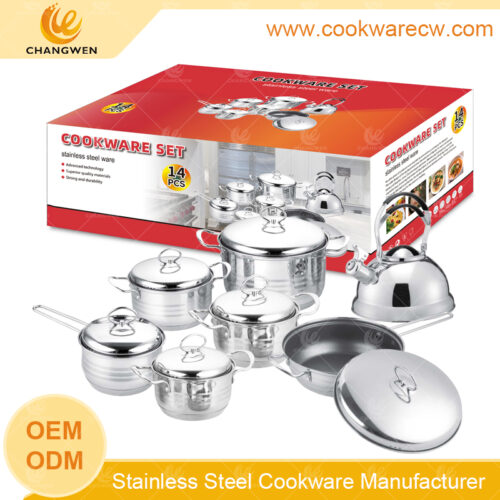
18/10 Stainless Steel Cookware CW-M1402G
-
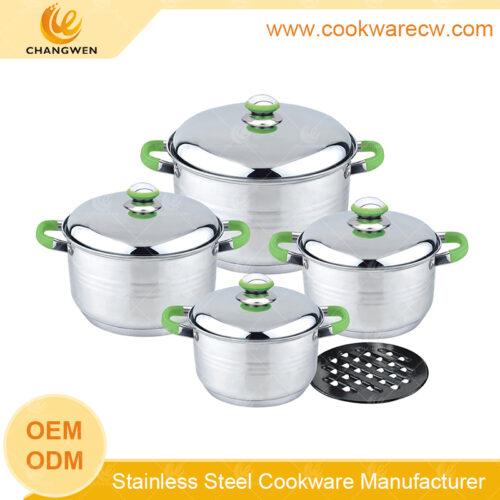
Stainless Steel Cookware Sets 9-Piece CW-M0903G