
Read time: 12 minutes
Introduction: Why Stainless Steel Frying Pans Remain a Top Choice in Global Cookware Markets
Stainless steel frying pans have held their place as one of the most commercially durable product categories in global cookware for a reason. No coating to degrade. No seasoning to maintain. Compatible with every stovetop type. Oven-safe without temperature restrictions. Dishwasher-safe (though hand washing is always preferred). And a professional aesthetic that justifies mid-to-premium retail pricing across every major market.
Consumer demand for stainless steel frying pans continues to grow because buyers increasingly value durability over convenience. Non-stick coatings wear out. PFAS concerns have pushed health-conscious consumers toward coating-free surfaces. And in professional kitchen contexts, stainless steel has always been the standard — because it survives the heat, the metal utensils, and the commercial dishwasher cycles that would destroy any coated pan within months.
For cookware brands and distributors, a successful stainless steel frying pan requires balancing performance, cost, manufacturing quality, and target market expectations. The material is the same — 304 stainless steel, 430 stainless steel, aluminum core — but the construction choices, thickness specifications, handle design, and surface finish create dramatically different products at dramatically different price points.
This guide gives you the specification framework to make those decisions correctly, whether you are developing a product line for the first time or evaluating an existing OEM supply relationship.
Changwen is a professional stainless steel cookware manufacturer in China, providing OEM and wholesale stainless steel frying pans for global distributors, retailers, and kitchenware brands. With over 22 years of manufacturing experience, we supply tri-ply, disc-base, and commercial frying pan programs to markets across South America, Europe, Southeast Asia, the Middle East, and Australia.
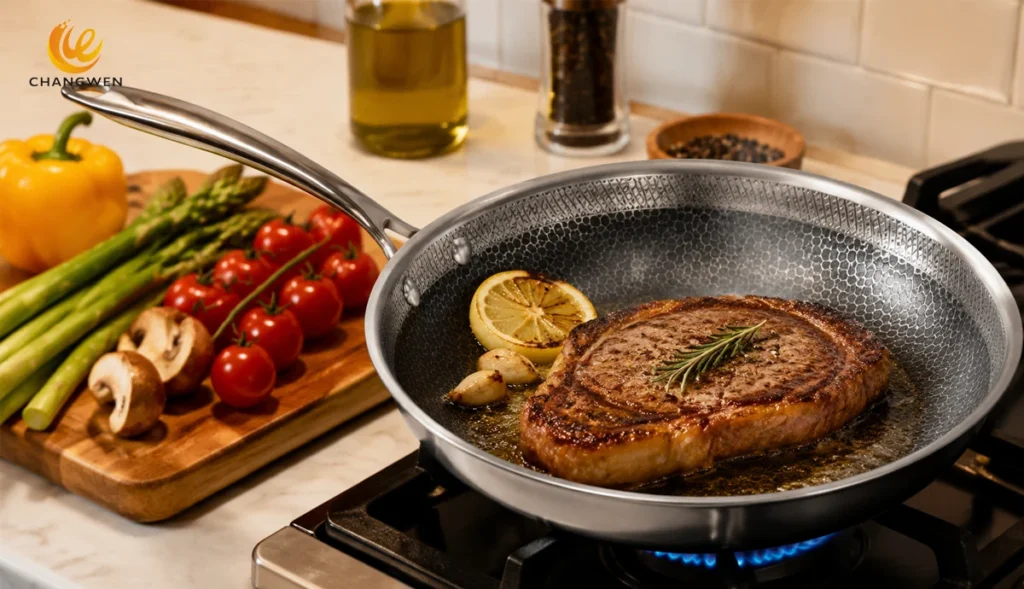
What Makes Stainless Steel Frying Pans Different from Other Cookware?
Stainless Steel vs Non-Stick Frying Pans
The comparison between stainless steel and non-stick is the most frequent buying decision in frying pan category development. Both serve real markets. Neither is objectively superior — they are engineered for different cooking styles.
| Feature | Stainless Steel | Non-Stick |
| Durability | Excellent — no coating to degrade | Medium — coating has a service life |
| High-heat cooking | Excellent — no temperature restrictions | Limited — coatings degrade above 260°C |
| Cooking surface | Bare metal — no coating | PTFE, ceramic, or granite coating required |
| Metal utensil safe | Yes | No — scratches coating |
| Professional kitchen use | High — industry standard | Medium — limited to specific tasks |
| Product lifespan | 10–20+ years | 3–7 years with careful use |
| PFAS concern | None — no coating | Varies by coating type |
| Searing and browning | Excellent — superior Maillard reaction | Good but limited at high heat |
| Ease of use for beginners | Requires technique | Easier — minimal sticking |
Premium cookware brands include stainless steel pans in their product lines because stainless positions at a higher retail price point, carries no coating liability, and communicates professional performance credentials. Non-stick serves the convenience-first consumer segment.
For brand strategy: stainless steel is the premium tier. Non-stick is the accessibility tier. The most commercially complete cookware brand has both.
Stainless Steel vs Aluminum Frying Pans
Stainless steel and aluminum are both used in frying pan construction, but they serve different roles and market segments.
Stainless steel advantages: Corrosion resistance — does not pit, rust, or react with acidic foods. Premium visual appearance — brushed or polished steel communicates quality at a glance. Non-reactive cooking surface — no metallic taste from tomatoes, wine, or citrus. Superior long-term durability — maintains structural and surface integrity over years of heavy use.
Aluminum advantages: Lighter weight — relevant for large commercial pans that staff must move frequently. Faster heating — aluminum’s thermal conductivity is approximately 15× higher than stainless steel. Lower production cost — aluminum is cheaper to form and process than stainless steel.
The key buyer consideration: target price, customer segment, and market positioning determine the right material. For entry-level non-stick programs, aluminum is the base material. For premium uncoated cookware, stainless steel is the specification.
Key Factors to Consider When Choosing a Stainless Steel Frying Pan
1. Stainless Steel Grade and Material Quality
The steel grade is the most important material specification in any stainless steel frying pan program. It determines food safety, corrosion resistance, and the durability of the cooking surface.
304 Stainless Steel (18/8)
304 stainless steel contains 18% chromium and 8% nickel. It is the global standard for food-contact cookware surfaces. The chromium forms a passive oxide layer that prevents corrosion and prevents the steel from reacting with acidic foods — tomatoes, wine, citrus, and vinegar cause no surface degradation or flavor transfer. The nickel content improves corrosion resistance and creates the bright, clean appearance associated with quality stainless cookware.
304 stainless steel is food-safe, verified by LFGB (EU), FDA (US), and all major food contact material standards. For any frying pan positioned at mid-range or above, the inner cooking surface should be 304 stainless steel, confirmed by material test report (mill certificate) from the steel supplier.
18/10 stainless steel is a variant of 304 with slightly higher nickel content (10% vs 8%), producing marginally better corrosion resistance and a brighter surface finish. It is the premium specification for the inner cooking surface.
430 Stainless Steel
430 stainless steel contains 17% chromium and no nickel. Its ferritic (magnetic) structure is required for induction cooktop compatibility — induction elements detect magnetic materials. Any stainless steel frying pan positioned for markets with significant induction penetration (EU, Australia, Japan, urban North America) must have a 430 stainless steel outer layer.
430 stainless steel is the correct material for the outer base of induction-compatible pans — not the cooking surface, which requires 304 for food safety and corrosion resistance.
The 201 fraud risk: 201 stainless steel contains 1–4% nickel (versus 8–10% in 304) and uses manganese as a substitute. It looks identical to 304 visually but has lower corrosion resistance and inferior food safety performance. The most common quality fraud in stainless steel cookware is 201 sold as 304. Require mill certificates (Material Test Reports) confirming 304 grade for every production batch. XRF testing on physical samples provides on-site verification.
2. Construction: Single Layer vs Tri-Ply vs Multi-Ply
Construction is the specification that most directly determines cooking performance and retail price positioning.
Single-Layer Stainless Steel Pan
A single layer of stainless steel — without any conductive core material. The least expensive construction.
Performance: adequate for boiling and simple sautéing. Develops hot spots because stainless steel is a poor heat conductor (approximately 16 W/m·K vs aluminum at 237 W/m·K). Food at the burner contact point heats differently from food at the edges. This makes consistent browning and searing more difficult.
Best for: entry-level market positioning, commercial stock pot applications where even heat distribution is less critical, price-sensitive retail channels.
Tri-Ply Stainless Steel Frying Pan
Three permanently bonded layers:
- 304 stainless steel— inner cooking surface (food-safe, non-reactive)
- Aluminum alloy core— heat distribution layer (conducts heat evenly across base and sidewalls)
- 430 stainless steel— outer layer (magnetic, induction-compatible)
The aluminum core distributes heat from the burner contact point rapidly and evenly across the entire cooking surface. In a quality tri-ply frying pan, the temperature difference between the center and edge of the pan at medium heat is typically less than 10°C. In a single-layer pan, this difference can exceed 50°C.
The full-clad configuration means the three layers run continuously from the base through the sidewalls. This matters for sautéing and pan sauce work — food that contacts the sides of the pan receives consistent heat, not just the base.
Benefits: even heat distribution across the full cooking surface, faster temperature recovery when cold food is added, better overall cooking performance for searing, sautéing, and reduction work.
Best for: mid-to-premium market positioning, retail brands, OEM programs targeting EU, North American, and Australian premium segments, cookware sets where consistent performance across all pieces matters.
5-Ply Stainless Steel Frying Pan
Five bonded layers — two stainless steel layers on either side of a multi-layer conductive core (typically two aluminum layers with a stainless steel or copper interlayer). The additional material mass increases heat retention and warp resistance.
Benefits versus tri-ply: marginally better temperature stability when cold food is added (larger thermal mass), improved warp resistance over sustained high-heat use, positioning story (“5-ply” communicates premium construction concisely in retail marketing).
Important consideration: total core thickness and material quality matter more than layer count alone. A well-specified tri-ply pan with a thick, high-quality aluminum core can match or exceed the performance of a thin 5-ply pan. Require total wall thickness and core thickness specifications in millimeters, not just ply count.
Best for: premium and luxury market positioning, high-end retail, brands that compete on technical specification depth.
How Thickness Affects Stainless Steel Frying Pan Performance
Pan Thickness and Heat Distribution
Wall thickness is the measurable specification that directly predicts heat distribution performance, warp resistance, and product longevity. Thicker walls distribute heat more evenly (more material to conduct heat laterally), resist warping under high-heat use, and feel more substantial — which influences perceived quality.
- Entry market (budget positioning):6–2.0mm total wall thickness. Lighter, less expensive, adequate for occasional home use.
- Mid-range (standard home and professional):4–2.8mm total wall thickness. Appropriate for most home cooking and standard commercial applications.
- Premium market:8–3.0mm+ total wall thickness. Maximum heat distribution consistency, excellent warp resistance under sustained commercial use.
Specify wall thickness in millimeters and confirm on production samples with a micrometer. “Heavy gauge” without a specific measurement is not a verifiable specification.
Finding the Right Balance Between Weight and Performance
Weight is directly related to wall thickness and ply count. The ideal frying pan balances cooking performance with handling comfort.
Too light (under 2.0mm total): feels cheap at retail, warps more easily under high heat, develops more pronounced hot spots. Produces the tactile impression of low quality that customers notice immediately when lifting the pan.
Too heavy (over 3.5mm total): requires more strength to maneuver, particularly relevant for wrist-intensive techniques like sautéing and tossing. For retail buyers, a pan that is difficult to lift will generate negative feedback from users who cook frequently.
The commercial sweet spot for a quality stainless steel frying pan at mid-to-premium positioning is 2.4–2.8mm total wall thickness — substantial enough to feel premium, light enough for comfortable daily use.
Choosing the Right Stainless Steel Frying Pan Size for Your Market
Popular Frying Pan Sizes
8-Inch (20cm) Stainless Steel Frying Pan
The smallest practical frying pan size. Suitable for single servings, omelets, single eggs, sauce reduction for one. Best positioned for single-person households, couples’ kitchen sets, and as an addition to larger-piece sets. Not the primary volume SKU for most programs.
10-Inch (24–26cm) Stainless Steel Frying Pan
The most versatile and commercially highest-volume frying pan size. Handles 2–3 portions of protein, a full vegetables sauté, pasta sauce, and most everyday cooking tasks. This is the size that drives the highest unit volume across both retail and e-commerce channels. Any frying pan program should prioritize this size.
12-Inch (28–30cm) Stainless Steel Frying Pan
Family-scale frying pan for 4+ portions, large-format searing (multiple steaks simultaneously), and professional cooking applications. Generates higher per-unit revenue than smaller sizes. Particularly strong for restaurant supply programs where cooking for multiple portions is the standard.
How Size Selection Impacts Sales Performance
Offering multiple sizes in a frying pan program increases conversion across different buyer segments. A buyer who wants a 10-inch for daily cooking may add a 12-inch for entertaining — but only if both are available as part of a coherent range.
Frying pan sets (e.g., 20cm + 26cm + 30cm sold together) create higher order values and reduce the price-sensitivity of individual size purchases. For retail programs, set pricing typically generates better margin per unit than single-piece pricing on the same specifications.
Handle Design: An Important Detail for Product Success
Stainless Steel Handle vs Bakelite Handle
Handle design is the first tactile impression a buyer has of a frying pan. Before a single egg is cooked, the handle communicates quality, comfort, and positioning.
Stainless steel handle:
- Premium appearance that matches the pan body
- Oven-safe without temperature restriction — critical for programs marketed for stovetop-to-oven use
- Hollow construction stays cooler during stovetop use than solid cast handles
- Durable and easy to clean — no heat-resistant material to degrade over time
- Heavier than Bakelite — adds weight to the pan
Bakelite handle:
- Comfortable, warm-to-touch grip even when the pan is hot (the material does not conduct heat efficiently)
- Lower production cost than stainless steel handles
- Oven safe to 180–200°C with standard phenolic formulation — confirm specific temperature rating
- Available in multiple colors for brand differentiation in lifestyle programs
- Can become brittle over years of high-heat use
Selection guidance: stainless steel handles for premium positioning and oven-safe marketing claims. Bakelite (or silicone-coated Bakelite) for mid-range programs where handle comfort and cost are priorities.
Handle Attachment Methods
Riveted handles: The handle is fixed to the pan body with load-bearing rivets that penetrate through the sidewall. Riveted attachment tolerates the lateral and torsional stress of sautéing technique, tossing, and daily handling without loosening over time. Industry standard for commercial-grade and premium consumer cookware.
Welded handles: The handle is welded to the pan body. Provides a cleaner aesthetic with no rivet heads visible on the interior surface. Appropriate for lighter-duty consumer programs. Less durable than riveted attachment under repeated heavy loading.
Buyer consideration: for any frying pan positioned at mid-range or above, or for any commercial kitchen program, riveted handle attachment is the correct specification.
Important Features Cookware Buyers Should Evaluate
Induction Compatibility
Induction cooktops account for over 50% of new cooktop sales in Western Europe and are growing rapidly in Australia, Japan, South Korea, and urban North America. A stainless steel frying pan without induction compatibility is excluded from a significant and growing share of the consumer market.
Induction compatibility requires a magnetic base material — specifically, a 430 stainless steel outer layer in tri-ply construction provides this by design. For disc-base construction, a 430 stainless steel base disc must be included.
Verify induction compatibility with a magnet test on production samples — the base should attract and hold a magnet. For OEM programs, specify 430 outer layer explicitly and require confirmation.
Oven Safety
A stainless steel frying pan with stainless steel handles is oven-safe without practical temperature limitations — far above any domestic oven temperature. This allows the pan to be used for stovetop-to-oven techniques: sear a steak on the burner, finish in the oven. Sear a frittata on the burner, set it in the oven.
Oven-safe marketing claims are only valid when the entire pan — body and handles — can enter the oven. Confirm oven temperature rating on physical samples and in product specification. Bakelite handles typically limit oven safety to 180–200°C.
Dishwasher Compatibility
Stainless steel frying pans are technically dishwasher-safe — the material can withstand dishwasher temperatures and cleaning agents. However, dishwasher detergents contain alkaline compounds that dull polished surfaces over time, and repeated dishwasher cycling accelerates wear on the exterior finish.
The standard recommendation: dishwasher-safe for convenience marketing, hand washing recommended for longevity. Communicate this clearly in care instructions on packaging.
How to Select Stainless Steel Frying Pans for Different Markets
Entry-Level Market
Specification: single-layer stainless steel with disc base, 1.6–2.0mm total wall thickness, Bakelite handle, basic brushed or mirror finish. 304 inner surface where budget allows.
Target channels: supermarkets, mass-market e-commerce, budget home retail. Competitive on price. Volume-driven. Lower margin per unit, higher unit velocity.
Mid-Range Market
Specification: tri-ply full-clad construction (304-aluminum-430), 2.4–2.6mm total wall thickness, riveted Bakelite or stainless steel handle, brushed exterior. LFGB or FDA food contact certification.
Target channels: mid-tier retail chains, specialty kitchen stores, mid-market e-commerce, Amazon mid-range positioning. Competitive on specification-to-price ratio. This is the most commercially competitive segment.
Premium Market
Specification: tri-ply or 5-ply full-clad, 2.6–3.0mm+ total wall thickness, stainless steel riveted handle (oven-safe), premium surface finish (mirror, PVD color, or hammered), 18/10 inner surface, full certification package.
Target channels: premium kitchenware retailers, specialty stores, high-end e-commerce brands, wedding registry programs, gift market. Competitive on brand story and specification depth. Highest margin per unit.
Stainless Steel Frying Pan Quality Checklist Before Bulk Purchasing
Before placing a production order with any stainless steel cookware manufacturer, verify these quality checkpoints:
Material:
- Inner surface confirmed as 304 stainless steel (18/8 or 18/10) by mill certificate
- Food contact certification: LFGB test report (EU) or FDA compliance documentation (US)
- No 201 substitution — confirmed by material documentation
Construction:
- Total wall thickness measured in millimeters (micrometer on physical sample)
- Full-clad confirmed by cross-section cut on sample (not disc-base presented as full-clad)
- Base flatness — no warping on production samples
Finishing:
- Interior surface: consistent, smooth, no tool marks or polishing inconsistencies
- Exterior finish: brushed grain consistent across the full surface, no cross-hatching or scratches
- Logo engraving: clean edges, consistent depth, correct placement
Accessories:
- Handle strength: no movement when lateral and torsional load is applied (simulating sautéing and tossing)
- Handle attachment rivets: flush, no protrusion or sharp edges on interior
- Packaging quality: no damage marks, correct labeling, appropriate cushioning
How to Source Stainless Steel Frying Pans from a Reliable Manufacturer
Questions to Ask Your Cookware Supplier
Before committing to any OEM stainless steel frying pan program, ask:
- What stainless steel grades are used for the inner surface and outer layer? Can you provide mill certificates per production batch?
- Is the construction full-clad tri-ply, or disc-base? Can you provide a cross-section cut of a sample?
- What is the total wall thickness and core thickness?
- What certifications do you hold (LFGB, FDA, ISO 9001)?
- What is the MOQ for catalog products with OEM branding?
- Can you customize handle material, color, and design?
- Can you produce custom retail packaging and logo engraving?
- Do you support pre-shipment inspection by third-party companies (SGS, Bureau Veritas, Intertek)?
A manufacturer who cannot answer these questions specifically — who responds with “high quality” instead of documented specifications — is a manufacturer whose quality claims are unverifiable.
OEM and Private Label Opportunities
A quality stainless steel cookware manufacturer offers full customization across every element of the product:
- Logo:Laser engraving (permanent, dishwasher-safe), embossing, or etching
- Surface finish:Brushed satin, mirror polish, matte/sandblast, PVD color (black, gold, rose gold, hammered), hammered texture
- Handle:Material (stainless or Bakelite), color, ergonomic specification
- Set composition:Individual SKUs or configured sets by piece count
- Packaging:Custom retail box, insert card, care instructions, barcode placement
The OEM program that delivers brand differentiation is not just “put my logo on their pan” — it is the combination of verified material specification, chosen construction tier, selected finish, and custom packaging that creates a product the buyer cannot replicate from the factory’s general catalog.
Final Buying Checklist: Choosing the Best Stainless Steel Frying Pan
Before finalizing any stainless steel frying pan OEM program:
✓ Select the correct stainless steel grade — 304 (18/8 or 18/10) inner surface, 430 outer layer for induction, confirmed by mill certificate
✓ Choose construction matched to market positioning — full-clad tri-ply for mid-to-premium, disc-base for entry; specify wall thickness in mm
✓ Match thickness to market positioning — 2.4mm+ for mid-range, 2.6mm+ for premium
✓ Evaluate handle material and attachment — riveted for durability, stainless for oven-safe, Bakelite for comfort and lower cost
✓ Confirm induction compatibility — 430 magnetic outer layer, tested with magnet on production sample
✓ Require food contact certification — LFGB for EU markets, FDA compliance for US, ISO 9001 from manufacturer
✓ Review OEM customization options — logo, finish, handle, packaging, set composition
✓ Commission pre-shipment inspection on first orders — verify specification compliance before container loading
Work With Changwen for OEM Stainless Steel Frying Pan Programs
Changwen is a professional stainless steel cookware manufacturer based in Jiangmen, Guangdong, China, with over 22 years of OEM and wholesale manufacturing experience. We produce stainless steel frying pans, stainless steel skillets, tri-ply cookware sets, and commercial frying pans for global brands and distributors.
OEM and wholesale frying pan capabilities:
- Tri-ply full-clad (304-aluminum-430) in 20cm, 24cm, 26cm, 28cm, 30cm
- Disc-base construction for entry market programs
- Custom surface finish: brushed, mirror, matte, PVD color, hammered
- Riveted stainless steel or Bakelite handle options
- Laser logo engraving and custom retail packaging
- Material test reports (mill certificates) per production batch
- LFGB food contact compliance documentation
- FDA compliance documentation
- ISO 9001:2015 certified manufacturing
Looking for a professional stainless steel frying pan manufacturer? Contact Changwen for OEM and wholesale cookware solutions including stainless steel frying pans, skillets, cookware sets, and custom kitchenware production for global brands and distributors.
-
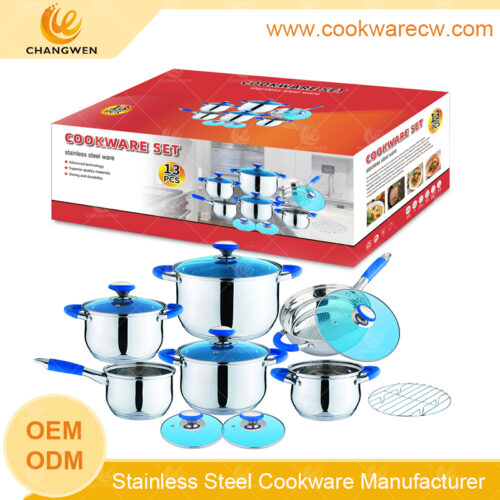
Wholesale price stainless steel pots and pans mirror polished cookware set saucepan milkpot casseroles with blue silicone and blue glass lids steamer wire rack CW-M1307G-01
-
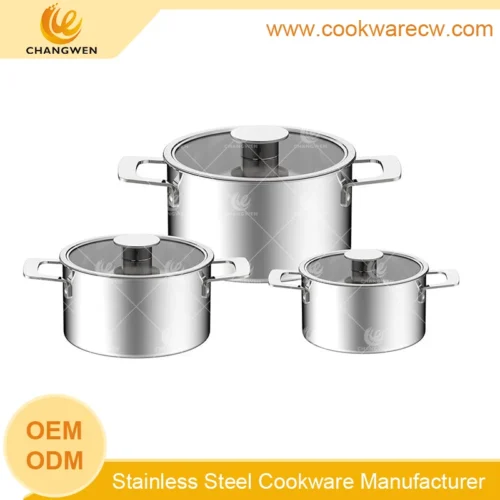
Durable Stainless Steel Pot Set for Everyday Use CW-TP0604
-
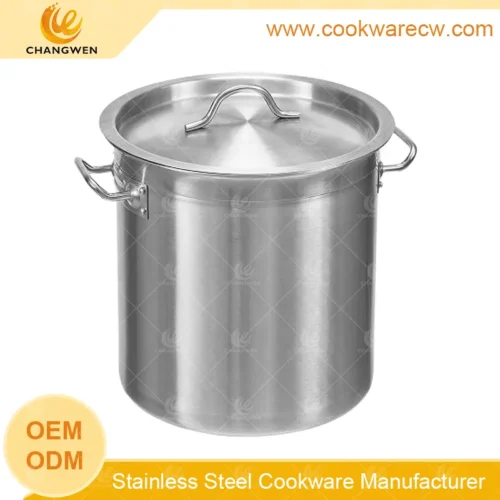
Wholesale Soup Pots CW-SP001
-
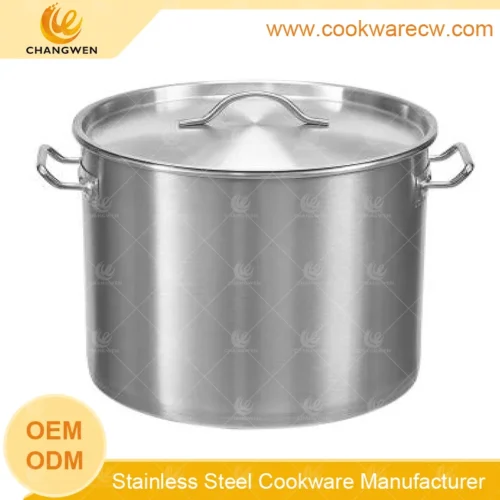
Wholesale Stock Pot CW-SP002
-
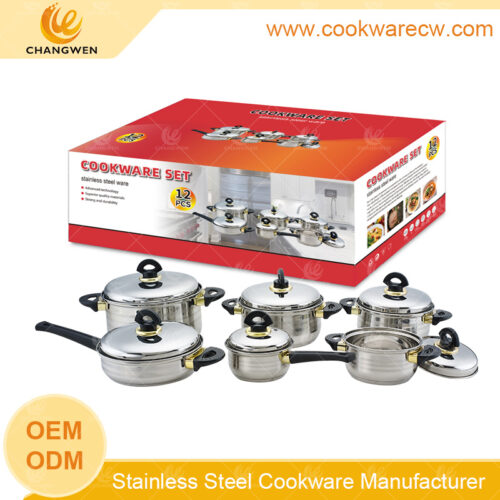
China cookware set 12pcs pots wholesale stainless steel lids black handle and knob frypan casserole saucepan CW-M1229B
-
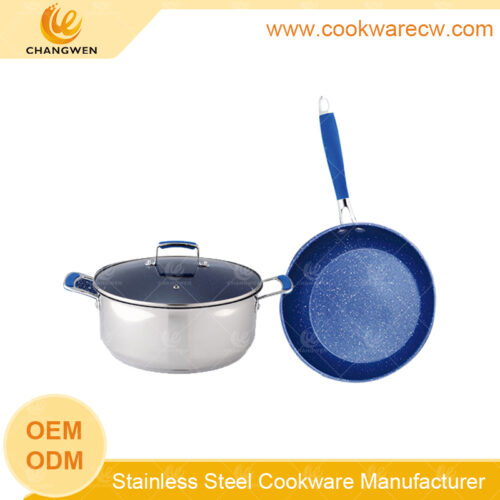
Camping Pot Stainless Steel
-
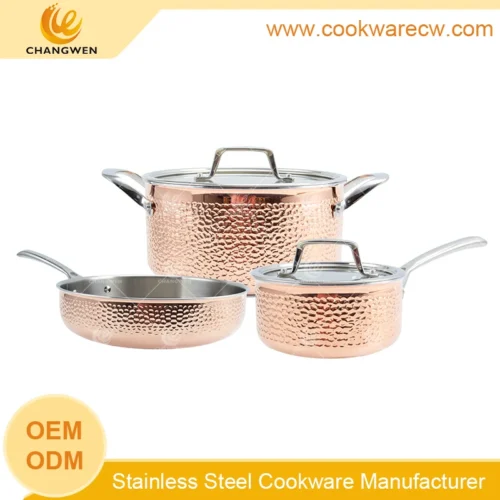
Gold Hammered Stainless Steel Cookware for Luxury Kitchens CW-ETP0501
-
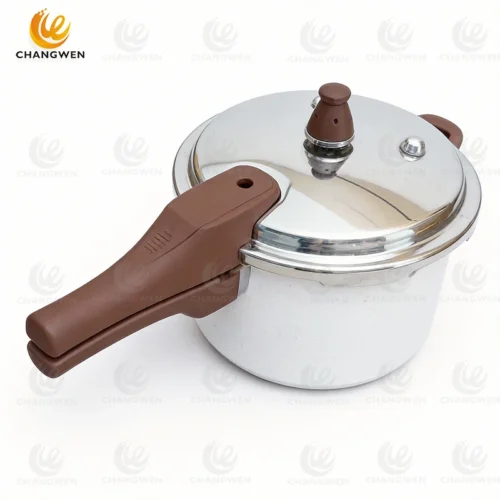
Small Aluminum Pressure Cooker for Fast & Safe Home Cooking