
Reading time: 10 minutes
Introduction
If you are importing cookware from China in 2026, you are navigating one of the most complex cost structures in recent memory. Freight rates have normalized from 2021–2022 pandemic highs, but the tariff environment has changed dramatically. The US-China trade situation has shifted significantly since early 2025, and the question “what is the import tariff from China to USA today” has a more complicated answer than it did two years ago.
This guide gives you a complete, honest breakdown of every cost component in importing cookware from China to the US — from FOB factory price through to your warehouse. Product cost, freight, insurance, customs duties, broker fees, and destination charges. Real numbers for 2026, not averages from 2022.
Whether you are importing a full container of stainless steel cookware sets or testing the market with a smaller LCL shipment, this guide gives you the framework to calculate your actual landed cost before you commit to a purchase order.

Key Takeaways
- Landed cost is the only number that matters. It includes product cost + freight + insurance + import duty + customs fees + destination charges. Quotes that show only one or two of these numbers are incomplete.
- The HTS code for stainless steel cookware is primarily 7323.93 (table and kitchen articles of stainless steel). The base US duty rate under this code is 2%. However, Section 301 tariffs add significantly more for Chinese-origin goods.
- Current US import tariffs on Chinese goods in early 2026 include Section 301 tariffs (~25% for most cookware categories) plus additional layers — total effective rates on cookware from China are approximately 25–30% of the customs value as of early 2026. This figure is subject to change given ongoing trade policy activity.
- Ocean freight remains the most cost-effective shipping mode for cookware. A 40ft container from China to the US West Coast runs approximately $2,100–$2,700 in early 2026.
- The $800 de minimis exemption for Chinese goods was eliminated in May 2025. Every commercial shipment from China now requires full customs entry and duty payment regardless of value.
- Working with a licensed customs broker is essential. The US-China tariff landscape is too complex and too rapidly changing to navigate without professional support.
Part 1: Understanding Your Cookware HTS Code
Before calculating any import costs, you need the correct HTS (Harmonized Tariff Schedule) code for your cookware. HTS codes determine the base duty rate and which Section 301 tariff list applies.
Key HTS Codes for Cookware
Stainless steel cookware:
- 7323.93 — Table, kitchen or other household articles of stainless steel. This is the primary code for stainless steel pots, pans, cookware sets, and kitchen articles. Base duty rate: 2%.
Aluminum cookware:
- 7615.10 — Table, kitchen or other household articles of aluminum. Covers aluminum cookware sets, pots, and pans. Base duty rate: 3–3.3% depending on specific subheading.
Cast iron cookware:
- 7321.11 or 7323.10 depending on the specific product. Cast iron skillets and cookware typically fall under different subheadings than stainless steel.
Glass cookware:
- 7013 — Glassware for table, kitchen, or other household purposes. Different duty structure from metal cookware.
Why HTS Code Accuracy Matters
Two similar-looking products can fall under different HTS codes with meaningfully different total duty rates. A stainless steel cookware set and a stainless steel kitchen tool set may be classified differently. Misclassification creates problems at customs — and if CBP (Customs and Border Protection) reclassifies your goods to a higher-rate code, you will owe the difference plus potential penalties.
For cookware imported in sets that include multiple materials (stainless steel pots plus non-stick aluminum frying pan, for example), the classification follows the essential character of the set or may be split by component — this is worth confirming with a customs broker before your first shipment.
Part 2: What Is the Import Tariff from China to the USA Today?
This is the most frequently searched question among cookware importers in 2026, and the answer requires understanding several overlapping layers.
Layer 1: Base MFN (Most Favored Nation) Duty
The baseline duty rate applied to most imported goods regardless of origin. For stainless steel cookware (HTS 7323.93), the MFN base rate is 2%. This is applied to the customs value (typically the FOB price of the goods).
Layer 2: Section 301 Tariffs
Section 301 tariffs were first imposed on Chinese goods starting in 2018 through the Office of the US Trade Representative (USTR) as a response to trade practices concerns. They are applied in addition to the base MFN duty and are China-specific.
Most cookware falls on Section 301 List 3, which currently carries a rate of approximately 25%. Some cookware products may be on List 4A, which was raised to 15% in February 2025.
These tariffs remain active and are the dominant driver of the tariff cost on cookware from China.
Layer 3: Additional Tariffs (2025–2026)
The US-China trade environment shifted significantly in early 2025. Several additional tariff layers were added, modified, and in some cases struck down by courts:
- A 10% “fentanyl” tariff was added in February 2025
- Additional reciprocal tariffs were introduced and modified through 2025
- The US Supreme Court struck down certain IEEPA-based tariffs in February 2026, reducing the total by approximately 5 percentage points at that time
- A new 10% global tariff took effect February 24, 2026 under a separate statutory authority
The practical implication: As of early 2026, the total effective tariff rate on most cookware from China is approximately 25–40% of the customs value, depending on which layers apply to your specific HTS code and which have been modified by court rulings or executive action since this was written.
Important: This tariff environment is actively changing. New executive actions, court rulings, and trade negotiations are ongoing. Always verify the current applicable rate for your specific HTS code with a licensed customs broker before finalizing your landed cost calculation.
Layer 4: Section 301 Exclusions
The USTR maintains an exclusion process that allows importers to petition for temporary tariff relief on specific products. Some cookware subheadings have had exclusions granted in the past. Checking whether an active exclusion applies to your HTS code costs nothing and can represent meaningful savings — work with your customs broker to verify.
Tariff Calculation Example
For a shipment of stainless steel cookware (HTS 7323.93) with a customs value of $10,000 FOB:
| Tariff Component | Rate | Amount |
|---|---|---|
| Base MFN duty | 2% | $200 |
| Section 301 (List 3) | 25% | $2,500 |
| Additional tariff layer (early 2026) | ~10% | $1,000 |
| Estimated total duty | ~37% | ~$3,700 |
This is an illustration only. Your actual rate depends on your specific HTS code, the tariff layers in effect on your entry date, and any applicable exclusions. Confirm with a customs broker.
Part 3: Shipping Costs from China to the USA
Ocean Freight (The Primary Mode for Cookware)
Ocean freight is the standard shipping method for cookware imports — it is cost-effective for the weight and volume involved, and cookware is not typically time-sensitive enough to justify air freight economics.
Current ocean freight rates (early 2026, port-to-port, excluding origin and destination charges):
| Container Type | To West Coast (LA/LB) | To East Coast (NY/Savannah) |
|---|---|---|
| 20ft (20GP) | $1,800–$2,200 | $2,650–$3,150 |
| 40ft (40GP/40HC) | $2,100–$2,700 | $3,400–$4,100 |
| LCL (per CBM) | $50–$120/CBM | $80–$150/CBM |
Note: These are port-to-port ocean freight rates only. They do not include origin charges, destination charges, customs clearance, or inland delivery. Total door-to-door costs are higher.
What does a full container of cookware hold?
A standard 40ft container can hold approximately 26–28 CBM of cargo. Depending on packaging density, a 40ft container of stainless steel cookware sets might hold 800–1,500 sets, depending on piece count and packaging size. Your freight forwarder can calculate exact CBM from your carton dimensions.
Transit times from China to the USA:
- West Coast (Los Angeles, Long Beach): 15–20 days port-to-port
- East Coast (New York, Savannah, Norfolk): 25–40 days port-to-port
- Add 5–10 days for inland delivery and customs clearance
LCL (Less Than Container Load)
For smaller shipments that do not justify a full container, LCL allows you to share container space with other importers and pay only for the volume you use. LCL is calculated in CBM (cubic meters).
LCL costs more per CBM than FCL and typically takes longer due to consolidation and deconsolidation. It is the right choice for initial market tests, smaller reorder quantities, or mixed product shipments that do not reach FCL minimum volumes.
Practical threshold: If your shipment exceeds 12–15 CBM, FCL typically becomes more cost-effective than LCL.
Air Freight
Air freight for cookware makes sense in limited scenarios: urgent orders to fill unexpected demand, high-value products where freight cost is a small percentage of product value, or samples ahead of a main ocean shipment.
Current air freight rates (early 2026):
- Standard air freight: $5–$8 per kg
- Express courier (DHL, FedEx, UPS): $7–$15 per kg
- Transit time: 3–7 days door-to-door
For context: a 40ft container of stainless steel cookware might weigh 10,000–15,000 kg. At $6/kg air freight, that same shipment would cost $60,000–$90,000 to ship by air versus $2,500–$4,000 by ocean. Air freight is simply not economical for volume cookware imports.
Part 4: Additional Import Costs
These are the costs that many importers overlook when calculating their initial business case. They are real costs that must be included in your landed cost calculation.
Customs Broker Fees
A licensed customs broker handles your import entry with CBP. In 2026, every commercial shipment from China requires a formal customs entry — the $800 de minimis exemption was eliminated for Chinese goods in May 2025.
Typical customs broker fees:
- Customs entry filing: $125–$300 per shipment
- ISF (Importer Security Filing): $25–$75 per shipment (required for ocean freight, must be submitted 24 hours before vessel departure from China)
- Additional fees for AMS (automated manifest system), exam, and handling if your shipment is selected for inspection
Destination Terminal Handling Charges
Port destination charges are charged by the terminal and/or your freight forwarder at the US port of entry. These are often excluded from initial freight quotes and can be significant:
- Destination terminal handling charge (DTHC): $200–$500 per container
- Chassis fee (for container transport from port to your warehouse): $150–$400
- Port congestion surcharges (when applicable): variable
Inland Delivery
Transport from the port to your warehouse or distribution center:
- Drayage (port to local warehouse, same metro area): $300–$600
- Inland trucking (port to remote destination): $1,000–$3,000+ depending on distance
Insurance
Cargo insurance protects against loss, theft, or damage during transit. For cookware imports, which are relatively fragile, insurance is strongly recommended.
Typical cargo insurance rates: 0.1–0.7% of shipment value (including freight and goods value)
For a $50,000 cookware shipment, insurance might cost $50–$350 depending on coverage level and route risk.
Part 5: Full Landed Cost Calculation
Here is how to assemble all the cost components into a complete landed cost per unit.
Example: Importing a 40ft Container of Stainless Steel Cookware Sets
Assumptions:
- 1,000 units of tri-ply stainless steel cookware sets
- FOB factory price: $35 per set (total goods value: $35,000)
- Shipping to Los Angeles
- HTS code 7323.93, approximate total tariff rate 37%
| Cost Component | Calculation | Amount |
|---|---|---|
| Product cost (FOB) | 1,000 × $35 | $35,000 |
| Ocean freight (40ft container to LA) | Flat rate | $2,400 |
| Origin charges (export docs, terminal) | Estimate | $400 |
| Cargo insurance (0.3% of $37,400) | $37,400 × 0.003 | $112 |
| Customs duty (37% of $35,000 FOB) | $35,000 × 0.37 | $12,950 |
| Customs broker fee | Flat fee | $200 |
| ISF filing | Flat fee | $50 |
| Destination terminal handling | Estimate | $350 |
| Chassis fee | Estimate | $250 |
| Inland delivery (port to warehouse LA) | Estimate | $450 |
| Total landed cost | $52,162 | |
| Landed cost per set | $52,162 / 1,000 | $52.16 |
In this example, the FOB price of $35 per set becomes a landed cost of approximately $52 per set — a 49% increase from factory price to warehouse. The tariff component ($12.95 per set) is the largest single addition beyond the product cost.
This is why landed cost calculation must happen before you negotiate or commit to pricing — the tariff environment makes the gap between factory price and shelf cost very significant for China-sourced goods in 2026.
Part 6: Strategies to Manage Import Costs
1. Verify Your HTS Code Before Ordering
The right HTS classification can make a material difference in your tariff rate. Work with a customs broker to confirm the correct code for your specific product before finalizing your business case.
2. Check for Active Section 301 Exclusions
The USTR exclusion process has granted temporary tariff relief on some product categories. An active exclusion on your HTS code can eliminate the Section 301 tariff for the exclusion period. Check the USTR exclusion database or ask your customs broker.
3. Use FOB Incoterms and Understand What You Are Buying
FOB (Free On Board) means the seller’s responsibility ends when the goods are loaded onto the vessel at the origin port. All freight, insurance, customs, and delivery from that point are your cost. CIF (Cost Insurance Freight) means the seller pays freight and insurance to the destination port — but you still pay customs duty and inland delivery.
When comparing supplier quotes, always compare on the same Incoterms basis. An FOB quote and a CIF quote for the same goods are not directly comparable.
4. Plan Shipping Volume to Optimize FCL vs LCL
If your order is close to FCL volume (12–15+ CBM), the per-unit freight savings from moving to FCL can be significant. Coordinate with your supplier on order timing to consolidate smaller orders into full container loads where possible.
5. Time Your Orders to Avoid Peak Season Surcharges
Freight rates spike significantly during peak season (August–October) as US retailers stock for the holiday period. Orders placed for shipment in Q2 (April–June) typically achieve better freight rates than Q3 orders.
6. Consider the Total Supply Chain, Not Just Tariffs
Tariffs are significant but not the only lever. Supplier pricing, product quality and return rates, freight negotiation, and payment terms all affect the economics of importing cookware from China. A supplier who provides material certificates, consistent quality, and reliable lead times reduces the hidden costs of quality disputes and shipment delays that do not appear in the initial cost calculation.
FAQ
What is the import tariff from China to USA for cookware today?
As of early 2026, most stainless steel cookware from China (HTS 7323.93) faces a base MFN duty of 2% plus Section 301 tariffs of approximately 25%, plus additional tariff layers that have been added, modified, and partly struck down through 2025–2026. The total effective rate on most cookware categories is approximately 25–40% of the customs value. This is actively changing — verify the current rate for your specific HTS code with a licensed customs broker.
What is the HTS code for stainless steel cookware?
Stainless steel kitchen and cookware articles fall primarily under HTS 7323.93 (table, kitchen or other household articles of stainless steel). Specific subheadings within 7323.93 apply to different product types: teakettles, bakeware, and general cookware have distinct subheadings. Confirm the correct 10-digit subheading for your specific product with a customs broker.
How long does it take to ship cookware from China to the US?
Ocean freight from China to the US West Coast typically takes 15–20 days port-to-port, with total door-to-door transit of 25–35 days including customs clearance and inland delivery. East Coast destinations add 10–15 days. Air freight is 3–7 days but is not economically viable for volume cookware shipments.
Do I still need to pay import duties on small shipments from China?
Yes. The $800 de minimis exemption for Chinese-origin goods was eliminated effective May 2, 2025. Every commercial shipment from China now requires a formal customs entry and full duty payment regardless of value.
How much does it cost to ship a container of cookware from China to the US?
A 40ft container from a Chinese port to Los Angeles or Long Beach costs approximately $2,100–$2,700 in ocean freight (port-to-port, early 2026). Total door-to-door costs including origin charges, destination handling, customs clearance, and inland delivery add $1,500–$2,500, bringing total logistics costs to approximately $4,000–$5,000 per 40ft container before duties.
Should I use a customs broker for cookware imports from China?
Yes — working with a licensed customs broker is strongly recommended. The US-China tariff environment is complex and rapidly changing. A customs broker ensures correct HTS classification, files your ISF on time, handles entry documentation, and can advise on applicable exclusions or duty reduction strategies. Broker fees of $200–$400 per shipment are a minor cost relative to the penalties and delays that classification errors can create.
Conclusion
Importing cookware from China in 2026 means managing a landed cost structure that looks very different from three years ago. The tariff environment has made the gap between factory price and delivered cost significantly wider — for most cookware from China, expect your landed cost to be 40–60% above your FOB factory price when all components are included.
This does not mean importing from China is unviable. China remains the world’s most capable and cost-competitive cookware manufacturing base, and for most product categories, the economics work even at current tariff levels. But the business case must be built on accurate landed cost, not factory price.
The importers who succeed in this environment are the ones who calculate every cost component before committing, work with qualified customs brokers, verify HTS classifications, and build supplier relationships that provide the material documentation and quality consistency needed to manage a US import program reliably.
Source Your Cookware with Changwen
Changwen is a stainless steel cookware manufacturer based in Jiangmen, Guangdong, China, with over 22 years of OEM and ODM experience. We provide complete export documentation including material test reports, packing lists, commercial invoices, and certification documents to support smooth customs clearance for our buyers’ import programs.
📧 changwen@cwcooking.com 📞 0086-18022963948 🌐 www.cookwarecw.com/contact-us
Tariff rates and freight costs in this article reflect conditions as of early April 2026 and are subject to change. Always verify current applicable rates with a licensed customs broker before making import decisions.
-
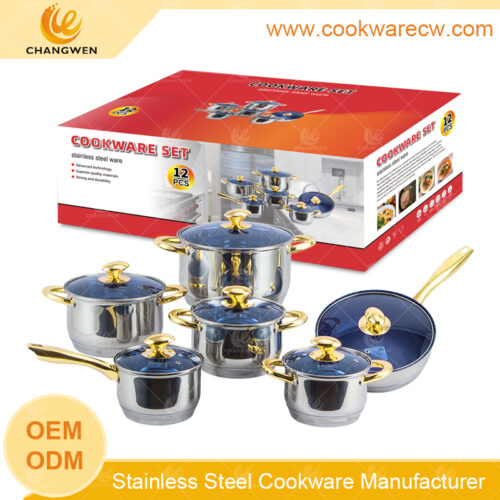
hot sales 12pcs stainless steel cookware set cooking pots set 16cm saucepan 24cm casserole & non-stick frypan with induction usage bottom CW-M1214
-
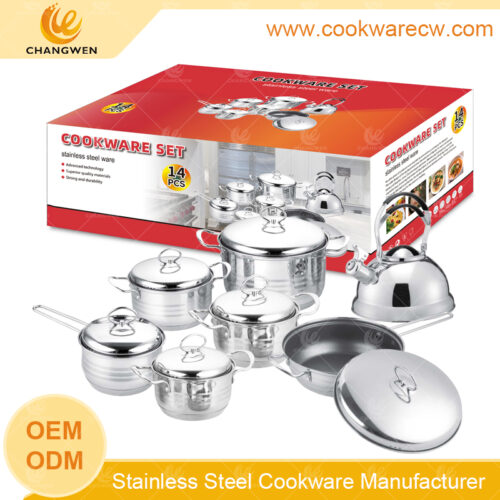
18/10 Stainless Steel Cookware CW-M1402G
-
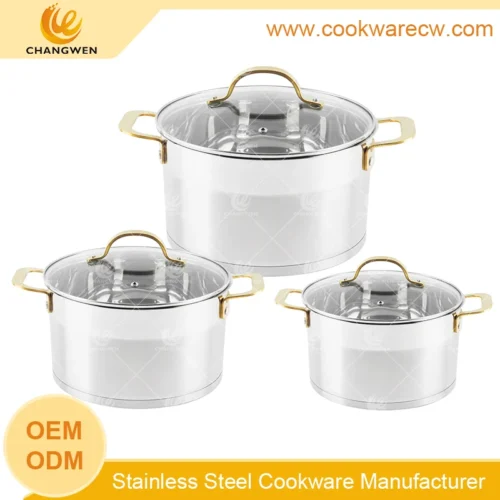
6-Piece Matte Stainless Steel Pot Set with Multi-Color Handles CW-ES0617
-
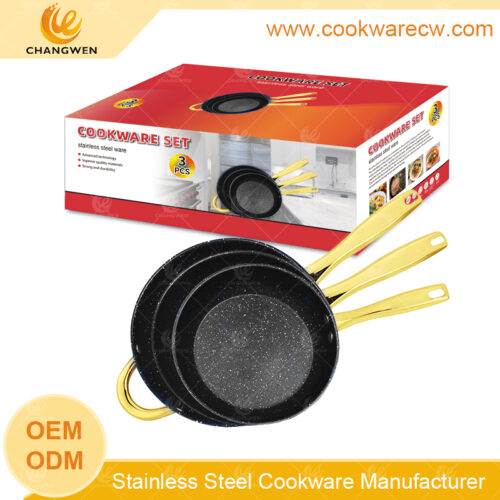
Hot sale 3pcs stainless steel nonstick fry pan set golden plated handles black coating cookware CW-M0301-01
-
high quality stainless steel pots and pans 12pcs cookware set nonstick fry pans with 5-9 steps capsule bottom CW-M1212
-
Stainless Steel Stock Pot 8 Qt/20l/30 Litre/60 Qt CW-M0802
-
Red Silicone-Handle Stainless Steel Cookware Set CW-ES1202
-
7pcs Die Cast Aluminum Cookware Set with Marble Nonstick Coating