
Quick answer: Importers and private-label brands should buy a stainless steel steamer pot as a defined system, not as a diameter and a photograph. Specify the base pot, the exact number of perforated food tiers, lid, material by component, usable tier dimensions, stove compatibility, handle and stack fit, packaging, and an agreed sample-approval plan. Compare quotations only after suppliers price the same configuration and verification requirements. A larger stated capacity or a lower unit price cannot compensate for tiers that do not fit, a base that fails the target hob, or packaging that arrives damaged.
This guide is for B2B buyers preparing a new steamer SKU or evaluating an OEM offer. Changwen already has a general stainless steel steamer buying guide focused on consumer use. Here, the emphasis is different: how a brand turns its intended cooking use into measurable specifications, comparable quotes, and a repeatable bulk-order acceptance decision.
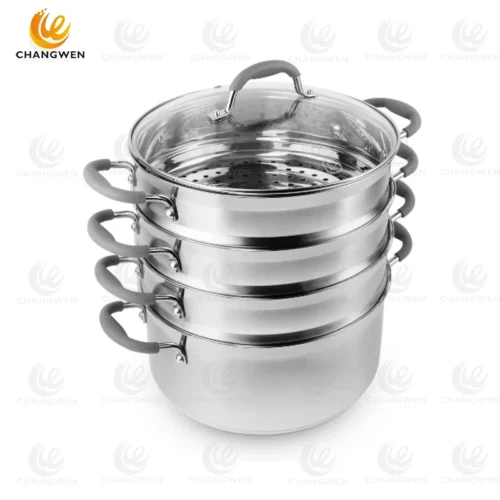
Estimated reading time: 14 minutes. The product and process images in this article are illustrative; they do not establish the material grade, compliance status, or performance of a specific production batch.
What should an importer decide before asking for a steamer quotation?
A steamer quotation becomes useful when the buyer first decides who will use the product, what food must fit, which cooktops the base must support, and what retail presentation the brand needs. A supplier cannot price equivalent offers if one buyer means a base with one insert while another means a base with three food tiers and a glass lid. Write the target use case and configuration in one sentence before discussing finish or price.
For a compact home line, the priority may be a manageable diameter, easy storage, and a lid that fits both the base and upper tier. For a family-oriented line, the priority may shift toward two food tiers and enough clear height for buns or dumplings. For a larger-format line, usable food area, lifting stability, cupboard height, and carton strength may matter more than headline liter capacity. These are positioning examples, not universal size recommendations.
What parts of a stainless steel steamer pot must the specification identify?
A complete steamer system normally includes a water-holding base, one or more perforated food tiers, a lid, and handles. Each component should have its own material, dimensions, finish, and fit requirement. The base is the only component exposed directly to the hob, while upper tiers depend on stack geometry and steam openings. A statement such as “three-layer steamer” can be ambiguous unless it says whether the water pot is counted as a layer.
| Specification field | What to record | Why it changes the buying decision |
|---|---|---|
| Set configuration | Base pot, number of food tiers, lid, and spare parts | Prevents two quotes with different contents from appearing comparable. |
| Working dimensions | Inner tier diameter, usable floor area, clear tier height, assembled height | Shows what food fits, not merely how much water the base holds. |
| Materials | Steel grade for each food-contact component; lid, handle, and base construction | Makes cost, corrosion behavior, and verification requirements explicit. |
| Fit and stability | Rim engagement, stack wobble limit, lid seating, handle clearance | Controls safe handling and consistent steam flow. |
| Cooktop claim | Target gas, electric, ceramic, or induction conditions | Requires testing of the actual base, not a generic magnet statement. |
| Commercial terms | Quantity, carton, labeling, spare parts, inspection, delivery term | Determines landed cost and launch readiness. |
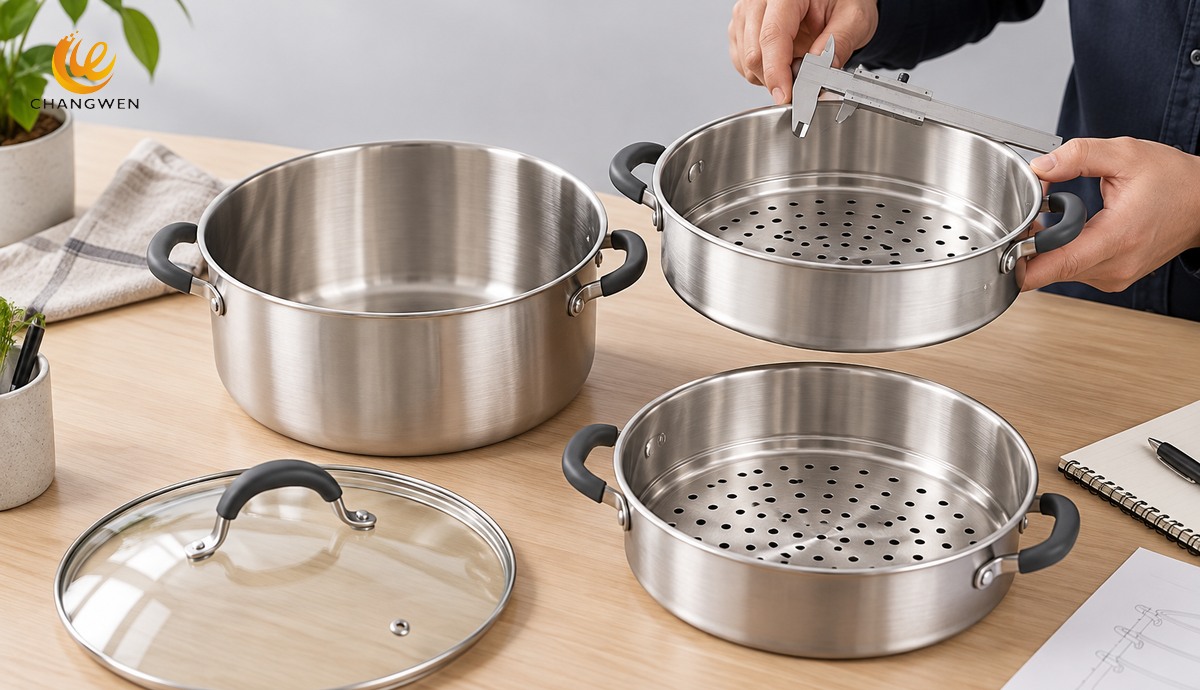
Ask the supplier to return a marked drawing and a component list, not only a catalog picture. A drawing can identify whether diameter is measured at the rim, the interior floor, or the outside of the handle envelope. It also provides a reference for sample approval and repeat orders. If a dimension matters to the product claim, add an agreed tolerance and a measurement point.
How should a brand choose one, two, or three food tiers?
One food tier offers the simplest assembly and lowest stack height, making it attractive when storage and everyday handling dominate. Two food tiers increase simultaneous cooking area without requiring a second burner, but they add another fit interface and more parts to clean. Three food tiers maximize nominal stacked area on one burner, yet the taller stack creates more opportunities for uneven loading, handling difficulty, and inadequate cupboard clearance.
Specify whether each tier is interchangeable and whether the lid fits every upper position. If tiers have different heights or rim profiles, label each part and test the intended stacking order. Interchangeable tiers simplify replacement inventory, but only if actual samples nest and seal consistently. The stack also needs secure engagement when lifted or rotated, without a falsely “locked” appearance that encourages unsafe handling.
Do not equate tier count with set piece count. A base pot, two perforated tiers, and one lid are four physical pieces but only two food tiers. Put both expressions on the specification and retail package. That small clarification reduces buyer disputes and helps customer service explain the product accurately.
How is useful steamer capacity different from pot volume?
Base-pot capacity measures how much liquid the lower vessel can contain under a defined fill method; useful steaming capacity measures the food footprint and clearance available above the water. A 10-liter base does not tell a buyer how many buns, fish portions, or vegetable servings fit in the baskets. Importers should request base-pot brim volume and recommended operating fill range separately from each tier’s usable diameter, flat perforated area, and clear height.
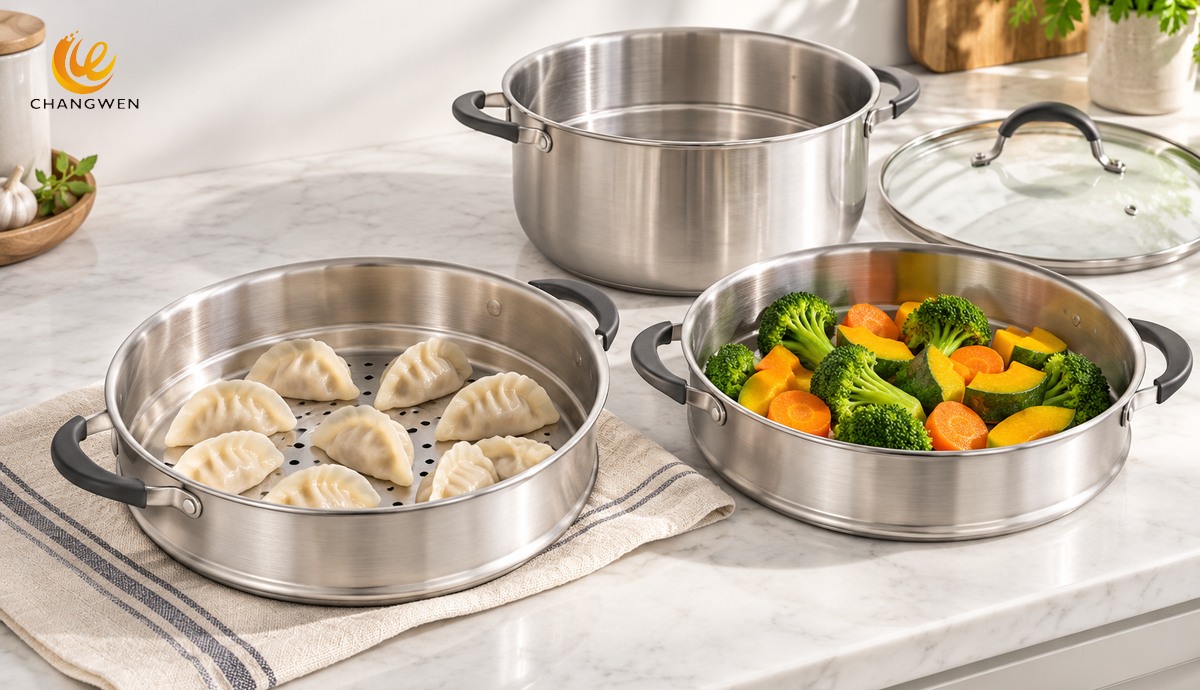
A practical capacity test starts with the food that drives the listing. Place representative pieces on a production-equivalent tier with the spacing required for steam circulation. Count the pieces that fit without crowding, then check whether the lid closes and the food remains clear of the next tier. Record food size and spacing so the result is reproducible. A claim such as “fits 18 dumplings” is meaningful only if the dumpling dimensions and layout are stated.
Water reserve is a separate safety question. The lower vessel must hold enough water for the intended steaming cycle while leaving appropriate separation below the food tier under active boiling. A larger water reservoir may reduce refill frequency but can increase weight and storage height. Ask the supplier to mark or recommend the operating water range only after testing the actual configuration and typical burner setting; do not publish a universal water depth as if it applied to every design.
Which stainless steel and base construction should an importer request?
Stainless steel grade should be specified by component and verified with appropriate supplier records or agreed independent testing. A food-contact basket, an exterior structural component, and an induction-facing base layer may serve different functions. For example, a supplier might propose one grade for the food-contact body and a magnetic grade at the base for induction. The buyer should evaluate the complete design and destination-market requirements rather than treating one grade number as proof of overall quality.
Ask the supplier to state the nominal grade, sheet thickness, surface finish, and material traceability method for the base, food tiers, lid rim, and any other relevant part. A generic claim that the whole set is “304” can hide exceptions if component scope is not defined. Where grade is commercially critical, XRF screening can help compare declared stainless composition, but an XRF result alone does not verify every aspect of food-contact compliance or mechanical performance.
The base construction should match the heat-source claim. A single-layer base, a bonded disc, and a more complex multilayer design can all generate steam, but they may differ in heating response, flatness retention, weight, and price. A thicker base is not automatically a better steamer if it increases cost without solving the actual use case. Ask for a cross-section or drawing of any bonded base and define how flatness and bonding will be checked on samples.
Induction compatibility deserves a working test on the intended hob range. A magnet can indicate that part of the base is magnetic, but it cannot by itself establish reliable startup, heating behavior, noise, or flat contact on every induction hob. If induction is a retail claim, document the tested cooktop, vessel size, water load, and observation criteria. The same principle applies to gas or ceramic claims: specify the condition being verified.
Wall thickness should be evaluated with diameter, rim reinforcement, and target usage. Thin walls can reduce shipping weight but may flex; thicker walls can increase cost without improving the intended task. Compare samples rather than thickness alone; see Changwen’s stainless steel cookware thickness guide.
What details make a steamer easier and safer to use?
Tier rims and interfaces should seat predictably because the user handles a hot, wet stack. Inspect every combination for rocking, sharp edges, pinched fingers, and gaps that leak steam toward the grip area. A secure interface does not need to be difficult to separate; the design should balance stability with removal after cooking. Ask for an assembled-stack photo and a hands-on sample review, because a drawing cannot fully convey lifting feel.
Handle design should be evaluated with the actual loaded weight and heat exposure. Side handles need enough clearance for a protected grip, while their attachment must withstand repeated lifting. An insulated-looking dark handle should not be labeled “stay-cool” unless the claim has been tested under stated heating conditions. The safest brand language describes verified use instructions and recommends heat protection where appropriate.
A glass lid helps users see food without opening the stack, but a glass lid also introduces breakage, knob, vent, and carton-protection questions. A stainless lid can be more resistant to transport breakage, yet removes visibility. Compare lid options against the target shopper and channel, then specify lid diameter, rim seating, knob attachment, vent design, and replacement policy. Whichever lid is chosen, inspect how condensate runs when the lid is lifted.
Perforation design matters because steam must reach food through open paths. Small dense holes, larger holes, and patterned layouts can change drainage, food support, and cleaning effort. The buyer should check whether small ingredients fall through, whether food residues lodge in openings, and whether punched edges are smooth on both sides. Avoid claiming that one hole pattern universally steams faster without a controlled comparison under the same load and heat input.
How should the sample be tested before a bulk order?
A useful sample test compares the steamer against the approved drawing and the intended consumer task. Begin with a parts count, visible finish, dimensions, weight, base flatness, edge safety, lid fit, and tier interchangeability. Then assemble the complete stack and repeat handling with a representative load. Record photographs and measured values in one approval sheet so the sample becomes a reproducible reference instead of an informal impression.
A functional steam trial should use a documented water amount, stove setting, food substitute or representative food load, and observation time. Observe steam escape at interfaces, stability, water depletion, condensation paths, and any noticeable deformation after cooling. The trial need not promise a universal cooking time; it should reveal whether two samples behave differently under the same conditions. If a claim will appear on packaging, test that specific claim under a relevant method.
Include a cleaning trial because food residues and water minerals are normal in use. Wash the perforated tiers, inspect punched edges and seams, and check whether handles or lid hardware trap moisture. The brand should define acceptable staining and finish appearance after an agreed number of cycles. A visually pristine unused sample is not sufficient evidence that a steamer remains practical after repeated use.
Finally, approve the golden sample with a signed specification version and clearly identified deviations. If a supplier proposes a later change to steel, handle, lid, hole pattern, or packaging, require reapproval of the affected checks. A “similar” replacement component can alter fit, safety, or customer perception even when the overall photograph looks unchanged.
What documentation matters for importers and private-label brands?
Import documentation should connect the exact SKU and batch to the materials, claims, and market in which the product will be sold. Request a component specification, material declarations and traceability records, relevant test reports, packaging artwork approval, and a clearly scoped inspection plan. A report for a different handle, coating, supplier, or market is not automatically transferable. The importer remains responsible for checking the applicable requirements in its destination market.
For the European market, the general framework for materials intended to contact food is Regulation (EC) No 1935/2004; national measures and the actual component materials may also matter. The EU’s reference laboratory provides technical guidance on kitchenware testing conditions. For the United States, the FDA explains that cookware is within the broader food-contact context. These references are starting points for market-specific review, not certificates for a particular steamer.
Keep a claims matrix for “induction compatible,” “dishwasher safe,” “food-contact compliant,” and “stay-cool handles.” Each claim needs its own evidence, product version, and permitted market wording; one report does not substantiate every label.
How can two steamer quotations be compared fairly?
Send each supplier the same request for quotation (RFQ) and ask them to return exceptions explicitly. The RFQ should identify the full part count, component materials, usable dimensions, base construction, finish, handle and lid design, logo and packaging requirements, destination market, quantity bands, sample plan, inspection criteria, lead time, and shipping term. Without these common inputs, a price spread may simply reflect different products.
Normalize each offer into a landed-cost worksheet. The quoted factory unit price is only one line; tooling, sample charges, testing, packaging, spare parts, outer-carton size, estimated freight, and likely damage exposure can change the final economics. A taller stack may increase carton volume even if steel weight stays similar. A glass lid may require better cushioning and a replacement policy. Record assumptions beside each cost rather than hiding them in a single score.
Ask the supplier to separate fixed tooling from recurring unit costs and to explain the minimum order quantity for each customization. A new logo on an existing configuration may have a different threshold from a new tier diameter or mold. Do not treat MOQ as a universal factory property; it depends on the exact component, decoration method, packaging, and production plan. An importer evaluating several variants should ask whether shared components can reduce inventory complexity.
Use a decision table with weighted criteria only after non-negotiable requirements have passed. For example, reject any sample that fails food-contact documentation, stack fit, or the required hob test before comparing unit price. Then score acceptable suppliers on measured sample quality, responsiveness, quote completeness, packaging, replenishment plan, and landed cost. This order prevents a cheap but nonconforming quote from winning by arithmetic.
What should the inspection plan cover before shipment?
Pre-shipment inspection should check the actual production lot against the approved golden sample and purchase-order specification. Confirm configuration and count, material identification where specified, critical dimensions, surface defects, handle security, rim condition, lid fit, stack stability, packaging, labels, and carton markings. Agree on sampling and defect classification before production; an inspector should not invent acceptance limits on the loading dock.
Separate critical, major, and minor issues according to customer risk and the approved standard. A sharp food-contact edge or an unstable stack deserves a different response from a small cosmetic variation in a hidden area. Photograph borderline examples during sample approval so the factory and buyer share the same visual reference. If a defect can compromise a published claim, the relevant test should be repeated on production samples.
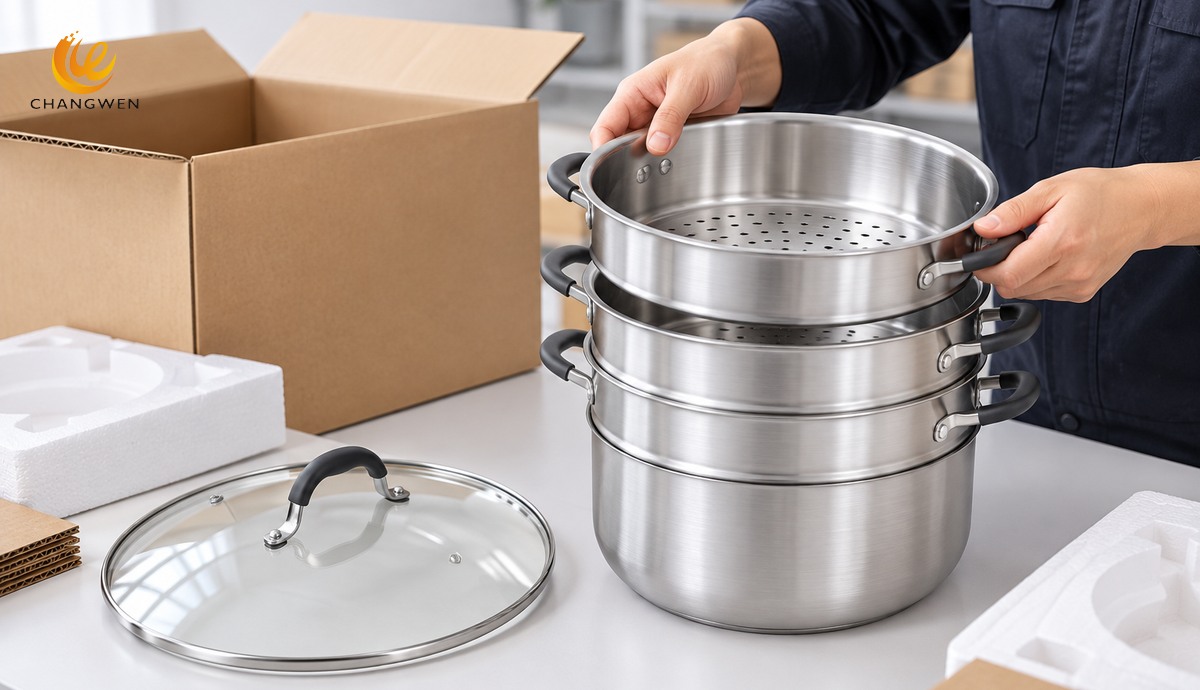
Packaging checks should mimic the supply chain the product will actually travel. Verify that tiers do not abrade each other, the lid is immobilized, handles do not press through the carton, and a consumer can identify all included parts. Inspect inner packing and master-carton dimensions because a package that protects the sample but changes volume materially may affect the landed-cost comparison. Carton testing and labeling requirements should match the buyer’s channel and destination, not a generic template.
What is a practical example of a steamer buyer brief?
Consider a hypothetical importer launching a two-food-tier steamer for family kitchens. The buyer’s one-page brief could state: base pot plus two interchangeable perforated tiers and one lid; target food examples and required tier layout; specified usable interior diameter and headroom; defined steel grades by component; an induction claim requiring a documented working test; and a retail carton that protects the lid. The brief should also name the target market and sales channel. These are fields to resolve with the supplier, not specifications inferred from the illustrative product photograph.
The buyer should ask for a drawing, component list, sample quotation, two or more order-quantity bands, tooling charges, packaging dimensions, and exceptions to the brief. On receipt, the buyer should measure all tier interfaces, load the full stack, run the agreed hob and steam trials, wash the parts, and sign a controlled sample record. Only then should the buyer approve artwork and a production order. This sequence makes later quality discussions traceable to an agreed product rather than a memory of a sales image.
Common importer questions about stainless steel steamer pots
Is 304 stainless steel always required for every part?
No single grade label settles the entire product decision. The buyer should define the relevant food-contact components, destination-market requirements, corrosion exposure, and price target, then require the supplier to declare and substantiate material for each part. A different magnetic layer at the induction-facing base may serve a legitimate design purpose. Judge the documented complete system, not a marketing shorthand.
Does a larger liter capacity mean more food fits?
No. Liter capacity usually describes the lower water vessel, while food capacity depends on the flat perforated area, usable diameter, headroom, and spacing on each tier. A buyer should test representative food pieces on the actual insert before making a servings or piece-count claim.
Can a magnet prove that a steamer is induction compatible?
A magnet can screen for magnetic material at the base, but it does not replace a working test on the intended induction hob. The buyer should verify startup, stable heating, flat contact, and the water load that reflects real use before putting an induction claim on the carton.
Should a brand choose a glass or stainless steel lid?
A glass lid offers visibility, while a stainless steel lid may simplify breakage management. The best choice depends on shopper preference, use case, packaging, replacement policy, and verified performance. Request both options priced to the same steamer configuration if the trade-off is not yet clear.
What is the most important document before mass production?
The most useful control is an approved specification tied to a signed golden sample and revision number. Material records, claims evidence, artwork, and inspection criteria should refer to that same version. Without version control, a supplier can deliver a visually similar steamer that differs in a critical component.
Final buying decision: approve the system, not the photograph
A strong steamer purchase begins with a target user and ends with a verified, repeatable configuration. Decide the food layout and tier count; define each component and its tolerances; verify the base on the intended hob; approve the loaded stack and its packaging; then compare fully normalized quotations. This sequence gives an importer evidence for its claims and gives a supplier a clear manufacturing target.
Changwen offers cookware manufacturing, wholesale, private-label, and OEM support. If you are planning a stainless steel steamer line, send Changwen your target market, desired diameter, number of food tiers, lid preference, cooktop requirements, estimated order quantity, and packaging brief. Explore the stainless steel steamer pot range and contact the team to discuss a specification-led quotation and sample plan. A detailed brief makes the first response more useful and helps prevent costly changes after tooling or artwork approval.
-
Hot sale SS ollas non-stick coated frying pans and pots stock pot with a kitchenware clip CW-M1204
-
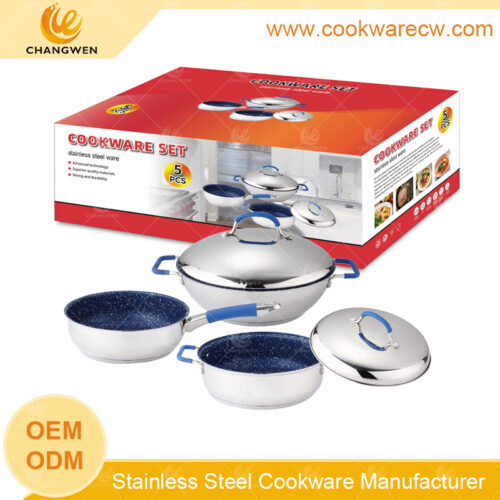
non-stick fry pans coating wok stainless steel wire handles & knobs with silicon cover high quality material lid CW-M0502G
-
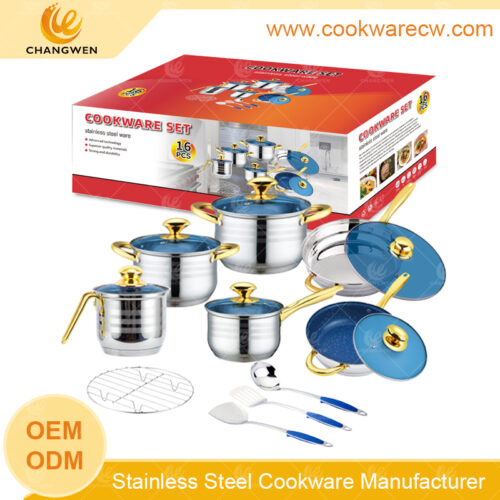
Heavy high quality stainless steel pots and pans 16pcs cookware set with gold plated nonstick fry pan steamer rack and slotted turner spatula ladle CW-M1601
-
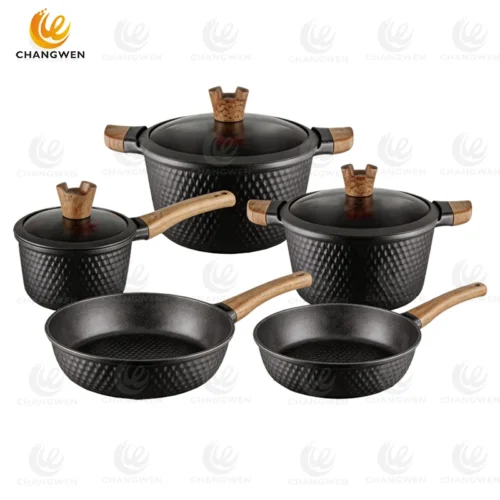
8pcs Die Cast Aluminum Cooking Set with Marble Ceramic Nonstick Coating
-

Hotsale 12pcs stainless steel cooking sets soup stock pot kitchen ollas saucepan casserole and milkpot fry pan nonstick CW-M1209
-
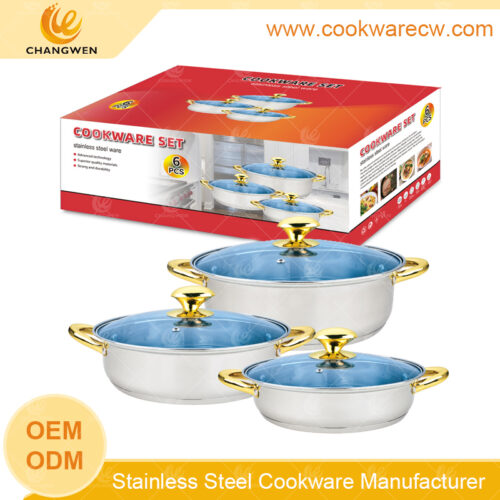
Cook Stainless Steel Stock Pot CW-M0606
-
Stainless Steel Steamer Pot for Home and Commercial Kitchens CW-ES034
-
Heavy Duty Stainless Steel Cooking Utensils