
Read time: 11 minutes
Introduction
Most people buy the wrong camping cookware. Not because they made a bad decision — but because they made a decision for the wrong trip.
The solo thru-hiker who needs to shave every gram buys the same set as the family who drives to a campsite with a pickup truck. The casual weekend camper picks titanium because it sounds premium, then wonders why their eggs always burn. The group camper grabs an ultralight set that cannot hold enough water for four people.
The best camping cookware is not the most expensive, the lightest, or the most-reviewed. It is the one that matches how you actually camp.
This guide gives you a clear decision framework: the four main materials and when each is right, how to size a camping pots and pans set for your group, what features actually matter on the trail, and a complete checklist for choosing your setup.

Key Takeaways
- Material is the most important decision. Titanium is the lightest but conducts heat poorly. Hard-anodized aluminum gives the best everyday performance. Stainless steel is the most durable for campfire cooking. Each has a clear use case.
- Match volume to your group size. A good rule: plan 500ml of pot capacity per person. A solo camping cooking pot can be 0.8–1.0L. A camp cookware set for four needs at least 2.0–2.5L total pot capacity.
- Nesting design matters more than you expect. A camping cookware set that does not nest efficiently costs you pack space on every trip.
- Best camping cookware for backpacking is hard-anodized aluminum or titanium — depending on whether you prioritize cooking performance (aluminum) or weight savings (titanium).
- Best camping cookware for car camping and group trips is stainless steel or hard-anodized aluminum — durability and cooking performance matter more than weight.
- A complete camping cooking ware setup does not require a complete set. Many experienced campers carry two or three carefully chosen pieces rather than a full camp cookware set.
Part 1: The Four Main Materials
Hard-Anodized Aluminum — Best All-Round
Hard-anodized aluminum is the most practical material for most campers. The anodizing process electrochemically hardens the surface, making it significantly more scratch-resistant, durable, and chemically stable than raw aluminum.
Why it works:
Aluminum conducts heat approximately 10 times better than stainless steel. In a camping context, this means faster boil times, more even heat distribution, and better cooking performance for anything beyond just boiling water. Hard-anodized aluminum camping pots and pans heat quickly on a small canister stove, distribute that heat evenly to prevent hot spots, and cool down reasonably fast.
The non-stick surface option (PTFE or ceramic coating over anodized aluminum) simplifies cleanup at camp — a genuine quality-of-life advantage when cleaning resources are limited.
Weight comparison: A 1.5L hard-anodized aluminum camping cooking pot weighs approximately 180–220g. Comparable stainless steel is 350–450g. Titanium is 100–140g.
The trade-off: Aluminum dents more easily than stainless steel. It should not be used directly in a campfire (aluminum melts at 660°C — dangerously close to campfire temperatures). Handle with reasonable care.
Best for: Backpacking, weekend camping, group cooking sets, anyone who actually cooks at camp rather than just boiling water.
Titanium — Best for Ultralight Backpacking
Titanium is approximately 45% lighter than stainless steel while being equally strong. For backpackers who count every gram — thru-hikers, alpine climbers, ultralight enthusiasts — titanium camping cookware is the premium choice.
Why it works (for the right use case):
A titanium camping pot can weigh under 100g for a solo-sized vessel. Combined with a compact canister stove system, a complete titanium cooking set can bring total kitchen weight below 300g. That weight savings adds up over 100 miles.
Titanium is also completely non-reactive, corrosion-proof, and essentially indestructible under normal use. A quality titanium camping pot will outlast everything else in your kit.
The critical limitation: Titanium conducts heat poorly — approximately the same as stainless steel, and far worse than aluminum. This creates hot spots at the base of the pot directly over the flame. For boiling water, this does not matter. For actual cooking — simmering a sauce, making scrambled eggs, cooking rice — titanium’s poor heat distribution leads to scorching at the center while the edges undercook.
Titanium is best for boiling water only. For actual cooking, aluminum outperforms it consistently.
Best for: Solo thru-hikers, ultralight backpackers, anyone whose camp cooking consists primarily of boiling water for dehydrated meals or hot drinks.
Stainless Steel — Best for Durability and Campfire Cooking
Stainless steel is the heaviest of the main camping cookware materials — a stainless pot weighs roughly 2–3 times the equivalent aluminum version. But it is also the most durable, and the only material that manufacturers recommend for direct campfire cooking.
Why it matters:
Campfire temperatures can reach 500°C (930°F) and above. Aluminum approaches its melting point at these temperatures. Titanium handles it, but is expensive. Stainless steel handles campfire cooking safely, survives being dropped on rocks, handles metal utensils, and requires no careful handling.
Stainless steel is the only material that manufacturers suggest is suitable for placing directly in a campfire.
For car campers, overlanders, bushcraft enthusiasts, or group cooking where the cookware will be heavily used over many years, stainless steel is the right call. A stainless camping cookware set bought today may still be in service in 20 years.
The trade-off: Weight. A stainless steel camp cookware set for a group of four will weigh significantly more than equivalent aluminum or titanium. For backpacking, this weight penalty is a genuine obstacle.
Best for: Car camping, bushcraft, group trips, overlanding, anyone cooking directly over a campfire, buyers who want cookware that will last a decade of hard use.
Cast Iron — Best for Campfire Cooking Versatility (Car Camping Only)
Cast iron is too heavy for backpacking, but for car camping it offers cooking performance — particularly searing, baking, and sustained high-heat cooking — that other camp materials cannot match.
A cast iron camping skillet heats slowly but retains heat exceptionally well. Properly seasoned, it develops a natural non-stick surface. It can go directly into a campfire or on a grill grate and survive indefinitely.
Best for: Car camping with a vehicle, campfire cooking specialists, anyone who wants to cook real meals (not just heat food) at camp.
Part 2: Material Comparison at a Glance
| Factor | Hard-Anodized Aluminum | Titanium | Stainless Steel | Cast Iron |
|---|---|---|---|---|
| Weight | Light | Ultralight | Heavy | Very heavy |
| Heat distribution | Excellent | Poor (hot spots) | Moderate | Excellent |
| Campfire safe | No | Yes | Yes | Yes |
| Durability | Good | Excellent | Excellent | Excellent |
| Rust resistance | Excellent | Excellent | Excellent | Needs seasoning |
| Non-stick option | Yes | No | No | Seasoning only |
| Price | Mid | High | Low-mid | Low-mid |
| Best trip type | Backpacking, weekend | Ultralight backpacking | Car camping, group | Car camping |
Part 3: Sizing Your Camping Cookware Set
Getting the size wrong is one of the most common camping cookware mistakes. Too small means multiple cooking rounds. Too large means unnecessary weight and bulk.
Solo Camping
A single-person camping cooking pot of 0.8–1.0L handles boiling water for a freeze-dried meal, making coffee or tea, and simple one-pot cooking. Add a small camping frying pan (18–20cm) if you cook eggs, meat, or anything that needs a flat surface.
Minimum solo setup: 0.9L pot + small frying pan + lid that doubles as a pan or bowl.
Duo Camping
For two people, a 1.2–1.5L pot handles most meals comfortably. A camping pots and pans set designed for two typically includes a medium pot, a frying pan, and two bowls or cups that nest inside.
Minimum duo setup: 1.3L pot + 20cm frying pan + two bowls/cups.
Group Camping (4+ people)
For four people, total pot capacity should be at least 2.0–2.5L — and more if you cook pasta, soups, or any meal requiring significant water volume. A camp cookware set for groups typically includes two pots (different sizes), a large camping frying pan or camping skillet, and serving utensils.
Group car camping setup: 2.5L large pot + 1.5L small pot + 24cm frying pan + camping utensils set.
Part 4: What Features Actually Matter
Nesting Design
The best camping cookware sets nest completely — pots inside each other, lids double as plates or pans, utensils fit inside the stack. A set that nests cleanly takes up a fraction of the pack space of the same pieces purchased separately.
Test a set’s nesting before buying: do all the pieces — including the camping utensils set, pot grabber, and lid — fit together in a single compact package?
Heat Exchanger Technology
Some camping cooking pots include fins pressed into the base of the pot — called heat exchanger technology. These fins increase the surface area in contact with the flame, transferring heat faster and more efficiently. The result is faster boil times and up to 30% reduction in fuel consumption.
Heat exchanger technology increases fuel efficiency by up to 30%, which matters significantly on multi-day trips where every gram of fuel canister weight counts.
For backpackers counting fuel weight on long trips, a heat exchanger pot is worth the slight weight premium.
Lid Design
A well-designed lid does three things: seals the pot to speed boiling and reduce fuel use, doubles as a frying pan or plate to reduce total piece count, and has a heat-resistant handle that does not get dangerously hot during cooking.
A strainer lid — with holes or mesh built in — eliminates the need for a separate strainer when cooking pasta or draining excess water.
Handle System
Camping pot handles come in two types:
Folding bail handle: A wire bail that swings out for carrying and folds flat for storage. Allows you to hang the pot over a campfire. Standard for camping cooking pots and stainless steel systems.
Removable pot gripper: A separate clamp that attaches to the pot rim when you need to move it. Keeps the system lighter since you only carry one gripper for multiple pots.
For a minimalist backpacking cooking camping set, a pot gripper system is typically lighter. For car camping where convenience matters more than grams, a bail handle on each pot is more practical.
Non-Stick Coating
Non-stick coatings on camping pans and camping skillets make a meaningful real-world difference for camp cooking:
- Eggs, fish, and pancakes do not stick without precise temperature control
- Cleanup requires less water — important when water is scarce or you are camping near sensitive water sources
- Cooking with less oil is easier and healthier
Current non-stick options for camping cookware:
PTFE coatings: Traditional Teflon-type non-stick. Effective but requires care — avoid overheating (above 260°C), metal utensils, and abrasive cleaning. Current PTFE is PFOA-free.
Ceramic coatings: No PTFE or PFAS. Works well at moderate temperatures. Degrades faster than PTFE under rough handling and high heat. The right choice for buyers with PFAS concerns.
For most camp cooking applications — moderate heat, silicone or nylon utensils — either type works well. Ceramic is the cleaner chemistry option.
Weight
For backpacking and hiking, weight is the non-negotiable constraint. A useful framework:
- Gram-conscious backpacking: Total cooking system (pot + stove + fuel for 3 days) target under 400g
- Standard backpacking: Total cooking system under 600g
- Weekend camping: Weight is less critical; prioritize cooking performance and set completeness
- Car camping: Weight is irrelevant; prioritize cooking capability and durability
Part 5: Camping Cookware Sets vs Building Your Own Kit
There are two approaches to assembling a camping cooking ware setup: buy a complete camp cooksets package, or build a custom kit piece by piece.
Complete Camping Cookware Sets — Advantages
Designed to work together. Pieces nest perfectly. Handles, lids, and sizes are matched. You get a system, not a collection of individual items.
Lower total cost. A complete camping cooking set typically costs less than buying equivalent individual pieces.
Camp cooksets for beginners are particularly useful — you get everything you need without researching individual piece specifications.
Typical contents of a complete camping cookset:
- 1–2 pots (different sizes)
- 1 camping frying pan or lid-as-pan
- Bowls/plates (may double as lids)
- Camping utensils set (fork, spoon, spatula)
- Pot grabber or bail handles
- Carry bag
Building a Custom Kit — Advantages
Optimized for your exact use case. Solo ultralight backpackers do not need the complete 12-piece camp kitchenware set. Two pieces optimized for your specific needs will perform better and weigh less than a complete set with pieces you will never use.
Mix materials. Many experienced campers use a titanium pot for boiling water plus a small hard-anodized aluminum camping frying pan for actual cooking — combining the weight savings of titanium where it matters with the heat distribution of aluminum where it matters.
Replace only what wears out. A custom kit lets you upgrade individual pieces without replacing everything.
Recommendation by Camping Style
Solo backpacker: Build a custom kit. One pot (titanium or aluminum, 0.9L) + one small aluminum camping frying pan + pot gripper + lightweight camping utensils set.
Weekend camping duo: Complete duo camping cookware set is typically the best value — designed for two, nests properly, contains the right piece count.
Family or group car camping: Complete outdoor cooking pots and pans set in stainless steel or hard-anodized aluminum. Prioritize cooking capacity (2.5L+ total) over weight.
Campfire cooking enthusiast: Stainless steel or cast iron as the primary material. Look for a campfire cooking set specifically designed for open-fire use with bail handles and campfire-appropriate construction.
Part 6: Camping Cookware for Specific Use Cases
Backpacking and Thru-Hiking
Priority: Weight above everything. Then fuel efficiency. Then cooking capability.
For a solo thru-hiker, the minimum viable cooking system is a titanium camping cooking pot (0.9L, with lid) and a canister stove. Total weight under 250g. Everything else is optional.
For a hiker who cooks real meals rather than just rehydrating freeze-dried food, a hard-anodized aluminum hiking pan or small camp cooking pan (18–20cm) adds meaningful cooking capability at minimal weight penalty.
Family Car Camping
Priority: Cooking capability. Then durability. Then ease of use. Weight is irrelevant.
A complete outdoor cooking pots and pans set with a large pot (2.5L+), medium pot, large camping frying pan or camp skillet, and full camping utensils set is the right approach. Stainless steel or hard-anodized aluminum. Look for a set with non-stick coating on the frying pan.
Overlanding and Vehicle-Based Adventure
Priority: Durability. Then cooking capability. Then versatility.
Overlanders can carry heavier, more capable cooking gear. Cast iron camping skillet, stainless steel pots, and a dedicated campfire cooking set are all viable. The cookware may see years of hard use — prioritize quality over lightness.
Bikepacking and Ultralight Travel
Priority: Minimum weight and volume. Cooking capability is secondary.
Titanium is the natural material choice. A single titanium camping pot (650–750ml for solo), a titanium or lightweight cup, and minimal utensils. Total cooking kit under 200g.
Camping Cookware Care and Maintenance
For all materials:
- Avoid soap when water sources are nearby — use it only away from streams and lakes, and use minimal quantities
- Wipe pots with a paper towel while still warm to remove food residue before washing
- Allow all cookware to dry completely before packing — moisture inside a stuff sack promotes rust in stainless steel and mold in any material
For stainless steel:
- Stainless steel can handle metal utensils, abrasive cleaning, and rough treatment
- Surface discoloration from campfire heat is normal and does not affect performance
For hard-anodized aluminum:
- Use silicone, nylon, or wooden utensils to protect non-stick coatings
- Avoid overheating a dry non-stick pan — always have oil or liquid present
For titanium:
- Essentially maintenance-free. Titanium does not rust, does not corrode, and does not react with food
- Allow to cool before cleaning — titanium holds heat longer than it appears to
For cast iron:
- Dry completely after every use and apply a thin layer of neutral oil for storage
- Re-season if the cooking surface becomes rough or rust appears
FAQ
What is the best camping cookware material?
Hard-anodized aluminum is the best all-round camping cookware material for most people. It conducts heat evenly, is lightweight, and is available with non-stick coatings that simplify camp cooking and cleanup. Choose titanium if minimum weight is your absolute priority. Choose stainless steel if durability and campfire cooking are your priority.
How do I choose the right size camping cookware set?
Plan approximately 500ml of pot capacity per person. Solo campers need 0.8–1.0L. Duo setups work well with 1.2–1.5L. Groups of four need at least 2.0–2.5L total pot capacity. Also consider whether you will cook one-pot meals or separate dishes — the latter requires more total capacity.
Is titanium camping cookware worth the price?
Yes — if weight savings is your primary goal and you primarily boil water at camp. Titanium is approximately 45% lighter than stainless steel and essentially indestructible. However, titanium conducts heat poorly, creating hot spots that can burn food during actual cooking (beyond just boiling). For active cooking, aluminum outperforms titanium at significantly lower cost.
Can I use camping cookware on an induction stove at home?
It depends on the material. Stainless steel camping cookware with a 430-grade magnetic outer layer is induction-compatible. Hard-anodized aluminum is not induction-compatible unless it has a stainless steel base disc added. Titanium is not induction-compatible. If you want cookware that works both camping and at home on induction, specify stainless steel construction with 430 outer layer.
What is included in a typical camping cookware set?
A standard camp cookware set includes one or two pots with lids, a camping frying pan or camping skillet (sometimes the lid doubles as one), plates or bowls that nest inside the pots, a camping utensils set (fork, spoon, spatula), and a pot grabber or integrated handles. Higher-end sets may include a cutting board, coffee press, or camp kettle.
How do I clean camping cookware with limited water?
Wipe the pot with a paper towel while still warm to remove most food residue before washing. For stuck-on food, boil a small amount of water in the pot to loosen it. Use minimal soap and a small mesh scrubber (pack lightweight, weigh almost nothing). For stainless steel, a paste of water and a small amount of baking soda cleans effectively without soap. Always disperse wash water at least 60 meters from any water source.
What is a heat exchanger pot and is it worth it?
A heat exchanger pot has fins pressed into or attached to the base that increase the surface area in contact with the flame. This transfers heat to the water faster, reducing boil time and fuel consumption by up to 30%. For multi-day backpacking where fuel canister weight matters, a heat exchanger pot can reduce the number of fuel canisters you need to carry. It is worth the slight weight premium for any trip over three days.
Conclusion
The best camping cookware is the cookware that matches your actual camping style — not your aspirational one.
Titanium is exceptional for ultralight backpacking where you are primarily boiling water. Hard-anodized aluminum is the best everyday choice for campers who actually cook. Stainless steel is the right choice for campfire cooking, car camping, and heavy use. Cast iron is unmatched for campfire cooking performance when weight does not matter.
Get the material right, match the size to your group, choose a nesting design, and consider heat exchanger technology for backpacking. Beyond those four decisions, the details matter less than actually getting out and cooking something.
A good camp meal does not require the most expensive cookware on the market. It requires the right cookware for the trip you are actually taking.
About Changwen
Changwen is a cookware manufacturer based in Jiangmen, Guangdong, China, with over 22 years of OEM and ODM experience. We produce camping cookware sets, camping pans, camping skillet, camping pot set for brands and distributors worldwide.
For wholesale and OEM/ODM enquiries on camping and outdoor cookware programs, contact us directly.
-
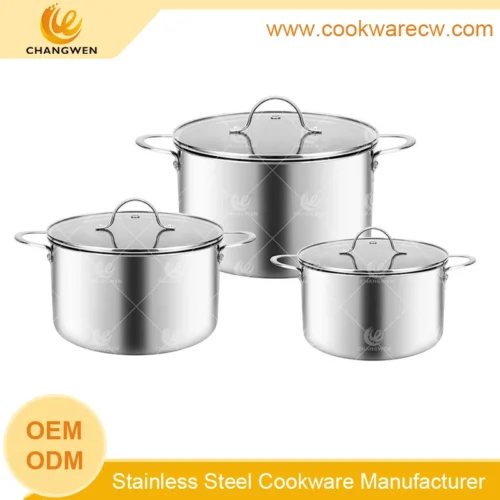
High-Quality Stainless Steel Pot Set with Heat-Resistant Handles CW-TP0603
-
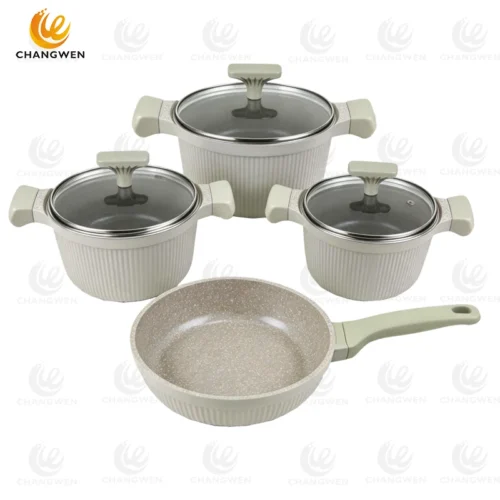
7pcs Vertical Stripe Nonstick Aluminum Cookware Set with Silicone Lid | Changwen Aluminum Cookware Factory China
-
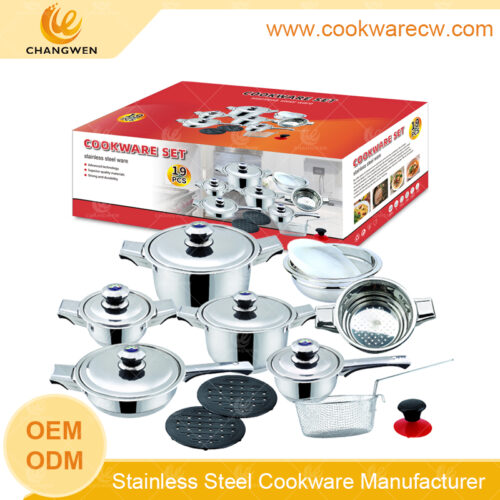
Heavy weight cookware set steamer pot 19pcs stainless steel pots and pans with thermal knobs and heat insulation handle frying basket salad bowl with PP lid kitchen utensil fire mats suction knob CW-M1901G
-
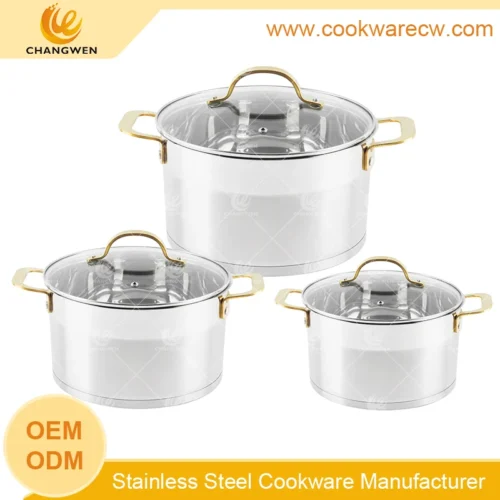
6-Piece Matte Stainless Steel Pot Set with Multi-Color Handles CW-ES0617
-
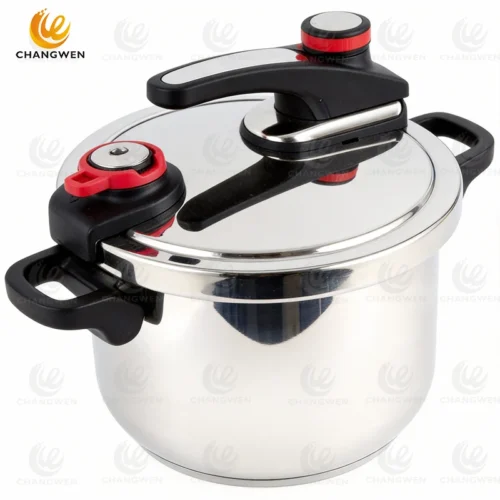
Stainless Pressure Cooker with Secure Locking Lid
-
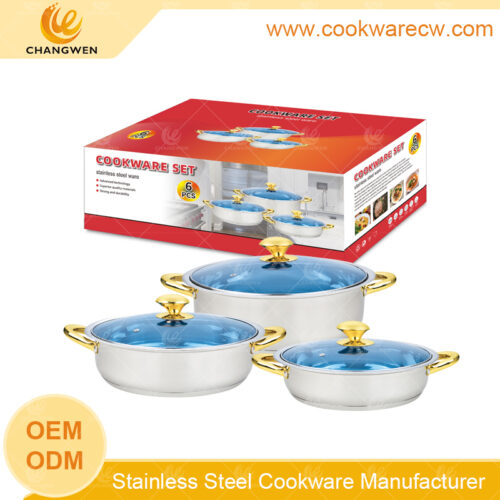
Stainless Steel Cook Pot Set CW-M0606
-
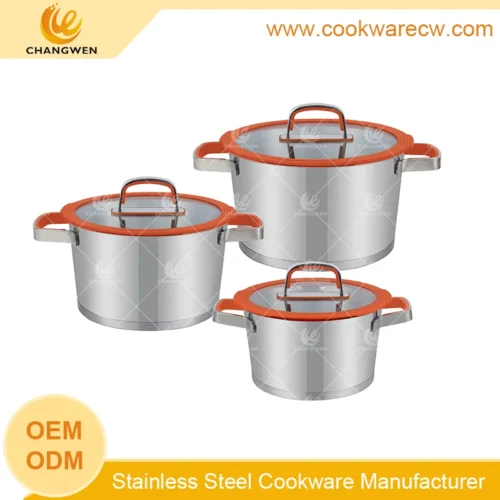
6-Piece Stainless Steel Pot Set with Orange Silicone-Edge Lids CW-ES0611
-
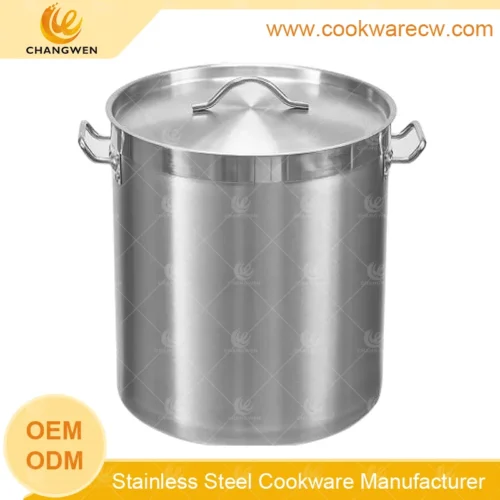
Wholesale Large Stock Pot CW-SP001