
Read time: 12 minutes
Introduction
Here is the thing about launching a custom cookware brand: the process is not complicated. The execution is.
Every year, hundreds of brands and Amazon sellers start OEM cookware programs with a clear idea in their head — the pan they want to sell, the market they want to own, the price point that makes the business work. And a meaningful percentage of them end up with 2,000 units of the wrong product, or the right product with wrong certifications that a major retailer rejects, or packaging that was not designed for the Amazon FBA system and costs them a 15% oversize surcharge on every shipment.
None of these outcomes are inevitable. They are all the result of the same thing: someone skipped a step in the OEM process, or did not know the step existed.
This guide covers the complete OEM cookware process from the beginning: what OEM and ODM actually mean, the specification decisions that determine everything, how samples protect you, what certifications your market actually requires, how to structure an order for Amazon FBA without surprises, and what to require from any cookware manufacturer before a single unit goes into production.
This is the guide you read before you spend money, not after.
Part 1: OEM vs ODM vs Private Label — Know Which Model You Are Actually Using
These three terms are used interchangeably in everyday business conversation and mean different things. Knowing which model applies to your program determines your cost, your timeline, and what you can and cannot control.
OEM (Original Equipment Manufacturer)
In OEM, you own the product specification. You tell the manufacturer exactly what to make — the material, the construction, the dimensions, the handle design, the surface finish, the logo placement. The manufacturer produces it to your specification. You sell it under your brand name.
The intellectual property in an OEM program belongs to you. If you invest in proprietary tooling (a custom handle shape, a unique pan silhouette), that tooling is yours. No other brand can buy the same product from the same factory.
OEM requires more upfront work — you need to write a complete specification, manage sample revisions, and approve production standards in writing. But the result is a product that genuinely belongs to your brand.
ODM (Original Design Manufacturer)
In ODM, the manufacturer owns the product design. You select from their existing catalog — an established pan construction, a proven handle design, a tested coating system — and brand it as your own. You apply your logo, your packaging, your color choice. The design and tooling belong to the manufacturer.
ODM is faster and less expensive to launch than full OEM. You are not paying for tooling development or design engineering. The trade-off is differentiation — the same manufacturer can sell the same underlying product to multiple buyers under different brand names.
Private Label
Private label is the simplest model: the manufacturer produces a standardized product, you put your label on it, you sell it. Minimal customization. Fastest time to market. Lowest upfront investment. Lowest product differentiation.
The Model Most Amazon Sellers Actually Use
Most successful Amazon cookware sellers use a hybrid: ODM with OEM branding elements. They select a proven pan construction from the manufacturer’s catalog (avoiding tooling investment and reducing risk), then add:
- Custom logo via laser engraving or embossing
- Exclusive surface finish color (PVD black, hammered cream, custom PVD)
- Custom handle color or selection from manufacturer’s available options
- Custom retail packaging designed for their brand and for Amazon FBA requirements
This hybrid approach lets you launch in 10–14 weeks, differentiate meaningfully from generic competitors, and avoid the tooling investment that full OEM requires — without competing on a product identical to five other sellers.
Part 2: Writing Your Product Specification — The Foundation of Everything
A product specification is a written document that defines exactly what you are ordering. Not a description of a competitor product. Not a verbal conversation with the factory. A document with specific, measurable parameters.
Every quality problem in a custom cookware OEM program traces back to one of two causes: a specification that was not written clearly enough, or a specification that was written but not enforced. The specification is the contract before the contract.
Material Specification
Inner cooking surface: 304 stainless steel (18/8 or 18/10) for any quality-positioned stainless steel cookware. This is the food-contact surface. It must be non-reactive, corrosion-resistant, and confirmed by material test documentation. Do not accept “food-grade stainless steel” as an answer — that phrase has no regulated meaning. Ask specifically for 304 grade and require a mill certificate.
Core material (for multi-ply construction): Aluminum alloy, with thickness specified in millimeters. The core determines heat distribution performance. Thicker core = better heat distribution = fewer hot spots = better cooking results and fewer customer complaints.
Outer layer (for induction-compatible stainless steel): 430 stainless steel. Ferromagnetic, required for induction cooktop compatibility. If your product will be sold in markets with significant induction penetration (EU, Australia, Japan, urban North America), the 430 outer layer is effectively mandatory.
For aluminum cookware: Specify base material (die-cast, forged, or stamped aluminum), surface treatment (hard-anodized or raw), and coating system (PTFE, ceramic, granite) with PFOA-free and PFAS-free certification requirements.
Construction Specification
Full-clad vs disc-base: The single most impactful construction decision. Full-clad (layers running continuously from base through sidewalls) delivers even heat distribution for sautéing, searing, and sauce work — and justifies premium retail pricing. Disc-base (layered disc bonded to the base of a single-layer body) delivers good performance for boiling and simmering at lower manufacturing cost. For Amazon positioning, full-clad tri-ply is the specification that supports competitive differentiation at $80+ price points. Below $60 retail, disc-base is commercially appropriate.
Wall thickness: Specify in millimeters. Minimum 2.4mm total for quality tri-ply full-clad. Under 2.0mm produces pans that warp faster and develop hot spots. This number is measurable with a micrometer and should be confirmed on every production sample.
Verify full-clad by cross-section: Request the manufacturer to provide a cross-section cut of a sample pan showing the layer structure from base through sidewall. Disc-base construction can be described as “tri-ply base” in misleading supplier communication. The cross-section eliminates ambiguity.
Surface Finish Specification
Interior: Ra (surface roughness) ≤ 0.8 µm for food-contact compliance. Passivation treatment required. These are measurable and certifiable.
Exterior: Choose your finish based on brand positioning and target market:
- Brushed satin: Most versatile, fingerprint-resistant, professional aesthetic
- Mirror polish: Premium/luxury positioning, higher photography value
- Matte/sandblast: Contemporary, trending in EU and Australian markets
- PVD color: Premium differentiation — black, gold, rose gold, hammered cream
- Hammered: Strong retail visual, currently trending in UK, EU, and Middle East
Handle Specification
Handle material (stainless steel for oven-safe, Bakelite or silicone-coated for heat resistance), attachment method (riveted for commercial-grade durability), oven temperature rating, and ergonomic grip geometry. For Amazon listings, handle ergonomics are frequently cited in reviews — evaluate handle comfort on physical samples before production sign-off.
Lid Specification
Glass or stainless steel, knob material and oven temperature rating (polymer knobs are typically rated to 180°C — confirm this does not limit your marketing claims), fit tolerance (test lid fit on physical sample), and stackability if the product is sold as a set.
Part 3: OEM Cookware for Amazon Sellers — The Specific Considerations
Amazon’s fulfillment infrastructure, customer review system, and product listing requirements create specific considerations for OEM cookware programs that generic import guides do not cover.
Amazon FBA Packaging Requirements
Amazon FBA imposes size and weight requirements on inbound shipments. For cookware sets specifically:
Standard-size threshold: 18″ × 14″ × 8″ (46cm × 36cm × 20cm) and under 20 lbs (9kg) per unit qualifies as standard-size. Cookware sets that exceed these dimensions enter oversize tier, which carries significantly higher FBA fulfillment fees.
Implication for OEM specification: Design your cookware set packaging to fit within standard-size FBA dimensions wherever possible. This means:
- Nested pan and pot design to minimize box height
- Tight packaging construction (foam inserts that hold pieces securely without excess volume)
- Packaging dimensions confirmed and specified before production
Poly-bag requirement: Individual items that could potentially be seen as loose or separate must be poly-bagged. Confirm FBA prep requirements for your specific product category before finalizing packaging.
Barcode placement: FNSKU barcode must be scannable on the exterior of every unit. Specify barcode placement and size in your packaging specification. Barcode placement that requires the FBA prep team to manually sticker items adds a prep service fee.
Amazon Product Review Dynamics
Amazon customer reviews directly affect sales rank and buy box position. The most common negative review categories for cookware are:
Warping: A pan that warps within the first few months generates a negative review within the first few months. This is a wall thickness and construction quality failure. Specify adequately thick walls (2.4mm+ for tri-ply) and warp resistance testing in your QC protocol.
Sticking: “Food sticks to the pan” is the most common non-stick cookware complaint and is frequently a coating quality issue. For stainless steel cookware, this is a product education issue. Include clear “how to use stainless steel cookware” instructions with every unit.
Handle problems: Loose handles, handles that get hot, handles that feel cheap. Riveted handle attachment, appropriate handle material, and sample evaluation of ergonomics before production sign-off address all three.
Packaging damage: Products that arrive damaged — broken glass lids, dented pan bodies — generate negative reviews without the product ever being used. Specify drop-test certified outer cartons in your packaging spec and request drop test results from the manufacturer.
Amazon Listing Optimization and OEM Specification Connection
Your OEM specification choices become your Amazon listing claims. Common high-converting claims and their specification foundations:
| Amazon Listing Claim | Required Specification |
|---|---|
| “Tri-ply full-clad construction” | Full-clad confirmed by cross-section sample |
| “304 stainless steel (18/8)” | Mill certificate per production batch |
| “PFOA-free, PFAS-free” | Third-party laboratory certificate |
| “Induction compatible” | 430 outer layer confirmed |
| “Oven safe to 500°F” | All-stainless construction, riveted handles |
| “Dishwasher safe” | Material confirmation (stainless steel) |
| “LFGB food contact certified” | LFGB test report from accredited laboratory |
Every claim you make in your Amazon listing should be backed by a document in your specification file. Claims without documentation expose you to Amazon listing takedowns and, in the US, FTC compliance risk for marketing claims.
Part 4: The Complete OEM Process Timeline
Stage 1: Inquiry and Specification Development (Week 1–2)
Send your product brief to 3–5 shortlisted cookware manufacturers. Include your complete written specification — not just a reference product link.
A reliable cookware manufacturer responds with:
- Itemized FOB quote within 48 hours
- Construction recommendations if your specification has gaps
- Certification capability confirmation for your target market
- Sample lead time and cost
Red flags in manufacturer responses: inability to confirm material grade in writing, vague answers about construction type (disc-base vs full-clad), no certification documentation available.
Stage 2: Sample Production and Approval (Week 2–6)
Catalog product samples: Existing products with OEM branding applied. Delivery in 7–15 days. Evaluate construction, finish quality, handle ergonomics, lid fit, and logo quality.
Modified catalog samples: Changes to color, handle selection, set composition, packaging. Delivery in 15–25 days.
Custom tooling samples: New handle shape or pan silhouette. Tooling development 4–6 weeks before first sample. Not typically required for first-time OEM programs — ODM hybrid approach avoids this.
The non-negotiable step: written sample sign-off.
When you are satisfied with a sample, send a written email that states: “We approve the sample received [date] as the production standard for
. The approved sample will be retained at both parties for reference during production QC.”
This email, combined with the manufacturer’s Sample Specification Sheet (confirming measured wall thickness, Ra value, material grade, handle attachment method), constitutes your production standard. Any deviation in production is a verifiable non-conformance.
Stage 3: OEM Customization Confirmation (Week 4–6, parallel)
While samples are in development, confirm:
Logo artwork: Vector format (AI or EPS) required for laser engraving. Confirm placement position, engraving depth, and size on actual sample before production.
Packaging design: Finalize retail box design, barcode placement, care instructions, and marketing claims. Confirm all claims are backed by specification documentation. For Amazon-specific programs, confirm dimensions fit FBA standard-size threshold.
Material certificates: Request and review LFGB test report, FDA compliance documentation, and mill certificates before signing the purchase order. Do not defer this to post-production.
Stage 4: Purchase Order and Production (Week 6–12)
Sign the purchase order only after:
- Sample approved in writing
- All packaging artwork confirmed
- All certification documentation reviewed
- Payment terms confirmed (standard: 30% deposit, 70% balance before shipment)
Production lead time: 40 days from deposit receipt for catalog OEM products at most established cookware manufacturers. Note this is factory-to-port time, not door-to-door.
During production, a reliable cookware manufacturer provides:
- Incoming material confirmation (steel grade, thickness — IQC)
- Production start notification
- Goods ready for inspection notification
Stage 5: Quality Control and Pre-Shipment Inspection (Week 12–13)
Factory QC stages:
- IQC: Incoming material verification (steel grade by XRF, thickness measurement)
- IPQC: In-process inspection at critical production stages
- OQC: Outgoing AQL sampling inspection before packaging
Pre-shipment inspection (recommended for all first orders):
Commission SGS, Bureau Veritas, or Intertek to conduct a physical inspection at the factory before container loading. Cost: $200–$400 for a standard inspection. The inspection covers dimensional compliance, surface quality, handle security, lid fit, packaging quality, and carton labeling.
The pre-shipment inspection is the last checkpoint before 2,000 units of your product are 40 days away on a container ship. It is the cheapest insurance available.
Stage 6: Shipment, Import, and Amazon Delivery (Week 13–20)
Freight: FOB is the standard Incoterms for OEM cookware from China. You arrange and pay freight, insurance, and customs from the origin port.
Ocean freight transit times to key Amazon markets:
- Amazon US (West Coast): 15–20 days port-to-port
- Amazon US (East Coast): 25–32 days port-to-port
- Amazon EU (Germany/Netherlands): 28–35 days
- Amazon UK: 26–32 days
Customs documentation: Commercial invoice, packing list, bill of lading, certificate of origin (for FTA tariff reduction where applicable), LFGB test reports (for EU), FDA documentation (for US). Your customs broker handles the import entry.
Amazon FBA inbound: After customs clearance and inland delivery, create the FBA shipment in Amazon Seller Central and ship to the designated fulfillment center. Amazon processes inbound inventory in 1–5 business days.
Part 5: Certifications — What Your Market Actually Requires
EU Market: LFGB Is the Standard
LFGB (Lebensmittel-, Bedarfsgegenstände- und Futtermittelgesetzbuch) is Germany’s food contact material standard, accepted across the EU. It is the most comprehensive food safety certification for cookware and covers:
- Overall migration testing (total substances transferring to food simulants)
- Specific heavy metal migration (nickel, chromium, lead, cadmium)
- Sensory testing (the cookware must not impart taste or odor to food)
For any cookware sold in EU markets — including through Amazon.de, Amazon.fr, Amazon.it, and Amazon.es — LFGB certification is the expected standard. Request original LFGB test reports from an accredited laboratory (SGS, TÜV, Bureau Veritas, Intertek) covering your specific product type.
US Market: FDA and California Prop 65
FDA compliance for cookware materials (21 CFR food contact standards) and, for brands selling to California or through major US retail chains, California Proposition 65 lead and cadmium limits. Third-party laboratory testing confirming compliance is the documentation standard.
Amazon Marketplace: The Practical Requirements
Amazon does not uniformly mandate specific food safety certifications at the account level, but:
- Category managers and Amazon’s product compliance systems increasingly request certification documentation for cookware listings
- Negative reviews citing safety concerns can trigger Amazon listing reviews
- Retailers who sell through Amazon Business (B2B) commonly require FDA/LFGB documentation
Having LFGB and FDA documentation for your OEM cookware program protects your listing, enables B2B sales, and eliminates the vulnerability that arises when a competitor reports your listing for inadequate certification.
Part 6: Common OEM Mistakes and How to Avoid Them
Specifying “304 stainless steel” without requiring documentation. The most frequent quality failure in stainless steel OEM programs. 201 stainless is visually identical to 304, cheaper to produce, and commonly substituted without disclosure. Require mill certificates per production batch — not per product line, per batch.
Approving a sample informally. “It looks good” communicated verbally or in a WeChat message is not a production standard. The written approval email with the manufacturer’s Sample Specification Sheet is your protection when production deviates.
Building Amazon packaging without checking FBA dimensions. A beautiful retail box that puts your cookware set into oversize tier costs you $3–$6 per unit in additional FBA fees. On 1,000 units, that is $3,000–$6,000 in avoidable cost. Confirm packaging dimensions against FBA fee calculator before finalizing box design.
Conflating sample lead time with production lead time. A sample delivered in 15 days does not mean production takes 15 days. Production is 40 days from deposit receipt. The sample tells you what the product looks and feels like. The production timeline tells you when it ships.
Choosing a trading company when you need a factory. Trading companies source from multiple factories and cannot directly control production specifications. When the 201-for-304 substitution happens in a trading company’s supply chain, the trading company often does not know and cannot fix it at the source. For any OEM cookware program where material specification matters, a direct factory relationship is the correct model.
Not reading the Incoterms. FOB means the manufacturer’s responsibility ends when goods are loaded at the origin port. Every cost and risk from that point — freight, insurance, customs, delivery to Amazon — is yours. CIF means the manufacturer arranges freight to your destination port, but you still pay customs and last-mile. Know which Incoterms you are buying and what that means for your total landed cost.
FAQ
What is the difference between OEM and ODM cookware?
OEM means you specify the product design and the manufacturer builds it to your specification — you own the design. ODM means you select from the manufacturer’s existing designs and brand them — the manufacturer owns the design. Most cookware brand launches use a hybrid: ODM construction and tooling (no tooling investment) with OEM branding elements (custom logo, exclusive finish, custom packaging). This reduces cost and lead time while delivering meaningful brand differentiation.
What MOQ should I expect for custom OEM cookware?
For catalog products with OEM branding (logo, custom packaging), established cookware manufacturers work from 1,000 units per item. For full custom tooling programs (new handle shape, proprietary pan design), MOQs are higher to amortize tooling investment — typically 3,000–5,000 units per SKU. For Amazon sellers testing a new product, 1,000 units at catalog OEM is the standard entry point.
How long does the complete OEM process take?
From first inquiry to Amazon FBA inventory available: 14–20 weeks for catalog OEM programs. The breakdown: 1–2 weeks specification and manufacturer selection; 2–4 weeks sample production and approval; 6 weeks production (40 days); 3–5 weeks ocean freight and Amazon inbound processing. For custom tooling programs, add 4–6 weeks for tooling development before production begins.
What certifications do I need for Amazon cookware?
For Amazon US: FDA compliance documentation for food contact materials is the standard expectation. California Prop 65 compliance (lead and cadmium testing) for brands selling to California. For Amazon EU: LFGB certification from an accredited laboratory is effectively required for quality-positioned cookware listings. ISO 9001 from the manufacturer is the baseline quality management certification for all markets.
How do I verify that my supplier is using 304 stainless steel and not a lower grade?
Require mill certificates (Material Test Reports) from the steel supplier showing the chemical composition of the specific production batch. For sample verification, commission XRF (X-ray Fluorescence) testing on physical samples — this provides on-site elemental analysis confirming steel grade within minutes. Visual inspection and the magnet test cannot distinguish 304 from 201.
What should I include in my packaging specification for Amazon FBA?
Confirm retail box dimensions fit within FBA standard-size limits (18″ × 14″ × 8″ maximum). Include FNSKU barcode placement, scannable from outside packaging. Specify drop-test certified outer cartons for fragile items (glass lids). Include all required care instructions in the languages required for your target Amazon marketplace. Confirm whether individual items require poly-bagging per Amazon’s category requirements.
Conclusion
Custom cookware OEM is a systematic process with defined stages and documented deliverables at each gate. The brands and Amazon sellers who get it right the first time follow the process. The ones who end up with warehouses full of the wrong product skipped a stage — usually the specification stage, the material verification stage, or the packaging dimension confirmation stage.
Write the specification before you contact factories. Get the material documentation before you sign the purchase order. Approve samples in writing. Commission pre-shipment inspection on first orders. Confirm FBA packaging dimensions before finalizing box design.
None of these steps are complicated. They are all necessary. Do them in order and the OEM process delivers what it promises: your brand, your product, your margin.
Work With Changwen for Your Custom Cookware OEM Program
Changwen is a stainless steel cookware manufacturer based in Jiangmen, Guangdong, China, with over 22 years of OEM and ODM manufacturing experience. We supply brands and Amazon sellers across South America, Southeast Asia, the Middle East, Europe, and Australia with documented-specification cookware programs.
-
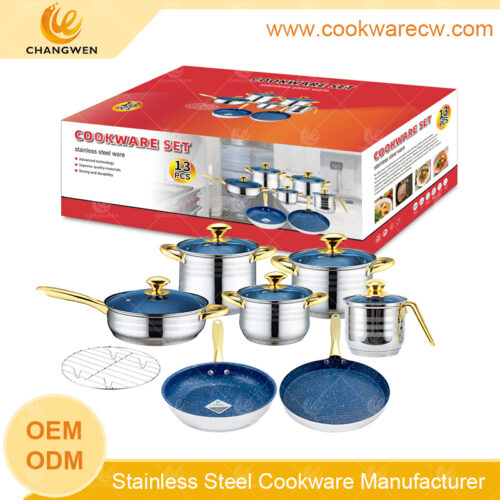
Mexican cookware set olla milk pot high stock pot kitchen wire rack and non-stick coating frypans CW-M1308
-
8pcs Stretched Aluminum Cookware Set Nonstick Pots and Pans | Aluminum Cookware Wholesale Supplier China
-
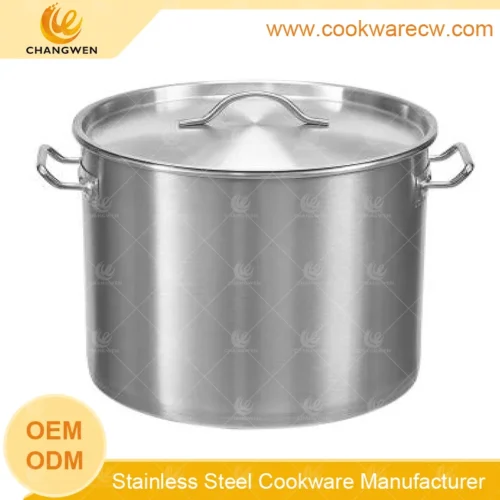
Wholesale Stock Pot CW-SP002
-
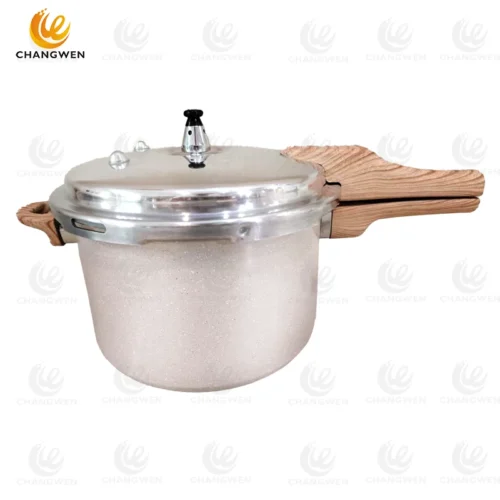
Custom Small Aluminum Pressure Cooker – Compact & Durable
-
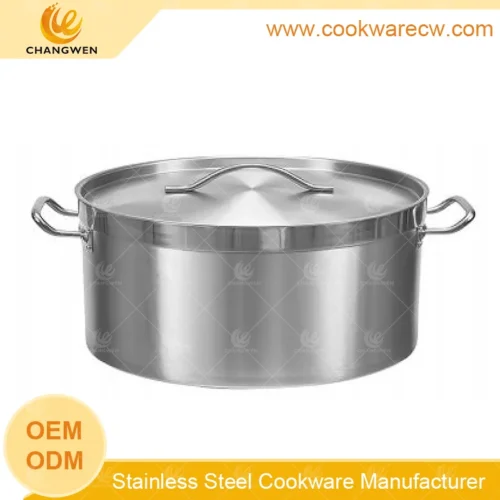
Stainless Steel Stock Pot CW-SP002
-
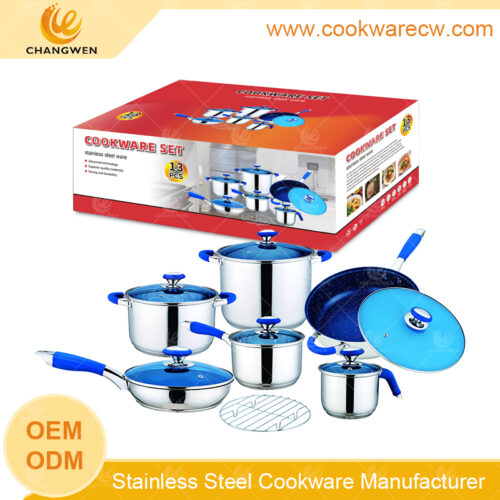
Newly Launched 13pcs stainless steel cookware set with iron wire rack nonstick fry pan with helper mirror polished soup stock pot saucepan and casserole CW-M1306G-02
-
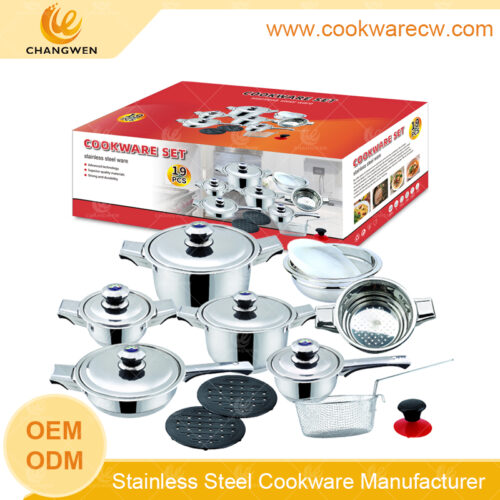
Heavy weight cookware set steamer pot 19pcs stainless steel pots and pans with thermal knobs and heat insulation handle frying basket salad bowl with PP lid kitchen utensil fire mats suction knob CW-M1901G
-
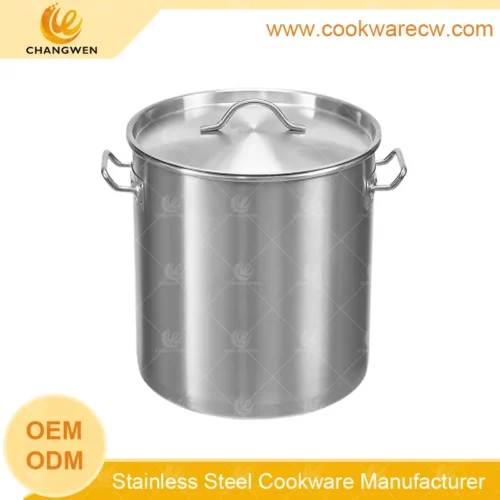
Wholesale Stainless Steel Stock Pot CW-SP001