
Read time: 11 minutes
Introduction
There is a comfortable story the cookware industry tells you: spend more, cook better.
It is a satisfying narrative. Expensive cookware must be better cookware, because why else would serious cooks pay for it? There is a whole vocabulary built around this story — “professional-grade,” “lifetime investment,” “restaurant quality” — that makes the price tag feel like a specification rather than a marketing decision.
Here is the less comfortable truth: the most expensive stainless steel cookware is not always the best. Sometimes it is. Sometimes the premium price reflects genuine engineering superiority — thicker core, better steel grade, tighter construction tolerances. And sometimes it reflects the cost of a famous name, a retail distribution chain, and forty years of brand equity that you are paying for whether you wanted to or not.
This guide tells you what actually determines stainless steel cookware quality — the specifications that predict real-world performance, the corners that budget manufacturers cut, and the ones that expensive manufacturers do too. After reading this, you will know how to evaluate any stainless steel pan on the shelf, whether it costs $30 or $300, and buy the right one for your kitchen without paying for the parts that do not cook your food.

Key Takeaways
- The specification, not the price, determines quality. Total wall thickness, core material, steel grade, and full-clad vs disc-base construction are the variables that predict cooking performance. None of these is reliably indicated by price alone.
- The biggest quality leap in stainless steel cookware happens at the $40–$80 range, where full-clad tri-ply construction becomes available. Above that, performance gains are incremental.
- 201-grade steel substituted for 304 is the most common quality fraud in stainless steel cookware — it appears in both cheap pans and mid-range products presented as premium. Visual inspection and price cannot detect it. Material documentation can.
- Full-clad construction is the real upgrade, not 5-ply over 3-ply. A properly constructed 3-ply full-clad pan outperforms a 5-ply disc-base pan for everyday cooking tasks.
- The performance gap between well-specified mid-range stainless steel and very expensive branded stainless steel is, for most home cooks and most cooking tasks, smaller than the price gap suggests.
- Certified stainless steel cookware from a manufacturer in China with verified 304 grade, proper full-clad construction, and LFGB food contact documentation can perform at the level of significantly more expensive branded alternatives.
What You Are Actually Paying For When Cookware Is Expensive
Price in stainless steel cookware is a composite of several things — some of which affect your cooking, and some of which do not.
Things That Cost Money AND Make Cooking Better
Full-clad tri-ply or multi-ply construction. A pan where the aluminum core runs continuously through the base and sidewalls distributes heat evenly across the entire cooking surface. This is a manufacturing decision that costs more to execute than disc-base construction, and it genuinely improves cooking performance for sautéing, searing, and sauce work. More expensive pans are just made better in this specific way — handles that do not jiggle, heating elements running up the sides, better balance. But this construction is now available at mid-range prices, not only at premium ones.
Thicker aluminum core. More aluminum in the core means better heat distribution and faster temperature recovery when cold food hits the pan. A thick, high-quality aluminum core is an engineering investment that shows up in cooking results. The gold standard for heating performance in tri-ply has an aluminum heating core of approximately 1.7mm. You can find this specification at multiple price points.
18/10 stainless steel for the inner layer. The higher-nickel version of 304 stainless produces better corrosion resistance and a brighter, more consistent surface finish. It costs slightly more than 18/8. Both are genuinely food-safe and non-reactive; 18/10 is the premium specification.
Quality handle ergonomics and attachment. A handle that is properly balanced, comfortable for extended cooking, and attached with load-rated rivets that do not loosen over years of use is genuinely better than a handle that wobbles. This is a manufacturing quality difference that price partially predicts.
Things That Cost Money AND Don’t Make Cooking Better
Brand heritage premium. Established cookware brands charge a premium that reflects their marketing costs, retail distribution infrastructure, and decades of brand investment. You are partly paying for the name, not just the pan. This is not inherently dishonest — brand trust has value — but it is separate from the cooking performance of the pan itself.
Retail distribution markup. A pan sold through a specialty kitchen store or department store has passed through multiple distribution layers, each adding margin. The same specification pan sold direct-to-consumer or through a wholesale channel costs less at the same manufacturing quality. Direct-to-consumer cookware brands disrupted this in the 2010s with products that use the same construction approach as the most expensive stainless cookware on the market at significantly lower prices.
Country of manufacture premium. “Made in USA” or “Made in France” commands a price premium regardless of whether the specific product’s manufacturing quality exceeds that of a certified Chinese-manufactured equivalent. Some country-of-origin premiums reflect genuine quality control and labor cost differences; others are primarily marketing positioning.
Marketing costs bundled into product price. High-visibility cookware brands spend significantly on advertising, influencer partnerships, and content marketing. These costs are recovered through product pricing. The pan itself does not cook better because the brand spent money on Instagram.
The Specifications That Actually Predict Performance
Here is the framework that cuts through price signaling. Evaluate any stainless steel cookware on these six criteria and you will know what you are buying regardless of brand name or retail price.
1. Full-Clad vs Disc-Base Construction
This single variable explains more about real-world cooking performance than any other specification. Full-clad construction bonds the conductive core (aluminum) continuously through the base and sidewalls. Disc-base construction attaches a multi-layer disc only to the bottom of a single-layer steel body.
In practice: with disc-base, heat concentrates in the base where the disc is and the sidewalls run cooler. Food touching the sides of a sauce simmering in a disc-base pan experiences a different temperature than food at the bottom. In a full-clad pan, the aluminum core carries heat up the sides, producing consistent temperature across the entire cooking surface.
For boiling pasta water or making stock, disc-base performs comparably to full-clad — the differentiation matters for technique-sensitive cooking (searing, reduction sauces, sautéing). For everyday cooking that includes these techniques, full-clad is the correct specification. The good news is that full-clad tri-ply construction is available at mid-range price points, not exclusively at premium. The concept is the same as the most expensive stainless cookware on the market, just minus the brand premium.
2. Total Wall Thickness
Measured in millimeters at the sidewall (not just the base). Thicker walls mean better heat distribution, higher thermal mass (the pan rebounds faster from cold food being added), and stronger resistance to warping over time. A minimum of 2.4mm total wall thickness is appropriate for quality tri-ply. Under 2.0mm indicates thin-gauge construction that will develop hot spots and warp faster.
Total wall thickness is measurable with a micrometer. A pan specification that does not state wall thickness should be treated skeptically — any serious stainless steel cookware manufacturer can provide this number. Importantly, total wall thickness is independent of whether the pan is 3-ply or 5-ply. Some 5-ply pans are thinner overall than quality 3-ply pans, because the five layers are distributed more thinly.
3. Steel Grade: 304 vs 201
The most frequently faked specification in stainless steel cookware. 304 stainless steel (18/8 or 18/10) contains 18% chromium and 8–10% nickel, producing a stable, non-reactive, corrosion-resistant cooking surface. 201 stainless steel contains lower nickel (1–4%), uses manganese as a substitute, looks identical to 304 visually, and costs less to produce.
The substitution of 201 for 304 is a documented quality fraud in the cookware industry — it appears in cheap pans and in some products marketed as premium. A pan labeled “304 stainless steel” cannot be verified as 304 through visual inspection or by touch. Verification requires an XRF (X-ray Fluorescence) material analyzer or a mill certificate (a laboratory document from the steel supplier showing chemical composition) for the specific production batch.
Not all stainless steel cookware is created equal specifically because of this fraud risk. A premium-priced pan from a transparent, verifiable manufacturer is not the same thing as a premium-priced pan from a manufacturer who cannot or will not document their steel grade. The price does not make the steel grade reliable. The documentation does.
4. Aluminum Core Quality and Thickness
The aluminum core is what gives stainless steel cookware its even-heating advantage. The performance of the core depends on two variables: aluminum purity and alloy quality, and core thickness.
Better aluminum alloys have higher thermal conductivity and distribute heat faster. Core thickness directly affects heat retention — a thicker aluminum core stores more thermal energy and recovers faster when cold food is added. For searing proteins, this means the pan maintains searing temperature through multiple pieces rather than cooling down between each addition.
A quality full-clad tri-ply pan has approximately 1.5–2.0mm of aluminum in the core. This specification should be available from any serious stainless steel cookware manufacturer. The combination of core thickness and alloy quality determines cooking performance more concretely than the ply count.
5. Passivation Treatment
Passivation is a chemical treatment that removes free iron particles embedded in the stainless steel surface during manufacturing and restores the chromium oxide passive layer that gives stainless steel its corrosion resistance. Without passivation, newly manufactured stainless steel cookware will develop rust spots — particularly near welds and handle attachment points — within months of use.
Passivation is invisible in the finished product. You cannot see it, feel it, or detect it through visual inspection. But its absence shows up within a few months as rust spots on “stainless” pans. This is a manufacturing process quality issue that expensive pans can have just as easily as cheap ones, if the manufacturing process does not include it. Asking for a passivation certificate is a reasonable request from any serious manufacturer.
6. Food Contact Certification
LFGB (EU Germany food contact standard) or FDA compliance documentation confirms that the specific product has been tested for heavy metal migration and food safety. These tests measure what actually leaves the pan surface and enters food during cooking under defined conditions.
Price does not guarantee certification. A $250 pan from a household brand name and a $60 pan from a certified manufacturer both need food contact documentation to verify food safety. The cheaper price does not mean the steel grade is wrong, and the higher price does not mean it has been properly tested. Require the test report, not just the price tag.
Where the Price-to-Performance Curve Actually Works
The relationship between price and performance in stainless steel cookware is not linear — it has a steep curve at the bottom and flattens significantly at the top.
Under $40 for a set: This is where legitimate quality compromises happen. Thin-gauge construction, disc-base only, potentially unverified steel grade, inadequate passivation, marginal handle quality. The cooking performance is correspondingly limited — hot spots, warping, inconsistent results.
$40–$80 for a set: The real quality step up. At this price point, full-clad tri-ply construction becomes available from reputable manufacturers. Steel grade can be verified. Passivation is standard. Cooking performance for everyday techniques is genuinely good. This is where the most significant performance improvement per dollar spent occurs.
$80–$200 for a set: Incremental quality improvements — better core thickness, 18/10 vs 18/8 inner layer, improved handle ergonomics, better surface finish consistency. Real improvements, but increasingly marginal in terms of cooking outcome for everyday home kitchen use.
$200–$500+ for a set: You are increasingly paying for brand premium, retail distribution costs, and marketing investment alongside genuine manufacturing quality. The cooking performance is excellent. But the cooking performance difference versus a well-specified $80–$120 equivalent is, for most cooking tasks, smaller than the price difference suggests.
The most important quality jump in stainless steel cookware happens at full-clad construction. Above that level, marginal improvements in core thickness, steel grade refinement, and surface finish quality are real but incremental. A cook who sears steak three nights a week might experience the difference between a $120 and a $400 pan in their cooking results. A cook making weeknight dinners most likely will not.
The “China Made = Low Quality” Assumption Is Outdated
One persistent reason buyers pay brand premiums for expensive cookware is the assumption that expensive Western-branded cookware is manufactured to a higher standard than Chinese-manufactured cookware. This assumption deserves scrutiny.
China is the world’s dominant stainless steel cookware manufacturing location. The factories in Jiangmen and Chaozhou, Guangdong are not producing substandard cookware — they are producing the majority of the stainless steel cookware sold globally, including products that carry Western brand names at premium retail prices. Most “premium” cookware brands do not own factories. They source from manufacturing partners, some of whom are Chinese factories.
A stainless steel cookware manufacturer in China with verified 304 steel (XRF tested, mill certificates provided), full-clad tri-ply construction (cross-section sample available for verification), LFGB food contact certification from an accredited laboratory (SGS, TÜV, Bureau Veritas), and ISO 9001 quality management certification is producing genuinely quality cookware. The country of manufacture does not determine the quality. The specification, the manufacturing process, and the documentation do.
The difference between a well-specified Chinese-manufactured tri-ply stainless steel pan and an expensive Western-branded pan made in the same Jiangmen production cluster by the same construction method is, in many cases, primarily the distribution chain and the brand premium. In blind cooking tests, mid-range fully-clad stainless steel pans have repeatedly performed comparably to significantly more expensive branded alternatives.
What Genuine Quality Looks Like at Any Price
Regardless of brand, regardless of origin country, regardless of retail price point, quality stainless steel cookware has these verifiable characteristics:
Documented steel grade. The manufacturer can provide mill certificates or XRF test data confirming 304 (18/8 or 18/10) stainless steel for the inner food-contact surface. “304 stainless steel” as a marketing claim without supporting documentation is a starting point for verification, not verification itself.
Full-clad construction confirmed by cross-section. The conductive core runs through the base AND sidewalls. Request a cross-section cut from the manufacturer to confirm. Disc-base construction masquerading as full-clad is a documented marketing issue in the industry.
Total wall thickness of 2.4mm or more. Measured at the sidewall. This is a physical measurement, not a claim. A micrometer confirms it.
Passivation certificate. The pan has been treated to restore its passive chromium oxide layer after manufacturing. This is particularly important at welds and handle attachment points.
LFGB or FDA food contact test report. From an accredited testing laboratory, covering the specific product (not a different product from the same manufacturer). This confirms food safety under actual testing conditions, not under assumptions about material composition.
Handle security. Riveted handles with no lateral movement when load is applied. Welded handles for applications where interior cleanliness is prioritized. Either attachment method should show no movement under firm pressure.
None of these quality characteristics are exclusive to expensive cookware. All of them are available from manufacturers at multiple price points. The skill in cookware buying is demanding these specifications — and receiving them — rather than using price as a proxy.
The Practical Buying Framework
Here is how to buy quality stainless steel cookware without overpaying for brand premium.
Step 1: Decide on full-clad vs disc-base based on your cooking. If you sear, sauté, and make pan sauces regularly, full-clad is worth the premium over disc-base. If you primarily boil, steam, and make soups, disc-base performs comparably and costs less.
Step 2: Establish your minimum specification. For full-clad: 304 inner layer, minimum 2.4mm total wall thickness, 430 outer layer for induction. These are non-negotiable.
Step 3: Require documentation. Steel grade documentation. Food contact certification. Passivation confirmation. Any manufacturer who will not provide these is telling you something.
Step 4: Evaluate the price range where your specification is met. Once you have the specification and the documentation, compare price. At that point, any additional premium represents brand equity, retail markup, or country of origin — not more cookware quality.
Step 5: Buy the best specification at the lowest price that meets your documentation requirements. This is the rational decision. It may or may not be the most expensive option on the shelf.
FAQ
Is expensive stainless steel cookware worth it?
Sometimes yes, sometimes no. The cooking performance difference between a well-specified mid-range full-clad stainless steel set and a premium-branded equivalent is, for most home cooking tasks, smaller than the price difference suggests. The premium often partly reflects brand heritage, retail distribution costs, and marketing investment rather than manufacturing quality. Use the specification framework — steel grade, construction, wall thickness, certification — to evaluate whether you are paying for better cookware or a better brand story.
What actually makes stainless steel cookware good quality?
Full-clad construction with conductive core running through base and sidewalls, 304 stainless steel inner layer confirmed by documentation, total wall thickness of 2.4mm or more, passivation treatment for corrosion resistance, and LFGB or FDA food contact certification. These specifications predict cooking performance and food safety. Price alone does not reliably indicate whether any of these specifications are met.
How can I tell if a pan is really 304 stainless steel?
Visual inspection and touch cannot distinguish 304 from 201 stainless steel — they look and feel identical. Verification requires XRF (X-ray Fluorescence) material testing on the actual pan, or a mill certificate from the steel supplier showing the chemical composition of the specific production batch. Require one of these documents from any serious manufacturer or retailer.
Is Chinese-made stainless steel cookware reliable?
Yes, when specifications are documented and verified. China manufactures the majority of the world’s stainless steel cookware, including products sold under Western brand names at premium prices. A Chinese stainless steel cookware manufacturer with verified 304 steel grade, LFGB food contact certification from an accredited laboratory, and ISO 9001 quality management certification produces genuinely quality cookware. The country of manufacture does not determine quality — the specification, manufacturing process, and documentation do.
What is the biggest quality difference between cheap and expensive stainless steel cookware?
The biggest single quality difference is full-clad vs disc-base construction. Disc-base concentrates heat at the base and leaves sidewalls in single-layer steel. Full-clad runs the conductive core through the entire pan body. For sautéing, searing, and sauce work, this construction difference has a real cooking impact. Above the full-clad threshold, subsequent price increases buy incremental improvements — marginally better steel grade, thicker core, finer surface finish — that matter more in professional kitchens than in everyday home cooking.
Does the price of stainless steel cookware reflect quality?
Partially. Price partially reflects genuine manufacturing quality differences, and partially reflects brand premium, retail distribution costs, marketing investment, and country of manufacture positioning. At the low end, price is a reasonable quality signal — very cheap stainless steel cookware does involve genuine quality compromises. In the mid and upper price ranges, price becomes a less reliable quality predictor. Specification documentation is a more reliable quality signal than price at any level.
Conclusion
Price is a convenient shortcut for evaluating stainless steel cookware because it is visible at a glance. The actual quality indicators — steel grade documentation, construction type, wall thickness, passivation, food contact certification — require more effort to find and verify.
The effort is worth it. A well-specified mid-range stainless steel pan with verified 304 steel and proper full-clad construction will outperform an expensive pan with undocumented steel grade and disc-base construction, every time, for every cooking technique that benefits from even heat distribution.
The most expensive stainless steel cookware is not always the best. And the best stainless steel cookware at any price point can be identified by the same set of specifications — none of which appear on the price tag.
Buy the spec, not the story.
About Changwen
Changwen is a stainless steel cookware manufacturer based in Jiangmen, Guangdong, China, with over 22 years of OEM and ODM manufacturing experience. We supply brands, importers, and distributors across South America, Southeast Asia, the Middle East, Europe, and Australia with verified-specification stainless steel cookware.
What we provide that quality cookware requires:
- Verified 304 stainless steel (18/8), mill certificates for every production batch
- Full-clad tri-ply construction (304-aluminum-430), cross-section samples available
- LFGB food contact test reports from accredited laboratories (SGS, TÜV, Bureau Veritas)
- FDA compliance documentation
- Passivation certificates
- ISO 9001:2015 quality management certification
-
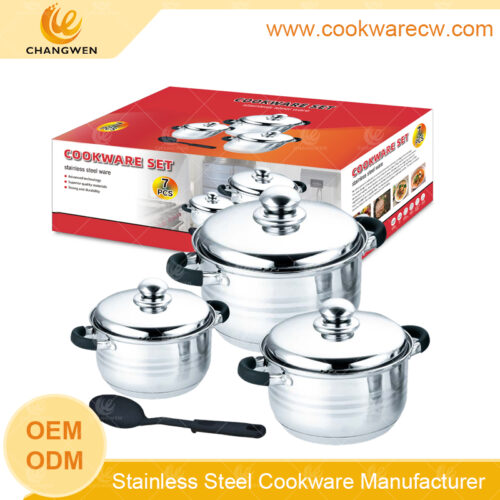
Mercado Libre hotsale cookware 7pcs cooking pot set stainless steel lids silicone handle kitchen tool solid serving spoon CW-M0702G
-
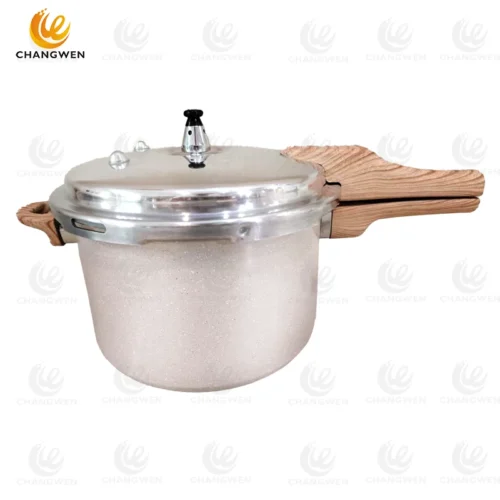
Custom Small Aluminum Pressure Cooker – Compact & Durable
-
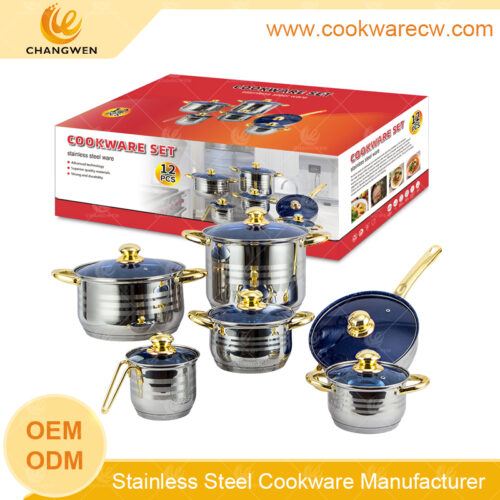
heavy S/S 12pcs cookware set pots wholesale nonstick fry pan blue glass lid golden handle cooking pan milk pot CW-M1222
-
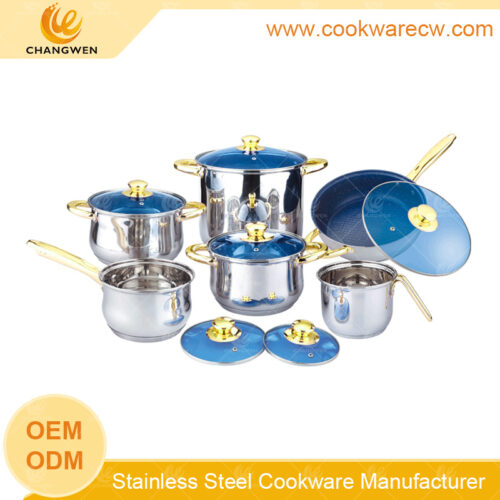
Safest Stainless Steel Cookware
-
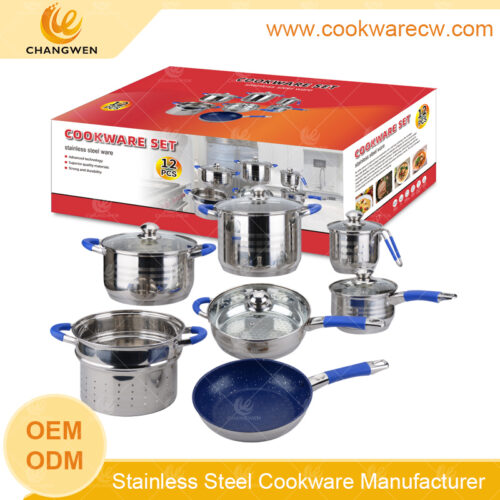
12pcs stainless steel cooking pots & pans set with color silicon handles coating conic frypan 24cm pasta pot in China CW-M1311
-
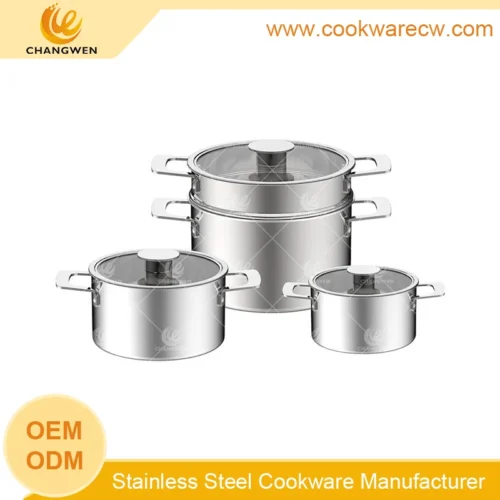
Commercial-Grade Stainless Steel Pot Set for Chefs CW-TP0705
-
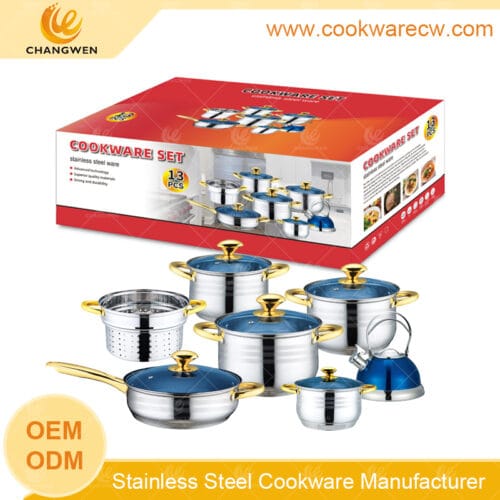
Mercado Libre stainless steel 13pcs cookware set tea kettle pasta pot nonstick frying pan golden handle blue coating CW-M1305
-
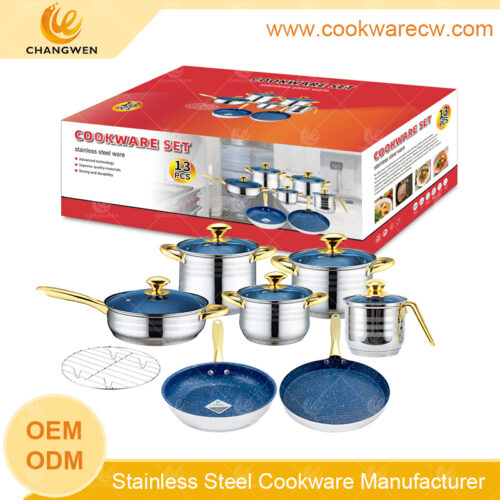
Mexican cookware set olla milk pot high stock pot kitchen wire rack and non-stick coating frypans CW-M1308