
Read time: 11 minutes
Introduction: Why Choosing the Right Soup Pot Actually Matters
Soup is one of the most universally cooked dishes in the world — and one of the most forgiving. A mediocre broth can still nourish. A decent stew can still satisfy. But the pot you cook it in determines whether your soup is efficient or frustrating, whether the flavors develop fully or evaporate away, whether the pot lasts three years or thirty.
A good soup pot affects cooking efficiency, heat distribution, flavor extraction, cleaning experience, and long-term durability. These are not trivial variables. A thin-bottomed pot scorches the base of a long-simmered tomato soup before the flavors have time to develop. A pot with poor heat retention drops temperature every time you lift the lid. A pot with compromised handles becomes a safety risk when full of liquid.
For home users, the priority is durability, reliable performance, and easy maintenance. For restaurants and commercial kitchens, the priority is high-capacity construction, resistance to continuous heavy use, and stackable design. For wholesale buyers and importers, the critical factors are material grade, wall thickness specification, and supply consistency.
Changwen is a professional stainless steel cookware manufacturer in China with over 22 years of OEM and wholesale production experience. We produce stainless steel soup pots and commercial stock pots for global distributors, restaurant suppliers, and kitchenware brands. This guide reflects that manufacturing knowledge — it is not a consumer review roundup.
What Is a Soup Pot?
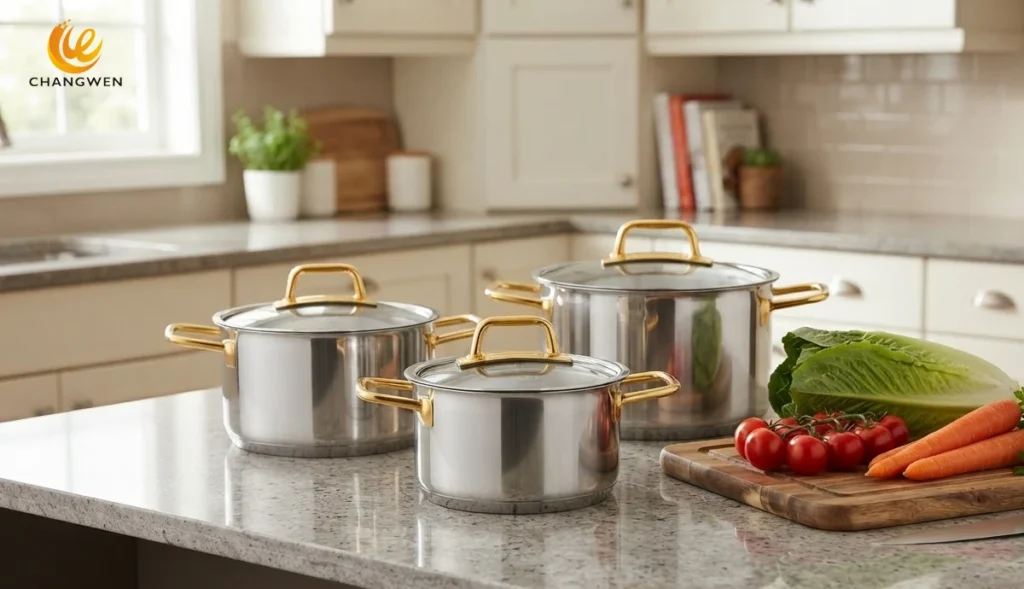
A soup pot is a large, deep-sided cooking vessel designed to hold significant volumes of liquid and sustain long cooking times at controlled temperatures. Unlike a frying pan, which is designed to release moisture and achieve surface browning, a soup pot is engineered to retain liquid, distribute heat evenly from base to sidewalls, and maintain a stable simmer over extended periods.
Typical characteristics of a soup pot:
- Deep body with high sides that minimize evaporation
- Large capacity to accommodate multiple servings or batch cooking
- Heavy-duty construction that handles the weight of a full liquid load
- A tight-fitting lid to control steam and retain heat
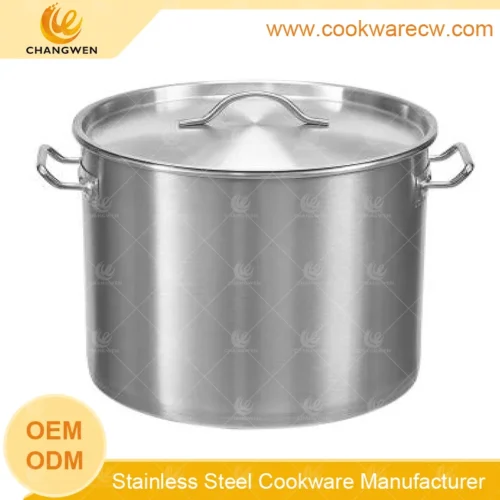
- Two loop handles for safe, two-handed carrying when the pot is full
What a soup pot is used for: everyday soups and broths, stews and chili, pasta boiling, seafood boiling, stock preparation, and batch cooking for meal prep. It is one of the most frequently used vessels in both home and commercial kitchens.
Soup Pot vs Stock Pot: What Is the Difference?
These two terms are often confused because both are deep, large vessels used for liquid cooking. The distinction matters when you are choosing what to buy.
| Feature | Soup Pot | Stock Pot |
|---|---|---|
| Depth | Medium to high | Very deep (taller than wide) |
| Primary use | Daily soup, stews, braises | Large-batch stock, pasta, canning |
| Typical capacity | 4–12L | 8–100L+ |
| Surface-to-volume ratio | Moderate | Low (minimum evaporation) |
| Home use suitability | Excellent | Good for large families |
| Commercial use | Very good | Excellent for high-volume operations |
| Stovetop maneuverability | Good (manageable weight) | Requires two hands when full |
A soup pot is the everyday workhorse. A stock pot is optimized for maximum liquid volume with minimum evaporation — typically used for 6–12 hour simmering projects where maintaining liquid volume is the priority.
What Makes a Good Soup Pot? The Key Purchasing Factors
1. Material: The Decision That Determines Everything Else
Stainless Steel Soup Pot (Recommended for Most Applications)
Stainless steel is the gold standard for soup pot construction across both home and commercial applications. It combines all the properties that long-duration liquid cooking demands.
Durability: Stainless steel resists corrosion, scratching, and physical impact. A quality stainless steel soup pot does not rust, does not pit, and does not degrade when used for acidic preparations. It can withstand commercial dishwasher cycles and will maintain its structural integrity under years of heavy use.
Non-reactive cooking surface: Stainless steel does not interact with acidic ingredients — tomatoes, wine, citrus, vinegar — that characterize many soup and stew recipes. Food tastes like the ingredients, not the pot.
Food-grade compliance: Quality stainless steel soup pots use 304 stainless steel (18/8) for the food-contact inner surface. This grade contains 18% chromium and 8% nickel, providing the corrosion resistance and food safety properties required for food contact materials. It passes LFGB (EU) and FDA (US) food safety certification.
Induction compatibility: With a 430 stainless steel outer layer (magnetic), the soup pot works on induction cooktops as well as gas, electric, and ceramic-glass stovetops. 430 stainless steel is the outer layer specified for universal cooktop compatibility.
Easy maintenance: Stainless steel is dishwasher safe, does not require seasoning, and does not need special cleaning products. Stains from hard water or mineral deposits clean with a diluted vinegar solution.
Aluminum Soup Pot
Aluminum heats rapidly and distributes heat efficiently, making it a practical option where weight and heating speed are priorities. An aluminum soup pot reaches boiling temperature faster than stainless steel of the same capacity.
Advantages: Lightweight (relevant for large commercial pots that staff must move when full), fast heating, cost-effective at commercial scale.
Limitations: Raw aluminum reacts with acidic foods — tomato-based soups, citrus preparations, wine-based broths. The reaction can impart a metallic taste and cause surface pitting over time. Hard-anodized aluminum eliminates the reactivity issue but at higher cost. Aluminum is softer than stainless steel and more susceptible to denting and deformation.
Best for: High-volume boiling applications in commercial kitchens where heating speed outweighs material longevity, or where contents are non-acidic.
Cast Iron Soup Pot
Cast iron has exceptional heat retention — once hot, it stays hot for a long time without additional energy input. This makes it excellent for long, slow braises and for keeping contents warm at the table.
Advantages: Unmatched heat retention, develops a cooking surface character with use, dramatic presentation when serving directly at the table.
Limitations: Very heavy — a 6L cast iron pot weighs 5–7kg before any liquid. Slow to heat. Requires seasoning (bare cast iron) or careful handling to avoid enamel chipping (enameled cast iron). Not practical for high-volume commercial operations.
Best for: Home cooks who do slow braises and want to serve at the table, and for recipes specifically benefiting from sustained residual heat.
What Size Soup Pot Should You Buy?
Sizing is where most buyers make mistakes in both directions — too small creates crowded, poorly cooked batches; too large wastes energy heating excess volume and makes handling unwieldy.
The correct principle: your soup pot should be filled two-thirds full during cooking. This allows adequate stirring room and prevents overflow during simmering, while ensuring the liquid depth is sufficient for even heat distribution.
| Capacity | Best Suited For |
|---|---|
| 3–5 Quart (3–5L) | 1–2 person household, small batches |
| 6–8 Quart (6–8L) | Family of 4, standard daily cooking |
| 10–12 Quart (10–12L) | Large family, regular batch cooking |
| 20–50 Quart (20–50L) | Restaurant kitchen, catering service |
| 50L+ | Commercial central kitchen, institutional use |
The 6–8 quart (6–8L) range is the most versatile for family home use. This capacity handles a generous batch of chicken soup (whole bird plus vegetables), a full pot of chili for six, or pasta water for a family dinner — without being so large that it takes 20 minutes to heat.
For restaurants: Most restaurant soup stations use 20–40 quart (20–40L) stainless steel soup pots that can be prepared in batches and held warm throughout service. High-volume operations use larger vessels for initial batch preparation then transfer to smaller holding pots for service efficiency.
Important note for commercial buyers: When specifying commercial soup pot capacity, account for the working load limit of your burners and the physical capacity of your staff to handle the vessel when full. A 40L pot full of soup weighs approximately 45kg. Specify pots with appropriate handle configuration and, for very large vessels, consider a tilting kettle design for safe pouring.
How Thick Should a Soup Pot Be?
Wall thickness directly determines heat distribution performance, deformation resistance, and the pot’s service life under sustained use. Thicker walls take slightly longer to heat but distribute heat more evenly and resist warping or denting under heavy use.
Home soup pots: 0.8–1.0mm wall thickness. Sufficient for regular home cooking, provides good heat distribution for stovetop use, appropriate weight for household handling.
Restaurant soup pots: 1.0–1.5mm wall thickness. The additional thickness handles daily high-heat use, provides better heat distribution for commercial burner output levels, and resists deformation from heavy contents and repeated thermal cycling.
Heavy-duty commercial and industrial: 1.5mm and above. Maximum durability for continuous use in central kitchens, institutional food service, catering, and high-throughput restaurant operations.
Changwen’s commercial stainless steel soup pots use durable stainless steel construction with thickness specifications designed for professional use environments, manufactured to specification per OEM program requirements.
Stainless Steel Soup Pot Construction Explained
The internal construction of a stainless steel soup pot determines its heat performance beyond what wall thickness alone describes.
Single-Layer Stainless Steel
The most common and cost-effective construction. A single layer of stainless steel forms the pot body, with the thickness providing the structural integrity. Heat from the burner is applied directly to the steel.
Performance: Adequate for boiling and simmering applications where even heat distribution across the sidewalls is not critical. Hot spots can develop at the base if the burner output is uneven relative to the base diameter.
Best for: Standard commercial soup and stock operations, high-volume boiling applications, price-sensitive wholesale programs.
Tri-Ply Stainless Steel Construction
Three permanently bonded layers:
- 304 stainless steel (inner food-contact layer)
- Aluminum alloy core (heat distribution layer)
- 430 stainless steel (outer induction-compatible layer)
The aluminum core distributes heat from the burner contact point rapidly across the entire base and up the sidewalls. This eliminates hot spots and creates a consistent cooking temperature across the full cooking surface.
Performance: Significantly better heat distribution than single-layer construction. Food heats evenly, reducing the constant stirring required with single-layer pots on high-output burners. Energy efficient — reaches target temperature faster and maintains it more consistently.
Best for: Premium consumer soup pot programs, restaurant fine dining applications, OEM cookware brands positioning at mid-to-premium price tiers.
Important Features to Look for When Buying a Soup Pot
Strong Handles: Safety Under Load
A full soup pot can weigh 10–20kg or more. Handle security is not a comfort feature — it is a safety requirement. Quality soup pot handles should be:
Riveted attachment: Rivets penetrate through the pot wall and are secured from the inside, tolerating the lateral and downward stress of a heavily loaded pot without loosening. Welded handles are lighter and have a cleaner appearance but tolerate heavy load stress less reliably over time.
Ergonomic geometry: The handle should allow a secure two-handed grip with the pot tilted slightly toward the body for safe carrying. Loop handles (rather than ear handles) on soup pots provide better grip control when moving a heavy vessel.
Heat-resistant material: For pots used on gas burners where the handle may be closer to the flame, heat-resistant materials at the grip area prevent burns during cooking. Stainless steel handles with hollow construction stay cooler than solid cast handles on high-heat applications.
Tight-Fitting Lid: Retention and Efficiency
A lid that seals the pot reduces evaporation during simmering, retains heat so the burner can be lowered after reaching temperature, and shortens the time to boiling by keeping steam inside. For commercial applications where soup simmers for several hours, a good lid fit can meaningfully reduce gas or electricity consumption.
Check lid fit by placing it on the pot and feeling for seal resistance — there should be slight resistance when lifting, indicating a snug fit without any gap around the rim.
Induction Compatibility
For markets with significant induction cooktop penetration (EU, Australia, Japan, urban North America), confirm that the soup pot has a magnetic outer base layer (430 stainless steel). A pot with a 304 stainless outer layer or an aluminum body without a stainless steel disc is not induction-compatible.
Easy Pouring Design
A soup pot filled with hot liquid that needs to be poured or ladled is a safety consideration. A slight pouring rim at the lip helps direct liquid flow. Balanced weight distribution between pot body and handles reduces wrist strain during pouring. For large commercial pots, a tilting kettle design or a dedicated ladle station is safer than manual tipping of a heavy vessel.
Soup Pot for Home Use vs Restaurant Use
Home Soup Pot Priorities
Home cooks prioritize a soup pot that performs reliably for everyday family cooking, looks presentable at the table, and is easy to clean after use. The right home soup pot is durable enough for 10–20+ years of regular use without requiring special maintenance.
Recommended specification: 6–10 quart (6–10L) stainless steel soup pot with tri-ply construction or quality single-layer construction, 0.8–1.0mm wall thickness, glass or stainless lid, induction-compatible base.
Commercial Soup Pot Priorities
Restaurant and catering kitchens require soup pots that handle multiple uses per day across years of service. Commercial soup pots must be large enough to batch-cook efficiently, thick-walled enough to withstand high-output commercial burners without deforming, and stackable for efficient storage.
Recommended specification: 20–50 quart (20–50L) stainless steel construction, 1.0–1.5mm wall thickness, riveted loop handles, induction-compatible (for mixed kitchen equipment environments), designed for commercial dishwasher cleaning.
Applications: Restaurant soup and broth stations, hotel banquet kitchen operations, catering companies preparing for large-format service, central kitchen batch production for multi-location operations.
Common Mistakes When Buying a Soup Pot
Choosing material that is too thin. A soup pot with walls under 0.7mm will develop uneven heating and base deformation within months of regular use. Visible warping in a thin soup pot base means the pot is no longer making full contact with the stovetop — a problem that worsens with every use. Specify minimum wall thickness and confirm it on physical samples.
Buying the wrong capacity. A pot that is too small forces you to cook in batches, losing the time and energy efficiency that batch cooking is supposed to provide. A pot that is too large for regular use takes excessive time and energy to heat for small-batch cooking. Match capacity to your actual serving volume, not your aspirational cooking scale.
Ignoring handle quality. A soup pot with inadequate handle attachment or uncomfortable grip geometry is a safety risk. Handles that feel secure when the pot is empty may flex or wobble when the pot holds 15kg of liquid. Evaluate handles on fully loaded pots — not just display samples.
Choosing non-stick for high-heat soup applications. Non-stick coatings begin to degrade above 260°C and are not designed for the extended high-heat use typical of commercial soup operations. For soups and broths, bare stainless steel provides better longevity, wider temperature range, and no coating deterioration concern.
How to Clean and Maintain a Stainless Steel Soup Pot
Stainless steel soup pots require minimal maintenance compared to cast iron or coated alternatives. Follow these practices to maintain performance and appearance:
Routine cleaning: Wash with warm soapy water and a soft sponge after each use. Stainless steel is dishwasher safe; commercial dishwasher cycles are fine for restaurant operations.
Avoiding damage: Do not use steel wool or abrasive scrubbers on polished surfaces — they scratch the finish and can leave iron particles that cause surface discoloration. Use nylon or soft-fiber scrubbers for stubborn residue.
Removing mineral deposits and watermarks: Hard water leaves mineral deposits that appear as white spots or clouding. A diluted solution of white vinegar (1:3 vinegar-to-water ratio) applied with a soft cloth and rinsed thoroughly removes these deposits without damaging the surface.
Removing discoloration from high heat: Blue or golden heat tinting on the exterior is normal for stainless steel used on gas burners at high temperatures. Bar Keepers Friend or a similar oxalic acid-based cleaner restores the surface appearance.
Storage: Dry completely before stacking. Wet pots stacked together create environments where surface spotting develops. For commercial stacks, nesting dry pots prevents moisture accumulation between surfaces.
FAQ
What is the best material for a soup pot?
Stainless steel (304 grade, 18/8) is the best material for most soup pot applications. It provides durability, corrosion resistance, non-reactive food contact, easy maintenance, and long service life. Tri-ply stainless steel construction adds even heat distribution across base and sidewalls for premium performance. Aluminum is a valid choice where weight and fast heating are priorities, but requires careful handling with acidic ingredients.
Is stainless steel good for making soup?
Yes — particularly 304 stainless steel (18/8). Stainless steel is non-reactive with acidic soup ingredients (tomatoes, wine, citrus), easy to clean, durable over decades of use, and compatible with all stovetop types with the correct outer base layer. Tri-ply construction with an aluminum core improves heat distribution for more even simmering.
What size soup pot is best for a family?
A 6–8 quart (6–8L) soup pot handles most family cooking tasks comfortably — a whole chicken for broth, a full batch of soup or chili for four to six people, or a large pasta boil. If you regularly cook for larger groups or do weekly batch meal prep, a 10–12 quart (10–12L) pot provides more working volume without becoming too large to handle.
What soup pot do restaurants use?
Restaurants typically use heavy-gauge stainless steel soup pots with 1.0–1.5mm wall thickness, large capacity (20–50 quart depending on operation size), riveted loop handles for safe carrying under heavy loads, and induction-compatible bases for flexible kitchen equipment configurations. The stainless steel construction withstands commercial dishwasher cycles and daily high-heat use without degrading.
Can soup pots be customized for wholesale?
Yes. Soup pot manufacturers can customize capacity, wall thickness, handle design and material, surface finish, logo engraving, and retail packaging for OEM and wholesale programs. Commercial soup pots can be specified with custom diameters, heights, and construction grades for specific restaurant or institutional kitchen requirements.
What is the difference between a soup pot and a stock pot?
A soup pot has medium-to-high sides and is designed for everyday soups, stews, and batch cooking — typically 4–12L capacity. A stock pot is taller relative to its diameter, minimizing evaporation during multi-hour stock simmering, and is available in much larger capacities (8–100L+). For everyday home cooking, a soup pot is more practical. For large-volume stock production, a stock pot’s shape is the correct specification.
Why Choose Changwen as Your Soup Pot Manufacturer?
Changwen has been manufacturing stainless steel cookware in Jiangmen, Guangdong, China for over 22 years. Our production capability covers the full range of stainless steel soup pot specifications for wholesale, OEM, and commercial supply programs.
What Changwen produces:
- Stainless steel soup pots (home and commercial specifications)
- Commercial stock pots (20L to 80L+)
- Custom capacity, wall thickness, and handle design per OEM program
- Private label production with custom logo, finish, and packaging
- Bulk wholesale supply with consistent quality across production batches
📧 Contact Changwen for stainless steel soup pot catalog and wholesale pricing
-
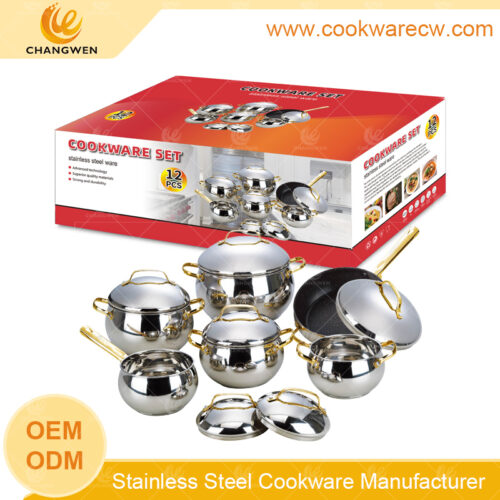
Pots wholesale apple shape cookware set mirror polished stainless steel lids golden wire handles and knobs nonstick frypan CW-M1220
-
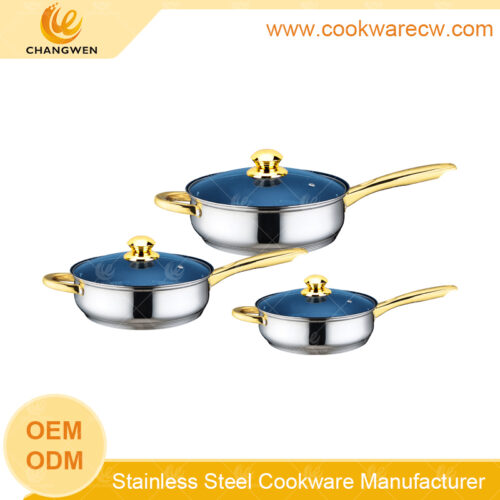
Best Nonstick Stainless Steel Pan
-
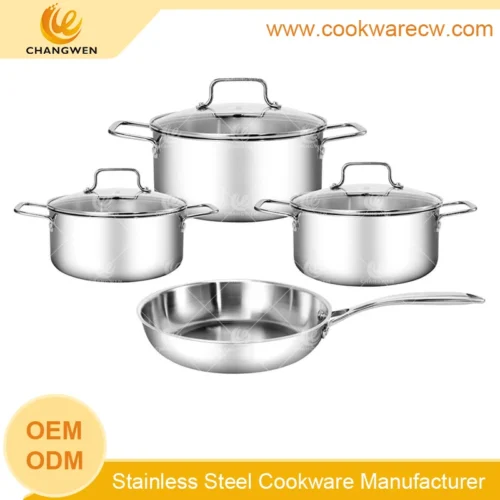
Premium Stainless Steel Cookware Set for Modern Kitchens CW-ETP0703
-
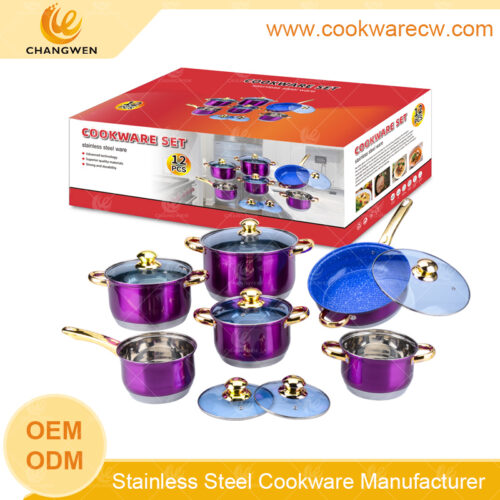
color coating surface stainless steel pots non-stick frypan golden S/S handles and knobs 430 protector for induction CW-M1225
-
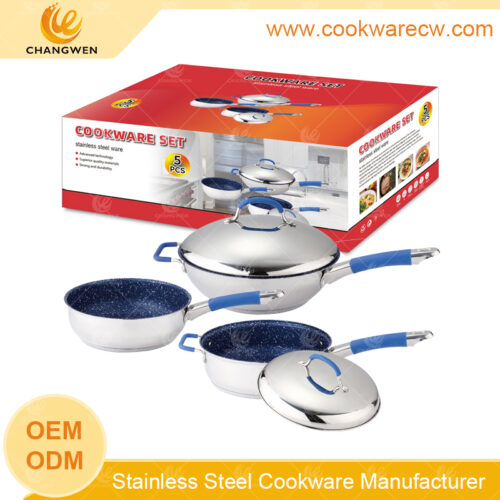
Customize color box 3pcs fry pan set blue marble nonstick coating frying pans stainless steel lids and blue silicone cover CW-M0501G
-
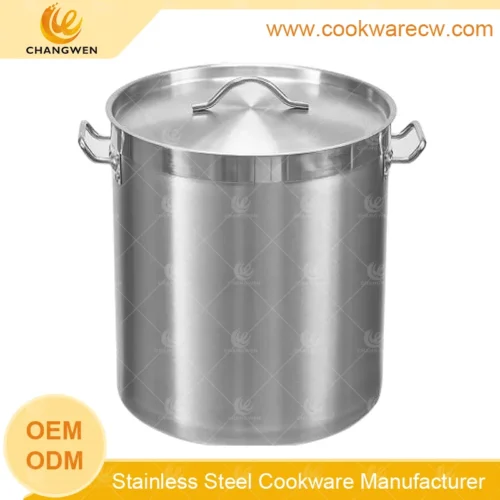
Wholesale Large Stock Pot CW-SP001
-
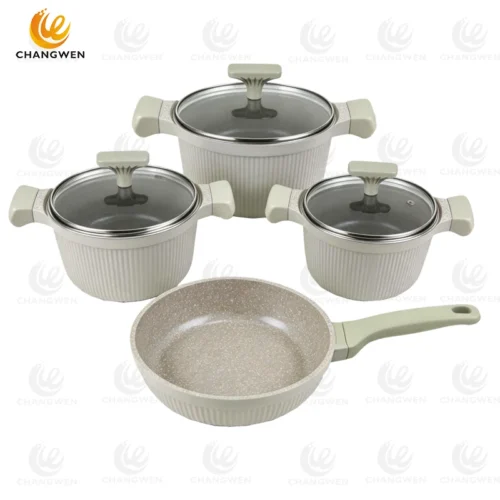
7pcs Vertical Stripe Nonstick Aluminum Cookware Set with Silicone Lid | Changwen Aluminum Cookware Factory China
-
Wholesale Stock Pot CW-SP002