
Read time: 12 minutes
Introduction: Why Unit Price Is the Wrong Number to Optimize
Most cookware importers lose money before their first container ships. Not because they chose the wrong product. Because they compared the wrong number.
Unit price is visible, clean, and easy to compare between suppliers. Landed cost is complicated, requires a spreadsheet, and involves numbers from six different parties. So importers optimize for unit price and discover the landed cost problem when the invoice arrives from their customs broker.
Here is the math that matters: A stainless steel cookware set quoted at $28 FOB from Supplier A sounds better than $34 FOB from Supplier B. But Supplier A’s order requires custom color boxes with a 10,000-unit packaging MOQ (you only need 3,000 units), ships from an inland factory with $800 in origin charges, and packs 8 sets per carton. Supplier B’s order ships in stock brown boxes (upgradeable later), ships from a port city, and packs 12 sets per carton — fitting 40% more units in the same container. By the time both orders reach your warehouse, Supplier B’s $34 pan is the cheaper one.
This is not a hypothetical. It is what happens when importers treat MOQ, packaging, and shipping as afterthoughts rather than as the primary cost variables they are.
This guide gives you the framework to evaluate all three correctly — before you place an order.
Part 1: Understanding MOQ in Cookware Manufacturing
What Does MOQ Mean in Cookware Sourcing?
MOQ (Minimum Order Quantity) is the smallest production run a factory will accept for a given product. It is not an arbitrary restriction — it is the output of a specific manufacturing economics calculation that includes raw material purchasing, production scheduling, equipment setup, and quality control efficiency.
A factory setting an MOQ of 1,000 units for a stainless steel frying pan is communicating that at quantities below 1,000, the cost per unit becomes inefficient for the production process. The steel coil may need to be purchased in minimum widths. The polishing line takes 2 hours to set up regardless of whether it runs for 50 or 500 pieces. The carton print run has a fixed plate cost that amortizes over quantity.
Understanding why MOQs exist helps importers negotiate them more effectively. You are not asking the factory to give you something for free when you negotiate MOQ — you are asking them to identify which cost elements are adjustable and which are fixed.
Why Cookware Products Usually Have Higher MOQ Requirements
Cookware manufacturing involves more production stages than most product categories. Each stage has its own setup cost and minimum efficiency threshold:
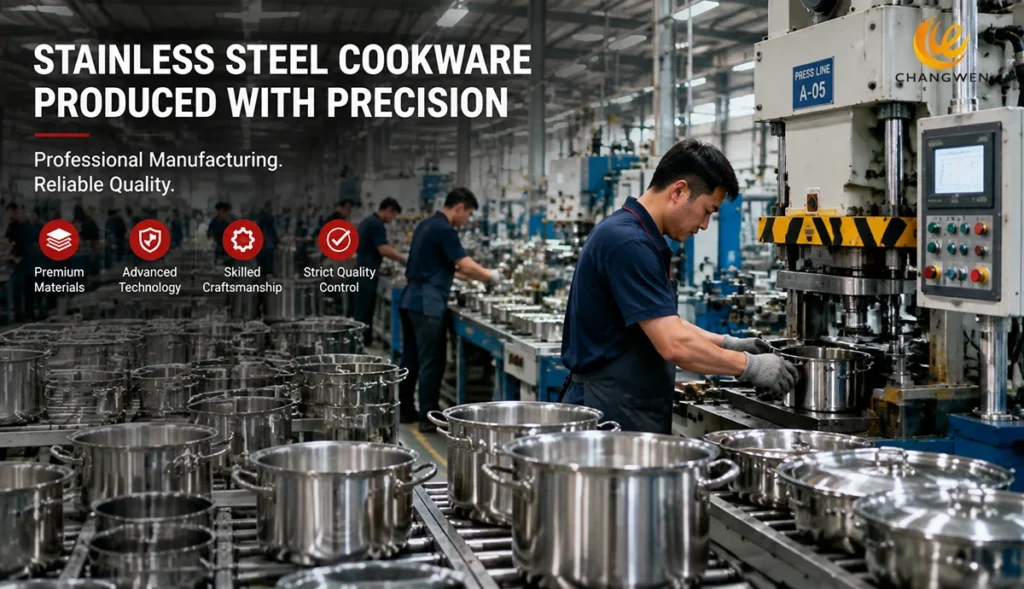
Metal forming: Steel sheet arrives as coil, which must be cut to blanks and then deep-drawn (stamped and pressed) into shape. Setup time for the forming press is fixed regardless of batch size. Small batches mean high setup cost per unit.
Surface finishing: Polishing is labor-intensive. A satin brushed finish requires multiple polishing stages on each piece. The polishing line throughput assumes minimum batch sizes to justify the setup and operator time.
Coating application: Non-stick coating (PTFE, ceramic, granite) requires spray booth setup, curing oven cycles, and quality inspection per batch. Small coating batches are significantly less efficient than production-scale batches.
Packaging production: Custom color boxes require artwork, printing plates, and minimum print runs. A print run of 500 boxes may cost nearly as much in setup fees as a run of 5,000 — the unit economics only work at minimum quantities.
Handle and lid assembly: Components (Bakelite handles, glass lids, rivets) are purchased in minimum quantities from component suppliers. Small orders from the cookware factory mean small orders up the supply chain, with proportionally higher component costs.
These stacked setup costs are why a cookware factory with a 1,000-unit MOQ is not being arbitrary. They are communicating the minimum scale at which production economics work.
Part 2: Different MOQ Levels for Different Cookware Project Types
Stock Products With Existing Designs
A factory’s catalog products use existing tooling — the molds, dies, and fixtures for the pan body, handle, and lid are already made and paid for. Ordering a catalog product means the factory’s setup cost for that order is primarily scheduling and material procurement — not tooling investment.
For importers, this means catalog product MOQs are typically lower, lead times are shorter, and the per-unit cost is more predictable. The trade-off is limited differentiation — the same product is available to other buyers from the same factory.
Common customization on catalog products without new tooling: logo engraving (laser engraving on the existing pan body), packaging design (custom color box artwork), and handle color selection (from available Bakelite color options). These customizations create meaningful brand differentiation without the cost and lead time of full tooling investment.
Practical MOQ range for catalog OEM programs: 500–1,000 units per item from most established cookware manufacturers.
OEM Cookware Projects
In an OEM program, you modify the product specification beyond what the factory’s existing tooling supports. You might specify a different handle shape, a non-standard pan diameter, an unusual depth-to-diameter ratio, or a proprietary surface texture. Any of these requires either new tooling or significant modification to existing tooling.
OEM project MOQs are higher because:
- Tooling investment is amortized over the production run (lower volume = higher tooling cost per unit)
- Sample development and approval add weeks before production begins
- Quality control during production requires more oversight for non-standard specifications
Practical MOQ range for OEM projects with new tooling: 3,000–10,000 units per item depending on tooling complexity.
Private Label Cookware Programs
Private label occupies the middle ground: you apply your brand identity (logo, packaging, possibly handle color) to the factory’s existing product designs. The factory owns the product design; you own the brand.
Private label programs allow new brands to enter the market with professional-quality branded cookware without the MOQ and lead time investment of full OEM. The differentiation is in the brand rather than the product — which is a legitimate market entry strategy, particularly for e-commerce brands where packaging and photography drive purchase decisions more than product design details.
Practical MOQ range for private label programs: 500–2,000 units per item, with set-level MOQ for multi-piece cookware sets.
Part 3: How to Negotiate MOQ With a Cookware Manufacturer
Start With Existing Product Platforms
The single most effective MOQ reduction strategy is selecting products from the manufacturer’s existing catalog. No new tooling means no tooling amortization pressure. The factory can work with lower quantities because their fixed costs for that product are already absorbed.
When you approach a factory with a custom design requiring new molds, you are asking them to invest in tooling before they see a return. When you approach with a catalog product selection plus branding requirements, you are starting from a much lower-risk position for both parties.
Combine Different SKUs to Reach MOQ
A factory’s MOQ threshold is typically for the production run as a whole, not always for each individual SKU. Combining related SKUs into a single order can reach the total quantity needed for production efficiency while keeping individual item quantities lower than the stated per-item MOQ.
Example: A factory requires 1,000 units per item. You need:
- 24cm frying pan: 400 units
- 26cm frying pan: 350 units
- 28cm frying pan: 250 units
Total: 1,000 units of frying pans. The factory may accept this as meeting the production efficiency threshold, since the setup is similar across sizes, the material is the same, and the production scheduling is continuous.
Always ask: “Can we combine SKUs to reach the minimum?” The answer is often yes for products sharing the same material and production process.
Separate Product MOQ From Packaging MOQ
This is the most commonly missed distinction in cookware sourcing — and one of the most expensive omissions.
Product MOQ and packaging MOQ are set by different supply chains and different suppliers. The cookware factory sets the product MOQ based on metal forming and processing economics. The packaging supplier sets the packaging MOQ based on print run economics.
Common scenario: A factory accepts 2,000 units as the product MOQ. Custom full-color retail packaging from the packaging supplier has a 5,000-unit minimum print run. If you order 2,000 units of product but need 5,000 packaging units, you either pay for 3,000 boxes you cannot use, or you negotiate a different packaging solution.
Resolution strategies:
- Use the factory’s standard packaging for the first order and implement custom packaging from the second order at a higher quantity
- Confirm packaging MOQ at the same time as product MOQ, before committing to specifications
- Specify stock box sizes that the factory already uses, reducing packaging setup to labeling or sticker application only
Part 4: Why Cookware Packaging Is a Critical Part of Import Cost
Packaging Protects Products During International Shipping
A cookware set traveling from Jiangmen, Guangdong to a warehouse in Los Angeles or Rotterdam passes through: factory loading, inland trucking to port, port terminal handling, ocean container transit (14–30 days), destination port unloading, terminal transfer to freight forwarder, inland trucking to warehouse, and warehouse receiving.
Each of these stages involves physical handling — some of it careful, some of it not. Glass lids break when inner packaging allows them to contact the pan during vibration. Stainless steel scratches when pieces are not separated adequately. Pan bodies dent when cartons are stacked beyond their compression strength.
Packaging damage discovered at the warehouse after customs clearance is a loss with no efficient recovery path. The container is days or weeks away from the factory. Replacement shipments take 6–10 weeks. Insurance claims require documentation the importer often does not have. Adequate packaging — designed for the specific cookware item and the expected handling environment — is the lowest-cost insurance available.
Common Cookware Packaging Structures
Individual packaging (for retail single-piece sales):
- Poly bag around the pan surface to prevent scratches
- Protective paper or foam wrap around the body
- Individual inner box (typically color-printed for retail display)
- Multiple inner boxes per master carton
Suitable for: single frying pans, individual saucepans, pieces sold at retail in individual packaging.
Set packaging (for retail cookware sets):
- Nesting: pieces stacked inside each other (lid inside pot, small pan inside large pan)
- Protective separators between each nested piece (foam pads, cardboard inserts, or PE foam)
- Color outer box with retail graphics, specifications, certifications
- Multiple sets per master carton with appropriate carton-level cushioning
Suitable for: retail-branded cookware sets, gift configurations, Amazon FBA programs.
Bulk packaging (for commercial and wholesale distribution):
- Individual pieces in poly bag or simple protective wrap
- Multiple pieces per master carton without retail-level packaging
- Strapping for larger cartons
Suitable for: restaurant supply, institutional buyers, wholesale distribution where the importer will repack or sell without retail packaging.
How Packaging Design Affects Cookware Quotation
Custom packaging adds cost in several ways that new importers consistently underestimate:
Artwork and prepress: Professional graphic design for a retail cookware box can cost $300–$1,500 depending on complexity. This is a one-time cost, but it is incurred before a single box is printed.
Printing plates: Color printing requires a set of printing plates (one per color). A four-color box requires four plates at $100–$400 per plate. Plates are reused for reprints, but the initial cost is real.
Print run setup: Each print run has setup time regardless of quantity. Low-quantity runs have proportionally higher setup cost per unit.
Special materials and finishes: Matte lamination, spot UV coating, soft-touch lamination — each adds unit cost and may increase minimum quantity requirements from the packaging supplier.
Inserts and accessories: Branded foam inserts, care instruction cards, warranty cards — each is a separate component with its own MOQ and lead time.
| Packaging Type | Per-Unit Cost | Protection Level | Container Efficiency |
|---|---|---|---|
| Bulk wrap + standard carton | Low | Moderate | High |
| Retail color box (standard) | Medium | High | Medium |
| Premium gift box with insert | High | Very High | Lower |
| Retail set box with foam insert | Medium-high | Very High | Medium |
Part 5: Shipping Options for Cookware Importers
Ocean Freight: The Correct Choice for Volume Cookware
Ocean freight is the only economically viable shipping mode for volume cookware imports. The math is straightforward: a 40-foot container can carry approximately 2,000–3,000 stainless steel cookware sets depending on carton size. At $2,000–$4,000 for the container (depending on destination and season), the per-set freight cost is $0.70–$2.00. Air freight for the same shipment would cost $60,000–$90,000.
Ocean freight transit times from Jiangmen-area factories to major global markets:
- US West Coast (Los Angeles, Long Beach): 15–20 days port-to-port
- US East Coast (New York, Savannah): 25–32 days port-to-port
- EU (Hamburg, Rotterdam): 28–35 days port-to-port
- Australia (Sydney, Melbourne): 12–18 days port-to-port
- Southeast Asia (Singapore, Bangkok): 5–10 days port-to-port
Total door-to-door time (including customs and inland delivery): add 7–14 days to port-to-port transit.
Full Container Load (FCL) vs Less Than Container Load (LCL)
| Factor | FCL (Full Container) | LCL (Shared Container) |
|---|---|---|
| Volume suitability | Large orders (10+ CBM) | Smaller orders (under 10 CBM) |
| Cost per unit | Lower — fixed container cost regardless of fill | Higher — pay by CBM |
| Handling complexity | Lower — container goes door-to-door | Higher — consolidation and deconsolidation at both ends |
| Damage risk | Lower — fewer handling stages | Higher — more handling, mixed cargo |
| Transit time | Standard ocean transit | Standard + consolidation time (typically add 5–7 days) |
| Practical threshold | Most volume cookware orders at 1,000+ units | Trial orders, samples, small test batches |
The practical decision point is approximately 10–15 CBM. Below this, LCL is typically more cost-effective despite higher per-CBM rates, because you are not paying for empty space in a private container. Above 15 CBM, FCL almost always costs less and delivers better protection.
Air Freight: Samples and Urgent Small Shipments Only
Air freight is appropriate for:
- Production samples (2–5 pieces) for evaluation before bulk order
- Urgently needed small quantities for market launches or trade shows
- High-value, low-volume specialty products where time cost outweighs freight premium
Air freight is not appropriate for cookware at any meaningful volume. Cookware is heavy (dense metal) and bulky (high volume-to-value ratio). These characteristics make it one of the worst product categories for air freight economics. Current air freight rates of $5–$8 per kilogram create a cost structure that cannot be recovered through retail pricing on standard cookware.
Part 6: How Container Loading Affects Import Costs
Why Carton Dimensions Matter More Than Product Weight
Many importers focus on product weight when estimating freight costs. For cookware, volume (CBM — cubic meters) often matters more than weight, because cookware cartons tend to be larger than their weight would suggest.
A 40-foot container has approximately 67 CBM of usable space. How many cookware sets fit depends entirely on carton size. A cookware set packed in a 60×40×35cm carton (0.084 CBM) fits approximately 795 sets in a 40-foot container. The same set packed in a 70×50×40cm carton (0.140 CBM) fits approximately 478 sets — 40% fewer sets per container, meaning 40% higher freight cost per unit.
Carton size is a specification decision made at the packaging design stage. Importers who specify packaging without checking carton dimensions against container capacity are discovering the freight impact when the bill of lading arrives.
Nested Packaging Improves Container Efficiency
For cookware sets specifically, nesting (stacking pieces inside each other before packing) dramatically reduces the carton volume per set. A saucepan inside a stock pot inside a deep dish, with a frying pan and lid, can reduce the total carton volume by 25–35% compared to individually packed pieces in the same carton.
Nesting requires adequate inter-piece protection — foam pads, cardboard separators, or PE foam inserts between each nested piece — to prevent surface scratching and movement during transit. The cost of adequate separators is always less than the freight savings from the reduced carton size.
Common Loading Mistakes
Oversized cartons: Cartons designed for visual impact rather than container efficiency. A beautiful 40×40×40cm retail box for a single frying pan may look premium at retail but wastes significant container volume on air space.
Inadequate inner protection: Pieces that move within the carton during transit generate surface-to-surface contact and scratching. The damage is discovered at the warehouse; the cause is in the packaging specification.
Incorrect pallet sizing: Some importers specify pallet configurations that do not optimize for 40-foot container interior dimensions (12.03m × 2.35m × 2.39m). Pallet stacks that do not reach the container ceiling or that leave side gaps waste container capacity.
Asymmetric weight distribution: Loading all heavy items on one side creates container imbalance, increases risk of shifting during sea transit, and can create customs inspection flags.
Part 7: Lead Time Factors Cookware Buyers Should Understand
Standard Cookware Production Timeline
A well-managed cookware order from a factory with material in stock follows this timeline from order confirmation:
- Days 1–5: Raw material procurement (steel coil, Bakelite handles, glass lids, packaging materials) and incoming inspection
- Days 6–20: Metal forming — blanking, deep drawing, polishing or surface treatment
- Days 21–30: Handle attachment, lid assembly, quality inspection
- Days 31–37: Packaging, carton packing, outgoing inspection
- Days 38–40: Container loading and export documentation
Standard production lead time: 40 days from order confirmation and deposit receipt for catalog OEM products.
Why OEM Orders Take Longer
Custom OEM orders add phases before production begins:
- Product specification finalization: 5–10 days of back-and-forth on material, dimensions, and construction details
- Sample production: 15–30 days from specification confirmation
- Sample shipping and evaluation: 3–7 days each way
- Sample revision cycles: 10–20 days per revision if changes are needed
- Packaging artwork approval: 5–10 days for design, 7–14 days for printing proofs
For a new OEM product requiring tooling development: add 4–6 weeks for tooling production before sample production begins.
Total timeline from first contact to production approval: 8–16 weeks for new products. This is the timeline that new importers most consistently underestimate, and it is the timeline that causes missed launch windows.
Factors That Delay Production
Knowing the most common delay causes allows importers to prevent them:
Late packaging artwork approval: The factory cannot start packaging production until artwork is approved. A packaging artwork approval that slips by two weeks delays shipment by two weeks. Start packaging design earlier than you think necessary.
Material shortages: Steel coil, specific Bakelite handle colors, glass lid components — shortages happen, particularly during high-demand periods. Factories with established supply relationships have fewer material delays; factories that purchase components opportunistically have more.
Design changes after sample approval: Every design change after sample approval restarts the relevant production stage. The cost of a change increases exponentially as you move further through the production timeline.
Failed pre-shipment inspection: An inspection that identifies non-conforming goods requires rework before re-inspection. Each cycle adds 5–10 days. Preventing this requires thorough sample evaluation and written specification sign-off before production begins.
Part 8: Calculating Landed Cost — The Only Number That Matters
The landed cost of cookware is the total cost per unit from factory to your warehouse. It includes everything:
Component 1: Product cost (FOB): The factory invoice price per unit at the agreed Incoterms. This is the number that appears in supplier comparisons. It is typically 55–70% of the final landed cost.
Component 2: Freight: Ocean freight for the container, divided by the number of units. For a 40-foot container at $3,000 freight carrying 2,000 cookware sets, this is $1.50 per set.
Component 3: Origin charges: Export documentation, terminal handling at the origin port, container booking. Typically $300–$600 per container from China.
Component 4: Insurance: Marine cargo insurance, typically 0.1–0.5% of shipment value.
Component 5: Import duties: For US-bound stainless steel cookware from China, the current effective rate is approximately 27–30% of customs value (2% base MFN + approximately 25% Section 301 tariff). On a $40,000 FOB container, this is approximately $11,000–$12,000 in duties. For EU markets, tariff rates are substantially lower. For Australia, ChAFTA preferential rates apply for eligible Chinese-origin goods.
Component 6: Customs broker fees: $150–$400 per entry. ISF filing (ocean freight to US): $35–$75.
Component 7: Destination handling: Port terminal charges, chassis fees, local trucking to warehouse. Typically $600–$1,500 depending on port and distance.
Component 8: Warehouse receiving: Some warehouses charge receiving fees. If using Amazon FBA, consider FBA prep services and inbound shipment fees.
Sample landed cost calculation (US market, 40ft container):
| Cost Component | Amount |
|---|---|
| Product cost (FOB, 2,000 sets × $32) | $64,000 |
| Ocean freight (40ft to Los Angeles) | $2,600 |
| Origin charges | $450 |
| Cargo insurance (0.3%) | $201 |
| Import duties (~28% of $64,000) | $17,920 |
| Customs broker + ISF | $375 |
| Destination terminal + chassis | $650 |
| Inland trucking to warehouse | $550 |
| Total landed cost | $86,746 |
| Landed cost per set | $43.37 |
The FOB price of $32 per set becomes a landed cost of $43.37 per set — a 36% increase. Any retail pricing model that uses $32 as the cost basis will be wrong by a meaningful amount.
Part 9: Questions Cookware Importers Should Ask Before Ordering
MOQ Questions
- What is the MOQ for each product in your catalog?
- Can different models or sizes be combined to reach the total MOQ threshold?
- Is the MOQ for custom packaging different from the product MOQ?
- Is a lower MOQ available for a first trial order, with different pricing?
- What is the MOQ for reorders once the first order is placed?
Packaging Questions
- Is custom color box packaging available? What is the minimum print quantity?
- What standard packaging is available if I am not ready to invest in custom packaging?
- What packaging materials are used — corrugated grade, padding type, insert material?
- How many units fit per master carton, and what are the carton dimensions?
- Can you provide a sample carton for drop-test evaluation before mass production?
Shipping Questions
- Which port do you ship from? What are the origin terminal charges?
- What is the confirmed production lead time from order confirmation and deposit?
- Can you provide carton dimensions and gross weight per carton for freight calculation?
- How many units fit in a 20-foot and 40-foot container?
- Do you ship on FOB terms? Can you support CIF if needed?
- Can you recommend a freight forwarder you have worked with?
Common Mistakes Made by New Cookware Importers
Choosing a supplier based only on unit price. The lowest FOB price does not produce the lowest landed cost. Packaging configuration, container efficiency, origin port, and freight negotiation capability all affect total cost.
Ignoring packaging until after the order is placed. Packaging decisions made after production is complete have no optimization opportunity. Carton size, protection level, and retail presentation must be specified before production begins to influence freight and display outcomes.
Ordering too many customized items at once. A first order with six custom SKUs in custom packaging requires six separate packaging developments, six sample approval cycles, and six MOQ calculations. The operational complexity multiplies the risk. Start with proven catalog products, add customization incrementally.
Not accounting for all components of landed cost. Importers who calculate cost as “FOB price + freight” are understating total cost by 30–50% in US market conditions. Import duties, broker fees, destination charges, and warehouse receiving all add to the real per-unit cost.
Assuming the factory’s stated lead time is reliable without a buffer. State “40 days” as the target, plan for “55 days” as the reality. Packaging approval delays, material lead times, and inspection cycles regularly add 10–20% to stated production lead times.
How to Choose the Right Cookware Manufacturer
Evaluate Production Capability
A factory’s stated capability and its actual capability are verified differently. Ask for:
- Photos of production equipment (forming presses, polishing lines, coating booths)
- Sample production timelines on recent similar orders
- Reference contacts or case studies from existing OEM buyers
Confirm OEM Experience
An OEM-capable cookware manufacturer can:
- Accept and execute a written product specification
- Produce samples to specification and document deviations
- Provide food contact certification (LFGB for EU, FDA compliance for US)
- Supply material documentation (mill certificates confirming 304 steel grade)
- Prepare complete export documentation (commercial invoice, packing list, certificate of origin, test reports)
Look for Long-Term Partnership Signals
A factory oriented toward long-term supplier relationships communicates differently from one focused on transaction-level sales. Long-term partners flag production issues proactively rather than waiting for inspection to surface them. They suggest specification improvements. They maintain consistent quality across batches, not just the first delivery.
The best question to evaluate this: “Can you describe a situation where a quality issue arose in a customer’s order and how it was resolved?” A factory with real quality management history will answer this question specifically.
FAQ
What is MOQ in cookware manufacturing?
MOQ (Minimum Order Quantity) is the smallest production run a cookware factory will accept for a given product. MOQ is set by production economics — setup costs for metal forming, surface finishing, and packaging production are fixed regardless of quantity, so small batches are proportionally more expensive to produce. Most established cookware manufacturers set MOQs of 500–1,000 units for catalog OEM programs and higher for custom OEM projects requiring new tooling.
How can cookware buyers reduce MOQ?
Buyers can reduce effective MOQ by selecting catalog products (no tooling investment), combining multiple SKUs into a single production run, separating product MOQ from packaging MOQ and using standard packaging initially, and negotiating first-trial-order pricing with a specific reorder commitment.
Why does cookware packaging affect quotation and lead time?
Custom packaging has its own MOQ (print run minimums), setup costs (artwork, plates), and lead time (artwork approval, printing, delivery to factory). If custom packaging MOQ exceeds product order quantity, the importer either pays for surplus packaging or delays packaging development to a subsequent order. Custom packaging development typically adds 3–6 weeks to total order lead time.
How is cookware shipped internationally?
Volume cookware shipments use ocean freight — either FCL (full container, best above 10–15 CBM) or LCL (shared container, best for smaller quantities). Air freight is used only for samples and urgent small shipments. Ocean freight transit from China ranges from 5 days to Southeast Asia up to 35 days to Europe.
What is the best shipping method for cookware imports?
Ocean freight (FCL for orders above 10–15 CBM, LCL for smaller quantities) is the correct shipping method for all volume cookware imports. Air freight costs $5–$8 per kilogram — cookware’s weight makes this economically unviable for any quantity above a few cartons.
How long does OEM cookware production take?
Standard catalog OEM production (existing product with logo and custom packaging): 40 days from order confirmation and deposit receipt. Custom OEM with new product specifications and new tooling: add 4–6 weeks for tooling development before production begins. Total from first contact to shipment for new OEM products: 14–20 weeks.
How do importers calculate landed cost?
Landed cost = FOB product cost + ocean freight + origin charges + insurance + import duties + customs broker fees + destination terminal charges + inland trucking to warehouse. For US-market stainless steel cookware from China in 2026, import duties add approximately 27–30% to the FOB cost (2% base + ~25% Section 301). Total landed cost is typically 135–160% of FOB price depending on destination and duty rates.
How do you choose a cookware manufacturer?
Evaluate production capability (equipment, capacity, quality systems), OEM experience (ability to execute written specifications, provide certifications and material documentation), and partnership orientation (communication quality, proactive problem-solving, consistent quality across batches). Request mill certificates confirming 304 stainless grade, food contact certification (LFGB or FDA), and ISO 9001 certification as the minimum documentation standard.
Conclusion: Successful Cookware Importing Requires More Than Finding a Factory
The factory that quotes you the best unit price is not always — or even usually — the factory that delivers the best total outcome. MOQ flexibility, packaging configuration, carton efficiency, lead time reliability, and documentation quality all affect the real per-unit cost and the operational risk of the import program.
Importers who optimize all three variables together — MOQ that fits their actual market testing needs, packaging that protects products and communicates brand value without wasting container space, and shipping arrangements that reflect actual product volume — consistently achieve lower landed costs than importers who focus on unit price alone.
The best cookware manufacturer is the partner who helps you control total cost, reduce operational risk, and build a product line that competes on quality and margin — not just the factory with the lowest quote on the enquiry form.
-
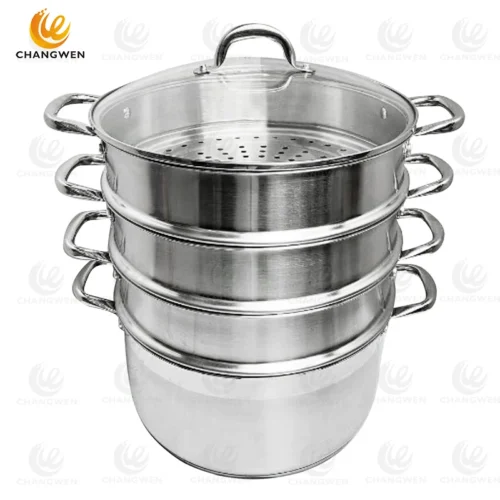
Stainless Steel Steamer Pot for Tamales – Large Capacity Design CW-ES019
-
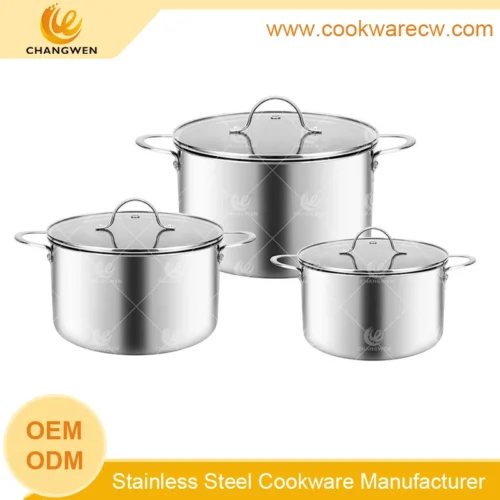
High-Quality Stainless Steel Pot Set with Heat-Resistant Handles CW-TP0603
-
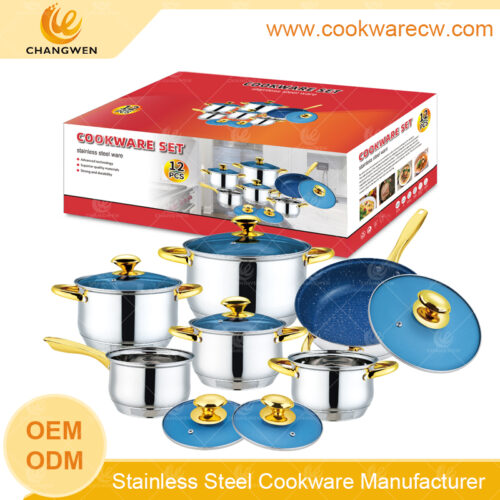
China manufacturer stainless steel 12pcs cookware set non-stick frying pan blue glass lid golden handles & knobs CW-M1209N
-
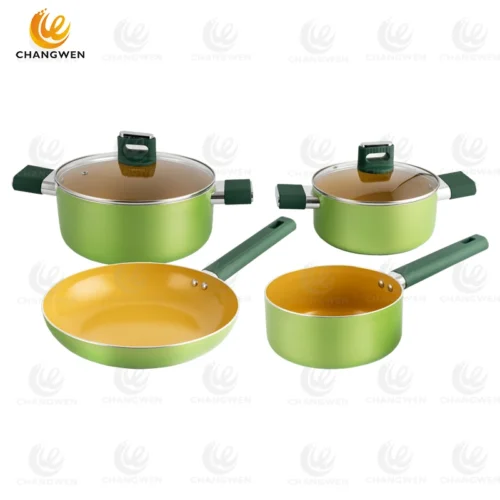
Custom Aluminum Cookware 6pcs Green Granite Nonstick l Manufacturer China
-
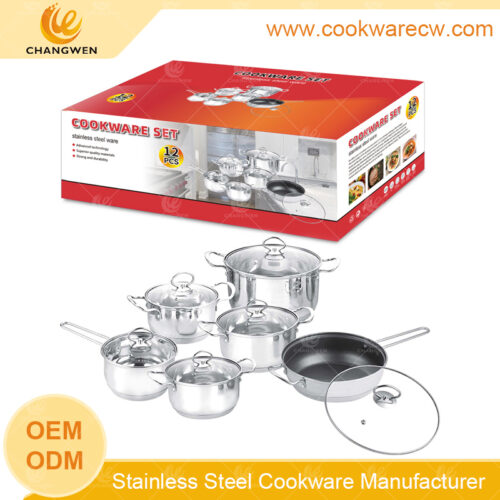
New design stainless steel 12pcs pots wholesale wire handle and knob cookware mirror polished saucepan casserole kitchen pots nonstick coated frypan CW-M1218
-
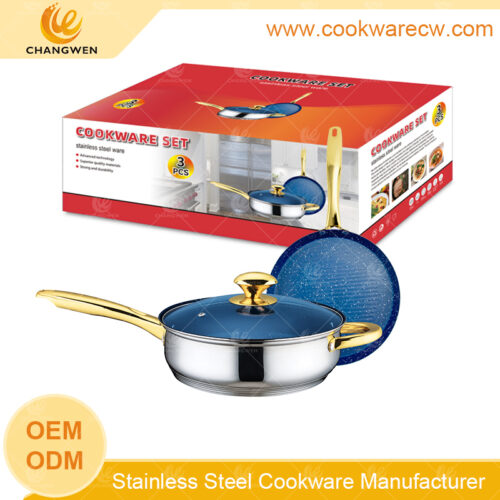
China factory wholesale blue marble nonstick coating fry pan set stainless steel mirror polished frypans golden handles and knobs CW-M0303
-
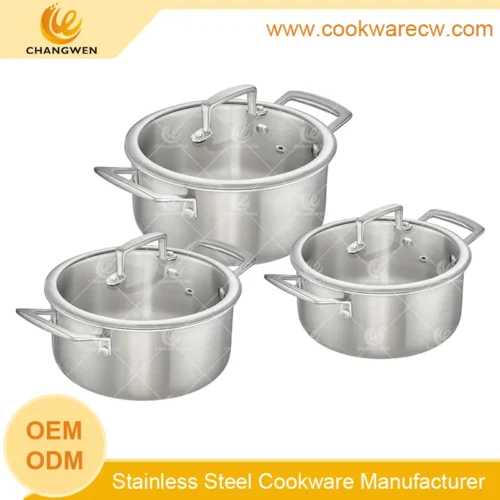
Versatile Stainless Steel Pot Set with Multiple Capacity Options CW-ETP018
-
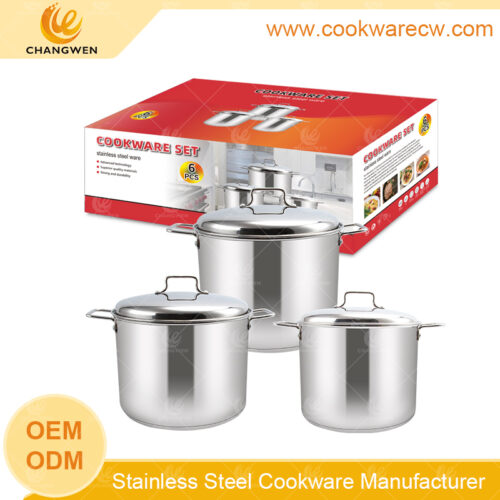
Customize color box high soup stock pot set stainless steel lids and knobs large volume 10L 13L 15L cookware pots wholesale CW-M0602