
Blog
Changwen is a leading cooking utensils manufacturers. We supply high quality stainless steel cooking pots and pans to all over the world. We can also customize the local hot-selling stainless steel pots and pans. Please send your requirements to Changwen.
How To Create Cookware That Enhances Customer Loyalty
Read time: 11 minutes
Introduction
Most cookware brands approach customer loyalty backwards.
They build the product first, then bolt on a loyalty program — points systems, referral incentives, post-purchase email sequences — and wonder why retention numbers stay flat. The loyalty program is treated as the retention strategy. The product is treated as a given.
Here is the uncomfortable truth: no loyalty program fixes a forgettable product. And no marketing budget sustains a brand that customers do not feel something about when they cook with it.
The cookware brands with the highest customer lifetime value do not start with loyalty mechanics. They start with the product itself — designing and manufacturing cookware that creates loyal customers before a single points system is ever built. Quality that outlasts expectations. Consistency that builds trust across orders. An unboxing experience that makes the purchase feel confirmed rather than questioned.
This guide covers both sides of the equation: how to build cookware products that generate loyalty at the product level, and how to reinforce that loyalty with the brand and post-purchase strategies that compound it. For cookware brands sourcing from OEM manufacturers, distributors building private label programs, and established brands looking to improve retention, the principle is the same — loyalty starts with what is in the box.
Key Takeaways
- Product quality is the foundation of customer loyalty in cookware. No retention marketing compensates for a pan that warps, a coating that peels, or a handle that loosens in the first year.
- The global cookware market is projected to grow from USD 38.34 billion in 2026 to USD 67.87 billion by 2034 — but premium brands with genuine customer loyalty are growing faster than the market average. Loyalty is a commercial advantage, not just a brand value.
- Cookware loyalty is built across the collection lifecycle — the customer who buys a frying pan first is a potential customer for saucepans, stock pots, bakeware, and accessories over a 5–10 year horizon. Retention strategy must address the full lifecycle, not just the first purchase.
- Transparency about materials and manufacturing has become a loyalty driver, particularly among health-conscious consumers. Verifiable food-grade certifications (LFGB, FDA) and honest material documentation (304 stainless steel confirmed by test reports) build brand trust that discount codes cannot.
- Packaging is part of the product experience. The unboxing moment sets the expectation for the product’s quality — when packaging communicates premium, the product is evaluated as premium from the first touch.
- The most effective cookware loyalty programs combine product excellence + transparent brand story + post-purchase engagement — not any one element alone.
Part 1: Product-Level Loyalty — What Your Cookware Must Deliver
Consistent Performance Across the Life of the Product
Customer loyalty in cookware is earned or lost over years of daily use. The customer who buys your frying pan in January will still be using it in March — and in March of the year after that. What they experience in that time determines whether they buy your saucepan next, recommend the brand to a friend, or quietly replace it with something else.
The performance variables that drive loyalty:
Heat distribution. A pan with hot spots punishes the cook for the manufacturer’s shortcut. Quality tri-ply construction (304-aluminum-430 for stainless steel, or heavy-gauge anodized aluminum) distributes heat evenly from base through sidewalls. Consistent heat means consistent cooking results — the kind that makes a cook credit the pan, not compensate for it.
Warp resistance. A warped pan is visible evidence of product failure. It rocks on the stovetop. It creates uneven heat contact. It is impossible to ignore and impossible to recommend. Heavy-gauge construction, quality base disc specification, and proper wall thickness prevent warping. This is a manufacturing decision, not a luck variable.
Coating durability. For non-stick cookware, coating longevity is the loyalty variable. A coating that degrades in 12 months creates a customer who blames the brand and switches. A coating that performs consistently for 3–5 years creates a customer who extends the collection. Specify coating layer count, adhesion testing, and PFOA-free certification — then communicate these specifics in product descriptions and packaging.
Handle security. A handle that moves, creaks, or loosens over time generates immediate distrust. Riveted handles with proper specification (load-rated rivets, appropriate rivet count for handle length and pan weight) do not fail under normal use. This is a specification decision with zero tolerance for compromise.
Material Honesty as a Loyalty Driver
Health-conscious consumers are researching cookware materials actively. Searches for “is 304 stainless steel safe,” “PFAS-free cookware,” and “food grade certification cookware” represent millions of monthly queries globally. These consumers are not casual — they are making considered purchases, and they are evaluating whether brands can be trusted.
Brands that can answer these questions with verifiable documentation earn disproportionate loyalty from this segment:
- LFGB test reports (EU food contact standard — the most comprehensive certification available for cookware) confirm that heavy metal migration is within safe limits and that the cookware does not affect food taste or odor
- Material test reports (mill certificates from the steel supplier) confirm that 304 stainless steel is actually 304, not lower-grade 201
- PFOA-free / PFAS-free certificates for any coated cookware, from an accredited laboratory
When a cookware brand can say “here is the laboratory report confirming our steel grade” rather than “we use high-quality materials,” it is communicating something competitors cannot fake. That transparency becomes a loyalty signal — and a trust foundation that makes the customer willing to extend the collection rather than audition alternatives.
Longevity as Brand Promise
Cookware loyalty is structurally different from loyalty in consumable product categories. The customer who buys a box of cereal returns in two weeks. The customer who buys a cookware set may not need to replace anything for 3–7 years.
This creates a specific retention challenge: how do you maintain a relationship with a customer whose next natural purchase occasion is years away?
The answer is product category expansion — and this requires a product line designed around a coherent collection that customers want to complete over time.
The collection architecture approach:
Design your product range so each piece is independently compelling and collectively cohesive. A customer who buys the frying pan should have a reason to return for the saucepan, then the stock pot, then the sauté pan, then the lid for the piece they bought as a single item. The visual consistency (matching finish, handle design, brand mark), the functional compatibility (lids that fit across pieces), and the brand story that connects them all create a collection dynamic.
Brands with strong collection architecture have customers who return to complete or extend their set — not because of a loyalty points incentive, but because the incomplete collection bothers them aesthetically and functionally.
Part 2: The Unboxing Experience — Loyalty Before First Use
The moment a customer opens a cookware package is a loyalty moment. It either confirms the purchase decision or introduces doubt that the cook then watches for evidence of throughout the product’s life.
Packaging That Communicates Premium
A quality cookware set in generic packaging communicates a contradiction. The product says “I am worth the premium.” The packaging says “we spent as little as possible getting this to you.” The customer receives both signals simultaneously.
Premium packaging is not expensive for its own sake. It is a communication tool:
- Material quality: Rigid box construction, quality printing, clean color and typography communicate that the brand takes the product seriously
- Specification communication: Listing the construction (tri-ply, 304 stainless steel), the certifications (LFGB, PFOA-free), and the material grade on the packaging tells the customer why they paid the premium before they touch the product
- Brand story: A brief, honest statement about who makes the cookware, what they care about, and what the customer can expect from the product creates a relationship context that transcends transaction
The specific elements that create unboxing loyalty:
Insert cards. A card inside the packaging — not a generic warranty card, but a specific communication about the product’s construction and care — extends the purchase justification. “This pan is made from 304 stainless steel (18/8), confirmed by food safety testing, and designed to last a minimum of 10 years with proper care” is a loyalty statement that arrives before the first use.
Care instruction quality. Thin, generic care instructions communicate that the brand considers afterthought communication acceptable. Thoughtful, specifically written care guidance that explains why (not just how) — “dry immediately after washing because stainless steel resists but does not eliminate water spots” — positions the brand as expert and the customer as competent.
Packaging finish. Matte lamination, spot UV, magnetic closure, or ribbon-pull opening all create tactile premium signals. They cost marginally more to produce and create measurably better unboxing impressions.
Part 3: Post-Purchase Loyalty — Keeping the Customer Through the Collection Lifecycle
The first purchase is the beginning of a loyalty relationship, not the completion of a transaction. Post-purchase strategy for cookware brands must account for the long intervals between natural purchase occasions.
The Collection Completion Strategy
The highest-return retention approach for cookware brands is collection completion marketing — communications and incentives designed specifically to move a customer from one product to the next product in the range.
How it works in practice:
A customer who buys a 3-piece starter set receives, 60 days after purchase, a communication that says: “Your set is designed to grow — here’s the sauté pan that completes the collection.” The communication shows the customer’s existing pieces alongside the recommended addition. It communicates why the specific next piece is the right extension of what they already own.
This is different from generic upsell email. It is specific, product-knowledge-based communication that treats the customer as someone building something rather than someone to sell more things to.
The timeline for collection completion communications:
- 30–60 days: first follow-up (initial satisfaction check, care tip, introductory offer on next piece)
- 90–120 days: collection extension communication (specific product recommendation)
- 6 months: higher-value extension (larger piece, premium add-on)
- 12 months: collection review and expansion (new launch, limited edition, seasonal)
Cooking Education as Retention
Cookware loyalty is higher among customers who cook more. A brand that helps customers cook better is a brand that creates more loyal customers.
This is the strategic logic behind cooking content as a retention tool. Recipe content, technique guides, and product-specific cooking tips have two functions: they are useful content that generates search traffic, and they are loyalty touchpoints that keep the brand present in the customer’s kitchen practice between purchases.
Content formats with the highest loyalty impact:
Product-specific technique guides. “How to get a perfect sear on your stainless steel pan” uses the cooking technique instruction to reinforce why the specific product the customer owns is the right tool for the job. This is simultaneously useful content and loyalty reinforcement.
Seasonal menu content. Content timed to cooking occasions (holiday entertaining, summer grilling, back-to-school batch cooking) arrives when the customer is already in purchase-and-cook mode. Recipe collections that specifically feature your cookware pieces create natural visibility for the full range.
Maintenance and care content. “How to restore the shine to your stainless steel pan” or “When to replace your non-stick coating” builds the customer’s confidence in caring for the product and positions the brand as a long-term partner rather than a one-time vendor.
Loyalty Programs That Work for Cookware
In the competitive world of e-commerce, cookware brands face a unique paradox: their products are designed to last for years, yet the cost to acquire a single customer continues to climb. Standard points programs designed for replenishment categories (where the customer buys the same product repeatedly) do not translate well to cookware, where repeat purchases mean different products in the same collection.
Loyalty mechanics that fit the cookware category:
Collection-based tier rewards. Instead of points-per-dollar (which implies repeated identical purchases), reward customers for the depth of their collection. Customers who own 3+ pieces unlock a tier. Customers who own a complete set unlock a higher tier. The reward is tied to collection investment, not transaction volume — which is a better fit for how cookware is actually purchased.
Referral programs. A customer who loves their first frying pan is highly likely to return for a saucepan, a stockpot, or a full knife set. They are also likely to tell someone about it — if the referral experience is structured and rewarded. Referral programs in cookware have particularly high value because the referred customer typically enters the brand with the same collection-building intent as the referring customer.
Milestone rewards. Cookware purchases align with life milestones — first home, marriage, kitchen renovation, having children. Loyalty programs that acknowledge these milestones (wedding registry partnerships, “new home” collections, graduation gift configurations) create emotional resonance that points programs do not.
Lifetime warranty communication as loyalty. A brand that communicates “we stand behind this product for its lifetime” is making a loyalty commitment, not just a warranty offer. The customer who knows they can return a defective pan without friction does not need to hedge their emotional investment in the brand. Frictionless warranty fulfillment is a powerful loyalty driver in a category where product failures erode trust.
Part 4: Building Loyalty Through Brand Story and Transparency
The Manufacturing Story as Trust Asset
In cookware, where consumer anxiety about materials (PFAS, heavy metals, coatings) is high and growing, the manufacturing story is a brand trust asset.
Brands that can tell the story of how their cookware is made — where, from what materials, tested to what standards — are communicating things that cannot be faked. A brand that says “our stainless steel cookware is manufactured in Jiangmen, Guangdong, the world’s primary stainless steel cookware production region, from 304 stainless steel confirmed by food safety testing to LFGB standards” is giving the consumer something to trust that goes beyond marketing language.
This manufacturing transparency works particularly well in:
- E-commerce product descriptions where purchase decision is made without tactile evaluation — the specification story compensates for the inability to handle the product
- Sustainability-positioned brands where consumers expect supply chain honesty
- Health-focused brands where material verification documentation is a direct response to consumer concern
- Premium brands where the manufacturing story is part of the premium justification
Community Building Around Shared Values
Cookware loyalty is deepest when it connects to identity — the customer who sees themselves as a serious home cook, a health-conscious parent, or a culinary enthusiast is not just buying a pan. They are equipping an identity.
Brands that build community around the identity rather than the product create loyalty that survives individual product disappointments and outlasts competitor offers:
- Cooking communities where brand customers share recipes and techniques using the cookware
- Social content that shows the food, not just the pan — the aspirational outcome of owning the cookware rather than the product itself
- Chef and culinary professional partnerships that validate the product for serious cooks and create aspirational association for home cooks
Part 5: For OEM Brands — Building Loyalty Into the Product Specification
For brands sourcing cookware from OEM manufacturers in China, customer loyalty is built at the specification stage — not just in the post-purchase marketing.
The specification decisions that directly affect customer loyalty:
Material grade verification. 304 stainless steel (18/8) confirmed by mill certificates produces a consistent, non-reactive cooking surface over years of use. 201-grade steel, sometimes substituted fraudulently for 304, corrodes faster and produces a product that generates complaints within 2–3 years. Material verification protects your brand from loyalty-destroying product failures before the container is loaded.
Wall thickness specification. Thin-wall pans warp. Warped pans generate returns, negative reviews, and lost customer confidence. Specify wall thickness in millimeters in every purchase order and require QC documentation confirming it.
Surface treatment specification. Interior Ra value (≤ 0.8 µm), passivation certificate, and coating adhesion testing for non-stick products determine whether the product performs safely and durably over its rated life. These specifications are invisible at retail and become visible through product performance over time.
Packaging specification. Custom retail packaging with brand story, material specifications, certifications, and care instructions is not a budget item — it is the first loyalty touchpoint. Specify packaging as completely as you specify the product.
Certification documentation. LFGB test reports and FDA compliance documentation give your marketing team the verifiable claims that turn “we use high quality materials” into “here is the laboratory confirmation.” These documents are loyalty assets, not just compliance paperwork.
Cookware Customer Loyalty: The Framework
Effective cookware brand loyalty operates across three time horizons:
At purchase (0–30 days): Product quality, unboxing experience, packaging communication, and immediate post-purchase engagement. This is where trust is established or broken.
Through the first year (30–365 days): Product performance in daily use, cooking content and education, collection completion communications, and care guidance. This is where loyalty is reinforced or eroded.
Across the collection lifecycle (1–10 years): New product launches, collection extensions, milestone moments, referral activation, and warranty fulfillment. This is where customer lifetime value is realized.
Brands that invest at all three horizons — starting with the product specification, not just the marketing stack — build the kind of loyalty that generates referrals, resists competitive pricing, and sustains growth without depending entirely on customer acquisition spend.
FAQ
What makes cookware customers loyal to a brand?
Customer loyalty in cookware is primarily driven by product performance over time — heat distribution, warp resistance, coating durability, and handle security. Secondary loyalty drivers include transparent material communication (verifiable certifications, honest specification), packaging and unboxing experience, cooking education content, and collection architecture that gives customers reasons to return for additional pieces. Loyalty programs amplify loyalty that the product has already earned; they cannot create loyalty the product has not.
How do cookware brands encourage repeat purchases?
Repeat purchases in cookware are driven by collection expansion — the customer who owns a frying pan returning for a saucepan, stock pot, or complete set upgrade. Brands encourage this through collection completion marketing (specific recommendations for the customer’s next piece), cooking education content that creates occasion-based purchase reasons, milestone-based offers (seasonal, life event), and loyalty programs designed around collection depth rather than transaction frequency.
Why is transparency about materials important for cookware loyalty?
Consumer awareness of PFAS, heavy metal migration, and material grades is growing significantly. Cookware consumers who research materials are motivated, engaged, and willing to pay a premium for brands they trust. Brands that provide verifiable documentation — LFGB test reports, material test certificates, PFOA-free certifications — earn disproportionate loyalty from this segment because the documentation creates trust that marketing language cannot replicate.
How does packaging affect cookware customer loyalty?
Packaging sets the expectation before the product is used. Premium packaging that communicates construction quality, certifications, and brand values primes the customer to evaluate the product as premium — reinforcing the purchase decision rather than creating doubt. Insert cards with specific care and product information, quality box construction, and honest specification communication all create loyalty at the unboxing moment, before the first use.
What is the biggest product mistake that destroys cookware customer loyalty?
Warping is the most visible product failure that drives customers away — a warped pan is a daily reminder of product quality failure. Coating delamination is the second. Both are preventable with correct specification: sufficient wall thickness (minimum 2.4mm for tri-ply stainless steel), quality base disc specification, and multi-layer coating with adhesion testing. These are manufacturing decisions, not post-purchase recoverable situations.
How should an OEM cookware brand think about building customer loyalty?
Start with the specification. Material grade verification (304 stainless confirmed by mill certificates), wall thickness specification, surface treatment requirements (Ra ≤ 0.8 µm interior, passivation certificate), coating adhesion testing, and certification documentation (LFGB, FDA) determine whether the product performs reliably over years of daily use. Loyal customers are created by products that exceed expectations consistently — which requires specifications that force manufacturing quality, not just marketing claims that promise it.
Conclusion
Customer loyalty in cookware is not primarily a marketing problem. It is primarily a product problem.
The brands with the highest customer lifetime value in the cookware category share one characteristic: they made product quality the non-negotiable foundation and built their loyalty strategy on top of it. Their certifications are verifiable. Their specifications are documented. Their packaging communicates what the product is and why it was worth the price. And their post-purchase strategy operates across the full 5–10 year collection lifecycle, not just the 30 days after the first order.
Loyalty programs, referral incentives, and email sequences amplify loyalty that the product has already earned. They cannot substitute for it.
Build the product correctly. Document what makes it correct. Communicate that documentation throughout the customer journey. That is the loyalty strategy that compounds.
Build a Loyalty-Worthy Cookware Product with Changwen
Changwen is a stainless steel cookware manufacturer based in Jiangmen, Guangdong, China, with over 22 years of OEM and ODM experience. We help cookware brands build the product foundation that customer loyalty requires: verified 304 stainless steel, LFGB-compliant food contact testing, documented quality control, and custom retail packaging that communicates premium from the first touch.
What we provide for OEM loyalty-focused programs:
- 304 stainless steel confirmed by mill certificates (every production batch)
- LFGB test reports from accredited laboratories
- ISO 9001:2015 certified manufacturing
- Custom retail packaging with brand story, specification communication, and certification claims
- Tri-ply full-clad construction (304-aluminum-430) for premium collection positioning
- Complete product range for collection architecture: cookware sets, frying pans, stock pots, saucepans, steamer pots, pressure cookers
Popular Blog
China Kitchenware: A Comprehensive Overview
The Ultimate Guide: Where to Buy Large Stainless Steel Steamers
Which is better 18/10 or 18/8 stainless steel cookware?
Stainless Steel Soup Pot Buying Guide
Tri Ply Stainless Steel Cookware VS Stainless Steel
Where To Buy Stainless Steel Cookware?
Tags
Recommend Products
-
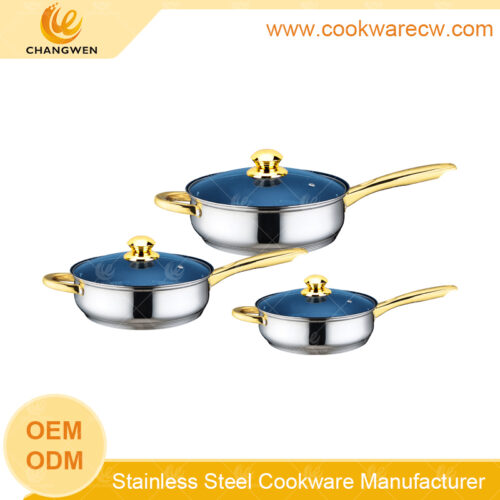
Best Nonstick Stainless Steel Pan
-
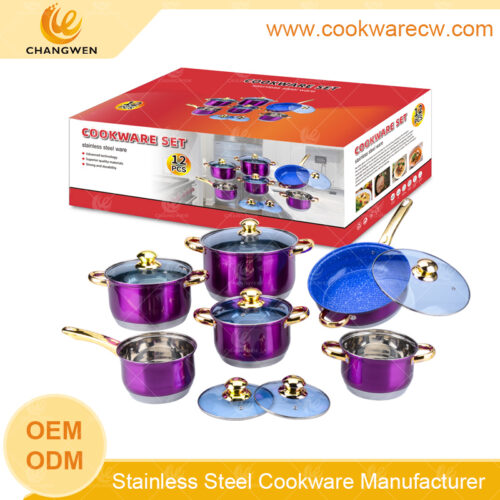
color coating surface stainless steel pots non-stick frypan golden S/S handles and knobs 430 protector for induction CW-M1225
-
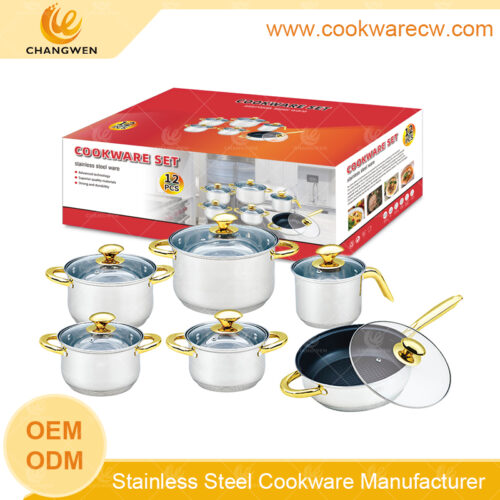
high quality stainless steel pots and pans 12pcs cookware set nonstick fry pans with 5-9 steps capsule bottom CW-M1212
-
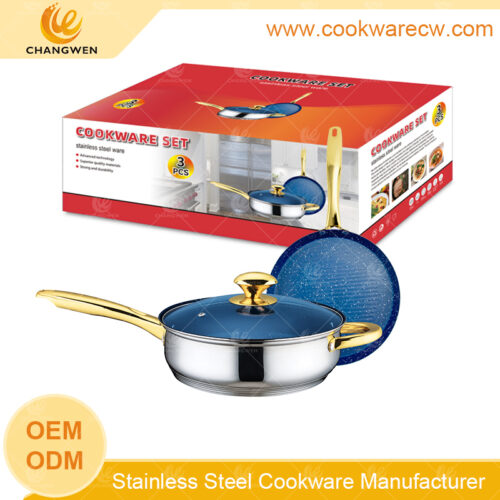
China factory wholesale blue marble nonstick coating fry pan set stainless steel mirror polished frypans golden handles and knobs CW-M0303
-
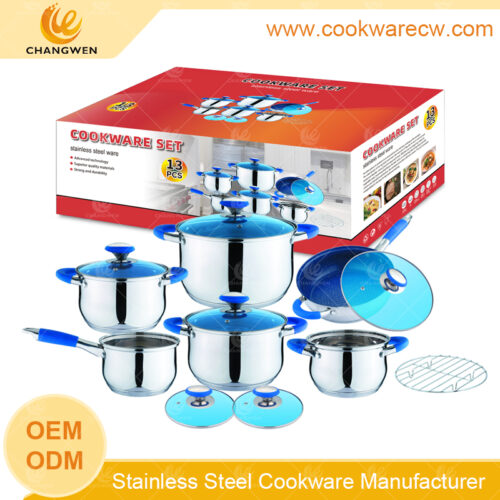
Wholesale stainless steel pots mirror polished cooking pot set nonstick frypan milk pot casseroles saucepan with blue glass lids and silicone iron wire rack CW-M1307G-02
-
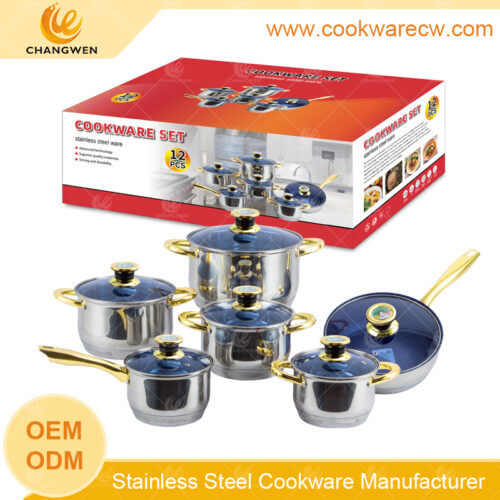
Pots wholesale cookware set 12pcs stainless steel pots and pans nonstick fry pan with thermal knobs and golden handles blue glass lids CW-M1215
-
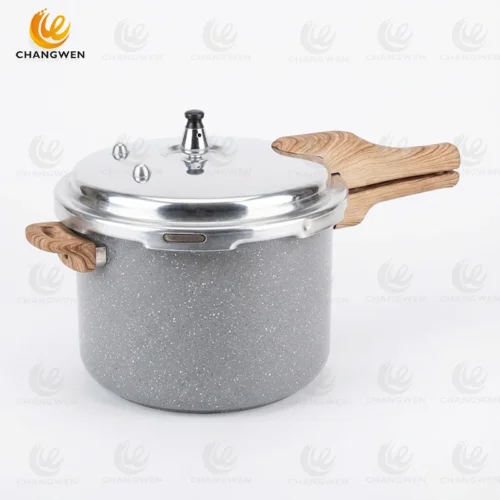
4 Quart Aluminum Pressure Cooker – Safe & Explodable-Proof Design
-

Professional Honeycomb Stainless Steel Fry Pan CW-ETP021