
Quick answer: The best cookware manufacturer is not automatically the factory with the lowest quotation, the largest catalog, or the fastest sample. A dependable manufacturer must match the buyer’s product strategy, control the required materials and processes, document compliance, reproduce an approved sample at scale, support realistic order quantities, and deliver consistently. Buyers should compare manufacturers with evidence-based pass/fail gates and a weighted scorecard instead of relying on sales claims.
Read time: 13 minutes.
Choosing a cookware manufacturer affects product performance, regulatory exposure, inventory, customer reviews, and long-term margin. A weak decision can create costs that never appear on the initial quotation, including failed tests, packaging rework, late launches, inconsistent finishes, returns, and emergency freight. The following ten factors create a practical selection framework for cookware brands, importers, wholesalers, retailers, and hospitality buyers.
What should buyers decide before comparing cookware manufacturers?
A buyer should define the intended market, target user, product type, material, construction, performance claims, price position, order volume, destination market, packaging format, and launch date before contacting factories. A vague request such as “premium frying pan” allows every manufacturer to quote a different product, so the resulting prices cannot be compared. A controlled request for quotation turns the commercial idea into measurable requirements.
Every requirement should be labeled mandatory, preferred, or negotiable. Food-contact conformity, safe handle attachment, and an approved construction may be mandatory. A decorative finish may be preferred, while carton details may remain negotiable during early development. This hierarchy prevents an attractive sample or a low price from hiding a failure that should disqualify the supplier.
A buyer should also decide whether the project needs an original equipment manufacturer, an original design manufacturer, or an existing private-label product. A custom OEM project offers stronger differentiation but requires more engineering, tooling, validation, time, and order commitment. An existing design reaches the market faster but gives the buyer less exclusivity. The correct model depends on launch goals rather than prestige.
How should the ten factors be weighted?
A weighted scorecard makes supplier selection explainable. The weights below are a starting point, not a universal rule. A regulated pressure cooker program should give more weight to engineering and compliance, while a seasonal promotional line may give more weight to speed, MOQ, and packaging flexibility.
| Factor | Suggested weight | Minimum evidence |
|---|---|---|
| 1. Product and market fit | 10% | Relevant range, target-price understanding, comparable projects |
| 2. Material and process capability | 15% | Bill of materials, process map, equipment and technical answers |
| 3. Quality management | 15% | Control plan, inspection records, traceability and corrective action |
| 4. Compliance readiness | 15% | Relevant reports, declarations and change-control process |
| 5. Sampling and development | 10% | Measured sample, revision history and approval standard |
| 6. Capacity and lead time | 10% | Production schedule, bottleneck analysis and delivery history |
| 7. MOQ and commercial terms | 8% | Transparent minimums, payment terms and tooling ownership |
| 8. Total landed cost | 7% | Like-for-like quotation and complete cost assumptions |
| 9. Communication and project control | 5% | Named owners, revision control and escalation path |
| 10. Packaging and continuity | 5% | Pack validation, replenishment plan and contingency options |
Pass/fail gates should be applied before scoring. A manufacturer that cannot prove required materials, pass applicable safety requirements, or control critical assembly should not advance merely because it scores well on price or communication. Weighted scores rank qualified options; they should not rescue an unqualified one.
Factor 1: Does the manufacturer fit the product and target market?
Product-market fit means the manufacturer already understands the performance, appearance, price, packaging, and documentation expected for the buyer’s category. A factory specializing in thin promotional cookware may not be the best partner for heavy fully clad pans, even if both products are stainless steel. A specialist usually recognizes process risks faster and maintains more relevant tooling, suppliers, and inspection methods.
Buyers should request examples of comparable construction, complexity, sales channel, and destination market without asking for confidential customer details. Similarity matters more than catalog size. A factory that produces hundreds of unrelated kitchen items may offer convenient sourcing, while a focused cookware producer may offer deeper control of forming, bonding, coating, polishing, and assembly.
The manufacturer should also understand why the product exists. A retailer may prioritize shelf presentation and low return rates, an online brand may prioritize parcel protection and review consistency, and a hospitality distributor may prioritize durability and replacement availability. A supplier that translates customer use into technical decisions provides more value than one that simply accepts a drawing.
Factor 2: Can the factory control the required materials and processes?
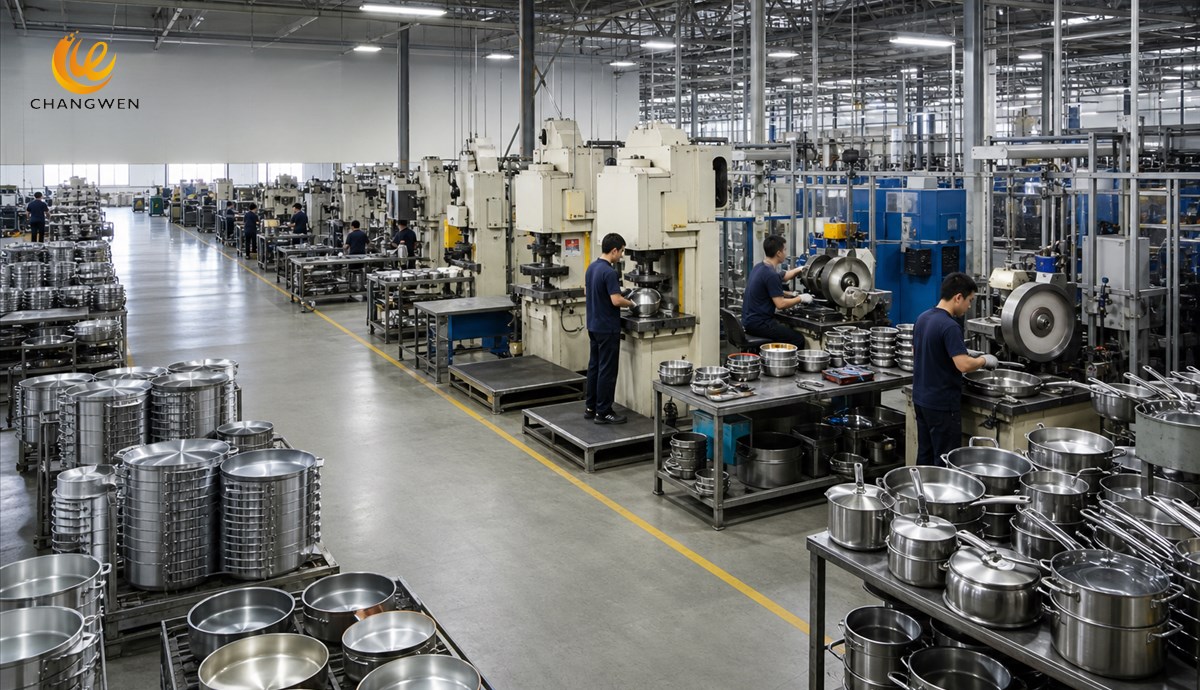
Manufacturing capability should be verified at the process level. Stainless steel cookware may require drawing, impact bonding or cladding, trimming, polishing, welding or riveting, cleaning, and passivation. Aluminum products may require stamping, die casting, hard anodizing, spraying, or coating and curing. Carbon steel cookware may require forming, surface preparation, nitriding, seasoning, or coating. Each process creates different quality risks.
A capable manufacturer should explain which processes are performed in-house, which are subcontracted, how outsourced work is approved, and where critical measurements are taken. Outsourcing is not automatically negative, but undisclosed or uncontrolled subcontracting weakens traceability. The buyer needs to know who controls the result when a bonded base separates, a coating fails, or a handle loosens.
Material descriptions must be component-specific. A pan can contain different metals in the food-contact surface, core, induction layer, handle, fastener, and lid rim. Buyers should request a bill of materials, nominal thickness or weight, material certificates tied to lots, and verification appropriate to the risk. The site’s 304 versus 316L stainless steel guide shows why material selection should follow use conditions instead of a generic premium label.
Factor 3: Does the quality system control variation, not just inspect defects?
A strong quality system prevents defects by controlling incoming materials, production settings, assembly methods, and approved limits. Final inspection alone finds some visible problems but cannot reliably correct weak bonding, inconsistent coating cure, wrong alloy, or hidden fastener issues after production is complete. Process control is therefore more valuable than a large final-inspection team.
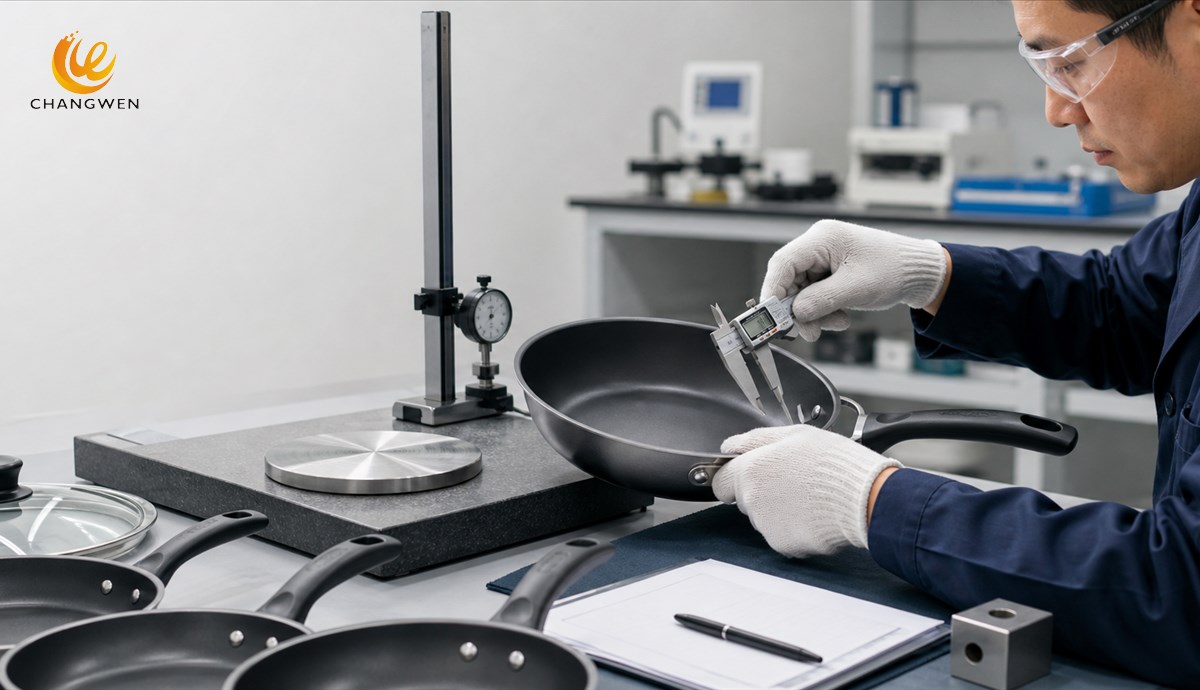
Buyers should ask for a product-specific control plan that names the characteristic, method, frequency, equipment, acceptance limit, record, and reaction. Important cookware checks may include alloy identity, thickness, capacity, base flatness, bonding coverage, coating thickness, cure conditions, handle torque, lid fit, rim finish, induction recognition, surface defects, labeling, and packaging configuration.
Traceability should connect incoming material, production batch, operators or line, inspection results, and shipment. When a defect occurs, the manufacturer should quarantine affected goods, identify root cause, implement corrective action, and verify that the action works. Replacing rejected pieces without changing the process treats the symptom rather than the source.
Factor 4: Can the manufacturer support compliance in the destination market?
Compliance readiness means the manufacturer can provide product-specific evidence for the intended market and maintain conformity during repeat production. Requirements vary by country, material, coating, product type, claims, and sales channel, so buyers should confirm the applicable obligations with qualified laboratories or local advisers. A certificate from an unrelated product does not prove that the quoted cookware complies.
Useful evidence can include material declarations, food-contact test reports, restricted-substance documentation, coating information, labeling inputs, packaging declarations, and traceability records. Buyers should verify the product identity, materials, laboratory, test method, report date, tested sample, and geographic scope. The food-grade certification guide for cookware buyers explains why the relevance of a report matters as much as its existence.
Compliance must survive engineering changes. Purchase agreements should require written approval before changes to alloy, thickness, coating formula, lubricant, bonding method, handle, fastener, subcontractor, or packaging. A visually identical substitution can change migration, corrosion, durability, or labeling results and may invalidate earlier evidence.
Factor 5: How well does the manufacturer develop and reproduce samples?
A development sample should be evaluated against a written specification rather than general appearance. The buyer should record dimensions, capacity, weight, material, construction, base flatness, handle alignment, lid fit, finish, induction response, cooking behavior, cleaning performance, packaging, and any relevant durability tests. Photographs and measurements create a clearer approval reference than an email saying the sample looks good.
One polished sample cannot prove manufacturing consistency. Buyers should request multiple units when variation matters and confirm that samples use production-intent materials, tooling, processes, and components. Hand finishing can be acceptable during early design exploration, but it should be disclosed because it may hide what normal production will look like.
The approved golden sample, signed specification, drawings, bill of materials, color references, artwork, and inspection standard should share controlled revision numbers. A pilot order provides the strongest bridge between a development sample and full production because it tests normal operators, equipment, material flow, packaging, and inspection under realistic conditions.
Factor 6: Are production capacity and lead-time promises credible?
Capacity should be verified at the bottleneck, not described with a single maximum output number. A factory may have enough presses but limited polishing, coating, bonding, curing, assembly, testing, or packing capacity. Buyers should ask how output changes by product construction, order mix, shift pattern, maintenance, peak season, and current commitments.
A credible lead time is divided into stages: specification approval, tooling, material procurement, sample approval, production, testing, inspection, packing, and shipment readiness. Each stage should state its assumptions and dependencies. A shorter promise without a material plan or reserved capacity creates more risk than a slightly longer schedule supported by milestones.
Delivery performance should be measured with agreed definitions such as on-time shipment or on-time-in-full delivery. Buyers should also ask how the manufacturer handles delayed raw material, equipment failure, failed inspection, labor constraints, and urgent replenishment. A contingency plan does not eliminate disruption, but it reveals whether the supplier manages risk before a crisis.
Factor 7: Do MOQ and commercial terms match the business model?
Minimum order quantity should be broken down by SKU, color, finish, component, packaging version, production batch, and total order. A low headline MOQ may still depend on a much larger minimum for custom handles, coated colors, printed cartons, glass lids, or special base plates. The buyer should identify what physically or commercially drives each minimum.
MOQ flexibility has a cost. Smaller batches can require more setup, purchasing, inspection, and packaging changes per unit, while larger batches reduce unit cost but increase inventory, cash exposure, and markdown risk. The best MOQ is the quantity that balances factory economics with realistic sales velocity, not simply the smallest or largest number available.
Commercial terms should define currency, trade term, payment schedule, tooling charges, sample fees, artwork ownership, mold ownership, testing responsibility, inspection rights, warranty handling, defect remedies, and change approval. The cookware MOQ, packaging, and shipping guide provides additional context for aligning order structure with landed cost.
Factor 8: Is the total landed cost competitive and transparent?
A manufacturer should be compared on total landed cost, not factory unit price alone. The relevant calculation can include product price, tooling, packaging, testing, inspection, inland transport, freight, insurance, duty, financing, inventory carrying cost, expected defects, replacement handling, and possible rework or markdown. Not every cost is known exactly, but excluding predictable costs makes the comparison misleading.
Every quotation should use the same specification, quantity, currency, trade term, packaging, accessories, testing responsibility, and delivery point. A cheaper offer made with thinner material, a smaller base, weaker packaging, or excluded testing is not a saving because it is not the same product. Buyers should normalize quotations before calculating a score.
A higher unit price can create better margin when the manufacturer reduces defect rates, improves retail presentation, lowers packaging volume, meets delivery windows, or supports faster replenishment. Value should be traced to measurable commercial consequences. Unsupported claims of premium quality should not justify a premium quotation.
Factor 9: Does communication support engineering and project control?
Effective supplier communication is accurate, traceable, and early. A manufacturer should assign clear owners for sales, engineering, quality, compliance, packaging, and escalation. Questions should be answered with measurements, drawings, photographs, test results, or documented assumptions rather than automatic agreement.
Response speed is useful but incomplete. A fast answer that later changes can create more delay than a careful response that confirms technical details. Buyers should evaluate whether the supplier identifies contradictions, explains tradeoffs, records decisions, controls file revisions, and reports risks before they affect the schedule.
Meetings should end with written decisions, responsible owners, due dates, and affected documents. Drawings, artwork, specifications, samples, and inspection criteria should have version identifiers. Strong project control prevents the factory, buyer, packaging vendor, and inspection company from working from different instructions.
Factor 10: Can packaging, replenishment, and continuity support long-term sales?
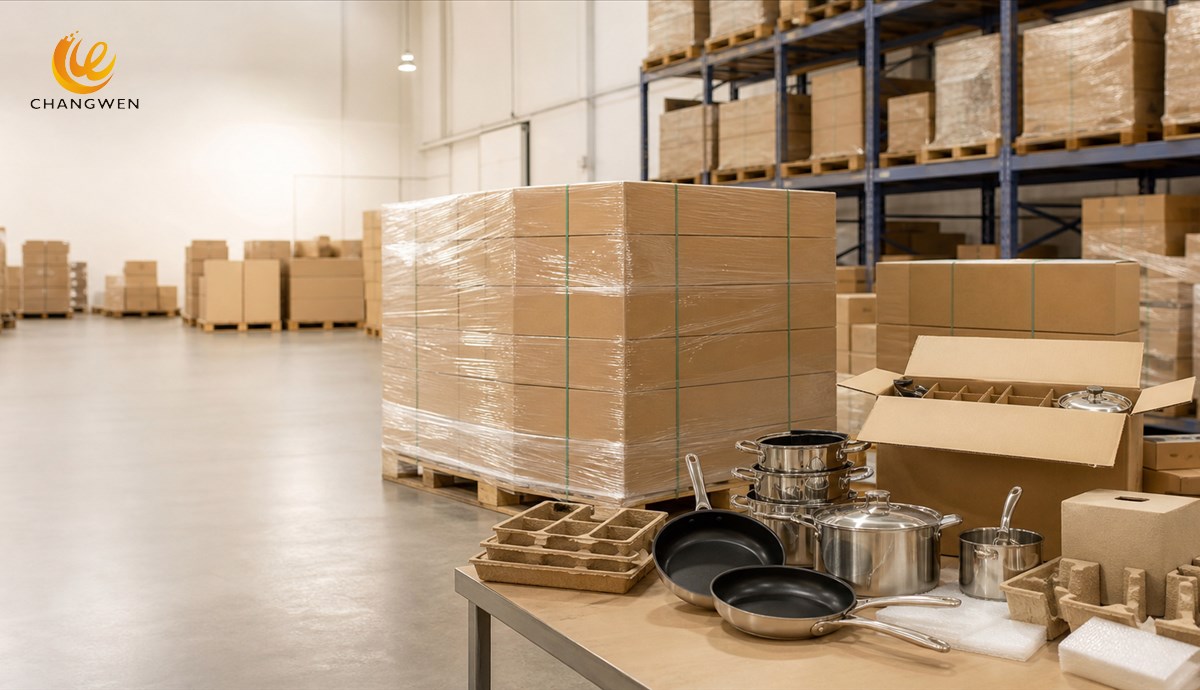
Packaging is part of product quality because it protects cookware, presents the value proposition, supports warehouse handling, and influences freight efficiency. Buyers should validate scratch protection, handle restraint, lid security, drop performance, carton strength, barcode placement, instructions, origin marking, pack dimensions, pallet configuration, and channel-specific requirements.
Retail packaging and e-commerce packaging solve different problems. A retail box emphasizes shelf communication and display consistency, while a parcel-ready pack must survive repeated handling and impact. One package can sometimes serve both channels, but the design should be tested rather than assumed. The cookware packaging customization guide explains the cost and operational effects of common choices.
Continuity planning should cover normal reorder lead time, peak-season capacity, critical component availability, safety-stock options, minimum reorder quantities, and recovery from disruption. Core products need more stable component and tooling plans than limited seasonal items. A supplier remains valuable only if approved quality can be replenished when the market needs it.
How should buyers verify a cookware manufacturer before signing?
Verification should move from low-cost screening to higher-cost proof. Buyers can begin with company identity, factory location, product scope, documents, references, and a structured technical questionnaire. Qualified candidates can then proceed to video review, sample testing, an on-site or third-party audit, compliance testing, packaging validation, and a pilot order.
A factory audit should follow material and product flow from receiving through forming, surface treatment, assembly, inspection, packing, and shipment release. Auditors should verify that documented procedures are used, gauges are suitable and calibrated, nonconforming goods are segregated, approved samples are available, and critical subcontractors are controlled.
The final agreement should capture the complete approved product, change-notification rules, inspection rights, acceptance criteria, shipment milestones, defect remedies, documentation, confidentiality, and tooling ownership. Buyers developing a new branded product can use the custom cookware OEM process guide to connect supplier selection with development stages.
Which warning signs should disqualify a cookware manufacturer?
A buyer should stop or investigate when a supplier will not identify the production site, gives inconsistent company information, provides reports unrelated to the offered SKU, refuses material verification, cannot explain critical processes, changes specifications without approval, or promises a lead time unsupported by a schedule. Repeated inconsistency indicates weak control even when individual explanations sound plausible.
An unusually low price is also a warning when it cannot be reconciled with material weight, construction, packaging, and compliance responsibilities. Legitimate savings normally have an identifiable source, such as shared tooling, efficient design, stable volume, automated processing, or simplified packaging. A price gap without a technical explanation may indicate a specification gap.
Perfect answers can be a warning when evidence is missing. Reliable manufacturers acknowledge constraints, propose alternatives, and quantify consequences. A supplier that agrees to every request without engineering review may be optimizing for the order rather than for successful production.
How should the final manufacturer decision be made?
The final decision should combine pass/fail gates, weighted scores, documented risks, and a plan for unresolved items. Each score should cite evidence, and evaluators should use the same definitions. A cross-functional review involving purchasing, product, quality, compliance, logistics, and merchandising reduces the chance that one attractive dimension dominates the decision.
Buyers can compare one primary manufacturer with a qualified backup when volume and risk justify dual sourcing. Dual sourcing improves continuity but adds tooling, sample, documentation, forecast, and consistency complexity. It is valuable when the cost of interruption exceeds the cost of maintaining two controlled sources.
Supplier approval should remain conditional after the first order. Performance indicators can include sample-to-production variance, defect rate, on-time-in-full delivery, claim resolution, corrective-action effectiveness, document accuracy, and unapproved changes. Continuing approval should reflect current evidence rather than the reputation established during sourcing.
Frequently asked questions
What is the most important factor when choosing a cookware manufacturer?
The most important factor is the manufacturer’s proven ability to reproduce the required product safely and consistently. Price, capacity, and service matter only after the factory demonstrates material, process, quality, and compliance control.
Should a buyer choose a factory or a trading company?
Neither model is automatically superior. A factory can offer direct process access, while a capable project partner can coordinate specialized suppliers. Buyers should verify who owns the specification, controls production, manages corrective action, and remains accountable for conformity.
How many cookware manufacturers should be shortlisted?
Three to five qualified candidates usually provide enough competition without making audits, samples, and tests unmanageable. Complex or high-risk programs may justify a wider initial screen followed by a smaller verified shortlist.
Is a factory certificate enough to approve a manufacturer?
No. A management-system certificate can support confidence in factory processes, but product compliance requires evidence relevant to the actual materials, construction, destination market, and production sample.
When should buyers request a pilot order?
A pilot order should be used before a large commitment when tooling, construction, packaging, process variation, or market risk is significant. The pilot should use production-intent materials and normal manufacturing conditions.
Final verdict
The right cookware manufacturer is the supplier that converts a commercial concept into a controlled, compliant, repeatable, and replenishable product. Buyers should define requirements first, eliminate candidates that fail critical gates, and score qualified manufacturers across product fit, process capability, quality, compliance, development, capacity, commercial terms, landed cost, communication, packaging, and continuity.
A disciplined selection process may take longer than choosing the lowest quotation, but it reduces expensive uncertainty before tooling, inventory, and brand reputation are committed. The strongest manufacturer is not the one that promises the most. It is the one that provides the clearest evidence, manages tradeoffs honestly, and reproduces the approved product through repeat orders.
-
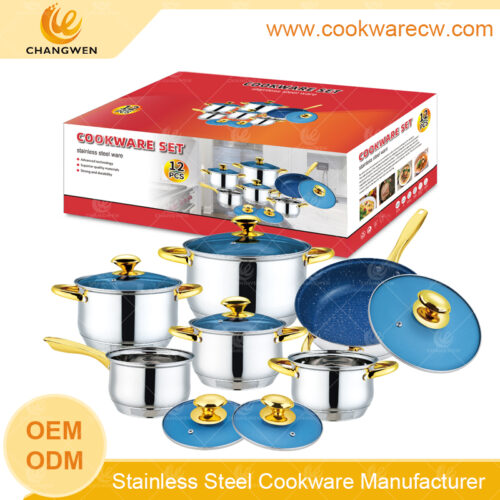
China manufacturer stainless steel 12pcs cookware set non-stick frying pan blue glass lid golden handles & knobs CW-M1209N
-
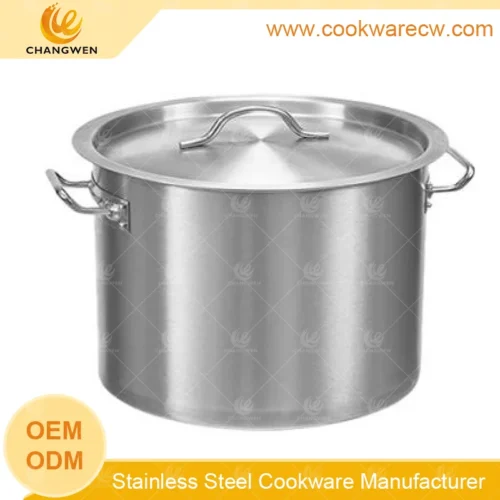
Stainless Steel Stock Pot For Restaurants CW-SP002
-
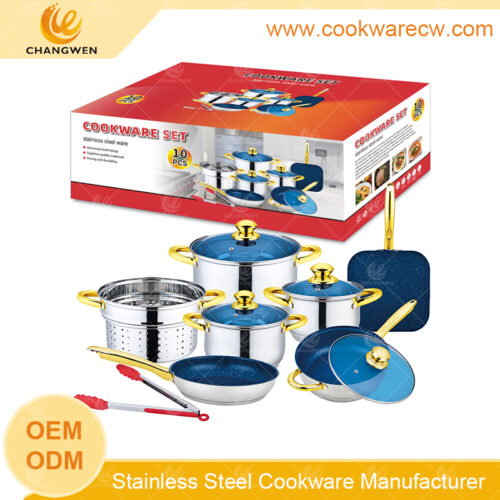
Stainless steel cookware set nonstick pans and pots casserole pot frying pan steamer with glass blue lid and a kitchenware clip CW-M1203
-
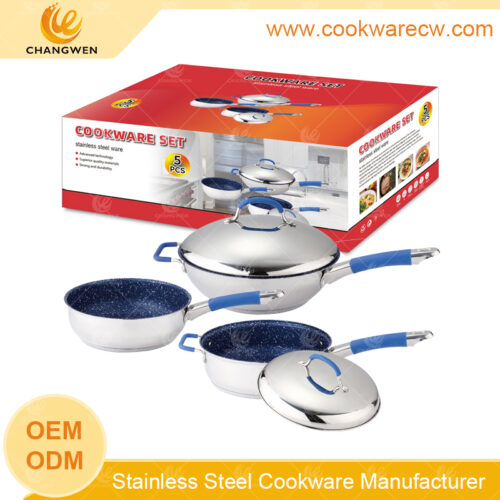
Customize color box 3pcs fry pan set blue marble nonstick coating frying pans stainless steel lids and blue silicone cover CW-M0501G
-
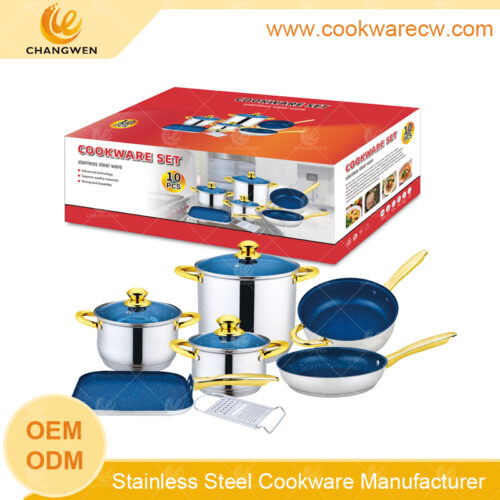
Wholesaler stainless steel cookware set conic fry pan square aluminum coated frypan with a kitchenware grater CW-M1003
-
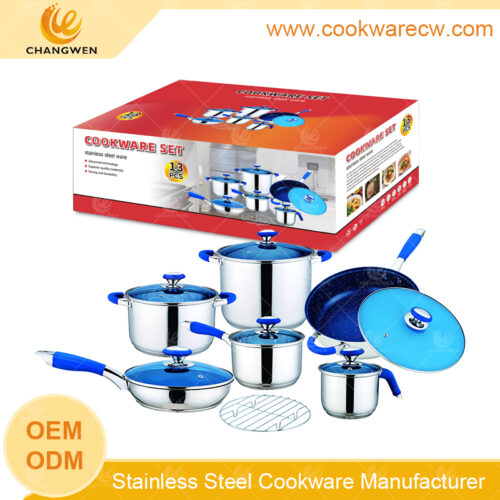
Newly Launched 13pcs stainless steel cookware set with iron wire rack nonstick fry pan with helper mirror polished soup stock pot saucepan and casserole CW-M1306G-02
-

Hotsale 12pcs stainless steel cooking sets soup stock pot kitchen ollas saucepan casserole and milkpot fry pan nonstick CW-M1209
-
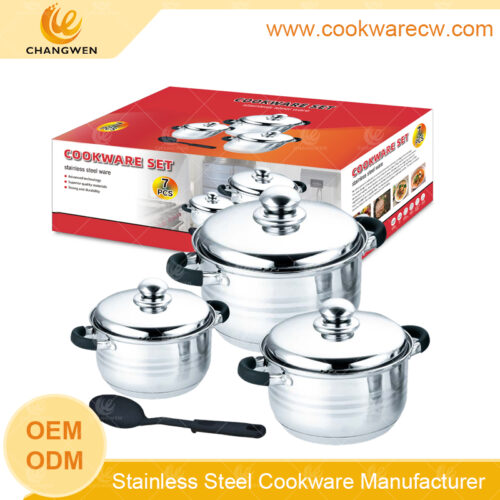
Mercado Libre hotsale cookware 7pcs cooking pot set stainless steel lids silicone handle kitchen tool solid serving spoon CW-M0702G