
Nonstick aluminum cookware is a strong retail and private-label category when the buyer specifies the aluminum body, surface preparation, coating system, induction base, hardware, test methods, and defect limits as one product. A quotation that says only “aluminum pan with nonstick coating” is not comparable because stamped, forged, and die-cast bodies can behave differently, while two visually identical coatings can have different cure control, release life, and claim documentation.
This guide gives importers, wholesalers, retailers, and private-label teams a practical specification and verification framework. The article does not repeat the site’s broader discussion of aluminum cookware types and safety, the dedicated PFAS and PTFE safety guide, or the detailed die-cast aluminum engineering guide. Instead, it explains how to convert a target market position into measurable requirements that suppliers can quote and inspectors can verify.
What Should a Buyer Decide First?
A buyer should define the intended user, cooking tasks, heat sources, retail tier, service-life promise, and destination markets before selecting a body or coating. A lightweight promotional frying pan, a family cookware set, and a premium induction-ready saute pan should not share the same thickness, handle design, coating test, packaging, or acceptance plan. The product claim determines the technical requirement, not the other way around.
The fastest way to prevent specification drift is to write a one-sentence product brief. A useful example is: “A mid-tier household range for low-to-medium-heat daily cooking, with induction compatibility, easy-clean nonstick performance, soft-touch or wood-look handles, and retail packaging suitable for parcel delivery.” That sentence gives every later choice a consistent reference point.
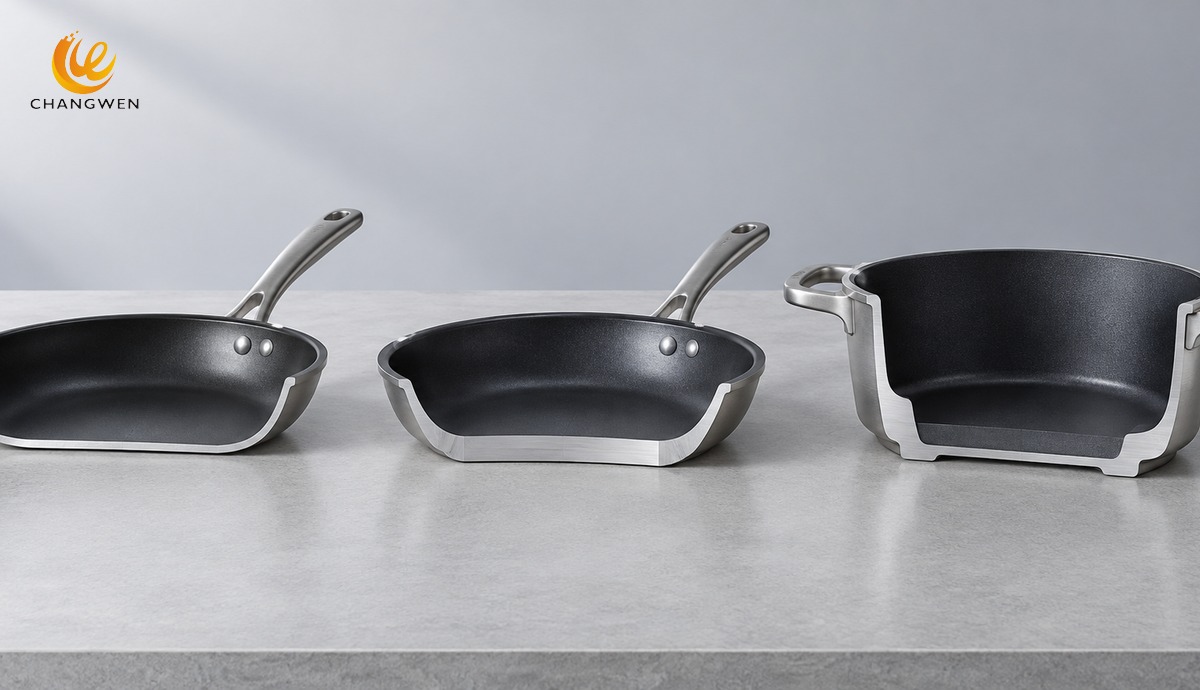
Quick Comparison: Stamped vs Forged vs Die-Cast Aluminum
| Decision factor | Stamped aluminum | Forged aluminum | Die-cast aluminum |
|---|---|---|---|
| Best commercial fit | Simple shapes, high volumes, value ranges | Mid-tier pans needing a reinforced base and controlled profile | Shaped bodies, integrated features, substantial premium feel |
| Wall geometry | Usually more uniform and limited by drawing | Can concentrate material in selected zones | Can use intentionally variable sections, ribs, and bosses |
| Weight potential | Usually lightest | Moderate | Often heaviest, depending on design |
| Tooling commitment | Lower for simple forms | Moderate | Higher because each shape requires dedicated casting tooling |
| Main control risk | Thin sections, distortion, forming marks | Profile and thickness consistency | Porosity, flow defects, trimming, and dimensional stability |
No forming method is universally superior. Stamping is often the most efficient route for a simple value set, forging balances controlled geometry with moderate weight, and die casting enables deeper forms and integrated design details. Buyers should compare quotations only after the body route, drawing revision, target mass, and thickness zones are fixed.
1. How Should the Aluminum Body Be Specified?
The body specification should identify the manufacturing route, aluminum alloy or agreed composition range, target body weight, critical dimensions, sectional thicknesses, and tolerances. The phrase “food-grade aluminum” does not define chemistry, mechanical response, surface quality, or traceability. A supplier should state the standard used and explain how incoming material or melt composition is controlled.
Thickness should be defined by zone rather than a single marketing number. A frying pan may need a stable base, a controlled transition radius, lighter upper walls, a reinforced rim, and adequate material around handle rivets or bosses. Excess metal increases heating time, freight, and user fatigue, while insufficient metal can increase deformation and create a flimsy retail impression.
Body weight is useful only after geometry and alloy are locked. A weight tolerance can reveal forming variation, incomplete casting, excess machining, or an unapproved design change, but weight cannot prove flatness or coating quality. The approved drawing and sample should therefore control dimensions and mass together.
2. What Surface Preparation Does a Reliable Coating Need?
A nonstick coating depends on the aluminum surface beneath it. Degreasing, cleaning, blasting or controlled roughening, rinsing, drying, and primer application must remove oils, die release residues, oxide, and dust while creating a repeatable surface profile. An expensive topcoat can still peel if pretreatment is inconsistent.
The process specification should identify the preparation route, acceptable surface condition, maximum delay before coating, and controls for contamination. The factory should record key process parameters by batch or shift instead of relying only on final appearance. A smooth, attractive pan can hide weak adhesion until thermal cycling or repeated cleaning exposes the problem.
3. How Should Buyers Compare Nonstick Coating Systems?
Buyers should compare coating systems by chemistry family, layer architecture, intended use, film build, cure window, verified performance, and claim documentation. Layer count alone is not a quality ranking because one well-designed system can outperform another system with more nominal layers. The relevant question is whether the complete system is approved for the actual aluminum substrate, application line, color, food type, and use temperature.
PTFE-based systems are commonly selected for strong initial food release and familiar consumer behavior, while sol-gel ceramic systems are often selected for a PFAS-free positioning and different color or heat-response expectations. The two systems should not be compared using a vague promise such as “premium nonstick.” Buyers should set the release, abrasion, stain, cleaning, and service-life expectations appropriate to each chemistry.
Marketing language must match evidence. “PFOA-free” and “PFAS-free” are not interchangeable claims, and a claim for one component does not automatically cover the whole finished article. The U.S. Food and Drug Administration explains that food-contact status depends on the specific substance, manufacturer, and intended conditions of use; its current PFAS guidance also distinguishes polymerized nonstick cookware applications from other PFAS uses. Review the FDA food-contact material guidance and FDA PFAS questions and answers for the U.S. market.
Environmental or “free-from” claims also require substantiation. The U.S. Federal Trade Commission states that environmental claims should be supported by competent and reliable evidence and should be qualified when consumers could interpret them too broadly. The FTC Green Guides summary provides a useful claims-review framework, although destination-market counsel should approve final packaging language.
4. Which Documents Should Support the Finished Product?
A complete compliance file should connect each food-contact component to the finished product and intended market. Useful records can include coating declarations, formulation or system identifiers, supplier technical data, migration or extractables reports where applicable, aluminum and stainless component declarations, silicone or polymer component support, and traceability records. A generic certificate without the exact coating system, color, substrate, supplier, or use condition is not enough.
For the European Union, Regulation (EC) No 1935/2004 establishes the general framework for materials intended to contact food, including health protection and traceability principles, while Regulation (EC) No 2023/2006 requires good manufacturing practice and documented quality systems. Buyers can consult Regulation (EC) No 1935/2004 and Regulation (EC) No 2023/2006, then confirm any additional national or material-specific requirements for the target market.
5. Which Coating Tests Produce Comparable Results?
Comparable tests require fixed methods. An abrasion result is meaningless without the abrasive material, load, stroke length, speed, cleaning interval, temperature, and failure definition. An adhesion result requires the cut pattern, spacing, tape, conditioning, and rating method. A food-release result requires ingredients, oil quantity, preheating, temperature, cooking time, cleaning, and the point at which release is considered unacceptable.
A practical approval sequence starts with dry-film thickness and visual condition, then checks adhesion, initial release, repeated release, abrasion, staining, corrosion exposure, cleaning resistance, and thermal cycling. Not every project needs the same test duration, but every claim should have a test that represents the promised use. A value pan and a premium frequent-use pan can use different limits without either specification being dishonest.
Pass or fail should be supported by raw observations. Record the number of cycles, appearance changes, release behavior, exposed substrate, blistering, discoloration, and the exact failure point. Detailed records make supplier comparisons more reliable and make later production investigations faster.

6. How Should Color and Exterior Finish Be Controlled?
Exterior color is a commercial feature that needs technical limits. Specify the coating type, color reference, gloss range, texture, acceptable shade variation, edge coverage, overspray limits, and permitted marks by surface zone. A red, cream, or speckled set can lose shelf value if pieces within the same carton look mismatched.
Color approval should use a physical master sample viewed under a defined light source and distance. Screen images are not reliable standards because display settings and photography change perceived color. The golden sample should represent the center of the acceptable range rather than a one-time perfect finish that normal production cannot repeat.
7. What Makes an Aluminum Pan Induction-Compatible?
Aluminum requires a ferromagnetic interface to work on conventional induction hobs. A buyer should specify the magnetic base material, diameter, thickness, attachment method, edge finish, flatness, corrosion resistance, and detection performance. A magnet test confirms magnetic response but does not prove efficient heating, stable bonding, or recognition across different hob designs.
Induction approval should include startup on the intended hob classes, heating observation, temperature mapping, noise or vibration checks, and flatness measurement before and after thermal cycles. A large stainless plate may improve coupling, but disc coverage alone does not guarantee uniform heat. The aluminum body above the plate must spread energy without permanent distortion or an unstable hot zone.
8. Why Must Flatness Be Checked Hot and Cold?
Cold flatness determines whether cookware sits correctly before use, while hot flatness reveals stress and expansion behavior. A pan can pass a room-temperature gauge and rock after repeated heating because the body, coating, and induction plate respond differently to temperature. The test method should define measurement points, permitted gap, heating power, target temperature, dwell time, cooling method, and cycle count.
Base contact diameter should be stated separately from rim diameter. A 28 cm frying pan may have a much smaller active base, which changes burner matching and heat distribution. Sample comparisons are valid only when pans use similar contact areas and the same heating conditions.
9. How Should Handles and Knobs Be Approved?
Handle approval should cover grip shape, balance, heat transfer, pull strength, torsion, repeated loading, fastener retention, oven claim, and damage after thermal cycles. A wood-look or soft-touch grip may improve perceived value, but its coating, insert, color, odor, and cleaning resistance require separate controls.
Riveted handles need controlled rivet setting and sealed food-contact geometry, while screwed handles need thread engagement and an anti-loosening strategy. Detachable handles require lock-cycle, misuse, and load tests. Every handle test should use a defined vessel load because an empty sample cannot represent the leverage created by a filled saute pan or stockpot.
10. What Should Be Specified for Lids?
A lid specification should define glass or metal type, thickness, rim construction, fit clearance, rocking limit, knob attachment, steam vent, thermal-shock requirement, and packing protection. A glass lid offers visibility but increases transit and fit risks, while an aluminum lid changes weight and heat behavior. The correct option follows the product claim and retail position.
Lids should be checked across multiple bodies from the batch instead of only with their paired samples. Interchangeability matters in cookware sets, retail replacements, and after-sales service. Buyers should also confirm that lid knobs and side handles leave enough room for a safe gloved grip.
11. How Should a Cookware Set Be Built?
A cookware set should be designed around cooking tasks rather than the largest possible piece count. A practical family may combine a frying pan for open-surface cooking, a saucepan for liquids, a casserole for braising, and a larger pot for boiling. Counting each lid as a separate piece can make two sets with identical vessel coverage appear different, so the specification should list every vessel and accessory clearly.
Shared components reduce tooling and inventory only when the fit is intentional. Common lid diameters, handle platforms, knobs, and packaging inserts can simplify production, but excessive standardization can produce poor balance or awkward proportions. Buyers should approve each assembled size, not assume that a successful 24 cm pan automatically validates the 30 cm version.
12. How Should the Golden Sample Be Defined?
A golden sample is useful only when it is tied to a controlled specification pack. The pack should include the current drawing, bill of materials, body weight, thickness zones, coating identity, color master, hardware, lid fit, induction base, artwork, packaging, defect boundaries, performance methods, and compliance documents. A physical sample alone cannot show which details are mandatory and which occurred by chance.
Keep one sealed reference with the buyer and one with the manufacturer, then record sample codes, revision, and approval date. A change to aluminum source, forming tool, pretreatment, coating system, cure schedule, induction plate, handle, or packaging should trigger a documented review. The review should decide whether the change requires limited verification or full requalification.
13. What Belongs in a Shipment Inspection Plan?
A shipment plan should classify critical, major, and minor defects according to risk. Critical problems include sharp edges, cracked bodies, loose handles, detached bases, exposed food-contact defects, and incorrect materials. Major defects can include severe rocking, poor lid fit, coating damage, missing components, or wrong artwork, while minor defects usually concern limited cosmetic variation.
Inspection frequency should follow the type of evidence. Obvious damage, missing pieces, and assembly errors can be checked broadly. Dimensions, weight, flatness, coating thickness, handle movement, lid fit, and carton condition can use a defined sampling plan. Destructive abrasion, sectioning, or extended thermal-cycle tests need scheduled samples tied to lots, shifts, material changes, or risk signals.
Changwen’s cookware quality control process and R&D and manufacturing overview provide additional context for connecting sample approval, production records, and final inspection.

14. How Should Packaging Be Tested?
Packaging must protect the coated interior, colored exterior, rim, glass lid, handles, and induction base from rubbing and impact. Bags, tissue, sleeves, separators, molded pulp, and films should be selected according to the real contact points. A package can prevent breakage and still fail if vibration creates visible coating marks that make the retail set unsalable.
Transit testing should match the channel. Palletized wholesale cartons and single units shipped through parcel networks face different drop, vibration, compression, and presentation risks. Specify carton material, dimensions, gross weight, stacking direction, barcode position, test method, and separate acceptance limits for the product, gift box, and master carton.
15. What Should a Comparable RFQ Include?
- Market and claim: destination countries, price tier, household or foodservice use, heat sources, intended service level, and every packaging claim.
- Range: vessel types, top diameters, usable capacities, heights, base contact diameters, lids, handles, accessories, and set count method.
- Body: stamped, forged, or die-cast route; alloy; thickness zones; weight; tolerances; rim; critical dimensions; and traceability.
- Coating: chemistry family, exact system, layers, dry-film thickness, cure window, colors, appearance limits, and compliance support.
- Performance: adhesion, initial and aged release, abrasion, stain, corrosion, cleaning, thermal cycling, and failure definitions.
- Induction: magnetic material, disc geometry, attachment, flatness, hob recognition, heat distribution, and post-cycle requirements.
- Hardware: handle and knob materials, fasteners, load and torque methods, heat behavior, oven limit, and replacement strategy.
- Packaging: protective materials, retail artwork, carton construction, barcode, transit protocol, and acceptance limits.
- Commercial terms: tooling ownership, mold life expectations, MOQ by size and color, sample charges, lead time, spare parts, and change control.
Every supplier should quote the same RFQ revision and list deviations explicitly. A lower unit price may reflect a thinner body, smaller induction plate, simpler coating, reduced testing, lighter packaging, or excluded compliance work. Normalizing those differences is necessary before a price comparison becomes meaningful.
How Should Buyers Score Competing Samples?
A weighted scorecard should reflect the product promise. A frequent-use range may emphasize aged food release, abrasion, flatness, handle stability, and color consistency. A value set may give more weight to acceptable function, low mass, efficient packaging, and price. The scorecard prevents an attractive finish from hiding weak engineering and prevents unnecessary premium features from overwhelming a price-sensitive brief.
Run the same sequence on every sample and record raw data. Useful observations include mass, dimensions, base contact area, heating pattern, flatness before and after cycling, coating thickness, release behavior, abrasion endpoint, handle movement, lid interchangeability, appearance, and packaging damage. A common method turns samples into comparable evidence rather than subjective impressions.
Frequently Asked Questions
Is forged aluminum always better than stamped aluminum?
Forged aluminum can provide a reinforced profile and premium feel, while stamped aluminum can be lighter, simpler, and more cost-efficient. The better option is the one that meets the required geometry, deformation resistance, volume, and target price with controlled variation.
Does a thicker pan always have better nonstick performance?
Thickness can improve stability and heat spreading, but nonstick performance depends on surface preparation, coating design, cure control, temperature management, and use. A thick body with poor pretreatment can peel earlier than a thinner body with a well-controlled coating process.
Is PFOA-free the same as PFAS-free?
No. PFOA is one substance within the broader PFAS category, so a PFOA-free claim does not automatically mean the product contains no PFAS. Buyers should define the exact claim, obtain support for the finished coating system, and review destination-market requirements before printing packaging.
Can nonstick aluminum cookware work on induction?
Yes, when the base includes a suitable ferromagnetic component. Buyers should verify material, coverage, attachment, cold and hot flatness, hob detection, and performance after thermal cycling instead of relying only on an induction symbol.
How many coating layers should a good pan have?
No universal layer count defines quality. Buyers should evaluate the approved system, total and per-layer film build where relevant, cure conditions, adhesion, release, abrasion, stain resistance, and compliance evidence. Performance under a controlled method is more useful than a layer-count claim.
What is the most important pre-shipment check?
No single check is sufficient, but loose handles, sharp edges, cracked bodies, detached induction bases, exposed food-contact defects, incorrect materials, and severe coating damage deserve the strictest control. The full inspection plan should also cover dimensions, appearance, lid fit, flatness, labeling, and packaging.
Final Buying Recommendation
The strongest nonstick aluminum cookware program begins with a use claim and ends with a measurable batch decision. Lock the body route, alloy, thickness zones, pretreatment, coating system, claim evidence, induction base, hardware, test methods, defect boundaries, packaging, and change-control rules before comparing final quotations. This process reduces ambiguity between the showroom sample and bulk production.
Changwen supports cookware wholesale, private-label, and OEM programs that require coordinated product development and production control. Buyers can review Changwen’s custom kitchenware services and cookware product range, then contact Changwen with the target market, vessel list, body route, coating claim, induction requirement, quantity, and packaging format for a project review.
-
Durable Stainless Steel Pot Set for Everyday Use CW-TP0604
-
popular stainless steel 12pcs cookware set pots and pans casserole fry pan with kitchenware tools and wire reack CW-M1208
-
China factory wholesale blue marble nonstick coating fry pan set stainless steel mirror polished frypans golden handles and knobs CW-M0303
-
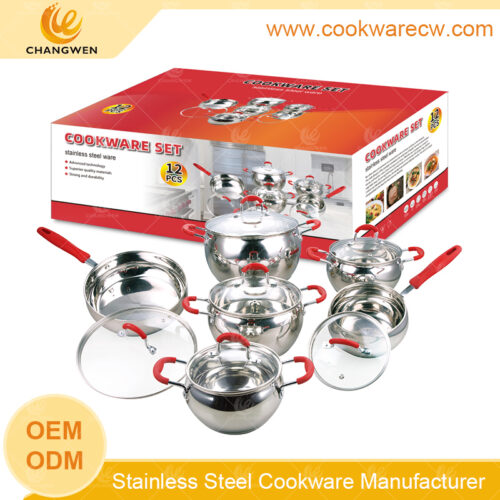
Hot sale stainless steel apple shape cookware set red silicone cover glass lid mirror polished kitchen pots and pans CW-M1219G
-
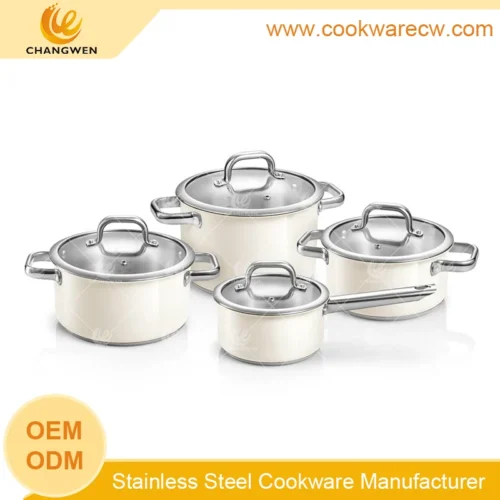
8-Piece Cream White Stainless Steel Cookware Set with Saucepan CW-ES0803
-
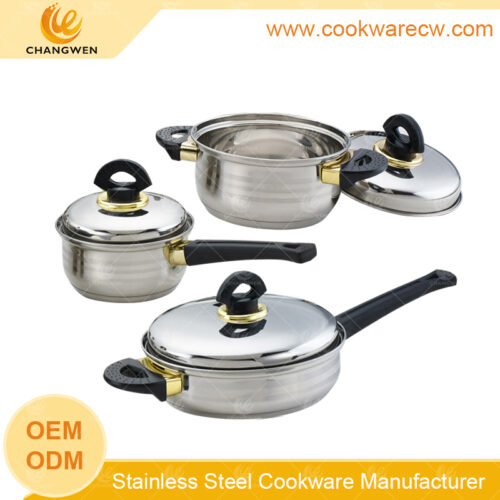
Best Stainless Steel Cookware In India
-
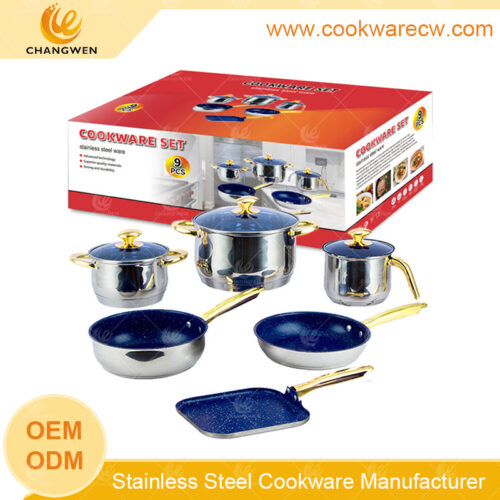
9pcs stainless steel cookware set pots and pans with non-stick coating golden hollow handle and knob with rivets wholesaler factory CW-M0901
-
Pressure Cooker Aluminum – Single-Hand Rotation & Safety