
Estimated reading time: 17 minutes.
The best stainless steel cookware is not the set with the largest piece count, the thickest wall, or the longest list of marketing claims. The best choice is a small, coherent group of vessels whose shapes match the buyer’s cooking tasks, whose construction matches the heat source, and whose specifications can be verified before purchase. A frying pan built for browning, a saucepan designed for controlled liquid cooking, and a stockpot sized for batch volume solve different problems; evaluating all three by one feature leads to poor decisions.
Direct buying rule: choose the vessel first, the construction second, and the convenience features third. Start with the food, batch size, burner, storage space, and handling needs. Then compare the cooking-surface material, heat-spreading layer or base, effective cooking diameter, handle geometry, lid design, and measurable dimensions. This order prevents an attractive finish or an inflated set count from hiding a weak assortment.
What makes stainless steel cookware a practical long-term choice?
Stainless steel cookware is valued because a well-designed cooking surface is durable, corrosion resistant, smooth, and straightforward to clean. The material does not create effortless food release in the way a fresh nonstick coating can, but it tolerates browning, deglazing, simmering, and repeated cleaning without depending on a sacrificial coating. Stainless steel is therefore a strong general-purpose choice for kitchens that value versatility and a long service life.
Stainless steel alone does not guarantee good heating. Many stainless grades conduct heat less efficiently than aluminum or copper, so cookware designers often combine a stainless cooking surface with a more conductive core or base. The resulting performance depends on where that conductive material is placed, how far it extends, how thick it is, and whether the completed vessel remains flat. A buyer should evaluate the whole construction rather than treating the words “stainless steel” as a complete specification.
The practical limitation is technique. Food can stick if a pan is overheated, underheated, crowded, or moved before browning releases it naturally. Buyers who expect coating-like release from bare stainless steel may be disappointed. Stainless cookware works best for users willing to control heat, use an appropriate amount of fat, and allow food to form a crust before turning.
Which cookware shape belongs to each cooking task?
Cookware geometry changes evaporation, access, tossing space, and the ratio between cooking area and liquid volume. A wide frying pan exposes more food to the hot surface and allows moisture to escape. A tall stockpot reduces the footprint needed for a large liquid volume. A saucepan balances depth with access for stirring, while a saute pan combines a broad floor with straight walls that contain liquid. The correct starting question is therefore “What will this vessel cook?” rather than “How many pieces are in the set?”
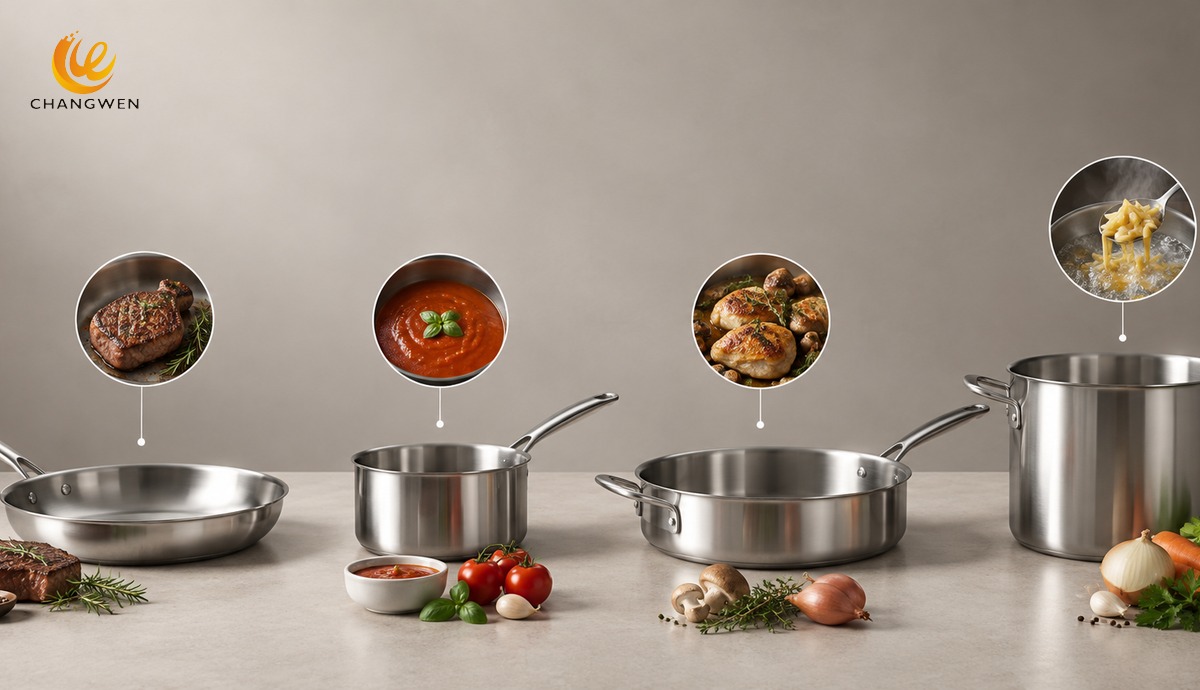
| Vessel | Best suited to | Most important dimensions | Common buying mistake |
|---|---|---|---|
| Frying pan or skillet | Searing, browning, sauteing, reducing pan sauces | Flat cooking diameter, wall angle, handle balance | Buying by rim diameter while ignoring the smaller usable floor |
| Saucepan | Sauces, grains, reheating, small liquid batches | Capacity, opening width, pouring rim, handle leverage | Selecting a handle that feels fine empty but becomes unstable when full |
| Saute pan | Shallow braises, one-pan meals, high-volume browning | Floor area, wall height, helper handle, lid fit | Treating it as interchangeable with a sloped frying pan |
| Stockpot | Pasta, stock, soup, steaming, batch cooking | Usable volume, height, base diameter, loaded carry clearance | Choosing maximum capacity without checking burner and sink fit |
| Dutch oven or casserole | Braising, stewing, oven-to-table cooking | Base area, oven clearance, lid retention, two-handle grip | Assuming a heavier vessel is automatically more stable or efficient |
A useful starter collection often includes fewer pieces than a promotional set. One medium frying pan, one saucepan, and one stockpot may cover more real meals than several near-duplicate saucepans. A fourth piece should solve a clear missing task, such as a saute pan for batch browning or a steamer insert for vegetables and dumplings. Piece count should describe useful cooking components, not create an impression of value by counting every lid as a separate vessel.
How should buyers compare stainless steel grades?
A stainless grade identifies a material family, not the complete quality of a pan. Austenitic stainless steels commonly used for food-contact interiors contain chromium and nickel in proportions that support corrosion resistance and formability. Ferritic stainless steels are magnetic and may be used on an exterior layer or base to support induction. A multi-material vessel can therefore use different stainless grades in different locations for different functions.
Labels such as 18/10 and 18/8 are shorthand descriptions of nominal chromium and nickel content, but they do not replace an alloy designation, supplier declaration, or appropriate test report. A polished surface cannot reveal the alloy, and a magnet cannot identify every hidden layer. When grade matters to a purchase, ask which grade is used at the food-contact surface, exterior wall, base plate, rim, handle, and fasteners.
Food-contact evaluation must also reflect intended use. The U.S. Food and Drug Administration explains that food-contact substances are assessed in relation to exposure and intended conditions of use, including food type and temperature. A buyer selling across markets should specify the destination requirements and obtain documentation for the actual construction rather than relying on a broad statement that stainless steel is “food safe.”
What is the difference between single-wall, disc-base, and fully clad cookware?
Single-wall stainless steel uses one primary sheet through the vessel. It can be light, economical, and appropriate for tasks dominated by water, but it may distribute burner heat less evenly when used for frying or thick sauces. Disc-base cookware adds a conductive layer beneath the floor, usually enclosed by an exterior plate. Fully clad cookware extends bonded layers from the base through the walls, which can change sidewall heating and responsiveness.
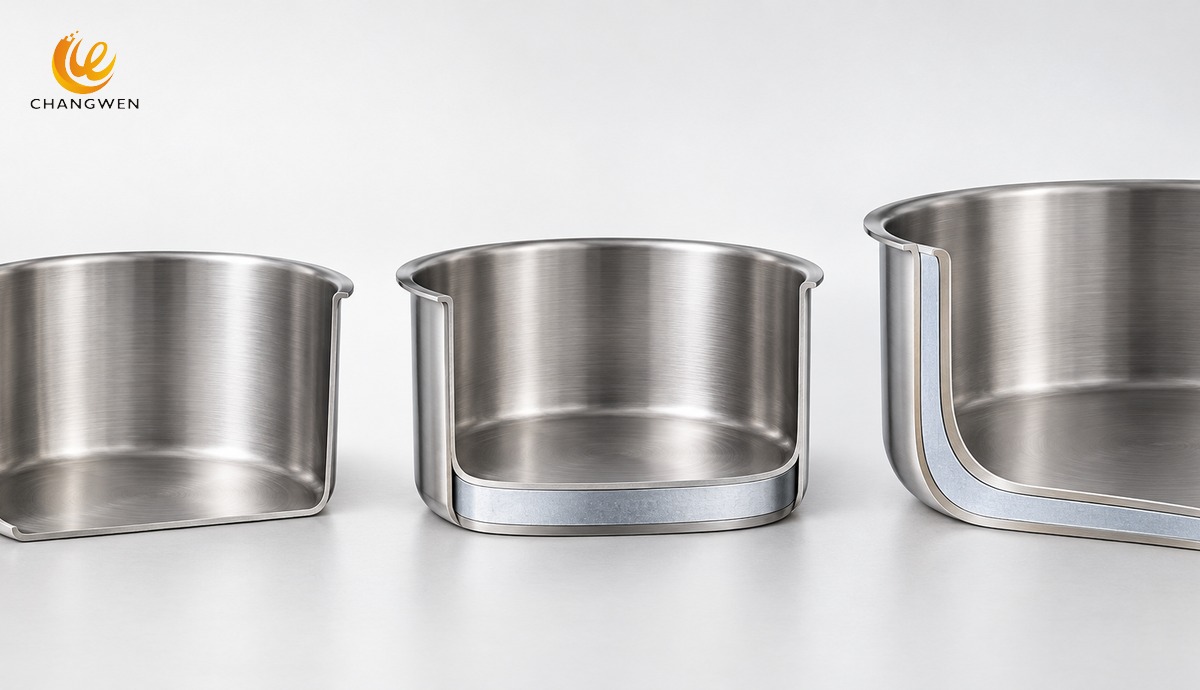
No construction is universally superior. A well-made disc base can be a rational choice for a stockpot that mainly heats liquid from below, especially when the base covers the active burner area. Fully clad walls can be more useful in frying pans, saute pans, and saucepans where food contacts the sides or where quick, even response matters. Single-wall pieces can suit inserts, mixing vessels, and low-intensity liquid tasks. The vessel’s job should determine where additional conductive material creates value.
The terms “tri-ply,” “three-layer,” and “clad” require location and composition. A tri-ply base is not the same product as a body clad from base to rim. Buyers evaluating that construction can use the site’s detailed tri-ply cookware guide to define layers, sample checks, and approval evidence without turning layer count into a quality shortcut.
Does greater thickness always produce better cookware?
Greater thickness can improve rigidity and change heat storage, but it also adds weight, cost, and thermal inertia. The useful question is not simply “How many millimeters?” but “Which material is that thick, where is it measured, and what task must it improve?” Extra stainless steel and extra aluminum do not produce identical thermal behavior. A total thickness number is incomplete when the layer stack and measurement location are unknown.
Thin cookware may respond quickly but can develop stronger temperature differences over a concentrated burner and may be more vulnerable to deformation. Very heavy cookware may heat more slowly, feel secure during searing, and become tiring to lift or pour. A balanced specification connects thickness to vessel size, expected load, handle leverage, and heating test results. The separate stainless steel cookware thickness guide compares common wall gauges and explains why the same number does not suit every vessel.
Base coverage matters as much as thickness. An encapsulated disc that stops far inside the sidewall can leave an outer ring with different heating behavior. A broad disc may distribute heat across more of the usable floor, but only if it remains flat and is matched to the hob. The guide to cookware base disc diameter and edge-to-edge coverage provides a focused method for comparing this geometry.
How should capacity and diameter be interpreted?
Nominal capacity is the volume to the brim unless the specification says otherwise. Usable cooking capacity is lower because food needs headspace for stirring, boiling, foaming, and safe transport. Two pots advertised with the same volume can behave differently when one is tall and narrow and the other is lower and wider. The wider vessel usually offers more evaporation and access; the taller vessel may occupy less burner space and retain more liquid.
Rim diameter is also not the same as cooking diameter. Sloped walls reduce the flat floor, so a nominal 28 cm frying pan may provide much less direct searing area than its rim suggests. Buyers should record rim diameter, internal floor diameter, base contact diameter, internal height, brimful capacity, practical fill line, and empty weight. These measurements make different shapes comparable and help predict packaging, shelf space, and loaded handling.
For sets, capacity progression should be meaningful. If two saucepans differ only slightly, most users will favor one and ignore the other. A stronger set assigns each vessel a distinct job: a small saucepan for sauces, a medium saucepan for grains or reheating, and a larger stockpot for pasta or soup. The assortment should reduce task overlap rather than maximize the number printed on the carton.
What does induction compatibility actually require?
Induction compatibility requires a magnetic base that couples with the cooktop and a geometry the appliance can detect. A magnet adhering to the bottom is a useful initial screen, but it does not measure heating speed, uniformity, noise, low-power stability, or resistance to distortion. Some stainless grades are weakly magnetic or nonmagnetic, so a pan described only as stainless steel is not automatically induction ready.
The U.S. Department of Energy recommends checking for a flat magnetic bottom when selecting cookware for induction. Real compatibility should still be confirmed on representative cooktops because detection zones and control behavior vary. Test the smallest and largest vessels in the line, record the active base diameter, and repeat flatness checks after controlled heating and cooling cycles.
Gas, radiant electric, ceramic glass, and induction also place heat differently. A vessel that performs acceptably over a broad gas flame may reveal a concentrated hot area over a smaller electric or induction zone. Buyers serving several markets should not translate “works on all cooktops” into “performs identically on all cooktops.” A bounded claim names compatibility while leaving performance to controlled comparison.
Which handle details matter after the pan is full?
A handle must be evaluated with the vessel loaded, not only while it is empty on a display table. Length, angle, cross-section, attachment points, and weight distribution determine wrist leverage and control. A smooth handle can still be difficult to grip when wet, while a narrow edge can become uncomfortable under a heavy load. Large vessels benefit from helper handles that allow two-handed lifting with adequate knuckle clearance.
Riveted handles are familiar and mechanically visible, but exposed rivet heads can create extra interior cleaning points. Welded handles leave a smoother interior when the joint is executed correctly, but their quality depends on the weld design and process control. Neither attachment method should be accepted by name alone. Inspect alignment, gaps, sharp transitions, movement after load cycling, and the effect of repeated heating.
“Stay-cool” is a conditional claim, not an absolute state. Handle temperature changes with burner size, flame spread, cooking duration, vessel fill, and oven use. A hollow or vented stainless handle may reduce heat transfer on a stovetop, yet it can still become hot. Compare designs with the same pan size, burner setting, liquid load, time, and measurement points, and always communicate oven and lid-knob limitations clearly.
How should lids and rims be evaluated?
A lid controls evaporation, visibility, splatter, and storage height. Glass allows the user to observe cooking but adds weight and can introduce a metal rim where residue collects. Stainless lids are opaque but can be robust and easier to match to an all-metal oven-use claim. The best choice depends on the task and the intended retail promise rather than a universal hierarchy.
Check lid seating at several rotational positions because an apparently good fit can hide rim distortion. The lid should remain stable during a gentle simmer without binding when removed. If a steam vent is present, define its location and diameter; if no vent is present, avoid promising pressure control. Knob clearance should allow a secure grip, and the specified oven temperature should be limited by the least heat-resistant component.
A rolled or flared rim can improve pouring, but the benefit should be tested with water and a viscous liquid from both sides of the pan. Record drips, stream control, and the grip needed to tilt a filled vessel. A pouring claim is stronger when it describes an observed function than when it relies on the rim’s appearance.
What finish should a buyer choose?
A polished exterior creates a bright premium appearance but makes fingerprints, fine scratches, and polishing waves more visible. A brushed exterior can conceal minor handling marks and produce a quieter look, but brush direction and consistency become acceptance criteria. Satin interiors may make light use marks less obvious, while mirror interiors can make cleaning residue easier to see. Finish selection therefore affects both presentation and inspection.
Decorative performance should be separated from structural performance. Color bands, hammered textures, etched logos, and measurement marks can support differentiation, but they do not compensate for an unstable base or uncomfortable handle. Any colored finish also needs a defined application area, color tolerance, adhesion expectation, and care instruction. The golden sample should establish what acceptable appearance means under consistent lighting.
Inspect high-risk locations: around handle attachments, beneath rolled rims, at base edges, along polishing transitions, and inside embossed or laser-marked areas. A general phrase such as “good finish” is not measurable. Buyers should define critical defects that are never acceptable, major defects that affect saleability or function, and minor defects that are limited by an agreed sampling plan.
How can a buyer compare cookware performance fairly?
A fair comparison changes one major variable at a time and holds the test conditions constant. Use vessels of similar diameter, the same heat source and zone, the same starting temperature, the same water or food mass, and the same measurement points. Record the procedure before seeing the results. Otherwise a larger burner, lower fill, or different preheat can create an apparent advantage unrelated to construction.
Useful checks include time to heat a known water mass, temperature spread across the base, response after reducing power, handle temperature, base flatness before and after cycling, pouring control, lid fit, and loaded balance. Browning tests can add practical context, but they require consistent food thickness, moisture, starting temperature, oil quantity, and turning time. Do not describe a casual kitchen trial as laboratory certification.
Evaluation should connect each result to a decision. A small temperature difference may matter in a frying pan used for delicate proteins but matter less in a stockpot filled with water. Faster heating may be helpful for boiling yet make a saucepan harder to control at low power. Performance data becomes useful only when it is interpreted for the vessel’s intended task.
What should be checked on a sample before buying?
A sample inspection should verify identity, dimensions, assembly, appearance, and function. Record the SKU, version, date, and measured values rather than relying on photographs alone. Measure rim diameter, cooking-floor diameter, base contact diameter, height, capacity, weight, wall or body thickness at defined points, lid fit, handle alignment, and packaging dimensions. Compare every observation against the approved specification.
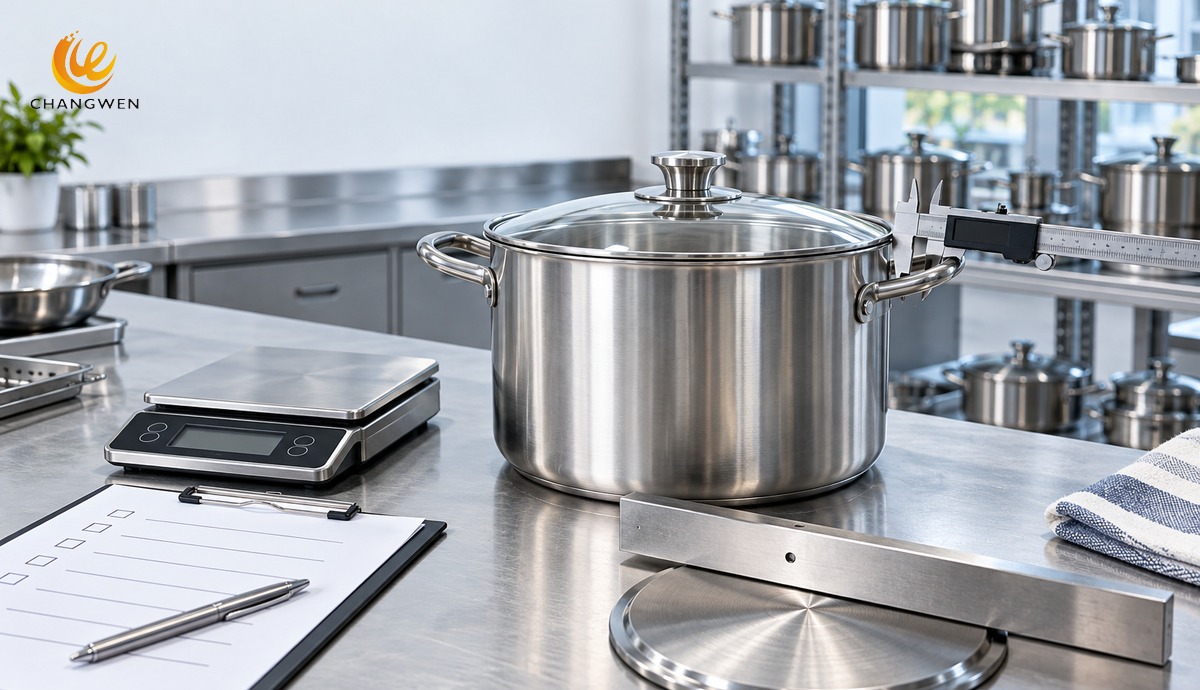
Place the pan on a known-flat surface and check rocking before and after the agreed heat cycle. Fill it to a realistic working level, lift it with dry and damp hands, and confirm that handles provide clearance and control. Test the lid in different positions, pour from both sides where relevant, inspect every joint, and check that edges are smooth. These simple observations reveal issues that a product photo cannot show.
Material claims need supporting evidence appropriate to the claim. An XRF reading can help identify exposed alloy surfaces, but it cannot by itself prove the composition or thickness of a hidden aluminum core. Construction can require supplier documentation, controlled section analysis, mass and dimension checks, or another agreed method. The site’s importer and private label cookware guide covers specification control, comparable quotations, and production approvals in more detail.
- Confirm the vessel’s job: define the cooking task, batch size, heat source, and handling conditions.
- Verify dimensions: measure the usable floor, base contact area, practical capacity, height, and weight.
- Identify the construction: state material grades, layer location, thickness references, and tolerances.
- Check assembly: inspect handles, fasteners, rims, lids, welds, and transitions.
- Run task-based tests: compare heat behavior, flatness, pouring, balance, and cleaning with a fixed method.
- Freeze the approval: retain an identified golden sample, signed specification, packaging standard, and defect criteria.
Is a cookware set better than buying individual pieces?
A set is better when every vessel has a recurring task and the shared design reduces decision effort. Individual pieces are better when a set includes redundant sizes, oversized pots, or lids counted as though they were cooking vessels. The economic comparison should use the cost of the pieces the buyer will actually use, not the discount against an inflated piece count.
For a compact home kitchen, a three-vessel core can cover most daily work: a frying pan, a saucepan, and a stockpot. A household that braises frequently may add a saute pan or casserole. A kitchen that cooks large pasta batches needs more stockpot capacity, while a small household may gain more from a second frying-pan size. There is no universally correct set because menu, household size, storage, and burner layout vary.
Retail and private label buyers should build a set around a clear user story. A “first kitchen” set should favor versatile, manageable pieces. A family set should create meaningful capacity steps. A performance set may prioritize a larger searing surface and a more conductive construction. This assortment logic differentiates the offer more credibly than adding accessories solely to increase the number on the box.
What are the most common buying mistakes?
The first mistake is selecting by headline material alone. “Stainless steel” does not define alloy location, heat-spreading construction, induction behavior, thickness, or finish quality. The second mistake is buying by rim diameter or brimful liters without measuring usable floor and practical fill. The third is assuming a heavy pan, high layer count, or magnetic response proves superior cooking.
Another mistake is reviewing only the unloaded product. Handles, helper grips, lid knobs, and balance must be checked with realistic weight and heat. Buyers also overlook storage: long handles, tall knobs, and non-nesting shapes can make an otherwise capable set frustrating in a small kitchen. Cleaning access around rivets, rims, and seams should be examined before the visual design is approved.
The final mistake is accepting claims that cannot be traced to the supplied SKU. A catalog photo does not prove grade, thickness, or full-body cladding. A certificate for a different model does not automatically apply. A reliable buying process connects every important claim to a drawing, material record, test, or approved sample that identifies the product version.
How should stainless steel cookware be used and maintained?
Start most stainless frying tasks with moderate preheating rather than maximum power. Add cooking fat at the appropriate time, dry food surfaces, avoid crowding, and allow browned food to release before turning. For sauces and grains, use enough liquid and reduce heat once the target temperature is reached. The right technique improves release and reduces scorched residue without pretending that bare stainless steel is nonstick.
Allow hot cookware to cool before exposing it to a large temperature shock. Wash according to the manufacturer’s instructions, use non-scratching tools for routine soil, and dry the surface to reduce water spotting. Mineral haze and heat tint are appearance changes that may require an appropriate stainless cleaner; aggressive abrasives can alter a polished or brushed finish. Care instructions should match the actual components, including coated details, glass lids, and insulated knobs.
Dishwasher compatibility should be treated as a tested product claim rather than a synonym for stainless steel. Detergent chemistry, water hardness, mixed-metal components, decorative finishes, and repeated cycles can change appearance. A brand that promises dishwasher use should define the relevant test, acceptance criteria, and care caveats for the complete vessel.
Frequently asked questions about stainless steel cookware
Is 18/10 stainless steel always the best choice?
18/10 is a useful shorthand for a common corrosion-resistant stainless composition, but it does not determine the pan’s heat distribution, base flatness, handle comfort, or assembly quality. The best choice specifies which alloy is used at each component and verifies the finished vessel for its intended use.
Does all stainless steel cookware work on induction?
No. Induction requires a suitable magnetic base and compatible geometry. A magnet test is a helpful first screen, but actual detection, low-power control, heating behavior, and post-cycle flatness should be checked on representative appliances.
Is fully clad cookware always better than disc-base cookware?
No. Fully clad walls can benefit frying pans, saute pans, and saucepans, while a broad, well-made disc base can be efficient for stockpots and liquid-heavy tasks. The better design is the one that delivers measurable performance for the vessel’s job without unnecessary weight or cost.
How many cookware pieces does a typical kitchen need?
Many kitchens can begin with three useful vessels: a frying pan, a saucepan, and a stockpot. Additional pieces should add a distinct capability or capacity. Lids and accessories should not distract from how many actual cooking vessels the set contains.
Can a product photo confirm stainless steel grade or layer construction?
No. A photo can show shape, visible finish, lid style, and handle design, but it cannot confirm alloy chemistry, hidden layers, layer thickness, or tested performance. Those claims require product-specific specifications, documentation, and appropriate verification.
What is the final decision rule?
Choose stainless steel cookware by following a fixed hierarchy: cooking task, vessel geometry, usable size, construction, cooktop compatibility, handling, lid and rim function, finish, and verified quality. Reject features that do not solve a defined user problem. Compare samples with the same procedure, and make every important sales claim traceable to the approved product.
Changwen supports cookware wholesalers, importers, retailers, and private label programs with custom sizes, constructions, finishes, logos, packaging, and OEM development. Buyers can review the company’s custom cookware capabilities and quality control approach, then contact Changwen with the target market, vessel list, required capacities, construction, annual volume, branding, packaging, and compliance needs. A precise brief makes samples and quotations easier to compare and turns a broad cookware idea into a controlled product program.
-
Ceramic Non Stick Aluminum Cookware Set
-
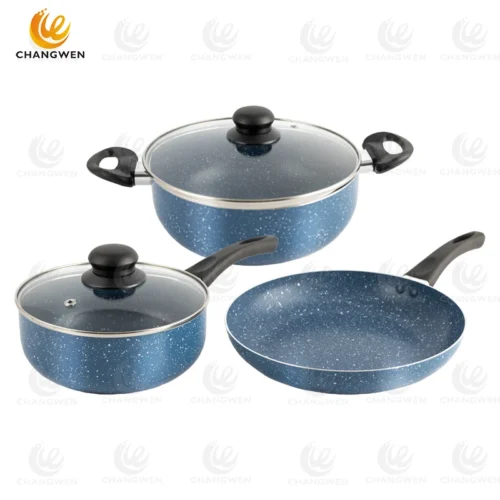
5pcs Granite Stone Nonstick Aluminum Cookware Set Private Label Supplier China | Changwen
-
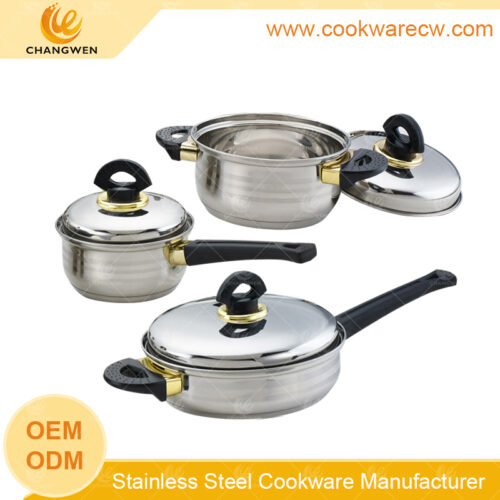
Best Stainless Steel Cookware In India
-

Stainless Steel Frying Pan with Professional Heat Control CW-ETP020
-
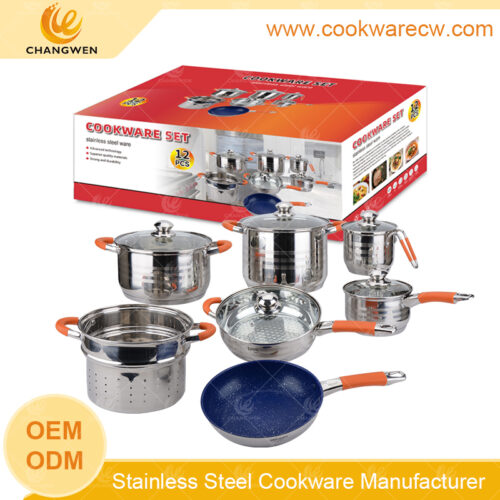
12pcs stainless steel cookware set with silicon handles coating conic frypan 24cm pasta pot in China CW-M1311
-
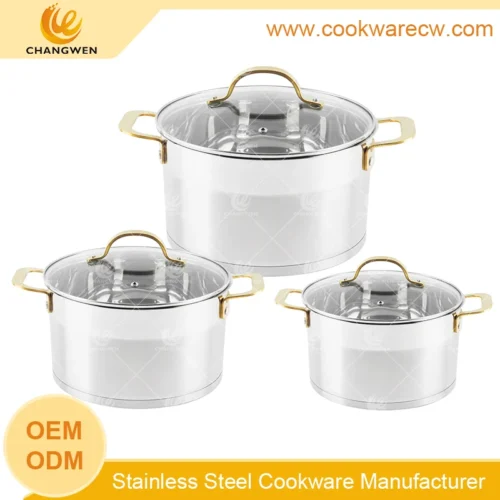
6-Piece Matte Stainless Steel Pot Set with Multi-Color Handles CW-ES0617
-
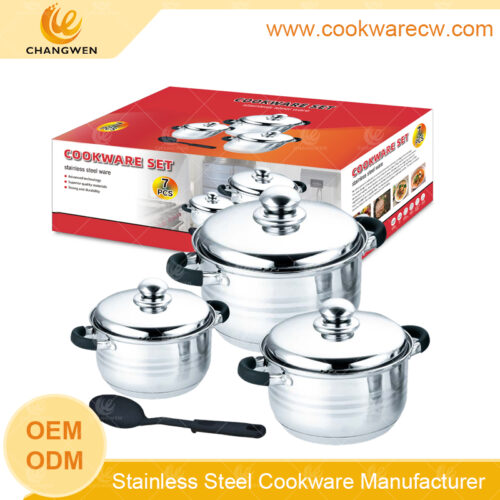
Mercado Libre hotsale cookware 7pcs cooking pot set stainless steel lids silicone handle kitchen tool solid serving spoon CW-M0702G
-
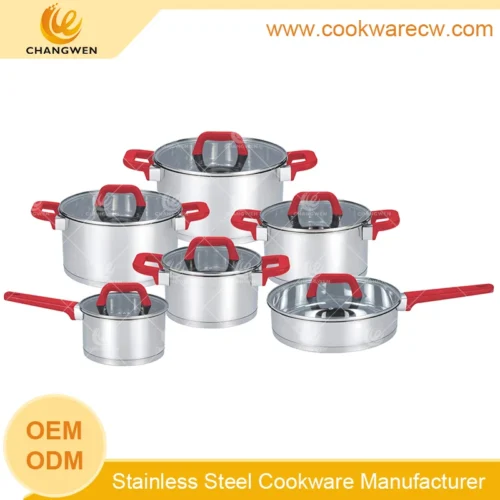
12-Piece Stainless Steel Cookware Set with Red Silicone Handles CW-ES1203G