
A stainless steel cookware buying guide for importers and private label brands should do more than list steel grades or compare prices. It should turn a product concept into a controlled set of specifications, tests, approvals, and purchasing decisions. The most reliable buying process begins with the intended customer and ends with evidence that mass production still matches the approved sample.
Importers often receive quotations that look comparable because every supplier names the same pot sizes and stainless steel grades. Those quotations may actually describe products with different body thicknesses, base diameters, handle construction, lid fit, surface finish, packaging protection, and inspection standards. A low unit price is not meaningful until every commercially important variable has been normalized.
This guide uses an evidence-first approach. It explains how a buyer can define the product role, build a specification stack, compare quotations on equal terms, validate performance, approve a golden sample, and protect the specification during production. That angle complements our existing technical articles instead of repeating a general sourcing sequence.
Key takeaways for cookware buyers
- Choose specifications from the target use case and retail position, not from a supplier’s default configuration.
- Compare total product systems: body, base, handle, lid, finish, packaging, testing, and order terms.
- Require measurable evidence for every claim that affects safety, performance, durability, or consumer expectations.
- Use a signed golden sample and change-control process to keep mass production aligned with the approved design.
- Evaluate landed commercial value rather than selecting the lowest quoted unit price.
What should an importer decide before asking for a cookware quotation?
An importer should decide who will use the cookware, what cooking jobs each item must perform, where the range will sit in the market, and which claims the packaging will make before requesting a quotation. These decisions determine whether the product needs an entry-level disc base, broader heat-spreading coverage, a fully clad body, reinforced handles, premium finishing, or more protective packaging.
A retail opening-price set and a professional-looking premium set can share the same nominal diameters while requiring very different engineering. The opening-price set may prioritize low packed volume, familiar shapes, and controlled material use. The premium set may need heavier hand feel, more even sidewall heating, refined rim geometry, tighter cosmetic limits, and packaging that communicates higher value. Asking for “a 10-piece stainless steel set” does not express those differences.
Every SKU should have one primary job. A 16 cm saucepan may be intended for sauces and small portions, while a 24 cm stockpot may be intended for family meals or batch cooking. The job determines useful capacity, depth, handle leverage, lid venting, pouring behavior, and heat-source compatibility. A specification becomes easier to defend when each requirement traces back to a real user task.
How should a private label brand build its SKU architecture?
A private label brand should build a range around complementary cooking jobs rather than collecting unrelated factory models. A coherent core range often begins with a fry pan, saucepan, saute pan, and stockpot, then expands only when consumer demand supports additional diameters or specialty pieces. This method reduces inventory fragmentation and makes replacement, packaging, and marketing easier to manage.
Good-better-best architecture should create visible and measurable reasons for each price step. “Good” may use a controlled disc base and straightforward finish. “Better” may add wider base coverage, thicker components, improved lid fit, and more ergonomic handles. “Best” may use fully clad construction, more demanding surface tolerances, and upgraded packaging. A price ladder fails when adjacent tiers look different but cook the same, or cost more without a buyer-relevant benefit.
Which stainless steel construction is right for the target market?
The right construction is the least complex system that consistently meets the required cooking performance, durability, appearance, and price position. Stainless steel is durable and corrosion resistant, but it spreads heat less effectively than aluminum. Cookware therefore combines stainless cooking surfaces with an aluminum heat-spreading layer in a bonded base or a multilayer body.
Disc-base cookware concentrates the conductive layer under the cooking floor. It is often efficient for stockpots and saucepans because most heat demand occurs at the base. Fully clad cookware extends the conductive layer through the sidewalls, which can improve temperature continuity for sauteing, reduction, and recipes that contact the walls. Fully clad construction is not automatically better for every SKU; it adds material, forming complexity, weight, and cost that must produce a useful benefit.
Steel grade should be specified by component, not as one vague statement for the entire product. The food-contact interior, exterior shell, induction layer, handle, fasteners, and lid rim may perform different functions and may use different alloys. A buyer who needs objective material confirmation can use XRF testing to verify stainless steel grade instead of relying only on appearance or a stamped marking.
How do thickness and base coverage change performance?
Thickness affects stiffness, mass, forming behavior, heat response, and perceived quality, but a single thickness number never describes the entire pan. A thicker stainless wall may resist denting and feel more substantial, while a thicker conductive layer may reduce temperature variation. Added thickness also increases weight, material cost, heating time, and handle load, so the correct value depends on the product role.
Importers should state where thickness is measured and whether the figure refers to one steel wall, total clad thickness, or a base assembly. Rolled sheet can thin during deep drawing, especially near transitions, so a nominal input thickness may not equal the finished wall at every point. Our 0.5 mm to 1.2 mm cookware thickness guide provides a deeper comparison of the tradeoffs.
Base-disc diameter matters because conductive material cannot distribute heat beyond the area it covers with equal effectiveness. A small disc may leave a cooler outer ring or create a sharp thermal transition near the edge. A larger disc can improve usable heated area, although it may add weight and require more precise bonding. Buyers should specify the actual conductive disc diameter, finished base diameter, and allowed offset rather than accepting “full induction base” as a complete definition. See our guide to cookware base-disc coverage for measurement details.

What belongs in a cookware specification stack?
A cookware specification stack should define every variable that can change function, cost, appearance, packaging, or compliance. The document should separate mandatory requirements from acceptable ranges and optional alternatives. That separation allows suppliers to identify real constraints without quietly substituting a cheaper configuration.
| Specification layer | What to define | Why it matters |
|---|---|---|
| Product identity | SKU, vessel type, nominal diameter, useful capacity, set count | Prevents different product concepts from being quoted as equivalents |
| Materials | Alloy by component, food-contact layer, induction layer, declarations | Controls corrosion behavior, compatibility, claims, and cost |
| Construction | Disc base or clad body, layer structure, bonding method, rim design | Determines heat flow, forming limits, durability, and weight |
| Dimensions | Finished diameter, height, wall and base thickness, flatness, tolerances | Makes samples and production objectively measurable |
| Handles and lids | Material, attachment, load requirement, temperature target, fit, vent | Controls handling safety, comfort, repair risk, and user experience |
| Finish | Interior and exterior polish, brush direction, color, defect limits | Aligns visual quality with retail price and photography |
| Packaging | Retail pack, inserts, carton strength, labels, drop test, packed size | Protects appearance and affects freight, fulfillment, and shelf impact |
| Validation | Test method, sample size, equipment, conditions, acceptance criteria | Turns subjective promises into repeatable evidence |
Tolerances should be realistic and functional. An unnecessarily tight tolerance increases inspection disputes and manufacturing cost, while a vague tolerance allows meaningful variation. The buyer should connect each tolerance to an outcome: base flatness affects stability and hob contact, lid clearance affects rattle and steam behavior, and handle alignment affects both appearance and stacking.
How can buyers make supplier quotations genuinely comparable?
Buyers can make quotations comparable by issuing one revision-controlled specification and requiring every supplier to complete the same deviation schedule. A supplier should either confirm each requirement, propose a clearly identified alternative, or state that the requirement is unavailable. Silence should never be interpreted as compliance.
The comparison sheet should normalize currency, Incoterm, tooling, testing, packaging, spare parts, inspection, payment terms, production lead time, and order quantity. A quote that excludes tests and retail packaging may appear cheaper than a quote that includes them. The difference is commercial scope, not necessarily manufacturing efficiency.
A practical quotation normalization rule
Compare every option at the same approved specification, test package, order volume, packing method, trade term, and quality threshold. If one variable changes, calculate and label its effect separately. This rule prevents a material downgrade, smaller base disc, lighter carton, or omitted inspection from hiding inside a lower unit price.
Which samples should an importer request?
An importer should distinguish reference samples, development samples, pre-production samples, and the golden sample. A reference sample communicates direction but may not be manufacturable at the target cost. A development sample tests proposed materials and geometry. A pre-production sample should use the intended materials, tooling, processes, decoration, and packaging. The golden sample becomes the signed standard for production.
Buyers should retain at least one sealed approved sample and a signed approval record. The record should state which variations are accepted, which tests were passed, and which unresolved items require production verification. A complete cookware golden-sample sign-off checklist helps prevent an attractive sample from being approved without functional evidence.
What evidence should support material and performance claims?
Every claim should have an evidence type matched to the claim. Alloy claims need material identification or traceable supplier documentation. Induction claims need compatibility checks across the intended base sizes. Even-heating claims need a repeatable thermal test. Stay-cool claims need defined heating conditions, measurement points, time, and pass limits. Dishwasher claims need a cycle method and post-test inspection criteria.
A test result is useful only when another qualified person can reproduce it. The report should identify the sample, revision, equipment, calibration status, setup, heat input, test duration, measurement locations, observations, and acceptance criteria. A photograph of a pan on a hob is evidence that a trial occurred, but it is not enough to compare suppliers.
Heat maps should be evaluated against the cooking job rather than judged only by visual symmetry. A frying pan needs a broad, predictable cooking zone, while a tall stockpot may tolerate a different sidewall gradient. Our repeatable cookware hot-spot mapping method explains how fixed conditions make base designs comparable.
Handle temperature should be measured at defined grip locations because the attachment area, neck, and usable grip can heat at different rates. Handle length, cross-section, hollow construction, attachment geometry, and proximity to the vessel all influence temperature. The stay-cool handle comparison test shows how to replace a broad marketing phrase with measurable results.

How should compliance requirements be specified?
Compliance should be defined from the destination market, food-contact materials, product construction, and claims on the product or packaging. A generic statement that cookware is “certified” is incomplete because different markets and materials can require different declarations, test methods, labeling, or technical records.
The importer should create a compliance matrix that lists each applicable requirement, responsible party, evidence document, sample identity, test laboratory when required, and renewal or validity condition. Packaging artwork should be reviewed against the same matrix because an unsupported marketing claim can create risk even when the physical pan performs well.
How do finish and visual defect standards affect private label value?
Surface finish is a commercial specification because consumers often judge stainless cookware before they cook with it. Mirror polish can create a bright premium appearance but reveals waves, drag lines, and handling marks. Brushed finishes can look more technical and may hide minor wear, but inconsistent grain direction or transition lines remain visible.
Visual inspection needs zones and viewing conditions. A primary display surface may require stricter limits than the underside of a base, while food-contact areas may have separate functional requirements. Define lighting, viewing distance, angle, inspection time, and whether defects are judged before or after protective film removal. Approved limit samples are often clearer than adjectives such as “minor” or “acceptable.”
How should buyers evaluate handles, lids, and assembly quality?
Handles should be evaluated as a mechanical and thermal system. A comfortable shape can still fail if the attachment loosens, traps residue, concentrates stress, or becomes too hot in the intended cooking test. The buyer should define handle material, attachment method, fastener requirements, alignment tolerance, load or torque test, temperature limit, and acceptable movement after testing.
Riveted handles are familiar and mechanically direct, but interior rivet heads can affect cleaning. Welded attachments can create a cleaner interior, but weld quality and heat-affected appearance must be controlled. Detachable systems can improve packing density and replacement options, but they add moving parts and require repeated-cycle testing. The correct choice follows the product promise and service model.
Lids should be evaluated for fit, stability, steam behavior, visibility, cleaning, and thermal handling. A loose lid may rattle or lose steam faster, while an excessively tight fit can be inconvenient or behave unpredictably as pressure and temperature change. Glass lids improve visibility but add breakage and packaging considerations; stainless lids improve durability but hide cooking progress.
Why do packaging and logistics belong in product development?
Packaging belongs in product development because it affects cosmetic yield, packed volume, freight, fulfillment, shelf presentation, consumer setup, and return risk. A pan that passes laboratory testing can still arrive scratched if metal surfaces touch, handles move in transit, or lids carry load through the wrong contact points.
Importers should request a packing specification with the product specification. It should show protective bags or films, separators, handle protection, lid position, inserts, retail box dimensions, master-carton quantity, carton construction, gross and net weight, markings, and pallet pattern when applicable. Drop and vibration validation should use the intended packed configuration, not a temporary sample box.
Container efficiency should not be improved by weakening protection without evidence. Reducing carton volume can lower freight per unit, but tighter nesting may increase rubbing, deformation, or unpacking difficulty. The correct decision compares logistics savings with damage rate, rework, customer returns, and brand impact.
How should landed value be calculated?
Landed value should include the unit price plus tooling allocation, testing, inspection, packaging, freight, insurance, duties, warehousing, financing time, expected defects, replacement inventory, and returns. A more expensive pan may deliver better landed value if it reduces damage, inspection failures, complaints, or warranty costs.
Buyers should model at least a base case and a risk case. The base case uses expected freight, yield, and sales velocity. The risk case tests slower sell-through, higher damage, exchange-rate movement, or a delayed reorder. This comparison shows whether a small unit-price saving creates a larger exposure elsewhere in the program.
What must be approved before mass production starts?
Mass production should start only after the product specification, bill of materials, drawings, artwork, packaging files, test plan, approved samples, defect criteria, inspection plan, and commercial terms share the same revision. Conflicting revision dates create a predictable risk: different departments may build, inspect, and pack against different instructions.
A production release checklist should assign an owner to every open item. Conditional approval is appropriate only when the unresolved point is documented, its impact is understood, and a verification stage is scheduled before irreversible production. Verbal approval should be converted into a signed record.
The buyer should also define which characteristics are critical, major, or minor. Material identity, structural security, sharp edges, base stability, and regulated food-contact requirements may be critical. Visible finish defects and dimensional deviations may be major or minor depending on location and severity. Classification keeps inspection decisions consistent across batches.

How can importers protect the approved design during production?
Importers can protect the design through incoming material controls, first-article approval, in-process checkpoints, final inspection, and formal change control. Final inspection alone may discover a problem after most value has already been added. Earlier controls find the same issue while correction is less disruptive.
Production inspection should sample measurable features from the specification, not only general workmanship. Useful checks may include alloy verification, weight, wall and base dimensions, flatness, handle alignment and security, lid fit, finish limits, decoration, packed configuration, barcode readability, and carton condition. Functional tests should use the same methods and limits approved during development.
No material, component, sub-supplier, process, finish, artwork, or packaging change should be accepted without written review. A substitution that seems visually identical may affect corrosion behavior, induction response, handle temperature, bonding reliability, food-contact evidence, or color consistency. The change request should explain the reason, affected SKUs, risk, samples, validation, implementation date, and traceability.
What makes a cookware program reorder-ready?
A reorder-ready program preserves the information needed to reproduce the approved product without rebuilding the decision from memory. The buyer should maintain the current specification, bill of materials, drawings, test reports, approved artwork, color and finish standards, golden-sample record, inspection history, corrective actions, and approved-change log.
Reorder performance should be tracked by batch. Useful measures include on-time completion, first-pass inspection rate, defect distribution, carton damage, consumer return reasons, replacement demand, and variation in critical dimensions or weight. Trend data can identify process drift before it becomes a visible market problem.
Importer buying checklist
- Define the target customer, cooking jobs, channel, price position, and claims.
- Build a coherent SKU architecture and honest set-count convention.
- Specify materials by component and construction by product function.
- State finished dimensions, thickness locations, base coverage, weight, and tolerances.
- Define handle, lid, finish, decoration, and packaging requirements.
- Issue one controlled RFQ and require a deviation schedule from every supplier.
- Normalize quotation scope, trade terms, tests, tooling, and packaging.
- Develop samples through documented revisions and repeatable tests.
- Approve a golden sample, defect limits, compliance file, and inspection plan.
- Lock change control and retain batch data for reliable reorders.
How can Changwen support an importer or private label cookware brand?
Changwen supports stainless steel cookware development from product definition through production and packing. The company’s custom cookware service covers stainless steel cookware sets, fry pans, saucepans, stockpots, and related configurations, with OEM and ODM support for buyers that need controlled materials, dimensions, finishes, handles, packaging, and brand presentation.
Changwen’s integrated manufacturing process includes cutting, forming, impact bonding, brazing, polishing, assembly, cleaning, and packing. Product engineers and order teams can review drawings, standards, test methods, sample requirements, and packaging needs as one connected project. That coordination helps an importer convert a commercial concept into a specification that can be quoted, sampled, inspected, and reordered.
To request a useful proposal, prepare your target market, expected order quantity, SKU list, size and capacity requirements, construction preference, steel grades, finish, handle and lid direction, packaging format, compliance destination, test expectations, and target timeline. If some details remain open, identify the required outcome so that practical alternatives can be compared.
Ready to develop or refine a stainless steel cookware program? Contact Changwen for a cookware quotation and specification review. A clear brief will help the team recommend suitable OEM, private label, and wholesale options while keeping performance, quality, packaging, and landed value visible from the beginning.
-
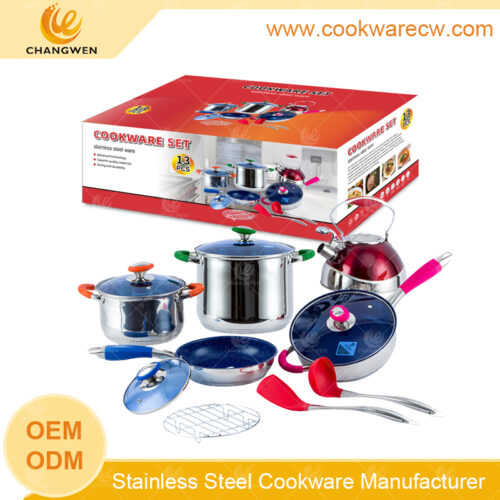
Heavy weight pots wholesale 13pcs stainless steel cookware colored silicone pots nonstick grilled frypan set with 5 steps capsule bottom 3L whistling tea kettle with frying basket kitchen tools spatula ladle CW-M1302G
-
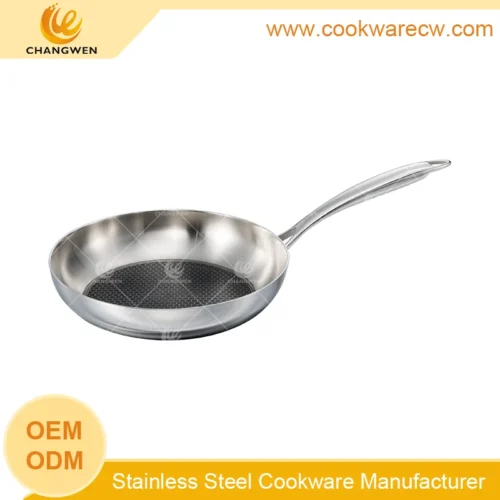
Premium Honeycomb Stainless Steel Nonstick Frying Pan CW-ETP016
-
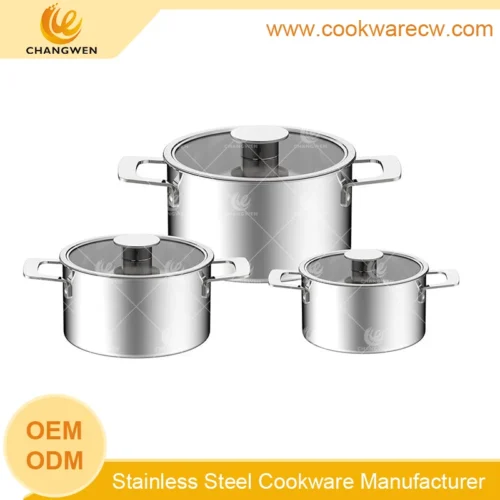
Durable Stainless Steel Pot Set for Everyday Use CW-TP0604
-
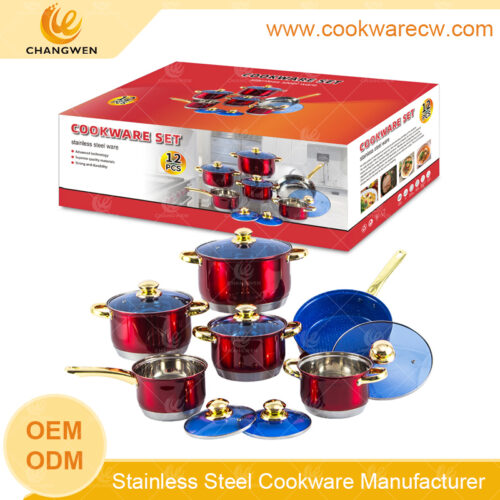
pots wholesale red color outside coating cookware pots non-stick fry pan with stainless steel 430 5-stepped bottom CW-M1225
-
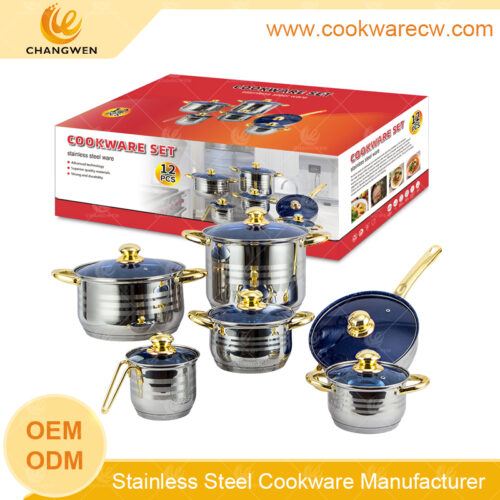
heavy S/S 12pcs cookware set pots wholesale nonstick fry pan blue glass lid golden handle cooking pan milk pot CW-M1222
-
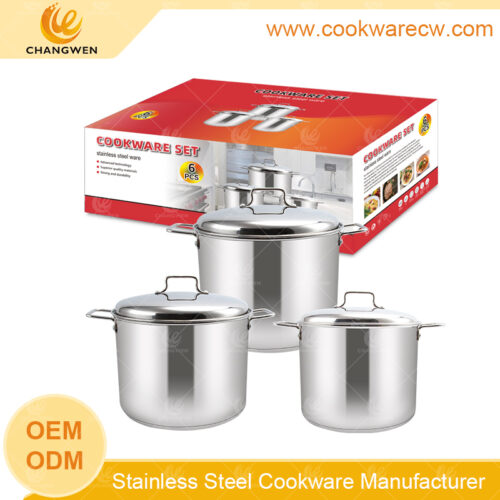
Customize color box high soup stock pot set stainless steel lids and knobs large volume 10L 13L 15L cookware pots wholesale CW-M0602
-
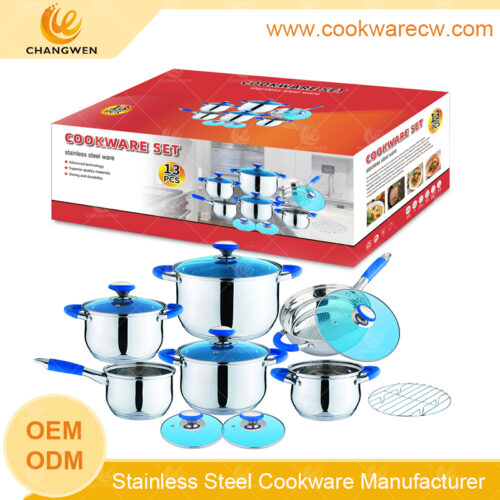
Wholesale price stainless steel pots and pans mirror polished cookware set saucepan milkpot casseroles with blue silicone and blue glass lids steamer wire rack CW-M1307G-01
-
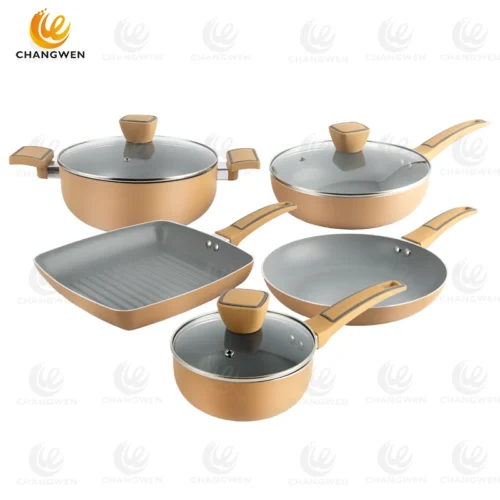
8pcs Stretched Aluminum Cookware Set Nonstick Pots and Pans | Aluminum Cookware Wholesale Supplier China