
Estimated reading time: 13 minutes.
Stainless steel cookware thickness should be selected by construction type, vessel size, cooking load, target price, and expected service intensity rather than by choosing the largest number automatically. For a single-layer body or the stainless body of disc-bottom cookware, 0.5 mm is best reserved for lightweight, price-sensitive products; 0.8 mm is the most versatile starting point for mainstream household lines; 1.0 mm provides a stronger premium balance of rigidity and manageable weight; and 1.2 mm is suited to demanding, large-capacity, or commercial applications where deformation resistance matters more than low mass.
The comparison only works when every measurement refers to the same part of the cookware. A 1.0 mm body wall cannot be compared directly with a 4.0 mm bonded base or a 2.5 mm fully clad wall because those measurements describe different material stacks and different thermal functions. A reliable specification must identify the measurement location, the layer structure, the finished tolerance, and the test method before thickness is used to predict quality.
What does stainless steel cookware thickness actually measure?
Stainless steel cookware thickness usually describes the metal gauge at the sidewall, but suppliers may also quote the rim, bottom disc, aluminum core, or total clad wall. The sidewall controls body stiffness, dent resistance, weight, and forming behavior, while the base or conductive core has a larger influence on heat spreading across the cooking surface. A buyer who asks only for “1.0 mm cookware” leaves enough ambiguity for two factories to quote products with very different performance.
Single-ply and disc-bottom cookware commonly use a stainless body in the 0.5-1.2 mm range. A bonded base may add several millimeters of aluminum and magnetic stainless steel beneath that body. Fully clad cookware is different because its quoted wall thickness is the combined thickness of all bonded layers, so a clad wall can exceed the values in this guide even when each stainless skin is comparatively thin. The construction distinctions are explained further in this comparison of tri-ply, 5-ply, and composite-base cookware.
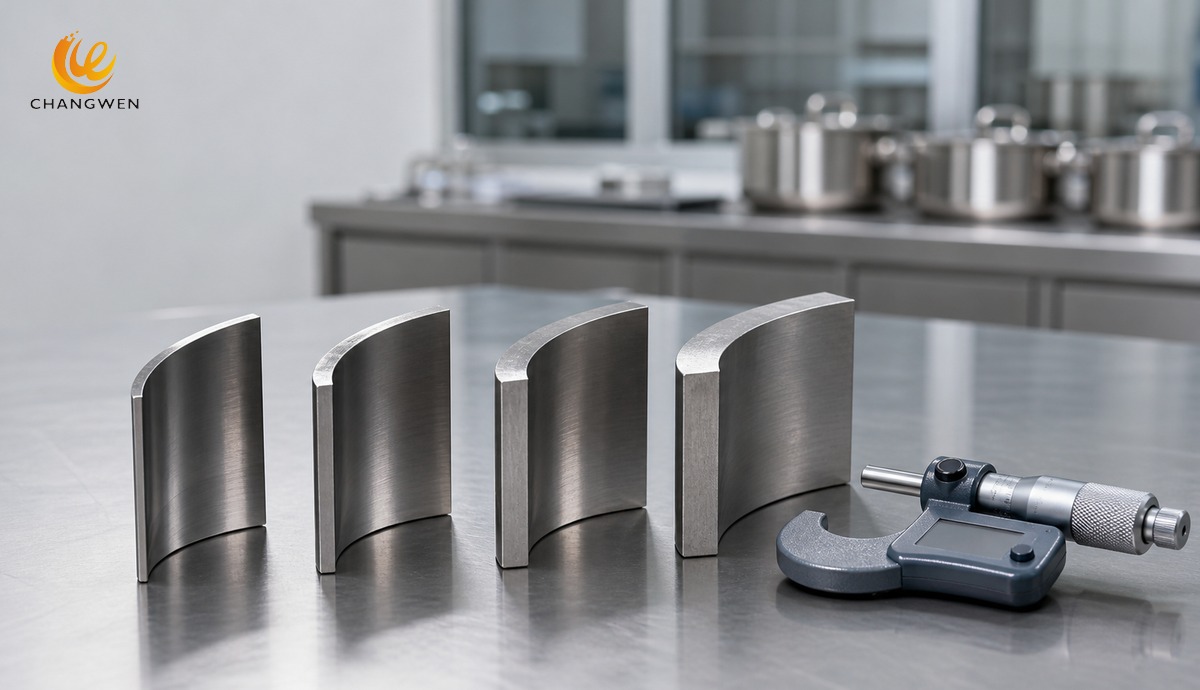
Finished thickness should be measured after drawing, spinning, polishing, and other forming operations because manufacturing can thin some areas of the blank. The upper wall, corner radius, and transition near the base may not retain the original sheet gauge. A useful purchase specification therefore states a nominal finished wall thickness plus an agreed tolerance and measurement points rather than relying only on the raw sheet certificate.
Which thickness is the best overall choice?
For most single-wall household cookware with a bonded base, 0.8 mm is the best overall starting point because it improves rigidity over 0.5 mm without the weight and material cost of 1.0-1.2 mm. The 0.8 mm option is not automatically the final answer, however, because a wide frying pan, a tall stockpot, and a small saucepan place different mechanical demands on the same sheet thickness.
A 1.0 mm body is often the better choice when the product must feel substantial, resist handling damage, support welded or riveted hardware, and tolerate frequent heating cycles. A 1.2 mm body becomes more rational as diameter, capacity, loading, or commercial duty increases. A 0.5 mm body remains valid when low weight, fast response, compact size, and controlled cost are explicit design priorities rather than accidental compromises.
| Nominal body thickness | Primary advantage | Main limitation | Best-fit application |
|---|---|---|---|
| 0.5 mm | Lowest weight and material cost | Lowest dent and warp resistance | Small, lightweight, entry-level vessels |
| 0.8 mm | Balanced stiffness, weight, and cost | May need reinforcement in wide or heavy-duty products | Mainstream household cookware |
| 1.0 mm | Stronger premium feel and structural stability | Higher weight and forming cost | Premium household and frequent-use lines |
| 1.2 mm | Highest rigidity among the four options | Greatest material use and handling weight | Large-capacity and demanding commercial cookware |
When does a 0.5 mm stainless steel body make sense?
A 0.5 mm stainless steel body makes sense when a product is deliberately designed for low weight, accessible pricing, and moderate duty. Small saucepans, steam inserts, lids, bowls, and compact pots can use thin material more successfully than wide frying pans because smaller diameters reduce leverage and limit the unsupported area that can flex. A properly formed 0.5 mm vessel can satisfy a defined entry-level use case, but it should not be presented as equivalent to a heavier-duty body.
The main risk at 0.5 mm is not that stainless steel suddenly becomes unusable; the main risk is that the complete design has less margin for thermal stress, impact, and poor handling. Wide flat bottoms can distort when heating is uneven, sidewalls can dent during logistics, and handle attachment zones can flex under load. Rolled rims, reinforcing beads, controlled corner radii, a well-bonded base, and packaging protection become more important as the body gauge decreases.
Why is 0.8 mm the mainstream balancing point?
A 0.8 mm stainless steel body is a practical mainstream specification because the 60 percent increase in nominal metal thickness over 0.5 mm creates a meaningful improvement in stiffness and damage resistance without doubling the material. Actual stiffness does not rise in a simple one-to-one ratio with thickness because geometry, work hardening, rim shape, and base design also contribute, but the additional section gives engineers more room to manage daily use.
The 0.8 mm option works especially well for medium household saucepans, casseroles, and stockpots paired with a properly engineered impact-bonded base. The body remains manageable when filled, the rim can feel more stable during pouring, and attachment areas can better support handles. For detachable-handle products, the interface geometry and local reinforcement still need separate validation because a secure mechanism depends on more than the nominal wall gauge; the site’s detachable-handle cookware guide covers those additional design choices.
The 0.8 mm choice is less convincing when a product is unusually wide, very tall, repeatedly exposed to commercial impacts, or expected to communicate a heavy premium feel. Those applications place higher loads on the wall, rim, and handle joints, which can justify 1.0 or 1.2 mm. The correct conclusion is that 0.8 mm is a versatile baseline, not a universal quality threshold.
What does a 1.0 mm body add in real use?
A 1.0 mm stainless steel body adds structural margin, a more substantial hand feel, and better resistance to dents and local flexing than 0.8 mm when vessel geometry and material grade remain comparable. The extra metal is particularly useful around rivets, weld zones, pouring rims, and tall walls that carry a full food load. Buyers often choose 1.0 mm for premium household collections because the product can feel durable without becoming as heavy as a 1.2 mm commercial-oriented design.
The thermal benefit of moving from 0.8 to 1.0 mm should be described carefully. The thicker stainless wall stores somewhat more heat and changes response, but a 0.2 mm increase in stainless steel does not compensate for an undersized aluminum disc or a thin conductive core. A quality specification should prioritize the complete thermal path: burner contact, base flatness, conductive layer coverage, bond integrity, and sidewall construction.
When is 1.2 mm worth the additional weight?
A 1.2 mm stainless steel body is worth the additional weight when cookware is large, frequently moved while full, exposed to intensive service, or expected to resist deformation over many operating cycles. Commercial stockpots, large steamers, institutional cookware, and premium heavy-duty vessels can benefit because wall flex and rim distortion become more consequential as diameter and capacity increase.
The 1.2 mm option is not automatically superior for every consumer. A small saucepan with a 1.2 mm body may feel unnecessarily heavy once the base, lid, and handle are included. Additional mass can reduce comfort for users who lift, pour, or toss food frequently, and higher material consumption can push the product beyond its intended retail position. A premium specification should produce a better user outcome rather than use weight as a substitute for engineering.
A heavy-gauge body also does not guarantee induction compatibility, corrosion resistance, or uniform heating. Induction behavior depends on a magnetic exterior or base layer, corrosion behavior depends on stainless grade and processing, and heat distribution depends heavily on conductive layers. Buyers evaluating magnetic constructions can use this explanation of why 430 stainless steel is used in cookware to separate magnetic function from wall thickness.
How does thickness change heating performance?
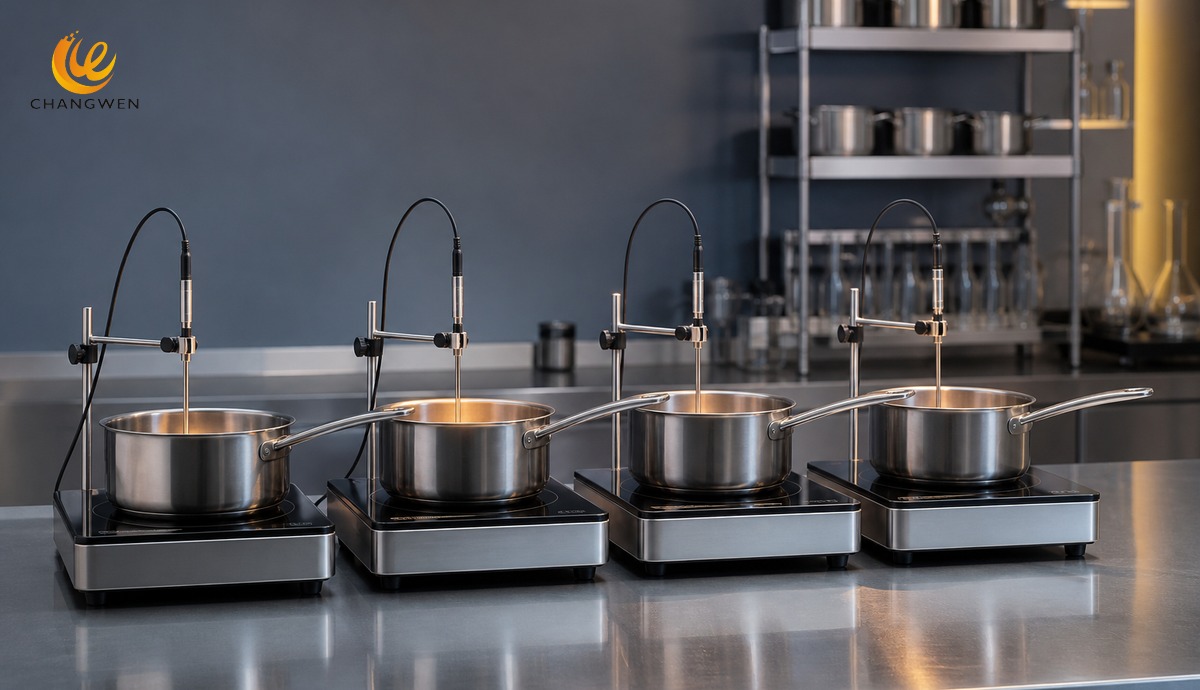
Greater stainless steel thickness generally increases thermal mass, which can stabilize temperature but slow the rate at which the vessel responds to a burner adjustment. Lower thickness generally reduces mass, which can make the body respond faster but provides less thermal buffering. This tradeoff is most visible only when construction, diameter, load, and heat input are held constant.
Even heating depends more on the conductive architecture than on stainless thickness alone. Aluminum and copper spread heat far more effectively than stainless steel, so disc dimensions and core thickness deserve separate line items in a specification. A thick stainless body with a small base disc may still show an abrupt temperature change near the disc edge, while a thinner body with a well-sized conductive layer may heat the cooking surface more uniformly.
How does vessel geometry change the right answer?
Vessel diameter changes the required thickness because a wider unsupported surface experiences greater leverage and is more sensitive to flatness errors. A 0.8 mm small saucepan and a 0.8 mm large frying pan do not have the same deformation risk even when they use identical steel. Wider pans often need a thicker body, stronger formed geometry, or a more rigid base assembly to maintain contact with a flat cooktop.
Vessel height changes the required thickness because tall sidewalls can flex, dent, and carry greater load at the handles. A deep stockpot filled with liquid transfers substantial force through its attachment points, so 1.0 or 1.2 mm can provide useful structural margin. A shallow insert or lid experiences a different load path and may achieve adequate strength with thinner material and formed reinforcement.
Shape can compensate for some thickness limitations. Rolled rims, beads, flares, steps, and curved transitions increase local stiffness without thickening the entire body. These features do not make all gauges interchangeable, but they explain why two vessels with the same nominal thickness can feel and perform differently. Finished samples must therefore be evaluated as systems rather than as metal coupons alone.
Is thicker cookware always more resistant to warping?
Thicker cookware is generally more resistant to warping when material, diameter, geometry, and thermal exposure are comparable, but thickness cannot prevent every distortion mechanism. Uneven heating, an undersized burner, rapid quenching of a hot empty pan, residual forming stress, poor base bonding, and inadequate flatness control can deform even a substantial vessel.
Warp resistance should be verified with repeatable tests rather than inferred from hand feel. A useful protocol records initial base flatness, heats the vessel under a defined power and load, cools it under a defined method, and measures flatness again after repeated cycles. Rocking on a glass plate, visible oil pooling, or loss of induction contact can reveal distortion, but quantified tolerances make supplier comparisons more reliable.
The best prevention strategy combines suitable wall gauge with correct base diameter, bond quality, forming control, and usage instructions. A warning against heating empty cookware at maximum power is not a substitute for a robust design, but it reduces unrealistic thermal shock. Buyers who want a broader specification framework can consult the stainless steel cookware sourcing guide.
How do material grade and thickness work together?
Material grade and thickness solve different problems. Stainless grade influences corrosion resistance, formability, magnetism, appearance, and cost, while thickness primarily affects stiffness, mass, dent resistance, and forming demands. Increasing a corrosion-prone grade from 0.8 to 1.0 mm does not create the same corrosion performance as selecting an appropriate food-contact grade and controlling passivation. Surface finishing can also remove material locally, so the guide to stainless steel cookware surface treatments explains why finish controls belong beside the gauge requirement.
What should an OEM thickness specification include?
An OEM thickness specification should define the construction before listing a number. State whether the product is single-ply, disc-bottom, or fully clad; identify each material layer; separate sidewall thickness from base-stack thickness; and mark the measurement locations on a drawing. This structure prevents a factory from meeting the stated number at an easy location while the critical area falls below expectation.
The specification should also define nominal value, tolerance, sampling plan, and measuring instrument. For example, “finished sidewall thickness: 0.8 mm nominal, measured at three marked heights away from formed features” is more actionable than “heavy stainless steel.” The final tolerance must reflect material supply, forming reduction, polishing loss, measurement capability, and the performance margin required by the design.
Performance requirements should accompany dimensional requirements. Base flatness, handle load, drop resistance, thermal cycling, bond integrity, corrosion testing, rim deformation, and induction operation each reveal failures that thickness alone cannot predict. A supplier comparison based on samples and trials is more reliable than a quote comparison based only on nominal gauge; this trial-based manufacturer comparison method provides a practical framework.

Which quality checks matter before mass production?
Before mass production, the approved sample should be measured at multiple wall locations because a single reading can hide thinning caused by forming. Inspectors should record the upper wall, mid-wall, lower wall, and any critical transition identified by engineering. The measurements should be linked to a sample ID and drawing revision so later production can be compared with the same reference.
Thermal and mechanical checks should use realistic conditions. Heat-cycle testing should match the intended cooktop and vessel load; handle testing should represent the filled product; and packaging tests should reflect the actual distribution route. A 0.5 mm product may pass its intended light-duty protocol, while a 1.2 mm product may still fail if a weld, base bond, or package design is defective.
What thickness should each cookware category use?
Frying pans and skillets usually need more attention to diameter, flatness, and handle leverage than small pots. A 0.8-1.0 mm disc-bottom body can provide a practical range for many household designs, while demanding or large formats may justify additional gauge or a clad construction. The site’s stainless steel skillet buying guide covers the other variables that should be assessed with thickness.
Large stockpots, steamers, and commercial vessels often benefit from 1.0-1.2 mm because capacity increases wall load, rim stress, and handling impacts. The final choice should consider whether the pot is routinely carried full, whether welded or riveted handles are used, and whether stacking creates concentrated contact. Reinforcement can improve a thinner design, but it should be proven by load and cycle testing.
What is the final decision rule for 0.5 mm vs 0.8 mm vs 1.0 mm vs 1.2 mm?
Choose 0.5 mm when low weight and cost are deliberate priorities, the vessel is compact, and reinforcement plus testing confirm adequate durability. Choose 0.8 mm when a mainstream household product needs a balanced combination of rigidity, manageable weight, and cost. Choose 1.0 mm when a premium or frequent-use product needs more structural margin without the full mass of a heavy-duty build. Choose 1.2 mm when large size, commercial duty, repeated loading, or high deformation resistance justifies the added material.
The final decision should be made only after construction type, geometry, base design, material grade, handle loads, manufacturing tolerance, and target-user comfort are defined. Thickness is a powerful engineering variable, but it is one variable within a system. The most defensible purchase specification names each layer, measures the finished product, validates performance, and connects every added gram of metal to a clear user or business benefit.
Frequently asked questions
Is 0.8 mm stainless steel cookware thick enough?
A 0.8 mm stainless steel body is thick enough for many well-designed household saucepans, casseroles, and stockpots, especially when a suitable bonded base spreads heat and formed features reinforce the rim and wall. Large diameters, commercial duty, or heavy handle loads may require 1.0-1.2 mm or additional structural reinforcement.
Is 1.2 mm cookware always better than 1.0 mm cookware?
A 1.2 mm body offers more rigidity and dent resistance than a comparable 1.0 mm body, but it also adds weight, cost, and forming demands. The 1.2 mm option is better only when the product’s size, load, duty cycle, and market position benefit from that extra structural margin.
Does thicker stainless steel heat more evenly?
Thicker stainless steel can moderate temperature changes, but even heating depends more strongly on the cookware’s aluminum or copper core, bonded base coverage, base flatness, and burner match. Stainless thickness should be evaluated with the complete thermal construction rather than used as a standalone promise of uniform heat.
How can a buyer verify cookware thickness?
A buyer can verify finished wall thickness with a calibrated micrometer at agreed points on the upper, middle, and lower wall. A complete inspection also compares results with the drawing tolerance, confirms base-stack dimensions separately, records sample identity, and checks whether forming or polishing created local thin areas.
What thickness is best for a stainless steel stockpot?
A medium household stockpot commonly fits a 0.8-1.0 mm body, while a large or commercial stockpot often benefits from 1.0-1.2 mm. Capacity, diameter, filled lifting load, handle attachment, rim reinforcement, and base construction should determine the final gauge.
-
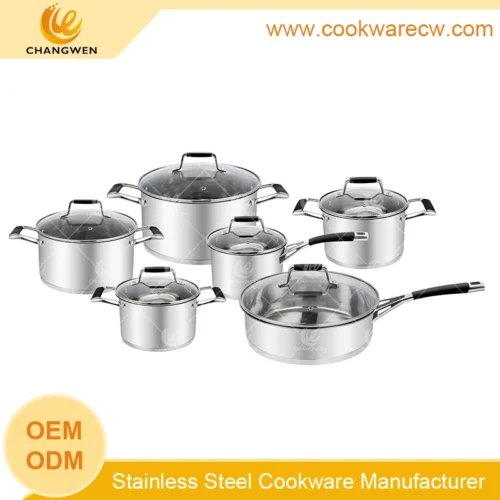
Premium 12-Piece Stainless Steel Cookware with Black Handles CW-ES1204G
-
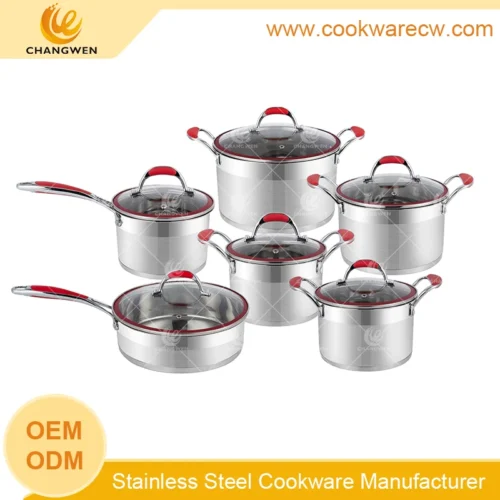
Red Silicone-Handle Stainless Steel Cookware Set CW-ES1202
-
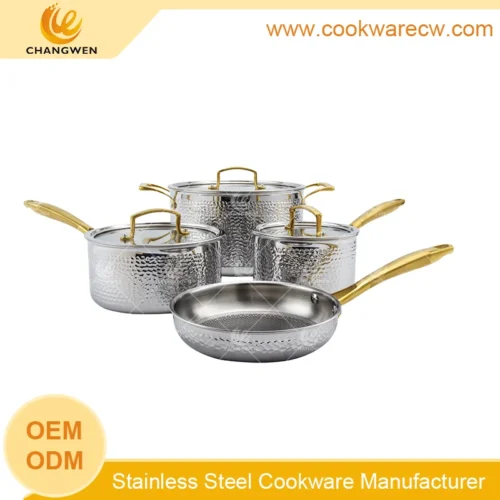
Gold-Handle Hammered Stainless Steel Cookware Set CW-ETP0701
-

Honeycomb Structure Stainless Steel Frying Pan CW-ETP014
-
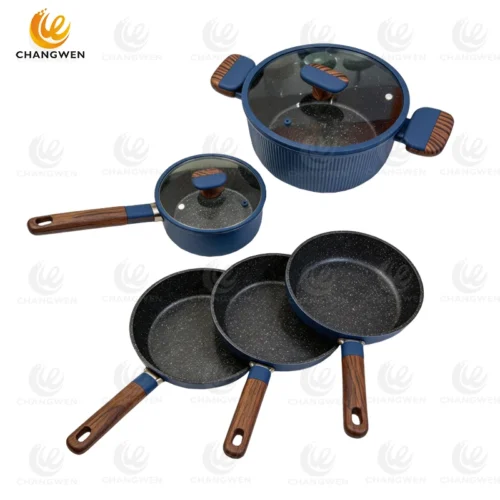
5 Piece Vertical Stripe Nonstick Die-Cast Aluminum Cookware Set | Custom Aluminum Cookware Manufacturer China
-
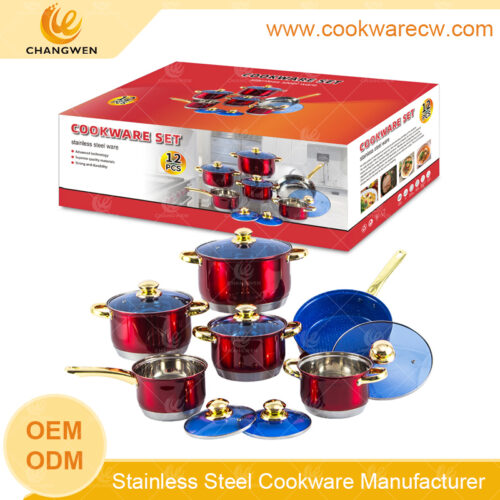
pots wholesale red color outside coating cookware pots non-stick fry pan with stainless steel 430 5-stepped bottom CW-M1225
-
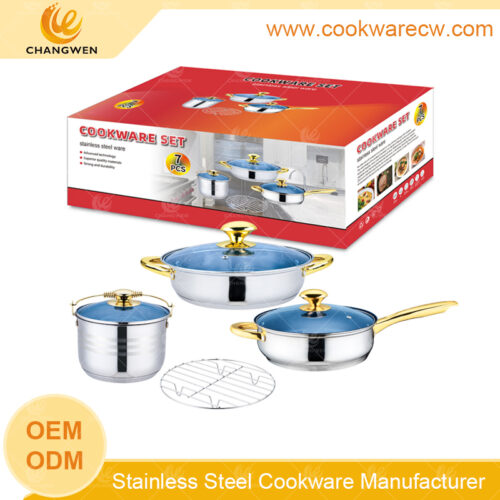
Stainless steel kitchen 7pcs cookware rice cooker with capsule bottom frypan with helper gold plated hollow handle and blue glass wire rack CW-M0701
-
Premium Honeycomb Stainless Steel Nonstick Frying Pan CW-ETP016