
Quick answer: Buyers should compare cookware manufacturers beyond price by converting every offer into the same product specification, estimating total landed and failure costs, testing whether samples represent normal production, and adjusting supplier scores for the strength of the evidence. A low quotation is valuable only when it covers the same materials, construction, packaging, compliance, delivery responsibility, and quality risk as the alternatives.
Read time: 13 minutes.
This guide does not repeat a general list of supplier-selection factors. It presents a practical comparison method for buyers who already have quotations from two or more cookware manufacturers and need to decide which offer creates the best risk-adjusted business result.
Why are cookware manufacturer quotations difficult to compare?
Cookware quotations often describe products that look similar but are technically different. Two 28 cm frying pans can use different steel grades, wall thicknesses, conductive layers, finished weights, base diameters, handle attachments, finishes, coatings, packaging, inspection levels, and delivery terms. The lower price may simply describe less product.
Service scope also changes the offer. One manufacturer may include artwork support, testing coordination, final inspection, protective packaging, spare parts, and claim handling. Another may quote only the finished pan at the factory gate. Comparing the two unit prices without separating scope rewards omission rather than efficiency.
Risk is the third hidden difference. A supplier with weak traceability, uncertain capacity, or unverified sample consistency can appear inexpensive until failures create rework, late shipment, returns, or emergency freight. The correct comparison unit is not price per pan. It is expected cost per conforming, saleable, on-time unit.
What is the four-step method for comparing manufacturers?
| Step | Buyer task | Decision output |
|---|---|---|
| 1. Normalize | Convert every quotation to one specification and commercial scope | Comparable base cost |
| 2. Risk-adjust | Add landed cost, expected quality loss, delay exposure, and inventory effects | Expected total cost |
| 3. Validate | Test sample-to-production consistency and supporting evidence | Confidence level |
| 4. Decide | Combine expected value, critical gates, and residual risk | Approved supplier and conditions |
The four steps should be completed in order. A weighted scorecard cannot correct quotations that describe different products. A detailed cost model cannot protect the buyer if the factory cannot reproduce the approved sample. Comparison quality depends on a controlled baseline.
Step 1: How do buyers normalize cookware specifications?
Normalization begins with a master specification issued to every candidate. The document should define SKU dimensions, capacity, material by component, construction, thickness or weight, base design, handle and fastener, lid, rim, finish, coating where relevant, induction requirement, performance tests, cosmetic limits, accessories, packaging, labeling, and destination market.
Component-level detail is necessary because broad material names hide commercial differences. A stainless steel pan may use one alloy on the food-contact surface, an aluminum conductive layer, a magnetic exterior, and a different grade in the handle or fastener. An aluminum pan may differ in alloy, forming method, anodizing, coating system, and finished body weight.
Buyers should ask each manufacturer to identify deviations rather than silently adapt the specification. A deviation register lists the requested value, offered value, reason, price effect, performance effect, and approval status. An unapproved deviation should not enter the comparison as if it were equivalent.
The site’s tri-ply and fully clad wholesale guide shows why similar layer terminology can represent different constructions and cost positions.
How should buyers normalize the commercial scope?
Every manufacturer should quote the same quantity, currency, trade term, delivery point, payment schedule, packaging, accessories, testing responsibility, inspection scope, tooling treatment, sample charges, and validity period. If one offer uses FOB terms and another uses EXW terms, inland transport and export handling must be added before comparison.
MOQ should be separated by finished SKU, color, finish, component, printed packaging, production batch, and total order. A supplier may advertise a low product MOQ while requiring a large handle or carton commitment. The buyer should allocate unused components and packaging to the project rather than ignore them.
Payment terms have a financing cost. A larger deposit paid earlier ties up cash longer, while a later balance or credit period reduces working-capital pressure. Buyers can convert the timing difference into an estimated finance cost using their own cost of capital rather than assuming all payment schedules are equal.
How can a buyer create a like-for-like quotation table?
A normalized table should use one row per cost or specification item and one column per manufacturer. Each cell should show the offered value, evidence source, deviation, and adjusted cost. Empty cells are not zero; they are unresolved assumptions that require clarification.
| Comparison line | Manufacturer A | Manufacturer B | Adjustment rule |
|---|---|---|---|
| Body material and weight | Record offered values | Record offered values | Reject or reprice deviations |
| Packaging | Included or excluded | Included or excluded | Add equivalent approved pack |
| Testing and inspection | Scope and payer | Scope and payer | Add missing required services |
| Trade term | Named term and location | Named term and location | Convert to common delivery point |
| Payment timing | Deposit and balance | Deposit and balance | Add financing difference |
| Unused MOQ exposure | Components and packaging | Components and packaging | Allocate expected write-off |
Normalization should preserve technical truth. Buyers should not force every supplier into an identical design when a manufacturer proposes a better solution. A justified alternative can be compared as a separate scenario with its performance, risk, and cost clearly stated.
Step 2: What belongs in total landed cost?
Total landed cost includes the normalized product price plus tooling, development, packaging, testing, inspection, inland transport, export handling, freight, insurance, duty, brokerage, local delivery, financing, inventory carrying cost, and predictable handling fees. The calculation should use the same shipment assumptions for all candidates.
Volume and packaging efficiency can change freight per unit. A slightly higher product price may deliver a lower landed cost when compact packaging improves container utilization or reduces parcel charges. Buyers should compare verified carton dimensions, gross weight, units per carton, pallet pattern, and loading quantity.
Duty and tax treatment should be confirmed using the correct product classification and destination-market advice. Manufacturers can provide product descriptions and composition, but the importer remains responsible for appropriate classification. An unrealistically favorable estimate should not be treated as supplier advantage.
The existing cookware MOQ, packaging, and shipping guide explains how these operational decisions interact before the first container leaves the factory.
What is risk-adjusted cost?
Risk-adjusted cost adds the expected financial effect of uncertain quality, delivery, compliance, and continuity to landed cost. It does not assume that a failure will occur. It estimates probability multiplied by impact so that a cheap but poorly evidenced offer does not receive an artificial advantage.
A simple model can estimate expected quality cost as defect probability multiplied by affected units and average cost per defective unit. The per-unit impact can include sorting, replacement, freight, customer service, markdown, disposal, and lost margin. Safety or compliance failures may require scenario analysis because their impact is too severe for a routine average.
Expected delay cost can include lost contribution margin, retailer penalties, idle launch spending, storage, rescheduling, and expedited freight. The buyer should use internal business data where available and document assumptions. The purpose is consistent comparison, not false precision.
How should uncertainty be represented without inventing numbers?
When reliable probabilities are unavailable, buyers can use low, base, and high scenarios. Each scenario states the evidence and impact assumptions. A factory with verified on-time performance and reserved capacity may receive a narrow delay range, while an unsupported lead-time promise receives a wider range.
Sensitivity analysis identifies which assumptions can change the decision. If one supplier wins only when defects remain below an unverified threshold, the buyer knows which evidence or pilot test matters most. A decision that remains stable across reasonable scenarios is more robust than one dependent on a single optimistic estimate.
Unknowns should be visible. An unresolved material certificate, missing packaging test, or unverified subcontractor should be recorded as a confidence gap, not assigned a convenient zero cost. Evidence can reduce the risk adjustment before supplier selection.

Step 3: How do buyers measure sample-to-production consistency?
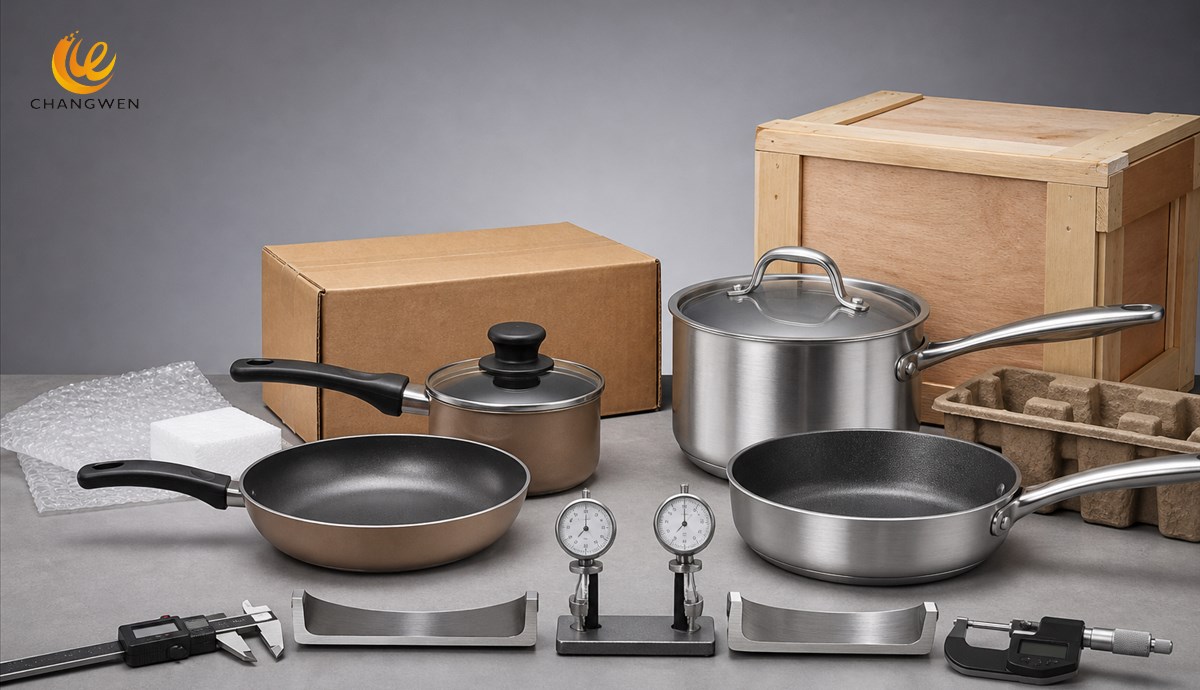
A showroom sample demonstrates possibility, while a production sample demonstrates repeatability. Buyers should compare multiple units from production-intent tooling, materials, equipment, and operators. Hand-polished prototypes can support design approval but should not be treated as proof of normal process capability.
Measurements should match the product risk. Cookware checks can include alloy identity, body weight, thickness, base flatness, bonded area, capacity, handle alignment and strength, lid fit, rim finish, coating thickness, induction recognition, surface appearance, heat behavior, cleaning, and packaging condition.
Variation matters as much as the average. Two manufacturers can deliver the same average weight, but one may produce a narrow controlled range while the other produces light and heavy extremes. Buyers should record minimum, maximum, average, and outliers for critical characteristics instead of approving a single favorable unit.
Production consistency should be checked again during the pilot order and pre-shipment inspection. The approved golden sample, drawing, bill of materials, inspection standard, and test sample should share controlled revisions so the comparison remains tied to the same product.
How can buyers compare quality systems with evidence?
Quality evidence should be scored by relevance, recency, and traceability. A product-specific control plan is stronger than a general quality manual. Current lot records are stronger than a blank form. A corrective action showing root cause and effectiveness is stronger than a promise to replace defects.
Buyers should inspect incoming material control, in-process checks, final inspection, gauge calibration, nonconforming-product segregation, traceability, change control, and shipment release. The goal is not to reward more documents. The goal is to determine whether the system prevents and contains the failure modes of the quoted cookware.
Compliance evidence should match the offered model, materials, factory, and destination market. The food-grade cookware certification guide explains why an authentic report can still be irrelevant to the actual order.
How should delivery reliability be compared?
Lead time should be decomposed into material procurement, tooling, sample approval, production, testing, inspection, packing, and shipment readiness. A supplier that states assumptions and bottlenecks provides a more credible schedule than one that offers the shortest total immediately.
Capacity should be verified for the exact product and period. Press output does not prove sufficient bonding, polishing, coating, curing, assembly, inspection, or packing capacity. Buyers should ask about current utilization, peak-season commitments, maintenance, subcontractor capacity, and recovery plans.
Historical delivery data should use a consistent definition such as on-time-in-full. If data cannot be verified, a pilot order can establish evidence. Delivery reliability belongs in the financial comparison because availability affects sales, inventory, and customer commitments.
Step 4: What is an evidence-confidence score?
An evidence-confidence score reduces the influence of unsupported claims. A manufacturer can receive a technical score for capability and a separate confidence rating for the proof behind that score. For example, a capability claim supported by an audit, process record, and production sample deserves more confidence than the same claim supported only by a sales presentation.
| Confidence level | Evidence condition | Decision treatment |
|---|---|---|
| High | Product-specific, current, traceable, and independently checkable | Use the score with minimal adjustment |
| Medium | Relevant but incomplete or not yet production-verified | Apply conditions or pilot validation |
| Low | Generic, outdated, indirect, or verbal | Reduce score and increase risk allowance |
| Failed | Contradictory, irrelevant, or refused | Stop at a critical gate |
Confidence scoring prevents polished communication from being confused with operating capability. It also creates a clear path for suppliers to improve their position by providing evidence or completing a pilot rather than negotiating the score.
Which critical gates should override the price comparison?
Critical gates should cover legal factory identity, required material verification, safety-critical construction, applicable compliance, reasonable audit or inspection access, approved change control, and the ability to reproduce the specification. A supplier that fails a critical gate should not win through a lower risk-adjusted cost.
The gate should match the project. Pressure cookware requires different safety evidence from an open saucepan. A coated aluminum pan has different critical processes from an uncoated stainless steel stockpot. Buyers should define gates before opening quotations to prevent price from weakening standards.
The site’s ten-factor cookware manufacturer guide can support the earlier supplier-qualification stage; the method in this article begins after candidates have passed basic screening.
How can buyers compare packaging and retail readiness?
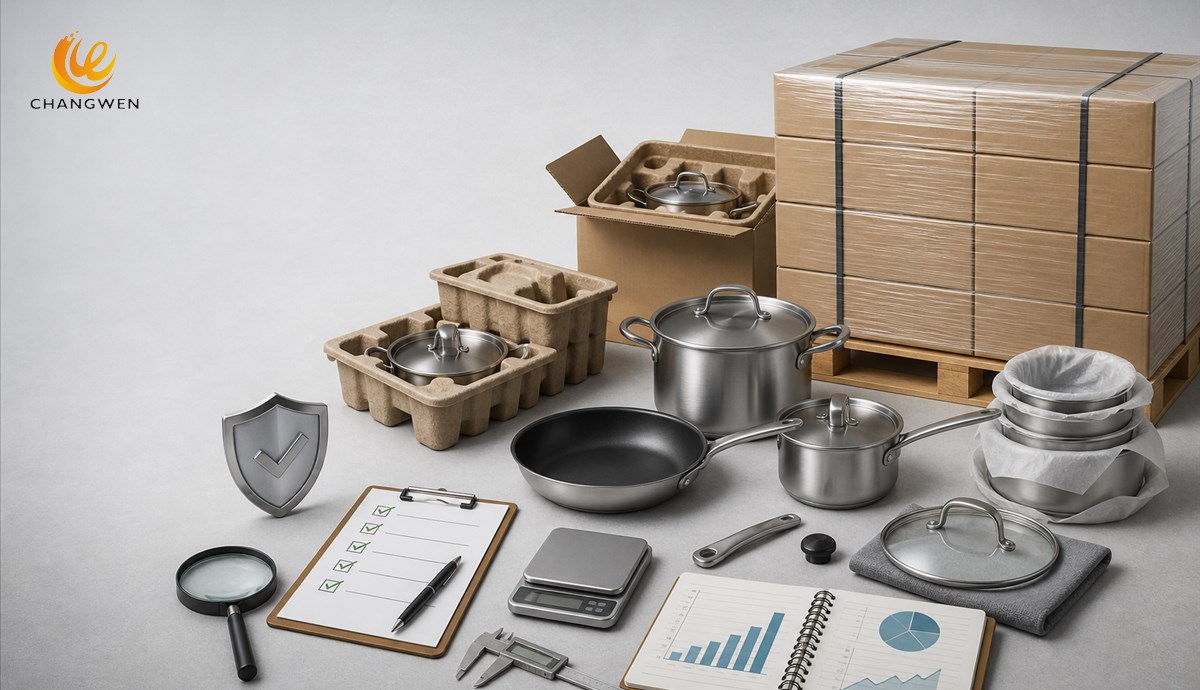
Packaging should be compared as a tested system rather than a decoration. The approved pack should protect finishes, restrain lids and handles, survive expected distribution, present the product correctly, support barcode scanning, comply with labeling needs, and fit warehouse and shipping economics.
A cheaper carton can increase total cost through scratches, broken lids, returns, repacking, or inefficient loading. A more expensive pack can also waste money when it adds material without improving protection or presentation. Buyers should compare test results, dimensions, weight, assembly time, recyclability goals, and customer-channel requirements.
Artwork control affects launch risk. Version identifiers, signed proofs, barcode checks, color references, and approved physical samples reduce expensive reprinting. Packaging capability should be evaluated through evidence of execution, not only design options.
How should after-sales support enter the model?
After-sales support has value when responsibilities are specific. The comparison should define the claim window, evidence required, response time, investigation method, credit or replacement options, freight responsibility, corrective-action process, and handling of repeat defects.
A generous warranty promise has little value when the supplier cannot trace batches or identify root cause. Buyers should compare the practical claim mechanism and past corrective-action behavior. Expected claim recovery can reduce loss estimates only when the remedy is contractually clear and commercially credible.
Continuity support should include reorder lead time, component availability, tooling maintenance, document retention, peak-season planning, and alternative capacity. Long-term supply value depends on repeat consistency, not only the first shipment.
What does a complete comparison worksheet contain?
A complete worksheet contains the master specification, deviation register, normalized quotation, landed-cost model, risk scenarios, sample measurements, quality and compliance evidence, capacity and timeline review, packaging results, commercial terms, confidence rating, critical gates, and unresolved actions.
Each input should show its source and date. Manufacturer-provided data, buyer measurements, laboratory results, audit observations, and financial assumptions should remain distinguishable. This separation helps reviewers understand which conclusions are facts and which are estimates.
The final recommendation should state why the selected supplier wins, which assumptions could change the decision, which risks remain, and what conditions must be completed before deposit or mass production. A transparent decision is easier to defend and monitor.
How does the method change a real supplier decision?
Consider two manufacturers quoting the same nominal frying pan. Manufacturer A offers the lower unit price, while Manufacturer B quotes a higher amount. Normalization reveals that Manufacturer A offers a lighter body, smaller bonded base, simpler packaging, and excludes inspection and testing. Manufacturer B follows the requested weight and base dimensions and includes the approved pack. The original price gap therefore describes two different products.
After equivalent materials, packaging, inspection, and delivery scope are added, Manufacturer A may still remain cheaper. The buyer then reviews production evidence. If Manufacturer A has wide sample variation, an unverified coating subcontractor, and a schedule dependent on an uncertain component, its expected defect and delay costs rise. Manufacturer B may produce the lower risk-adjusted cost despite the higher invoice price.
The example can also produce the opposite result. If Manufacturer A supplies current process records, passes a pilot order, tightens the specification, and proves packaging performance, the risk adjustment falls. Manufacturer A can then win on both cost and evidence. The method does not favor expensive suppliers; it rewards complete, verifiable value.
The buyer should record the conditions that changed the result. A required pilot, revised carton, material certificate, reserved production slot, or updated payment term becomes part of approval. The decision remains valid only while those conditions remain true, so repeat orders should confirm critical assumptions rather than inherit them automatically.
What common comparison mistakes should buyers avoid?
The first mistake is comparing unit prices before specifications. The second is treating missing scope as free. The third is scoring every factor with equal confidence. The fourth is approving one perfect sample without measuring production variation. The fifth is ignoring the financial effect of delay, defects, excess MOQ, and packaging inefficiency.
Another mistake is adding so many subjective factors that the scorecard produces the desired answer. Buyers should use measurable evidence, pre-agreed weights, and critical gates. A complex spreadsheet cannot make weak assumptions more accurate.
Finally, buyers should not penalize every honest limitation. A manufacturer that identifies a constraint and offers a controlled alternative may be safer than one that agrees to everything. Transparency reduces uncertainty and should improve confidence when supported by action.
Frequently asked questions
Is the lowest cookware quotation ever the best choice?
Yes. The lowest quotation can be the best when it represents the same approved specification, complete scope, acceptable evidence, reliable delivery, and the lowest risk-adjusted total cost. Low price is not a problem; an incomplete comparison is.
How many manufacturers should buyers compare?
Three to five qualified candidates usually provide useful competition without making samples, audits, and normalization unmanageable. The number should reflect project complexity, order value, and available evaluation resources.
Can buyers calculate risk-adjusted cost without exact failure probabilities?
Yes. Low, base, and high scenarios can show how uncertainty affects the result. Sensitivity analysis is more honest than assigning false precision to unsupported probabilities.
Should quality always receive the highest weight?
Critical quality and safety requirements should be pass/fail gates. Among qualified suppliers, weights should reflect the project’s commercial risks, including delivery, inventory, compliance, and development complexity.
Final decision rule
Buyers should select the cookware manufacturer that delivers the strongest expected result per conforming, saleable, on-time unit. The decision begins with a common specification, continues through normalized cost and risk scenarios, and ends with production evidence and critical gates.
Price remains important because sourcing must be commercially sustainable. The difference is that price becomes one verified input rather than the conclusion. A manufacturer creates value when the quoted product, delivered product, and repeat-order product remain the same under real business conditions.
-
Best Tri Ply Stainless Steel Cookware
-
8-Piece Cream White Stainless Steel Cookware Set with Saucepan CW-ES0803
-
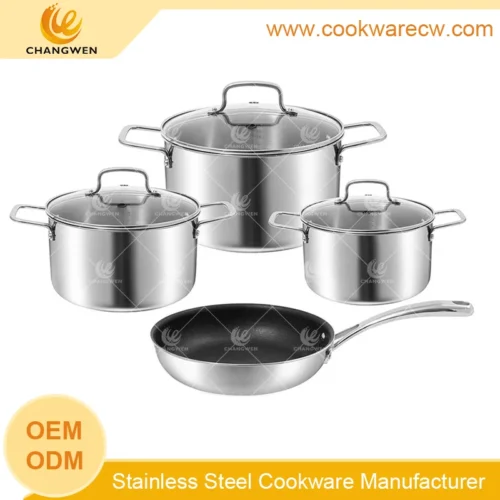
Professional Stainless Steel Cookware Set for Daily Cooking CW-ETP0704
-
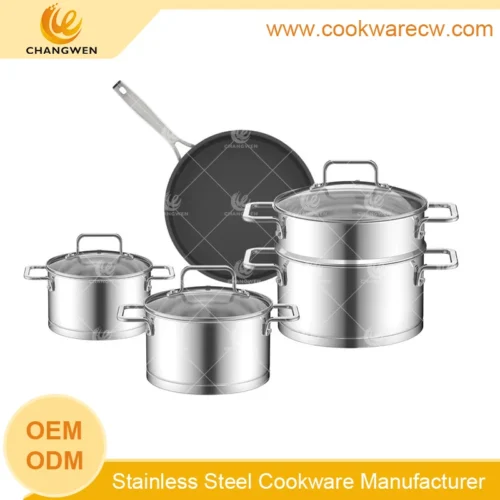
8-Piece Stainless Steel Cookware Set with Nonstick Pan & Steamer CW-ES0907
-
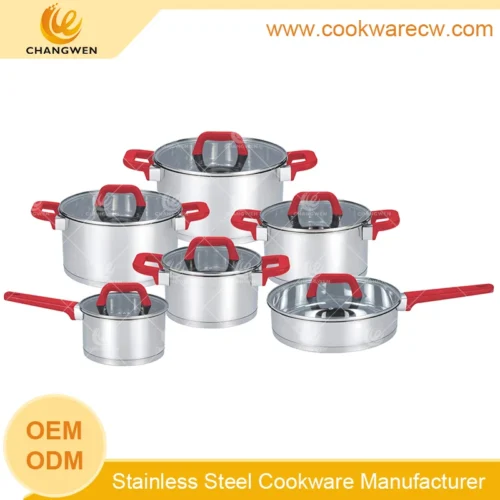
12-Piece Stainless Steel Cookware Set with Red Silicone Handles CW-ES1203G
-
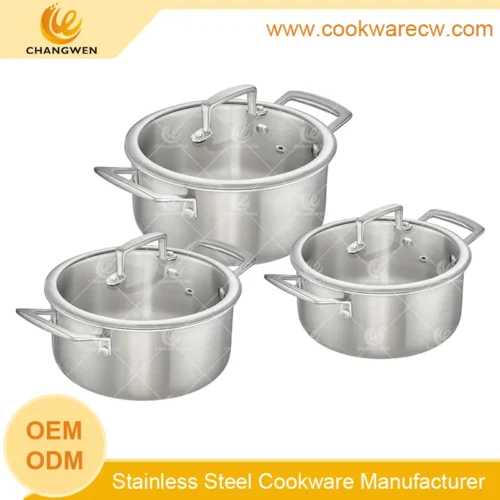
Versatile Stainless Steel Pot Set with Multiple Capacity Options CW-ETP018
-
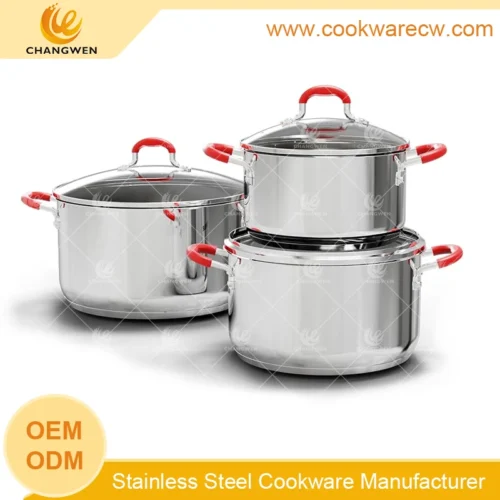
6-Piece Stainless Steel Pot Set with Red Silicone Handles CW-ES0613G
-
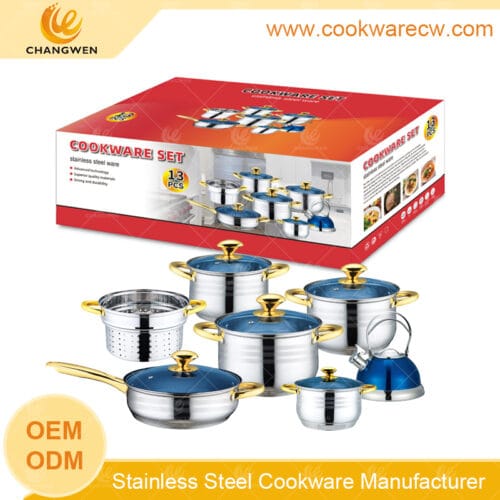
Mercado Libre stainless steel 13pcs cookware set tea kettle pasta pot nonstick frying pan golden handle blue coating CW-M1305