
A fair cookware handle temperature test heats matched vessels under the same conditions, measures several defined points along each handle, records temperature over time, and includes the post-heating peak. The comparison must control cookware size, body construction, water load, starting temperature, lid position, cooktop, power, burner fit, ambient conditions, handle orientation, probe attachment, and test duration. Without those controls, a lower reading may reflect a different test rather than a better stay-cool design.
This guide gives cookware brands, importers, product developers, and quality teams a repeatable method for comparing fixed metal, insulated, polymer-grip, and detachable handles. The method does not create a universal safe-touch temperature because contact time, skin condition, pressure, moisture, and user sensitivity affect burn risk. Instead, the protocol produces comparable evidence that can support product requirements, warnings, and sample approval.
What does stay-cool mean for a cookware handle?
A stay-cool handle is a design intended to limit heat transfer from the hot vessel to the normal hand-grip zone during a defined cooking condition. The term does not mean that the handle stays at room temperature, remains safe under every burner setting, or can be touched after oven use. A useful claim must name the vessel, heat source, operating condition, grip location, exposure period, and acceptance criterion.
Handle temperature is not uniform from root to end. The attachment area usually receives the strongest conducted heat from the vessel wall, while the outer grip may remain substantially cooler. Radiant heat from a gas flame, hot sidewall, or adjacent burner can create a second heating path. One temperature point cannot describe the complete surface that a user may touch.
A stay-cool comparison should focus on the intended grip zone while still measuring hotter transition areas. The grip zone should be marked on the drawing and on the test sample. If the user can naturally slide a thumb or finger into a hotter region, that region belongs in the usability assessment even when it falls outside the nominal center point.
Why do casual touch tests produce unreliable results?
Casual touch tests are unreliable because people have different sensitivity and contact behavior. A quick fingertip tap is not equivalent to holding a loaded pan, and a dry hand is not equivalent to a damp hand. Human touch should not replace instruments during comparative development, especially when the result may influence a safety-related product claim.
A single end-of-test reading can miss the true maximum. Metal handles often continue to warm after burner power stops because stored heat moves from the vessel toward the grip. The protocol should record a cooling phase long enough to identify any delayed peak. A design that looks cooler at shutdown may become hotter several minutes later.
Which variables must remain identical between samples?
The vessel body must be matched when the purpose is to isolate handle design. Diameter, height, wall thickness, base construction, handle attachment position, and finish can change heat flow. The stainless steel cookware thickness guide explains why body gauge can affect thermal response and should not vary silently between comparison samples.
The liquid load must use the same mass, composition, starting temperature, and fill level. Water is convenient for a controlled screening test because its mass and temperature are easy to reproduce. A product-specific validation may require oil, food, or an empty-pan stage, but those conditions should be separate protocols rather than undocumented changes within one comparison.
The lid state must remain fixed because a lid changes heating rate, steam exposure, and the time required to reach a process endpoint. Lid-on and lid-off results answer different questions. If the normal use case includes both, the test plan should contain two labeled conditions and should not average them into one stay-cool result.
The cooktop and power setting must be repeatable. Induction, radiant electric, and gas heating deliver energy differently, while control labels on consumer appliances may not represent equal power. A laboratory can verify input or use a defined equipment setting after repeatability is demonstrated. The cookware hot-spot mapping method provides a related example of controlling thermal test variables.
Burner fit is essential for gas tests. A flame that extends beyond the cookware base can heat the handle or bracket directly, turning a conduction comparison into a flame-exposure comparison. Both conditions may matter in real use, but they should be reported separately. The test record should include burner diameter, flame pattern, pan position, and evidence that the flame remained within the specified boundary.
Ambient temperature, airflow, nearby hot equipment, and handle direction must also remain controlled. A ventilation draft can cool one handle more than another. Handles positioned over an adjacent active zone can receive extra radiant heat. Testing stations should provide comparable clearance, and sample order should be rotated when one station cannot be proven equivalent to another.
Where should temperature sensors be placed?
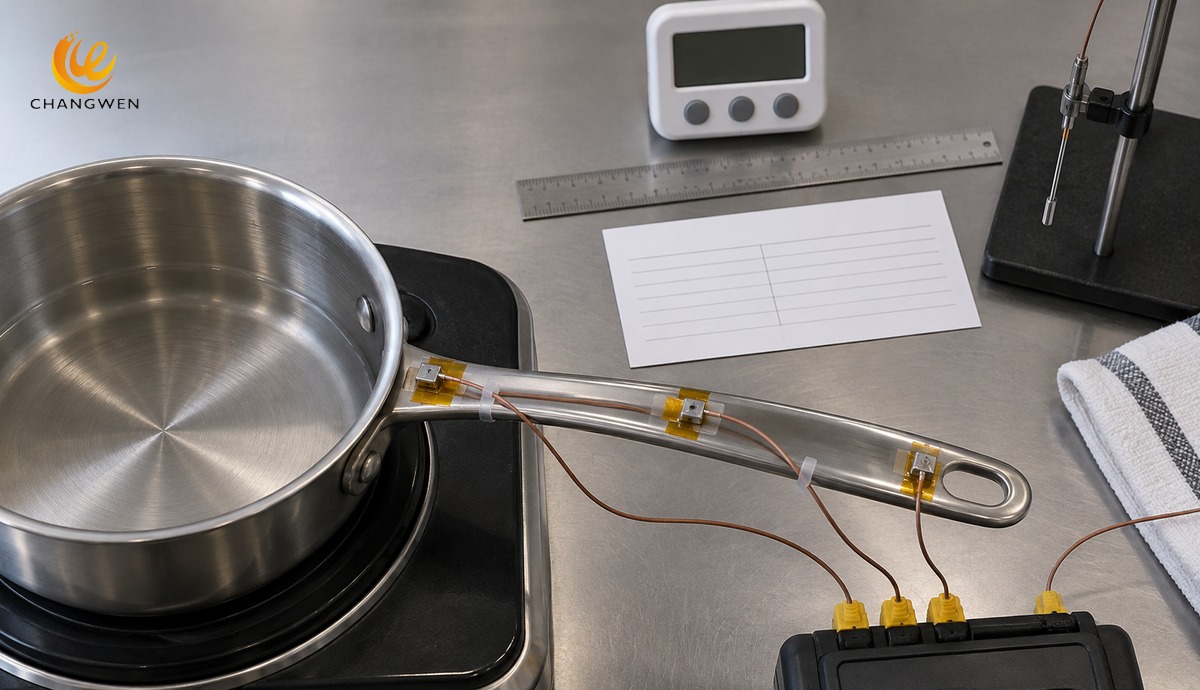
A practical fixed-handle map uses at least three surface locations: near the vessel attachment, near the middle of the intended grip, and near the outer grip end. The root point shows heat entry, the middle point represents typical hand contact, and the end point reveals how effectively temperature falls along the handle. A separate ambient sensor allows results to be reported as rise above room temperature.
Wide loop handles require more than one path. A stockpot side handle may have two attachment legs, a top grip, an underside, and corners that receive different radiation. The drawing should mark the points most likely to contact fingers and palms during a loaded lift. Testing only the visually central point can miss a hot joint or underside.
Detachable handles require sensors on the vessel interface, locking structure, and hand-grip material. The handle should be fully engaged using the approved method before heating. The detachable handle cookware guide describes why attachment geometry, locking security, and thermal isolation must be evaluated as one system.
Which instrument gives the most reliable handle reading?
Small contact thermocouples are often practical for continuous handle measurements because they can record rapid changes at several points. The sensor type, wire diameter, data-logging interval, accuracy, calibration status, and attachment method should be documented. Using the same model and preparation across samples reduces instrument-related variation.
Probe attachment can change the result. A loose junction may read surrounding air, while a thick adhesive pad may insulate the sensor or alter local heat flow. The laboratory should use a thin, repeatable attachment that maintains surface contact without covering an excessive area. The attachment should remain secure throughout heating and cooling.
An infrared thermometer can be misleading on polished stainless steel because low or uncertain emissivity and reflected radiation can distort the apparent temperature. A reflective handle may show the temperature of nearby objects rather than its own surface. Infrared tools can support scanning after emissivity and target preparation are controlled, but they should not silently replace verified contact measurements.
What is a repeatable step-by-step test procedure?
Step one is to condition every specimen and test liquid in the same environment until their starting temperatures fall within the agreed range. Record sample ID, drawing revision, handle type, vessel dimensions, mass, material, and attachment method. Inspect the handle for looseness or damage before heating so a pre-existing defect is not confused with thermal performance.
Step two is to mark sensor locations from a controlled drawing and attach the probes using the approved method. Connect the ambient sensor away from direct radiation and confirm every channel at baseline. A channel that differs unexpectedly before heating should be investigated rather than corrected later in a spreadsheet.
Step three is to add the defined water mass at the specified starting temperature, place the vessel centrally on the designated cooking zone, set the handle orientation, and apply the lid condition. Start temperature logging before power begins. This sequence captures baseline, ramp, steady operation, shutdown, and delayed heating in one continuous record.
Step four is to apply the defined power and heating endpoint. The endpoint may be a fixed time, a liquid temperature, first sustained boiling, or a controlled simmer period. A fixed time compares heat exposure, while a boiling endpoint compares a recognizable cooking event. The protocol should choose the endpoint that best represents the intended use and should report it explicitly.
Step six is to stop power and continue recording during the off-heat period. The pan may remain on the cooking zone or move to a defined insulated surface, but every sample must follow the same rule. Keeping the pan in place captures residual heat from the appliance, while moving it isolates heat already stored in the cookware. These are different test conditions.
Step seven is to repeat the run with sufficient independent specimens and cycles to evaluate variation. Repeating one sample measures repeatability but does not reveal production spread. Multiple samples from a traceable pilot lot provide stronger evidence for a bulk specification. The final plan should reflect project risk and process capability rather than an arbitrary universal sample count.
Which metrics make stay-cool designs easy to compare?
Maximum grip temperature is the highest recorded value within the defined grip zone during heating and cooling. This metric is easy to understand but should never stand alone. Two handles can reach the same maximum at very different times, and one may expose a much larger contact area.
Temperature rise above ambient separates handle performance from modest room-temperature differences. The calculation subtracts the recorded ambient value from the handle value at the same time. This normalized rise is useful when different laboratories cannot hold exactly the same room temperature, although major environmental differences still require investigation.
Time to a defined comparison level shows how long a user has before the grip reaches a project-specific threshold. The threshold must be justified for the product and test method; it should not be presented as a universal burn boundary. Time-to-level results are especially useful when products have similar peak values but different heating rates.
The root-to-grip temperature gradient shows how effectively the design interrupts conduction. A high root temperature with a substantially lower grip temperature can indicate useful thermal isolation. A low gradient may reflect a solid conductive path, short handle, or strong radiant heating across the grip. Geometry should be reviewed alongside the numbers.
Post-shutdown overshoot is the difference between the temperature at power-off and the later maximum. A large overshoot warns that the handle continues to heat after cooking stops. Reporting overshoot prevents a design from appearing favorable merely because the test ended before heat reached the grip.
Variation between specimens and cycles shows consistency. Average performance can hide one unusually hot handle caused by a weld, bracket gap, insulation placement, or assembly difference. The report should include individual curves, maximums, and dispersion so engineering and quality teams can distinguish design performance from manufacturing instability.
| Metric | What it answers | Why it matters |
|---|---|---|
| Maximum grip temperature | How hot did the intended contact zone become? | Provides the clearest peak comparison under one protocol |
| Rise above ambient | How much heat did the handle gain relative to the room? | Reduces the influence of small baseline differences |
| Time to comparison level | How quickly did the grip warm? | Separates fast-heating and slow-heating designs |
| Root-to-grip gradient | How much heat was lost along the handle? | Reveals effectiveness of geometry and thermal breaks |
| Post-shutdown overshoot | Did the handle become hotter after power stopped? | Captures delayed user exposure |
| Between-sample variation | Is the result consistent across production samples? | Connects design approval with manufacturing control |
How should gas and induction test results be interpreted?
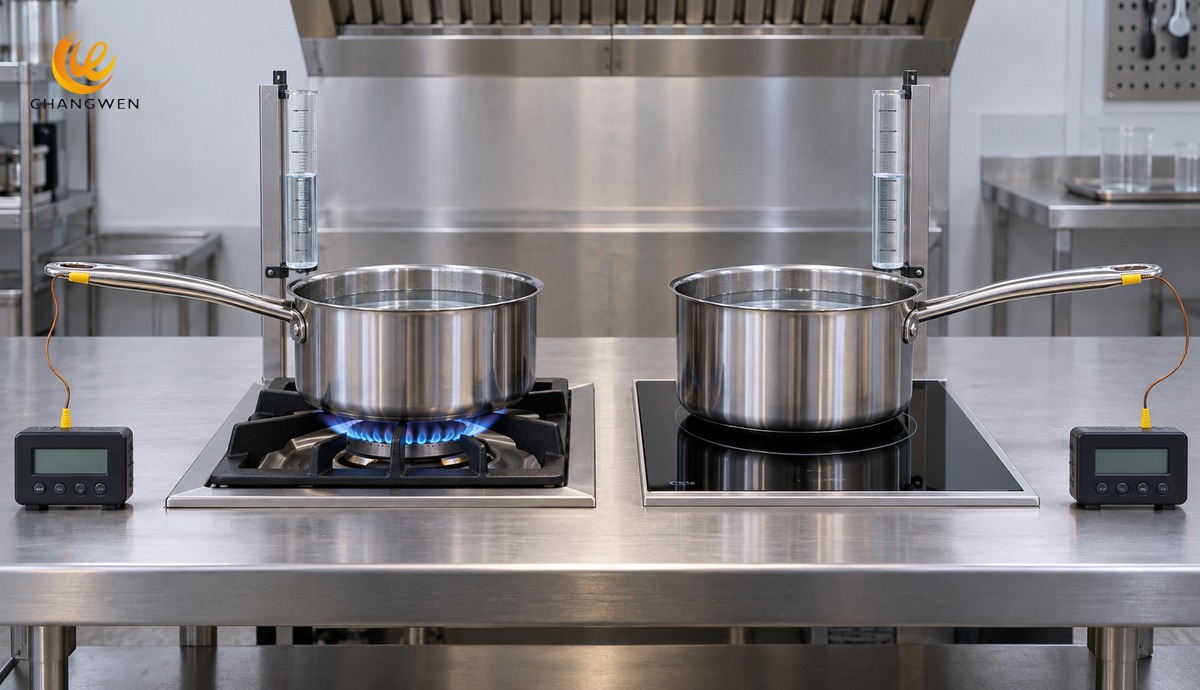
Gas testing combines conduction from the vessel with convection and radiation from the flame. Burner size, flame height, pan centering, drafts, and handle angle strongly affect the result. A stay-cool design for gas use should be tested with a correctly sized flame and, when relevant, a controlled misuse condition such as limited flame spread. The two results should remain separate.
Comparing gas and induction can reveal the dominant heat path. A large temperature increase only on gas may indicate direct flame or hot-gas exposure near the bracket. Similar curves across both systems may indicate conduction through the vessel and attachment. This interpretation is a diagnostic inference and should be confirmed by sensor maps or controlled shielding trials.
How do common handle constructions manage heat?
A solid metal handle provides a continuous conductive path and can become hot during extended cooking. Its thermal behavior depends on length, cross-section, attachment area, alloy, and exposure to flame or radiation. Solid construction can offer mechanical durability and oven compatibility, but a pot holder may still be required according to the intended use and warning strategy.
A hollow metal handle can reduce conductive cross-section and create an internal air space, but hollow does not guarantee cool. Welds, brackets, trapped moisture, wall thickness, openings, and geometry affect the result. The manufacturing process must also keep the cavity clean and structurally sound. Testing the finished assembly is more reliable than accepting a hollow description.
Polymer, silicone, or composite grip sections can reduce contact temperature and improve grip comfort when their material and attachment are suitable. Their limitations may include oven temperature, open-flame exposure, aging, staining, odor, or separation. The component rating and the finished-product test must both support the stated use.
A detachable handle creates a removable thermal path and may stay away from the vessel during part of cooking. The attachment interface can still become hot, and the user may connect the handle immediately after heating. Temperature, lock security, wear, contamination, and attachment cycles should be evaluated as related risks rather than isolated features.
Why must oven use remain separate from stovetop stay-cool claims?
Oven heating surrounds the cookware and handle with hot air and radiant energy, so a handle that stays relatively cool on a stovetop can approach the oven environment temperature. A stovetop test cannot justify bare-hand contact after oven use. Oven suitability depends on every component, including grip materials, fasteners, coatings, lid parts, and detachable mechanisms.
How should handle temperature be combined with mechanical testing?
Thermal cycling can change joints, coatings, polymers, adhesives, and clearances. A handle should be checked for movement, cracking, deformation, discoloration, odor, and loss of grip after the specified cycles. Temperature performance measured only on a new sample may not represent the handle after repeated service.
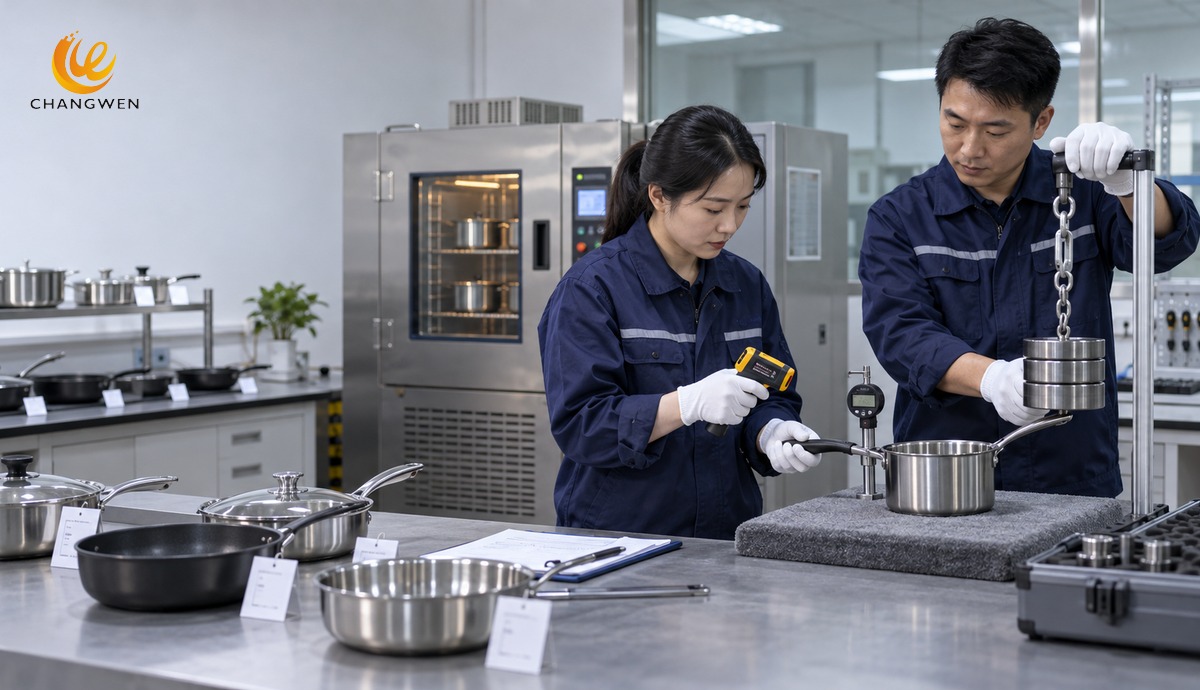
Mechanical load testing should follow the thermal sequence when the project needs to evaluate retained strength. The vessel load, force direction, restraint, duration, and acceptance limit must be defined. The Changwen quality-control overview includes handle attachment and dimensional checks that can inform a broader inspection plan.
How should a golden sample and bulk inspection use the test?
The approved golden sample should carry an ID, drawing revision, bill of materials reference, handle supplier, attachment method, and test report. Approval should record the complete temperature curves and not only a pass label. The cookware golden sample checklist explains how controlled sign-off connects a physical sample with production requirements.
Bulk inspection can use a shortened screening method after the full design protocol establishes sensitive points and expected ranges. The screening plan should define lot, random sample selection, heating condition, measurement points, acceptance rules, and escalation. A screening failure should trigger containment and investigation, not an improvised retest with easier conditions.
Supplier comparisons should use the same pan size, construction target, and test laboratory whenever possible. If factories run their own tests, the buyer should provide one method and audit the fixtures, sensors, and calculations. A controlled trial project, as described in the guide to comparing cookware manufacturers through trials, can reveal whether results remain repeatable before a large order.
What belongs in a handle temperature test report?
A complete report should identify sample, SKU, drawing, date, operator, laboratory, cookware dimensions, mass, body construction, handle design, attachment, cooktop, burner, power, liquid load, lid state, starting conditions, ambient conditions, sensor type, sensor locations, attachment method, logging interval, endpoint, cooling method, and any deviation.
The result section should include time-temperature curves for every sensor, maximum values, time-to-level values when used, ambient rise, root-to-grip gradient, post-shutdown overshoot, and variation across specimens. Photographs should show pan position, flame boundary for gas tests, sensor placement, handle orientation, and the complete fixture.
The conclusion should state only what the protocol demonstrates. A result can show that one design remained cooler than another under the tested condition. It cannot prove safe bare-hand contact for every user, burner, recipe, duration, or oven mode. Bounded conclusions are more useful for product engineering and reduce the risk of an overbroad claim.
Handle temperature test checklist
- Define the intended use, heat source, duration, and contact zones.
- Match vessel size, body construction, water load, lid state, and starting temperature.
- Control cooktop, power, burner fit, pan position, airflow, and handle direction.
- Measure root, grip center, grip end, and ambient temperature continuously.
- Document sensor type, calibration, wire, attachment, and logging interval.
- Record baseline, heating, operating stage, shutdown, and delayed peak.
- Report maximum, rise, heating rate, gradient, overshoot, and variation.
- Test fixed, helper, lid, and detachable contact points separately.
- Keep stovetop and oven claims separate.
- Combine thermal cycles with handle security and retained-load checks.
- Approve controlled samples and translate the full method into bulk screening.
- Use product-specific acceptance limits rather than an unsupported universal number.
Frequently asked questions
Can an infrared thermometer test a polished cookware handle?
An infrared thermometer can produce misleading readings on polished metal because emissivity is low or uncertain and the surface reflects surrounding radiation. A validated surface preparation or emissivity method is required. Contact thermocouples are often more practical for repeatable time-temperature comparisons on shiny handles.
Should the handle be tested with the lid on?
The lid condition should match the intended scenario and remain identical between samples. Lid-on and lid-off tests may both be useful because the lid changes heating time and steam exposure. Their results should be reported as separate conditions rather than combined.
Why can a handle get hotter after the burner is turned off?
A handle can continue warming after shutdown because heat stored in the vessel and attachment keeps conducting toward the grip. The cooktop may also retain heat. Continuous logging during a defined off-heat phase captures this delayed maximum and prevents premature comparison.
Does a hollow stainless steel handle always stay cool?
No. A hollow design can reduce conductive material, but attachment geometry, wall thickness, welds, length, airflow, flame exposure, and test duration still control the result. The finished handle must be tested on the intended cookware body.
Build a verifiable stay-cool handle specification
A strong OEM brief should define the cookware body, handle geometry, material, attachment, grip zone, intended cooktops, oven limitations, thermal procedure, acceptance metrics, mechanical tests, labeling, and sample revision. The custom cookware OEM process provides broader context for converting a product idea into controlled drawings, samples, testing, and production.
Changwen supports cookware development, wholesale supply, private label programs, and OEM manufacturing for brands, importers, distributors, and commercial buyers. A useful inquiry includes target pan sizes, body and base construction, handle concepts, expected loads, cooktops, thermal test conditions, oven requirements, order quantity, packaging, destination market, and inspection plan.
Contact Changwen to discuss a handle comparison or customized cookware project. The project team can review design options, sample requirements, measurable temperature criteria, attachment testing, branding, packaging, and quality checkpoints before bulk production.
-
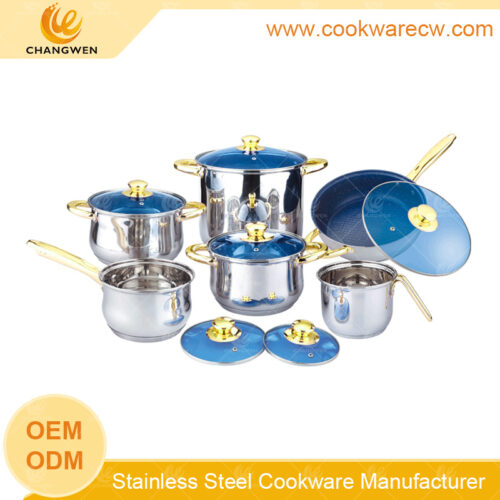
Pots wholesale apple shape cookware set mirror polished stainless steel lids golden wire handles and knobs nonstick frypan CW-M1220
-
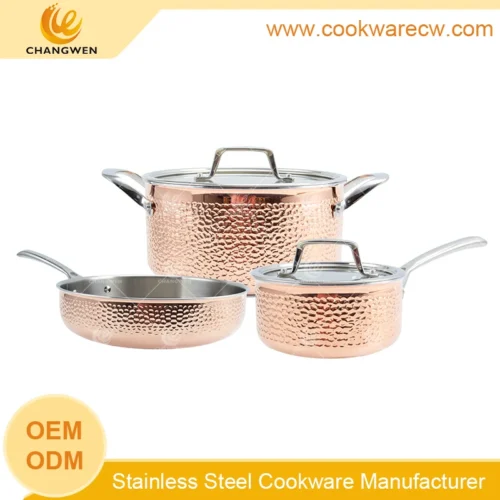
Gold Hammered Stainless Steel Cookware for Luxury Kitchens CW-ETP0501
-
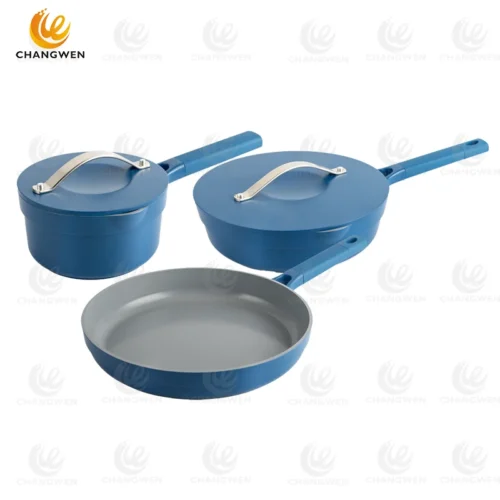
5pcs Ceramic Nonstick Aluminum Cookware Set OEM Manufacturer China | Aluminum Cookware Factory
-
Safest Stainless Steel Cookware
-
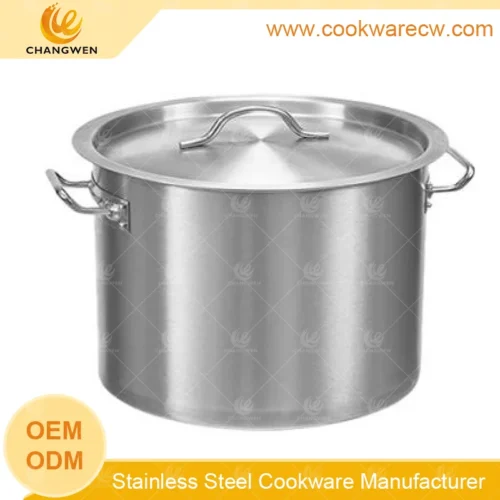
Stainless Steel Stock Pot For Restaurants CW-SP002
-
6-Piece Matte Stainless Steel Pot Set with Multi-Color Handles CW-ES0617
-
Stainless Steel Griddle For BBQ Grills
-
Mexican cookware set olla milk pot high stock pot kitchen wire rack and non-stick coating frypans CW-M1308