
Read time: 13 minutes
Granite cookware is becoming an important wholesale category because it combines a recognizable stone-look finish, easy-release cooking, coordinated color options, and accessible retail positioning. The opportunity does not come from granite as a solid material. Most products sold as granite cookware use an aluminum body with a speckled nonstick coating that creates a mineral-inspired appearance. For wholesalers, the trend is valuable when the product is accurately specified, properly tested, and matched to a clear consumer segment.
Granite cookware can sit between basic nonstick cookware and design-led premium collections. A coherent range can give retailers more visual impact than a group of unrelated pans, while aluminum construction can keep the product manageable in weight and responsive to heat. The category is not automatically superior to stainless steel, ceramic-coated cookware, or conventional nonstick cookware; its commercial advantage comes from combining familiar performance with a distinctive merchandising story.
What Is Granite Cookware?
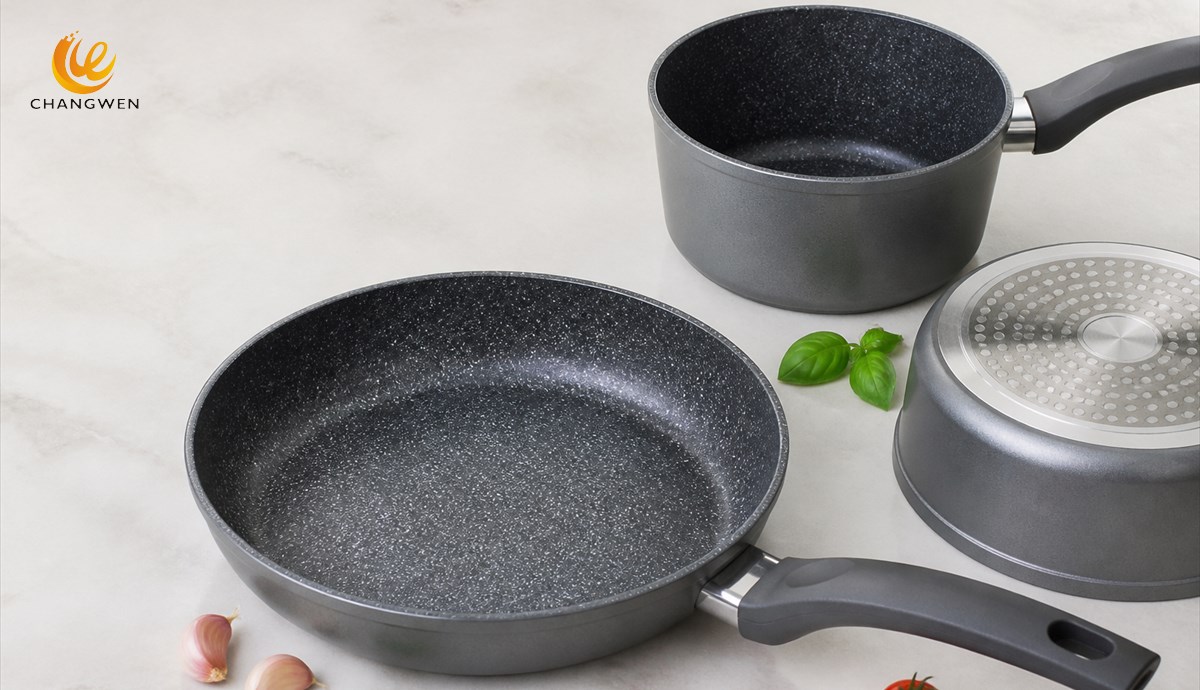
Granite cookware usually means aluminum cookware finished with a speckled coating that resembles natural stone. The body may be stamped, forged, or die-cast aluminum, and the exterior may use a matching decorative coating. An induction version normally adds a magnetic stainless steel plate or compatible base because aluminum alone does not activate most induction cooktops.
The term “granite” describes appearance more often than composition. Buyers should not assume that a pan is carved from stone or that visible speckles prove the presence of granite particles. The supplier should identify the body material, coating system, number of coating layers, application process, recommended temperature range, and applicable food-contact documentation.
Granite-look cookware belongs to the broader nonstick cookware category. Its release performance, abrasion resistance, stain behavior, and service life depend on the coating formulation and manufacturing control rather than the visual pattern alone. A premium-looking speckle can improve shelf appeal, but it cannot replace coating adhesion, curing accuracy, base flatness, or consistent film thickness.
Why Is Granite Cookware Attracting Wholesalers?
Granite cookware attracts wholesalers because one construction platform can support many visible variations. A factory can apply coordinated colors, speckle densities, handle styles, lid designs, and exterior finishes to frying pans, saucepans, casseroles, and cookware sets. This flexibility helps a wholesaler build a family of products instead of selling isolated items.
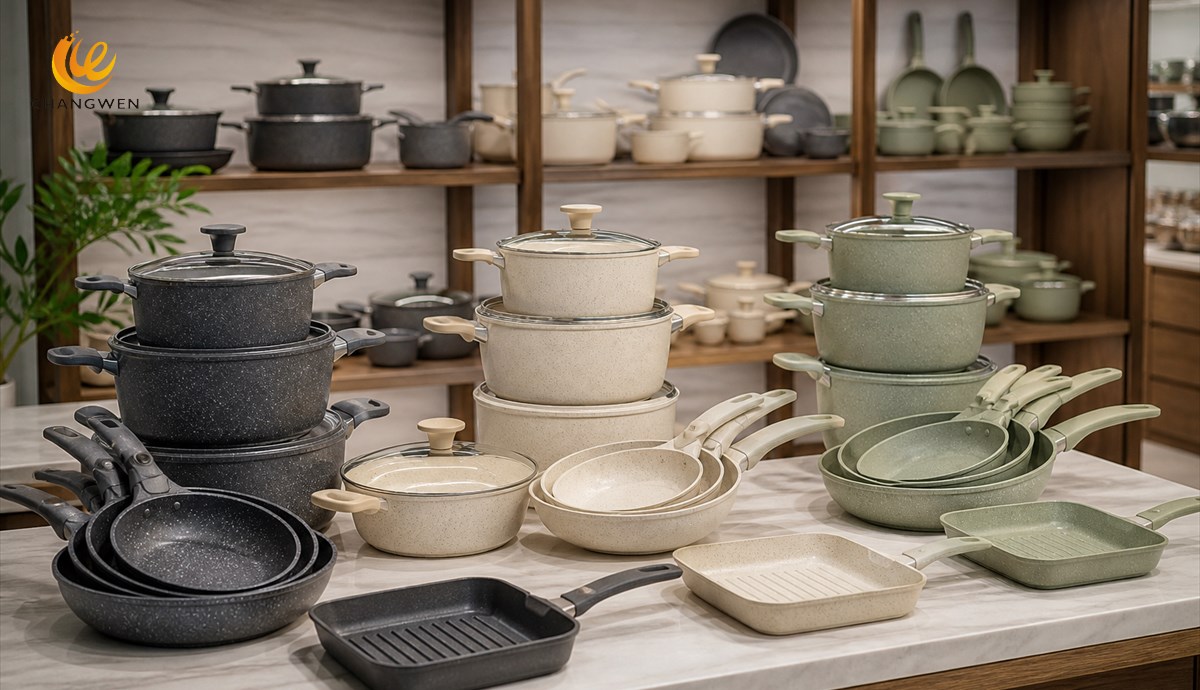
The stone-look surface communicates warmth and domestic style more quickly than plain metal in a retail photograph. Neutral charcoal, cream, beige, and muted green can fit modern kitchen palettes without requiring printed decoration on the cooking surface. Strong visual identity can improve catalog clarity, online thumbnail recognition, and cross-selling between sizes.
Granite cookware also gives wholesalers an understandable value ladder. A stamped aluminum entry line can target price-sensitive channels, while forged or die-cast bodies, thicker bases, upgraded handles, and stronger coating specifications can support a higher position. The commercial logic is strongest when each tier has a measurable construction difference rather than a color change alone.
What Consumer Needs Does the Category Address?
Granite cookware addresses demand for easy food release and simpler cleaning. A sound nonstick surface can reduce the force needed to turn eggs, pancakes, fish, and other delicate foods. The benefit depends on correct heat and utensil use, but it offers a lower learning curve than uncoated stainless steel for many everyday tasks.
The category addresses demand for lighter cookware than many heavy multi-layer metal products. Aluminum distributes heat efficiently relative to its weight, so a well-designed pan can be responsive without becoming difficult to lift. Die-cast construction may feel more substantial than thin stamped cookware while remaining manageable for routine use.
Granite cookware also addresses interest in coordinated kitchen design. Buyers increasingly evaluate cookware as a visible home product rather than a hidden tool, particularly when pans hang on rails or appear in open storage. A consistent colorway across cookware shapes allows retailers to sell a visual collection and allows consumers to expand it gradually.
How Does Granite Cookware Compare With Other Categories?
| Category | Primary strength | Main limitation | Best wholesale role |
|---|---|---|---|
| Granite-look coated aluminum | Visual differentiation and easy release | Coating requires controlled use and testing | Design-led everyday cookware |
| Conventional coated aluminum | Familiar performance and broad price range | Can look generic without design development | Entry and mass-market programs |
| Ceramic-coated cookware | Alternative coating story and varied colors | Release performance can change with use | Coating-conscious lifestyle ranges |
| Stainless steel cookware | Durability, high-heat use, and no applied nonstick layer | Requires cooking technique for low sticking | Long-life and professional positioning |
| Cast iron cookware | Heat retention and traditional durability | Heavy and requires specific care | Specialist and heritage collections |
Granite cookware should not be marketed as a replacement for every material. Stainless steel is better suited to repeated high-heat searing and long service without a nonstick coating, while coated aluminum is often easier for eggs and low-to-medium-heat cooking. The site’s stainless steel and ceramic cookware comparison illustrates why material and surface choices should follow the intended cooking method.
Why Does the Granite Look Work Well in Retail?
The granite look works in retail because speckling gives the surface visible texture without adding a complex printed graphic. The pattern can help disguise minor visual variation and makes neutral colors appear more distinctive in product photography. A consumer can recognize the family from a distance when lids, handles, and exterior colors remain consistent.
A granite collection can occupy more shelf space coherently than a single pan because the same finish can extend across multiple shapes. A retailer can place a hero casserole beside frying pans and saucepans, then use size and function to create price steps. This assortment logic increases choice without forcing every item to tell a different design story.
Packaging can reinforce the material explanation by showing the aluminum body, coating type, cooktop compatibility, care instructions, and included pieces. Packaging should avoid implying that the cookware is solid stone when it is coated metal. Accurate language strengthens trust and reduces complaints caused by unrealistic expectations.
Which Products Should Start a Granite Cookware Range?
A 24 or 28 cm frying pan is a practical lead product because consumers understand the use immediately and can assess handle comfort, weight, and food release. A two-pan set can provide an accessible trial purchase while creating a higher basket value than a single item. Frying pans also display the speckled interior clearly in online images.
A saucepan and medium casserole expand the range into boiling, sauces, grains, and family meals. Glass lids improve visibility and help the collection appear complete, while compatible knobs and handles maintain the visual system. The article on why saucepans are a valuable retail category explains how this versatile shape supports assortment depth.
A shallow casserole or saute pan can serve as the higher-value hero item. Its large visible surface highlights the finish, and its combination of frying and simmering functions supports a strong product demonstration. Wholesalers should add grill pans, woks, or specialty shapes only after core sizes show repeat demand.
How Should Wholesalers Segment the Range?
An entry segment can use a controlled stamped aluminum body, a reliable basic coating, and straightforward handles. The specification must still meet applicable food-contact and performance requirements. Entry price should come from efficient construction and limited options, not from skipping adhesion tests or material documentation.
A mid-range segment can use forged or die-cast bodies, improved base stability, induction compatibility, upgraded coating specifications, and coordinated soft-touch or wood-look handles. This tier often provides the strongest balance between perceived quality and retail affordability. A limited set of well-developed colors is easier to forecast than too many low-volume variants.
A premium segment should justify its position through measurable differences such as thicker construction, improved base design, verified coating performance, refined lid fit, stronger handles, and more controlled finishing. Decorative packaging can support the offer, but premium pricing is fragile when the product underneath is identical to the entry tier.
Which Body Construction Is Best?
Stamped aluminum is efficient for high-volume, price-sensitive programs. It supports fast production and lighter products, but inadequate thickness or poor forming control can increase deformation risk. The specification should state body thickness, base flatness tolerance, and handle attachment requirements.
Forged aluminum can offer a stronger structure and a more substantial feel while retaining relatively efficient production. Forging can help control the distribution of material, although the final result still depends on tooling, alloy, and process consistency. Buyers should compare finished samples rather than treating the word “forged” as proof of performance.
Die-cast aluminum supports thicker walls, integrated shapes, and distinctive design details. It is well suited to coordinated granite-look collections but requires greater tooling commitment and careful porosity and flatness control. The die-cast aluminum cookware manufacturing guide explains the OEM decisions behind this construction.
What Coating Questions Should Buyers Ask?
Buyers should ask for the coating supplier, coating chemistry category, layer structure, target dry-film thickness, curing parameters, and intended use conditions. A statement such as “three-layer granite coating” is incomplete unless the manufacturer can explain what each layer does and how the process is controlled.
Buyers should ask whether the decorative speckles are part of the functional system or primarily visual. The answer affects neither food safety nor durability by itself, but it prevents the pattern from being confused with reinforcement. Performance should be supported by test methods and acceptance criteria rather than by the appearance of mineral particles.
Buyers should also request documentation relevant to the target market and final coating system. The site’s food-contact certification guide for cookware importers explains why test scope, laboratory identity, sample description, and destination market must align.
How Should PFAS and PTFE Claims Be Managed?
Granite appearance does not identify whether a coating contains PTFE or belongs to another coating family. A speckled PTFE-based coating and a speckled ceramic-type coating may look similar while behaving differently. Wholesalers must obtain the exact coating declaration before making PFAS-free, PTFE-free, or similar claims.
A claim should match the tested finished product and the legal expectations of the destination market. Supplier brochures are not a substitute for traceable formulation statements and appropriate laboratory reports. The PFAS and PTFE cookware guide provides a useful framework for separating chemistry, regulations, and consumer language.
Care instructions must match the coating system. Temperature limits, preheating guidance, utensil recommendations, cleaning methods, and replacement indicators should be specific enough to protect performance. Vague claims such as “indestructible” or “permanent nonstick” create unnecessary warranty and reputation risk.
What Quality Tests Should Wholesalers Require?
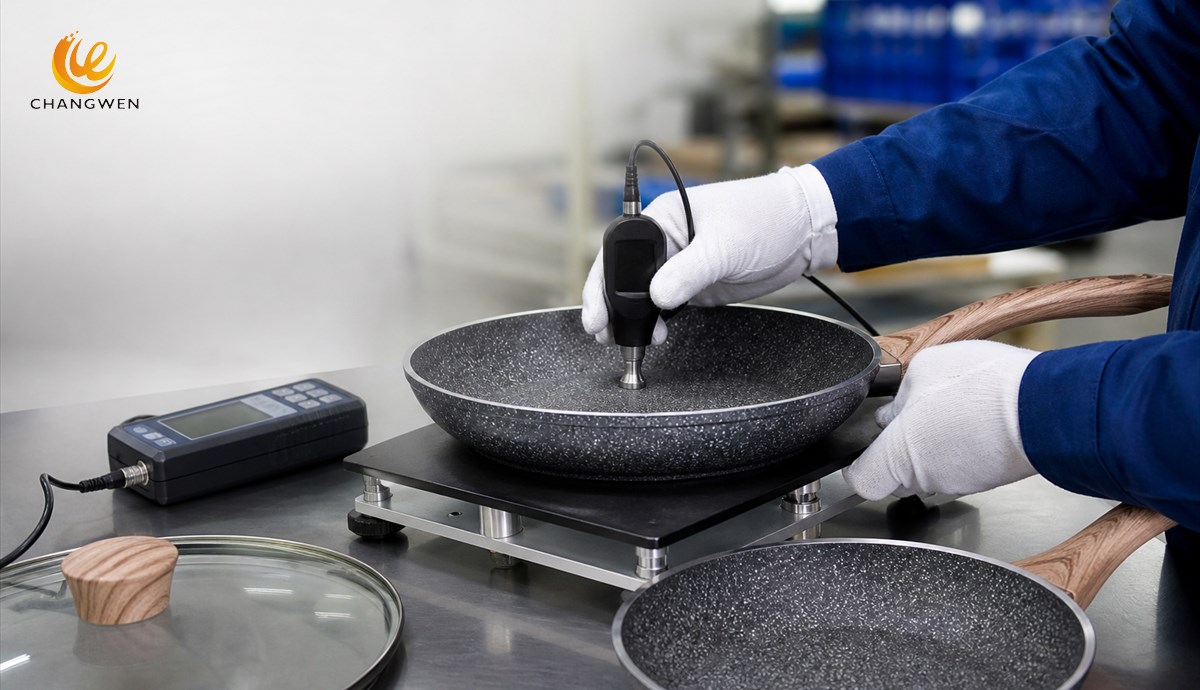
Coating adhesion should be tested because a visually perfect surface can fail when layers do not bond correctly. The test method, conditioning, scoring system, and sample quantity should be agreed before production. Results from a development sample do not replace checks on production lots.
Abrasion and release tests should reflect realistic use rather than a single dramatic demonstration. Buyers should define the utensil or abrasive medium, load, cycle count, heating condition, food test, and pass criteria. Comparative testing is most useful when all samples follow the same protocol.
Base flatness and thermal deformation matter because an uneven base reduces cooktop contact and causes unstable spinning or rocking. Induction products also require verification of the magnetic base, heating response, and bond integrity. Handles should receive torque, fatigue, and loaded-lift checks, while lids should be checked for fit, thermal shock, and secure knobs.
Dishwasher claims require repeated-cycle evaluation of coating appearance, exterior finish, exposed aluminum, handle components, and fasteners. A product may survive one cycle yet show progressive dulling or corrosion after repeated exposure. The article on dishwasher-safe cookware testing shows why a marketing label needs a defined test protocol.
How Can Granite Cookware Improve Wholesale Margins?
Granite cookware can support margin through perceived design value rather than raw material cost alone. A coordinated finish, color story, handle design, lid system, and packaging can create visible differentiation from generic nonstick cookware. The additional margin is sustainable only when quality supports the promise and return rates remain controlled.
Sets can increase average order value because consumers receive a complete visual collection and retailers gain an obvious promotional unit. Sets also increase carton size, inventory exposure, and replacement complexity. Wholesalers should compare gross margin with landed cost, damage rate, sell-through, returns, and markdown risk.
A mixed assortment can reduce dependence on one product type. Granite cookware can serve design-led everyday cooking, while stainless steel covers high-heat and long-life needs. The site’s analysis of stainless steel and aluminum cookware profitability explains why portfolio strategy matters more than selecting a universal winner.
What Are the Main Commercial Risks?
The first risk is treating visual similarity as quality equivalence. Two speckled pans can use different alloys, thicknesses, primers, topcoats, curing conditions, and handle systems. A lower quotation may reflect an acceptable efficient design, or it may hide weaker specifications that increase returns.
The second risk is over-expanding colors and SKUs before demand is proven. Every color-size combination consumes forecasting attention, minimum order quantity, packaging inventory, and warehouse space. A disciplined launch uses a small core palette and expands only after sales data identifies reliable combinations.
The third risk is inaccurate product language. Calling coated aluminum “stone cookware” without clarification can lead consumers to expect solid mineral construction, unlimited heat tolerance, or permanent release. Transparent descriptions should explain the metal body, coating system, compatible cooktops, and required care.
The fourth risk is relying on pre-production samples alone. Production can drift in color, speckle density, film thickness, cure, base flatness, or handle alignment. Golden samples, approved specifications, in-process controls, and pre-shipment inspection reduce the gap between the showroom sample and the delivered order.
How Should a Wholesaler Launch the Category?
A wholesaler should begin with a market brief that defines customer, retail channel, target price, cooking habits, cooktop mix, preferred colors, and expected certifications. This brief prevents the factory from choosing features that look attractive but do not fit the market. The brief should distinguish mandatory specifications from optional design choices.
The next step is a focused assortment with one lead frying pan, one saucepan, one casserole, and either a shallow casserole or set. Samples should undergo cooking, cleaning, handle, flatness, and coating tests before packaging is finalized. Claims on the box should be based on the approved construction and test evidence.
Packaging should protect rims, lids, handles, and coated surfaces during transit while explaining use and care. Shipping configuration matters because large nested sets can be efficient in volume but vulnerable to abrasion without separators. The cookware MOQ, packaging, and shipping guide provides additional planning criteria for importers.
Initial orders should preserve enough focus to generate clean sales data. Wholesalers can track sell-through by color and size, return reasons, coating complaints, packaging damage, repeat orders, and attachment sales between individual pieces and sets. The second order should reflect observed demand rather than expanding automatically.
What Should Be Included in an OEM Specification?
- Body: alloy, forming method, thickness, diameter, depth, and weight tolerance.
- Coating: supplier, chemistry category, layer system, color, speckle standard, thickness, and curing controls.
- Base: flatness tolerance, induction plate specification, bond method, and cooktop compatibility.
- Handles: material, color, attachment, heat behavior, torque requirement, and loaded-lift test.
- Lids: glass or metal specification, rim, vent, knob, fit tolerance, and thermal test.
- Testing: food contact, adhesion, abrasion, release, thermal cycling, dishwasher, and corrosion where applicable.
- Packaging: protectors, nesting method, carton strength, labeling, instructions, and barcode requirements.
- Inspection: sampling plan, defect definitions, golden sample, color tolerance, and acceptance criteria.
An OEM specification turns a visual concept into a repeatable product. The custom cookware OEM process guide explains how product briefs, samples, approvals, production, and inspection connect across a private-label program.
Frequently Asked Questions
Is granite cookware made from real granite?
Most granite cookware is not made from a solid piece of granite. The term normally describes a speckled stone-look coating applied to an aluminum cookware body. Buyers should verify the written material and coating specification instead of inferring composition from appearance.
Is granite cookware always PTFE-free?
No. Granite appearance does not identify coating chemistry. Some speckled coatings may be PTFE-based, while others may use different systems. Any PTFE-free or PFAS-related claim should be supported by the exact formulation declaration and appropriate finished-product evidence.
Is granite cookware suitable for induction?
Granite-look aluminum cookware can work on induction when it includes a properly designed magnetic base. Buyers should test activation, heating uniformity, base bond, and flatness on representative induction appliances rather than relying only on an induction symbol.
What granite cookware colors are easiest to merchandise?
Charcoal, cream, beige, and muted natural colors create coordinated collections that fit many kitchen styles. The best palette depends on the market and channel. A small proven color group is generally easier to forecast and replenish than a large launch with many low-volume variants.
What is the biggest quality risk in granite cookware?
The biggest quality risk is assuming that a premium-looking speckled surface guarantees coating durability. Adhesion, film thickness, curing, abrasion performance, base stability, and handle strength must be defined and tested independently of appearance.
Should wholesalers sell sets or individual pieces?
Individual frying pans lower the trial barrier and reveal which sizes sell, while sets increase order value and strengthen the coordinated design story. A balanced launch often uses individual core pieces plus one carefully configured set, then expands according to sell-through and return data.
Final Verdict: Is Granite Cookware the Next Big Wholesale Trend?
Granite cookware has strong potential as a wholesale growth category because it combines familiar nonstick utility with a visible design identity that works across individual pans and coordinated sets. Its value is especially clear for retailers seeking an accessible lifestyle range between generic nonstick products and higher-priced specialist cookware.
The opportunity is not automatic. Wholesalers should define granite cookware accurately as coated metal cookware, verify the coating and body construction, control claims, limit initial SKUs, and test production quality. A disciplined program turns the stone-look finish into a credible product platform; an appearance-only program creates avoidable returns and short-lived demand.
-
Commercial Stainless Steel Stock Pot CW-SP001
-
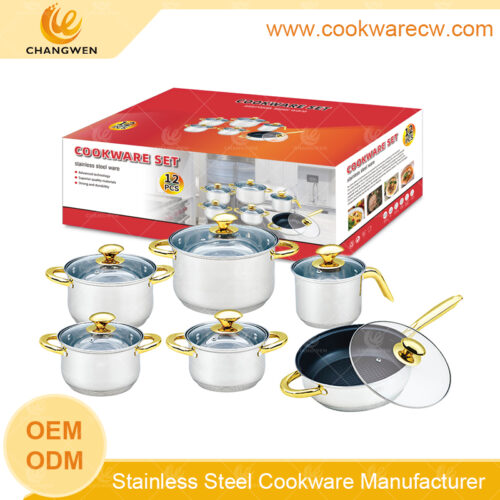
high quality stainless steel pots and pans 12pcs cookware set nonstick fry pans with 5-9 steps capsule bottom CW-M1212
-
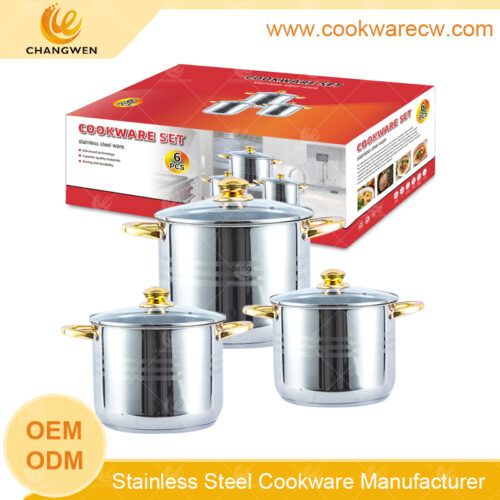
Heavy Duty Stock Pots Stainless Steel CW-M0607
-
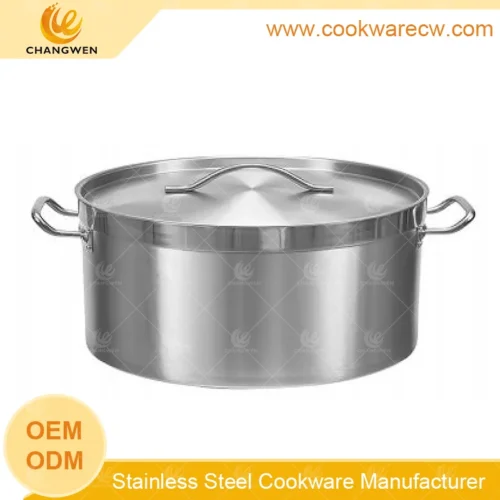
Stainless Steel Stock Pot CW-SP002
-
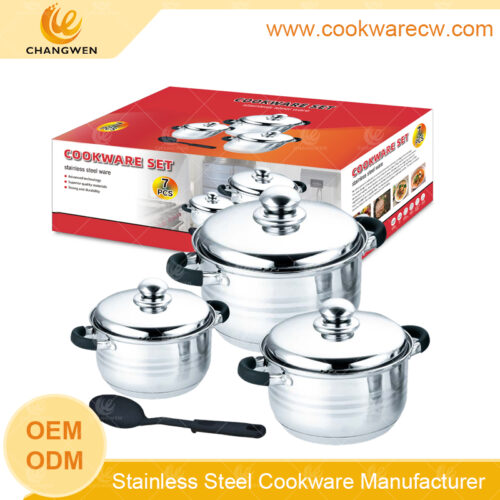
Mercado Libre hotsale cookware 7pcs cooking pot set stainless steel lids silicone handle kitchen tool solid serving spoon CW-M0702G
-
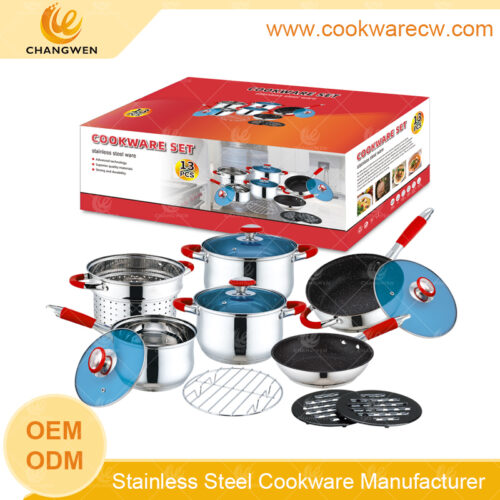
High quality pots wholsesale stainless steel pasta pot fry pan nonstick set saucepan casseroles with red silicone steamer rack heat insulation black mats CW-M1303G
-
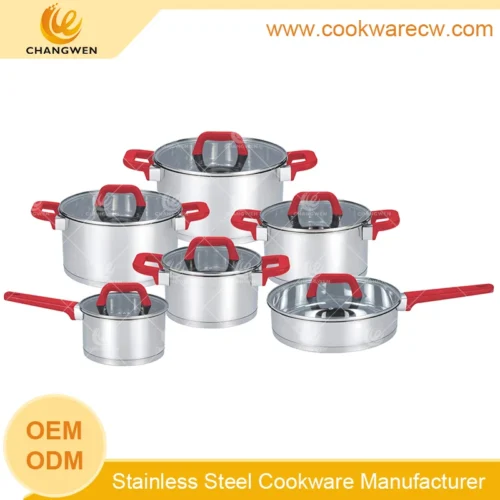
12-Piece Stainless Steel Cookware Set with Red Silicone Handles CW-ES1203G
-
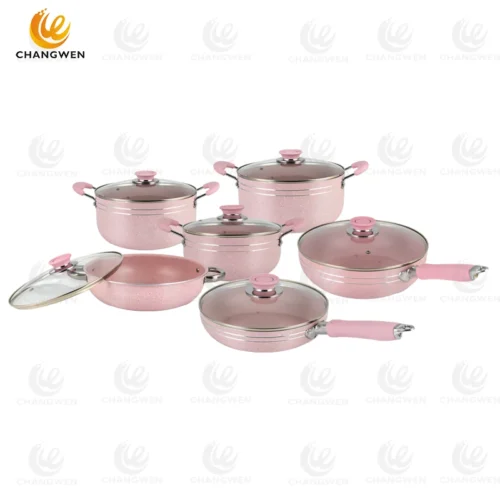
Ceramic Non Stick Aluminum Cookware Set