
Reading time: 11 minutes
Introduction
Here is the uncomfortable truth about the cookware industry: most of the brands you see on retail shelves do not own a factory. They own a brand. The manufacturing happens at a cookware manufacturer in China.
This is not a criticism — it is the model. Building a private label cookware brand through a Chinese cookware manufacturer lets you access world-class production capability, decades of materials expertise, and competitive pricing that would be impossible to replicate if you built the factory yourself.
This guide gives you the complete picture: what private label cookware manufacturing actually involves, how to find and evaluate a cookware manufacturer in China, what customization options are genuinely available, what the process looks like from first contact to first shipment, and the specific mistakes that derail most brand programs.

What Is Private Label Cookware?
Private label cookware means a product manufactured by a factory and sold under your brand name. You own the brand identity. The manufacturer owns the production capability. You control specifications, packaging, and how the product is positioned. The manufacturer controls the factory floor.
The commercial logic is straightforward. A cookware manufacturer in China has invested millions in stamping equipment, polishing lines, coating systems, and quality control infrastructure. You access all of that without building it. Your capital goes into brand development, marketing, and distribution — the activities that create retail value.
Why China for Private Label Cookware?
The answer is not just cost. China’s cookware manufacturing advantage is structural.
Depth of supply chain. In production clusters like Jiangmen and Chaozhou in Guangdong, every component needed to make a cookware set is available within hours of the factory. This integrated supply chain reduces lead times and simplifies sourcing.
Accumulated expertise. China has been the world’s primary cookware manufacturer for decades. The engineering knowledge embedded in production teams is not something a competitor in a lower-cost country can replicate quickly.
Certification infrastructure. Established Chinese cookware manufacturers hold LFGB, FDA, and ISO 9001 certifications routinely required for EU and US market entry. Working with a manufacturer who already holds them compresses your time to market.
Scale flexibility. From 500-unit trial runs to 50,000-unit production orders, China’s cookware manufacturing ecosystem serves every volume level.
The Private Label Cookware Process: Step by Step
Step 1: Define Your Product Before You Contact Anyone
The most common mistake brand owners make is approaching manufacturers without clear product specifications. This leads to generic samples and a selection process based on whoever follows up most aggressively rather than who is best suited to your actual product.
Before contacting any cookware manufacturer, document:
Product type and range. What exactly are you selling? A stainless steel cookware set? Non-stick aluminum frying pans? Cast iron skillets? The manufacturing requirements differ significantly by product type.
Market and price positioning. Where will you sell — e-commerce, retail chain, hospitality, food service? What is your target retail price? This determines acceptable material grade, construction type, and finishing level.
Required certifications. EU market requires LFGB. US market requires FDA compliance. Foodservice buyers often require NSF. Know which certifications your target channel demands before selecting a manufacturer.
Step 2: Find and Shortlist Manufacturers
Sourcing platforms (Alibaba, Made-in-China, Global Sources): Useful for initial discovery. Always ask directly whether the factory manufactures in its own facility — trading company profiles look identical to factory profiles on these platforms.
Canton Fair (Guangzhou, twice yearly): The most comprehensive face-to-face sourcing event for cookware. You can evaluate multiple manufacturers, see product samples, and begin direct relationships in a single trip.
Shortlisting criteria: Narrow to 3–5 based on product type match, certifications held, OEM experience, and communication quality.
Step 3: Request Samples and Verify Specifications
Never commit to a production order without physical samples tested under real use conditions.
When requesting samples, specify:
- Material grade (304 stainless steel for inner surface, 430 for outer layer if induction-compatible)
- Construction type (full-clad tri-ply vs composite base — be explicit)
- Total wall thickness in mm
- Surface finish (brushed, mirror polish, matte, PVD color)
- Handle material and attachment method
Test samples for heat distribution, warp resistance, handle security, and finish consistency. For material grade verification, XRF (X-ray Fluorescence) testing is the only reliable method to confirm 304 vs lower-grade steel — visual inspection cannot distinguish them.
Step 4: Confirm Customization Options
Standard customization (no new tooling required):
- Logo application: laser engraving, embossing, or etching
- Surface finish: choice between available finishes
- Handle color: selection from available options
- Packaging: custom box design, inner packaging, carton labeling
- Set composition: selecting which pieces form your set
Tooling-required customization (additional cost and lead time):
- New handle shape or proprietary ergonomic design
- Non-standard pot or pan shapes
- Proprietary lid design
For most brand launches, standard customization creates sufficient product differentiation. Proprietary tooling makes sense when your brand has volume to amortize the investment — typically 5,000+ units per SKU.
Step 5: Negotiate Terms and Sign a Contract
Confirm in writing before placing a purchase order:
- Material specification: Steel grade, construction type, wall thickness
- Certifications: Required documentation and originals, not photocopies
- MOQ: 1,000 units is standard for catalog products with OEM branding
- Lead time: 40–45 days standard, plus 4–6 weeks for custom tooling
- Payment terms: 30% deposit on order confirmation, 70% balance before shipment
- NDA: Required before sharing any proprietary designs
- Quality dispute process: Define defect criteria and remedies
Step 6: Production Monitoring and Pre-Shipment Inspection
For significant orders, commissioning a pre-shipment inspection through a third-party company (SGS, Bureau Veritas, Intertek) provides an independent quality check before goods leave China. The cost of $200–$400 is minor relative to the cost of a shipment with systemic quality issues.
What to Customize: Where Brand Value Is Built
Handle design is the first thing consumers touch. A well-designed handle communicates quality before the consumer even looks at the cooking surface.
Surface finish sets the visual positioning. Mirror polish communicates luxury. Brushed finish communicates professional durability. Matte or hammered finish communicates artisan character.
Packaging is where retail brands are won or lost on the shelf. Packaging that communicates construction, certifications, and brand story converts browsers into buyers.
Logo placement and method matters. Laser engraving creates a permanent brand mark that survives dishwashers. Printed labels on handles will peel.
How to Evaluate a Cookware Manufacturer for Private Label
Material traceability. Can they provide mill certificates confirming the steel grade for each production batch? Without this, material grade claims are unverifiable.
OEM track record. Ask for examples of private label programs they have executed. Established manufacturers can show packaging samples and product photos from past programs even if client names are confidential.
Certification documentation. Request original certificates. Verify the issuing laboratory is accredited. Check validity dates.
Communication quality. A manufacturer who answers technical questions accurately and promptly is showing you who they are as a long-term partner.
Factory visit or third-party audit. For any significant program, this verifies production capability and QC processes independently.
Private Label vs OEM vs ODM: Which Model Is Right for You?
Private label means adding your brand to an existing manufacturer product with minimal specification changes. Fastest to market. Least differentiated.
OEM (Original Equipment Manufacturer) means you specify the product and the manufacturer builds it to your specification. You own the design. More control, more specification investment.
ODM (Original Design Manufacturer) means selecting from the manufacturer’s existing designs and branding them. The manufacturer owns the product design.
Most successful programs use a combination: start with ODM (select a proven construction) and add OEM elements (custom handles, exclusive finish, proprietary packaging). This reaches market faster than full OEM and creates more differentiation than pure private label.
Common Mistakes in Private Label Cookware Programs
Specifying material grade without requiring verification. The most common fraud in cookware supply chains is substituting 201-grade steel for 304. Both look identical visually. Require material test reports.
Selecting a manufacturer on price alone. The cheapest factory is rarely the cheapest total outcome when quality disputes and missed deliveries are factored in.
Skipping the NDA. Without a signed NDA before sharing proprietary designs, you have no legal protection.
Underestimating packaging lead time. Custom packaging adds 2–3 weeks. Plan for this from the start.
Treating the first order as the end of due diligence. Build ongoing QC processes into your program — not just the first shipment.
FAQ
What is the minimum order quantity for private label cookware from China?
For catalog products with OEM branding, most established cookware manufacturers work from 1,000 units per item. Programs requiring new tooling typically require higher minimums. Some factories accept smaller trial orders at higher per-unit cost.
How long does a private label cookware program take from first contact to first shipment?
For catalog products with OEM branding: 10–14 weeks is realistic. Approximately 2–4 weeks for sampling and approval, 40–45 days production, 3–5 weeks ocean freight. Custom tooling programs add 4–6 weeks.
Can I protect my designs from being sold to other buyers?
Yes — with a properly written NDA before sharing designs, and clear contract language specifying that custom tooling you pay for belongs to you, not the factory.
What certifications do I need for private label cookware?
For EU retail: LFGB certification. For US retail: FDA compliance. For commercial foodservice: NSF/ANSI 51. Check retail platform requirements before finalizing specifications.
What is the standard material for private label stainless steel cookware?
The global standard for quality private label stainless steel cookware is tri-ply construction: 304 stainless steel on the cooking surface, aluminum core for heat distribution, and 430 stainless steel on the outer layer for induction compatibility.
Is it possible to visit the factory before committing?
Yes, and it is strongly encouraged for any significant program. Most established cookware manufacturers welcome factory visits. Third-party audits through SGS, Bureau Veritas, or Intertek provide independent verification if you cannot visit in person.
Conclusion
Private label cookware manufacturing in China works — when you do it correctly.
Find a manufacturer whose core capability matches your product type. Specify materials in writing and require verification. Invest in packaging that communicates your brand’s quality. Build ongoing QC processes, not just first-order checks. Treat your manufacturer as a technical partner, not a commodity supplier.
The brands that get this right build durable businesses on products their customers trust and return to.
Launch Your Private Label Cookware Program with Changwen
Changwen is a stainless steel cookware manufacturer based in Jiangmen, Guangdong, China, with over 22 years of OEM and ODM experience. We work with brands, distributors, and importers across South America, Southeast Asia, the Middle East, and Europe.
Our private label capability includes tri-ply 304 stainless steel cookware sets, frying pans, stock pots, steamer pots, pressure cookers. Custom logo, surface finish, packaging, and set composition available. Material test reports for every production batch. NDA available.
📧 changwen@cwcooking.com 📞 0086-18022963948 🌐 www.cookwarecw.com/contact-us
-
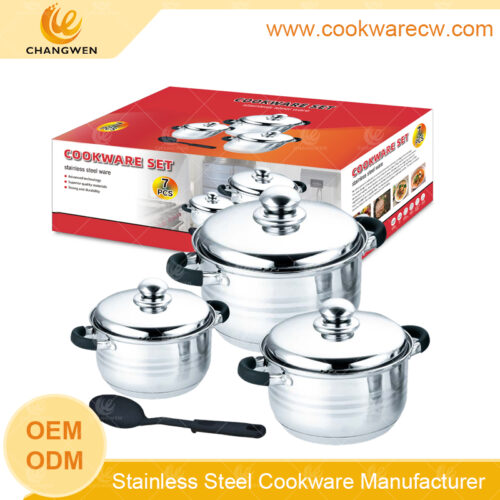
Mercado Libre hotsale cookware 7pcs cooking pot set stainless steel lids silicone handle kitchen tool solid serving spoon CW-M0702G
-
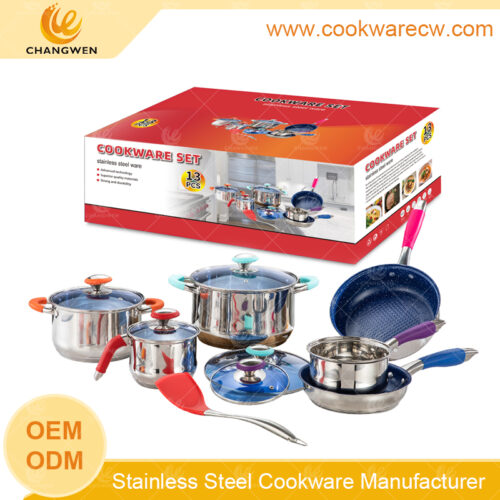
popular stainless steel pots 13pcs cookware set with heat insulated colored silicone and glass lids milkpot casseroles nonstick frypan set CW-M1206G
-
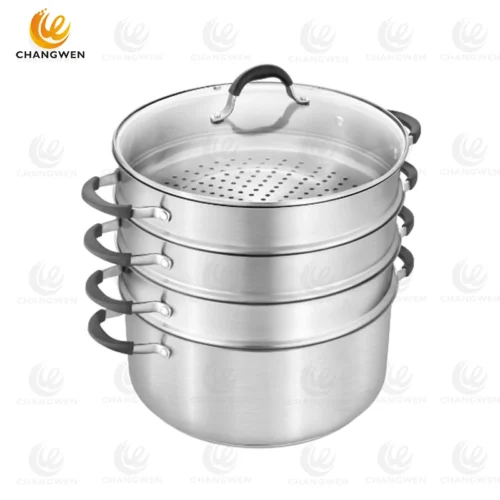
Stainless Steel Steamer Pot with Removable Basket Insert CW-ES034
-
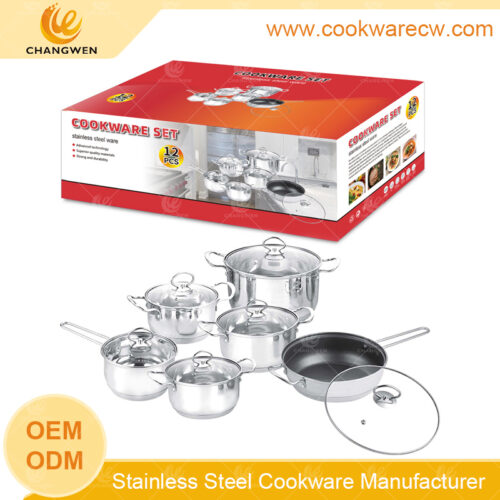
New design stainless steel 12pcs pots wholesale wire handle and knob cookware mirror polished saucepan casserole kitchen pots nonstick coated frypan CW-M1218
-
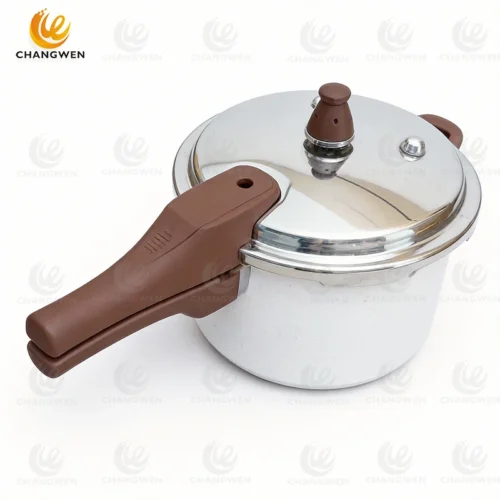
Small Aluminum Pressure Cooker for Fast & Safe Home Cooking
-
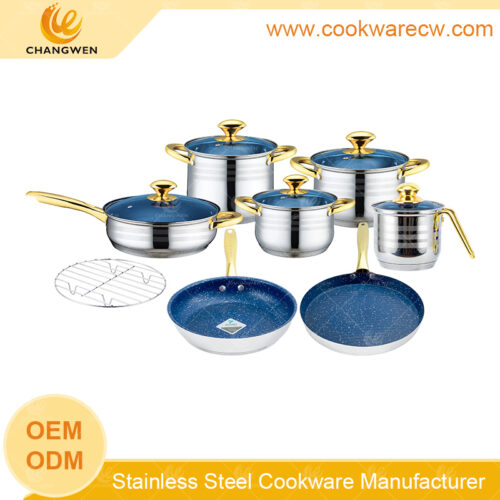
Best Tri Ply Stainless Steel Cookware
-
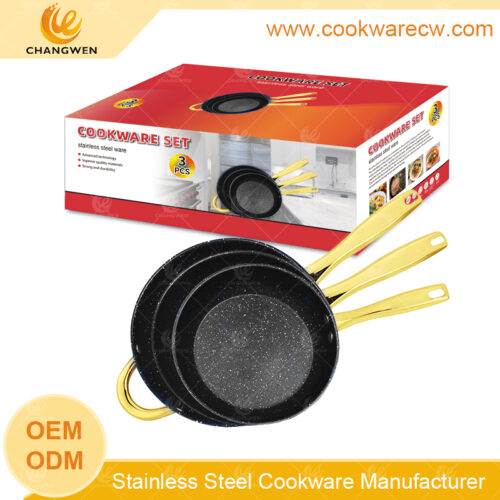
Hot sale 3pcs stainless steel nonstick fry pan set golden plated handles black coating cookware CW-M0301-01
-
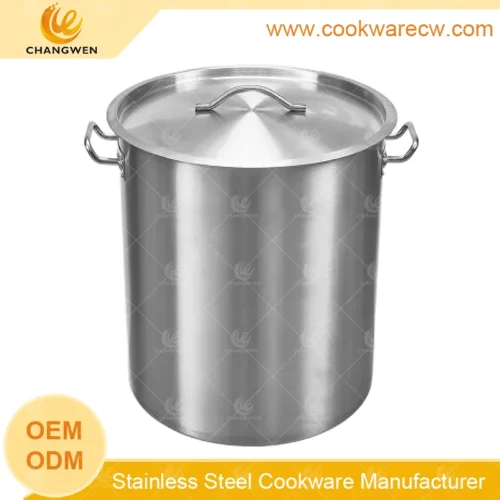
Commercial Stainless Steel Stock Pot CW-SP001