
Estimated reading time: 14 minutes.
Short answer: The best stainless steel cookware set is the smallest configuration that covers the buyer’s real cooking tasks at a verifiable specification and an acceptable landed cost. A “10-piece” label describes the number of items in the box, not ten separate pots or pans. Buyers should count cooking vessels, lids, and accessories separately; check whether each vessel fills a distinct role; then compare entry, core, and premium offers using the same dimensions, construction, packaging, order terms, and inspection criteria.
This guide is for importers, private label brands, distributors, and retail buyers designing a sellable set rather than selecting one individual pan. It concentrates on assortment architecture, piece-count arithmetic, and price-tier decisions. Readers who first need a primer on steel grades, heat-spreading layers, and general vessel selection can use Changwen’s stainless steel cookware buying guide. A set quotation should begin with a component-level bill of materials, not a headline piece count.
What does “piece count” actually include in a cookware set?
A cookware set’s advertised piece count usually adds every separately supplied item in the package: cooking vessels, fitted lids, inserts, and sometimes utensils. A lid may be counted as one piece even though it cannot cook independently. There is no safe shortcut from a 10-piece label to ten usable pots and pans because manufacturers can assemble different combinations under the same number.
The most useful three-number description of a set is vessels + lids + accessories. For example, a set with four pots and pans, three lids, and no other items can be described as seven pieces, but only four pieces are cooking vessels. If a spoon, steamer insert, or spare lid is added, the advertised count can rise without improving the number of simultaneous cooking positions. Ask the supplier for a photographed packing list and an itemized component table before approving packaging copy.
Shared lids deserve special attention because one lid might fit two vessels of the same rim diameter. A shared lid saves material, box volume, and storage space; it may also prevent both vessels from being covered at once. A buyer should therefore record both the number of lids supplied and which exact vessels each lid fits. The meaningful question is not merely “How many lids?” but “Can the target customer perform two covered tasks simultaneously?”
How can buyers compare 5-, 7-, 10-, and 12-piece configurations?
Piece-count labels are most useful when converted into a role map. The examples below are illustrative design briefs, not universal definitions of those package sizes. Each arithmetic total is explicit, so a buyer can change a vessel or lid without losing track of the marketed count. A product page or RFQ should always replace these examples with its actual included-items list.
| Illustrative set | Vessels | Lids | Count check | Best starting audience |
|---|---|---|---|---|
| 5-piece | Frying pan, saucepan, stockpot | Saucepan lid, stockpot lid | 3 + 2 = 5 | Small kitchens, first-home buyers, compact retail offer |
| 7-piece | Frying pan, saucepan, saute pan, stockpot | One lid for each covered vessel | 4 + 3 = 7 | Everyday family cooking with a useful second pan shape |
| 10-piece | Two frying pans, two saucepans, saute pan, stockpot | Two saucepan lids, saute lid, stockpot lid | 6 + 4 = 10 | Broader household coverage or a mid-to-upper retail line |
| 12-piece | Two frying pans, two saucepans, saute pan, casserole, stockpot | Two saucepan lids, saute lid, casserole lid, stockpot lid | 7 + 5 = 12 | Large assortment with a demonstrable extra cooking role |
A five-piece configuration can outperform a larger set for a compact kitchen when its three vessels cover frying, small-volume boiling, and batch cooking. The larger package only earns its space if each added item solves a distinct task or useful size gap. Doubling two nearly identical stockpots may increase the advertised count while making the set harder to store and less convincing at shelf level.
A seven-piece configuration often adds a saute pan because a wide, straight-sided vessel can bridge frying and covered simmering. That role is different from merely adding another small saucepan. The buyer should still verify actual base diameter, internal capacity, usable handle clearance, and lid fit; a vague vessel name cannot prove that the proposed set has a meaningful cooking benefit.
A ten-piece configuration should be evaluated as an assortment, not as a larger version of a seven-piece box. Two frying-pan sizes can support small and large burner tasks, while two saucepan capacities can separate reheating from larger-volume sauces. If the second frying pan is only marginally different in cooking area, the extra item may produce little utility for its added cost and shelf footprint.
A twelve-piece configuration should justify its seventh vessel with a clearly distinct use case. A casserole can add oven-to-table appeal only if the exact handles, lid components, and product instructions support the claimed oven conditions. Buyers should not infer temperature suitability from the word “stainless”; inspect the complete assembled product and approved instructions instead.
Which vessels belong in a balanced stainless steel cookware set?
A balanced set covers four common cooking jobs before it adds decorative variety: quick frying, small-batch liquid cooking, covered one-pan cooking, and larger-volume boiling or simmering. The exact vessel mix changes with household size and cuisine, but those jobs offer a stable way to compare proposals. A buyer should write the intended jobs beside each proposed SKU before approving a new configuration.
The frying pan should be selected by usable cooking surface rather than rim diameter alone. Two pans with identical nominal rim sizes can provide different food-contact areas when their sidewall slopes differ. A product brief should list both rim diameter and approximate flat cooking-area diameter, then identify whether the pan is meant for eggs, proteins, vegetables, or a general-purpose role.
The saucepan should be selected by the volume of food a customer regularly prepares, not simply by a round liter figure in a catalog. A narrow, taller saucepan can reduce evaporation and use burner space differently from a broad, shallow one at the same nominal capacity. For a multi-size set, adjacent saucepan capacities should be far enough apart to change practical use; otherwise one size may remain unused.
The saute pan adds value when its wider flat base and higher sides enable covered one-pan meals, shallow braising, or sauce reduction. It should not be counted as a distinct benefit solely because the supplier gives it a different name. Compare internal base diameter, wall height, overall weight, and lid compatibility with the set’s frying pan and casserole.
The stockpot or casserole should match the intended buyer’s portion size and storage capacity. A very large pot may attract attention in a product photograph but can make the carton bulky and difficult for an urban household to store. A retail assortment should weigh its useful capacity against box dimensions, shipping cost, and the likelihood that customers will use it weekly rather than rarely. Changwen’s stainless steel stockpot guide provides more vessel-specific checks.
What changes when a set is designed for induction or mixed stovetops?
Induction compatibility must be verified for every included cooking vessel, not assumed from a single magnetic sample. The base’s magnetic response, contact area, flatness, and dimensions should match the intended hob requirements. If a set includes a nonstick frying pan alongside stainless pots, the pan may use a different base construction; list compatibility and test results by SKU rather than by box.
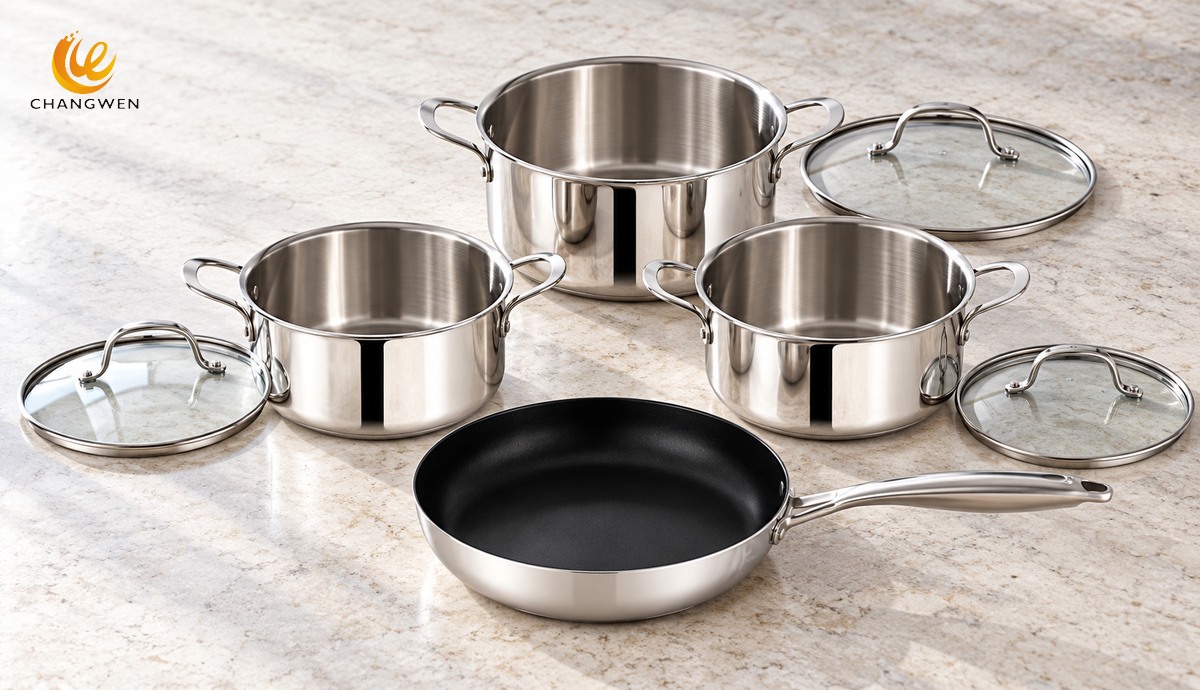
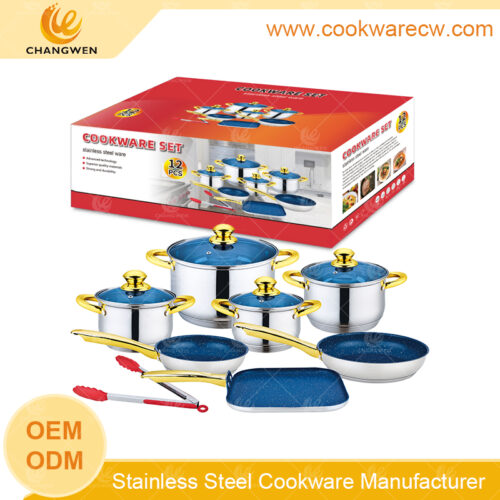
A cookware set can contain different cooking-surface technologies without being misleading, provided the listing says exactly what each item is. The supplied product reference, for example, visually combines mirror-finish stainless pot bodies and a frying pan with a dark interior. An image cannot establish whether that interior is coated, textured, or another finish; a specification sheet and approved sample must make the distinction explicit. Retail claims should never turn a visual impression into an unsupported material promise.
How should entry, core, and premium price tiers be defined?
Price tiers are specification packages, not universal dollar thresholds. A set that is entry-level in one market may be mid-tier in another after duties, retail margins, freight, and positioning are included. The reliable approach is to define three repeatable product briefs and compare supplier quotes against each brief. Avoid calling a set premium simply because it has more pieces or heavier packaging.
| Tier | Buyer proposition | Typical specification focus | What must be demonstrated |
|---|---|---|---|
| Entry | Essential tasks at accessible cost | Lean vessel mix, controlled packaging, practical finish and lid choices | Usable base, secure handles, consistent fit, clear material and care claims |
| Core | Broader everyday utility with fewer compromises | Better role coverage, clearer size steps, stronger fit and finish targets | Measurable differences from entry in construction, ergonomics, and inspection |
| Premium | Distinct performance, design, or ownership value | Justified construction upgrade, refined details, cohesive branding and after-sales plan | Documented benefit, stable sample-to-batch consistency, defensible retail story |
An entry tier should remove redundant items before it removes critical quality. A compact set with reliable attachment, stable bases, and correctly fitting lids is preferable to a larger box with weak handles or inconsistent finish. Keeping one coherent handle family, one lid style, and efficient carton design can control cost without asking customers to accept a flawed cooking tool.
A core tier should add function that shoppers can understand in seconds. A second useful saucepan capacity, a saute pan, or a more convenient lid system is easier to explain than an unsupported claim about “professional quality.” The core brief should state which entry-tier limitation the added item or upgraded construction solves and what the change does to landed cost.
A premium tier should earn its price through a verified product benefit and a coherent ownership experience. Fully clad construction may suit a particular heat-response brief, while a well-designed encapsulated base can remain appropriate for other tasks and budgets. Buyers should compare actual construction, dimensions, manufacturing tolerances, and test evidence rather than assuming that more layers automatically make every vessel better. Changwen’s tri-ply cookware guide and capsule-bottom guide explain the construction trade-offs in detail.
Retail price should not be guessed from factory unit price alone. A useful tier model starts with the quoted set cost, then adds packaging, inland movement, export and import charges, freight, duties, warehousing, expected returns or service allowance, and the channel’s margin structure. These amounts are specific to destination, terms, order size, and date. A buyer should model them from real quotes instead of borrowing a generic “budget,” “midrange,” or “luxury” price band from another market.
How do you compare two supplier quotes for the same piece count?
Two ten-piece quotes are comparable only when their component lists and major specifications are aligned. The buyer should normalize each offer to the same vessel roles, capacities, lids, steel or cooking-surface specifications, body and base construction, handle design, finish, packaging, inspection plan, order quantity, and Incoterm. A lower number on a quote may simply reflect a smaller pan, lighter base, simpler carton, or a different delivery obligation.
The first useful calculation is quoted set price divided by usable cooking vessels. This is not a complete value metric, but it exposes a set padded with inexpensive accessories or extra lids. A second calculation is the incremental cost of each added functional role: compare a seven-piece and ten-piece brief with the same core specifications, then divide the price difference by the number of genuinely useful added vessels. If role coverage does not change, the buyer should question the upsell.
A third calculation compares the cost of the components that drive perceived value and failure risk. Ask for a line-by-line breakdown of vessel bodies, lids, handles, inserts, surface treatments, branded packaging, and master-carton protection. Some suppliers will quote only a complete set, but they should still be able to state what is included and which changes alter price or lead time. Changwen’s guide to comparing quotes beyond price explains the broader commercial checks.
What should a buyer put in the set specification sheet?
A set specification sheet should have one row per physical item, not one row per box. Each row should identify the component name and quantity, nominal and measured dimensions, capacity method, material or surface finish, construction, handle or knob type, lid fit, weight range, cooktop and oven claims, cleaning guidance, and drawing or sample revision. Without component-level rows, a later change to one saucepan or lid can be missed while the advertised set name remains unchanged.
The carton section should specify retail box dimensions, inner protection, master-carton quantity, gross and net weight, barcode placement, country-of-origin wording, manuals, and required language versions. Packaging affects both damage risk and landed cost; a quote with thinner protection may look inexpensive until breakage or returns are considered. Request actual packed samples before finalizing shelf-space or fulfillment assumptions.
The commercial section should state target order volume, color or finish mix, sample lead time, production lead time, payment terms, delivery term and named place, spare-part expectations, and the buyer’s acceptance criteria. When a factory quotes a 5-, 7-, and 10-piece line, request all three at a consistent specification level. This makes the range’s price ladder visible and reduces accidental tier overlap. Changwen’s MOQ, packaging, and shipping guide
How do you prevent set configurations from competing with each other?
A three-tier line should give each set a distinct reason to exist. The entry set can cover essential tasks in a smaller box; the core set can add one or two genuinely different cooking roles; the premium set can add a documented construction or usability upgrade. If the only change is another lid or a nearly duplicate pot, customers may choose the cheapest box and the upper tier may stagnate.
A retailer can test the assortment using a simple “job, difference, proof” sentence for each tier. For example: “This compact set covers daily frying, boiling, and soup cooking; its three vessels and two lids keep storage simple.” A core sentence might describe the added saute role. A premium sentence should name the verified product upgrade and how it benefits the intended cook. If the team cannot write a truthful distinct sentence, the lineup probably needs revision.
What should be checked on the golden sample before bulk production?
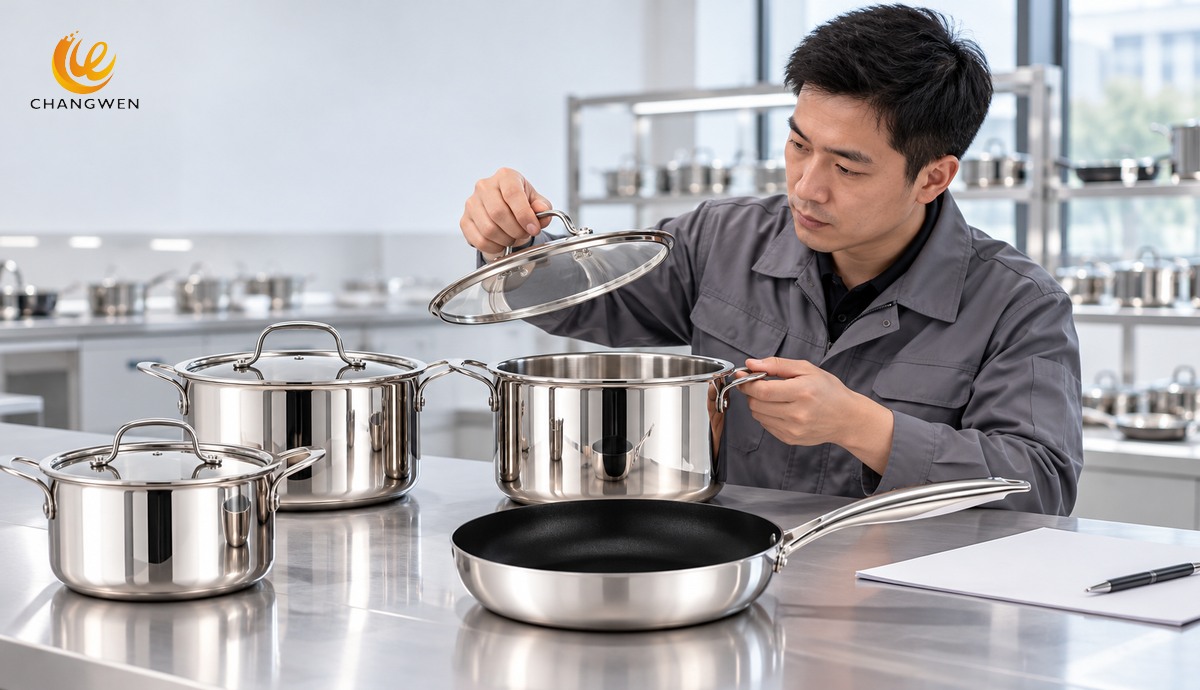
The approved golden sample should include every vessel, every lid, all accessories, printed materials, and the final retail and master cartons. A photograph of a set is not an adequate substitute because finish, handle attachment, lid seating, weight, and packaging protection are physical properties. Assign a revision identifier to the sample and use the same identifier in the purchase order, drawings, and inspection plan.
Inspect each vessel for stable seating, base flatness, repeatable lid fit, handle security, edge finishing, and visible surface defects under agreed lighting. Check that a lid called “shared” actually seats on both named vessels, and that a nested arrangement does not scuff another piece during shipment. Run the agreed use or performance checks on each construction family in the box rather than extrapolating from one representative pot. Changwen’s golden sample sign-off checklist
Confirm every consumer-facing statement against the approved sample and supporting documents. Claims about induction, dishwasher use, oven limits, steel grades, coatings, or food-contact suitability should be stated at the level actually verified for each item and destination market. A set should not inherit the strongest claim from one pot if a different pan or lid cannot meet it. Disclose use restrictions plainly in the listing and care instructions.
What is a practical decision sequence for choosing a cookware set?
- Define the buyer and channel. Record household size, common meal types, hob mix, storage constraints, retail shelf format, and target landed-cost envelope.
- List cooking jobs. Specify frying, small-volume liquid cooking, covered sauteing, and larger-volume boiling before choosing a marketed piece count.
- Build a vessel-first configuration. Select distinct vessel roles and sizes; add lids only where they support intended simultaneous tasks.
- Audit the count. Publish a transparent vessel + lid + accessory total and show the exact included-items list on the box and product page.
- Freeze comparable specifications. Record materials, construction, dimensions, tolerances, finish, handle and lid design, packaging, claims, and test method by item.
- Quote tiers consistently. Request entry, core, and premium alternatives with the same quote terms, then calculate set cost, cost per usable vessel, and actual landed cost.
- Approve physical samples. Inspect the full packed set, validate claims per item, and sign off a revision-controlled golden sample before production.
This sequence deliberately delays the marketing number until the functional assortment is clear. It also makes a supplier’s alternatives easier to evaluate: a buyer can see whether the offer improves a cooking job, a verified quality characteristic, or only the apparent size of the box.
Frequently asked questions
Does a 10-piece stainless steel cookware set contain ten pots and pans?
No. A 10-piece set counts all included pieces according to its disclosed packing list. A plausible configuration is six cooking vessels and four lids, but another brand may include fewer vessels and more lids or accessories. Buyers should compare the vessel, lid, and accessory counts separately.
Is a larger cookware set automatically better value?
No. A larger set is better value only when the additional pieces perform useful, distinct tasks at an acceptable incremental cost and fit the customer’s storage and stove. Extra accessories, duplicate capacities, or oversized vessels can make the headline count larger without improving everyday use.
Are all vessels in a stainless steel cookware set made the same way?
Not necessarily. A mixed set may combine stainless pots with a different frying-pan interior, or include vessels with different base and wall construction. Buyers should require a component-level material and construction list and avoid treating the package-level name as a technical specification for every item.
How should a private label buyer select an entry, core, and premium range?
A private label buyer should give each tier a distinct product brief and a measurable reason for its price. Entry should deliver dependable essentials, core should add useful role coverage, and premium should offer a verified improvement in construction, ergonomics, finish, or ownership experience. Price each tier from a real landed-cost model, not a universal dollar threshold.
What information should be sent to a cookware supplier for a comparable set quotation?
Send an itemized vessel-and-lid list; dimensions and capacities; material, construction, handle, finish, and packaging requirements; target market and supported claims; order quantity; inspection standard; delivery term; and the desired sample schedule. Request any alternative in a marked-up comparison so the buyer can identify what changed and why the price moved.
Build a set that earns its shelf space
Changwen supplies stainless steel cookware sets for wholesale and private label programs and offers OEM/ODM options for configuration, sizes, handles, lids, logos, and packaging. To request a useful proposal, send your target market, desired vessel roles, piece-count goal, target tier, annual or initial order volume, and any existing reference sample or drawing. Ask for an itemized configuration and quotation rather than only a “best price” for a headline count. Explore the cookware range or contact Changwen to discuss a set brief.
-
Premium Stainless Steel Cookware Set for Modern Kitchens CW-ETP0703
-
Hot sale SS ollas non-stick coated frying pans and pots stock pot with a kitchenware clip CW-M1204
-
hot sales 12pcs stainless steel cookware set saucepan casserole non-stick frypan with golden handles & knobs & 5-stepped capsule bottom CW-M1202
-
Stainless Steel Pot Set for Professional Cooking Performance CW-TP0605
-
Heavy weight pots wholesale 13pcs stainless steel cookware colored silicone pots nonstick grilled frypan set with 5 steps capsule bottom 3L whistling tea kettle with frying basket kitchen tools spatula ladle CW-M1302G
-
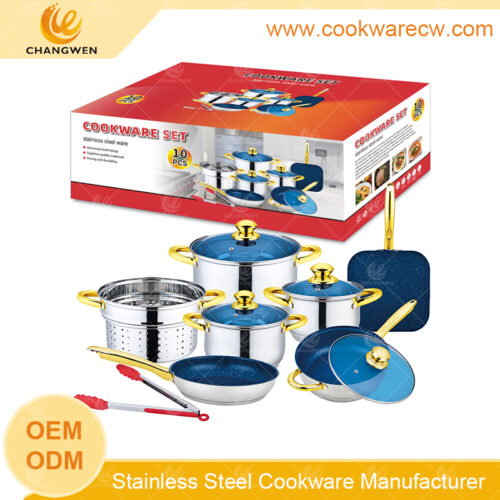
Stainless steel cookware set nonstick pans and pots casserole pot frying pan steamer with glass blue lid and a kitchenware clip CW-M1203
-
Wholesale Soup Pots CW-SP001
-
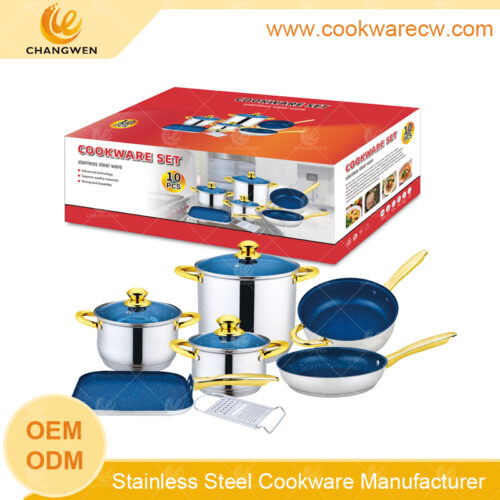
Wholesaler stainless steel cookware set conic fry pan square aluminum coated frypan with a kitchenware grater CW-M1003